Blog Security Risk

September 29, 2008

I don’t mean to alarm all of you, but I should tell you that Greg Forster, Matt Ladner, and I were all in the same place last week.  I know that this was an unacceptable breach of blog security — if something awful should have happened to us, if terrorists had struck, who would have been left to carry-on with the blog?

Normally we maintain blog security by ensuring that one of us is kept in a bunker in an undisclosed location when the other two meet.  Having us all three together was running an unreasonable risk.

We have taken concrete steps to improve blog security.  In particular, I have successfully cloned myself so that Jay Prime can go to the bunker if the three of us ever get together again.  Jay Prime has been taught all of the secrets of the Jay P. Greene Blog so that if anything should happen the blog will be able to continue.  The Blog Security color remains orange, so we will continue to be vigilant against any and all threats.


Reporter in Bed with School Official, Literally

September 27, 2008

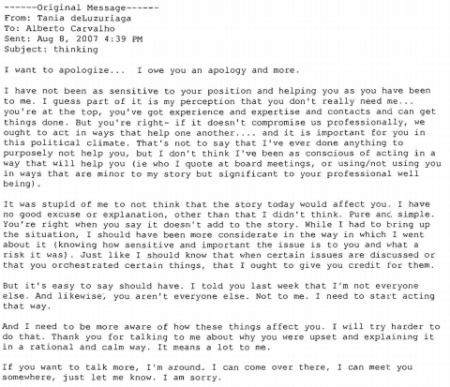
A series of e-mails between reporter, Tania deLuzuriaga, and a senor Miami-Dade school official, Alberto Carvalho, suggest an affair between the two while deLuzuriaga covered Miami schools for the Miami Herald.  deLuzuriaga has resigned from her job at the Boston Globe, where she moved last fall.  And Carvalho’s  selection as the new superintendent of Miami-Dade schools is in jeopardy.

The most alarming part of this story is not the affair itself, but how the affair distorted news coverage.  In addition to documenting the relationship, the emails detail how deLuzuriaga attempted to shape her reporting to preserve her relationship with Carvalho and how he bullied her about it.  In this exchange we see that Carvalho argued with deLuzuriaga about her coverage and she apologizes, asking for “understanding” about not quoting him more and giving him more credit:Carvalho

And in this e-mail deLuzuriaga explicitly apologizes for not helping Carvalho more and pledges that “we ought to act in ways that help one another”

Carvalho2Unfortunately, too many education reporters, especially outside of major cities, are in bed with school officials — figuratively.  They depend upon those officials for access and treat their pronouncements and views as accepted facts when they should be much more skeptical. 

If you want to see some examples of the rare investigative education reporter, check out Scott Reeder or Mike Antonucci.


The Arkansas Lottery Lock Box

September 23, 2008

Arkansas’ Lt. Governor, Bill Halter, has staked his political fortunes on a constitutional amendment creating a state lottery.  Halter has urged adoption of the lottery to increase funds for college scholarships and K-12 teacher bonuses.  All of the money, he emphasizes, will be used to increase education spending: “The bill specified that revenue generated by the lottery would expand, not replace, existing education funding.”

Promising that lottery dollars will be earmarked for increasing education spending is a common strategy to expand political support.  But of course it is impossible to guarantee that lottery proceeds would supplement and not substitute for spending.  Dollars are fungible, so it is always possible that lottery dollars would replace dollars from other sources that would have been used to fund increases.  That is, as long as education spending goes up (as it consistently has in the past), who’s to say whether those increases would not have occurred anyway without the lottery?  The lottery money could just free what would have been spent on education to be spent on something else.  That is, lotteries are basically just general tax increases even if it is claimed that the revenue is targeted for a particular purpose.  (See for example Spindler, 2003)

So, if lotteries are just another tax increase and not a free way to increase education spending, are they a good way to increase taxes?  Well, the tax burden from lotteries falls disproportionately on the poor and disadvantaged.  Supporters of progressive taxation shouldn’t be very interested in lotteries. 

On the other hand, some people enjoy gambling and want lotteries.  Liberty concerns would probably favor permitting gambling.  But a state operated lottery is effectively a local gambling monopoly, which lovers of liberty should dislike.  I guess the question is whether a monopoly is better than a prohibition as far as liberty goes.

However you slice it, the lottery isn’t a great deal.  There is no lock box into which the lottery dollars go to ensure that they increase education spending and cannot substitute for other dollars.  Lotteries are a regressive tax.  And lotteries barely increase liberty because they are operated as local monopolies.  Bill Halter may want to find a new issue to make his political fortune.


In Defense of Failure

September 18, 2008

Good can come from failure.  Abraham Lincoln’s failure to capture a Senate seat set the stage for his presidential run.  Winston Churchill’s failure at Gallipoli prepared him for the strategic challenges of WW II.  Recognizing failure and trying to move forward is almost always better than pretending that you haven’t really failed.

So why is the federal government preventing the failure of financial firms, such as AIG or Bear Stearns?  Providing government loans to AIG or guaranteeing the buyer of Bear Stearns against loss did not alter any of the financial reality.  Nothing new was produced or created.  No new capital was created; it was simply transferred from taxpayers (either by contributing to inflation or by adding to national debt) to people who do work for or business with these firms. 

Conversely, if these firms had instead been allowed to fail by going bankrupt nothing would have been destroyed.  All of the financial capital held by these firms would still exist.  And all of the human capital of the people who works for those firms would still exist.  Bankruptcy doesn’t mean that you take all of the capital of a firm, put it in a pile, and blow it up.  It’s all still there.  What bankruptcy does is it forces people to reorganize what they will do with that financial and human capital.  That is, they are forces to recognize their failure and figure out a better way to do things.  

And even more importantly, failure forces people involved with these firms to experience the consequences of their actions.  Those people — and everyone else — learns from those consequences and hopefully changes their behavior in the future.  To prevent failure is to prevent learning.

The same is true for schools.  Good can come from failure.  Of course, we’d prefer to avoid failure, if at all possible.  But if the reality is that students or educators or schools have failed, then insulating people from that reality doesn’t do anyone any favors.  No new knowledge is created by hiding failure and none is destroyed by recognizing it.  Admitting that students, educators, or schools have failed allows us to reorganize how we do things and to all learn important lessons.


The Denominator Law

September 16, 2008

Education policy debates should have a law.  No one should be allowed to highlight numerators without also presenting denominators.  That is, it is often misleading to describe a big number without putting that number in perspective.  In almost every education policy issue we see debates distorted by large numbers (the numerators) without the benefit of perspective that comes from also mentioning the denominator.

For example, the placement of disabled students in private schools is a regular sore spot for school districts and the topic of numerous alarming articles in the media.  New York City complained as part of its lawsuit in the Tom F. case that private placements initiated by parent request were costing NYC schools $49.3 million in a single school year.

Wow, that sounds like a huge burden — it’s millions of dollars!  But that is just the numerator.  If we add the denominator to the discussion, private placements no longer seem like a large financial burden.  NYC has a total annual budget of about $17 billion.  Once we add the denominator we see that private placement consists of about .3% of the NYC budget.  And if we consider that disabled students would have to be educated in the public schools if they were not placed in private schools, the additional cost of private placement is less than .1% of the total NYC budget.  See what a difference a denominator can make?

Articles in the New York Times, Time Magazine, the San Francisco Chronicle, Boston Globe, etc… lament the crushing burden of private placements.  One would think from all of these articles that private placements happen all of the time.  In fact, there are 57,708 disabled students using public funds to be educated in private schools at parental request.

Wow, that’s tens of thousands of students.  But wait.  There are more than 6 million disabled students and almost 49 million total students in K-12 education.  So privately placed students represent less than 1% of all disabled students and about one-tenth of one percent of all students.  Enforcing the denominator law would have a huge effect on news coverage of this issue.

The presentation of numerators without denominators also distorts the “boy crisis” debate.  In a recent report issued by the American Association of University Women, they argue that boys are doing fine since the number of men graduating college has increased over time: “More men are earning college degrees today in the United States than at any time in history. During the past 35 years, the college educated population has greatly expanded: The number of bachelor’s degrees awarded annually rose 82 percent, from 792,316 in 1969–70 to 1,439,264 in 2004–05.” It’s true that the number of women enrolled in college has increased even faster, they claim, but as long as college enrollment is rising for both men and women, there is no cause for alarm.

But there are also more people in the United States over time.  How do things look when we add a denominator to the discussion?  In 2006 25.3% of men between the ages of 25 and 29 had a BA or higher.  If we look at the cohort of men three decades earlier (ages 55-59) 34.7% have a BA or higher.  Educational attainment is declining for men once we add the denominator.  The same comparisons for women show an increase from 27.4% holding a BA or higher among those ages 55-59, rising to 31.6% among women ages 25-29.

The Denominator Law is important because the number of people and dollars involved in education is so huge that everything seems big without the benefit of the perspective that denominators bring.


The Wolf that Cried Ad Hominem

September 15, 2008

The NY Sun columnist, Andrew Wolf, has posted a long and angry comment, taking exception to Matt Ladner’s post, Little Ramona’s Gone Hillbilly Nuts.  In that post Matt challenged Diane Ravitch’s assertion that Joel Klein, Cory Booker, Michelle Rhee, and Adrian Fenty were seeking to “dismantle public education, piece by piece” by supporting merit pay, reductions in teacher tenure, and charter schools.  Matt observed that these were extra-ordinary charges to make “without presenting a scintilla of supporting evidence.”

But Wolf responds: “I am astounded by the puerile ad hominem attack on Dr. Diane Ravitch that appeared in Jay Greene’s blog. Like all of us, Dr. Ravitch has a right for her opinion to be respected and discussed without opponents resorting to such a childish (and inaccurate) attack. Apparently, Prof. Greene and his band of acolytes can’t muster the intellectual arguments to counter those of Dr. Ravitch, so must resort to this denigration of her scholarship and beliefs.”

I see.  And accusing Klein, Booker, Rhee, and Fenty of seeking to dismantle public education without any supporting evidence is not ad hominem?   

It is not ad hominem to say, as I did in my post on this, that “it is shocking to see these new claims made without any evidence that merit pay, weaker tenure, and charter schools harm public education, let alone destroy it.  Other than the fact that Bloomberg and Klein support these policies, it is not clear why Diane Ravitch opposes them.”  The fact is that Diane Ravitch did not provide evidence to support her claim and it is perfectly within reasonable discourse to point that out. 

If Andrew Wolf wants a substantive discussion rather than ad hominem, how about if he starts by providing the evidence that merit pay, reduced tenure rights, and charter schools “dismantle public education” that Ravitch neglected to provide?

In his own defense, Matt added, “A long and distinguished career does not entitle one to make such reckless and unsupported claims.”


Palin and Fundamentalist Muslims? More than Lipstick

September 9, 2008

Juan Cole has an awful piece on Salon this morning “What’s the difference between Palin and Muslim fundamentalists? Lipstick.”

A friend of mine commented: “Hmmmmm….well, lipstick, and the whole blowing up innocent people thing…. personally, its the blowing up people that gets me a bit upset about radical Islam, but hey, that’s me.”

Another friend noted: “So if this is what Juan Cole really thinks, why does he support one set of fundamentalists (the ones with suicide belts) and not the other (the ones with lipstick)?”

(edited to correct source as Salon)


A Few Comments

September 9, 2008

It must be the back to school season because there are a lot of interesting education pieces on the web.  I thought I’d just mention and briefly comment on some:

  • On Matt Ladner’s Little Ramona’s Gone Hillbilly Nuts about Diane Ravtich’s new-found enthusiasm for teacher unions and hostility to charter schools and merit pay — I posted this comment on his piece: “I liked Left Back, Language Police, and much of her historical work. That’s why it’s so disappointing to read what she is writing these days. From her earlier work one would never have guessed that she would accuse people who favor merit pay, reduction in teacher tenure rights, and charter schools of plotting to destroy public education.  And for someone whose past work relied on rigorous scholarship, it is shocking to see these new claims made without any evidence that merit pay, weaker tenure, and charter schools harm public education, let alone destroy it.  Other than the fact that Bloomberg and Klein support these policies, it is not clear why Diane Ravitch opposes them.”
  • Marcus Winters has a great piece on National Review Online about how reforming the teacher compensation system is the key to improving teacher quality and, in turn, student achievement.
  • Thomas Hibbs has a not-so-great piece on National review Online about how “the true teacher cannot simply be an instrument of the wishes of the student’s family.”  He’s right that parents can sometimes try to shield their children from burdens by lowering academic expectations and that teachers need to strive for excellence regardless.  But it’s unrealistic to expect that we can build an educational system based on “the teacher’s love.”  Parents, whatever their shortcomings, are more likely to be effective advocates for a child’s progress than even well-intentioned and well-trained teachers because the parents have a love for children that we cannot realistically expect from teachers. 
  • I don’t have time to comment on them, but you should also check out the rest of the National Review Online pieces, including those by Checker Finn, Neal McCluskey, Mike Petrilli and Amber Winkler, and Susan Konig.

Special Ed Vouchers in NRO

September 9, 2008

I have a piece this morning on National Review Online about special education vouchers. 

Governor Palin said in her convention speech that she was going to be an advocate for special-needs kids in the White House.  I discuss what she should be an advocate for — special ed vouchers.


Happy Labor Day

September 1, 2008


These stories are all from the last month:

3rd Union Leader on Leave Amid Financial Inquiry

August 31, LOS ANGELES (AP) — The executive vice president of the Service Employees International Union has stepped aside while accusations that she paid thousands of dollars in union money to a former boyfriend are being investigated, The Los Angeles Times reported Sunday.

The vice president, Annelle Grajeda, is the third major official of the union to be placed on leave in recent months amid accusations of misspending union money.

The Los Angeles Times reported the union’s Los Angeles local paid hundreds of thousands of dollars to companies owned by chapter President Tyler Freeman’s wife and mother-in-law and also spent a lot of money at luxury venues such as the Four Seasons Resort and Morton’s Steak House.

Enforcement agency announces 10 criminal convictions and 8 indictments for July 2008. The U.S. Department of Labor’s Office of Labor-Management Standards (OLMS) today announced its criminal enforcement data for July 2008. During the month, OLMS obtained 10 convictions, eight indictments and court orders of restitution totaling more than $500,000. The office’s totals for fiscal year 2008 (which began on Oct. 1, 2007) now stand at 87 convictions and 112 indictments, with restitution of more than $3 million. Since 2001, OLMS has obtained 889 criminal convictions. The bulk of the cases have involved the embezzlement of union funds.

EDITORIAL: Getting to the bottom of things

Aug 21, 2008 … The trial was hardly under way when former chancellor Roy Johnson was called to the stand to testify. Under oath, he discussed how the head of the Alabama Education Association, Paul Hubbert, and Speaker of the House Seth Hammett came to him to get a job for Schmitz — one of the AEA’s most dependable allies in the House. Johnson testified that the speaker and another legislator found a job and the money to pay for it, and that Schmitz took the job and the money but did no work.

Ex-bookkeeper allegedly embezzled longshore union

The Associated Press

Article Launched: 08/13/2008 08:59:32 AM PDT

LOS ANGELES—An ex-bookkeeper has been indicted for allegedly embezzling $108,000 from the South Los Angeles office of the International Longshoremen and Warehouse Union.

Ex-union secretary in Pa. accused of embezzlement

The Associated Press  Article Last Updated: 08/26/2008 03:38:18 PM EDT

PITTSBURGH—Federal prosecutors in Pittsburgh say a western Pennsylvania woman embezzled more than $87,000 from the United Steelworkers of America.

Prosecutors say between June 2006 and January, 42-year-old Donna Simpson of East McKeesport embezzled the money from a bank account for the Steelworkers Organization for Active Retirees. Prosecutors say Simpson was working as a field secretary for the union at the time and wrote 82 unauthorized checks to herself.

Former Union Secretary Convicted Of Embezzling

August 21, 2008

Two years on probation, with 90 days of those being served under house arrest is the sentence for a Lima woman convicted of taking money from an area union.  Amy Cross pleaded guilty to a charge of embezzling from the Utility Workers Local 308 according to the U.S. Department of Labor.