Pass the Popcorn: City of the Dark Knight (Issue #3)

August 8, 2008

(Guest post by Greg Forster)

We’re now on our fourth issue of the series and we haven’t said anything yet about Heath Ledger. That was intentional, for three reasons.

First and most important, there’s not much interesting to say, or at least not that I can say. It’s obviously a virtuoso performance, and would have been a career-making breakthrough. Ledger was clearly one of the most talented performers of his generation, and it’s a shame he never reached his potential until the end of his abbreviated career.

Beyond that, what’s to say? If I were in the acting business, I could no doubt analyze the performance and say more about what makes it great. But I lack even the rudamentary ability to do so, and I’m not interested in bluffing.

Second, too much of the chatter about Ledger and this performance is shallow and feels exploitative of his death, and I don’t want to contribute to that.

And third, I think Ledger’s masterpiece contribution is overshadowing other contributions. I don’t want to take away any of the honor Ledger has justly earned, but for this movie to be what it is, a whole lot of people had to turn in top-flight performances.

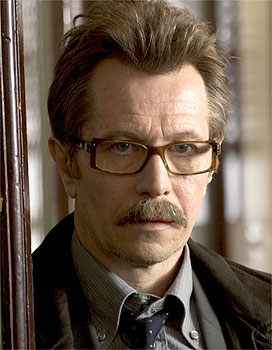
Back in Issue 1, commenter Captain Napalm mentioned Aaron Eckhart and Gary Oldman – both of whom were indeed outstanding. I’ve just praised Morgan Freeman in Issue 2, and Michael Caine’s contribution shouldn’t be overlooked – one of the most important differences between a good film and a great one is that all the little things are done right, as well as the big ones. Caine and Freeman didn’t get the big drama, but they delivered fantastic little gems – “We burned down the forest” is one of the most memorable moments in the movie. So is “You have no idea.”

Everyone – by which I mean the handful of movie geeks whom I personally know – seems to agree that Christian Bale had essentially nothing to do in this movie. The first movie was about Batman, not the villains, so the villains were (as I mentioned last time) unmemorable. This movie was about the Joker, so Batman was unmemorable. But serving as the Joker’s foil is something. The Joker carries the movie, but he can’t do that if Christian Bale doesn’t act well his part, wherein all honor lies. Imagine this movie with Ledger playing opposite George Clooney – or even Michael Keaton, who I thought did surprisingly well as Tim Burton’s Batman, but would have been totally inappropriate as Chris Nolan’s. (And let’s also acknowledge that “I’m not wearing hockey pants” was well delivered.)

And naturally we should be crediting Chris Nolan. Having done a little amateur acting, I know how much a director contributes to an actor’s performance – or doesn’t. When any six actors, even six really good ones, all deliver a top-notch ensemble performance, it’s as much the director’s work as theirs.

Above all, though, we should be thanking the writers. Think about every scene you remember of Ledger. Isn’t it the brilliant lines as much as the brilliant performance that make this movie so amazing? “When you think about it, I knew your friends better than you did. Would you like to know which of them were cowards?” That’s really brave writing. And of course, all those clever one-liners we’ve been taking notice of in this and previous issues had to come out of somebody’s keyboard before they could come out of Morgan Freeman, Michael Caine, etc.

You do know who wrote the movie, don’t you?

Chris Nolan shares the screenplay credit with his brother Jonathan Nolan, and shares the story credit with David Goyer. The Nolan brothers also co-wrote Memento and The Prestige (which came out between Batmans). Goyer has a long track record on comic book movies that includes Blade and co-writing Batman Begins with Chris Nolan, as well as sole story credit on Batman Begins. And of course Frank Miller should get a nod for his influence.

All that said, Ledger did pull off an amazing feat. In addition to what’s on the screen, consider how much prior baggage he had to overcome with the Joker character:

First Appearance!

The Clown Prince of Crime

The Ultimate Psychopath: “Whatever’s in him rattles as it leaves.”

The Outer Edge of Insanity

(Wrong “Joker,” moron!)

A lot of people thought no one could play the Joker after Nicholson, particularly not the star of A Knight’s Tale. Nicholson himself, for one. He said as much, as The Dark Knight was approaching release. I wonder if he repented after he saw the performance.


Tuition Datum Mystery Solved!

August 6, 2008

(Guest post by Greg Forster)

In this recent post, I noted that a blogger had cited a datum for private school tuition levels in the U.S. in 2003-04, attributing it to NCES. Since I knew that tuition levels aren’t collected in the Private School Universe Survey, and that the most recent datum I’d seen from NCES was from 1999-2000, I wondered whether the blogger had mistakenly used an old datum, or if NCES was putting out new private school tuition data and I missed it.

Turns out it was neither! Well, not really.

I’ve been offline for a few days while moving, and when I got back I discovered a very nice note from Bill Evers at IES. He says NCES does indeed still collect private school tuition data, but in the Schools and Staffing Survey, not the Private School Universe Survey. (You can’t tell your surveys without a scorecard.) It’s collected every four years.

But I don’t have to feel bad about missing it, because the updated data haven’t been incorporated into the NCES web tables yet. If you know exactly where to click, though, you can access it.

Many thanks to the good people at IES for 1) collecting the data we need, which is a huge job that they do very well, and 2) taking a minute to straighten me out on this question. I’ve said some hard things about IES’s recent misadventure publishing that HLM study of private schools, but I hope nobody doubts my respect for their work in all other regards.


Pass the Popcorn: City of the Dark Knight (Issue #2)

August 3, 2008


(Guest post by Greg Forster)

Okay, and now for something completely different! Today we’re going to talk about Bat Gear.

What was the one thing in The Dark Knight that just didn’t work? So far, everyone I’ve talked to has the same answer, even if you don’t ask them the question – it’s the citywide “sonar.” Lame.

The first time through, it was really obtrusive – for a few minutes. One of the greatest innovations in storytelling in the last ten years is that movie and TV people have learned the value of throwing a lot of story at you and trusting you to keep up; among many other virtues, this means badly done moments in the narrative get left behind more quickly.

The second time through, I didn’t really mind. That was partly because dumb plot elements are always less obtrusive the second time around, because you aren’t being hit with the shock of recognizing their stupidity. This, for example, is why it is possible to watch the Lord of the Rings movies repeatedly without their being spoiled by a bunch of friggin’ elves marching into Helm’s Deep, or the army of the dead effortlessly wiping out the beseiging force at Minas Tirith (which means all those Rohirrim who gave their lives on the Pelannor died for nothing).

But it was also partly because the second time I saw how it was supposed to fit into the movie. Somehow, the first time through, I totally missed the “like a submarine” gag. You remember, when Lucius comes out of the evil corporation’s building in Hong Kong and shows Bruce the sonar readout:

“Sonar? Just like a . . .”

“Like a submarine, Mr. Wayne – just like a submarine.”

It just flew by and I missed it completely. (How am I supposed to catch all these little things when they throw so much at you and expect you to keep up with it all?)

Obviously they were thinking that we would buy the “sonar” because sonar fits with the bat theme. And it’s not a crazy theory. When a plot element fits the theme of the movie, artistic liberties with reality are much less obtrusive (a subject I’ve had occasion to discuss at greater length before).

But it didn’t work. And that got me thinking about the gadgets in this movie. F’rinstance, does the Bat Cycle (apparently to make it seem less fruity they’re telling us to call it a Bat Pod) belong in this movie? I mean, honestly – doesn’t it just look like the suits in the marketing department demanded that they throw in something new that would sell toys? After all, the twelve year old boys of America – who should never be permitted to see this movie under any circumstances whatsoever – are not going to shell out for another Batmobile unless it’s different from the last one.

He’s prob’ly fighting for freedom! Buy all our playsets and toys!

And the skyscraper-assault gadgets (in the Hong Kong scene and again in the assault on Fortress Joker) feel artificial, too.

But that’s not what you’d expect, is it? Gadgets belong in a Batman movie. They’re an integral part of the franchise – even more so than in the James Bond franchise.

Consider the first Batman movie – well, okay, not absolutely the first, but the first one that counts. The Tim Burton one. (The Tim Burton one that counts.) That movie doesn’t get its propers anymore, in large part because we now take for granted so much of what Burton did to define the modern comic book movie. Much of what was radical in Burton’s Batman is now so expected that it’s not even noticed.

It was a much more uneven movie than Nolan’s Batmans are – parts just didn’t work, but parts worked brilliantly. And that movie was just brimming with gadgets. The Batmobile actually did stuff – and no, going really fast and changing the driver position from Standard Seated Position to Lying Down for No Reason Position doesn’t count as doing something. Yes, okay, in the first Nolan movie the Batmobile jumped rooftops. But Burton’s Batmobile did so much more. And Batman himself used gadgets more often and it felt more natural. One of those brilliant moments that really worked was when Batman swooped in, foiled one of the Joker’s plans, and swooped out on one of his flying wires (or something) and the Joker was just so impressed that he didn’t even think about how badly he’d been beaten – he just stood there and asked: “Where does he get those marvellous toys?”

Or consider what must be the best gag ever done in a comic – from the Batman/Planetary crossover.

(If you don’t know what Planetary is . . . well, how are you even alive?)

Anyway, the Planetary crew are in Gotham chasing a man whose mind keeps opening dimensional rifts, and of course they run into Batman, who of course is chasing the same guy. But every time the guy opens a dimensional rift, they shift to an alternate reality where Batman is slightly different:


HT Planetary. How many can you identify? How many will you admit you can identify? (No fair peeking at the URLs!)

Here’s the gadget gag: Jakita Wagner, a superpowered female hero, is about to throw down with one of the badass Batmans. Then a rift opens and suddenly it’s not a badass Batman, it’s the Adam West Batman from the supercamp sixties TV show. And . . . he would never hit a girl!

So when she rushes him, he avoids compromising his honor by whipping a spray can out of his utility belt and dousing her in the face. (I always suspected the Adam West Batman was really a sucker-punching bastard.) She falls back, clutching her eyes, and Batman drops the can and springs away to chase after the rift-opening guy. As she curses him, we see the can roll into the frame.

The label on the can reads: Bat Female Villain Repellent.

I swear I Googled for probably half an hour looking for that panel, so I could share it with you. I guess you’ll have to buy the crossover instead.

But back to our subject. Gadgets not only belong in Batman, they ought to belong in Chris Nolan’s Batman. After all, this is the first movie version to include Batman’s “Q”, and he’s used to outstanding effect in both movies. What are the most memorable moments in the first movie? Liam Neeson blathering on about destroying Gotham? Dr. Crane attacking people with his fear drug? No, that movie had some of the least interesting villains ever to appear in a comic book movie. (Not a criticism – that movie was about Batman, not about them.) What you remember is: “Oh, the tumbler? You wouldn’t be interested in that.” And: “Just don’t think of me as an idiot.”

And Chris Nolan clearly knows how to get the best out of Morgan Freeman, because he’s used just as well in the new one. That “your plan is to blackmail this person?” speech is priceless.

Come to think of it, in the first movie Batman used a “bat caller” gadget to produce a swarm of bats where he needed it. It was ridiculous, of course – but it fit the theme of the movie, especially in that it was trying to explain why Bruce Wayne chose to dress up like a bat when fighting crime. Being attacked by a swarm of bats would tend to put the fear in you.

So why didn’t the gadets work in this one? The first thought to occur to me was that they were trying to force the citywide sonar to perform an awkward plot function – they wanted to abruptly set up a little mini-debate between Batman and Lucius on the whether it’s OK to spy on the whole city. But frankly, I don’t really think that’s it. I think citywide sonar would have failed even without that scene. (Speaking of which, when I first saw it, I thought that Lucius’s position was “This is wrong, but I’ll do it just this once,” which of course is a contemptable position. But that’s not what he says, as I discovered upon seeing the scene a second time. I think his position is really “This is OK as a one-time deal, but it would be wrong to use it on an ongoing basis.” I’m inclined to think that if it’s OK as a one-time deal, it’s hard to justify throwing it away, especially in a city that seems to attract supervillains like a magnet – but it’s not a contemptable position.)

Maybe – and I’m not sure about this – maybe it’s just that they obviously could have accomplished the same thing with less tampering with reality. Batman could have simply set up a computer to scan all phones for the Joker’s voice. And they could still have worked in the bat/sonar theme by equipping the Batsuit with its own sonar, which he could then have used in the Assault on Fortress Joker scene.

Like I said, I’m not sure. Theories?

(Oh, and I’m still hoping somebody can help me with the tally on Dent’s body count. I’m one cop short.)


PJM Column on the Education Agenda

August 2, 2008

(Guest post by Greg Forster)

I have a column up on Pajamas Media noting that education just flared up in the presidential race recently, and then asking (and answering) the question: Just what can a president do about education, anyway, given that it’s primarily an area of state authority rather than federal?

It’s a question worth asking, because education is going to come up again before this campaign is over. Well, here are five things the next education president (they’re all “education presidents” these days) can do to improve the nation’s schools without expanding federal authority over education beyond its current level.


Where Did You Get That Marvelous Datum?

July 31, 2008

(Guest post by Greg Forster)

NRO blogger Jim Geraghty has a good post today about Obama and school choice. But what I particularly want to point out is this, which he notes in passing:

These numbers from the Department of Education’s National Center for Education Statistics for the 2003-2004 school year put average tuition paid by private elementary school students at $5,049

It looks to me like the word “these” was supposed to have a link, but there’s no link. I wasn’t aware NCES had collected any private school tuition data since 1999. And that figure looks a whole lot like the figure NCES was reporting back in 1999. Did Geraghty find the tuition number and assume it came from the most recent iteration of the Private School Universe Survey? (Actually the PSS has just released its 2005 data, but we’ll overlook that for the moment.) Or does NCES still collect private school tuition data, and somehow I missed it?

I’m not sure which outcome to root for.


Teacher Contracts: Blame States, Too

July 30, 2008

(Guest post by Greg Forster)

The National Council on Teacher Quality has published a new report on the sausage-factory process behind teacher contracts. (HT EIA, or as I like to call him, ALELR.)

Readers of Jay P. Greene’s Blog will probably not need to be told that reformers have long identified teacher contracts as one of the most important root causes, if not the single most important root cause, of the system’s ills. It is because of these contracts, for example, that pay scales, quality control and disciplinary procedures in education resemble those of a factory (even a factory circa 1965) more than those of a profession.

Defenders of the system sometimes argue that teachers should recieve the deference that is due to professionals. Personally, I’d love to see that – but not until they’re compensated and held accountable like professionals.

When that day comes, teachers will be able to say, “Now we have freedom and responsibility. It’s a very groovy time!”

Until then, you can’t expect to have one without the other for very long. The universe doesn’t work that way.

Reformers have long argued that the fundamental problem is disproportionate union influence on school boards. Union members have a much stronger motive to vote in school board elections than anyone else, especially when the elections are held separately and require a special trip to the polls. Thus, at contract renewal time the union ends up “negotiating with itself.”

However, the NCTQ report’s main argument seems to be that we should be griping less about the actual bargaining process between districts and unions, and more about the laws passed by state legislatures mandating certain provisions in those contracts. The unions find it easier to extract what they want in the statehouse, NCTQ argues: “As unions have matured, their leaders have realized that it is more efficient to lobby state legislatures on particular provisions than to negotiate district by district every few years as contracts expire.”

The report collects a lot of useful information on the subject, and any contribution to knowledge on this badly understudied subject is valuable. And clearly NCTQ is right when it observes that bad state mandates ought to be deplored alongside bad district/union negotiations, and they currently aren’t.

But if I may play devil’s advocate (“When don’t you?” the unions may ask), I think NCTQ overstates its case on the importance of state mandates vis-a-vis district negotiations.

The report’s opening concedes that “the teacher contract still figures prominently on such issues as teacher pay,” but asserts that “on the most critical issues of the teaching profession, the state is the real powerhouse,” citing how teachers are evaluated, when they get tenure, their benefits, and the notorious issue of firing procedures. But are benefits really that important as an obstacle to reform, so long as compensation is structured on a factory-worker scale? And does the procedure for evaluating teachers matter as an obstacle to reform so long as evaluations play no role in compensation – again because compensation is structured on a factory-worker scale? When teachers get tenure and how hard it is to fire the bad ones are obviously important as obstacles to reform. But are they really so much more important than the factory-worker scale? Whether teachers get tenure early or late is less important than the fact that they get it. Disciplinary procedures only affect a small number of teachers. Even if we include the absence of a more widespread deterrent effect, we’re still not talking about something that affects all or even most of the profession.

I also think NCTQ is barking up the wrong tree when it argues that lobbying the state for goodies is more “efficient” than fighting for goodies district by district. As Hamilton, Madison and Jay (the “Three Founderos”) observed in the Federalist Papers, selfish interests will always find it easier to extract goodies from the public fisc in a whole bunch of little local places than in one big place. While centralization does provide one-stop shopping, it also creates more intense scrutiny and greater opporutnities for opposition.

In fact, in the case of the teachers’ unions, I’m not even sure why it would take more resources to extract goodies on a district-by-district basis. They have to “negotiate district by district” anyway. They get coerced dues payments from millions of teachers precisely to pay the costs of negotiating in every district. And conditions on the ground in those districts are more favorable than those in the statehouse.

Moreover, the old saying goes “the crime is what’s legal.” In this case, the big obstacle to reform is what the teachers don’t have to bother negotiating for: the factory-worker structure of compensation. It’s not like they have to go back and win that all over again every time the contract comes up for renewal.

Finally, it’s not clear that state-mandated and district-negotiated provisions can be separated all that clearly. For example, check out this chart from the NCTQ report, illustrating how the process for firing teachers is mandated by state law in California:

Pretty nice graphic! But check out the contents of the first box:

School district must document specific examples of ineffective performance, based on standards set by the district and the local teachers union.

And the third box:

If the school board votes to approve dismissal . . .

And the fifth box:

School board must reconvene to decide whether to proceed . . .

And the seventh box:

. . . and persons appointed by the school board . . .

And the ninth box:

If . . . the school district appeals the decision . . .

See what I mean? The larger reality of the union/school board relationship will influence the board’s behavior in discipline cases. And the standards for documenting misconduct are subject to union/board negotiations.

I don’t mean to diminish NCTQ’s important contribution here. We should absolutely be paying more attention to state teacher contract mandates. But I think NCTQ goes too far to argue that they’re more important than the dysfunctional school board system.


NCLB: Less Than Meets the Eye, More Than Nothing

July 29, 2008

Given all of the wailing and gnashing of teeth, one would think that NCLB was a crushing burden on the school system.

In actuality NCLB demands very little. It only requires that states wishing to receive Title I funds have to establish goals for student success, select tests for measuring progress towards those goals, and report results from those tests broken out by subgroups.

The sanctions for failing to make progress toward those goals are almost non-existent. Schools failing to make progress have to offer tutoring or allow students to transfer to better-performing public schools in the same district (if one can be found). But, as we have previously discussed on this blog and in this article, there is widespread non-compliance with even these minimal sanctions. Too often schools fail to inform parents properly of their options under NCLB or direct students into their own tutoring programs, resulting in very few students taking any resources out of their local school, let alone district. Without placing school funds in jeopardy, the only possible sanction is public embarrassment. And that plus $4 will get you a latte at Starbucks.

I do not believe that a single tenured teacher out of the more than 3 million teachers currently working in public schools has been fired, experienced a pay-cut, or otherwise been meaningfully sanctioned because of NCLB. I do not believe that a single student out of the 50 million enrolled in public schools has been held back a grade, been denied a diploma, or otherwise been meaningfully sanctioned as a result of NCLB. (Some states have retention and graduation requirements as part of their state accountability systems, but those policies are not required for NCLB.) Yes, chronically failing schools might eventually face “restructuring” but that is likely to be yet more bark and no bite. Next they’ll be put on double secret probation.

So what supports complaints about “pressure cooker NCLB testing,” or “NCLB-post traumatic stress disorder,” or other “NCLB outrages”? If NCLB has almost no real consequences for teachers or students, what is all of the fuss about? The overwrought reaction seems to have more to do with a political campaign over the future direction of education policy than the actual effects of the current policy.

The most important future policy that the higher volume of squealing is meant to influence is increasing education spending. A center-piece of the complaints about NCLB is that it is an unfunded mandate. Let’s leave aside the fact that federal spending on education has increased 41% since passage of NCLB. And let’s leave aside that NCLB is not actually a mandate, since states do not have to comply with NCLB if they do not want Title I funds (which have increased 59% since 2001).

Besides neither being unfunded nor a mandate, the argument that NCLB is an unfunded mandate is especially odd because it makes one wonder what all of the funding that schools received before NCLB was for. It’s as if the unfunded mandate crowd is saying: “The $10,000 per pupil we already get just pays for warehousing. If you actually want us to educate kids, that’ll cost ya extra.” Remember, that NCLB just asks states to establish and meet their own goals. Didn’t they have goals before NCLB?

While NCLB demands much less than the overwrought rhetoric about it suggests, it does not demand nothing. Most importantly, NCLB entrenched the idea that we should take regular measures of student achievement and report the results, including results for subgroups. Even this is a smaller thing that it may seem at first glance since 37 states had already adopted state testing and accountability systems before passage of NCLB. But NCLB brought the laggard states on-board to this growing national consensus that we ought to have some systematic measures of how our students are doing. It also made reversal of this growing testing and accountability culture more difficult by placing it in federal as well as state law.

Greg Forster has already made the case for why this shift under NCLB has been important, so I will not repeat it here. I would just emphasize that the controversy over NCLB is not really about what NCLB does, but about the broader policy shift that it represents and the extra funding that folks hope they may get as they acquiesce to that policy shift.


Pass the Popcorn: City of the Dark Knight (Issue #1)

July 28, 2008

(Guest post by Greg Forster)

Well, it’s not as good the second time you see it. It’s better!

See here for the premiere installment of the PTP: City of the Dark Knight series. Oh, and: Spoiler alert (duh).

This time I caught a lot more of the “moral hypocrisy” theme being set up earlier in the movie. It’s not as clear when you don’t know yet how significant it’s going to be later. But they’re clearly telegraphing that the restoration of moral order in Gotham is requiring some compromises of the rules – for example, this flew by me the first time, but Dent brings that mass prosecution of criminals knowing full well that he can’t make most of the charges stick. He argues to the mayor that they should go forward with prosecution anyway, because most of the bad guys won’t be able to make bail (Batman, Gordon and Dent having taken away most of their money) and thus will have to sit in the slammer while the cases grind through the system. “Think what you could do with eighteen months of clean streets,” Dent tells the mayor. Wrong? Not necessarily. Politics is the art of the possible. But it’s bending the spirit of the law.

Also, notice that Gordon tells his people to lie to the media about Dent’s disappearance. I did notice this the first time, and I thought about it for all of five seconds or so, and then I had to keep up with the movie. The second time, it stands out more as part of the hypocrisy theme.

Perhaps the most important thing I caught this time around is why Dent blames Gordon and Batman for what happens to Rachel. It’s because Gordon built his Major Crimes Unit by including officers who were under a cloud of suspicion. This is another “moral compromise” narrative. Confronted about it at the beginning of the movie, Gordon first insinuates that when Dent was at Internal Affairs he had been bringing bogus corruption cases against clean cops in order to build his career. (At first I thought this might be a signal from Chris Nolan that the movie is right-wing, because prosecuting innocent people to build a career was always the right’s complaint about Eliot Spitzer. But then I remembered that Rudy Giuliani did the same thing.) However, Gordon seems to concede pretty quickly that his MCU does contain some shady characters. He says something like, “I have to do the best with what I have to work with.”

I also caught that they’re telegraphing from early on that Dent is not all he appears to be, morally speaking. The first time I saw the movie I wanted them to do more to establish Dent’s fall – he seems to go over to the dark side pretty quickly. But now I see that he was never really that good to begin with. That, plus it occurred to me that the “Two Face” Dent is still fighting for justice in his twisted way. He’s hunting down the people he blames for Rachel, subjecting each of them one by one to the judgment of the coin.

And now for something completely different: I noticed this time that the guy on the prisoners’ boat who throws the detonator out the window has a damaged right eye (his right, our left). I got really excited by this. I thought, where else in this movie did we see a black criminal have somthing happen to his eye? That’s right: “I’m going to make this pencil disappear!” So I thought: the Joker’s goal is to corrupt everybody. But what if one of his victims found himself forced to reexamine his life while sitting in the prison hospital, and he became good because of the Joker’s actions – and that same person’s goodness was the reason the Joker’s ferry experiment failed? Layers within layers within layers!

But, alas, I was barking up the wrong tree. Somebody has posted the pencil scene on YouTube, and it’s clearly not the same actor. Oh, well.

One more thing: I found an easy way to remember the mobster’s name, the one I couldn’t remember in my previous post. It’s Moroni – the same name as the angel who allegedly revealed the Book of Mormon to Joseph Smith. How’d that happen? Was the entire Warner Brothers marketing department asleep?

Let me close with a bleg: At the end, Gordon says that Dent’s rampage produced “five people dead, two of them cops.” I count Moroni’s driver, Moroni himself (assuming he died in the car crash), the first of the two crooked cops, and Dent himself. But the other cop won the toss and just got knocked unconscious. So that’s four people, one of them a cop. Whom am I missing? Are we supposed to assume Dent found a way to finish off the second cop despite the toss, just like he found a way with Moroni (assuming that’s what happened)? Is this a goof? Or what?


Pass the Popcorn: City of The Dark Knight (Issue #0)

July 25, 2008

New PTP Mini-Series, Issue #0 – Rare Collector’s Item!

Have you been regressing endogenous variables again?

(Guest post by Greg Forster)

It’s too much.

I mean, too much for one blog post. Last Friday I lightheartedly left a comment on Matt’s PTP entry promising to have my Batman post up by Monday. Surely, I thought, I’d be so juiced after the movie that I’d run straight back to my computer and blog until my fingers bled.

But no, this was a very dense movie. Chris Nolan is ambitious, and the movie vindicates his ambition triumphantly. After the movie, I was unable to talk much about it – because there was too much to digest. And by the time I was ready, I had already forgotten half the thoughts I’d had during and right after the movie. Clearly this is a work that’s going to repay a lot of repeat viewing – a hypothesis I intend to test vigorously, hopefully with plenty of checks for the robustness of the finding (e.g. does the movie repay repeat viewing if the repeat views are in a drive-in? In IMAX? With co-workers? In the afternoon? Does it make a difference if I order a soda with my popcorn? How about what kind of soda I order? I’d better try watching it once with each kind, just to be sure).

At this point I just know that any blogging I do is going to be no more than a pale shadow of what I really thought and felt during the movie. So, to assuage my conscience (and save myself from spending all day working on this post, fretting about what I’m forgetting to include) I’m hereby inagurating a special Pass the Popcorn Mini-Series. I’m posting some of my thoughts now, in anticipation of revisiting the subject later. (Don’t worry, not too often. But we are going to have to find something to write about on Fridays after the summer movie season dies down, and this will help fill the gap.)

Oh, before I forget:

(HT xkcd)

There are already some haters out there, like John Podhoretz in the Weekly Standard, who are offended – nay, outraged – that a comic book movie is getting the kind of praise The Dark Knight is getting. Well, OK, it ain’t Shakespeare, but that’s apples and oranges. Let’s take a similar example – say, a mob movie. Podhoretz never misses an opportunity to share his opinion that The Godfather is the best movie ever made. And I agree that The Godfather deserves to be taken seriously as a great work of art. But it is a mob movie. If The Godfather can be great, why not this?

Unforgivably, Podhoretz works out his anger by spoiling as much of the moive as he can get away with. So don’t read it until after you’ve seen the movie. (Reading the spoilers in this blog entry is of course an entirely different matter.)

It’s readily apparent from Podhoretz’s review what’s really eating him: he loves the old, wild and carefree tradition of superheroes from the Silver Age, recently resurrected so dazzlingly in Iron Man. That tradition got killed off in the 1980s, in large part due to Frank Miller’s amazing work in reinventing Batman, and Podhoretz resents that this type of superhero has crowded his preferences out of the market.

(As an aside, Frank Miller looks to have come way down in the world, artistically speaking; to judge by the preview they ran in front of Dark Knight, Miller’s newest project is to take Will Eisner’s treasure The Spirit and turn it into a porno movie. But all will be forgiven if Holy Terror, Batman! ever actually sees the light of day.)

I sympathize with Podhoretz. One of the best comics ever drawn is Scott McCloud’s ZOT!, which came out when the Dark and Serious school was at its height, as an attempt to rescucitate the wild and carefree hero. (According to McCloud’s introduction, it was especially a reaction against the literally murderous nihilism of Watchmen, which, alas, now looks like it’s finally going to get the movie they’ve been threatening to make of it for decades. Yes, there was a lot of real storytelling genius in Watchmen. That’s what makes it so horrible – to see such genius used to glorify cynicism and murder.)

But while most of the Dark and Serious stuff was crud, let’s face it, most of the Wild and Carefree stuff that preceded it was also crud. ZOT! and the new Iron Man are jewels, but jewels in the rough. So was Miller’s original Dark Knight Returns, and so is the new Dark Knight.

And then there’s the politics. There’s a handy precis of the issues, with links, here if you’re interested. My take: The Dark Knight probably isn’t directly about the war on terror. It’s about things that are universal. (Ever since Frank Miller’s Dark Knight Returns, Batman has periodically been used to explore these issues – meaning we don’t need to bring in the war on terror to explain why these issues are present in a Batman movie.) But of course if these things are universal then they’re as present in the war on terror as everywhere else, so the application of the movie’s subject matter to the war on terror in the viewer’s mind is perfectly valid. 

Having unburdened myself of these reactions to the reactions to the movie, do I have time left today to say anything about the actual movie? Just briefly.

Warning: Believe with Caution

The Dark Knight seems to be primarily about moral hypocrisy. People are not “basically good.” All human beings are both good and evil. However, it’s not in our nature to admit this about ourselves; we have to pretend that we’re good. And the same hypocrisy manifests at the social level – society, being made up of human beings, is not “basically good” but is both good and evil. However, in order to keep from becoming aware of our own evil, lest we should have to admit the truth about ourselves, we also have to sheild ourselves from other people’s evil. If we admitted that everyone else was not “basically good,” it would be really hard to avoid raising the question about ourselves. And so we have to pretend that everybody is “basically good.”

The Joker is out to expose our hypocrisy. His ultimate goal isn’t to kill, it’s to corrupt. He would say that he isn’t out to corrupt us, but to make us admit to the corruption that’s already there in our hearts. But to “admit” to the courrption in the Joker’s sense is really to surrender to it – to become “corrupt” on a whole different level.

This, incidentally, is why it was such a good decision to give the Joker no backstory (and not just by omission but by the Joker’s deliberate obfuscation about his own past). As Chris Nolan has said (I’m paraphrasing), this Joker isn’t a person, he’s a primal force. My hypothesis: the reason this Joker has to be a primal force and not a person is because he has to stand outside of our hypocrisy. The Joker’s place in the narrative requires him to be, not both good and bad, but all bad. And while the Joker is right that all people are bad, it’s also true that all people are good – therefore the Joker, being all bad, can’t be a person.

On the individual level, the Joker’s mission is manifested in the “one rule” dynamic between Batman and the Joker. As all real Batman fans know, Batman’s one rule is that he doesn’t kill people. The Joker’s goal for the Batman is to induce him to break his one rule – thereby proving that his rule is really a construction of self-righteous hypocrisy.

Here the influence of Miller’s Dark Knight Returns is obvious, although Miller’s Joker is primarily motivated by a desire for mass murder and cares about Batman’s one rule only secondarily:
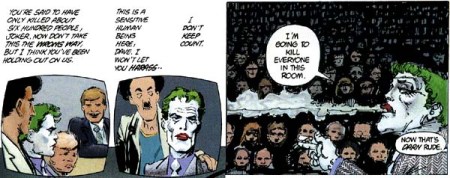
Late Nite Talk Show Host “Dave”: You’re said to have only killed about six hundred people, Joker. Now don’t take this the wrong way, but I think you’ve been holding out on us.

Pansy Liberal Psychologist: This is a sensitive human being here, Dave. I won’t let you harrass-

Joker: I don’t keep count . . . I’m going to kill everyone in this room.

Dave: Now that’s darn rude.

At the social level, the Joker is out to stop Gotham City’s resurgent belief in justice, embodied (in different ways) by Batman and Harvey Dent. I wish there had been an opportunity to establish more tangibly the positive impact that Dent’s mob cleanup was having on the city; it would have made us feel more urgently the real stakes that the Joker was playing for.

What the heck is this guy’s name again? They said it, like, five times in the movie. You would think I’d remember.

And that leads to the big twist at the end – maybe the best twist I’ve ever seen in a movie: the good guys have to defend hypocrisy. Of course it would be great if society could admit the truth about its own corruption and still strive to uphold justice anyway. But fallen human nature doesn’t work that way.

All my life, I’ve hated those cheesy TV shows where they decide to cover something up because “people need heroes.” Even the Simpsons, when they set out to parody this, couldn’t quite bring themselves to pull the trigger. It’s not done as a parody when Lisa decides not to reveal that Jebediah Springfield was actually a notorious pirate; they play it straight.

But The Dark Knight makes it work. People really do need their heroes, and their heroes really are fallen people. Ergo, people really do need hypocrisy. The reason I buy this in The Dark Knight when I’ve rejected it in all previous incarnations is because The Dark Knight doesn’t try to make it out to be a good thing. It’s wrong that people need hypocrisy – that people need to have heroes before they’ll agree to uphold justice and do good and so forth. It’s ugly and stupid and evil. As Dr. Surridge says in the original V for Vendetta comic (not the dreadful movie version), “There’s something wrong with us.”

Yes, it’s wrong that people need hypocrisy – but since they do need it, it’s not necessarily wrong to supply it.

Hold that thought. More to come. Stay tuned!


Eduwonk: Vouchers Boring, Bus Service Consolidation Fascinating

July 23, 2008

(Guest post by Greg Forster)

One of Eduwonk’s most important contributions to the education blogosphere is the snarky comment. Snark is frowned upon in these parts (don’t leave a snarky comment on this post, or you’ll be violating site policy). But if I may register a minority report on behalf of the loyal opposition, I think snarky comments do for the marketplace of ideas what short sellers and speculators do for the stock market: they’re not classy or respectable, but they perform an indispensable price-discovery function. (Another similarity is that the people who do them make tons of money – right, Andy? Andy?)

Of course, not all brokerage houses are interested in having their services used by short sellers, and there may be some sense in declaring some education blogs as snark-free zones. The short sellers can always take their business to other brokers – just like I post all my snarky comments on Pajamas Media.

But if Eduwonk is going to dish out snark, he’d better be able to take it. So check out what I found while scrolling through Eduwonk this morning.

In response to John McCain’s big education speech at the NAACP:

If this campaign turns into a debate about vouchers please just shoot me now. I’d prefer a debate that ignores education than that tired fight again.

Two days earlier:

Shouldn’t we be . . . trying to get school districts out of the busing business altogether? Big school districts like to boast about how they bus more passengers each day than Greyhound. That’s true, but also sort of insane if you think about it and consider that their primary mission is teaching and learning. Besides, today’s buses are horrendous polluters even when greener technology is available, control over transportation means control over parental decision-making, and school districts often aren’t even very good at designing efficient transportation schemes or adapting to changing circumstances like $4 gas, which was not exactly an unforeseen issue in the transportation world…Student safety means that, especially for younger students you want to be careful about how you merge transportation schemes, but having local or regional agencies that handle transportation would pay a lot of dividends if was approached with the dual principles of being greener and more parent- and civic-friendly at the front-end.

Got that? A debate about the policy that represents the most fundamental break from the existing system, is most consistently supported by empirical evidence, and is currently the most politically successful movement in the education world is boring enough to induce suicide. But the prospect of transferring control of bus services from school districts to local or regional transportation agencies is fascinating.

Supply your own snarky comment; I’m not allowed.

But before leaving the subject, I will note that if you’ve seen the new Batman movie, you already know whom to call for all your school bus operation needs:

You know how I got these scars? I was in an accident caused by an incompetent school bus driver, because educational transportation is controlled by school districts whose core mission is teaching and learning rather than by local or regional transportation agencies!