(Guest post by Greg Forster)
Obviously this is what UFT was thinking of!
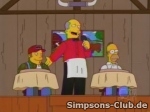

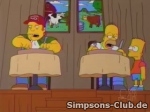
“I don’t understand!”

“There’s food in front of me, but I don’t want to eat it!”
(Guest post by Greg Forster)
Obviously this is what UFT was thinking of!
“I don’t understand!”
“There’s food in front of me, but I don’t want to eat it!”
 1 Comment |
  teacher union | Tagged: Greg Forster, steakholders |
  Permalink
 Posted by Greg Forster

As hard as Obama, Duncan, and Durbin try to minimize media attention to their efforts to kill D.C. vouchers with language slipped into an omnibus spending bill and Friday afternoon sneaky political tricks, the story just won’t go away.
Since our latest summary of greatest hits, I have an op-ed in the WSJ. Greg has a new piece in Pajamas Media. Shikha Dalmia has a piece in Forbes. Glenn Beck has devoted a segment of his Fox TV show to the issue. Senator Ensign gave a speech describing his fight for D.C. vouchers and vowing to expand federal voucher programs to include special education nationwide. Senator Lieberman will begin holding hearings on the re-authorization of D.C. vouchers next month.
If D.C. vouchers go down, they won’t go down quietly. Politicians who break their word to abide by the evidence, who would deny to others the choices and opportunities they enjoy, and who try to get away with sneaky Friday afternoon political tricks will have to account for their actions.
Greg put it best in his PM piece:
“Vouchers may lose in D.C., but that doesn’t mean they’re not winning in the long term. Every successful movement loses some battles. Indeed, the more important the cause, the more we should expect the entrenched interests of the status quo to invest in fighting it off. That will inevitably mean some setbacks alongside the victories.
Where would we be today if Martin Luther King’s letter from the Birmingham jail had just said, ‘Well, here I am in jail — I guess I’ve lost the fight’? King knew he wasn’t in jail because he was losing. He was in jail because he was winning.
And the cowards who put him in jail knew it just as well as he did.”
1 Comment | vouchers | Tagged: D.C. vouchers, Glenn Beck, Greg Forster, Jay Greene, Jay P. Greene, Shikha Dalmia | Permalink
Posted by Jay P. Greene

(Guest Post by Greg Forster)
Today’s installment of the ongoing series Questions for Leo features this 1974 photo of Leo Casey on vacation in the Everglades with the then-chairman of the New York City Council education committee.
The Daily News coverage of union financial contributions to the puppets on the education committee reminds us how much green the unions have to give. So our question for Leo today is, “Is it easy giving green?”
I mailed him the question (on a cue card, of course) and he replied:
It’s not that easy giving green
Having to wish each day my conscience would leave
When I think it could be nicer
Being a thief, or a con artist, or a pro wrestler
Or something much more honest like that
It’s not easy giving green
It seems you blend in with so many other ordinary lobbyists
And people tend to pass you over
‘Cause you’re not standing out like GSEs that destroy the economy
Or stars in Hollywood
But green is the color of nastiness
And green makes politicians cool and friendly-like
And green can make you big, like a tyrant
Or important, like a monopolist
Or walk tall like you had dignity
When green rolls in from union fees
It could make you wonder why you hate children
But why wonder? Why wonder?
I have green, and it’ll do fine
It’s beautiful!
And I think it’s what you want from me
Photo courtesy The Jim Henson Company via the Baton Rouge Advocate.
Leave a Comment » | teacher union | Tagged: AFT, cue card check, Greg Forster, Leo Casey | Permalink
Posted by Greg Forster
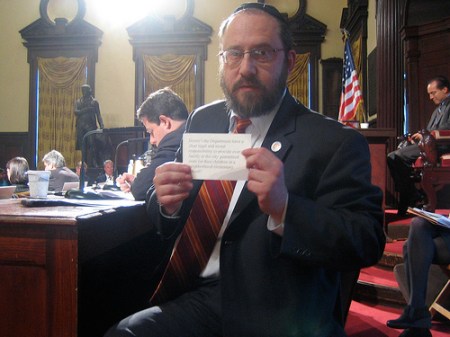
All images from GothamSchools, whose Elizabeth Green broke the story
(Guest post by Greg Forster)
Last week, the UFT got caught handing out cue cards to New York City Council members before a public hearing of the council’s education committee. The council members dutifully asked the questions they had been given, which pointedly invited anti-charter diatribes from the teacher-union and DOE witnesses.
The members then unanimously voted to make Grigori Potemkin their new committee chairman.
Internet wags are calling the scandal “cue card check.” ALELR has consulted his deep moles within UFT and offered an intriguing report on the union’s strategy for the Council’s next hearing.
The cue cards have to be seen to be believed:


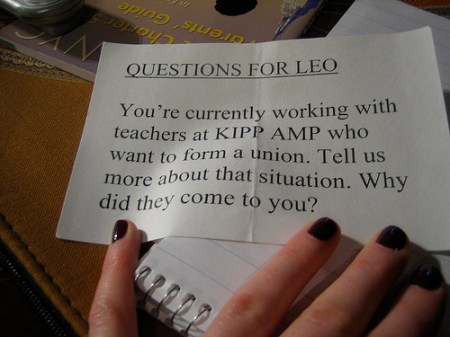
That’s “questions for Leo” as in our dear friend and Sith apprentice Leo Casey, who testified at the hearing. My pledge to you, the reader: from now on, every time Leo posts calumnies about Jay, I will post a link to this story.
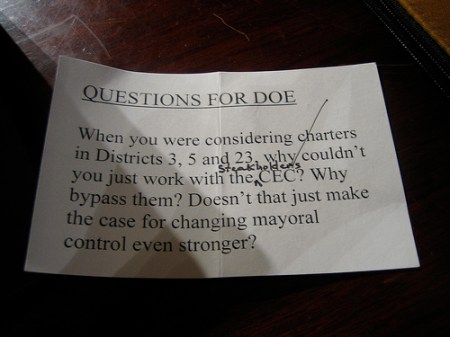
And that’s “questions for DOE” as in officials from the Department of Education. The cue cards were handed out by the UFT, but is it plausible that the department officials had no idea they were being asked scripted questions?
HILARIOUS UPDATE! When I first posted this, I didn’t look closely at the handwritten edit made to this cue card. Check it out – note the spelling. And this is from an organization of teachers!
This story doesn’t seem to have broken out of the local circuit yet, but it’s getting a whole lot of attention in the city media. The Daily News is leading the way, documenting the extent of UFT political contributions to the council members who got cue cards and covering Randi Weingarten’s attempts to deflect blame by claiming that a charter school organizer once did the same thing. (Not true, says the organizer – and who has more credibility here?)
But ALELR notes that props are not being given to Elizabeth Green of the blog GothamSchools, who broke the story and snapped all the pictures you see above (and more, which you can enjoy in all their glory by following the link).
Green wryly notes that the cue cards with accusatory anti-charter questions were handed out by “a representative of the city teachers union, which describes itself as in favor of charter schools.”
8 Comments | charter schools, journalism, teacher union | Tagged: Best of Greg, cue card check, Elizabeth Green, Greg Forster, Leo Casey, Mike Antonucci, Randi Weingarten, UFT | Permalink
Posted by Greg Forster

(Guest post by Greg Forster)
You may have heard that Sen. Benjamin Cardin is proposing a government bailout of the newspaper industry.
Some enterprising legislator who loves free speech should propose an amendment to the bill stating that any newspaper accepting its terms shall be required to change its name to PRAVDA. Truth in advertising!
Actually, “bailout” may not be technically the right term. Cardin swears his plan involves “no infusion of federal taxpayer money.”
Note the word “federal.”
Instead of handing out cash, which would make government the de facto owner of America’s newspapers (as the examples of GM and AIG show all too clearly), Cardin would allow newspapers to reorganize as nonprofit “educational” institutions. But since the law already allows nonprofits to publish and distribute their own newspapers if they want to, the only possible rationale for Sen. Cardin’s proposal is that it allows newspapers to continue charging money to cover their costs while also recieving tax-free subsidies.
And who would be doing the subsidizing? Even if government (at the state and local level) doesn’t do it directly, it’ll do it indirectly. Politicians have lots of wealthy friends who would love to have their own pet newspapers.
In fact, Cardin’s proposal is actually worse than a direct government subsidy. At least a direct subsidy would be on the books and subject to disclosure, oversight, and some level of accountability.
Cardin invokes the old Jeffersonian saw that it would be better to have newspapers without government rather than government without newspapers. Yes – but either of those would be better than having government newspapers.
Even though the proposal is obviously going to go nowhere because it fails the laugh test, you’ll still get a lot out of reading Michael Kinsley’s deconstruction of it:
Few industries in this country have been as coddled as newspapers. The government doesn’t actually write them checks, as it does to farmers and now to banks, insurance companies and automobile manufacturers. But politicians routinely pay court to local newspapers the way other industries pay court to politicians. Until very recently, most newspapers were monopolies, with a special antitrust exemption to help them stay that way. The attorney general has said he is open to additional antitrust exemptions to lift the industry out of today’s predicament. The Constitution itself protects the newspaper industry’s business from government interference, and the Supreme Court says that includes almost total immunity from lawsuits over its mistakes, like the lawsuits that plague other industries.
Kinsley notes that just as capitalism built newspapers, it’s now destroying them in order to build something better:
But will there be a Baghdad bureau? Will there be resources to expose a future Watergate? Will you be able to get your news straight and not in an ideological fog of blogs? Yes, why not — if there are customers for these things. There used to be enough customers in each of half a dozen American cities to support networks of bureaus around the world. Now the customers can come from around the world as well.
There’s a good Michael Kinsley who writes about issues and an evil twin Michael Kinsley who smears his opponents with reckless disregard for truth; this column is about as good as the good Kinsley gets.
Leave a Comment » | economics, journalism, politics | Tagged: Benjamin Cardin, Greg Forster, Michael Kinsley, newspaper bailout | Permalink
Posted by Greg Forster
(Guest post by Greg Forster)
The annual April Fool’s edition of the Gadfly is pretty good this year. It includes, among other things:
That last item contains the initiative’s recommended academic standards for various subjects. In science, the standard is: “Students really just need to know that the earth is round. That debate is old enough it should be a cinch.”
A round earth, you say? Hmmmm.
Leave a Comment » | blogging | Tagged: April Fool's, Fordham Institute, Gadfly, Greg Forster | Permalink
Posted by Greg Forster
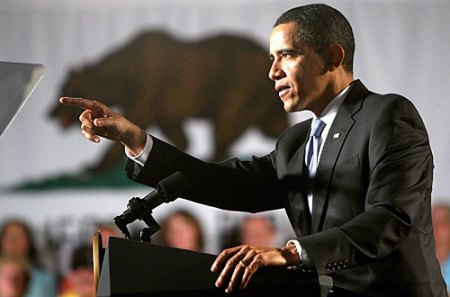
(Guest post by Greg Forster)
On Monday, Jay praised the president’s “courage” because the media were reporting that the administration was talking about bankruptcy for GM. I posted a comment to the effect that the media reports cited unnamed sources, and nobody should be praised for “courage” until somebody stood up and said “bankruptcy” in front of TV cameras.
Right after that, what does the president do but get up and say “bankruptcy” in front of TV cameras?
So, credit where it’s due. It was a bold move.
But there are two kinds of courage: the courage of the man who is resolved to do a hard thing because it’s right, and the courage of the man who is resolved to do a hard thing because it’s necessary to save his own skin.
We’ve yet to see which kind of courage this is. In today’s Journal, the indispensable Holman Jenkins makes the case that the president is bluffing because he needs to create the impression that he’s serious about bankruptcy.
Whatever else we may say about the president, he knows one thing the Clintons don’t: even if the only thing you care about is your own survival, you still have to take risks periodically. If you always do the “safe” thing, you’ll end up less safe.
Leave a Comment » | economics | Tagged: Barack Obama, GM, Greg Forster, Holman Jenkins | Permalink
Posted by Greg Forster
(Guest post by Greg Forster)
This morning, Pajamas Media carries my column on the results of the new Milwaukee studies released last week by the School Choice Demonstration Project:
It’s bad enough that everyone seems to be ignoring the program’s positive impact on public schools. About four-fifths of the students are still in public schools. Why look only at the results for the voucher students, only one-fifth of the total? If you had a medical treatment that would help four-fifths of all patients suffering from some horrible disease — and what else can you call the present state of our education system but a horrible disease? — that would be considered a fantastic result.
But it gets worse. These results don’t just show that the program improves education for students in public schools. They also indicate that the program improves education for the students who are using vouchers.
1 Comment | competitive effects, research reports, vouchers | Tagged: Greg Forster, Milwaukee vouchers, Pajamas Media, School Choice Demonstration Project | Permalink
Posted by Greg Forster

(Guest post by Greg Forster)
Jay was in town here yesterday and of course we talked about Lost. At this point neither of us had seen this week’s episode yet.
He shared with me his theory that 1) Daniel is wrong about the idea that you can’t change the past, and 2) during the flashy thing last week, when Jack, Kate, Hurley, and Sayid vanished off Flight 316 back to 1977, the rest of the plane shifted to an alternate timeline where events had been changed.
Guess that theory got a boost from this week’s episode, huh? We both had the same reaction – too bad he didn’t mention this theory last week. (Jay, you might want to give up your obsession with the lack of narrative unity in what is, after all, a serialized TV drama rather than a book or a movie. It’s distracting you from your true calling as our house NostraGreenedus.)
For discussion of this theory, we’ll call the original timeline T and the alleged new one T prime.
On the question of whether the past can be changed by anyone, I was skeptical. Yes, it’s theoretically possible that Daniel is wrong. But that would require a stunning lack of storytelling integrity on the part of the show’s writers. Jay had already lost enough respect for the writers (see last week’s post) to think that they will play that kind of arbitrary game with the rules of the narrative universe, but I didn’t think so. So far, at least, they haven’t done anything like that (Jay’s critique notwithstanding).
As for Flight 316 shifting to T prime, here was his evidence based on last week’s episode:
1) As the plane approached the Island, you could hear “the numbers” being read over the radio. Somehow, I missed this, even though I saw that episode twice. But last night I checked with my wife and she says she heard them, too. But in T, the transmission of the numbers was changed by Rousseau into a distress call some time after 1988, then shut off entirely in 2004.
2) The plane landed on a runway on the “other island.” But there was no runway on the “other island” in T. We know this because in Season 3, the Others were building it (they made Sawyer and Kate work on it).
3) When Sun and Frank arrive at the abandoned Dharma camp, it’s ruined (as we would expect) but it’s still a Dharma camp rather than an Others camp. It still has Dharma signs all over it. And it still has the old Dharma photographs hanging on the wall (one of which Christian showed to Sun). None of that was present in T.
There’s a problem with the second piece of evidence – there may have been no runway in 2004, but Flight 316 arrived in 2007. The Others could have built it in the interim.
The other evidence, however, seems convincing. It’s theoretically possible that somebody reinstated the radio transmission of “the numbers” between 2004 and 2007. But it seems a lot less likely than that we’re in an alternate timeline. And all the Dharma stuff still being in the camp the Others took over would be a shocking oversight if it were accidental.
And of course Sayid shooting the young Ben in this week’s episode makes it all the more plausible.
My defense of the writers’ integrity as storytellers is looking pretty vulnerable. Shifting the rules this arbitrarily would be pretty lousy craftsmanship on their part.
But remember, Ben may not be dead. Yet.
I’m hoping Desmond will show up and kill him.
2 Comments | Lost | Tagged: Get Lost, Greg Forster | Permalink
Posted by Greg Forster
(Guest post by Greg Forster)
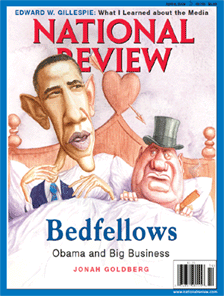
Folks, you simply must read Jonah Goldberg’s cover story in the new NR on how big business loves big government.
I know, I know, to most readers of JPGB it is not likely to be news that big business loves big government. But the article contains a whole slew of fascinating information that I never knew before, covering everything from a hundred years ago to the present day. And it’s very powerfully presented and argued – better than I’ve ever seen on this topic. The article is as delightful to read as it is informative.
There are revelations in the article about Upton Sinclair and the creation of government regulations for the meatpacking industry, and about how TR reversed his position on “trusts” after he left office, that floored me. Back when his book came out, Goldberg said he had to cut huge swaths of the original manuscript – I forget how much he said, but if I recall, it was definitely more than half – because the book was just too long. He was lamenting how much fascinating, little-known historical stuff wouldn’t go into the book and hoped that it would eventually be useful elsewhere. I think he’s getting some of that good stuff into circulation with this article.
Here’s a sample, from the opening:
Honesty and marital necessity require me to state that everything I know about prostitution I have learned from a distance. That said, based on what I’ve gleaned from reading and from films of dubious artistic value, it seems to me that the farther you move up the prostitution price range, the more elaborate the lies become….The relationships grow not only more complex but more reciprocal — and, most of all, the real lies aren’t what the hookers tell the johns, but what both parties tell themselves.
That’s something to keep in mind as we watch the spectacle of American big business and the Democratic party seducing each other once again.
It’s for subscribers only, alas. His syndicated column today takes on the same subject but is much, much less interesting – there’s not much in it that JPGB readers won’t already know. Besides, online subscriptions to NR are cheap and you should have one anyway.
Leave a Comment » | economics | Tagged: Greg Forster, Jonah Goldberg, National Review | Permalink
Posted by Greg Forster

 Jay P. Greene's Blog