Does Fordham Support a National Curriculum?

August 5, 2010


(Guest post by Greg Forster)

For weeks, Checker has been calling us “paranoid” for worrying that the national standards machine Fordham has helped create will be hijacked by the teacher unions.

Today, there lands in my inbox the new Gadfly from Fordham, featuring a guest editorial by Eugenia Kemble of the Shanker Institute. Kemble’s argument, in a nutshell: Now that we have national standards, the next thing we need is a national curriculum. That way we don’t just ensure that all schools set outcome targets and measurements in the one best way that’s right for everyone regardless of their individual needs; all schools will do everything in the one best way that’s right for everyone regardless of their individual needs. And we’ll have a benevolent dictator who will make sure that everyone will do everything in the one best way, and who will never abuse that power.

I paraphrase.

On Kemble’s list of the heroic, wonderful people she admires who have been pushing not just for national standards but a national curriclum are Bill Schmidt and Randi Weingarten at the AFT; teacher union shill Diane Ravitch; and . . . Checker Finn.

Inquiring minds want to know:

  1. Does the Fordham Foundation support a national curriculum?
  2. Given that Fordham is offering up the Gadfly as a platform from which Kemble can advocate using national standards as the first step toward broader federal control of schools, does the Fordham Foundation still consider it “paranoid” to be worried that national standards will be used as a first step toward broader federal control of schools?

I’ll hold my breath and wait for Checker to give us a clear, unambiguous answer.


Checker Finn, FREAK OF NATURE!

July 30, 2010


(Guest post by Greg Forster)

Yet you can count the voucher programs on your fingers.

Wow! Checker Finn has TWENTY-FIVE FINGERS!

(P.S. Congrats to FEC on the rockin’ new website.)

[Update: Just realized I should have added a link to Matt’s outstanding demolition of Checker, below.]


Two Senses of “Character”

July 28, 2010

(Guest post by Greg Forster)

Thinking back over these two posts on schools, citizenship and culture, I think there’s a further distinction I need to add. When I composed those posts, I didn’t explicitly distinguish two different ways in which schools can be said to contribute to the formation of national identity or moral character.

I was concerned to identify what I thought was a continuous historical dynamic, running from the foundation of the government school monopoly to the present day, in which the government monopoly is seen as a solution to America’s perennial anxieities over the formation of national identity and moral character. Because America has embraced religious freedom more fully than any other nation in history (far more fully than, say, the governments in continental Europe that preen themselves on their commitment to religious freedom while passing law after law after law governing the permissible boundaries of religious expression), and for other reasons as well, it is endemic to the American experiment that we are constantly worried about whether we will continue, over time, to share a common commitment to the shared moral values that define our civic order (don’t kill, don’t steal, etc.) and to the shared national identity that is the prerequisite of basic social cohesion. Many people are driven to embrace an aggressive use of government power, in the form of the school monopoly, in the name of various educational schemes designed to alleviate these anxieties. While many people on both sides of the ideological divide succumb to this temptation, I believe the temptation itself (as distinct from those who succumb to it) has its roots in the collectivist thinking that has historically been an ideological product of the left. And it can never work, for all the reasons that collectivism in every form can never work. And I still think all of that is right.

But I didn’t sufficiently distinguish between this dynamic and what one might call the “natural” role of schools in nurturing the formation of national identity and moral character in children. It was never my intention to deny that schools can, and should, nurture the formation of these attributes. What I deny is that the exercise of government power, in the form of a school monopoly or in any other way, contributes to such formation. Quite the opposite is the case, as the evidence shows – the more government gets out of the way, the better a job schools do at nurturing the formation of national identity and moral character.

To reiterate the wisdom of Silent Cal:

Governments do not make ideals, but ideals make governments. This is both historically and logically true. Of course the government can help to sustain ideals and can create institutions through which they can be the better observed, but their source by their very nature is in the people. The people have to bear their own responsibilities. There is no method by which that burden can be shifted to the government. It is not the enactment, but the observance of laws, that creates the character of a nation.

It is not the role of schools, but the role of government, that is the problem. What this ultimately boils down to is an insistence that schooling is a natural, and therefore prepolitical, phenomenon, not a creature of the state – and that the formation of national identity and moral character are included in the prepolitical nature of schooling. It may sound paradoxical to say that the formation of national identity is prepolitical, but it shouldn’t; indeed, the assertion that national identity precedes politics rather than following from it is basic to all liberty.


State, Nation, Culture, and Citizenship: Silent Cal Speaks Out

July 6, 2010

(Guest post by Greg Forster)

After publishing last week’s much-discussed post on schools, state power, culture and citizenship, I had two further experiences that I think are worth recording as a sort of appendix.

One clarification I want to add first, though – I should have bent over a little further backward to stress the distinction between “conservative ideas” and “ideas championed by conservatives.” I never denied – in fact I explicitly said – that the use of the government school monopoly to impose a moral order and civic culture on the nation is something some conservatives have advocated. What I deny is that the idea itself ought to be called “conservative.” If that’s a distinction we’re never allowed to make – which seems to be the position from which my post is being assailed – I can’t see any ground for even using labels like “conservative” at all, since they would have no meaning.

A few days after I put the post up, I was discussing Hayek’s The Road to Serfdom with a friend who is, not exactly a liberal, but certainly not a conservative. Hayek’s thesis was that the “soft” collectivist trends of the Anglo-American world mid-century were parallel in some very important ways to the “soft” collectivism of Germany after WWI – and that murderous totalitarianism was the logical endpoint of both trends. Not because the intentions of the soft collectivists were not noble and uplifting, and everything one might wish them to be; but because the unintended effect of their policies is to destroy the institutions and thought-patterns that obstruct totalitarianism, and strengthen those that give rise to it.

“Well,” remarked my friend,”it sure does make your job easier if you can tie your opponents’ position to Nazism.”

“Yes, it does,” I replied, “but that doesn’t mean it’s not true.”

The epigram to the introduction of Road to Serfdom, from Lord Acton, says it all: “Few discoveries are more irritating than those which expose the pedigree of ideas.”

I’m more than willing to have a civilized debate about the facts, provided I can find an interlocutor who’s interested in a civilized debate about the facts. Until I do, I think that’s pretty much all I have to say about this aspect of the controversy.

Then, over the weekend, I ran across Calvin Coolidge’s speech on the occasion of the 150th anniversary of the Declaration of Independence. The speech is very, very good and I encourage you to read it all. His critique of Progressivism, which was then in the slow and painful process of receding from the height of its power and influence, is simply devastating:

If all men are created equal, that is final. If they are endowed with inalienable rights, that is final. If governments derive their just powers from the consent of the governed, that is final. No advance, no progress can be made beyond these propositions. If anyone wishes to deny their truth or their soundness, the only direction in which he can proceed historically is not forward, but backward toward the time when there was no equality, no rights of the individual, no rule of the people. Those who wish to proceed in that direction can not lay claim to progress. They are reactionary. Their ideas are not more modern, but more ancient, than those of the Revolutionary fathers.

The more I learn about Coolidge, the more I think he’s known as “Silent Cal” primarily because he only spoke when he had something worth saying.

But in light of the topic I posted on last week – the contrast between the progressivism that sees the diligent exercise of state power as the grounding of a strong moral culture and civic identity, and the conservatism that trusts in our strong moral culture and civic identity as the grounding of state power – I couldn’t help but notice Silent Cal made the same point very well (and far more succinctly). Much of the speech is devoted to the idea that free political institutions ultimately derive from a culture that loves liberty, and cannot survive in its absence. After discussing the historical origin of that culture and some of the social institutions that maintain it, he remarks:

Governments do not make ideals, but ideals make governments. This is both historically and logically true. Of course the government can help to sustain ideals and can create institutions through which they can be the better observed, but their source by their very nature is in the people. The people have to bear their own responsibilities. There is no method by which that burden can be shifted to the government. It is not the enactment, but the observance of laws, that creates the character of a nation.

Wish I’d said it that neatly.

But then, how many hits did Cal’s blog have?

And how did I run across this speech? It was linked in The Corner by…Jonah Goldberg. Small world!


Let’s You and Him Fight!

July 1, 2010

HT Dateline Silver Age

(Guest post by Greg Forster)

Check out the editorial in today’s Washington Post about David Obey’s shameless attempt to redirect funding away from RTTT and into the teacher unions’ coke-and-hooker slush fund. While there’s a lot in it that’s worth reading, I particularly appreciated this twist of the knife:

That Mr. Obey’s proposal would pull back money intended to fund Race to the Top applications that have already been filed can only be seen as undercutting any credibility U.S. Education Secretary Arne Duncan would have in coaxing state officials to make the often-hard political decisions of education reform.

Did you hear what Dave just said about you, Arne? Are you going to stand there and let him say that? Fight! Fight!


Education and Citizenship on the Left and Right

June 29, 2010


(Guest post by Greg Forster)

I’m bowled over by the new Claremont Review – Bill McClay’s cover story on the underlying cultural and educational sources of the nation’s current crisis is a real show-stopper. In the shorter items, Charles Murray has a great piece on the ups and downs of Ayn Rand, and my dissertation advisor Steven Smith has a fantastic (not that I’m biased) overview of the issues surrounding Heidegger’s Nazism.

In the education hopper, there’s Terry Moe’s Moore’s [oops!] review of E.D. Hirsch’s new book The Making of Americans. I haven’t seen the book yet; Moe Moore writes that Hirsch, always a man of the Left, makes the lefty case for curriculum reform centered on cultural literacy. To wit, schools paternalistically imposing upon children a homogeneous American culture strongly rooted in a matrix of moral values is the best way to help the poor rise, which is what lefties want.

Moe Moore also casually inserts that in this book Hirsch renews his flat-footed argument against school choice – that empowering parents with choice won’t improve schools because what schools need is better currucula. We’ve been around this merry-go-round with Hirsch before; his argument is like saying that empowering computer users to choose what computers they buy has no impact on the quality of computers; what makes computers better is that the computer companies invest in making them better. Of course, the reason computer companies work so hard to make their computers better, faster and cheaper every year is because they have to serve their customers in a highly competative market.

Moe Moore doesn’t draw the connection between Hirsch’s lefty argument for cultural literacy and his harebrained opposition to school choice, but the connection is there. It’s equally visible in Little Ramona, who – like Hirsch – has been wrongly considered a “conservative” for many years solely because she opposes multiculturalism and supports . . . well, the lefty argument for curriculum reform based on cultural literacy.

This matters because everybody’s all topsy-turvy about what is “progressive” or “conservative” in education, and it will take some effort to get our thinking straight.

Moe Moore picks up Hirsch’s statement that the movement for “progressive curricula,” i.e. the whole Dewey-inspired attack on traditional academic curricula, is really not a movement for a progressive curriculum but a movement against having any sort of “curriculum” properly so called. The point is not to change what’s in the curriculum but to have no substantive curriculum at all when it comes to inculcating a national character or a shared national culture. This is true, and it’s relevant to the question of why lefties who love cultural literacy hate school choice.


Since the late 1960s, the “progressive curriculm” (that is, the “anti-curricular”) movement has dominated the political left by making common cause with the teachers’ unions, who were not congenitally anti-curricular but whose interests were served by promoting the anti-curricular cause. As Moe Moore insightfully points out, the anti-curricular movement is really also an anti-teaching movement; it is therefore a perfect fit for the union agenda of more pay for less work. Thus, anyone who is “pro-curricular” is pigeonholed as being on the political right.

But that is a temporary phenomenon brought about by a unique confluence of political circumstances. In its historical orgins and in the logic of the position, the drive to use schools as engines of cultural homogeneity is a phenomenon of the authoritarian political left.

This goes all the way back to the roots of the system. It’s widely known that one of the major reasons America adopted the government monopoly school system in the first place was hysteria over the cultural foreignness of Catholics. However, there’s another tidbit worth knowing. As Charles Glenn documents in The Myth of the Common School, one of Horace Mann’s motivations for pushing the “common” school system was his vitriolic contempt for evangelical Protestant Christianity. The hicks in the rural Massachusetts countryside with their backward and barbaric adherence to traditional Calvinist theology – which had survived down through the centuries from the Puritan settlers – was repugnant to civilized and enlightened Boston-Brahmin Unitarians like himself.

Someone had to do something to rescue these culturally deprived children from their unenlightened parents! That’s why Mann’s schools had such a heavy emphasis on teaching the Bible – teaching it in a very particular way. Part of the school system’s purpose was cultural genocide against evangelicals, to use the power of the state to indoctrinate their children with unitarianism. And it worked beautifully; how many traditional Calvinists are left in Massachusetts?

[Update: It has been brought to my attention that the Presbyterian Church in America, a traditional Calvinist denomination, has lately been experiencing dramatic growth in New England. So perhaps I should have said “It worked beautifully; after a century of Mann’s schools, how many traditional Calvinists were left in Massachusetts?”]

What we have to get clear is that both the anti-Catholic and anti-evangelical hysteria – then as now – were on the political left.

The great crusade in the early 20th century to use the government monopoly school system to forcibly “assimilate” immigrants with “Americanism” was likewise a movement on the political left. On this subject, please do yourself the biggest favor you’ll do yourself all year and read (if you haven’t already) Jonah Goldberg’s Liberal Fascism. Fanatical patriotism was, until the convulsions of the 1960s, the special hallmark of the left, not the right.

The issues got scrambled after the 1960s by two factors. First and most important was the rise of an aggressive cultural ideology (what we now call “multiculturalism”) seeking to use the government school monopoly to impose its amoral and anti-American value system on the nation’s children. This movement was not only born on the left, but, as noted above, it formed a fruitful partnership with the unions who were also on the left. So naturally, the backlash formed on the right, and the identification of being “anti-multiculturalist” applied to conservatives. However, this was never really the same kind of animal as the left-wing authoritarian drive to use government schools to enlighten the benighted and make them into good Americans. Conservative anti-multiculturalism is negative and defensive in character; it’s not seeking to use government to impose a culture, but to stop the multiculturalists from doing so.

Second, as Goldberg documents, the authoritarianism of 20th century progressivism began to migrate over and infect the right; hence we get absurd specatcles such as a “conservative” president saying such things as “when people are hurting, government has to move.” And, similarly, some conservatives try to use the power of the state to impose right-wing cultural values. But this is really the result of conservatives having drunk from the polluted cultural water of left-wing authoritarianism.

Now let me be perfectly clear. Anxiety about whether young people are picking up 1) moral values and 2) cultural identity as Americans is of course widespread on both sides of the political isle. Believe me, I’m as worried as anyone about whether the nation is successfully passing on its civilization to its children, and whether today’s immigrants will assimilate and self-identify as Americans – not only for the sake of the nation, but for their own sake, since the chief victims of amoralism and multiculturalism are the people who believe in them.

The difference is not in being worried about this problem, but in how we want to solve it. Using the brute power of a government monopoly school system to paternalistically impose a homogenous culture has never been a conservative idea. Go back and look at the great conservative debates over this in the 1990s; whether you’re talking about William Bennett, James Q. Wilson or Charles Murray, you just never find conservative thought leaders talking that way. It’s the lefties like E.D. Hirsch and Little Ramona who dream that their cultural anxieties can be salved with the soothing balm of state power.

And really, it should be obvious why. If you’re the kind of person who thinks the brute force of state power can change culture, well then, you’re probably also a political lefty. If you’re the kind of person who thinks our culture will get along just fine if the state will just stop tinkering with it through social engineering, then you’re probably also a political righty.

It all comes down to how you concieve of the relationship between the government and the nation – which is to say, between power and culture. As Reagan famously asked, are we a nation that has a state, or a state that has a nation? To put the same question another way, does culture drive politics or does politics drive culture? Or, to put it even more bluntly, is the use of power shaped by the conscience of the nation, or do we use power to shape the conscience of the nation?

The conservative approach to schools and American culture is to use school choice to smash state power, thus depriving the multiculturalists of their only serious weapon. Get the state out of the way and let Americans worry about how to pass on American civilization to the next generation.

Oh, and here’s one other way you can tell that this is the conservative approach: the evidence shows it works.

[HT Ben Boychuk for pointing out I misread “Terry Moore” as “Terry Moe” – and apologies to both Terrys!]


Pass the Popcorn: Toy Story’s Got Metaphysics

June 25, 2010

(Guest post by Greg Forster)

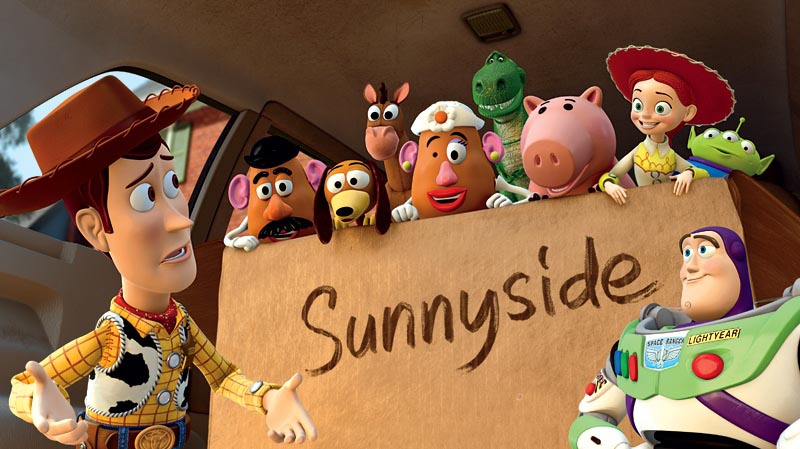
Toy Story 3 is at least as good as Toy Story 2. For a trilogy to go out as strongly as it came in is a remarkable feat in itself. For this trilogy to go out as strongly as it came in . . . words fail.

Spoiler alert – stop here if you haven’t seen the movie!

My hypothesis (which I’m still working on – comments are, as always, welcome) is that the main point is to extend the lesson from Toy Story 2 from the individual level to the socio-political level. If we draw a line between life in its material and spiritual aspects, the point of both movies is that the purpose of existence is in the spiritual aspect, which the material aspect exists to serve. Elevating the material aspect (survival) above the spiritual aspect (purpose) is dysfunctional. Toy Story 2 is about what happens to individual people when they prioritize survival over purpose. Toy Story 3 is about what happens to societies when those kinds of people are in charge. Anthropological materialism (“A toy is just a hunk of plastic. We’re all just junk heading for the dump!”) leads immediately to totalitarianism.


Remember, kids, Barbie sez: “The power of the state should be predicated on the consent of the governed, not the threat of force!”

The question I’m still wrestling with: does this theory make the child “owners” analogous to God? It is, after all, Andy’s personhood that constitutes the (wholly derivative) personhood and spiritual purpose of the toys. And Andy’s revealed will is to them a moral law – that, I think, is clearly implicit in everything Woody says and does in this movie. Even the very reasonable solution to the problem – the toys leave Andy for Bonnie – is accomplished not by an escape, but by persuading Andy to ordain it. A movie in which the toys escaped from the attic and made their way to Bonnie’s house would have had not just a different ending, but a completely different meaning.


“NOW a Warning?”

June 24, 2010

(Guest post by Greg Forster)

In Death Becomes Her, a powerful sorceress offers Meryl Streep a potion that will make her immortal and eternally young. There’s this long, tense scene where she hesitates over whether to drink it. Does she want to live forever? Is she tampering with powers she doesn’t understand? Then she drinks it and there’s a special-effects sequence. Then the sorceress dramatically intones, “And now, a warning.”

Streep’s eyes bug out. “NOW a warning?”

That’s the only thing I could think of when I saw this, the latest chapter in the Fordham Institute’s ever-twisting pretzel of attitudes about national standards.

For as long as they can get away with it, they ignore the question of whether national standards will, once they’re created, inevitably be captured by the blob, and remade in the blob’s image. What little they do say is empty of substance and easily shot down by the application of a little logic.

Then as soon as it’s clear the federal government steamroller has succeeded in ensuring that all states will be dragooned into adopting its “voluntary” standards, Fordham comes out with this big solemn think-piece about how we need to consider the important question of how we can ensure the standards aren’t captured by the blob.

Hey, guys – what if we can’t ensure that?

I guess it’s too late to ask that question now.


Beneath the Surface – DC Vouchers and Charters

June 23, 2010

(Guest post by Greg Forster)

I don’t want to jump to conclusions about yesterday’s DC school voucher study, since the study is only just out and we haven’t had time to digest it. But something really caught my attention when I first read the grad rate result that Matt highlighted yesterday:

The major finding of this report, and it is MAJOR, is that students who were randomly selected to receive vouchers had an 82% graduation rate.  That’s 12 percentage points higher than the students who didn’t receive vouchers.

Hold on! I thought to myself. That implies the control group’s graduation rate was seventy percent!

Sure enough, there it is, front and center in the study:

The offer of an OSP scholarship raised students’ probability of completing high school by 12 percentage points overall (figure ES-3). The graduation rate based on parent-provided information was 82 percent for the treatment group compared to 70 percent for the control group.


Seventy percent? I thought to myself. That doesn’t sound like the DC school system I know.

Sure enough, Education Week pegs the DC grad rate at forty-nine percent. So what’s the deal with this crazy control group?

Yes, one factor is that the control group is made up of “choosers” – families that sought out school choice. They’re likely to be systematically different from non-choosers, which is the whole reason we do these random assignment shindigs. But come on – they’re not that different.

Then it occurred to me – the 49% DC “public school” grad rate is for district schools; it doesn’t account for charter schools.

A whopping 38% of DC public school students are in charter schools. Now, given that the control group for this voucher study is made up entirely of “choosers,” what percent of that control group do you think are in charter schools? A lot higher than 38% is my guess. (I can’t seem to find data for this anywhere in the report – they spend so much time talking about how some of the private schools converted into charters, you would think they’d have found a few lines to talk about how some of the control group were in charters!)

[Update: HT to Brian for finding the figure (see comments) – 35% are in charters and 12% are in private schools. When I placed a bet that more than 38% would be in charter schools, I forgot that choosers would also choose private schools even without the voucher – which greatly strengthens my argument since private schools likely have even bigger effects on grad rates than charter schools.]

I mean, if your argument to explain the 70% grad rate in the control group is that choosers are very different from non-choosers, then doesn’t that very difference imply we should expect huge numbers of choosers who lose the voucher lottery to fall back on charter schools?

I hope you see where I’m going with this.

It seems obvious that if school choice improve graduation rates – which it clearly does, not only in this study but in previous ones in Milwaukee – then a lot of that benefit is being masked in this study because the control group is also excercising a lot of school choice!

What’s the real grad-rate benefit from school choice? Not “12 percentage points,” but somewhere between 12 percentage points and 33 percentage points.


It’s Not Easy Being Greene

June 14, 2010

(Guest post by Greg Forster)

Jim Geraghty, sorting through the various theories that have been offered to explain the mysterious landslide victory of unknown candidate Al Greene in the South Carolina Democratic senatorial primary:

Shortly after the election, Robert Ford, an African-American South Carolina state senator who ran for governor, offered the theory that voters could tell Greene was black by his last name: “No white folks have an ‘e’ on the end of Green. The blacks after they left the plantation couldn’t spell, and they threw an ‘e’ on the end.” This is an intriguing and possible theory, except that the world is full of people with the last name Greene who aren’t black (such as Florida Senate candidate Jeff Greene, author Graham Greene, and actress Michelle Greene) and plenty of African Americans with the last name “Green.”

Bad news, Jay – apparently you’re only the fourth most famous non-black Greene.