The Negative De-Sarcasticizer

May 14, 2009

Kevin Carey ran my post from yesterday through a “negative de-sarcasticizer”  and wants to take issue with the suggestion that D.C. vouchers were adopted democratically. 

First, I should warn Kevin that a negative de-sarcasticizer actually makes things more sarcastic.  I know because I bought one on Ebay and I use it to help make my posts as sarcastic as they are.  The negative de-sarcasticizer comes with a large, yellow label warning about the hazards of double negatives.

Second, the suggestion that DC vouchers were not democratically created because they affected DC and DC does not have a vote in Congress wouldn’t just call into question the legitimacy of DC vouchers.  All federal laws affecting DC would be undemocratic by this standard.  This would include NCLB and other federal education legislation that Kevin praises charter schools for more strictly obeying.

Third, I am glad that Kevin believes that “giving parents educational choices and opening up public education to competition and innovation will improve outcomes for students.”  And I agree with him that charters would be one way of expanding choices and competition.  But I continue to be puzzled by the argument that vouchers are bad because they are less accountable than charters.  Whatever regulation you believe is desirable for schools could be applied to vouchers as well as to charters.

Finally, I continue to be troubled by Kevin’s need to dismiss vouchers by labeling the idea as “unworkable” or “not serious.”  This is just argumentation by name-calling rather than addressing the substance of the issue.  When I hear this kind of argument it makes me want to turn my negative de-sarcasticizer up to full power.


More WaPo Gold

May 14, 2009

The Washington Post has yet another excellent editorial today on D.C. vouchers.  This time they discuss yesterday’s Senate hearings on the program featuring our very own Patrick Wolf.

It’s all money quote, so here’s the whole thing:

“WE HOPE that President Obama, Education Secretary Arne Duncan, Sen. Richard J. Durbin (D-Ill.) and others who have questioned the effectiveness of school vouchers were tuned in to yesterday’s Senate hearing on the District’s program. They would have heard moving testimonials from students whose lives have been changed by their ability to get an appropriate education, as well as a plea from a mother desperate that her young daughter have that same opportunity for a better future. Even more critically, they would have heard the judgment of an objective researcher that — contrary to the claims of some critics — vouchers are indeed working.

“In my opinion, by demonstrating statistically significant impacts overall in reading in an experimental evaluation, the D.C. [Opportunity Scholarship Program] has met a tough standard for efficacy in serving low-income inner-city students,” Patrick J. Wolf told the Senate Committee on Homeland Security and Governmental Operations. Mr. Wolf is the principal investigator on the team conducting a congressionally mandated study of the program and, as a professor of education policy at the University of Arkansas, has spent more than a decade evaluating school choice programs. Particularly striking was Mr. Wolf’s testimony that of the 11 other federal education programs evaluated, only three produced statistically significant improvements akin to what the voucher program has produced. Consider also his calculation that a typical student who entered the program in kindergarten would, by the time of graduation from high school, be reading 2 1/2 years ahead of peers who didn’t receive scholarships. There were no discernible impacts in math, although scores show some promise.

The hearing, convened by Sen. Joseph I. Lieberman (I-Conn.) and Sen. Susan Collins (R-Maine), was part of a last-ditch effort to save the federally funded program that gives D.C. low-income students vouchers of up to $7,500 to attend private schools. Congressional Democrats, backed by the powerful teachers unions, included language in the recent omnibus budget bill that would end the program in 2010. Mr. Obama has proposed letting the 1,700 students now in the program continue their schooling while admitting no new students and letting the program die by attrition. We are glad that Mr. Obama is protecting the interests of participating students, but, as Mr. Lieberman argued, if the program is working, why not continue it so more children can benefit?”

Also check out the news coverage of the hearing in the Washington Post.  In particular, I found this bit interesting:

“Lieberman said the committee invited “no less than six witnesses” who oppose the vouchers but got no takers.

Among them were the American Federation of Teachers and the National Education Association, the nation’s two major teachers unions.”

Apparently the unions and their fellow travelers are unable to defend their actions and feel no need to do so as long they can bully their way to victory behind the scenes.


Kevin Carey’s Too Cool for Vouchers… and Cooler Than You

May 12, 2009

Education Sector’s Kevin Carey has a piece in the Chronicle of Higher Education’s blog about why vouchers don’t matter.  It seemed to me that the piece had been highly edited, leaving out what Carey really thought. 

Sure enough, my secret agents were able to discover the original draft.  The parts that were edited out I’ve been able to restore.  They’re the bits in italics and bold:

Why School Vouchers Don’t Matter by Kevin Carey (Original Draft)

President Obama wants to appropriate enough money to keep the Washington, D.C. voucher program going for the children currently enrolled. Good — this is the only ethical position to take. I know some Democrats in Congress wish the program had never been implemented, but that’s the price of losing elections. Dragging low-income and minority students out of their schools just so the N.E.A. can score some petty political revenge would be inhumane and a political debacle besides.

That said, there’s a strong element of artifice to this whole debate. The D.C. voucher program does not represent serious public policy. It was a P.R. move, a bone thrown by the previous administration to the privatization crowd it marginalized by supporting NCLB.

You see, policies that are designed for P.R. or to satisfy political constituencies are not serious public policy.  Applying this standard I’ve determined that 99.44% of all public policies are not serious. 

The voucher dream (setting aside the obvious anti-labor agenda for the moment) has always been to introduce market dynamics to public education — to create new competition and provide incentives for innovators and entrepreneurs to bring energy and resources to the enterprise of educating students. 

Using my psychic powers to identify the dreams of others, I am certain that helping low-income families find better schools had nothing to do with passage of the D.C. voucher program.  That’s right, the only real test of a five-year, tiny voucher program that pays one-third per pupil what the public schools receive is whether new private schools are built.

The D.C. voucher program does none of these things. No new schools have been built as a result, no groundbreaking programs created, competition spurred, or innovators attracted. It’s basically just an exercise in seeing what happens when you take a couple thousand students out of pretty bad schools and put them in a range of other schools that are, collectively, somewhat better. Answer: some of the students may be doing somewhat better! I think we already knew this.

And by “we” I mean only the really cool people, not the majority in both chambers of Congress who voted to set an execution date for the program. 

Remarkably, the D.C. voucher program is being taken seriously even as, right here in the same city, charter schools are actually creating the whole range of market responses that vouchers are not.

Of course if we capped charter funding at $7,500 per pupil and limited their number to 1,700 students citywide and sunsetted the whole program after 5 years, I’m sure that charters would have “actually created the whole range of market responses” anyway.  Charters are just so cool that they could have beaten Mike Ditka in a Superbowl showdown with one hand tied behind their backs.

Drive across the river and see the brand-new schools built by KIPP and SEED, which are just a part of the tens of millions of dollars of new investment in public education spurred by charters, a wave of new organizations and people coming to the nation’s capital to educate disadvantaged students, along with many others who were here already, people who never would have been able to operate within the traditional public system.

One could argue, I suppose, that if vouchers had been given to 17,000 students instead of 1,700, they would have had more impact. But I’m not so sure — I kind of doubt that Sidwell Friends and Georgetown Day would up and build annexes in Anacostia in response.

Of course, I suppose that a bunch of the non-elite private schools where 99% of the voucher students attend might actually expand if you offered them 10 times as many spots and long-term security of funding, but that would undermine the straw-man argument I’m making. 

In any event, why bother? Who cares about the 1,700 students benefiting from D.C. vouchers?  Not cool folks like me!  I always remember to take my jaded pills each morning. 

D.C. charter schools are directly accountable to the public and specifically designed to serve urban students. Why would it be better to re-direct public funds to schools that are neither of those things? 

I mean, the private schools in D.C. aren’t really urban because when you enter them you are transported through a kink in the time-space continuum to a place outside of an urban area.  And those vouchers aren’t really accountable because even though they were democratically created, subject to oversight and renewal within 5 years of creation, and mandated (unlike charters) to participate in a rigorous random-assignment evaluation, they don’t have the word “public” in them.  And we cool people know that the magical addition of the word “public” makes things truly accountable to the public.

Yet the D.C. voucher debate is playing out on national television and has provoked a seemingly endless series of righteous editorials from the Washington Post.

Don’t they know that righteousness is my department?! 

This seems to be the real purpose of school vouchers — giving people the opportunity to scramble for the moral high ground of defending disadvantaged youth.

Never mind what I said at the start about the real purpose being to introduce market competition or to destroy unions.  The real REAL purpose is to defend disadvantaged youth — and is there anything more awful than that?

Many wealthy members of Congress send their children to private school! So does our wealthy President! Outrage! Hypocrisy revealed! 

More exclamation points!  Loud noises!  Harrumph!  Please pay no attention to the cynical thing I said in the last paragraph about how awful it is to care about disadvantaged kids!

Meanwhile, voucher opponents paint themselves as brave defenders of the education system, as if this was some crucial battle against the Wal-Martification of public schools.

There!  I’ve bashed both sides, so I get my triangulator license renewed.

In that sense vouchers do have some utility — they separate people who are serious about education policy from people who aren’t. The more you shout and carry on about them, the less you’re paying attention to the issues that really matter.

And I never shout or carry on about vouchers!  I’m too cool.


Does President Obama care more about black criminals than black schoolchildren?

May 7, 2009

Jason Riley asks the question in the Wall Street Journal

His answer: 

“Unfortunately, the Obama administration seems more interested in the sentencing gap than the learning gap. The president pays lip-service to the need to open pathways to educational achievement, but he and Education Secretary Arne Duncan have been actively working to shut down Washington, D.C.’s Opportunity Scholarship Program, which provides low-income children with $7,500 per year to use toward tuition at a private school. Mr. Obama can’t claim that the program isn’t working. The latest evaluation by his own Education Department showed scholarship recipients — 99% of whom are black or Hispanic — outperforming their public-school peers in reading. That finding takes on even more significance when you consider that black 12th-graders in this country average lower reading scores than white 8th-graders.

Yesterday, the administration announced that it will support allowing current students to remain in the program but will oppose letting any new kids join them. The illogic is exquisite. If the president believes that school vouchers are effective enough to grandfather existing participants, the scholarship program deserves to be expanded, not shuttered.”


Geraghty Sums It Up

May 7, 2009

damage-control

HT Damage Control Music

(Guest post by Greg Forster)

NRO’s Jim Geraghty sums up Obama’s new position on D.C. vouchers:

“We know our stance is indefensible; please make this issue go away.”


WaPo Strikes Again

May 7, 2009

The Washington Post has another excellent editorial today praising Obama’s willingness to grandfather existing  students in the DC voucher program but lamenting his unwillingness to extend the same opportunity to future students.

As they put it:

“It is to President Obama’s credit that he wants to uphold the right of fledgling poet Carlos Battle and 1,715 other voucher recipients not to have their educations disrupted. We can’t help but wish, though, that other needy students would get the same opportunity of choice.”

And in a bit of understatement they added:

“Maybe there was also some thought given to the political optics of booting hundreds of poor, black students from private schools back into troubled public schools.”

Umm….  maybe just a bit.

And they close:

“In an ideal world, we would hope for more than that compromise. The Senate Homeland Security and Governmental Affairs Committee had already scheduled a hearing next week to evaluate the program. Parents, students and a scientist who have studied the program are among those scheduled to testify…  The hearings need to be conducted with an open mind. If indeed this program is shown to work to the benefit of children, it should be continued. And, not — we submit — just for the ones who are lucky enough to be in it now.”

(corrected typo from WaPo)


D.C. Voucher Rally Photos

May 6, 2009

forDCkids8.jpg

forDCkids1.jpg

School choice rally

(HT: NRO The Corner, and The Weekly Standard)


The Wall Street Journal Strikes Again

May 5, 2009

The Wall Street Journal has another strong editorial today condemning Barack Obama and Arne Duncan’s hypocrisy in seeking to end the D.C. voucher program.  Here’s a highlight:

“See if you can follow this political syllogism. President Obama and his Education Secretary have repeatedly promised to support “what works,” regardless of ideology. The teachers unions adamantly oppose school vouchers, whether or not they work. Ergo, Messrs. Obama and Duncan decide to end a D.C. school voucher program that works and force poor kids back into schools where Messrs. Obama and Duncan would never send their own children. What a disgrace.”

There’s a rally of voucher families planned for this week and there will be congressional hearings on reauthorizing the program next week.  Stay tuned.


“Can You Get this tape to him and ask him ‘WHY?!?'”

May 4, 2009

(Guest Post by Matthew Ladner)

Reason TV on DC vouchers. BOOOOOM!


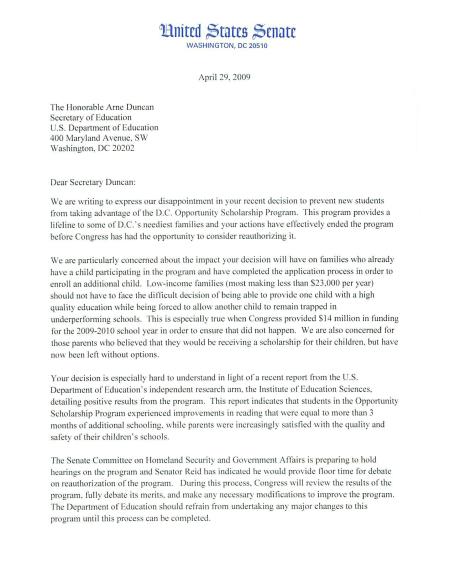
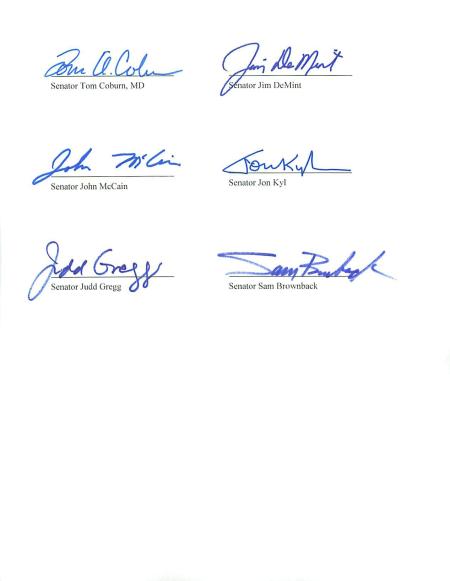
Bipartisan Senate Groups Asks Duncan to Reverse Good Friday Massacre

April 29, 2009

(Guest Post by Matthew Ladner)

duncan-letter2
duncan-letter-2
duncan-letter-31