The Misunderstood Greatness of “Great” Books

November 11, 2008

great_books

(Guest post by Greg Forster)

Yesterday’s Wall Street Journal carried a review of Alex Beam’s new history of the great books movement, A Great Idea at the Time. The reviewer, Robert Landers, approvingly quotes Beam’s statement that he wanted his history of the GB movement to be “brief, engaging, and undidactic . . . as different from the ponderous and forbidding Great Books as it could be.”

The GB movement has touched all levels of post-primary education – secondary, collegiate, and “continuing” – and it has come in for a lot of criticism, some of it justified, particularly as regards the pomposity and the (really surprising) intellectual vacuity of Mortimer Adler. Much that was written about the Great Books by some of their most prominent self-appointed champions was indeed prolix, unengaging, and didactic.

With some shame, I confess that in my excitement about great ideas during my intellectual youth, I was suckered into paying $50 for Adler’s useless cinder block of a book, the “syntopicon.” Adler’s ambition was to create a reference that would point you to everything that the great thinkers had ever thought about each of a hundred “great ideas.” Alas, the real content of the Great Books failed to line up with Adler’s preconcieved notions about what constitues a great idea, and Adler failed to realize this; consequently the book is as useless as it is long. Fortunately, thanks to the miracle of the Internet, I was able to find another sucker willing to pay me $50 to take the embarrassing thing off my hands.

But anyone who thinks the Great Books themselves are prolix, unengaging, and didactic has obviously never read one – or if he has, all the more shame on him that he didn’t pay attention to what he read.

Indeed, the greatness of Great Books consists precisely in the authors’ gift for communicating large ideas in a clear, easily understood, engaging, and undidactic way so that everyone – everyone – can benefit from them. People think that the greatness of Great Books consists in the greatness of the ideas, but this is false. Any fool can write a book about great ideas, as Mortimer Adler proved so conclusively. What takes greatness is to write a book about a great idea that makes those ideas accissible and exciting to all readers.

The issue here really goes to the heart of how we understand education when it comes to ideas as opposed to skills (like reading and math). What is the best way for people who are not themselves great philosophers to learn about great ideas? For a long time the nation’s educators have set themselves up as a parasitical priesthood class, arguing that the ordinary person lacks the capacity to recieve these things directly from the sources; they need priests to interpret for them. The GB movement argued that the great philosophers themselves were much better teachers of ordinary people than the educational priests – that is precisely what makes them so great.

C.S. Lewis – who wrote extensively about the purpose, methods, and philosophy of education – put it very concisely in an introductory essay he wrote to be included in a new edition of an old book (Athanasius’s On the Incarnation), which was subsequently published separately under the title “On the Reading of Old Books”:

I have found as a tutor in English Literature that if the average student wants to find out something about Platonism, the very last thing he thinks of doing is to take a translation of Plato off the library shelf and read the Symposium. He would rather read some dreary modern book ten times as long, all about “isms” and influences and only once in twelve pages telling him what Plato actually said. The error is rather an amiable one, for it springs from humility. The student is half afraid to meet one of the great philosophers face to face. He feels himself inadequate and thinks he will not understand him.

But if he only knew, the great man, just because of his greatness, is much more intelligible than his modern commentator. The simplest student will be able to understand, if not all, yet a very great deal of what Plato said; but hardly anyone can understand some modern books on Platonism.

It has always therefore been one of my main endeavours as a teacher to persuade the young that firsthand knowledge is not only more worth acquiring than secondhand knowledge, but is usually much easier and more delightful to acquire.

The whole essay is well worth reading for anyone who wants to think about how great ideas are communicated to ordinary people who want to know about them.

And for those of a more quantitative bent, I can’t resist examining the one quantitative claim implied by Beam’s comment – that his book, unlike the Great Books, is “brief.”

The Journal lists Beam’s book at 245 pages. I went to my office shelf and took down all the books that could be considered Great, and checked the page numbers – excluding introductions, interpretive essays, appendixes and the like (some of which occupy hundreds of pages in the volumes I have). Where I had multiple editions I picked the edition that I used regularly. I suspect the selection may be biased toward longer works because the books I keep at work as opposed to what I keep at home for regular reading are probably longer. One could argue that the selection is biased in the other direction because some books are so long that I don’t even bother to own a hard copy, and access them electronically (e.g. Aquinas’s Summa Theologica and Calvin’s Institutes). But I would argue that those longer works are not really Great Books at all, but reference works. Aquinas and Calvin never meant for anyone to sit down and read their works cover to cover; the idea was to provide a useful reference so that if you need help with some specific problem, you know where to look it up. (They’re kind of like Adler’s syntopicon that way, except they’re actually useful.)

Here’s what I came up with:

Plato, Apology of Socrates: 21 pages

Locke, A Letter Concerning Toleration: 49 pages

Rousseau, Discourse on the Origin of Inequality: 97 pages

Rousseau, The Social Contract: 144 pages

Locke, The Reasonableness of Christianity: 195 pages

Locke, Two Treatises of Government: 240 pages

Treatment case: Alex Beam, A Great Idea at the Time: 245 pages

Aristotle, Ethics: 276 pages

Niebuhr, Moral Man and Immoral Society: 285 pages

Burke, Reflections on the Revolution in France: 292 pages

Plato, Republic: 300 pages

Aristotle, Politics: 425 pages

Rousseau, Emile or On Education: 447 pages

Hobbes, Leviathan: 482 pages

Hamilton, Madison & Jay, The Federalist Papers: 494 pages

Locke, Essay Concerning Human Understanding: 678 pages

Tocqueville, Democracy in America: 705 pages

Montesquieu, The Spirit of the Laws: 722 pages

Augustine, The City of God: 1,086 pages

So it does seem fair to say that Beam’s book is on the shorter end of the distribution – but the generalization that Great Books are not “brief” is patently false. And that’s before we even get into the qualitative dimension; the Apology is more or less the Original Great Book (the educational equivalent of an OG, if you will) and in length it barely rises to the level of a pamphlet.

Bottom line: before you complain about the GB movement, try picking up a Great Book and reading it.

UPDATE: See additional data and discussion in my follow-up post.


Pass the Popcorn: All-Time Great Summer Movies

October 16, 2008

epi518

(Guest post by Greg Forster)

Inspired by Matt’s “all time best bad movie” contest, I decided to ask readers to cast their votes on the all-time great summer movies. And, like any good political science geek, I planned to use multiple voting systems. I was going to provide a slate of nominees and ask people to post a list of which nominated movies they thought were among the all-time great summer movies, in order of greatness. Then I was going to count up which movie got the most #1 votes, which movie got the most total votes, and which movie got the most votes if the votes were weighted based on where they fell on people’s lists.

But once I had compiled my list of nominees, I thought: why put it up for a vote? Excellence is not subject to democracy. So instead of being a list of nominees, this is just my list of the all-time great summer movies. (Since excellence is very much subject to freedom of speech even if it isn’t subject to democracy, you are very welcome to post your comments and your own lists!)

My list was selected by the following highly scientific process:

1) There was no such thing as a “summer movie” in the way we now think about that term before the 1980s or so. I chose 1980 as the cutoff date by a highly scientific process of noticing that it was divisible by both four and ten.

2) The definition of “summer” has changed over time. I chose May 1 to September 1 as my cutoff dates by a highly scientific process of deciding that I’m willing to stretch into May, but not April or September. I have manfully resisted the temptation to include as “honorary” summer movies the many excellent films with non-summer release dates (e.g. The Incredibles, November 5, 2004; Serenity, September 30, 2005; Casino Royale, November 17, 2006).

3) I examined the lists of movies first released in the US between May 1 and September 1 in every year from 1980 forward (that’s why God made IMDB) and chose the best nominees, selecting them by the highly scientific standard of whether or not I thought they were plausbile candidates for being an all-time great summer movie. After 2001 the IMDB lists get too long (they include not only the rapidly expanding straight-to-video market, but also a lot of miscellaneous media like video games) so for 2002 to 2008 I switched to using the list of the top 100 grossing movies and then seeing which of the plausible candidates was released in the summer. The dropoff in nominees after 2002 may be due to this methodology change, but I’m inclined to think not; rather while the quality of movies in general has not (I think) gone down, the rate of production for all-time great summer movies has.

After prolonged, highly scientific consideration, I decided to exclude small-budget comedies, even the major classics, on grounds that a movie needs a big budget to be a “summer movie.” Exceptions were made where I felt that a movie was striving for a big-budget, summer-movie “feel” even if the budget wasn’t actually big (e.g. the many big-name guest stars and over-the-top musical numbers in The Blues Brothers make it feel like a summer movie even though it probably didn’t cost summer-movie money; I got a similarly “summery” vibe from Ferris Bueller’s Day Off).

Likewise, dramas with a strongly “gritty” and/or “realistic” tone (e.g. Untouchables, June 3, 1987; Unforgiven, August 7, 1992; 28 Days Later, June 27, 2003) and movies intended to be accessible to younger children (e.g. E.T., June 11, 1982; Labyrinth, June 27, 1986; Finding Nemo, May 30, 2003) were excluded as not fitting the genre.

On the other hand, I strove to include movies that we might not immediately think of as “summer movies,” but which, upon reflection, might be considered within that category. And I did make allowances where I felt that a franchise was “owed” a place on the list, as you’ll see from my comments.

The Empire Strikes Back

May 21, 1980

luke_vs__vader_morph_by_joew771-d5u7bwn

From Leia’s anguished confession as Han goes into the carbonite to Luke’s heroic-cum-suicidal showdown with the Dark Lord, this movie was a high point not only for the franchise, but for science fiction generally and for film generally.

The Blues Brothers

June 20, 1980
BluesBrothers

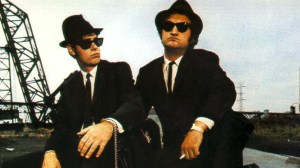
It’s big, it’s in your face, it has musical numbers and a finale where a SWAT team storms the building – it’s a summer movie. For me the most memorable line is during that final sequence when the police are closing in as the brothers are about to make the orphanage’s mortgage payment, and a police dispatcher, in a totally calm, monotone nasal voice, says: “The use of unnecessary violence in the apprehension of the Blues brothers has been approved.”

Raiders of the Lost Ark

June 21, 1981

indy1_zps00e1566e

In film as in all other occupations, the first step to doing great work is to do what you love. Spielberg loved 1930s cliffhanger serials and knew them well enough to bring them up to date, preserving what made them great in their own time while translating them into the (vastly superior) narrative idiom of modern film.

Star Trek II: The Wrath of Khan

June 4, 1982
kobayashi_maru

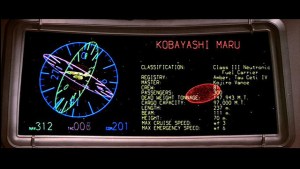
On this list, The Wrath of Khan stands as representative of the Star Trek franchise, not all of which were summer movies, but which cumulatively deserve representation. (Group rights are no good in politics but they have their place in “all-time greatest” lists.) But it’s convenient that one of the best of the series happens to have been a summer movie (two of them, actually – Insurrection was released in summer as well). Do you recognize the graphic above? The Kobayashi Maru is so widely referenced among sci-fi geeks that it’s a cliche, but there’s a reason it resonates so widely; it’s one of the best (in the sense of most fitting and most revealing) character backstories on film.

WarGames

June 3, 1983

6568_1

Remember this? Laugh if you will, but I think there’s a reason everyone from my generation remembers this movie. Has there ever been a more tense opening scene? “Turn your key, sir. TURN YOUR KEY.”

Krull

July 29, 1983

krull_cyclops

Also in the “laugh if you will” department, this odd but oddly gripping sci-fi/fantasy hybrid stretched your imagination. If you could get past the “Huh?” factor, the film clearly knows how to tap into the vein of epic drama even with a story that doesn’t follow the standard genre conventions.

Ghost Busters

June 8, 1984

Ghostbusters-Screencaps-ghostbusters-29592124-1920-1080

What makes this movie so surpassingly great is that all the little things are consistently right. You remember all the really great moments, of course, but think about some of the ones you don’t usually remember, like Annie Potts trying to handle the sudden surge of business (“I’ve quit better jobs than this.” [Picks up the phone] “Ghostbusters! Whaddaya want!”). These fully-drawn characters are why the movie succeeds when it reaches for something more than just comedy – like near the end, when the boys crawl back out of the broken street and the crowd goes wild, chanting “Ghost busters!” “Ghost busters!” and Venkman brags, “That’s all right, we can take it. We can take it. They wanna play rough!” It’s not a gag; it’s played straight, as heroism, offered for our admiration. And it works.

Back to the Future

July 3, 1985

89ce8721-43e0-487b-82e7-27c53dc6d61d

Behold the man, Christopher Lloyd. He’s spent decades doing nothing but crap, yet for just a couple of brief, shining moments, he was brilliant – so brilliant that no amount of subsequently produced crap can ever move us to regret his career.

Top Gun

May 16, 1986

untitled

Yes, the silliness quotient is getting a little high here. But this is the movie that set the standard for macho cool. (“We were inverted.”) And as Harvey Mansfield has recently demonstrated, machismo is not in itself a silly thing; in a dangerous world, the culture of machismo is serious business.

Ferris Bueller’s Day Off

June 11, 1986

ferris_buellers_day_off

Contains just enough “bigness” (the parade, “Save Ferris” on the stadium’s electronic billboard) and summer-ness to bump up from the “comedy” category to the “summer movie” category in my mind. The city itself is as much a character as Ferris and Cameron. Sure, it lacks the drama and epic scope of most summer movies, but Ferris himself is larger than life – more primal force than man, the Iago of slackers.

Big Trouble in Little China

July 2, 1986

Jack_Burton_h3

The Ghost Busters of the kung fu genre. Cheesy over-the-top martial arts thriller (half spoof, half serious) meets super-sharp dialogue and fully drawn characters, again with all the little things done right: “A brave man likes the feel of nature on his back, Jack.” “Yeah, and a wise man has got enough sense to get in out of the rain!

Aliens

July 18, 1986

Ellen-Ripley-Aliens-female-ass-kickers-29685715-1280-688

Continuing a theme, it’s the characters who make this a big cut above the standard action flick – another real high point for sci-fi, and one of the best “straight action” movies ever made (as distinct from movies that are more in the “epic” or “adventure” subgenres). The debate in the APC about whether to nuke the site from orbit (“it’s the only way to be sure”) is one of the most note-perfect scenes I’ve ever seen. It also serves (in a way so subtle that you don’t notice it until it’s all over) as a great character intro for Hicks, who has been silent in the background until now while Apone and Hudson stole the show, but now must lead the unit. “But he’s a grunt! No offense?” “None taken.” And the way he says it, it’s clear that there really was no offense taken. It’s not the standard “call of destiny” scene, like Luke standing over the still-smoldering ruins of his aunt and uncle’s farm. But it serves the same function in the narrative – for both Ripley and Hicks.

Spaceballs

June 24, 1987

spaceballs-06

“Aww, that’s just what we need . . . a Druish princess.”

“Funny – she doesn’t look Druish.”

Robocop

July 17, 1987

robocop-remake

Blends two of the great strengths of sci-fi that rarely go together well, but do so here: super-cool hi-tech action and smart social commentary, including some very clever social satire (“I’d buy that for a dollar!”). Kudos also for the excellent twist ending: The elderly corporation president is held hostage with a gun to his head by his villainous vice president. Robocop can’t save him because the VP has had him programmed to be unable to take action against an officer of the company. Then the old president, who has been mostly a smiling-grandfather figure until now, suddenly shows that he didn’t get to be the president without learning how to think quickly under pressure. “Dick . . YOU’RE FIRED!” Whereupon Robocop blows the VP away.

The Living Daylights

July 31, 1987
Living Daylights

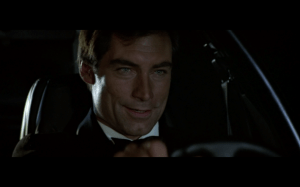
Just as the Wrath of Khan stands for the Star Trek franchise, this stands for the Bond franchise. But, again as with Wrath of Khan, it’s convenient that one of the franchise’s strongest entries happens to have been a summer movie. Vastly underappreciated due to the juvenile public reaction against the toning down of Bond’s sexual immorality, this complex espionage thriller delivers action, snappy dialogue (targeting recticles appear on the windshield of Bond’s car and he explains to the girl: “I’ve had a few optional extras installed”), and – not least important – marks the start of the series’ deliberate development of Desmond Llewelyn’s comic genius. Bond observes as an MI6 technician carrying a loud stereo on his shoulder flips a few switches and launches an RPG-type rocket out of it. “It’s a little something we’ve worked up for the Americans,” remarks Q with evident delight. “It’s called a Ghetto Blaster.”

Who Framed Roger Rabbit?

June 22, 1988
vlcsnap-3434311

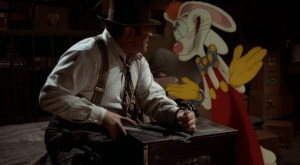
One of those times when a super-clever novelty act turns out to be more than just a novelty act. It does for classic cartoons what Raiders did for 1930s cliffhanger serials – translates it into the idiom of modern film. And see above re: Christopher Lloyd.

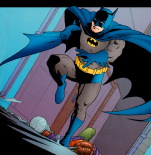
Batman

June 23, 1989

batman1_clip03

Remembered, of course, for Jack Nicholson’s Joker – and it still will be, even now that Heath Ledger has reinvented the character in an even more impressive way – it’s hard to remember now that it was this movie that resurrected the then-mostly-defunct genere of comic book movies, which is no small feat given the peculiar imperatives of that type of narrative, and also revolutionized the visual style of movies in related genres. One of the most influential movies of the last generation.

Terminator 2: Judgment Day

July 3, 1991

Terminator2

Noted at the time for its then-record budget, Terminator 2 did for special effects what Tim Burton’s Batman did for comic book narratives – showed the narrative power they were capable of weilding.

A Brief History of Time (Documentary)

August 21, 1992
a-brief-history-of-time

Just kidding! 🙂

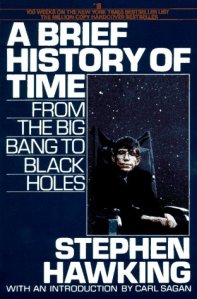
But I think his appearances on The Simpsons have shown Stephen Hawking’s potential as an action hero (“If you are looking for trouble, you found it”), and if they made a summer movie starring him, I’d go.

Jurassic Park

June 11, 1993
Jurassic-Park

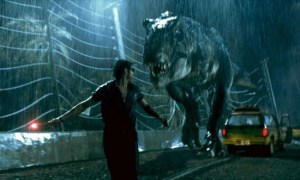
I suppose I’m including this mostly out of a sense of obligation, given its prominence and influence – although I did decide not to include Rambo 2 in spite of its (probably greater) influence. In this case I think the craftsmanship of the movie is better. (The moment where Sam Neil dismisses Jeff Goldblum as a “rock star” intellectual lightweight, for example, works well.) This is a movie I wouldn’t spontaneously suggest watching, but would happily watch if others in the room wanted it.

Speed

June 10, 1994

speed_1994_blu_ray_movie_review_full

Continuing that theme, here’s another movie that I include largely out of a sense of obligation, yet I wouldn’t include it if I didn’t think it had merits. Craftsmanship again makes the difference.

Apollo 13

June 30, 1995
apollo13b

Much more than a nerds-as-heros flick (although it is clearly that), this movie is a triumph of the filmmaker’s craft. Nothing in it is particularly spectacular in itself, but all the pieces click perfectly and the whole is much more than the sum of its parts.

Austin Powers: International Man of Mystery

May 2, 1997

123573

The franchise degenerated so quickly in the subsequent films that I don’t think the full cleverness of the original is still as widely appreciated. The better you know Bond, the more gags you’ll notice here. And maybe it’s just me, but I bust a gut laughing at Austin trying to get the little go-kart turned around in the narrow dead-end hallway. I don’t know why, it just works.

Men in Black

July 2, 1997
men_in_black

If you haven’t seen it in a while, plug it back in. It’s a lot funnier than you remember.

The Mask of Zorro

July 17, 1998
the-mask-of-zorro7

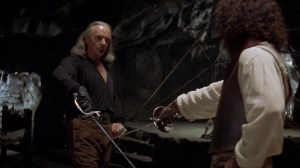
One more for the “laugh if you will” file, but I think this movie stands out from the crowd. Action, comedy, terrific performances, and – in case you haven’t noticed, this is an important mark of a great movie for me – really good dialogue. The aging Zorro (Anthony Hopkins) wants to train a drifter he’s picked up (Antonio Banderas) to replace him. Hopkins points to the sword in Banderas’s hand and asks, “Do you even know how to use that thing?” “Of course I do,” replies Banderas. “The pointy end goes in the other man.”

South Park: Bigger, Longer & Uncut

June 30, 1999

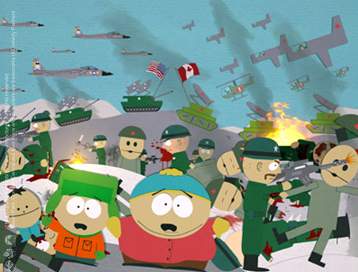
south-park-1

What does one say? If you haven’t seen it, words aren’t going to convey the experience. I’m only about 50% on board for the movie’s agenda, but they do it cleverly so as to avoid turning away people who aren’t ultimately with them – their focus is on the failure of parental responsibility, not on the policy question of what should be allowed on TV.

Shrek

May 18, 2001

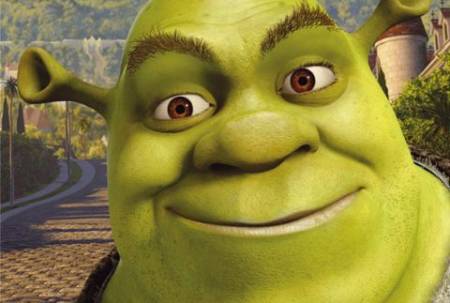
shrek-3

It could have been a one-joke movie, but consistent cleverness and Eddie Murphy’s breakout performance made it franchise-worthy.

Spider-Man

May 3, 2002

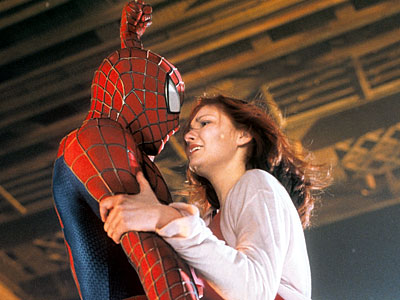
spider-man-11

What Batman created, Spider-Man recreated. Standing as radiant day to Tim Burton’s somber night, Sam Raimi’s equally powerful vision of the super hero radically broadened the scope of the genre.

Batman Begins

June 15, 2005
batman-begins-31

And then, of course, the dark night of Batman came roaring back with its own reinvention – this time with subtlety and intellectual heft. Chris Nolan embarks on the novel mission of making a Batman movie that’s all about Batman, and it works on every level.

The Dark Knight

July 18, 2008

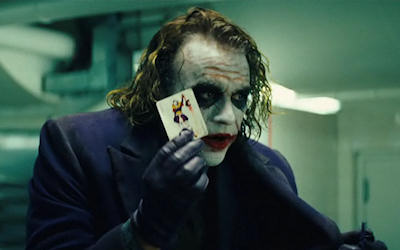
dark-knight-3

See here, here, here, here, here, and here. Nuff said.


Pass the Popcorn: City of the Dark Knight (Issue #5)

September 5, 2008

(Guest post by Greg Forster)

Okay, okay, okay, okay, okay.

I saw it for a third time last night and now I just have to post one more City of the Dark Knight before letting this movie go (as promised two weeks ago).

You may not be surprised to hear that after three viewings within three months, the “pencil trick” has lost all its magic (so to speak). As the Joker walks into the room, I’m sitting there thinking, “here comes the pencil trick.” And of course that sucks all the life out of it.

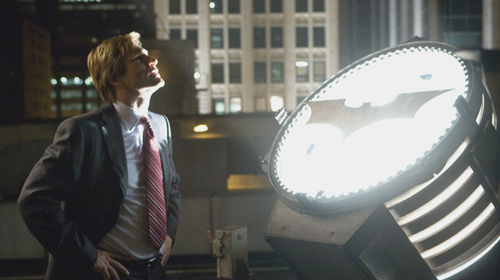
But much more important, every time I see this movie the story of Harvey Dent comes across more fully and more believably. Since Dent has been mostly in the background in my posts on this movie, today we’re going to be all Dent all the time.

Part of the reason the Dent story made less of an impression on me during the first viewing is just my own idiosyncratic way of experiencing movies. I generally don’t “look ahead” mentally while watching a movie. I know lots of people do that, and God bless them. Among regular moviegoers, those who look ahead are probably in the majority. One very dear friend of mine, who has worked in Hollywood full time for about twelve years now, looks ahead so diligently and is so intimately familiar with the conventions of the medium and the imperatives of storytelling that she claims no movie ending has ever surprised her – yet she also claims this has no impact on her enjoyment of movies. (And I guess the latter claim must be true, or she wouldn’t work in Hollywood.)

But that just isn’t how I’m built. It isn’t a conscious decision; I just don’t do it. I experience the movie as it comes. In some ways it’s better, in some it’s worse. Despite my friend’s testimony, I can’t help but think that plot twists and surprises must be much more enjoyable for me than for her. And I have a lot more patience for slow-paced movies like Heat, Unbreakable and Ghost Dog. I’m not sitting there thinking, “come on, come on, get on with it,” because I’m not looking at where we’re going, just at where we are. On the other hand, foreshadowing has to be pretty blatant before I’ll notice it. (One clever little movie, The Opposite of Sex, has the main character – a teenage girl – narrating the movie as it happens, on the pretense that she’s in control of what’s on the screen. In the first scene she’s packing up to run away from home, and she puts her father’s pistol in the backpack. Narration: “Oh, and this part where I take the gun? That’s like, duh, gonna be important later! My English teacher says that’s called foreshadowing.”) And if things happen early in a movie that turn out to have more significance later, I’m slower to catch up.

On second and subsequent viewing, however, you can’t help but look ahead. And when you do that, the Dent narrative comes across much better. The second time, when things happened like Dent saying “you either die a hero or you live long enough to see yourself become the villain,” I noticed them and said, “oh, I see what they’re doing here.” But it was still coming across all in bits and pieces. The third time was the charm – I saw the whole Dent narrative pull together. On the third viewing you’re bearing these things in mind from beginning to end – for example, one of the keys to the Dent narrative is that Dent knew all the time that Wertz and Ramierez – the cops in Gordon’s unit who got Rachel killed and him disfigured – were dirty. I don’t think I realized the full importance of that until the third viewing.

Obviously Chris Nolan was counting on you to look ahead. From the moment you hear the name “Harvey Dent,” you’re supposed to be thinking, “oh, he’s going to become evil.” And given the core audience for this movie, I’m sure that was a very sound decision. The movie is much more economical this way – sound economy being a precondition of artistic achievement.

It also helped that I now understand the Joker’s plan better. (Yes, in spite of his claims, he has a plan.) When he says to Dent “introduce a little anarchy” and hands him a gun, he’s not mainly inviting Dent to go out and kill Maroni – which is what I thought the first time. Obviously he does hope that Dent will go out and kill Maroni, which is why he plants the idea with Dent that killing Rachel was all Maroni’s idea. But what he mainly wants is for Dent to kill him, just as he previously wanted Batman to kill him. That makes the whole scene make a lot more sense.

The Joker tells Dent that the world is controlled by “schemers” who make “plans,” and that everybody organizes their lives around the “plans” even if the plans are horrible. Now let’s look at this from Dent’s persepective. All his career he’s been fighting to clean up Gotham. And what has been his primary obstacle? Not the bad guys, but the system. He has Maroni dead to rights, and Maroni walks. For that matter, years ago he had Wertz and Rameriez dead to rights on corruption and racketeering charges, and they walked, too. And then the system let Gordon set up his own little unit and put these dirty cops to work on Dent’s cases. And even after Gordon and Dent round up a whole city of full of bad guys by taking advantage of the broad racketeering laws, and Dent gets a judge to sign off on it, he still has to go to the mayor and beg for permission to prosecute the cases – over the vocal objections of the police commissioner (Gordon’s predecessor). Examples like this could be multiplied.

After a track record like that, is it any surprise that Dent, lying in that hospital bed, was receptive to the Joker’s message that the legal system’s “schemers” with their “plans” are not essentially different from the mafia’s “schemers” with their “plans”? That the real problem is the futility of trying to do things by “plans” at all?

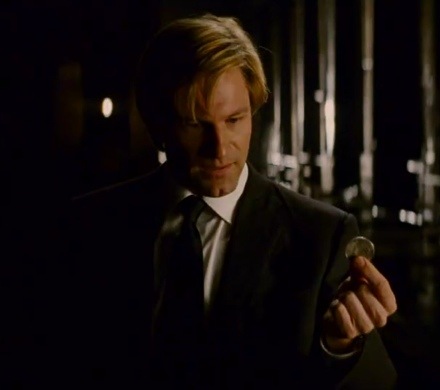
But – and here I’m sort of half expositing the movie and half speculating to fill in the blanks – Dent is not the Joker. Dent will not become simply an “agent of chaos.” He resents the system because it stands in the way of justice, and he’s still motivated by a desire to see justice done. So when he rejects the system, he doesn’t (at least from his perspective) simply set himself up as prosecutor, judge, jury, and executioner, because that’s not how justice works. Instead, he sets up a new “judge and jury” system of his own, one that will substitute for the real judges and juries who have proven so ineffective (their “plans” are “horrible,” as the Joker puts it). This leaves him to serve simply as prosecutor (he decides whose “cases” will come to the bar) and executioner. And the system he sets up – “chance,” as embodied in the coin toss – is “fair” not only in that it has no favorites but also in that it is not subject to all the other forms of human weakness and corruption. There will be no crazy, arbitrary rewriting of the rules by ideologically blinded judges or by self-serving, scheming politicians and police. How could there be, when chance by definition has no plans?

The temptation to set aside all civilized procedure in the pursuit of justice is a perennial one, inherent in the nature of a human race whose members are each good enough to desire justice yet evil enough not to be able to carry it out without the need for checks and balances. It is partly this temptation that makes Batman so popular in the first place, as this movie clearly understands. (“What gives you the right?” demands the Batman imitator. “What makes you different from me?” The crushing rejoinder “I’m not wearing hockey pants” is good for a laugh, yet the question remains.)

It’s a temptation that must be strictly avoided, because it never ends according to plan, as the Joker knows only too well – that, of course, is why the Joker starts Dent down this road in the first place, because he knows that Dent will end up an agent of injustice rather than of justice. He wanted to do the same with Batman. When Batman throws him from the building, he laughs with glee on the way down because he thinks he’s won. When Batman ropes him and hauls him back up, he says “you really are incorruptible, aren’t you?” That line is his admission of defeat, at least as far as Batman is concerned. But a moment later he drops the hammer: he admits defeat with respect to Batman, but (correctly) claims victory over Harvey Dent.

And in this game, the good guys have to win every time. The bad guys only have to win once.

Unless, of course, the good guys break the rules.


Modest Programs Produce Modest Results . . . Duh.

September 3, 2008

HT perfect stranger @ FR

By Greg Forster & Jay Greene
Edwize is touting a new “meta-analysis” by Cecilia Rouse and Lisa Barrow claiming that existing voucher programs produce only modest gains in student learning.

Edwize quotes the National Center for the Study of Privatization in Education (NCSPE), which sponsored the paper and is handling its media push, describing the paper as a “comprehensive review of all the evaluations done on education voucher schemes in the United States.”

But the paper itself says something different: “we present a summary of selected findings…” (emphasis added). Given EdWize’s recent accusations about cherry-picking research, which are repeated in his post on the Rouse/Barrow paper, we thought he’d be more sensitive to the difference between a comprehensive review of the reserach and a review that merely presents selected findings. (By contrast, the reviews we listed here are comprehensive.)

Even more important, the Rouse/Barrow paper provides no information on the criteria they used to decide which voucher experiments, and which analyses of those experiments, to include among the “selected findings” they present, and which to exclude from their review. The paper includes participant effect studies from Milwaukee, Cleveland, DC, and New York City, but does not include very similar studies conducted on programs in Dayton or Charlotte. In New York it includes analyses by Mayer, Howell and Peterson, as well as Krueger and Zhu, but not by Barnard, et al. The paper includes systemic effect analyses from Milwaukee and Florida, but excludes analyses by Howell and Peterson as well as by Greene and Winters.

Clearly this paper is not intended to be, and indeed it does not even profess to be, a comprehensive review.

But even with its odd and unexplained selection of studies to include and exclude, Rouse and Barrow’s paper nevertheless finds generally positive results. They identified 7 statistically significant positive participant effects and 4 significant negative participant effects (all of which come from one study: Belfield’s analysis of Cleveland, which is non-experimental and therefore lower in scientific quality than the studies finding positive results for vouchers). In total, 16 of the 26 point estimates they report for participant effects are positive.

On systemic effects, they report 15 significant positive effects and no significant negative effects. Of the 20 point estimates, 16 are positive.

And yet they conclude that the evidence “is at best mixed.” If this were research on therapies for curing cancer, the mostly positive and often significant findings they identified would never be described as “at best mixed.” We would say they were encouraging at the very least.

Moreover, the paper is not, and doesn’t claim to be, a “meta-analysis.” That term doesn’t even appear anywhere in the paper. It’s really just a research review, as the first sentence of the abstract clearly states (“In this article, we review the empirical evidence on…”). It looks like the term “meta-analysis,” like the phrase “comprehensive review,” was introduced by the NCSPE’s publicity materials.

What’s the difference? A meta-analysis performs an original analysis drawing together the data and/or findings of multiple previous studies, identified by a comprehensive review of the literature. The “conclusions” of a research review are just somebody’s opinion. Meta-analyses vary from simple (counting up the number of studies that find X and the number that find Y) to complex (using statistical methods to aggregate data or compare findings across studies). But what they all have in common is that they present new factual knowledge. A research review produces no new factual knowledge; it just states opinions.

There’s nothing wrong with researchers having opinions, as we have argued many times. It’s essential. But it’s even more essential to maintain a clear distinction between what is a fact and what is somebody’s opinion. Voucher opponents, as the saying goes, are entitled to their own opinions but not their own facts. (Judging by the way they conduct themselves, this may be news to some of them – for example, see Greg Anrig’s claims in the comment thread here.)

By falsely puffing this highly selective research review into a meta-analysis, NCSPE will decieve some people – especially journalists, who these days are often familiar with terms like “meta-analysis” and know what they mean, even if NCSPE doesn’t – into thinking that an original analysis has been performed and new factual knowledge is being contributed, when in fact this is just a repetition of the same statement of opinion that voucher opponents have been offering for years.

(We don’t blame Edwize for repeating NCSPE’s falsehood; there’s no shame in a layman not knowing the proper meaning of the technical terms used by scholars.)

And what about the merits of the opinion itself? The paper’s major claim, that the benefits of existing voucher programs are modest, is exactly what we have been saying for years. For example, in this study one of us wrote that “the benefits of school choice identified by these studies are sometimes moderate in size—not surprising, given that existing school choice programs are restricted to small numbers of students and limited to disadvantaged populations, hindering their ability to create a true marketplace that would produce dramatic innovation.”

And there’s the real rub. Existing programs are modest in size and scope. They are also modest in impact. Thank you, Captain Obvious.

The research review argues that because existing programs have a modest impact, we should be pessimistic about the potential of vouchers to improve education dramatically either for the students who use them or in public schools (although the review does acknowledge the extraordinary consensus in the empirical research showing that vouchers do improve public schools).

But why should we be pessimistic that a dramatic program would have a dramatic impact on grounds that modest programs have a modest impact?

One of us recently offered a “modest proposal” that we try some major pilot programs for the unions’ big-spending B.B. approach and for universal vouchers (as opposed to the modest voucher programs we have now), and see which one works. He wrote: “Better designed and better funded voucher programs could give us a much better look at vouchers’ full effects. Existing programs have vouchers that are worth significantly less than per pupil spending in public schools, have caps on enrollments, and at least partially immunize public schools from the financial effects of competition. If we see positive results from such limited voucher programs, what might happen if we could try broader, bolder ones and carefully studied the results?”

Has Edwize managed to respond to that proposal yet? If he has, we haven’t seen it. Come on – if you’re really as confident as you profess to be that your policies are backed up by the empirical research and ours are not, what are so you afraid of?

And while we’re calling him out, here’s another challenge: in the random-assignment research on vouchers, the point gains identified for vouchers over periods of four years or less are generally either the same size as or larger than the point gains identified over four years for reduced class sizes in the Tennessee STAR experiment. Will Edwize say what he thinks of the relative size of the benefits identified from existing voucher programs and class size reduction in the empirical research?


Pass the Popcorn: City of the Dark Knight (Issue #4)

August 22, 2008

(Guest post by Greg Forster)

After my two initial Pass the Popcorn entries on The Dark Knight, outlining what I thought was the main theme of the movie, I decided to let that go for a while rather than harp on it after I had already said my piece. But I always knew that after I had spent a while meandering around other topics, I would circle back around to the heart of the movie – the moral hypocrisy of all human beings and all civilization.

In the interim, the death of Aleksandr Solzhenitsyn has provided a reminder of just how perennially true and relevant the movie’s observations are. If any man of our time was ever entitled to treat his enemies as simply evil and his own side as simply good, surely that man was Solzhenitsyn. But, to the contrary, he made a point of not losing sight of the real basis of evil in the moral corruption that is endemic to our species, and that is one of the reasons his intellectual legacy will live on well beyond the context of the particular historical conflict in which he participated. To say it again, if any man was entitled to treat some people as “basically good” and other people as “basically bad,” he was – but the whole point is that no man is in fact entitled to do so.

Solzhenitsyn expressed the key insight succinctly yet beautifully:

“The line between good and evil passes not through states, nor between classes, nor between political parties either – but right through every human heart.”


I anticipate (without ruling anything out) that this will be my last PTP entry on The Dark Knight, at least for a good while. I’d like to end where the movie ended.

To recap the central point of my first post quickly: All human beings are both good and evil, but it isn’t in their nature to admit this about themselves; hence the ubiquitous fiction that “people are basically good.” People tell themselves this ultimately because it allows them to avert their gaze from their own corruption. The outcome of this is the outrageous extreme of moral hypocrisy that is easily observable (provided we’re willing to look without flinching) both in every individual person (no exceptions) and in society as a whole. In this movie, we see it play out on the individual level with the Joker’s desire to induce Batman to kill him, and at the social level with the fact that the whole restoration of Gotham City rests on the reputation of Harvey Dent – because people need heroes. Why do people need heroes? Because they’re not “basically good.” If people were basically good they wouldn’t make their support for civic justice conditional on the moral purity of some fallen human being. The very fact that people need to be rallied to support justice shows how far from real righteousness they are.

The Joker has our number:

“When the chips are down, these . . . these ‘civilized people’ . . . they’ll eat each other.”

So did Harvey Dent, in his way:

“You either die a hero or you live long enough to see yourself become the villain.”

One thing I didn’t comment on earlier is what Gordon says at Dent’s funeral. I noticed it especially the second time I saw the movie. If memory serves, Gordon says of Dent that “he was the hero we deserved – no more.” No more? Shouldn’t that be no less? Or is Gordon slyly reaching out to the few people in Gotham who know the truth, reassuring them that at least somebody realizes what’s really going on – that Dent was the hero Gotham deserved in the sense that Gotham deserved a man who really, really wanted to be good but ultimately failed to live up to his own standards, because that’s exactly how Gotham itself behaved?

As I wrote before, one of this movie’s biggest strengths is that it doesn’t attempt to convince us that it’s a good thing that people need hypocrisy. It’s a bad thing – it’s a sign of how evil we are – that people need hypocrisy.

But since people do in fact need it, it may not be wrong to supply it.

That last assertion is the thought the movie ends on, and it’s where I stopped my first post, saying “hold that thought.” Well, I’ve been holding that thought for a month and a half now. It’s time to unpack it.

Is it wrong to supply hypocrisy? We might answer by saying that if it is, we’re all totally screwed. On the evidence, it appears that no civil order of any kind can long survive without falling back on collossal heaps of hypocrisy.

I’m not even talking about the kind of rank everyday hypocrisy that hits you in the face every time you pick up a newspaper. Although there’s always plenty of that – obviously. Take the frenzy over the past month against “speculators” who have, according to both presidential candidates and most of our other leaders, driven up the price of gas. It’s an old social science maxim that you should never posit malice if ignorance covers the facts, but can John McCain and Barack Obama and all the rest of them really be as ignorant as all that? As Chrales Krauthammer wrote recently: “Congressional Democrats demand . . . a clampdown on ‘speculators.’ The Democrats proposed this a month ago. In the meantime, ‘speculators’ have driven the price down by $25 a barrel. Still want to stop them? In what universe do traders only bet on the price going up?”

It beggars belief that our leaders don’t know exactly what they’re shoveling here. And this is just one issue out of hundreds where the same dynamic occurs. Is there a single political issue where the public discourse isn’t dominated by claims that can’t possibly be believed by those who make them? Not for nothing did Michael Kinsley define a “gaffe” as when a politician accidentally tells the truth. But Mickey Kaus strikes nearer to the mark when he says that Kinsley’s definition ought to be expanded to include all cases where a politician accidentally says what he really thinks, whether true or not.

But that kind of hypocrisy doesn’t go to the roots of social order. Although its omnipresence would be sufficient to prove the universality of some type of corruption in human nature, from a standpoint of the political system it’s an epiphenomenon.

The real hypocrisy runs deeper. It was well captured a while back by an old college acquaintence of mine who subsequently served for a while as a small-town prosecutor. Please read this brutally honest essay in which he reflects, after having left the job, on the nature of his service representing the people in our courts:

We who deal in the laws of a free people are puppeteers. We must be so . . . because our system works better than any other, and because we have no choice but to make it work. We have to give the appearance that we possess the wisdom and authority needed to make our society function. We have to make believe that our culture possesses an exclamation point as strong and as firm as the question mark of [classical] liberalism. So on with the courtroom pomp and ceremony, on with the bluster and posturing! . . .

Men who doubt themselves need puppet shows. They need little passion plays to affirm the dignity of a frequently silly and corrupt form of governance, lest something more dignified but less humane rise to power. Ours is a system of laws administered by flawed and small-souled lawyers to foolish and wicked men; such a system cannot survive without the pantomimes of solemnity.

And note that he has (as far as I can tell) no regrets about having chosen to serve in this capacity. As he says, our system is better than the alternatives (i.e. “something more dignified but less humane”) and given the realities of fallen human psychology this is what it takes to sustain it.

It was with this in mind that I chose the title “City of the Dark Knight” for my mini-series on this movie. The title is meant as a tribute (an obscure one, no doubt) to Augustine, whose political theory I was reminded of by The Dark Knight’s unflinching meditation on society’s hypocrisy. Augustine works so hard to puncture the Romans’ ridiculous charade of virtue and honor not because he hates them – he loves Rome dearly – but because penetrating the mask of society’s pretense of righteousness is for him (as it was for Plato) the first step to any serious wisdom about justice. The fundamental political reality is that people are neither “basically good” or “basically bad.” We tend to associate the observation that if people were “basically good” there would be no government with Madison’s Federalist #10, but I think (though I’m open to argument) that Augustine is the real source of the insight. And there would equally be no government if people were “basically bad,” since people with no natural idea of justice would never develop a system for enforcing justice (however intellectually impressive Hobbes’s attempt to argue the contrary may be). Though Augustine doesn’t put it in exactly these words (or not that I recall), I think we can say that for him politics is a manifestation of the ongoing tension between the image of God that was planted in all men at creation and the moral corruption that was planted in all men at the fall.

And this, if I may be autobiographical for a moment, is why I fled screaming from Washington after spending a year between college and grad school working there. When people with little experience of academia hear that I have a Ph.D. in political science, about 50% of the time they immediately ask me “so are you going to run for president?” Set aside for a moment the charming naivete that associates the pursuit of a Ph.D. in political science with ambition to public service. More to the point is the fact that I could never serve in public office because I couldn’t practice the hypocrisy that all public servants, seemingly without exception, must practice on a regular basis to do their jobs.

Yet though I am not the man to do it, I can see clearly the necessity of maintaining the hypocrisy. Classically, “prudence” was identified as one of the four cardinal virtues. We have a moral responsibility to consider the outcomes of our choices and act so that we aim for those outcomes to conform to the proper ordering of ends (i.e. goals or purposes). Can it really be our responsibility to rank candor above the preservation of humanity? For a long time I was spellbound by Kant’s iron declaration “let justice be done though the heavens fall.” It would be a worthy resolution if “justice” meant simply “goodness” or “righteousness,” that is, virtue as such – including prudence. But “justice” is not virtue as such, it is only one of the virtues. And as Aristotle observed, only virtue as such can be pursued without limit. You can’t go “too far” in the right direction. But any partial good, as opposed to good as such, can be pursued too far – that is, to the exclusion of other partial goods that ought not to be excluded. Hence Kant was actually driven to the insane extreme of preferring the destruction of the universe to the utterance of a single false statement.

The healthy conscience recoils from Kant’s famous statement that if a man intending to murder your friend asks whether your friend is home, and he is, you should tell the truth. (For a while I wondered whether this claim was misunderstood – in the 18th century, gentlemen were usually armed, so when Kant said that you shouldn’t compromise your honor by lying, was he assuming that you would just shoot the guy instead? But when I shared this speculation with a friend, he pointed out that while gentlemen in 18th century England were usually armed, that wouldn’t have been the case in 18th century Prussia.)

And Kant’s dilemma of whether to lie to the murderer is, ultimately, the choice Batman and Gordon must make at the end of the movie. The “murderer” in this scenario is Gotham City itself – which threatens to give up on its own salvation unless it is told the lie that Batman and Gordon choose to tell it.

With that, I’ve said my piece. (Again.) Next week, on to other movies.

UPDATE: Well, I hadn’t quite said my whole piece. See here for the next chapter.


Pass the Popcorn: City of the Dark Knight (Issue #3)

August 8, 2008

(Guest post by Greg Forster)

We’re now on our fourth issue of the series and we haven’t said anything yet about Heath Ledger. That was intentional, for three reasons.

First and most important, there’s not much interesting to say, or at least not that I can say. It’s obviously a virtuoso performance, and would have been a career-making breakthrough. Ledger was clearly one of the most talented performers of his generation, and it’s a shame he never reached his potential until the end of his abbreviated career.

Beyond that, what’s to say? If I were in the acting business, I could no doubt analyze the performance and say more about what makes it great. But I lack even the rudamentary ability to do so, and I’m not interested in bluffing.

Second, too much of the chatter about Ledger and this performance is shallow and feels exploitative of his death, and I don’t want to contribute to that.

And third, I think Ledger’s masterpiece contribution is overshadowing other contributions. I don’t want to take away any of the honor Ledger has justly earned, but for this movie to be what it is, a whole lot of people had to turn in top-flight performances.

Back in Issue 1, commenter Captain Napalm mentioned Aaron Eckhart and Gary Oldman – both of whom were indeed outstanding. I’ve just praised Morgan Freeman in Issue 2, and Michael Caine’s contribution shouldn’t be overlooked – one of the most important differences between a good film and a great one is that all the little things are done right, as well as the big ones. Caine and Freeman didn’t get the big drama, but they delivered fantastic little gems – “We burned down the forest” is one of the most memorable moments in the movie. So is “You have no idea.”

Everyone – by which I mean the handful of movie geeks whom I personally know – seems to agree that Christian Bale had essentially nothing to do in this movie. The first movie was about Batman, not the villains, so the villains were (as I mentioned last time) unmemorable. This movie was about the Joker, so Batman was unmemorable. But serving as the Joker’s foil is something. The Joker carries the movie, but he can’t do that if Christian Bale doesn’t act well his part, wherein all honor lies. Imagine this movie with Ledger playing opposite George Clooney – or even Michael Keaton, who I thought did surprisingly well as Tim Burton’s Batman, but would have been totally inappropriate as Chris Nolan’s. (And let’s also acknowledge that “I’m not wearing hockey pants” was well delivered.)

And naturally we should be crediting Chris Nolan. Having done a little amateur acting, I know how much a director contributes to an actor’s performance – or doesn’t. When any six actors, even six really good ones, all deliver a top-notch ensemble performance, it’s as much the director’s work as theirs.

Above all, though, we should be thanking the writers. Think about every scene you remember of Ledger. Isn’t it the brilliant lines as much as the brilliant performance that make this movie so amazing? “When you think about it, I knew your friends better than you did. Would you like to know which of them were cowards?” That’s really brave writing. And of course, all those clever one-liners we’ve been taking notice of in this and previous issues had to come out of somebody’s keyboard before they could come out of Morgan Freeman, Michael Caine, etc.

You do know who wrote the movie, don’t you?

Chris Nolan shares the screenplay credit with his brother Jonathan Nolan, and shares the story credit with David Goyer. The Nolan brothers also co-wrote Memento and The Prestige (which came out between Batmans). Goyer has a long track record on comic book movies that includes Blade and co-writing Batman Begins with Chris Nolan, as well as sole story credit on Batman Begins. And of course Frank Miller should get a nod for his influence.

All that said, Ledger did pull off an amazing feat. In addition to what’s on the screen, consider how much prior baggage he had to overcome with the Joker character:

First Appearance!

The Clown Prince of Crime

The Ultimate Psychopath: “Whatever’s in him rattles as it leaves.”

The Outer Edge of Insanity

(Wrong “Joker,” moron!)

A lot of people thought no one could play the Joker after Nicholson, particularly not the star of A Knight’s Tale. Nicholson himself, for one. He said as much, as The Dark Knight was approaching release. I wonder if he repented after he saw the performance.


Pass the Popcorn: City of the Dark Knight (Issue #2)

August 3, 2008


(Guest post by Greg Forster)

Okay, and now for something completely different! Today we’re going to talk about Bat Gear.

What was the one thing in The Dark Knight that just didn’t work? So far, everyone I’ve talked to has the same answer, even if you don’t ask them the question – it’s the citywide “sonar.” Lame.

The first time through, it was really obtrusive – for a few minutes. One of the greatest innovations in storytelling in the last ten years is that movie and TV people have learned the value of throwing a lot of story at you and trusting you to keep up; among many other virtues, this means badly done moments in the narrative get left behind more quickly.

The second time through, I didn’t really mind. That was partly because dumb plot elements are always less obtrusive the second time around, because you aren’t being hit with the shock of recognizing their stupidity. This, for example, is why it is possible to watch the Lord of the Rings movies repeatedly without their being spoiled by a bunch of friggin’ elves marching into Helm’s Deep, or the army of the dead effortlessly wiping out the beseiging force at Minas Tirith (which means all those Rohirrim who gave their lives on the Pelannor died for nothing).

But it was also partly because the second time I saw how it was supposed to fit into the movie. Somehow, the first time through, I totally missed the “like a submarine” gag. You remember, when Lucius comes out of the evil corporation’s building in Hong Kong and shows Bruce the sonar readout:

“Sonar? Just like a . . .”

“Like a submarine, Mr. Wayne – just like a submarine.”

It just flew by and I missed it completely. (How am I supposed to catch all these little things when they throw so much at you and expect you to keep up with it all?)

Obviously they were thinking that we would buy the “sonar” because sonar fits with the bat theme. And it’s not a crazy theory. When a plot element fits the theme of the movie, artistic liberties with reality are much less obtrusive (a subject I’ve had occasion to discuss at greater length before).

But it didn’t work. And that got me thinking about the gadgets in this movie. F’rinstance, does the Bat Cycle (apparently to make it seem less fruity they’re telling us to call it a Bat Pod) belong in this movie? I mean, honestly – doesn’t it just look like the suits in the marketing department demanded that they throw in something new that would sell toys? After all, the twelve year old boys of America – who should never be permitted to see this movie under any circumstances whatsoever – are not going to shell out for another Batmobile unless it’s different from the last one.

He’s prob’ly fighting for freedom! Buy all our playsets and toys!

And the skyscraper-assault gadgets (in the Hong Kong scene and again in the assault on Fortress Joker) feel artificial, too.

But that’s not what you’d expect, is it? Gadgets belong in a Batman movie. They’re an integral part of the franchise – even more so than in the James Bond franchise.

Consider the first Batman movie – well, okay, not absolutely the first, but the first one that counts. The Tim Burton one. (The Tim Burton one that counts.) That movie doesn’t get its propers anymore, in large part because we now take for granted so much of what Burton did to define the modern comic book movie. Much of what was radical in Burton’s Batman is now so expected that it’s not even noticed.

It was a much more uneven movie than Nolan’s Batmans are – parts just didn’t work, but parts worked brilliantly. And that movie was just brimming with gadgets. The Batmobile actually did stuff – and no, going really fast and changing the driver position from Standard Seated Position to Lying Down for No Reason Position doesn’t count as doing something. Yes, okay, in the first Nolan movie the Batmobile jumped rooftops. But Burton’s Batmobile did so much more. And Batman himself used gadgets more often and it felt more natural. One of those brilliant moments that really worked was when Batman swooped in, foiled one of the Joker’s plans, and swooped out on one of his flying wires (or something) and the Joker was just so impressed that he didn’t even think about how badly he’d been beaten – he just stood there and asked: “Where does he get those marvellous toys?”

Or consider what must be the best gag ever done in a comic – from the Batman/Planetary crossover.

(If you don’t know what Planetary is . . . well, how are you even alive?)

Anyway, the Planetary crew are in Gotham chasing a man whose mind keeps opening dimensional rifts, and of course they run into Batman, who of course is chasing the same guy. But every time the guy opens a dimensional rift, they shift to an alternate reality where Batman is slightly different:


HT Planetary. How many can you identify? How many will you admit you can identify? (No fair peeking at the URLs!)

Here’s the gadget gag: Jakita Wagner, a superpowered female hero, is about to throw down with one of the badass Batmans. Then a rift opens and suddenly it’s not a badass Batman, it’s the Adam West Batman from the supercamp sixties TV show. And . . . he would never hit a girl!

So when she rushes him, he avoids compromising his honor by whipping a spray can out of his utility belt and dousing her in the face. (I always suspected the Adam West Batman was really a sucker-punching bastard.) She falls back, clutching her eyes, and Batman drops the can and springs away to chase after the rift-opening guy. As she curses him, we see the can roll into the frame.

The label on the can reads: Bat Female Villain Repellent.

I swear I Googled for probably half an hour looking for that panel, so I could share it with you. I guess you’ll have to buy the crossover instead.

But back to our subject. Gadgets not only belong in Batman, they ought to belong in Chris Nolan’s Batman. After all, this is the first movie version to include Batman’s “Q”, and he’s used to outstanding effect in both movies. What are the most memorable moments in the first movie? Liam Neeson blathering on about destroying Gotham? Dr. Crane attacking people with his fear drug? No, that movie had some of the least interesting villains ever to appear in a comic book movie. (Not a criticism – that movie was about Batman, not about them.) What you remember is: “Oh, the tumbler? You wouldn’t be interested in that.” And: “Just don’t think of me as an idiot.”

And Chris Nolan clearly knows how to get the best out of Morgan Freeman, because he’s used just as well in the new one. That “your plan is to blackmail this person?” speech is priceless.

Come to think of it, in the first movie Batman used a “bat caller” gadget to produce a swarm of bats where he needed it. It was ridiculous, of course – but it fit the theme of the movie, especially in that it was trying to explain why Bruce Wayne chose to dress up like a bat when fighting crime. Being attacked by a swarm of bats would tend to put the fear in you.

So why didn’t the gadets work in this one? The first thought to occur to me was that they were trying to force the citywide sonar to perform an awkward plot function – they wanted to abruptly set up a little mini-debate between Batman and Lucius on the whether it’s OK to spy on the whole city. But frankly, I don’t really think that’s it. I think citywide sonar would have failed even without that scene. (Speaking of which, when I first saw it, I thought that Lucius’s position was “This is wrong, but I’ll do it just this once,” which of course is a contemptable position. But that’s not what he says, as I discovered upon seeing the scene a second time. I think his position is really “This is OK as a one-time deal, but it would be wrong to use it on an ongoing basis.” I’m inclined to think that if it’s OK as a one-time deal, it’s hard to justify throwing it away, especially in a city that seems to attract supervillains like a magnet – but it’s not a contemptable position.)

Maybe – and I’m not sure about this – maybe it’s just that they obviously could have accomplished the same thing with less tampering with reality. Batman could have simply set up a computer to scan all phones for the Joker’s voice. And they could still have worked in the bat/sonar theme by equipping the Batsuit with its own sonar, which he could then have used in the Assault on Fortress Joker scene.

Like I said, I’m not sure. Theories?

(Oh, and I’m still hoping somebody can help me with the tally on Dent’s body count. I’m one cop short.)


Pass the Popcorn: City of the Dark Knight (Issue #1)

July 28, 2008

(Guest post by Greg Forster)

Well, it’s not as good the second time you see it. It’s better!

See here for the premiere installment of the PTP: City of the Dark Knight series. Oh, and: Spoiler alert (duh).

This time I caught a lot more of the “moral hypocrisy” theme being set up earlier in the movie. It’s not as clear when you don’t know yet how significant it’s going to be later. But they’re clearly telegraphing that the restoration of moral order in Gotham is requiring some compromises of the rules – for example, this flew by me the first time, but Dent brings that mass prosecution of criminals knowing full well that he can’t make most of the charges stick. He argues to the mayor that they should go forward with prosecution anyway, because most of the bad guys won’t be able to make bail (Batman, Gordon and Dent having taken away most of their money) and thus will have to sit in the slammer while the cases grind through the system. “Think what you could do with eighteen months of clean streets,” Dent tells the mayor. Wrong? Not necessarily. Politics is the art of the possible. But it’s bending the spirit of the law.

Also, notice that Gordon tells his people to lie to the media about Dent’s disappearance. I did notice this the first time, and I thought about it for all of five seconds or so, and then I had to keep up with the movie. The second time, it stands out more as part of the hypocrisy theme.

Perhaps the most important thing I caught this time around is why Dent blames Gordon and Batman for what happens to Rachel. It’s because Gordon built his Major Crimes Unit by including officers who were under a cloud of suspicion. This is another “moral compromise” narrative. Confronted about it at the beginning of the movie, Gordon first insinuates that when Dent was at Internal Affairs he had been bringing bogus corruption cases against clean cops in order to build his career. (At first I thought this might be a signal from Chris Nolan that the movie is right-wing, because prosecuting innocent people to build a career was always the right’s complaint about Eliot Spitzer. But then I remembered that Rudy Giuliani did the same thing.) However, Gordon seems to concede pretty quickly that his MCU does contain some shady characters. He says something like, “I have to do the best with what I have to work with.”

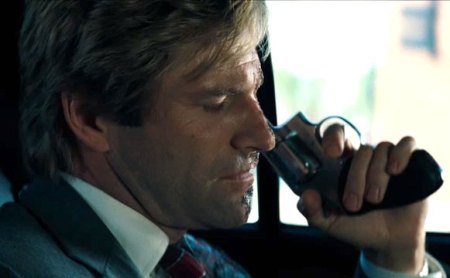
I also caught that they’re telegraphing from early on that Dent is not all he appears to be, morally speaking. The first time I saw the movie I wanted them to do more to establish Dent’s fall – he seems to go over to the dark side pretty quickly. But now I see that he was never really that good to begin with. That, plus it occurred to me that the “Two Face” Dent is still fighting for justice in his twisted way. He’s hunting down the people he blames for Rachel, subjecting each of them one by one to the judgment of the coin.

And now for something completely different: I noticed this time that the guy on the prisoners’ boat who throws the detonator out the window has a damaged right eye (his right, our left). I got really excited by this. I thought, where else in this movie did we see a black criminal have somthing happen to his eye? That’s right: “I’m going to make this pencil disappear!” So I thought: the Joker’s goal is to corrupt everybody. But what if one of his victims found himself forced to reexamine his life while sitting in the prison hospital, and he became good because of the Joker’s actions – and that same person’s goodness was the reason the Joker’s ferry experiment failed? Layers within layers within layers!

But, alas, I was barking up the wrong tree. Somebody has posted the pencil scene on YouTube, and it’s clearly not the same actor. Oh, well.

One more thing: I found an easy way to remember the mobster’s name, the one I couldn’t remember in my previous post. It’s Moroni – the same name as the angel who allegedly revealed the Book of Mormon to Joseph Smith. How’d that happen? Was the entire Warner Brothers marketing department asleep?

Let me close with a bleg: At the end, Gordon says that Dent’s rampage produced “five people dead, two of them cops.” I count Moroni’s driver, Moroni himself (assuming he died in the car crash), the first of the two crooked cops, and Dent himself. But the other cop won the toss and just got knocked unconscious. So that’s four people, one of them a cop. Whom am I missing? Are we supposed to assume Dent found a way to finish off the second cop despite the toss, just like he found a way with Moroni (assuming that’s what happened)? Is this a goof? Or what?


Pass the Popcorn: City of The Dark Knight (Issue #0)

July 25, 2008

New PTP Mini-Series, Issue #0 – Rare Collector’s Item!

Have you been regressing endogenous variables again?

(Guest post by Greg Forster)

It’s too much.

I mean, too much for one blog post. Last Friday I lightheartedly left a comment on Matt’s PTP entry promising to have my Batman post up by Monday. Surely, I thought, I’d be so juiced after the movie that I’d run straight back to my computer and blog until my fingers bled.

But no, this was a very dense movie. Chris Nolan is ambitious, and the movie vindicates his ambition triumphantly. After the movie, I was unable to talk much about it – because there was too much to digest. And by the time I was ready, I had already forgotten half the thoughts I’d had during and right after the movie. Clearly this is a work that’s going to repay a lot of repeat viewing – a hypothesis I intend to test vigorously, hopefully with plenty of checks for the robustness of the finding (e.g. does the movie repay repeat viewing if the repeat views are in a drive-in? In IMAX? With co-workers? In the afternoon? Does it make a difference if I order a soda with my popcorn? How about what kind of soda I order? I’d better try watching it once with each kind, just to be sure).

At this point I just know that any blogging I do is going to be no more than a pale shadow of what I really thought and felt during the movie. So, to assuage my conscience (and save myself from spending all day working on this post, fretting about what I’m forgetting to include) I’m hereby inagurating a special Pass the Popcorn Mini-Series. I’m posting some of my thoughts now, in anticipation of revisiting the subject later. (Don’t worry, not too often. But we are going to have to find something to write about on Fridays after the summer movie season dies down, and this will help fill the gap.)

Oh, before I forget:

(HT xkcd)

There are already some haters out there, like John Podhoretz in the Weekly Standard, who are offended – nay, outraged – that a comic book movie is getting the kind of praise The Dark Knight is getting. Well, OK, it ain’t Shakespeare, but that’s apples and oranges. Let’s take a similar example – say, a mob movie. Podhoretz never misses an opportunity to share his opinion that The Godfather is the best movie ever made. And I agree that The Godfather deserves to be taken seriously as a great work of art. But it is a mob movie. If The Godfather can be great, why not this?

Unforgivably, Podhoretz works out his anger by spoiling as much of the moive as he can get away with. So don’t read it until after you’ve seen the movie. (Reading the spoilers in this blog entry is of course an entirely different matter.)

It’s readily apparent from Podhoretz’s review what’s really eating him: he loves the old, wild and carefree tradition of superheroes from the Silver Age, recently resurrected so dazzlingly in Iron Man. That tradition got killed off in the 1980s, in large part due to Frank Miller’s amazing work in reinventing Batman, and Podhoretz resents that this type of superhero has crowded his preferences out of the market.

(As an aside, Frank Miller looks to have come way down in the world, artistically speaking; to judge by the preview they ran in front of Dark Knight, Miller’s newest project is to take Will Eisner’s treasure The Spirit and turn it into a porno movie. But all will be forgiven if Holy Terror, Batman! ever actually sees the light of day.)

I sympathize with Podhoretz. One of the best comics ever drawn is Scott McCloud’s ZOT!, which came out when the Dark and Serious school was at its height, as an attempt to rescucitate the wild and carefree hero. (According to McCloud’s introduction, it was especially a reaction against the literally murderous nihilism of Watchmen, which, alas, now looks like it’s finally going to get the movie they’ve been threatening to make of it for decades. Yes, there was a lot of real storytelling genius in Watchmen. That’s what makes it so horrible – to see such genius used to glorify cynicism and murder.)

But while most of the Dark and Serious stuff was crud, let’s face it, most of the Wild and Carefree stuff that preceded it was also crud. ZOT! and the new Iron Man are jewels, but jewels in the rough. So was Miller’s original Dark Knight Returns, and so is the new Dark Knight.

And then there’s the politics. There’s a handy precis of the issues, with links, here if you’re interested. My take: The Dark Knight probably isn’t directly about the war on terror. It’s about things that are universal. (Ever since Frank Miller’s Dark Knight Returns, Batman has periodically been used to explore these issues – meaning we don’t need to bring in the war on terror to explain why these issues are present in a Batman movie.) But of course if these things are universal then they’re as present in the war on terror as everywhere else, so the application of the movie’s subject matter to the war on terror in the viewer’s mind is perfectly valid. 

Having unburdened myself of these reactions to the reactions to the movie, do I have time left today to say anything about the actual movie? Just briefly.

Warning: Believe with Caution

The Dark Knight seems to be primarily about moral hypocrisy. People are not “basically good.” All human beings are both good and evil. However, it’s not in our nature to admit this about ourselves; we have to pretend that we’re good. And the same hypocrisy manifests at the social level – society, being made up of human beings, is not “basically good” but is both good and evil. However, in order to keep from becoming aware of our own evil, lest we should have to admit the truth about ourselves, we also have to sheild ourselves from other people’s evil. If we admitted that everyone else was not “basically good,” it would be really hard to avoid raising the question about ourselves. And so we have to pretend that everybody is “basically good.”

The Joker is out to expose our hypocrisy. His ultimate goal isn’t to kill, it’s to corrupt. He would say that he isn’t out to corrupt us, but to make us admit to the corruption that’s already there in our hearts. But to “admit” to the courrption in the Joker’s sense is really to surrender to it – to become “corrupt” on a whole different level.

This, incidentally, is why it was such a good decision to give the Joker no backstory (and not just by omission but by the Joker’s deliberate obfuscation about his own past). As Chris Nolan has said (I’m paraphrasing), this Joker isn’t a person, he’s a primal force. My hypothesis: the reason this Joker has to be a primal force and not a person is because he has to stand outside of our hypocrisy. The Joker’s place in the narrative requires him to be, not both good and bad, but all bad. And while the Joker is right that all people are bad, it’s also true that all people are good – therefore the Joker, being all bad, can’t be a person.

On the individual level, the Joker’s mission is manifested in the “one rule” dynamic between Batman and the Joker. As all real Batman fans know, Batman’s one rule is that he doesn’t kill people. The Joker’s goal for the Batman is to induce him to break his one rule – thereby proving that his rule is really a construction of self-righteous hypocrisy.

Here the influence of Miller’s Dark Knight Returns is obvious, although Miller’s Joker is primarily motivated by a desire for mass murder and cares about Batman’s one rule only secondarily:

Late Nite Talk Show Host “Dave”: You’re said to have only killed about six hundred people, Joker. Now don’t take this the wrong way, but I think you’ve been holding out on us.

Pansy Liberal Psychologist: This is a sensitive human being here, Dave. I won’t let you harrass-

Joker: I don’t keep count . . . I’m going to kill everyone in this room.

Dave: Now that’s darn rude.

At the social level, the Joker is out to stop Gotham City’s resurgent belief in justice, embodied (in different ways) by Batman and Harvey Dent. I wish there had been an opportunity to establish more tangibly the positive impact that Dent’s mob cleanup was having on the city; it would have made us feel more urgently the real stakes that the Joker was playing for.

What the heck is this guy’s name again? They said it, like, five times in the movie. You would think I’d remember.

And that leads to the big twist at the end – maybe the best twist I’ve ever seen in a movie: the good guys have to defend hypocrisy. Of course it would be great if society could admit the truth about its own corruption and still strive to uphold justice anyway. But fallen human nature doesn’t work that way.

All my life, I’ve hated those cheesy TV shows where they decide to cover something up because “people need heroes.” Even the Simpsons, when they set out to parody this, couldn’t quite bring themselves to pull the trigger. It’s not done as a parody when Lisa decides not to reveal that Jebediah Springfield was actually a notorious pirate; they play it straight.

But The Dark Knight makes it work. People really do need their heroes, and their heroes really are fallen people. Ergo, people really do need hypocrisy. The reason I buy this in The Dark Knight when I’ve rejected it in all previous incarnations is because The Dark Knight doesn’t try to make it out to be a good thing. It’s wrong that people need hypocrisy – that people need to have heroes before they’ll agree to uphold justice and do good and so forth. It’s ugly and stupid and evil. As Dr. Surridge says in the original V for Vendetta comic (not the dreadful movie version), “There’s something wrong with us.”

Yes, it’s wrong that people need hypocrisy – but since they do need it, it’s not necessarily wrong to supply it.

Hold that thought. More to come. Stay tuned!


Pass the Popcorn: Pixar as Art and Commerce

June 27, 2008

(Guest post by Greg Forster)

With Wall-E conquoring the movie universe today, how could we do anything else for this week’s Pass the Popcorn but a retrospective on Pixar?

Yet how much is there left to say, really? A retrospective of Pixar along the lines of the previous retrospectives I’ve done here would read like this: they made a really amazing movie, then they made another one, then they made another one . . .

I could tell you all about how great Toy Story and Finding Nemo are. But you already know. So I’ll skip the movie-by-movie retrospective and just look around for things to say about Pixar that everybody doesn’t already know.

“Hey, Marlin! Didja know Pixar made a whole bunch of really great movies?”

“Yes, Dory, I knew.”

“Oh. Okay, then. . . . Hey, Marlin! Didja know Pixar made a whole bunch of really great movies?”

If I shared the view that Pixar’s more recent offerings (Cars, Ratatouille) represent a step down from its earlier accomplishments, I might write my third consecutive retrospective of a great filmmaker who succeeds both artistically and commercially, then lets fame go to his head and produces substandard work. However, I don’t think Pixar’s quality has declined. Yes, Cars is not Toy Story. But you know what? A Bug’s Life ain’t Toy Story either. Between the two, I’m not sure which I’d take – they’re both quite good for what they are, definitely well above the average “family movie” (not that that’s saying much), but they’re not great filmmaking. Same goes for Monsters Inc.

Believe it or not, this was a Pixar movie. Remember?

And I don’t care what anybody else thinks, I think Ratatouille is a very impressive accomplishment. It not only has sharp dialogue (consider, for example, the duel of wits between Linguini and Anton Ego in the press conference scene) and great humor (in its context, the moment where Ego is transported back to childhood by his first bite of Remy’s ratatouille is every bit as funny as the “I am your father” line in Toy Story 2), but also philosophical depth (the whole movie is basically Plato’s Ion in cartoon form, with cooking as a proxy for art and creativity generally – as Ego’s climactic monologue makes clear).

“Not by craft does the poet sing, but by power divine.”

So Pixar movies have always ranged from good family movies (A Bug’s Life, Monsters Inc., Cars) to exceptionally good family movies (The Incredibles, Ratatouille) to landmark artistic achievements (Toy Story, Toy Story 2, Finding Nemo).

But other things about Pixar have changed over time. It’s hard to remember this now, but there was a time when the name “Pixar” primarily meant “digital animation.” Of course everyone acknowledged that Toy Story was also a great story, and would have been noteworthy even without the technological breakthrough. But it was the digital filmmaking technology everybody really noticed when Toy Story hit the theaters.

Once upon a time, this wasn’t the adventures of good old Woody and Buzz. It was a revolutionary breakthrough in digital filmmaking that was going to change the role of technology in movies – which happened to come in the form of a story about a bunch of toys.

Of course, today nobody cares about Pixar as a technological innovator – and that fact is as great a testament as anything to its accomplishments as a producer of art. “Pixar” now just means “great movies.”

Pixar as fine art (at MOMA; HT www.rationalistic.com)

And, technology aside, Pixar’s accomplishments are breathtaking not only as art but also as commerce – in fact, I think what’s really most noteworthy about Pixar is that it appears to have developed a working business model for consistently producing good-to-great movies.

The idea of a business model for producing good art will strike some as misguided or even offensive, but it is really nothing more than the reappearance of what was the normal mode of producing art in almost all times and places. All great art before the advent of Rousseau’s philosophy – from Aeschylus and Euripides to Dante and Hieronymus Bosch to Shakespeare and Rembrandt – was produced in the context of a economic system designed to systematize financial support for artists (in the form of community festivals, household patronage, guilds, etc.) who were in turn expected to produce good work in response to something approximating market demand. The supposed antinomy between art and commerce is a prejudice of our own time. As C.S. Lewis once remarked, before the Romantic movement with its idolization of the artist and the creative process, the idea that artists should not be expected to produce good work “to order” would have been considered as absurd as the idea of a captain who could only steer the ship when the fit took him. Socrates’ remarks to Ion notwithstanding, in addition to divine power there is indeed a “craft” to the production of good art, and the divine power responds to the craft as much as the craft responds to the divine power.

Their greatest challenge: Reconcile art and commerce!

By now everyone knows the formula: Pixar collects a small stable of very talented filmmakers and gives them a long production cycle (four to five years for each project) during which they work collaboratively, each member of the team contributing actively to the other members’ projects. Everyone draws on everyone else’s talent and ideas, and the long cycle ensures that nothing has to go out the door before it’s ready.

Presumably it’s the presence of so many great artists in such a collegial and collaborative atmosphere that explains the remarkable phenomenon of Pixar shorts – the company has taken a defunct genre, the animated short, and produced enough great work in it to support a separate release on its own DVD even though they’re all already out there as bonus features on the DVDs of Pixar movies (which everybody who bought the shorts DVD probably already owns). The short Knick Knack was by itself worth the price of admission to Finding Nemo. No doubt what we’re seeing is the ideas generated during artistic bull sessions at Pixar that couldn’t support a full-length movie, but were too good to throw away.

If you look at him and say, “Hey, that’s the guy who cleaned and fixed Woody in Toy Story 2!” you’re missing some of Pixar’s best work.

The Pixar formula looks very much like art-colony stuff, which is not what people expect from an intersection of art and commerce. But my point is that the Pixar formula is a formula – Pixar didn’t happen by accident, and it didn’t happen without investors who evaluated the business plan and judged (correctly, as it turns out) that the Pixar formula would produce reliable returns in the form of consistently good movies. In other words, while all the non-commercialized, anti-commercial art colonies seem to have stopped producing art worth seeing, in this case commerce produced an art colony that works. And it’s not fundamentally all that different from the household patronage system of Renaissance Italy, with Steve Jobs standing in for Lorenzo de’ Medici; capitalism just allows the patrons to draw resources from a broader base.

There’s no reason the Pixar model couldn’t be reproduced by other movie companies, by TV production houses, by music labels, etc. Even “high” art, for which there is a much more limited audience, could be produced this way. You would just have to finance it through contributions from, and sales to, the wealthy (and, presumably, through government subsidies) rather than by selling stock – which is pretty much how high art is financed now.

Of course, it takes a certain kind of person to create and sustain a collegial atmosphere among a bunch of top-flight artists – a class of personality not known for playing well with others. This is John Lasseter’s most important accomplishment, and recognizing the value of what Lasseter was doing is Steve Jobs’s most important accomplishment (at Pixar, anyway). For this, Lasseter can be forgiven even the egomaniacal introductory sgements he plastered onto the American DVD releases of the works of Hayao Miyazaki – but that’s a rant I’d better stop before it starts.

There are other Steve Jobses out there in the entertainment industry. There’s no reason they can’t find other John Lasseters and hire them to create new Pixars.

Pixar has a “formula” on the creative side as well as on the institutional side. Around the time of Toy Story 2 or so, I remember Jay remarking that Pixar movies succeed because all of them are about something, and specifically they’re about something that kids understand and adults still care about. In the early movies this was always pretty clear – Toy Story is about the anxiety of being replaced (Buzz is to Woody as a newborn baby is to the older sibling), A Bug’s Life is about standing up to bullies, Toy Story 2 is about death. In some of the later movies the subject isn’t as clear – you can make out a case that Monsters Inc. is about fear of the unknown, but you have to stretch a lot further. Nonetheless, the formula is still there for the most part, and it’s still pretty clear in most of the movies.

How will Wall-E fit in? The director (Andrew Stanton, he of Finding Nemo) has confirmed what seemed likely from the previews – namely that the movie has an environmental theme. That would of course be a disaster, since the last thing Pixar needs is to start making preachy movies. But Stanton swears the movie isn’t preachy. And I’ve long since given up judging Pixar movies by the previews, which always seem to promise disappointment, and thankfully have always proven wrong. The previews for Finding Nemo struck me as awful.

So I guess I’ll see you all at the theater tonight, and we’ll all find out together.