Incentives and Motivation

December 9, 2009

Surely we can find a happy medium?

(Guest post by Greg Forster)

I’ve just read a fascinating article – Frederick Herzberg’s “One More Time: How Do You Motivate Employees?” from the Harvard Business Review. The 1987 version, an update of the original 1968 article of the same title, went on to become HBR’s most requested reprint ever.

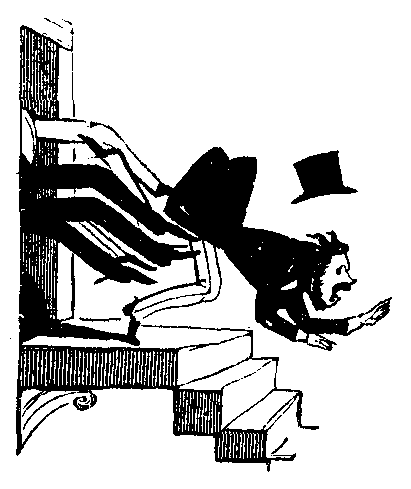
I can see why. Partly it’s the humor value, which  is considerable. “What is the simplest, surest, and most direct way of getting someone to do something?” Herzberg’s first answer: the KITA. (Hint: KIT stands for “Kick In The.” Herzberg claims original authorship of this acronym, and given that the article first appeared in 1968 I believe him.) The KITA comes in many forms, including what Herzberg dubs the “negative physical KITA,” i.e. the literal kick. But there are numerous problems with using the negative physical KITA to motivate employees, not least that “it directly stimulates the autonomic system, and this often results in negative feedback.” Translation: the subject may kick back.
 

Negative autonomic feedback

But Herzberg also makes a substantial contribution to organizational theory, one that’s forced me to do some new thinking on the regular debates we have on the role of incentives in education.

After a brief discussion of the negative physical KITA, Herzberg moves on to what he dubs the “negative psychological KITA,” i.e. making people feel bad unless they do something. The advantages of the negative psychological KITA over the negative physical KITA are considerable, including: “since the number of psychological pains that a person can feel is almost infinite, the direction and site possibilities of the KITA are increased many times”; “the person administering the kick can manage to be above it all and let the system accomplish the dirty work”; and “finally, if the employee does complain, he or she can always be accused of being paranoid; there is no tangible evidence of an actual attack.”

But it is pretty clear to most people that both types of negative KITA do not really produce what we usually call “motivation.” What they produce is movement. The subject moves, but does not become motivated. Hence – and this is the important part – the method is of limited effectiveness. As long as you keep applying KITAs the subject will keep moving, but only as long as you keep kicking and only as far as you kick. To be really effective, you need to do something to get the subject to keep moving – produce ongoing motivation.

Hence most organizations, sensibly enough, turn to positive incentives and discourage managers from using negative ones. And here things get really interesting. Herzberg argues that most of the positive incentives normally used in an attempt to produce motivation are really very similar in their outcomes to negative KITAs – producing movement rather than motivation. The subject subjectively experiences them as positive rather than negative, but objectively the result in terms of work output is similar. You’re just pulling rather than pushing. The subject only moves as long and as far as you pull. Herzberg thus gives these incentives the somewhat paradoxical label “positive KITAs.”

A positive KITA?

Herzberg’s examples of positive KITAs include pay and benefit increases, reduction in work hours, and improved workplace relations (i.e. communications and “sensitivity” training for managers, morale surveys and “worker suggestion” plans).

The positive KITA, Herzberg argues, despite being ubiquitous in the business world, is actually not much more effective than the negative – and it’s a lot more expensive. This is especially true since positive KITAs (unlike negative ones) must be progressive. If you give the worker a $500 bonus this year, when last year you gave him a $1,000 bonus, this objectively positive action will actually be subjectively experienced as negative.

Herzberg argues that a real, self-sustaining motivation can be produced in employees by something he calls “job enrichment.” That sounds like something the warm and fuzzy folks would advocate, but Herzberg actually spends a good deal of time taking the warm and fuzzy folks to task for their inanity. (This provides much of the humor value. It’s also historically interesting – it’s amazing to see how far the warm and fuzzy disease had already spread by 1968.) What Herzberg is arguing for is something more serious than the label implies.

His underlying psycological and organizational theory is a bit too much to recopy it all here, but here’s a capsule summary. He and others did a large number of empirical studies and found that job satisfaction and job dissatisfaction didn’t usually come from the same sources. For example, having a jerk for a boss produces job dissatisfaction, but having a nice boss usually does not produce any job satisfaction. Niceness in bosses simply prevents workers from feeling dissatisfied; it doesn’t actually make the job satisfying.

The key insight to get here is that removing dissatisfaction doesn’t produce any satisfaction, and highly effective motivation comes from producing satisfaction rather than from removing dissatisfaction.

His meta-analysis of the empirical research finds that pay and benefits, job security, company policy, working conditions and on-the-job relationships are all normally associated with levels of dissatisfaction, but rarely with levels of satisfaction. On the other hand, levels of satisfaction are associated with achievement, recognition for achievement, responsibility, advancement, aspects of the work itself, and development of one’s capacities to do the work.

Herzberg’s idea of “job enrichment” is to increase worker’s experiences of the things that provide high levels of satisfaction. Give workers more responsibility and more opportunity to achieve, and then recognize success – most importantly with advancement that brings still more responsibility and opportunity for achievement. The converse of this is that failure must also be “recognized” – primarily through withholding advancement and responsibility rather than through negative KITAs.

I find his theory and evidence persuasive. And it has helped me see a little more clearly the underlying logic behind some objections to education policies like merit pay.

Yet I don’t think this analysis actually does take anything away from the case for merit pay, still less from the case for other education reforms like school choice. If anything, it makes them stronger. And taking account of this analysis will help us make the case more effectively.

Some of the objections to merit pay are based on an essentially Herzbergian conception of worker motivation. Smart people don’t deny that money plays some role in motivating people to do more work. But even among those who don’t advocate touchy-feely romantic delusions about teachers who are angelic beings with no connection to the material world, there is a lot of skepticism that you can get them to work all that much harder just for “a few extra sheckels” (as one of the more sensible critics once put it in a comment here on this blog).

Yet consider what would have to happen for Herzbergian “job enrichment” to occur in the teaching profession. First of all, you’d need an objective measurement of achievement. Then you’d need to give teachers autonomy in the classroom and hold them accountable for results on that metric. And for the accountability to take the form of advancement and increased autonomy (and accountability), you’d need to remove the one-size-fits-all union scale and work rules that dominate the profession.

In other words, it’s not so much the pay that makes merit pay worth trying, as it is the fact that merit pay creates tangible recognition for success. The current system seems almost deliberately crafted to deny teachers as many opportunities for satisfaction as possible. Merit pay is an attempt to create more such opportunities.

It’s worth noting that Michelle Rhee’s proposed two-track system in DC labels the old, union-dominated track the “red” track and the new, merit-based track the “green” track. Rhee understands that what she’s offering isn’t just, or even primarily, more money. She’s offering DC teachers their professional pride.

But school choice looks even better by this light. Test scores would be a limited basis for creating opportunities for Herzbergian satisfaction. On the other hand, if your objective measurement of job performance is parental feedback, the sky’s the limit. In this context it’s worth noting that Herzberg says the only meaningful measure of job performance is ultimately the client or customer’s satisfaction; using any other measure is taking your eye off the ball.

You could even combine the two to create a truly graduated scale of autonomy and accountability. New teachers could be required to use a standard curriculum and be evaluated on how their students – all types of students, not just the rich white ones – progress in basic skills. (That, of course, is the real primary function of test-based accountability – ensuring that kids who face more challenges aren’t just warehoused for twelve years while the rich white kids get an education.) Teachers who prove they can deliver the goods on reading and math for students of all backgrounds could then be given more classroom autonomy and evaluated based on parental feedback rather than test scores. Freedom from test-based accountability is the payoff for proving you can teach basic skills reliably. Schools could set up any number of intermediate arrangements in between “pure” test scores and “pure” parental feedback, with teachers earning more and more recognition and autonomy as they prove more and more their ability to teach effectively.

Looking back at my previous posts on teacher autonomy and satisfaction levels in public v. private schools, the poisonous influence of one-size-fits-all pay scales, and the union-driven destruction of the teaching profession, I can see this is really the framework I’ve been trying to articulate all along. The unions keep bleating about how teachers should be treated like professionals. I agree. They should have autonomy, like professionals – and they should be held accountable for results.


William Higinbotham – NOT Nominated for Al Copeland Humanitarian

October 19, 2009

William Higginbotham

(Guest post by Greg Forster)

In our ongoing process of gathering nominees for the Al Copeland Humanitarian of the Year award, last week Jay nominated Fasi Zaka on grounds that ridicule of dictators (actual or aspiring) is an important part of mankind’s struggle for freedom.

Well, another important part of the struggle is serious condemnation. We must indeed laugh at dictators, because you can’t effectively undermine their support without including that element. But we must also sometimes sober up and be serious about the threat they pose.

For that reason, I am announcing that William Higinbotham, inventor of the videogame, will not be nominated for Al Copeland Humanitarian of the Year.

First, let’s dive head-first into the deeply divisive historical controversy over the invention of the videogame. (And you thought we were brave to take on the issues surrounding Christopher Columbus!)

CRTamdev-preview

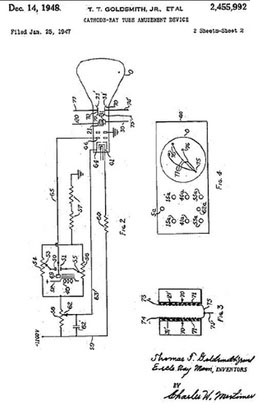
The first known electronic device created for gameplay was the Cathode Ray Tube Amusement Device (US Patent 2,455,992 granted February 1948) created by Thomas T. Goldsmith Jr. and Estle Ray Mann. The user twists a knob to guide a moving dot toward a target. But as it uses a non-representational display (rather than the graphical represntations implied by the term “video”) and is more a novelty skill test along the lines of a carnival “game” than a traditional “game” per se, it does not quite fit the meaning of the term “videogame.”

In March 1950 Claude Shannon published a program for a chess-playing game – but again without graphical representation.

NIMROD-players-prev

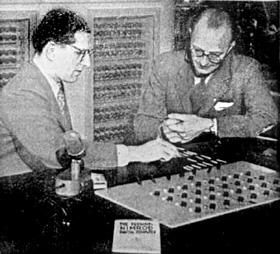
Next we get the NIM (aka “Nimrod”) computer, created by Ferranti International and presented at the Festival of Britain in 1951. It used a series of lights and buttons to play an ancient Chinese numerical game in which players manipulate “heaps” containing different numbers of objects; the player who takes the last object out of the last heap is the loser. Once again, without graphical representations we don’t yet have the “videogame.”

OXO_emulated_prev

Alexander Douglas’s tic-tac-toe program in 1952, designed as part of a Ph.D. thesis on questions of user interface design, almost gets us there. But while the display of Xes and Os on a board is a step toward graphical representation, it’s not strictly there yet – the Xes aren’t crude representations of some kind of X-shaped object, but symbols – not essentially different from the symbols chess players use to express their moves in letters and numbers. I’ll grant that the visual positioning of the symbols is an important step. But it’s not really a “video” game until you have graphical representation.

Enter, stage left, the genius of William Higinbotham. In 1958, he worked at the Brookhaven National Laboratories and often had to entertain guests waiting to take tours of the labs. To keep them occupied, he designed a tennis game (christened “Tennis for Two”) on one of the lab’s oscilloscopes.

Oscillosopes are all computer programs now, but my father used to have one of the old stand-alone units with the tiny little screen that showed waves going by. When I was a little kid he let me play with it – you could change the shape of the waves by turning the dials. I was endlessly fascinated by this. Here’s what a standard oscilloscope used to look like:

oscilloscope

And here’s what William Higinbotham got it to do:

tennis_for_two-prev

You turned a knob to change the angle of your shot and pressed a button to hit the ball – and entertainment was revolutionized forever.

tennispaddle

The modern videogame evolved into its final form with breathtaking rapidity – by 1961, MIT’s Stephen Russell led a team that created a game called “Spacewar!” The Magnavox Odessey, the first home video game system, was a functioning prototype by 1967 (dubbed “The Brown Box”) and on sale in stores in 1972. Everything after that is just the same thing better and faster.

So why would this achievement not be worthy of the Al Copeland Humanitarian of the Year award?

Because we have standards, that’s why – and William Higinbotham doesn’t meet them.

Take it away, Wikipedia:

He helped found the nuclear nonproliferation group, Federation of American Scientists, and served as its first chairman and executive secretary. . . . He is said to have expressed regret that he would more likely be famous for his invention of a game than for his work on nuclear non-proliferation. When after his death, requests for information on his game increased, his son William B. Higinbotham wrote, “It is imperative that you include information on his nuclear nonproliferation work. That was what he wanted to be remembered for.” [Emphasis added]

We shall not tarnish the sterling silver of Al Copeland’s reputation by associating it with such filth. Copeland may have offended the delicate sensibilities of many with his penchant for fast cars and boats. He may have annoyed his neighbors to the point of filing lawsuits with his extraordinary Christmas decorations. He may have failed in some busienss ventures. More seriously, he may have had a turbulent family life.

But say this for Al Copeland – he never thought nuclear non-proliferation was more important than videogames.

That’s a stick in the eye to everything the Al Copeland award stands for. And that is why William Higinbotham will never have the honor of being nominated for Al Copeland Humanitarian of the Year.

HT Pong Museum and Gamer’s Quarter for most of the images


Pass the Popcorn: Ponyo

August 28, 2009

ponyo

(Guest post by Greg Forster)

Quick, before it leaves theaters, go see Ponyo, the latest film from Japanese visionary Hayao Miyazaki. As I’ve written before, Miyazaki’s movies fall into two categories: family features and challenging epics. Ponyo is definitely on the family side of the equation. But I went without kids and loved it as a grown-up, so don’t be deterred. There’s plenty here to enjoy.

Well, OK, maybe not everyone should rush out to see it. If you’re the kind of person who would go to to a movie about the fantastic adventures of a five-year-old whose chance encounter with a magical fish-girl threatens to upset the balance of the magic and human worlds, possibly destroying both, and spend the whole time saying to yourself things like, “Hey, no five-year-old could push something that size on his own! And how come he has the vocabulary of a twelve-year-old?” maybe Ponyo is not for you.

But everyone else should go.

If you plan to see it, stop here. I’m not going to spoil the ending, but the movie reveals itself slowly (as many Miyazaki movies do) and you’ll probably enjoy it more if you don’t know much about it going in.

If, however, you need to be convinced, read on.

Ponyo is the daughter of a sea-wizard and lives with him at the bottom of the ocean. Her father hates the human world and forbids her to see it, which naturally makes her eager to go. But she gets into trouble (of course) and is rescued by a five-year-old boy named Sosuke, who protects her and takes care of her until her father comes to take her back to the sea.

ponyo-sosuke

Ponyo, starved for love in the house of her hard-hearted father and awed by the self-giving kindness of Sosuke, decides she’d rather be human. She gets into her father’s magical works and manages to open a rift in the barrier between the magical and human ecosystems, allowing her to change herself to assume a human form – but also causing a catastrophic disruption of the human ecosystem that leaves an entire town underwater and threatens to do worse.

After her transformation, Ponyo has a foot in both worlds – though she appears human, she can still work magic. Much of the movie’s charm comes from the shared delight of mutual discovery between Ponyo and Sosuke. Sosuke marvels as Ponyo turns a toy boat into a real boat and fixes broken household appliances with a glance; Ponyo is equally blown away by the delights of flashlights, ham sandwiches, and warm towels straight out of the dryer.

ponyo-sosuke toys

But back in the sea, her sea-wizard father and her mother (whose identity I’ll keep under wraps) determine that the only way to close the rift she’s opened and save the human world from destruction is for Ponyo to become entirely one thing or the other. She must either return to the sea, or else complete the transformation, giving up her magic and becoming fully human.

Of course they know Ponyo will be miserable if she returns to the sea, but to become fully human she must be drawn across the divide by a human love – by Sosuke. However, in the process of drawing Ponyo over that love will be tested. Does Sosuke really take care of Ponyo because he cares about her well-being? Or is he just interested in her because she’s magical and fascinating? If Sosuke fails the test, Ponyo’s desire to become human will destroy her.

Ponyo’s mother has faith in the genuineness of human love and thinks it’s better for Ponyo to risk death than to abandon her desires, so she arranges for the transfer. But her father hates humans and fears Sosuke’s love will fail the test. He may or may not be laying plans to interfere.

But all this plot is really irrelevant to the joy of the film. What Miyazaki is giving us here – besides gorgeous visuals and a delightful story in its own right – is a vision of how the world of humanity relates to the world of nature. “Magic” in this movie is symbolic of the spiritual significance most of us attribute (on some level) to nature.

Don’t get me wrong! The bad, human-hating kind of environmentalism is condemned pretty clearly. (This is a big step for Miyazaki, who has not been so enlightened about this in the past.) Ponyo’s sea-wizard father not only hates humans, but actually dreams of one day wiping them out – because he hates their impact on the environment. Those who see the ecosystem as something with its own inherent integrity apart from humanity, such that any impact of humanity’s existence on the natural world is bad simply as such, are implicitly wishing for humanity’s annihiliation.

In fact, we learn at one point that the sea-wizard father was born human and has somehow himself crossed the very same border Ponyo wants to cross, only in the other direction. The desire of some humans to get into nature – which drives so much of what now passes for environmentalism – is really a desire to get out of humanity. As the wizard says, they need to abandon humanity to serve the earth.

wizard

What do you know about humans? They treat your home the same way they treat their fithly black souls! I was human myself once. I had to leave all that behind to serve the earth.

But what if the shoe were on the other foot? What if we could “become one with nature” not by dragging humanity down, but by pulling nature up?

That’s the thought I couldn’t stop having as I watched the extended scene in which the rift opens between the human and magical worlds. The way Miyazaki does it, it’s breathtaking. Everyday things in our everyday world suddenly become magical. Not magical like wands and rings and such D&D fantasies – magic as a tool for humans to use – but magical with its own life and its own distinct nature. The road Ponyo’s mother drives down to get to work every day, with the forest on one side and the sea on the other, suddenly becomes bursting with little gods and goddesses all around them.

That’s what Ponyo’s desire to become human represents – against her father’s cold, self-loathing desire to have nature instead of humanity, her desire for love drives nature to come up alongside humanity, with its own personality, wanting to love us the way we love it. And on those terms we really can become one with nature.

Tree-huggers have got the wrong idea, because there’s nothing in a tree that can recieve a hug. There’s nobody else there, so you’re basically hugging yourself. But what if the trees hugged back?

We do – most of us, anyway – love nature and feel that somehow our relationship with it is disrupted and needs to be repaired or reestablished. There are, of course, some people for whom a forest is nothing but a source of lumber and a dog is nothing but an annoyance. But they’re pretty rare. Just to take one example, how many millions of people keep pets? How many millions more would like to keep them if not for the hassle, cost, allergies, etc.? And why do we want pets? There’s no explanation other than a desire to have some part of nature that is personal enough to have a relationship with. We want to love nature, so we seek out something in nature that can love us back.

And love, the movie very wisely percieves, is the unique quality of humanity which nature utterly lacks. Sheer force is something nature has in plenty, as we see when the flood destroys the town. Beauty nature has in spades. Even intellect is present in nature to some extent, as many animals are capable of some degree of calculation. We can, of course, out-calculate them. But what really makes humanity stand out next to mere nature – the smallest taste of which is enough to drive Ponyo to turn the whole world upside-down rather than go without it – is love.

Ponyo-Sosuke kiss

And let’s be clear that by “love” I’m not talking about mere gushy emotion or seniment. I mean a genuine desire for the good of others. In nature, mothers care for their young, and in one sense that’s love. But they only care for their young, not for others generally, and they do it in obedience to the maternal instinct. Doing good to another not because of any relationship we have with that other or to satisfy some instinct or desire of our own, but simply because we will the good of others – that’s something you’ll never find in nature. 

Or should I say, something you’ll never find in nature except where humanity has affected it. Try getting a wild dog to love you. But tame the dog and it will love you as well as any person – because in the taming, the influence of human love pulls it upward into a real (though of course limited) state of personhood.

Naturally, humans being only human, we are never perfectly selfless and all our behavior is mixed with some level of wrongful selfishness. That’s what gives the cynics, like the sea-wizard, their excuse for disbelieving in the reality of love. And of course in some particular cases the cynics turn out to be right – many behaviors that look like love from the outside really aren’t. That is Sosuke’s test – does he really want Ponyo to have what’s good for Ponyo simply because it’s good for Ponyo and he desires Ponyo’s good as such?

It’s not a perfect movie. Just like in Miyazaki’s last work, Howl’s Moving Castle, the ending of Ponyo is rushed and forced. Miyazaki has bittten off so much he can’t quite resolve it all in the time he has available. And, I regret to say, over the years I think he has become increasingly hesitant to let anybody’s story end sadly – not just the heroes but anybody at all. In his greatest work, Princess Mononoke, good triumphs in the end and utter destruction is averted, but many good things are lost and the hero and heroine must give up something they dearly love in order to save their respective peoples. Even in his earlier family movies, there was loss and regret. But more recently Miyazaki has tried to arrange for everybody to end up well, and that gives his endings a false note.

But, like I said, plot is not the reason to go see Ponyo, and thus I think the problems with the ending detract little from the movie. Even if you get nothing but the fun story and the amazing visuals, it’ll be well worth the price of admission. And I think there’s a lot more than that to be had.


The Student Loan Lesson for Health Reform

July 21, 2009

Monopoly - Pennybags

From now on, any time you need care, just come ask my permission!

(Guest post by Greg Forster)

In case you missed it, you’ll definitely want to check out Stephen Spruiell’s NRO column on what we can learn about health care reform from looking at the federal student loan program. “Reform” means irreversible steps that must inevitably end in dictatorial socialization.

It’s important to begin with the understanding that we don’t have a free market in health care as it is. What we have is a government-mandated cartel. Pretty much all the problems people complain about arise from the mandatory cartelization of health care. The question is whether we’re going to stick with this lousy command-economy cartel, or switch to an even worse direct government monopoly.

I’ve noted before how the already-complete monopolization of the education sector provides a general model for the ongoing monopolization of health care. But Spruiell’s article on how government muscled its way to becoming the sole student lender in America demonstrates that the education monopoly provides not only a general model, but a step-by-step tactical plan:

  1. Sponsor a huge, hubristic attempt to monopolize the market.
  2. When you lose that fight, fall back on the comparatively “reasonable” “compromise” of massive subsidies.
  3. Sit back and wait for the massive subsidies to badly distort the market, creating widespread suffering and injustice.
  4. Whip up public anger over the injustices you’ve created, directing blame away from yourself by demonizing the private service providers.
  5. Offer a “public option” as a way to “control costs” and “keep the private sector honest.” Subsidize the public option so it offers a better deal.
  6. Watch the “public option” become the dominant service provider, and then a de facto monopoly.
  7. Demonize the remaining private providers because they’re not as good as the public option.
  8. Outlaw the remaining private providers so everyone must now come to you.
  9. Begin reshaping the government service provider to meet your needs, taking advantage of your complete freedom to order everything however you want, since there are now no alternatives and thus no way for anyone to effectively resist you.
  10. Lie back and enjoy your tyrannical rule over a nation of willing slaves.

On federal student loans Congress is about to take step 8. On schooling generally we’ve long since completed step 6, but the periodic attempts to progress to step 7 have (so far) been successfully repulsed. On health care we are now being invited to take step 5.

The game is pretty simple. Most games are, once you read the box top and know what’s going on.

The only question that matters is: at what point does the progression become irreversible? I suspect that if we ever arrive at step 10, it will be primarily because at some prior stage, the people who were smart enough to see what was going on assured themselves that the point of no return had not yet been reached, when in fact it had.


The UFT’s “Cue Card Check”

April 15, 2009

guy-holding-cue-card

All images from GothamSchools, whose Elizabeth Green broke the story

(Guest post by Greg Forster)

Last week, the UFT got caught handing out cue cards to New York City Council members before a public hearing of the council’s education committee. The council members dutifully asked the questions they had been given, which pointedly invited anti-charter diatribes from the teacher-union and DOE witnesses.

The members then unanimously voted to make Grigori Potemkin their new committee chairman.

Internet wags are calling the scandal “cue card check.” ALELR has consulted his deep moles within UFT and offered an intriguing report on the union’s strategy for the Council’s next hearing.

The cue cards have to be seen to be believed:

cue-card-2

cue-card

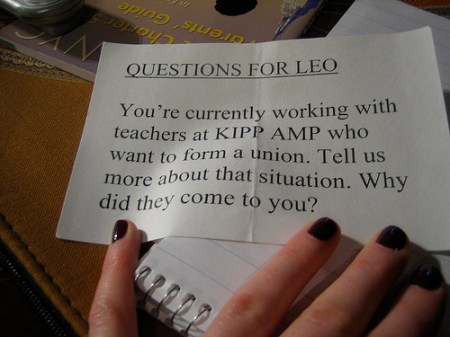
cue-card-leo

That’s “questions for Leo” as in our dear friend and Sith apprentice Leo Casey, who testified at the hearing. My pledge to you, the reader: from now on, every time Leo posts calumnies about Jay, I will post a link to this story.

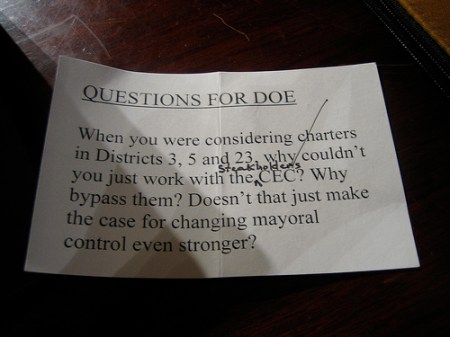
cue-card-doe

And that’s “questions for DOE” as in officials from the Department of Education. The cue cards were handed out by the UFT, but is it plausible that the department officials had no idea they were being asked scripted questions?

HILARIOUS UPDATE! When I first posted this, I didn’t look closely at the handwritten edit made to this cue card. Check it out – note the spelling. And this is from an organization of teachers!

This story doesn’t seem to have broken out of the local circuit yet, but it’s getting a whole lot of attention in the city media. The Daily News is leading the way, documenting the extent of UFT political contributions to the council members who got cue cards and covering Randi Weingarten’s attempts to deflect blame by claiming that a charter school organizer once did the same thing. (Not true, says the organizer – and who has more credibility here?)

But ALELR notes that props are not being given to Elizabeth Green of the blog GothamSchools, who broke the story and snapped all the pictures you see above (and more, which you can enjoy in all their glory by following the link).

Green wryly notes that the cue cards with accusatory anti-charter questions were handed out by “a representative of the city teachers union, which describes itself as in favor of charter schools.”


Fordham Splits the Baby

March 24, 2009

hemisphere

Extremist position #1: The earth is flat.

Extremist position #2: The earth is round.

Reasonable middle ground: The earth is a hemisphere.

HT Math Is Fun

(Guest post by Greg Forster)

Fordham has just released a new report on how voucher programs should be regulated. Their methodology seems to be that they don’t care about finding the truth, they only care about finding “middle ground.” It doesn’t matter whether a policy makes any sense, as long as falls 50% of the way between the policy on the right and the policy on the left, it must be the best policy.

They collect opinions from a bunch of education experts and then propose, as their preferred policy, something that falls roughly in the middle of the spectrum – they want to subject different voucher schools to different levels of regulation based on how many voucher students each school has. Naturally, since their proposal isn’t guided by any principle other than that of political triangulation, it accomplishes neither the goals held by one side nor the goals held by the other side, and will therefore please nobody. But no one can accuse Fordham of not seeking middle ground!

They’re just like Solomon splitting the baby – except that Solomon’s proposal was a ruse. Fordham really wants to actually take out their knives and split the baby.

Inspired by their example, I’ve decided to end the age-old debate over the shape of the earth. Some people hold the earth is round, which has the merit of providing a parsimonious explanation of the observed data. Other people hold that the earth is flat, which has the merit of being an ancient, time-tested view. But this tired old debate between two extremist positions is getting us nowhere.

First I convened a panel of experts, some from the National Astronomical Society and some from the Flat Earth Society. The experts achieved consensus on the following important points:

  • The shape of the earth is an important subject.
  • The earth is not cubical.
  • The earth is not made of green cheese.

Unfortunately, we were not able to achieve consensus on one issue: the earth’s actual shape.

To move beyond this tired old debate and find reasonable middle ground, I propose that the earth is hemispherical – flat on one side and round on the other. Since this position is 50% of the way between the two extremist positions, it must be true. QED.

Now we move on to the next great debate: which side do we live on, the flat side or the round side? I’m convening a conference in the Antipodes to begin exploring new research on this question.


Buildingpalooza

February 11, 2009

fancy-church  shack

An underfunded regular public school; a money-draining charter school

(Guest post by Greg Forster)

I can see that school buildings are going to be a big topic for us for the foreseeable future. There’s the feds’ desperate need to blow money on something, anything, in the “recovery” bill (they’re no longer even bothering to call it a “stimulus” bill, apparently). And Jay’s post on school construction last week generated some interesting conversation in the comment thread.

Then last week opponents of the bill had a lot of fun spotlighting its provision of $89 million for school construction in Milwaukee, despite the fact that Milwaukee has had major enrollment declines leading to lots of empty and “underused” buildings, its buildings are deemed to be in good condition, the city has no plans for any construction projects, and just last year it had a major scandal centering around the waste of tens of millions of dollars in construction funding.

But here’s something I don’t think anyone outside Milwaukee has highlighted yet. In the Milwaukee Journal Sentinel’s story on the funding, somebody at the paper (presumably a bemused editor) inserted the following subtitle above a section of the story:

What is “Construction”?

Somebody get Socrates on the line, because it’s a good question. As a commenter pointed out on Jay’s post last week, once money goes into the system, we can’t be sure what it really gets spent on. We know how much money was budgeted for “construction,” but typically there’s nobody checking to see what was actually bought with those “construction” funds.

Sure enough, the Journal Sentinel quotes a state Democratic spokesperson saying that all of that yummy yummy swag for “school construction” could legitimately be spent on “school modernization.”

Next month’s headline: “What is ‘School Modernization’?”

Do these sound like conditions under which the money will be spent wisely? And don’t kid yourself that Milwaukee is somehow a special exception, and the stimulus money is going to be well spent elsewhere.

Suppose you don’t believe the vast mountain of empirical research that Jay cited last week. Let’s just drop all that science into the toilet bowl and flush. Even so, can anyone believe that money will be well used when it’s handed over to a system that has no real transparency, much less effective oversight, never mind accountability for results – and that is run by people who also just happen to derive political power by diverting school funding into an enormous gravy train of featherbedding, pork, etc.?

If we’re dumb enough to hand over the money under those circumstances, why would they not divert it to the gravy train? I’m amazed the schools in the government monopoly system aren’t even worse than they are.

But wait. There’s yet another school building story on the horizon. This one broke out in the edreformblogosphere just yesterday.

stlouisarch

They built it with surplus “school construction” money

Like Milwaukee and pretty much every other city, St. Louis has long-term declining enrollment, but that didn’t stop it from pouring tons of money into school construction over the past few decades. Now St. Louis has a bunch of empty school buildings it needs to unload, so it’s going to sell them off.

But not everyone is allowed to bid on the empty school buildings. Joanne Jacobs puts it succinctly: “The school board has banned sales of buildings to liquor stores, landfills, distilleries, sex shops and charter schools.”

Read that again: Liquor stores, landfills, distilleries, sex shops and charter schools.

Not much more to say, is there? Charters are the one sector of the government-owned education system that is 1) growing fast, 2) willing to take on the most disadvantaged, toughest-to-teach kids, and 3) producing improved results, and they do it with less money – especially less construction money! – than the regular system. But they aren’t allowed to buy – not take for free, but buy, as in purchase at market value, by paying actual money – the city’s empty buildings.

drive-thru-liquorlandfill

distilleryPT006149

Some typical St. Louis charter schools

I’m with Matt – if the system’s defenders don’t realize they’re destroying millions of children’s lives in order to funnel money to a corrupt gravy train, it’s only because they don’t want to know.


AFT and UAW – More Alike Than You’d Think

December 30, 2008

aft uaw1

(Guest post by Greg Forster)

Lots of people are picking up on the temper tantrum about alleged “demonizing of teachers” begun by a Randi Weingarten speech and continued in Bob Herbert’s column on the speech.

Even that notorious right-winger Eduwonk points out that Weingarten and Herbert are hitting a straw man. I think the real problem is not that school reformers demonize teachers but that defenders of the government school monopoly angelize them. When we reformers insist that teachers should be treated as, you know, human beings, who respond to incentives and all that, rather than as some sort of perfect angelic beings who would never ever allow things like absolute job protection to affect their performance, it drives people like Weingarten and Herbert nuts.

guardian-angel

A typical teacher, as seen by Randi Weingarten

But what I’d like to pick up on is the question of whether the troubles of the government school system are comparable to the troubles of the auto industry.

Of the alleged demonizing of teachers, Herbert had written:

It reminded me of the way autoworkers have been vilified and blamed by so many for the problems plaguing the Big Three automakers.

Eduwonk points out Herbert’s hypocrisy (though he delicately avoids using that word) on this point, because elsewhere in the column, Herbert praises Weingarten for expressing a willingness to make concessions on issues like tenure and pay scales. Union recalcitrance on these types of reform, Eduwonk points out, is precisely why the auto industry is in so much trouble, and Weingarten has been driven to make noises in favor of reform because a similar dynamic has been at work in the government school system.

On the other hand, Joanne Jacobs thinks the comparison between the AFT and the UAW is inapt:

 I don’t think skilled teachers and unskilled auto workers have much in common.  Auto unions pushed up costs, especially for retirees, making U.S. cars uncompetitive.  In education, the problem isn’t excessive pay, it’s the fact that salaries aren’t linked to teacher effectiveness, the difficulty of their jobs or the market demand for their skills.

But teachers’ unions have pushed up costs – dramatically. In the past 40 years, the cost of the government school system per student has much more than doubled (even after inflation) while outcomes are flat across the board. And this has mainly been caused by a dramatic increase in the number of teachers hired per student – a policy that benefits only the unions.

It’s true that high salaries aren’t the main issue in schools, although teacher salaries are in fact surprisingly high. The disconnect between teacher pay and teacher performance is much more important. But the UAW has the same problem! Their pay scales don’t reward performance, either.

The source of Jacobs’ confusion is her mistaken view that auto workers are “unskilled.” Farm workers are unskilled, but not auto workers. The distinction she’s reaching for is the one between white-collar or “professional” work and blue-collar work. But some blue-collar work is skilled and some is unskilled, and auto workers are in the former category. This matters because with skilled blue-collar workers, as with white-collar workers, there’s a dramatic increase in the importance of incentives as compared with unskilled labor.

In fact, a lot of smart people have been arguing (scroll down to the Dec. 26 post) that exorbitant salaries and benefits aren’t nearly as much of a problem in the auto industry as union work rules – including poor performance due to absolute job protection, pay scales that don’t reward performance, and rigid job descriptions that make process modernization impossible.

Sound familiar?

(Edited)


Pass the Popcorn: Payback’s a Bitch

December 19, 2008

 vesper-1

(Guest post by Greg Forster)

Last weekend I finally got to see Quantum of Solace. I had heard it wasn’t as good as Casino Royale, so going in, I tried to manage my expectations.

“It doesn’t matter whether it’s as good as Casino Royale,” I told myself. “It’ll be fun, and it’ll probably be better than just fun, and that’s better than most movies. I’ll just enjoy what’s on the screen without worrying about what’s not.” That’s how I try to approach most movies.

It wasn’t enough.

Don’t get me wrong. Quantum of Solace is not a bad movie. I enjoyed most of the two hours I spent watching it. However, not only was there a tremendous amount of lost potential – an approach to the Bond story that could have taken the francise to a whole new level – but there were actually some pretty significant stretches that I couldn’t enjoy even on the level of fun or coolness.

quantum_of_solace-table

These data over here illustrate the precipitious decline of cool gadgets in James Bond films, as measured by both quality and quantity. I’ll move this electronic display across the tabletop just by moving my hand, so the audience will momentarily forget that this table-computer thingy is not an adequate substitute for a buzzsaw wristwatch.


The lost potential here is pretty darn serious. Casino Royale not only gave us a really cool  Bond movie, but the setup for what could have been a two-part (or longer) serious epic story arc- the first real epic storyline in the franchise.

vesper-2

I can’t find it now, but in the runup to the new movie, some fan put together a desktop wallpaper image of Vesper Lynd with the tagline “Payback’s a Bitch.” That got me more excited to see the movie than anything in the official advertising – Bond both loves and hates Vesper (“the bitch is dead”) and thirsts for revenge on her killers even as he hardens his heart against all natural human affection.

bond-and-vesper-shower1

Quantum of Solace does try to redeem that promise, and there are some really good moments. The very last thing Bond does before the end credits roll is a really shocking twist – not so much a plot twist as a “character twist” – that works perfectly. It violates our expectations pretty radically, yet resolves the story perfectly, though not in the way we had thought.

And about two-thirds of the way through the movie, there is a scene that pays tribute to a famous moment in an earlier Bond movie that could have been incredibly cheap and derivative, but is pulled off with note-perfect direction and ends up being extremely effective.

There are also a number of great dialogues in the movie. Bond’s intereactions with M at the beginning are great – Judy Dench is finally permitted to do more than scowl at Bond, and her talents unexpectedly provide real depth to the M character here. And there’s a short but really powerful scene between Bond and Felix Leiter, about which more later.

But while there is some good action, some coolness, and several good moments that show us the epic this movie could have been, the movie not only doesn’t fulfill its potential, it frequently doesn’t even work on the level of standard Bond movie.

It wasn’t just the absence of a decent villain – although that flaw alone is more than enough to shame any director who makes a Bond movie.

 quantum_of_solace-villains

That guy on the left? Literally the instant he came on the screen I was scared of him. He’s in the movie for about five minutes. The loser on the right is the “villain.”

One does wonder just what has to happen to a man to cause him to make a James Bond movie with a lame villain. All action/adventure movies, but especially Bond movies, depend on the personality of the villain; his cunning is needed to test the hero’s wits, his ruthlessness to test the hero’s courage, his power to test the hero’s strength, his evil to test the hero’s good. The lame villain would have prevented the film from reaching anything like its full potential even if there were no other flaws.

quantum_of_solace-villain

He’s supposed to be scary. I’m told that if you stare long enough you’ll start to see it, like those “magic 3D” posters from the 90s. Anyway, I think they were going for “creepy guy who makes your skin crawl,” but they got “bug-eyed pervy loser.”


It wasn’t just the gaping holes in the plot. In case you’re curious, those holes arise primarily because the filmmakers decided to give the movie an environmental theme. I say “theme” because the movie is not at all didactic about the environment. They were smart enough to avoid that trap. But they wanted the evil scheme to somehow involve the environment, and what they came up with (I won’t spoil it, though really there’s not much to spoil) doesn’t pass the laugh test.

As for the lengthy scene in the middle of the movie that takes place at a radically avant-guarde European opera performance, while many (including my wife) found it annoying, I actually didn’t mind it.

quantum_of_solace-opera

I can see why they put it in – just like they put in that scene at the “dead bodies” museum exhibit in Casino Royale. They’re trying to reintroduce the tone of the older Bond movies that was simultenously highbrow and exotic. Flying off to Brazil (or wherever) used to be something only the rich could do, and for those who couldn’t do it, it was a little like flying to Mars. Today, when the Bond audience is comfortably upper-middle class and airfares to just about everywhere in the world are within their reach, it’s hard to take Bond to esoteric places. While the scene probably doesn’t work as well as the director hoped it would, I think it’s serviceable.

But now back to the flaws.

It wasn’t just the movie’s anti-Americanism. Here the movie is didactic, alas. One winces to hear the mass-murdering psychopath Haitian dictator Aristide discussed (though he is identified by a generic description and not by name) as a saint. And the filmmakers don’t seem to be aware that the Aristide whom they so admire was returned to office by U.S. power after being deposed in a coup.

But the damage here is pretty radically mitigated by several factors. First, it’s obvious that they felt they had to have something left-wing in there to counterbalance the fact that the movie’s villain is a phony environmental philanthropist, which might be taken as a critique of certain real-life phony environmental philanthropists. (“I did learn something about the environment from this movie,” my wife said to me afterward.  “I learned not to trust people who claim to be acting on behalf of the environment.”) There’s a sense, or at least I had the sense, that when they denounce American imperialism, they do so out of a sense of obligation. Second, on some occasions America really has been guilty of the kind of evil attributed to it here – although one wonders whether either the filmmakers or the audience are aware of who the real perpetrators of those evils were (and are), and which of the two political parties they tend to be clustered in.

But most importantly, Felix Leiter is given an opportunity to point out that if America has sometimes done nasty things, it is, on balance, not the world’s worst offender. In a Bolivian bar, Bond snorts, “you guys have carved up this place pretty well,” and Leiter spits back, “I’ll take that as a compliment – coming from a Brit.” Even by the standards of civilized nations, America stands up pretty well.

bond-leiter


In the Bond films, Felix Leiter has always stood for America. He lacks Bond’s air of elegant sophitication and savior-faire, but also Bond’s arrogance and hard-heartedness. Bond is the advanced-but-decadent Old World, Leiter is the plain-but-decent New.

Watch, for example, the first few minutes of Goldfinger, and see how differently Bond and Leiter treat the girl in the bikini by the poolside. If you’ve studied your Tocqueville, you know how to pick out the American in any crowd of men – he’s the one who talks to women like they’re human beings, not property.

On the subject of Felix Leiter as representative of America, it’s almost amazingly appropriate that the Felix Leiter character has switched races – and not for the first time, if you’re prepared to accept the quasi-official Bond film Never Say Never Again, where Bernie Casey took the role. Race is the most distinctive aspect of the American experience, so it’s fitting that the representative American should be alternately black and white. America is as much the slick East Coast sharpness of Jack Lord in Dr. No as it is the wry “aw shucks” Midwestern charm of Cec Linder in Goldfinger; America is also the simultaneous smoothness and bluntness of Jeffrey Wright.

leiter-1

“Felix Leiter – a brother from Langley.”

leiter-2

leiter-3

I’ll go out on a limb and say that if Quantum of Solace had to be the first ever anti-American Bond film, it’s appropriate that the task of sticking up for America’s good name should fall to a black Felix Leiter. Those who hold themselves out as representatives of black America often don’t have much good to say about America, but that was not always the case, and if I may trust my personal experience, I find black Americans to be among the most intensely patriotic. Indeed, they’re almost the last sizeable population group among the core politically left groups who obviously mean it with all their hearts when they protest that they, too, love their country. And that’s not at all surprising – around the world, we are discovering that those who have been deprived of their liberties are the ones who cherish them most, while those who have long enjoyed liberty come to take it for granted. Why should we surprised to discover this at home? True, it was against American oppression that American blacks had to fight to gain their liberties, but now that they have liberty, they cherish it, and will not allow it to be lost. And they know that America, even with all it has done wrong, stands for liberty as no other nation does, or ever has.

But now, again, back to the flaws.

I think the main flaw in Quantum of Solace is the mandate that a sequel must be bigger and flashier than the original. Where Casino Royale centered around a card game and gave us intrigue, cunning, dialouge, and character development, Quantum of Solace is nonstop car chases, explosions, etc. Everything has to be bigger and blow up more spectacularly. That just doesn’t leave any time for the revenge plotline to develop properly.

This flaw is badly exacerbated by the poor editing and bad pacing of the action sequences. Each individual camera shot is too short, while each action sequence as a whole is too long. Because of the rapid-fire editing that spoils so much of the action, someone has called this “Bond for the ADD generation.” But I disagree; no one with ADD would have had the patience to sit through these interminably long action sequences. I barely had the patience to sit through them myself.

I wish I could say that this movie is good but not great. As I said, it’s not a bad movie. I enjoyed watching it, for the most part. But I just can’t bring myself to type that it’s a good movie. Looking at my grand unified field theorem of Bond movies, I’d have to say that where Casino Royale was “Reboot Awesomeness,” Quantum of Solace has skipped right past the “Still Good” phase and landed squarely in “Passable,” alongside The Spy Who Loved Me and The World Is Not Enough. That doesn’t bode well for the next one.

But remember the tagline to the end credits of every Bond movie: “James Bond will return.” And so he shall.


James Madison’s Case for Federal Education “Mandates”

November 19, 2008

madison

If you’re looking for an education secretary, Mr. Obama . . .

(Guest post by Greg Forster)

In a letter to Wall Street Journal on Friday, Pete Hoekstra follows the well trod path of populist conservatives who demonize “federal” interference in education and demand that power be handed back to “local schools.” (To his credit, Hoekstra also mentions school choice.)

Populist right-wingers need to learn that teachers’ unions and their allies laugh all the way to the bank when conservatives demand “local control” and romanticize the “local school.” The unions have a hammerlock on local school politics. The further you go down the chain geographically, the more power they have. Nobody votes in school board elections except school employees and their families and friends. They hold the elections at inconvenient times precisely to produce this result. Thus, local communities typically have little practical control over their own school boards. The school boards consider the staff unions representing teachers and other school employees to be their primary constituents. When the demands of school staff interfere with the needs of students, the school boards favor the staff.

If you want to know why so many of our schools are run as jobs programs and don’t produce a decent education, “local control” is how it’s done.

There are worthy criticisms of NCLB. Interference with local control isn’t one of them.

The “mandates” of NCLB aren’t even mandates. They’re conditions for funding. The federal government gives states tons of (my) money to participate in NCLB. Doesn’t it – don’t I – have a right to ask states to provide transparent data reporting and measurement of outcomes in return? And if the states are getting a bad deal, they can stop taking the money.

Whenever I point this out, the critics respond that states can’t be expected to turn down federal money no matter what terms it’s offered on. Well, if so, then the problem here isn’t with the federal government, is it?

But there’s a larger philosophical issue here. People think that pure, unsullied federalism requires not only that the federal government excercise no coercive power over areas of state authority, but that it exercise no form of influence whatsoever.

This is false, and for my authority I appeal to the original “federalists”: the authors of the Federalist Papers.

Federalist #47 and #48 take up an argument advanced by “the more respectable adversaries to the Constitution” – namely, that the Constitution fails to create a true separation of powers among the legislative, executive, and judicial branches because it allows each brach to influence the others. The president can veto legislation, the Senate gets to vote on cabinet members, etc.

Madison points out that there can be none of those crucial “balances and checks” between the separate branches if they exercise no influence over one another. A proper separation of powers not only permits but requires that each branch have some substantial beachhead of influence within each of the other branches:

Unless these departments be so far connected and blended as to give to each a constitutional control over the others, the degree of separation which the maxim [that powers must be separated] requires as essential to a free government can never in practice be duly maintained . . . . It will not be denied that power is of an encroaching nature, and that it ought to be effectually restrained from passing the limits assigned to it . . . . Will it be sufficient to mark, with precision, the boundaries of these departments in the constitution of the government, and to trust to these parchment barriers against the encroaching spirit of power?

This passage is the indispensible context – the “backstory,” as they say in Hollywood – for understanding the much more famous Federalist #51.

In #47 and #48, Madison shows that “pure” separation of powers is insufficient. In #49 and #50 he considers and rejects Jefferson’s position that government encroachments can be resisted by frequent appeals to the people. In #51, he draws the conclusion: true separation of powers requires not that powers be totally separate but precisely that they must be separated and then mixed or blended:

As all these exterior provisions are found to be inadequate, the defect must be supplied by so contriving the interior structure of the government as that its several constituent parts may, by their mutual relations, be the means of keeping each other in their proper places . . . . The great security against a gradual concentration of the several powers in the same department consists in giving to those who administer each department the necessary constitutional means and personal motives to resist encroachments of the others.

Whereupon he launches into the famous passage about ambition counteracting ambition, etc.

The real argument of Federalist #51 is not that we need a separation of powers – that argument comes in #47 – but that we need a certain kind of separation of powers. Specifically, the kind that allows each branch to have some power over the other branches.


Now, obviously this is all in the context of the separation of legislative, executive, and judicial powers, not the division of powers among local, state, and federal governments. But it seems obvious to me that the same principle applies – it would be dysfunctional for each level of government to have no influence over the others.

Of course, most of the founders did not envision the federal government influencing states and localities by offering them money. But it was always one of the very few great weaknesses of the original Constitution that it failed to clearly deliniate the boundaries of local, state, and federal responsibilities, and to provide institutional mechanisms to shore them up. It seems to me that in the phenomenon of what might be called “conditional federal subsidies,” like NCLB, we have stumbled unwittingly into a not-too-bad mechanism for allowing the federal government to influence states without directly taking over their operations.

As I said, there are legitimate criticisms of NCLB. The 100% proficiency promise is absurd. My own position has always been that the really valuable contribution of NCLB has been the mandate for transparent data reporting and testing.

But to say that it violates federalism to have the federal government attach conditions when it offers subsidies strikes me as not only incorrect, but an open door to unchecked power for “local” constituencies like the unions.