Gifts to Charters are Like Buckets of Water into the Ocean

June 17, 2015

(Guest Post by Patrick J. Wolf)

Charter schools remain controversial in the world of education.  Charters are public schools granted independence from some of the regulations that constrain traditional, district-run, public schools.  In exchange, charters promise to meet specific performance goals or close.  About 2.5 million students were enrolled in public charter schools in 2014-15, representing over 5 percent of the school-age population.

Charter schools not only are operated differently from district-run public schools, they also are funded differently.  They tend to receive little or no local property tax dollars, and often have to finance their buildings through operating funds, while district-run schools have access to capital funds to fund their facilities.

Today my crack school finance research team released Buckets of Water into the Ocean: Non-Public Revenue in Public Charter and Traditional Public Schools. Across the 15 states with both a sizable charter school population and detailed 2011-12 data about school funding from both public and non-public sources, we were able to determine that traditional public schools (TPS) received $13,628 per pupil in public revenue while charters received only $10,922, a funding gap of $2,706 per student or 20 percent.

Some commentators claim that the gap in public funding of charters and TPS is not a concern because public charter schools receive large donations from philanthropies to make up the gap.  (I’m talking about you Gary Miron and Bruce Baker.)  We set off to determine if that was true by conducting the first detailed study of the non-public revenues received by district-run public schools and charters across multiple states.

In fact, of the $504 million in charitable funds received by the schools in our study, $331 million or two-thirds was given to district-run schools while only $171 million or one-third was given to charter schools.  On a per-pupil basis, district-run schools received $18 from philanthropy while charters received $264, because district schools serve far more students than charters.

Importantly, the average amount of charitable funding per-pupil in the charter school sector masks the reality that a small number of charters receive the bulk of philanthropy.  Over 95% of all charter school philanthropy was directed at schools that enrolled just one-third of the charter students in our 15-state sample.  Over one-third of the charter schools received no philanthropic dollars at all.

Philanthropy isn’t the only source of non-public funds to schools, however.  Schools also receive non-public revenue from food service and investment income, among other things.  The district-run public schools in our study received $112 per pupil in food service revenue while the public charter schools received just $30.  The district-run schools also earned more investment income than the charters, $46 per pupil compared to $32.

When we add it all up, district-run public schools received $6.4 billion in non-public revenue in 2011-12 compared to $379 million for public charter schools.  On a per-pupil basis, district-run schools netted $353 in non-public funds compared to $579 for charters.  All sources of non-public funds together only shrunk the yawning per-pupil district-charter funding gap by $226, from $2,932 to $2,706 less in revenues for each charter school student.

Philanthropy simply can’t be expected to eliminate the gap in the public funding of district-run and charter schools.  The gap is too large and philanthropy too small for that to happen, a point already made with great eloquence by the namesake of this blog.  Almost 98 percent of all funding for district-run and charter schools comes from public sources.  Only 0.2 percent specifically comes from philanthropy.  If students in public charter schools are to receive funding on a par with students in traditional, district-run, public schools, it will have to come from more equitable public school funding laws.  Saying that charitable donations can make up the funding gap between district-run and charter schools is like saying that throwing buckets of water into the ocean will change the tide.


Florida Legislature proposes ESA funding and eligibility expansion, NVESA wonkathon is west bound and down!

June 16, 2015

(Guest Post by Matthew Ladner)

Travis Pillow over at RedefinED has details on the Florida special session budget process proposal for expanding funding and eligibility for Florida’s ESA program. Looking good Billy Ray!

Meanwhile NV ESA wonkathon is loaded up and truckin! New entries from Jonathan Butcher, Tracey Weinstein and Andy Smarick today. Each piece makes important points in my view.

Butcher (quite rightly) warns of the dangers of over-regulation and unintended consequences. Sith lord enforcers overly empowered bureaucrats will inevitably find your lack of faith in their benevolent wisdom…disturbing.

Weinstein raises equity concerns. She has a map (!) showing that Nevada’s modest pre-existing private school infrastructure tends to be clustered in well-to-do areas. Those experimenting with high-quality low-cost private school models-I’m looking directly at you Christo Rey, Acton and Notre Dame ACE Academies- we are firing up the signal!

And you bring something nice to wear…

Seriously though I hope we will see deeply committed efforts to expand the supply of options for disadvantaged children. Seth Rau raised the possibility of using the tax credit program to enhance the buying power of low-income students, which ought to be viewed in a benign fashion so long as the total amount of aid does not exceed the average spending per pupil. In the absence of these programs however, new private school efforts for low-income areas were terribly unlikely. I expect future wonkathon posts to raise additional equity concerns. These deserve careful consideration, especially if the trailer park schools with substitute teachers don’t happen to cluster in the leafy suburbs. The program does provide more funding for low-income children, but I view it as a perfectly legit topic for further discussion as to what level those funding differences ought to be set. This is a question upon which Nevada legislators must deliberate and decide on an ongoing basis.

Andy Smarick sounds a note of Burkean caution:

My bigger worry, though, relates to the rapidity and expanse of possible changes. Fast, fundamental change of longstanding institutions is generally hazardous. What we have today (in education and elsewhere) is the result of trial-and-error processes played out over generations. It is never perfect, but it is robust, and it often possesses wisdom.

I actually don’t expect rapid change. The supply of private school seats will start off quite limited, and our experience with private choice programs shows consistent incremental take-up rates. This program has more allowable uses and broader eligibility than most, but even so we have no reason to expect a blast furnace of participation in the early years. Funded eligibility creating a credible exit option will be crucial, the rate at which parents choose to exercise that option- not as much.

The McKay Scholarship program has been contributing to substantial public school gains among public school special needs children since 2001. It doesn’t bother me in the slightest that only 7% of Florida special needs students directly utilize the program, or that there are more special needs students in Florida public schools today than when the program passed in 1999, more people working in the schools etc. Color me blissfully unconcerned so long as the parents who have their children in the public schools are there by choice- meaning they had other options. Constraints on the supply of private school space just makes it all the better that Florida lawmakers have made ESAs available as well.


The Character Assessment Initiative (Charassein)

June 16, 2015

LogoRevisedimage

Under the direction of my colleague, Gema Zamarro, the Department of Education Reform is launching the Character Assessment Initiative, or Charassein.  Charassein (χαράσσειν) means to engrave, scratch, or etch and is the Greek root for the word character.  The idea of the initiative is to define, develop, and validate measures of what have often been called non-cognitive skills, but we think are more accurately described as character traits.  Once we have improved our understanding and ability to measure these traits, we will also be interested in evaluating potential interventions for shaping or altering them.  You should check out the Charassein web site to learn more about what we have and will be doing.

In some previous posts I’ve mentioned the incredibly innovative paper by Collin Hitt, Julie Trivitt, and Albert Cheng that looks at student non-response on surveys (leaving answers blank or saying “don’t know”) as a proxy for conscientiousness or effort.  They find that non-response is predictive in six different national longitudinal data sets of later life outcomes for students, including attainment, employment, and earnings, even after controlling for other relevant factors including cognitive ability.  That paper is part of our Character Assessment Initiative and I am pleased to report that it is moving closer to publication.  It received a positive R&R from a leading journal and, after the necessary revisions, is back under review.  You can find the updated paper here.

If you like that paper, you’ll love a new paper by Albert Cheng in which he looks at how teachers may affect student conscientiousness and later life outcomes.  Albert examines how teacher non-response on surveys influences student non-response.  Albert uses the Longitudinal Study of American Youth and confirms that student non-response on surveys is predictive of later life outcomes.  In fact, he shows that student non-response on surveys in grades 7-9 is more strongly predictive of graduating high school and completing a bachelors degree than math and science standardized test results. Albert then goes on to show that non-response on surveys administered to teachers is predictive of the non-response of their students.  Using a student fixed-effects model, he shows that student non-response tends to go up when they have a teacher who is more non-responsive on his/her surveys and tends to go down when students have teachers who are more responsive on surveys.  If we understand non-response as a proxy for conscientiousness or effort, then Albert has found that students become more conscientious when they have teachers who are more conscientious and less conscientious when they have teachers who are less conscientious.

This is an amazing breakthrough in character (or non-cog) research.  Albert demonstrates that teacher character influences student character and that student character is predictive of later life outcomes.  Check out his new paper and the updated version of the Hitt, Trivitt, and Cheng paper.  And for folks who think this is as cool as I do, keep in mind that both Collin and Albert will be hitting the job market in a year or two.


Nevada ESA Wonkathon

June 16, 2015

(Guest Post by Matthew Ladner)

The first three salvos in Fordham’s Nevada ESA oversight wonkathon have been fired by Michael Goldstein, Seth Rau and Yours Truly.

Goldstein’s call for a “harbormaster” has me a bit concerned about going from this:

To this:

I’m a big fan of the New Orleans experiment, and would like to know more specifics about the role of “harbormaster” but personally would like to see what Nevada parents come up with rather than having things nudged hard in a particular direction. I’m also a fan of charter schools chock full of TFA Ivy League kids but in the end that is more of a formula of tiny hot-house sectors rather than a model that can reach scale.

In my view we should work to improve the bill (inclusion of ELL and SPED weights and long-term higher education savings especially critical) and give parents space to see what they come up with. Living out in the wild west myself gives me an appreciation for the benefits of messy freedom. In the Arizona charter sector we often hear laments regarding the fact that the very expensive KIPP organization avoids our patch of cactus. I’d like to have KIPP, but I’m consoled by the development of low-cost high quality models like BASIS, Great Hearts and Carpe Diem. High quality and (lower) cost is what the country will badly need in the near future. MG’s call for micro-schools sounds like a great start.

Although I disagree that the use of a state test is in any way desirable, I admire Seth’s creative attempt at analogy.

My entry, New Tools for New Challenges, is here. I’m hopeful that we can apply the accountability lessons of uber to the education sector, especially the technology-enabled hyper transparency.

More posts in the wonkathon are on the way so stay tuned.


Dare to Watch Daredevil

June 14, 2015

I recently recommended the Netflix series, Daredevil, to a friend.  He replied: “Aren’t you tired of comic book-based movies?  They just tell the same story over and over.”  I suggested that the familiarity of comic book characters was precisely what allowed them to be so good.

Comic book stories are just the modern version of Greeks myths or medieval saint stories.  The audience is familiar with the characters and basic plot, but the art is in the particular telling of those familiar stories.  And because the characters and basic plot are mostly known by the audience, much less energy needs to be devoted to explication.  Only the ways in which the characters and plot deviate from the familiar pattern require greater development.

Originality in story-telling is often over-rated.  Shakespeare mostly relied on familiar characters and well-worn plots.  His contribution was in how he used what was already well-known.  Conversely, I love original Chris Noland films, like Inception and Memento, but it’s amazing how much time in those movies is consumed with explaining how dreaming or memory work.  There is an efficiency in using the familiar.

This all being said, good comic book stories still require some development of plot and character, especially to highlight the ways in which the current telling deviates from previous ones.  I thought the Avengers movies fell short in devoting far too little to character and plot development and way too much to mind-numbing action.

But the new Netflix series, Daredevil, is a wonderful example of how comic book stories can be excellent if they are told well.  I remember the boring Ben Affleck movie-version of Daredevil, so it is striking how different the same story can be if it is just done better.  The new Netflix series version benefits from a serialized format to develop its version of the plot and characters more slowly.  It also uses Foggy for great comic relief.

And best of all, it crafts a sympathetic Wilson Fisk — so sympathetic that at times I wasn’t entirely sure whether he or Matt Murdock were actually the villain.  Fisk clearly uses evil methods but appears genuine in his regret about those methods and sincere in his goal for a better city.  Murdock/Daredevil, on the other hand, admits that he derives pleasure from his violence and only differs from Fisk in his methods in his unwillingness to kill his enemies.  Deriving pleasure from torturing one’s opponents hardly seems better than killing them with remorse.

Like all good comic book-based stories, Greek myths, and saint stories, Daredevil’s characters are archetypes worth exploring.  They capture some essential element of humanity, with its mix of tragic flaws and potential for greatness.  Check out Daredevil and let me know if you don’t think it was better than the Avengers and worthy of attention, like stories about Hercules or St. Francis.


Governor Haslam signs TN ESA

June 12, 2015

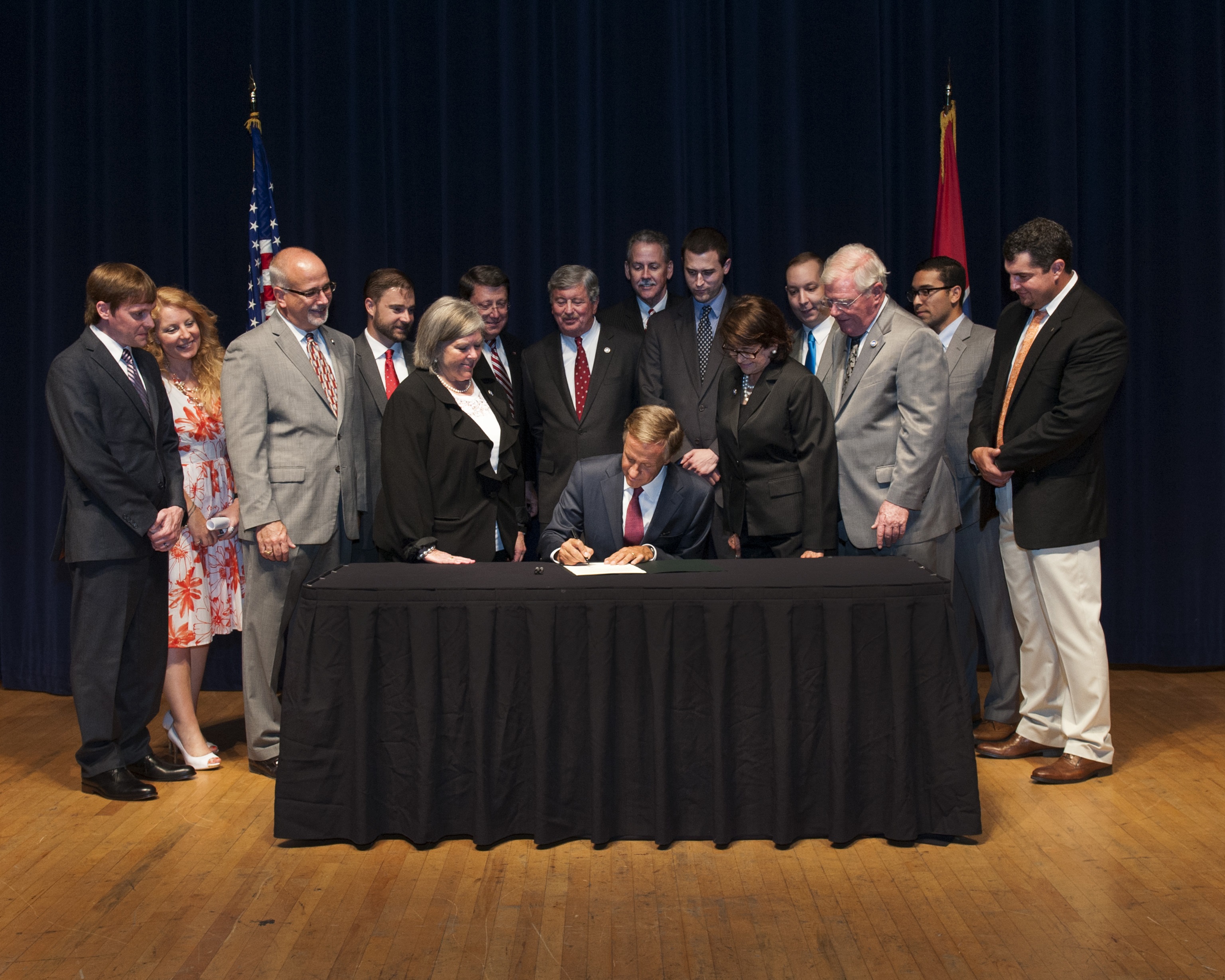
6/10/2015 Governor Bill Haslam signs SB 27

(Guest Post by Matthew Ladner)

Ryan Mahoney (Excel in Ed colleague- and the tall thin chap in the middle) sent me this happy photo of Governor Bill Haslam signing SB 27, the Tennessee ESA bill a couple of days ago.  I don’t know everyone in the photo, but do know some, including Rep. Debra Moody and Sen. Dolores Gresham (sponsors) along with Justin Owen from the Beacon Center, Jonathan Butcher from the Goldwater Institute and Daniel Zavala from Students First.


Oklahoman: School Choice is All Around

June 12, 2015

(Guest Post by Matthew Ladner)

Nice piece from the Oklahoman discussing the progress of school choice. P-Diddy Wolf consulted, which is always good. This quote got my attention:

There are essentially three policy mechanisms for providing private school choice: vouchers, tax credits, and the new kid on the block, education savings accounts (ESAs).

So choice bills continue to pass and more are to come. Hang tough and we can debate 2011 vs. 2015 after the smoke clears.


If the System Can’t Kill the Bunny with $312k per classroom, perhaps new choices will help them out

June 10, 2015

NSEA letter

(Guest Post by Matthew Ladner)

So during the recent Nevada legislative session, Nevada State Education Association President Ruben Murillo Jr. sent the above letter to the members of the Senate Finance committee. In the letter (in case you are squinting) he included the following paragraph:

However, the abundant number of overcrowded and aging campuses, high class sizes in middle and high schools, hundreds of unfilled licensed teaching positions, and an 81% non-compliance rate of the elementary class size limit law all point to the fact that Nevada’s public schools remain under-funded.

Well, that’s a little rich don’t you think? Especially given that the Digest of Education Statistics reports that inflation adjusted current spending per pupil more than doubled since 1969:

NV spending


Despite this doubling of current funding, there can be no doubt that overcrowding remains a chronic problem in Nevada. National Public Radio recently profiled Forbuss Elementary school in Clark County. Architects designed the building for 781 students, but it currently has 1,230 students, spilling out into 16 trailers. The Nevada public school system has been unable to keep up with either physical or human capital needs-thus the unfilled public school teaching positions cited by President Murillo. In the same NPR piece, a teacher in Bertha Ronzone Elementary School reports having 33 students in an overcrowded trailer classroom.

Now my excel spreadsheet says that if you multiply 33 by $9,455 you get $312,015 in current spending, with more in capital spending. How do you kill the bunny with these claws and teeth  hire a teacher for only $312,015? Sounds like they at least should not have a series of substitute teachers going through those trailer classrooms. But wait, Murillo notes hundreds of unfilled teaching positions. What’s that? Overhead?!? C’mon you’re a BEAR man!


Of course, if you can’t keep up with enrollment growth, can’t build public schools fast enough, can’t hire enough teachers, and create trailer parks outside your schools for extra classroom space, well, you’ve got problems. If the Census Bureau further projects a huge increase in your youth population and the NAEP say you only get a fraction of your students proficient this actually makes an entirely compelling case for giving as much choice as possible. Apparently the Nevada public school system needs as much help as it can get.

So Silver State legislators:

NSEA: thanks for the assist!


Randomistas Seek to Dispel Guesswork in Anti-Poverty Efforts

June 8, 2015

(Guest Post by Matthew Ladner)

Interesting article in the WSJ today on the use of random assignment studies in anti-poverty efforts. Known as “Randomistas” these economists show a lot of promising results. At one point in the article Columbia’s Jeffery Sachs attempts to pour cold water on the process:

Prof. Sachs says that “many, almost surely most, of the cutting-edge breakthroughs in actual development in recent years did not result from [randomized controlled trials].” He believes that tackling problems at the level of communities or entire societies, rather than just households, is likely to be more effective—though, he adds, randomized controlled trials should be “a part of a diverse arsenal of analytical and policy tools.”

Retorts Prof. Duflo of MIT: “The big difference between Jeffrey Sachs and us is that he knows what needs to be done, and we don’t. We’re trying to learn it.”


Pass the Popcorn: Families Versus Monsters

June 4, 2015

romance-black-widow-bruce-banner-hulk

“Thanks for asking nicely?” Brother, you hadn’t seen anything yet.

(Guest post by Greg Forster)

I don’t like to interrupt our celebration of the incomparably important victory for universal school choice in Nevada, but I have something that takes higher priority. I saw the new Avengers movie again and I have some new thoughts to add. Unlike my previous post, this one contains much more serious spoilers.

I liked this movie a lot better the second time. Before I was expecting that its deep theme would be tied to Ultron’s mission and motivation, so I was frustrated we got virtually nothing to chew on there. Loki articulated a clear and philosophically important argument against the dignity and freedom of the human person, so I was waiting for something analogous from Ultron. I see now that I was looking in the wrong place. The real action is in the tug-of-war for Bruce Banner.

In my essay on the first Avengers movie, I wrote that Banner, not Stark, is the real man of science, knowledge and Enlightenment. Those forces produce great power but cannot direct that power toward an end. While moral culture is important in its own right, ultimately it is religion that directs power toward ends. The great question of the past three hundred years or so has been the struggle of competing religions – Christianity, Romantic individualism, Marxism, fascism, etc. – to control the power unleashed by the Enlightenment. Our own culture represents a messy but reasonable working compromise between Christianity (represented by Steve Rogers) and Romantic individualism (represented by Tony Stark). The question raised by the first Avengers movie is whether that compromise can hold together.

The second Avengers movie is not the masterpiece the first one was, but I now see that it carries forward the same theme, but on totally different ground. The conflict between Rogers and Stark remains, and remains religious, as I observed before. But I was mistaken to view this as the center. A new conflict moves to center stage – a philosophical conflict rather than a religious one as such. The question is no longer science and God, but science and nature. (Although God continues to hover in the background and silently haunt this story with his presence, as he always does.)

In the first movie, the words “war” and “freedom” were featured prominently from the very first scene onward. The key themes in this movie are “monsters” and family. The movie dares not use the politically freighted word “family,” but you can hardly miss theme.

In one corner we have Tony Stark, the Romantic individualist. With clear echoes of the Frankenstein myth, he seduces Banner away from loyalty to the group, seduces him into creating a “monster.” He even says to Banner “we’re monsters” and urges him to embrace that identity. Now, in this context, a “monster” is what you get when you use science to reshape nature arbitrarily – use science not to understand nature and use it in accordance with some natural or supernatural scheme of values that tells you its proper purpose, but to manipulate nature as if it had no intrinsic or transcendent purpose. The implicit philosophy here is that science is above nature absolutely and arbitrarily – science is to nature as the potter is to the clay. Or, as another Romantic individualist once put it, “you shall be as gods.”

In the other corner we have, not Steve Rogers this time, but Natasha Romanov. She tries to seduce him as well, to seduce him away from loyalty to the group, but in this case toward the creation of a marriage. The context here is the Barton family and the clear signal it gives us – almost ham-handedly so – that (on the natural level at least) what makes life most meaningful is marriage and children. It has always been central to the Bruce Banner character that he is an outcast, bearing the burden of isolation and alienation due to his affliction. Romanov, who alone can tame the Hulk, offers him redemption. But when he finally accepts, the needs of the greater good drive them apart. Not even the family is ultimate; like Frodo, Romanov and Banner must give up their home so that others may have theirs.

And the family, of course, is the great foundation of human nature. The feminists are right to hate this movie, and not only because Marvel shamefully neglects and disrespects its female characters. (If anyone at DC had a brain, they’d be turning out Wonder Woman and Zatanna movies by the truckload to pick up these underserved customers. Alas.) I believe Whedon was probably catering to the gay lobby by making the point that marriage is meaningful even apart from childbearing. Of course, Christians have always said the same, but the rhetorical incompetence of the “new natural law” people has effectively concealed this. What Whedon apparently did not anticipate (unless he did it on purpose to court publicity) was the feminists’ offense – very justified if one takes their perspective – at the fact that Romanov’s and Banner’s lives are gravely wounded by their inability to have children.

Human nature is not, as the feminists (and the gay lobby!) would have it, infinitely malleable. It has a purpose, and when that purpose is thwarted, we suffer.

And why can’t Romanov and Banner have children? In both cases, the hubris of science that reaches past its bounds, creating “monsters.” Science is to nature not as the potter is to the clay, but as mother and father are to the child.