New Stanford Study of Academic Gains in School Districts

December 6, 2017

(Guest Post by Matthew Ladner)

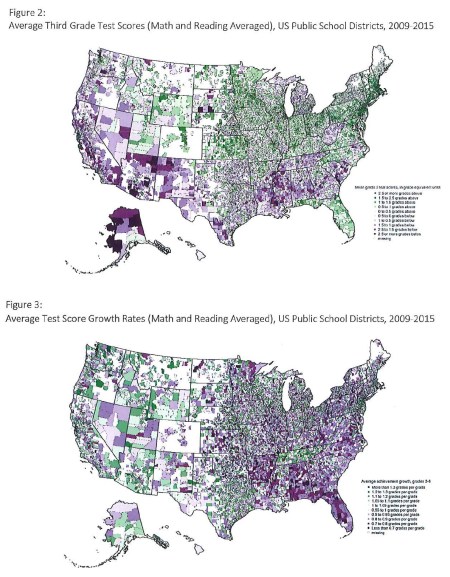
Fascinating new study from Stanford University’s Center for Education Policy Analysis using standardized test scores from 45 million students to track academic growth in over 11,000 school districts. The study tracks progress from grades 3 through 8. The money graph comes on page 33 and is included above. Just to save your eyes from squinting, let me provide a play by play: the top map shows average 3rd grade scores by district. Purple is low, green is high.

The second map shows academic progress over time between grades 3 and 8 between 2009 and 2015. Again purple is low, green is high.

Ok so just to (once again) brag on the Cactus Patch, you’ll notice that everything and anything on the top map bordering Canada looks green, anything and everything bordering Mexico from the Rio Grande Valley to So-Cal looks purple on the top map. Many decades after Senator Moynihan noted that the average performance on state tests is highly correlated with proximity to Canada, it remains the case today.

Cast your gaze down to the second map and you’ll see some signs for hope-most prominently in my book Arizona flipping from almost entirely purple to mostly green in growth. BOOOM!

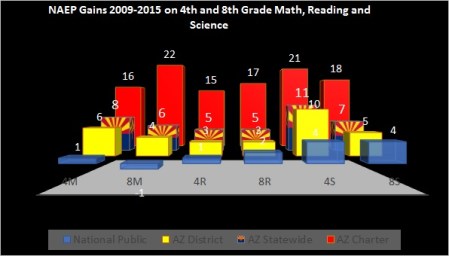
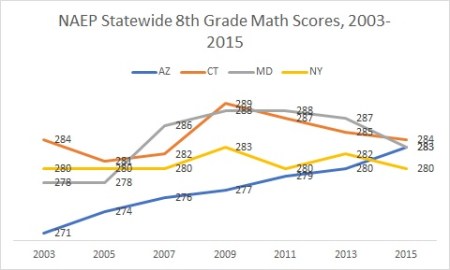
Now before I get comment section bricks thrown my way from the Dr. Eponymous, let me hasten to add that these results while relying upon state test scores, are entirely consistent with Arizona’s NAEP results in Arizona’s case. Given that there is no ability or incentive to teach to the NAEP, I feel reasonably confident that either the academic knowledge or the testing “give a darn” of Arizona students (or some combination thereof) is on the rise. I interpret either of these things as very welcome developments and I’m not overly concerned about the mixture.

It is also worth noting that since these results focus only on school districts with the highest statewide percentage of Arizona students attending charter schools, and Arizona charter schools exceeding districts in academic growth on NAEP (see below), that the above charts underestimate Arizona’s total progress between 2009 and 2015. Arizona is does the purple to green flip with only the yellow columns in the below NAEP graph (same period as the Sanford study): * see correction below

Tennessee also does the purple to green flip so bully for them. Notice that most of the Northeast starts out very green and ends pretty purple, but er, they aren’t alone in this. Cool graphic features in this NYT write up where you can plug in a school district and watch it move between 3rd and 8th grade here.

It’s too much…it’s too much winning! No Arizona we’ve got to win MOARRRRRRRRR!!!!!!!


CORRECTION : The author included charter school scores in the districts in which they operate.


David Osborne on Charter Policy

December 5, 2017

(Guest Post by Matthew Ladner)

Bob Bowdon interviews David Osborne and around the 8 minute mark the discussion raises the topic as to whether parents can lead the way in school closure. Osborne claims that parents cling to schools for non-academic reasons and should not be trusted with this task. Bowden raises Arizona as a counter-example, and Osborne cites research from five years ago that found Arizona charter schools had less than stellar results.

Osborne is correct that research from five years ago found less than stellar results. What one must appreciate however is that in a sector as dynamic as Arizona charters those results are ancient history. Charter schools are constantly opening and closing in Arizona. The studies referenced by Osborne have data that ended in 2012. In 2013 Arizona educators opened 87 new charter schools and closed 18 other schools. This alone was enough to mean that the Arizona charter school sector of 2013 was a different animal than the 2012 sector, but it was hardly the only change to happen that year. In addition to schools, teachers, students and administrators moved in and out of Arizona charter sector. Younger schools gained a year of experience, moving out of their shake down cruises. A professional football team can win the Superbowl in one year and fail to make the playoffs the next year, and there is a greater degree of year to year continuity in sports than in Arizona charters. Fortunately all the available indicators (NAEP and AZMerit) show over time improvement in Arizona charters.

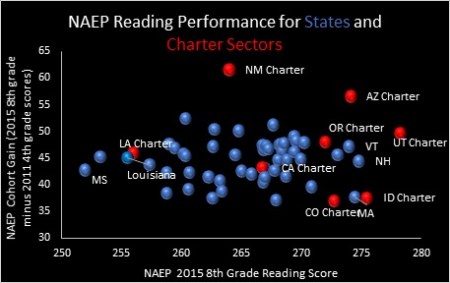
And then, it all happened again in 2014…and 2015…and 2016…and right now. Any look into academic results in a constantly changing Arizona charter sector is merely a snapshot. This makes it entirely possible for analysts like CREDO and Marty West to have found meh results in 2012 but for NAEP to show this in 2015:

This river of course runs both ways- the 2015 NAEP is just a snapshot as well. Fortunately Arizona’s charter results were also strong in the 2015 AZMerit, got better in the 2016 AZMerit and better still in the 2017 AZMerit.

Although Arizona law requires admission lotteries and Arizona charters educate a majority minority student body, there is obviously room for multiple factors to explain the above chart. Nevertheless, sometimes a cigar is just a cigar. Arizona’s AZMerit exam also shows large advantages for charter school students. In addition, school data of the sort CREDO and West relied upon five years ago is quite messy , especially when it comes to free and reduced lunch status. I won’t go into details but let’s just say that the record keeping at the Arizona Department of Education doesn’t always cover itself in glory and in addition many Arizona charter schools do not participate in the federal program at all. The use of Free and Reduced Lunch as an independent variable has grown increasingly questionable over time, but has been problematic for a long time in Arizona.

So in conclusion, Arizona charters are crushing the academic ball without the benevolent guidance of heavy handed technocrats. The same is true is several other Western states that show either high scores, high over time progress or else both of these things:

If Mr. Osborne would care to explain why westerners should abandon what they are doing to emulate Louisiana, I’m all ears but data from five years ago is of little more than historical interest to discussions of prospective policy.


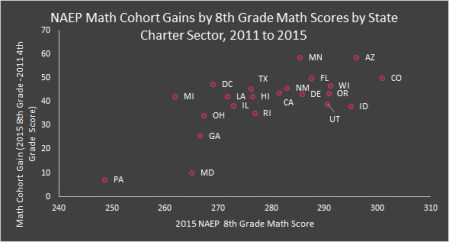
NAEP Cohort Gains by Scores for State Charter Sectors

December 4, 2017

(Guest Post by Matthew Ladner)

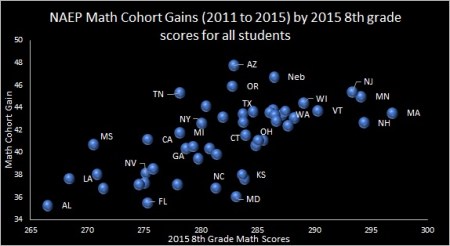
So to get into this chart you had to have a NAEP math score for your charter sector in the 2011 4th grade test, and then again for 8th graders in 2015. Many states either have no charter schools at all, or too few charter schools in 2011 (NC for example), or too few charter schools in 2011 or 2015 to make either sample. Some states fell into this lattercategory despite having venerable charter laws (yes I’m looking at you Indiana and Nevada). If you don’t see your state on the chart, keep calm and open more charter schools.

Otherwise a few notes: Pennsylvania and Maryland both look to have accidentally forgot their charter students any math between 4th grade in 2011 and 8th grade in 2015. I mean there is a few points of gain but one would expect that simply through aging. There might be something odd going on with the sampling or inclusion standards, but if I lived there, I’d be anxious to get to the bottom of it. I don’t so I’m not.

Michigan had the same progress over time as Louisiana despite the fact that Louisiana has been supported with philanthropy and TFA kids to a much larger extent.

Arizona and Colorado are sitting on the bench in the second half eating hot dogs and watching their backups brutalize their hapless opponents.


Debunking the “Michigan Charters Stink” Canard

November 30, 2017

(Guest Post by Jason Bedrick)

In The Detroit News, JayBlog’s own Matt Ladner and Max Eden of the Manhattan Institute highlight further evidence that the narrative painting Michigan charter schools as uniquely awful. Actually, as Ladner and Eden show, studies consistently find that they are outperforming Michigan’s district schools:

The first shot fired came from the opinion pages of the New York Times, where Tulane University professor Doug Harris declared that DeVos’ nomination represented, “a triumph of ideology over evidence.” He held her responsible for charter schools in Detroit, which he called “the biggest school reform disaster in the country.”

Oddly, Harris linked his claim to a Stanford study showing that Detroit’s charter schools significantly outperform its traditional public schools. He, and the rest of Michigan charter critics, also ignored studies from the Mackinac Center and Excellent Schools Detroit that also showed a substantial charter edge.

But no matter. The narrative was set. The Atlantic, the Washington PostPoliticothe New RepublicNewsweek, and others piled on: it’s the Wild West out there, there aren’t enough regulations, there isn’t enough accountability, there are too many for-profit operators. Never mind the best evidence at the time, from another Stanford study, that showed that Michigan’s charter schools outperform its traditional public schools on 52 of 56 metrics.

Add to this pile of evidence the results of the NAEP exam, showing that Michigan’s charters consistently outperform Michigan’s district schools, and a new random-assignment study finding that students enrolled in major for-profit charter network in Michigan scored higher in state math exams and reading exams than the control group.

Will the technocrats care about the empirical evidence? Ladner and Eden suspect not:

Some reformers, who claim to care solely about evidence, have already and will likely continue to ignore the evidence of Michigan’s charter school success. The reason has less to do with data, and more to do with the fact that Michigan’s charter sector isn’t tightly controlled by “experts.”

In addition to Michigan, technocratic reformers have a difficult time explaining charter school success in states like Arizona, California, Colorado, Idaho, New Mexico and Oregon. Whereas pro-regulation charter advocates give these states low grades for policy, charter schools in these states show either very high NAEP scores, very high rates of academic progress, and sometimes both. Maybe that’s because parents and teachers, given the freedom and flexibility, can do more to open good schools and close bad ones than the self-proclaimed experts. The “experts” who claim to follow the “evidence” may claim that Michigan is a failure. But the “evidence” of success makes you wonder whether these “experts” aren’t actually just ideologues.

Indeed.


TUDA Math 2011 to 2015

November 27, 2017

(Guest Post by Matthew Ladner)

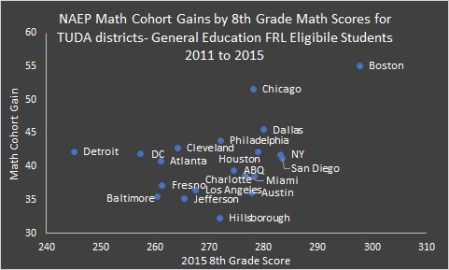
Only FRL eligible general ed students depicted here to get closer to apples to apples. Boston wins-maybe there is something to this whole curriculum thing? If so much of the rest of the country seems to be pushing on a string. Chicago looks better than I would have expected. DC strangely looks Detroitish once deprived of that whole gentrification phenomenon, and might look worse still if deprived of the charter scores.

New TUDA data due soon, so stay tuned…


In Memoriam for Parental Choice Irrational Exuberance

November 22, 2017

(Guest Post by Matthew Ladner)

I listened to the Federalist podcast this morning on my bike ride in which Megan McArdle debates Joy Pullman on school vouchers. In the discussion McArdle posits that parental choice programs allow parents to sort their kids for the purposes of being around other kids who are likely to want to go to college etc. She acknowledged that her instinct on this is informed by observation in the District of Columbia where she resides and that this has always been the case, it simply used to involve moving the suburbs. McArdle forsees a low-ceiling for choice as McArdle asserts that there are only so many good peer groups to go around, and large influxes of poor kids will lead to upper-middle class parents seeking to segregate their children elsewhere. Thus McArdle puts forward an air of jaded realism for choice as opposed to her optimistic days when she thought of parental choice as a cure for poverty. Worse still, her thesis would imply costs to choice for disadvantaged student groups.

Fortunatley, McArdle’s realism is not terribly realistic. Policy enthusiasts of all sorts and persuasions create problems for themselves when they sell their reform as a wonder drug that will cure the world’s pain and will do it today. People who buy in during the naive enthusiasm stage will invariably feel disappointed. This for instance is starting to happen with technology based personalized learning now.

The course of innovation does not run smoothly or in a predictable fashion. Technology enhanced learning may have a very bright future, but faces a messy process of sorting through things whether it ultimately proves out or not. The dot.com bubble provides a useful example. People of a certain age will recall the naive enthusiasm stage when any idiot who could mumble Silicon Valley lingo was able to get millions in venture capital funding for projects like Dogfood.com or whatever. When a great many of these dubious ventures went bust in the early aughts a fierce backlash mocked the broad notion that the internet was going to profoundly change business.

Give it some time however and no one is mocking now. The internet did profoundly change business and life and continues to do so- it just didn’t do it much by 2003, and not in the way we expected.

McArdle’s thesis combines elements of the disappointed naive early enthusiasm with a theory that those not exercising choice may be harmed by it. A large empirical literature on competitive effects however finds positive benefits from choice from students choosing to remain in district schools. The kids “left behind” in other words benefit academically from the fact that they have the possibility of leaving.

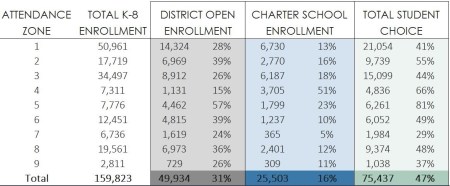
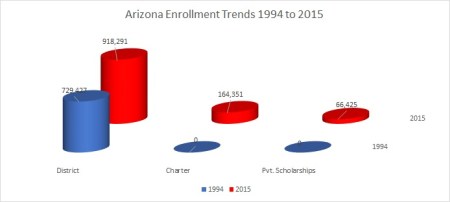
My home state of Arizona is a hot-bed for parental choice. We not only have the highest state percentage of students attending charter schools and private choice programs, recently data has come available showing that inter-and-intra district choice dwarfs both charter and private choice in the state. Arizona, a relatively low spending state (relative to other states not to its own past) that is in the midst of a border-state transition in student demographics (K-12 students ceased being majority Anglo years ago), is an odd state to be leading the nation in academic gains. Oh, well, we went and did it anyway.

Now McArdle’s thesis of tradeoffs and downsides should be visible in the academic trends for disadvantaged students. If the savvy parents are the ones exercising choice, and depriving disadvantaged kids of more ambitious peers, we might expect to see overall scores increasing but scores for disadvantaged kids sliding in Arizona’s results. Instead we see the opposite:

This of course does not prove that school choice lead to the larger than average gains, but good luck explaining how this happened if school choice were harmful to disadvantaged students.

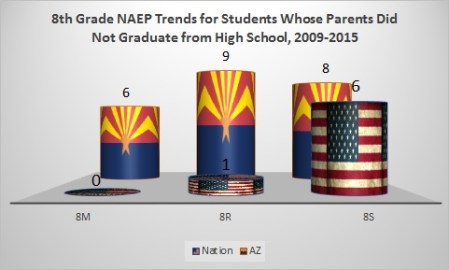
At the 8th grade level, NAEP allows for tracking student achievement by the education status of their parents. This is what it looks like for students whose parents did not finish high school for the entire period we can track all three tests:

If these charts were reversed and we saw disadvantaged children showing less progress than the national average, but stupendous gains for already advantaged kids, that would be consistent with McArdle’s thesis. If I wanted to beat the horse into horse-burger I could put up similar charts by ethnicity and disability status. You have a very, very hard time finding supportive evidence of choice harming the disadvantaged in the academic trends of the nation’s most choice happy state, or in the broad empirical literature.

Improvement of schooling outcomes maybe a necessary but hardly a sufficient step in inter-generational poverty. Choice programs have triggered a process of opening up the suburbs to open enrollment in Arizona, and they seem to be doing something similar in Indiana. The choice movement made a grave error in fixating on a particular type of school in inner cities, and then became obsessed with “accountability” when the urban-only strategy floundered.

I’m confident that the evidence will prove out that broad, inclusive programs work out better for students by hugely broadening available options relative to the necessarily limited efforts to build new charters. If you want to help inner city kids, yes you give them access to private schools and charter schools. If you really want to help them you give them access to all of that and the leafy suburbs (see above charts). You can’t force the burbs to take out of district kids, but you can create the right incentives by subjecting their (all too often complacent and underperforming) schools competition as well. You create enough competition to allow parents to close schools they don’t like. Expect backlash from reactionaries along the way. It’s not quick, it’s not easy, it lacks magical powers. It can however deliver real benefits to students and taxpayers.


That’s No Way to Run a Railroad, Subway or School System

November 20, 2017

(Guest Post by Matthew Ladner)

I’d suggest reading this fascinating article from the New York Times about how New Yorkers spend an obscene amount of money but get a subway system that is trending towards barely functional. The story is basically that the system has been mismanaged and plundered by various politicians and political interests and safety and reliability is in steep decline. The problems go much deeper than the below excerpt, but in the end the below excerpt encapsulates the overall problem:

According to a former union president, John Samuelsen, the organization has secured better deals over the past eight years than any other public labor group in New York.

“I look back with satisfaction on what, together, we have accomplished,” Mr. Samuelsen said in a September letter announcing that he was becoming the union’s international president.

Each of three deals signed from 2009 to 2017 cost more than the M.T.A. anticipated, forcing it to take money from other parts of the budget. The 2014 deal, which cost $525 million, was funded by tapping into a pay-as-you-go account that was intended to pay for capital work, former officials said.

Subway workers now make an average of $170,000 annually in salary, overtime and benefits, according to a Times analysis of data compiled by the federal Department of Transportation. That is far more than in any other American transit system; the average in cities like Boston, Chicago, Los Angeles and Washington is about $100,000 in total compensation annually.

The pay for managers is even more extraordinary. The nearly 2,500 people who work in New York subway administration make, on average, $280,000 in salary, overtime and benefits. The average elsewhere is $115,000.

Nearly 2,500 people make $280,000 per year for administering a system in deep decline. Nice work if you can get it. So if you run your school system too much like MTA runs the subway, and other states do less of that, slowly but surely you might see something like this, even if you spend twice as much per pupil:


Riding on the Trainwreck of New Orleans?

November 15, 2017

(Guest Post by Matthew Ladner)

Peter Cook brought bad news about the latest test scores from New Orleans, and used the term “train wreck” to describe the results. This was ironic as the other day I saw a quote from David Osborne’s book that claimed that states that close charter schools have charter school sectors that substantially outperform district schools. In previous looks at NACSA state charter law rankings that came out before the most recent NAEP data, something like six of the top 10 states had too few charter schools to have made it into the NAEP sample, with the top two states in the rankings (Indiana and Nevada) included in the no-scores club despite have charter laws for many years. Of the top 10 rated states, Louisiana looked to be the best of the bunch, and they were towards the bottom of the top 10.

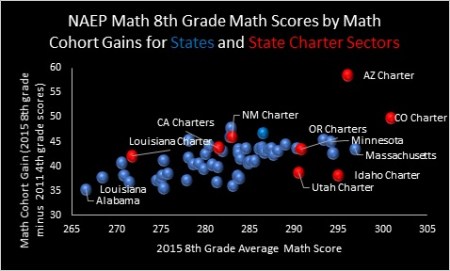
The figure below puts state charter sectors into context by comparing their 2015 NAEP 8th grade math score against their 2011 to 2015 cohort gain in scale points, and also includes all “Wild West” charter sectors. Unlike Nevada, most western states got middling to very low grades from NACSA, but can console themselves with the fact that they actually have “charter schools” generated by their “charter school law.”

Yes, okay, so well that happened. Don’t be looking for many westerners to be dropping everything their doing to emulate either Louisiana or Nevada. I remain a fan of the Louisiana RSD, as in my mind it was a very successful play to leverage the only thing New Orleans had left after the hurricane (empty school buildings) and get a system up and running. However, there is a lot of space between saying that and rushing to embrace the concept as the solution to our all of our problems.

Well, perhaps the reading results are more promising…

Nope- the reading results look very consistent with the math results. New Mexico charter school leaders just filed a petition with the Department of Cosmic Justice to protest Louisiana charters receiving much more hype but less demonstrable academic progress.

So my mutant mind reading power is reading objections in one or more of your minds. These comparisons aren’t fair! Only three of those Wild West sectors (Arizona, California, NM) have majority minority student bodies…given what we know about achievement gaps, we would not expect Louisiana charters to land on the right side of these charts. True enough unless you had a very high rate of improvement. Note that Louisiana charters demonstrate rates of improvement in both reading and math that weren’t bad, but also wasn’t either very high, or very different from the host state.

Again, this does not mean that RSD is bad. It seems to have been brilliant for New Orleans after the hurricane. That is a different question from “has it been so successful that everyone should rush to adopt them?” It is also a different question from “is this model politically sustainable in the face of predictable push-back?” or “what if Katrina hit Houston instead of New Orleans- are there that many TFA kids in the entire country?” or the question “is it possible that RSD would have been more successful without the benevolent guidance of a central command?” or most important of all “wouldn’t we be better off if we got to the point where parents rather than technocrats took the lead in closing schools?”

Some additional problems include the fact that a series of focus groups I saw earlier this year made it clear that people detest the idea of having the government shut down schools based on test scores. Oh, then there is the decisive rejection of an RSD by Georgia voters. The demos do not seem to be buying what the technos want to sell. Then there is the small matter of more recent state scores, which Peter Cook describes as a “train wreck” for RSD. Then the steady and insidious effort to essentially convert RSD back into a normal school district that seems to be going quite well for the reactionaries so far. I’m not sure about the train-wreck take, but I’m also confident that RSD is not a magic carpet made of steel, er, a solution we are likely to see politically sustained at scale.


More Regulation and Less Diverse School Options

November 14, 2017

(Guest Post by Corey A. DeAngelis and Lindsey Burke)

The first experimental evaluation to find negative impacts of a voucher program on student achievement was released to the public over two years ago. Since then, education scholars and public officials have debated whether the initially large negative effects in Louisiana could be explained by the program’s burdensome regulations. While some education policy analysts argued that the state-testing mandates and open-admissions policies deterred higher-performing private schools from participating, others contended that the program might have performed even worse without the rules in place to ensure that parents only chose high-quality educational institutions.

The discussion heated up again three months ago with the release of the Louisiana Scholarship Program’s (LSP) third-year reports showing that students using a voucher caught up to their public school peers on test scores. Just after the public release, John White, Louisiana’s superintendent of education, reasoned that “it may very well be the regulation itself – the accountability system – that is the thing that has promoted the performance.”

However, one of the third-year reports released by researchers at the University of Arkansas addressed this very issue and concluded that the heavy regulatory environment in Louisiana may have driven away higher-quality private schools from participating in the program at all.

Likewise, we just released an analysis examining whether school voucher environments in Louisiana, D.C., and Indiana affected the specialization of the private school market overall. We found that when individual private schools switch into highly-regulated voucher environments such as Louisiana, they are less likely to self-identify as specialized or nontraditional educational institutions.

Theory

Since the voucher programs in question are funded by taxpayers, the public has a legitimate interest in understanding the impact of regulations on private school function and structure. When publicly funded private school choice programs are introduced, most public officials have good intentions when attempting to guarantee that families have access to high-quality educational institutions. In a well-meaning attempt to control levels of school quality and institutional equity, policymakers require that private schools comply with regulations associated with academic quality, financial viability, and access.

Nonetheless, efforts to ensure “accountability” through regulations mirror the various policies governing traditional public schools. If government officials decide to regulate private schools operating within a voucher environment in the same way traditional public schools are regulated, the supply of schools in the private market is expected to become similar to public schools over time. Obviously, private schools that participate in a voucher program will behave more like public schools if they are required to do many of the same things: focus on state standardized tests, fill out supplementary paperwork, and conform admissions processes to the government model.

We expect that private schools in the most-heavily regulated program, the LSP, will be the most likely to experience reductions in specialization. After all, only a third of the private schools chose to participate in the LSP, while between 70 and 78 percent of private schools participated in the programs in D.C. and Indiana. The unusually low LSP participation rate may be because the program is targeted to the least advantaged children in Louisiana and requires students to take the state’s standardized tests and schools to have an open-admissions process.

Results

Every other year, private school leaders provide information about their institutions using the nationally representative Private School Universe Survey (PSS). For our analysis, we examine changes in responses to question eleven which asks school leaders to check one box that best describes their private institution. We examine whether switching into voucher program environments influences the relative likelihoods that private school leaders report that their institutions are regular, specialized, or alternative schools.

As shown in our study, three out of the four effects that were statistically different from zero were in Louisiana. After switching into the voucher program environment in Louisiana, individual private school leaders were around 4-percentage points, or about a tenth of a standard deviation, more likely to identify as regular schools. Furthermore, private school leaders in Louisiana were around 2-percentage points, or about a fifth of a standard deviation, less likely to identify as schools with a “special program or emphasis,” and about 2-percentage points, or around a tenth of a standard deviation, less likely to identify as “schools that offer a curriculum designed to provide alternative or nontraditional education.”

In addition, we found that private school leaders in the nation’s capital were about 10-percentage points, or over a half of a standard deviation, less likely to report that they were alternative schools. This may be because the D.C. voucher program was the only one that required teachers in core subjects to have a bachelor’s degree. It may be that D.C. private schools that provided a nontraditional or alternative education relied more heavily on a robust supply of diverse teachers.

No statistically significant impacts were detected in Indiana, the more lightly regulated voucher program of the three. Although Indiana private schools participating in the state voucher program are required to take the state test, the fact that most did so prior to the introduction of the voucher program in order to be eligible for the high school athletics association may have mitigated the effect such a regulation would have otherwise had on school participation.

But why does this matter? What does this mean for the education of children going forward?

Since individual student needs, learning abilities, interests, and desires are all unique, specialized services ought to lead to improved outcomes. Conversely, access to schools that mimic the district system may not offer much additional choice at all. Consequently, homogenization in the supply of schooling options could have led to the recent negative experimental impacts revealed in Louisiana.

While a hearty set of program regulations may be tempting to policymakers, especially since they give well-intentioned public officials the illusion of quality-control, the disheartening result may be a less meaningful set of choices for parents and their children.

Our results suggest that burdensome packages of regulations likely limit schooling choices in an unfortunate way. Policymakers and school choice advocates interested in establishing a robust universe of education options that are responsive to family needs and preferences should limit red tape and enable private schools to retain their unique identity and character.

###

Corey A. DeAngelis is an Education Policy Analyst at the Cato Institute’s Center for Educational Freedom.

Lindsey Burke is the Director of the Heritage Foundation’s Center for Education Policy.