Pass the Popcorn: Fresh Prince of the Fourth

July 11, 2008

(Guest post by Greg Forster)

Last week’s PTP was preempted by Independence Day, so this week we get a delayed look at the latest Will Smith summer blockbuster, which opened on July 2. As it happens, we went out and saw it last night at the drive-in, so for once I’ll have actually seen the movie I’m reviewing.

But since our focus around here is generally retrospective, I want to start with a look back at the amazing career of one of the few movie stars of his generation who’s always appealing. But, like Pixar, he wasn’t always what he is now! The Will Smith summer blockbuster machine is so effective that it’s hard to remember a time when he was just the latest fly-by-night novelty act. So join me – won’t you? – in a leisurely stroll down memory lane:
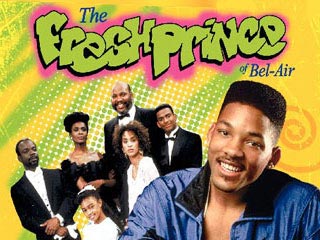
(HT Press Rewind)

Love the hat in that last one!

And who could forget this immortal contribution to the novelty genre? It’s hard for me to believe this now, but when I was 15 years old, that was the funniest thing in the whole history of the world without exception.

While we’re on the subject, is there anything more amazing, and at the same time profoundly disturbing, than the fact that the army of geeks who are the Internet have taken the time and the intelligence and the energy and all the other gifts God gave them and used them all to produce not only a detailed profile of the DJ Jazzy Jeff and the Fresh Prince act, but even one of DJ Jazzy Jeff himself? Jazzy Jeff has apparently gone on to become “an R&B producer of note,” so at least one member of the act managed to save his career after the breakup.

OK, this is all good fun, but we all know how the story ends. The crashed alien ship opens and the hideous monster appears, bent on destroying all human life it can lay its tentacles on, and then the Fresh Prince decks it in one blow, pops a stogie into his mouth and says . . .

“Welcome to Earth!”


In that golden moment, a star was born.

(Too bad the movie in which it occurred was such a comprehensive stinker; of the millions of humor e-mails that used to get circulated back when the Internet was text-based, one of the funniest I ever saw was “40 Things I Learned from Independence Day.”)

Actually, looking the man up on IMDB (carefully avoiding the entries for Will Smith, art director of one TV episode in 1998; Will Smith, writer and actor for obscure cable shows; Will Smith, actor in the 2006 movie Wormwood; William Smith, sound technician on numerous movies and TV shows for 16 years; and Will Smith, frequent appearer as himself on the program “HGTV Design Star”) I am shocked to discover that the movie Bad Boys came out a full year before Independence Day – in other words, at a time when there was no Will Smith, only the Fresh Prince of Bel-Air (which show was still on the air at the time).

The next July 4 weekend came Men in Black, which has worn extremely well and remains one of the all-time best summer movies. Don’t believe me? Get it out and watch it. If you don’t laugh your pants off, I’ll give you your money back on this blog entry.

And then, in a turn of events that has become something of a theme here on Pass the Popcorn, it all started to go wrong. First came Enemy of the State, which must have been a big comedown for Gene Hackman, who starred in The Conversation, the outstanding 1970s movie that Enemy of the State would have been trying to be if it were trying to do anything but milk money from Will Smith. And then there was Wild Wild West, which subject we shall pass by unremarked upon.

But in this case, Smith found redemption. He had always had serious acting chops and the ambition to use them, as he had proved waaaaaaaay back in 1993 with Six Degrees of Separation. So he quit making stupid movies and broadened his horizons, first with The Legend of Bagger Vance and then with Ali. No one mistakes these movies for timeless classics, but for Smith they represent the path back from the brink of the abyss.

Having rescued himself from a fate worse than death, he dove back into blockbuster territory, making Men in Black II (which was fun and did the job of killing two hours pleasantly), Bad Boys II and I, Robot. Then, after a one-year transitional return to comedy with Hitch, it was back to serious acting (this time even more serious) with The Pursuit of Happyness and I Am Legend – the latter clearly with one foot in both worlds, garnering praise for his performance as well as delivering action . . . though the angsty twist ending was changed at the last minute and what they hastily threw together to replace it makes no sense at all, landing the movie alongside Blade Runner, Dawn of the Dead, Superman II and Die Hard 4 on Cracked’s list of “5 Awesome Movies Ruined by Last-Minute Changes.”

Now we have Hancock. The critics hate it, but what do they know? I had a great time.

Skimming the pans, the main complaints seem to be 1) it contains “treacle,” and 2) it could have been much better than it was. It must be admitted up front that some treacle does occur in the movie. I found that it passed by relatively painlessly. I think that’s because the treacle is just there for setup. In order to communicate the premise in time to move on and do everything this movie wants to do, it has to paint you a psychological portrait of Hancock in double-quick time. This is done by having Hancock encounter a clean-cut do-gooder who rapidly diagnoses Hancock’s dysfunctions and explains to him why he behaves the way he does. And then we’re off to the races! It could certainly have been done with more subtlety, but I found the damage limited.
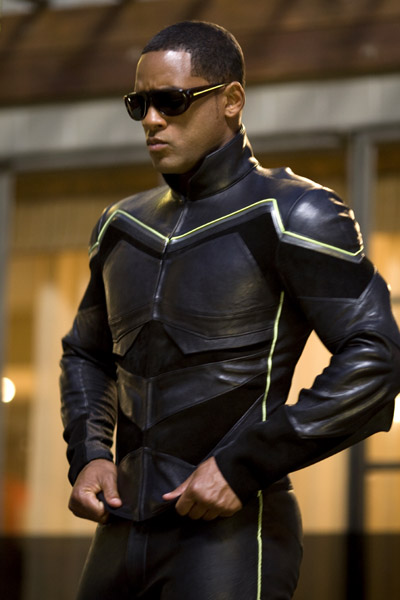
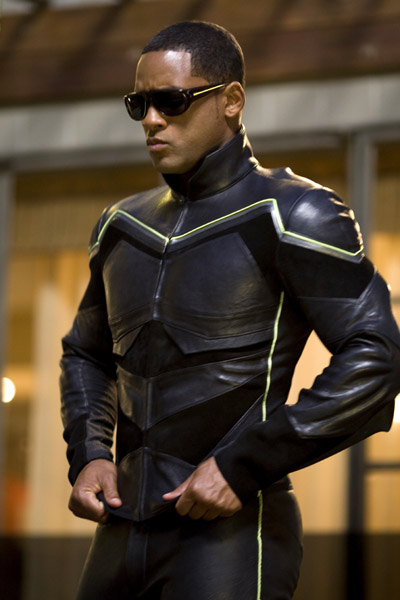
“I will fight crime . . . . . . . butt . . . naked . . . before I wear that.”

And it’s also true that this movie could have been something much better than it is – again, if it had been done with more subtlety, and if more care had been taken to keep certain plot points a little more logical, particularly in the climax. But while this isn’t the great movie it could have been, it’s still quite good if you take it for what it is. There’s a lot here to enjoy. Some of it is slapstick and bull-in-the-china-shop stuff – Hancock blundering through heroics while drunk, Hancock graphically describing to a seven-year-old (in front of his horrified mother) what he should do to the school bully – and that stuff is good, but there’s also some clever wit, especially when Hancock is trying to clean up his act with the help of a PR consultant, and we watch him walk through the same painfully artificial gestures that the same PR consultants train our business and political leaders to perform in real life, except that Hancock doesn’t have the skill they have at faking sincerity and it all comes off wrong. I doubt I’ll be buying the movie, but I thoroughly enjoyed the two hours I spent watching it.


Learn to Swim by Drowning

July 10, 2008

(Guest post by Greg Forster)

So far I’ve kept largely out of the hubbub over Reading First, but I can’t resist a comment on Stephen Krashen’s “opposing view” editorial in yesterday’s USA Today.

On the merits of Reading First I offer no opinion, but Krashen’s proposal for what we should be doing instead of Reading First is a good illustration of how little the program’s opponents are offering by way of promising alternatives.

Krashen argues that we should increase literacy by spending more money on libraries. Apparently the mere physical presence of books will help people learn how to read – by osmosis, presumably.

Actually, Krashen’s real argument is that we don’t have a problem with literacy anyway. He asserts that 99 percent of U.S. adults can read and write “on a basic level.” Thus, we should be focused on increasing people’s ability to read at a higher level – in which respect he asserts that the main obstacle is a lack of access to reading material among low-income populations.

His source for the 99 percent literacy datum is the CIA World Factbook. Insert your own joke about the CIA’s “slam dunk” intelligence on Saddam’s WMD program here.

In fact, the CIA includes all persons 15 years and older in this statistic, so we’re not just talking about “adults.” The CIA is actually claiming that 99 percent of U.S. adults and teenagers can read and write.

Clearly the CIA is defining “literacy” at such a low level as to be meaningless for evaluating the need for programs like Reading First. If the CIA considers 99 percent of U.S. adults and teenagers to be literate, then it must be counting the ability to read a stop sign as literacy. Reading First is intended to address literacy problems on a slightly more serious level.

As for the idea of spending more money on libraries, if the unspecified “studies” that Krashen asserts show literacy benefits from libraries involve scientifically valid analysis of systematically collected empirical data, then by all means let’s spare a little more money for the libraries. (In Krashen’s defense on that last point, USA Today doesn’t really offer a lot of space for specifics on what studies you’re referring to and what methods they used.)

But the alleged need for more libraries really ought to be considered separately from fights over pedagogy. The relevant question for evaluating the merits of Reading First is how we ought to be teaching reading in our schools. Unless Krashen wants to quit teaching reading in schools and just lock the kids in the library until they figure out how to read, his argument for more libraries really doesn’t speak to the question at hand. He might as well argue that since Reading First allegedly doesn’t work, we should be spending the money on hospitals instead.

All of this, of course, is separate from the question of whether spending more money on libraries really would improve literacy. In response to Krashen’s editorial, I recieved an e-mail that was circulated by Martin Kozloff of the education school at the University of North Carolina-Wilmington, who gave me permission to post it here:

This [proposal to spend more on libraries] has been Krashen’s refrain for the past 20+ years. It’s hard to argue with investment in libraries, but it feels like a bait and switch argument rather than addressing instructional needs of students.

Yes, we CAN eliminate drowning simply by building more swimming pools and then immersing the kids in water-rich environments.

“Here, ya go, Billy.” [SPLASH]

“HAAALLLLP!”

“It’s alright, Billy, you are an emergent swimmer.”

Kozloff takes quotes from critics of phonics-based instruction and substitutes swimming for reading:

“Children must develop [swimming] strategies by and for themselves.”

“Saying that we are determined to teach every child to [swim] does not mean that we will teach every child to [swim]…The best we can do … is … to ensure that, if not every child [survives a rip tide], there is a minimum of guilt and anguish on the part of teachers, students, and parents.”

“We might offer students some [floating] hints at an appropriate moment when they are [drowning] and aren’t sure how to [stay afloat].”

“[Swimming] learning proceeds naturally if the environment supports young children’s experimentation with [rip currents].”

“In my view, [swimming] is not a matter of [stroking with your arms and kicking with your legs] but of bringing meaning to [drowning].”

“Early in our miscue research, we concluded.That [the middle of an ocean] is easier to [swim in] than a [raging river], a [raging river] easier to [swim in] than a [lake] , a [lake] easier than a [pool], a [pool] easier than a [bath tub], and a [bath tub] easier than a [kitchen sink]. Our research continues to support this conclusion and we believe it to be true.”

“The worst [swimmers] are those who try to [paddle and kick] according to the rules of [physics and common sense].””In my view, [swimming] is not a matter of [stroking with your arms and kicking with your legs] but of bringing meaning to [drowning].”

“Early in our miscue research, we concluded.That [the middle of an ocean] is easier to [swim in] than a [raging river], a [raging river] easier to [swim in] than a [lake] , a [lake] easier than a [pool], a [pool] easier than a [bath tub], and a [bath tub] easier than a [kitchen sink]. Our research continues to support this conclusion and we believe it to be true.”

“The worst [swimmers] are those who try to [paddle and kick] according to the rules of [physics and common sense].” 

Kozloff is, of course, a harsh critic of whole language instruction. I have no desire to step into the phonics/whole language debate as such.

But Kozloff clearly has a point when he observes that offering libraries as an alternative to Reading First is like offering swimming pools as an alternative to a program of swimming lessons. Even if the lessons in the Swimming First program aren’t effective, it’s simply a distraction to respond by talking about the need for more swimming pools.

And quite a lot of the noise about Reading First has this quality about it – by which I mean what Kozloff calls a “bait and switch” quality. No one in the national spotlight seems to be championing whole language the way they were, say, ten years ago. If the critics think whole language is the way we should go, let them say so. If not, what are their alternative models for good pedagogy?


Eduresponses to Edubloggers

July 10, 2008

My recent posts on the release of our new study on the effects of high-stakes testing in Florida and posts here and here on the appropriateness of releasing it before it has appeared in a scholarly journal, have produced a number of reactions.  Let me briefly note and respond to some of those reactions.

First, Eduwonkette, who started this all, has oddly not responded.  This is strange because I caught her in a glaring contradiction: she asserts that the credibility of the source of information is an important part of assessing the truth of a claim yet her anonymity prevents everyone from assessing her credibility.  I prefer that she resolve this contradiction by agreeing with my earlier defense of her anonymity that the truth of a claim is not dependent on who makes it.  But she has to resolve this one way or another — either she ends her anonymity or she drops the argument that we should assess the source when determining truth.

But apparently she doesn’t have to do anything.  Whose reputation suffers if she refuses to be consistent?  Her anonymity is producing just the sort of irresponsibility that Andy Rotherham warned about in the NY Sun and that I acknowledged even as I defended her.  The only reputation that is getting soiled is that of Education Week for agreeing to host her blog anonymously.  If she doesn’t resolve her double-standard by either revising her argument or dropping her anonymity, Education Week should stop hosting her.  They shouldn’t lend their reputation to someone who will tarnish it.

Mike Petrilli over at Flypaper praises our new study on high stakes testing but takes issue with referencing comments by Chester Finn and Diane Ravitch about how high stakes is narrowing the curriculum in the “pre-release spin.”  I agree with him that this study is not “the last word on the ‘narrowing of the curriculum.’”  But to the extent that it shows that another part of the curriculum (science) benefits when stakes are applied only to math and reading, it alleviates the concerns Checker and Diane have expressed. 

As we fully acknowledge in the study, we don’t have evidence on what happens to history, art, or other parts of the curriculum.  And we only have evidence from Florida, so we don’t know if there are different effects in other states.  But the evidence that high stakes in math and reading contribute to learning in science should make us less convinced that all low stakes subjects are harmed.  Perhaps school-wide reforms that flow from high stakes in math and reading produce improvements across the curriculum.  Perhaps improved basic skills in literacy and numeracy have spill-over benefits in history, art, and everything else as students can more effectively read their art texts and analyze data in history.

Andy Rotherham at Eduwonk laments that what I describe as our “caveat emptor market of ideas” doesn’t work very well.  I agree with him that people make plenty of mistakes.  But I also agree with him that “in terms of remedies there is no substitute for smart consumption of information and research…”  There is no Truth Committee that will figure everything out for us.  And any process of reviewing claims before release will make its own errors and will come at some expense of delay.  Think Tank West has added some useful points on this issue.

Sherman Dorn, who rarely has a kind word for me, says: “Jay Greene (one of the Manhattan Institute report’s authors and a key part of the think tank’s stable of writers) replied with probably the best argument against eduwonkette(or any blogger) in favor of using PR firms for unvetted research: as with blogs, publicizing unvetted reports involves a tradeoff between review and publishing speed, a tradeoff that reporters and other readers are aware of.”  He goes on to have a very lengthy discussion of the issue, but I was hypnotized by his rare praise, so I haven’t yet had a chance to take in everything else he said.


John Rawls and Education Reform

July 9, 2008

(Guest Post by Matthew Ladner)

Matthew Miller’s book The 2% Solution utilizes the philosophy of John Rawls to make the case for parental choice in education. I’m more of a Nozick guy myself, but let’s follow the Rawls rabbit-hole down to the bottom.

John Rawls’ hugely influential work A Theory of Justice argued that societal ethics ought to be decided as if we were behind a theoretical “veil of ignorance.” Behind the veil, no one would be aware of what his or her position would be in a forthcoming society. You would not know whether you would grow up the child of a billionaire or poor in the inner city. The veil creates an incentive to leave a path out of the latter scenario. While many contest Rawls’ philosophy, it is hugely influential in left of center thinking. Does today’s system of public education remotely approach the Rawlsian ideal?

No, not even close. In fact, today’s public education system closely resembles the opposite. Today’s system systematically disadvantages the poor.

Consider the expanding body of research on teacher quality. Researchers have shown that the effectiveness of individual teachers plays a huge role in student learning gains. Examining test scores on a value added basis (year-to-year gains) has revealed that some teachers are hugely effective, while others are much less so.

What we have not had before is quantifiable evidence regarding just how important high quality teachers are in driving outcomes. Researchers examined the differences between teachers succeeding in adding value (the top 20% of teachers) and the least successful teachers (the bottom 20%). A student learning from a low quality teacher learns fifty percent less than a similar student learning from an effective teacher during the same period.

The question then quickly becomes: how do we get more teachers that are effective into the classroom? Only by making big systemic changes. Teaching is a profession with many rewards, but which has been tragically divorced from any recognition of merit. The teacher who works effectively and tirelessly is paid according to a salary schedule that will treat them identically to someone who does neither.

Job security and summers off are not big lures for the capable and ambitious sorts of people we need to attract into teaching in droves. To be sure, we have such people in our teaching ranks now, but the system treats them poorly. Our public schools do not pay them according to productivity- no rewards for success, no sanctions for failure. In short, we treat teachers not as professionals, but as unionized factory workers.

Most of our capable teachers will leave the profession frustrated, or go into administration. Those that we do keep in the classroom cluster in leafy suburbs far from the children who need them most.

What does the public system do for those children losing the Rawls lottery, who find themselves growing up in poor urban school districts? All too often, it assigns them to schools with decades long histories of academic failure. These children will serially suffer ineffective instructors.

Frighteningly high percentages of these students will never learn to read at a developmentally appropriate age. Many will never learn to read. Such students fall further and further behind each year. Unable to read their textbooks, never envisioning themselves advancing on to higher education, they will begin to dropout in large numbers in late middle school.

Fortunately, it is not hard to envision a better system. Public schools today are spending beyond the dreams of avarice for administrators from previous decades. We simply need to get a much better bang for our buck. A captive audience of students sponsors and promotes adult dysfunction in our schools. We should radically expand parental choice options for parents, especially for those for disadvantaged students.

More broadly, our students desperately need a complete overhaul of the entire system of human resource development and compensation for teachers. The system we have today largely reflects the preferences of the education unions. The education unions oppose parental choice, merit pay for teachers, alternative certification or differential pay based on teacher shortages. All of these positions are rational for a union boss, but detrimental to children.Progressives have traditional ties with organized labor, including the education unions. This marriage will not last.

Ask yourself if you would risk today’s education system from behind Rawls’ veil. There’s a good chance of being forced to go to school in the Dallas, DC, Detroit, Los Angeles, Newark or the_________ (fill in the blank with the closest large city) inner city public schools.

That sickening feeling in your stomach is telling you that those schools would not equip you with the skills you need to succeed in life. Rawls would say if those schools are not suitable for you in theory, then they are not suitable for inner city children in practice. Liberals should work closely with the education reform community in order to secure equality of opportunity for all children. Progressives can either have progress, or they can have an alliance with educational reactionaries, but they cannot have both.


Eduwonkette Apologizes

July 8, 2008

I appreciate Eduwonkette’s apology posted on her blog and in a personal email to me.  It is a danger inherent in the rapid-fire nature of blogging that people will write things more strongly and more sweeping than they might upon further reflection.  I’ve already done this on a number of occasions in only a few months of blogging, so I am completely sympathetic and un-offended.

One could argue that these errors demonstrate why people shouldn’t write or read blogs.  In fact some people have argued that ideas need a process of review and editing before they should be shown to the public.  These people tend to be ink-stained employees of “dead-tree” industries or academia, but they have a point: there are costs to making information available to people faster and more easily.

Despite these costs the ranks of bloggers and web-readers have swelled.  There are even greater benefits to making more information available to more people, much faster than the costs of doing so.  People who read blogs and other material on the internet are generally aware of the greater potential for error, so they usually have a lower level of confidence in information obtained from these sources than from other sources with more elaborate review and editing processes.  Some material from blogs eventually finds its way into print and more traditional outlets, and readers increase their confidence level as that information receives further review.

Of course, the same exact dynamics are at work in the research arena.  Releasing research directly to the public and through the mass media and internet improves the speed and breadth of information available, but it also comes with greater potential for errors.  Consumers of this information are generally aware of these trade-offs and assign higher levels of confidence to research as it receives more review, but they appreciate being able to receive more of it sooner with less review.

In short, I see no problem with research initially becoming public with little or no review.  It would be especially odd for a blogger to see a problem with this speed/error trade-off without also objecting to the speed/error trade-offs that bloggers have made in displacing newspapers and magazines.  If bloggers really think ideas need review and editing processes before they are shown to the public, they should retire their laptops and cede the field to traditional print outlets. 

We have a caveat emptor market of ideas that generally works pretty well.

So it was disappointing that following Eduwonkette’s graceful apology, she attempted to draw new lines to justify her earlier negative judgment about our study released directly to the public.  She no longer believes that the problem is in public dissemination of non-peer-reviewed research.  She’s drawn a new line that non-peer-reviewed research is OK for public consumption if it contains all technical information, isn’t promoted by a “PR machine,” isn’t “trying to persuade anybody in particular of anything,” and is released by trustworthy institutions.

The last two criteria are especially bothersome because they involve an analysis of motives rather than an analysis of evidence.  I defended Eduwonkette’s anonymity on the grounds that it doesn’t matter who she is, only whether what she writes is true.  But if Eduwonkette believes that the credibility of the source is an important part of assessing the truth of a claim, then how can she continue to insist on her anonymity and still expect her readers to believe her.  How do we know that she isn’t trying to persuade us of something and isn’t affiliated with an untrustworthy institution if we don’t know who she is?  Eduwonkette can’t have it both ways.  Either she reveals who she is or she remains consistent with the view that the source is not an important factor in assessing the truth of a claim.

No sooner does Eduwonkette establish her new criteria for the appropriate public dissemination of research than we discover that she has not stuck to those criteria herself.  Kevin DeRosa asks her in the comments why she felt comfortable touting a non-peer-reviewed Fordham report on accountability testing. That report was released directly to the public without full technical information, was promoted by a PR machine, comes from an organization that is arguably trying to persuade people of something and whose trustworthiness at least some people question.

So, she articulates a new standard: releasing research directly to the public is OK if it is descriptive and straightforward.  I haven’t combed through her blog’s archives, but I am willing to bet that she cites more than a dozen studies that fail to meet any of these standards.  Her reasoning seems ad hoc to justify criticism of the release of a study whose findings she dislikes.

Diane Ravitch also chimes in with a comment on Eduwonkette’s post: “The study in this case was embargoed until the day it was released, like any news story. What typically happens is that the authors write a press release that contains findings, and journalists write about the press release. Not many journalists have the technical skill to probe behind the press release and to seek access to technical data. When research findings are released like news stories, it is impossible to find experts to react or offer ‘he other side,’ because other experts will not have seen the study and not have had an opportunity to review the data.”

Diane Ravitch is a board member of the Fordham Foundation, which releases numerous studies on an embargoed basis to reporters “like any news story.”  Is it her position that this Fordham practice is mistaken and needs to stop?


Eduwonkette and Eduwonk Aren’t Edumarried?

July 8, 2008

The New York Sun had a nice profile yesterday of Eduwonkette.  Well, it’s not exactly a profile because Eduwonkette writes anonymously.  In the article some folks complain that her anonymity is a problem: “A co-director of the Education Sector think tank, Andrew Rotherham, suggested on his blog Eduwonk that Eduwonkette might be unfairly pretending to be unbiased because she has ‘skin in the game… It’s this issue of you got all this information to readers, without a vital piece of information for them to put it in context.'”

I think Andy’s mistaken on this. (Did they have some kind of edu-break-up?)  The issue is not who Eduonkette is, but whether she is right or not.  Knowing who she is does not make her evidence or arguments any more or less compelling.  I wish we all spent a whole lot less time analyzing people’s motives and a whole lot more time on their evidence and arguments. 

The only major problem with anonymity is lack of responsibility for being wrong.  There is a reputational price for making bad arguments or getting the evidence wrong that Eduwonkette avoids paying professionally — although she does pay a reputational price to the name brand of Eduwonkette.

Speaking of being wrong, Eduwonkette knocks the study Marcus Winters, Julie Trivitt, and I released today through the Manhattan Institute.  She complains: “It may be an elegantly executed study, or it may be a terrible study. The trouble is that based on the embargoed version released to the press, on which many a news article will appear today, it’s impossible to tell. There is a technical appendix, but that wasn’t provided up front to the press with the glossy embargoed study. Though the embargo has been lifted now and the report is publicly available, the technical appendix is not.”

This isn’t correct.  Embargoed copies of the study were provided to reporters upon their request.  If they requested the technical report, they could get that.  Both were available well in advance to reporters so that they could take time to read it and circulate it to other experts before writing a story.  Both the study and the technical report were made publicly available today (although there seems to be a glitch with the link to the technical report that should be fixed within hours).  The technical report can be found here.

And while we are on the subject of Eduwonkette being wrong, her attacks on test-based promotion policies are overdone.  The Jacob and Lefgren paper does raise concerns, but there is more positive evidence from the experience in Florida.  As I wrote in a previous post: “In a study I did with Marcus Winters that was published in Education Finance and Policy, we found that retained students significantly outperformed their comparable peers over the next two years.  In another study we published in the Economics of Education Review, we found that schools were not effective at identifying which students should be exempted from this test-based promotion policy and appeared to discriminate in applying these exemptions.  That is, white students were more likely to be exempted by school officials in Florida from being retained, but those students suffered academically by being exempted.”

Our results may actually be consistent with what Jacob and Lefgren find.  We find academic benefits for students retained in third grade.  They find: “that grade retention leads to a modest increase in the probability of dropping out for older students, but has no significant effect on younger students.”  It could be that test-based promotion is more beneficial when done with younger students.  It could also be that the policy has positive effects on achievement with some cost to graduation. 

And particularly severe problems with the integrity of test results used for promotion decisions in Chicago may limit the ability to generalize from Chicago’s experience.  In Chicago it may have been easier to move retained students forward by cheating on the next test than actually teaching them the basic skills they need to succeed in the next grade.

Besides, I’m sure that Edwuonkette wouldn’t put too much stock in Jacob and Lefgren’s non-peer-reviewed paper released straight to the public.  I’m sure she would be consistent in her view that: “By the time the study’s main findings already have been widely disseminated, some sucker with expertise in regression discontinuity may find a mistake while combing through that appendix, one that could alter the results of the study. But the news cycle will have moved on by then. Good luck interesting a reporter in that story… So as much as I like to kvetch about peer review and the pain and suffering it inflicts, it makes educational research better. It catches many problems and errors before studies go prime time, even if it doesn’t always work perfectly.”  

Or do these standards only apply to studies whose findings she doesn’t like?   If Eduwonkette isn’t careful she might get a reputation.


New Study Release Tomorrow

July 7, 2008

Keep your eyes peeled for the release tomorrow by the Manhattan Institute of a new study on the effect of high-stakes testing on achievement in low-stakes subjects. The study, led by Marcus Winters and co-authored by me and Julie Trivitt, examines whether achievement in math and reading comes at the expense of science on Florida standardized tests.  Because there are meaningful consequences for performance in math and reading, but not for the rest of the curriculum, many people have worried that schools would improve their math and reading results by skimping on science and other subjects.

These concerns are not just coming from the usual critics of school accountability.  Even accountability advocates have expressed second thoughts.  For example, Chester Finn writes in the National Review Online: “Do the likely benefits exceed the ever clearer costs? Boosting skill levels and closing learning gaps are praiseworthy societal goals. But even if we were surer that NCLB would attain them, plenty of people — parents, teachers, lawmakers, and interest groups — are alarmed by the price. I don’t refer primarily to dollars. (They’re in dispute, too, with most Democrats wrongly insisting that they’re insufficient.) I refer to things like a narrowing curriculum that sacrifices history, art, and literature on the altar of reading and math skills…”

Diane Ravtich has similarly stepped on the high-stakes brakes, expressing concern about the crowding out of other academic subjects and activities: “a new organization called Common Core was launched on February 26 at a press conference in Washington, D.C., to advocate on behalf of the subjects that are neglected by the federal No Child Left Behind legislation and by pending STEM legislation. These subjects include history, literature, the sciences, the arts, geography, civics, even recess (although recess is not a subject, it is a necessary break in the school day that seems to be shrinking or disappearing in some districts). I serve as co-chair of CC with Toni Cortese, executive vice-president of the American Federation of Teachers.”

To find out whether these concerns are supported by the empirical evidence from Florida, tune into the Manhattan Institute web site tomorrow to see the study.


Another Special Ed Post on Pajamas Media

July 5, 2008

Greg Forster and I continue the discussion of financial incentives and special education over at Pajamas Media.  This piece responds to a PJM column by Laura McKenna, which was a response to an earlier PJM column we wrote.

All of this builds on special education posts on this blog here, here, here, and here.


Another Order of Florida Reforms, Please

July 3, 2008

(Guest Post by Matthew Ladner)

In 2007, a family of four needed to earn less than $20,650 to qualify for a free lunch. In Arizona, the median family income for a family of four is over $65,000.

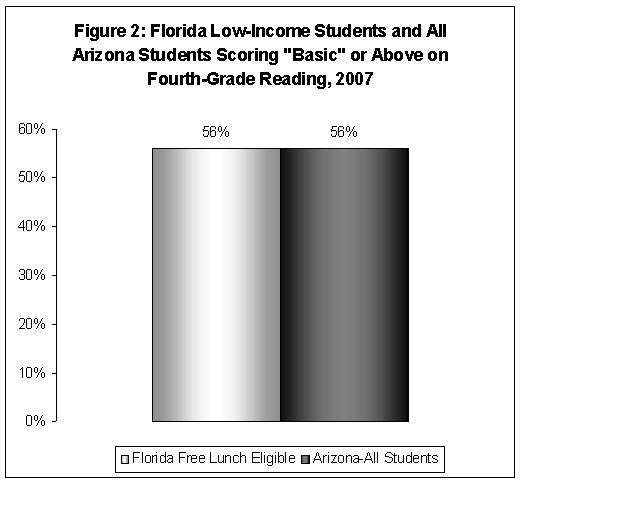
Here’s the surprising news: Low-income students in Florida—namely, those who qualify for free lunches—outperform all students in Arizona. That’s the insight to be gleaned by sifting through the treasure trove of data generated by the National Assessment of Educational Progress (NAEP), known as the Nation’s Report Card.

Figure 1 shows fourth grade reading scores for Florida students whose family income qualifies them for free lunch compared to all students in Arizona.

Figure 2 shows the percentage of Florida’s low-income children scoring basic or above on fourth grade reading and all Arizona students scoring at the same level.

You don’t need to take my word on these scores. You can go to the National Center for Education Statistics website and see them for yourself.

The point here is not to bash the underperformance of Arizona schools. Sadly, they have plenty of company. Rather, these data point to the enormity of the opportunity for improvement which we can and must achieve. Florida has found a way to significantly boost the performance of low-income students. Others should examine how and borrow everything we can.


Fortune Favors the Bold

July 2, 2008

(Guest Post by Matthew Ladner)

The Goldwater Institute released a new study today co-authored by yours truly titled Fortune Favors the Bold: Reforms for Results in K-12 Education.

The study makes the case for robust education reforms rather than incremental tinkering with a fundamentally broken system. Here in Arizona, for example, inflation adjusted spending per capita in the K-12 schools has tripled since 1960, and 44% of our 4th graders in public schools score “below basic” on the NAEP 2007 4th grade reading exam.

The kids are running around with their hair on fire, while we adults wonder whether to use a cup or a bucket of water to put out the flames. It’s time to use the fire hose.

The four reforms proposed:

  • A universal system of choice, either through vouchers or a universal tax credit. Despite having among the nation’s most robust system of private and public school choice, choice programs have simply absorbed about of the third of the increase in the public school population since the charter law passed in 1994. Arizona could enjoy substantial academic and financial benefits from passing a far bolder choice program than anything currently on the books, and we would still be building new public schools.
  • Reforming Public School Governance. Charter schools make up nine out of the top 10 high schools in the greater Phoenix area, and the 10th is a magnet school. Not a single district school cracks the top 10, with charters enormously overrepresented. The lesson is clear: good schools need a district bureaucracy like a fish needs a bicycle. Schools can and should govern themselves, freeing resources for instructional use.
  • Reform of Testing. Standardized testing has jumped the shark in Arizona and elsewhere. We put forward a proposal on how to preserve the transparency and diagnostic value of testing even when states respond to pressure to dummy down their tests.
  • Measure Teacher Effectiveness on a Value Added Basis. William Sanders’ path-breaking work on value added assessment shows that students learn 50% more over a three year period with highly effective teachers compared to those stuck in classes with the bottom 20%. Dr. Sanders finds that variation attributable to teacher performance is 10 to 20 times greater than that associated with class size. Further, high-quality teachers are too rare and clustered in the leafy suburbs. Value-added measurement serves as a pre-requisite for rational and just treatment of teachers as professionals and improving learning for children.
  • Jeb Bush put in what seemed like a radical set of reforms in Florida in 1999, and they have paid huge dividends. The time has come not only for other states to emulate Florida, but to reach further, and do more. Fortune favors the bold and American education reform dithers between being misguided, pointless, and too timid.