
(Guest Post by Matthew Ladner)
Joanne Jacobs has this week’s Carnival of Education.
 1 Comment |
  blogging | Tagged: Carnival of Education |
  Permalink
 Posted by matthewladner
(Guest post by Greg Forster)
On NRO yesterday, David Freddoso, author of The Case Against Barack Obama, launched a broadside against Obama as a faux education reformer. I have no interest in dissecting the details of Obama’s record on education, but Freddoso’s line of attack on the subject of teacher pay seems to me to miss the point.
Freddoso begins by quoting Obama asserting that schools in a Chicago neighborhood were closing early because the district couldn’t afford to pay teachers for a full day. Freddoso notes that teachers in that neighborhood are paid an average of $83,000; more than a quarter of them make over $100,000. (These figures don’t include administrators, who make even more.) Somehow, Obama managed not to mention this when bemoaning the district’s inability to pay for a full school day.
Freddoso may well be right about what’s happening that particular district; I don’t know. However, he goes on to build a more general case that Chicago teachers citywide are making big bucks while the system destroys children’s lives, and therefore Obama’s close alliance with the Chicago teachers’ union is similar in kind to his alliances with Tony Rezko, the Chicago machine, and other practitioners of “systemic corruption.”
I certainly agree with Freddoso that the government school monopoly, in Chicago as everywhere else, consumes large quantities of taxpayer money while destroying children’s lives. I’ll also agree that the teachers’ unions bear a lot of the blame. But is the size of teacher salaries a serious problem?
Freddoso says the entry level salary for a Chicago teacher is $43,702 plus $3,059 in pension contributions. Is that really so much, considering that 1) Chicago is an urban area, where the cost of living will be high, and 2) teachers have to have a college degree and specialized training in order to enter the profession?
Freddoso goes on to note that once these starting Chicago teachers gain four years’ experience, they’ll make $60,000, not including increases for additional education credentials. Since the large majority of teachers do pursue (educationally worthless) additional credentials in order to get these “pay for paper” salary increases, it would be good to know how much those salary increases are worth in Chicago. But setting aside that question, given that the empirical evidence suggests teachers get significantly more effective in their first few years, a bump up to $60,000 doesn’t seem all that bad (remembering again that we’re in an urban area).
In short, while teachers in Chicago – like teachers nationwide – are certainly paid well, they aren’t benefitting from “systemic corruption” a la Tony Rezko or the disgraced management of Fannie Mae and Freddie Mac or the “Friends of Angelo” at Countrywide, all of whom are connected to Obama.
Yet Freddoso writes about teacher pay as though being a teacher is some sort of scam. “Chicago teachers have terriffic pay and hours, and summer vacations,” and we should ask whether Obama’s link to the Chicago teachers’ union is “corrupting,” since this link is “part of a much braoder pattern that characterizes his political career, as with his backing of Chicago’s machine bosses, his sponsorship of legislation and earmarks to help such donors as Tony Rezko, and his support for special-interest subsidies in Washington.”
Freddoso is right that in addition to salary, teachers enjoy extremely strong job protection and shorter work hours, and this should be factored in when we consider whether or not they are “underpaid.” Still, it’s hardly fair to lump them in with Tony Rezko. Moreover, if the issue is not per se whether teachers are well paid, but accountability for the use of taxpayer funds (as the “corruption” meme suggests), then teachers’ job security and summer vacations don’t seem very relevant.
The real problem with teacher pay is not size, but technique. That is, it’s not primarily how much we pay, but how we pay. Teachers in the U.S. aren’t paid like professionals, they’re paid on a factory worker scale, with ability and performance totally unrelated to compensation. (Even calling this a “factory worker” scale is unfair to factory workers, since many factories have now adopted some reforms to the old pre-globalization pay system.) And it’s this pay structure, not the amount we pay, that’s the real problem. The system is designed to attract the lowest performers – since high performers can always earn more elsewhere while low performers always earn more by becoming teachers.
Freddoso mentions the subject of merit pay in passing, but only so he can assert that, on account of his alliance with the union, Obama’s merit pay plan is a toothless tiger. Whether it is or it isn’t, merit pay is a much more important issue than pay levels. If pay were tied to performance, high teacher salaries would be good – in fact, given the large role that teacher quality has been shown to play in student outcomes, if pay (and hiring) were linked to performance I would say the current pay levels would be too low.
Having said I would steer clear of evaluating his record as a whole, I will note that Obama’s openly supporting merit pay represents real progress, even if we agree with Freddoso that this support is only for show. It’s more of a show than any previous Democratic nominee has made, if I’m not mistaken (though I don’t trust my memory too far on this). Obama was actually booed by the NEA when he mentioned his views on differential pay during his speech accepting their endorsement. He didn’t have to mention teacher pay reform in his endorsement acceptance, but he did. That counts for something.
It’s also worth mentioning that the unions benefit far more than individual teachers from the direction the system has been moving in. Over the past few decades, while teacher salaries have stagnated, the number of teachers hired by the system has soared. That’s a mixed bag for teachers – it presumably means less work for each teacher, but it also exerts downard pressure on salaries. However, it puts big bucks in the unions’ pockets, with no real downside for them.
If I had to guess, I’d say Freddoso is overreacting against the widespread claim that teachers are “underpaid.” Since teachers are in fact well paid, this myth certainly does grate on anyone who knows the facts – especially so since this myth is even more obviously at odds with the facts than most education myths, and yet (or perhaps I should say “and therefore”) challenging it tends to produce an especially nasty and vicious response.
But let’s not get drawn into the opposite error. As Martin Luther is said to have said, if a man falls off his horse on the left side, the next time he rides he’ll fall off on the right side. Teachers aren’t paid too little or too much – they’re paid the wrong way. The problem here isn’t teachers, it’s unions.
6 Comments | politics, teacher pay, teacher quality, teacher union | Tagged: Barack Obama, David Freddoso, Greg Forster, NRO, teacher pay | Permalink
Posted by Greg Forster

(Guest Post by Matthew Ladner)
A few weeks ago I wrote a Pass the Popcorn on an underappreciated cinematic gem: Truck Turner. Now we have the sad news that Isaac Hayes has passed away at the age of 65.
I had the chance to see Isaac Hayes perform in Las Vegas about 5 years ago. He brought the house down. One song he sang, more spoke really, was about his intention to give his woman a back massage, a foot rub and a warm bath. I have never seen so many middle aged women go bananas in my life.
Some standing advice I give to people is that if you have the chance to see a legendary performer on stage, do it. I’ve yet to be disappointed by an Isaac Hayes, Tony Bennett, Tom Jones or Ramones concert. You just don’t know that you’ll ever get the chance again, and longevity is a strong predictor of greatness.
Happy trails Mr. Hayes. You’ll be missed.
7 Comments | Pass the Popcorn, tributes | Tagged: Isaac Hayes, Truck Turner | Permalink
Posted by matthewladner
Last week I had a post observing that high school reading lists were much less likely to contain feminist critiques if those critiques were of non-Western societies, such as Ayaan Hirsi Ali’s Infidel.
Later last week, the Wall Street Journal reported that Random House had cancelled the imminent publication of a book that it had under contract that was a fictionalized history of one of Mohammed’s wives. Random House engaged in this self-censorship out of “fear of a possible terrorist threat from extremist Muslims.”
Once again we see a double standard in the treatment of non-Western subjects. Where is the American Library Association (ALA) to denounce this self-censorship? The ALA rightly advocates against efforts to restrict the kinds of books that are available and maintains a list of the most frequently “challenged” books. They preface that list with a quotation from Judy Blume: “[I]t’s not just the books under fire now that worry me. It is the books that will never be written. The books that will never be read. And all due to the fear of censorship. As always, young readers will be the real losers.”
The ALA saw the need to issue a statement to denounce censorship in the wake of the 9/11 attacks. When will they release a statement denouncing Random House’s decision not to publish a book that they had deemed worthy of a $100,000 contract because they were bullied by threats of violence?
2 Comments | civic values | Tagged: American Library Association, censorship, Jay Greene, Jay P. Greene | Permalink
Posted by Jay P. Greene

(Guest post by Greg Forster)
We’re now on our fourth issue of the series and we haven’t said anything yet about Heath Ledger. That was intentional, for three reasons.
First and most important, there’s not much interesting to say, or at least not that I can say. It’s obviously a virtuoso performance, and would have been a career-making breakthrough. Ledger was clearly one of the most talented performers of his generation, and it’s a shame he never reached his potential until the end of his abbreviated career.
Beyond that, what’s to say? If I were in the acting business, I could no doubt analyze the performance and say more about what makes it great. But I lack even the rudamentary ability to do so, and I’m not interested in bluffing.
Second, too much of the chatter about Ledger and this performance is shallow and feels exploitative of his death, and I don’t want to contribute to that.
And third, I think Ledger’s masterpiece contribution is overshadowing other contributions. I don’t want to take away any of the honor Ledger has justly earned, but for this movie to be what it is, a whole lot of people had to turn in top-flight performances.
Back in Issue 1, commenter Captain Napalm mentioned Aaron Eckhart and Gary Oldman – both of whom were indeed outstanding. I’ve just praised Morgan Freeman in Issue 2, and Michael Caine’s contribution shouldn’t be overlooked – one of the most important differences between a good film and a great one is that all the little things are done right, as well as the big ones. Caine and Freeman didn’t get the big drama, but they delivered fantastic little gems – “We burned down the forest” is one of the most memorable moments in the movie. So is “You have no idea.”
Everyone – by which I mean the handful of movie geeks whom I personally know – seems to agree that Christian Bale had essentially nothing to do in this movie. The first movie was about Batman, not the villains, so the villains were (as I mentioned last time) unmemorable. This movie was about the Joker, so Batman was unmemorable. But serving as the Joker’s foil is something. The Joker carries the movie, but he can’t do that if Christian Bale doesn’t act well his part, wherein all honor lies. Imagine this movie with Ledger playing opposite George Clooney – or even Michael Keaton, who I thought did surprisingly well as Tim Burton’s Batman, but would have been totally inappropriate as Chris Nolan’s. (And let’s also acknowledge that “I’m not wearing hockey pants” was well delivered.)
And naturally we should be crediting Chris Nolan. Having done a little amateur acting, I know how much a director contributes to an actor’s performance – or doesn’t. When any six actors, even six really good ones, all deliver a top-notch ensemble performance, it’s as much the director’s work as theirs.
Above all, though, we should be thanking the writers. Think about every scene you remember of Ledger. Isn’t it the brilliant lines as much as the brilliant performance that make this movie so amazing? “When you think about it, I knew your friends better than you did. Would you like to know which of them were cowards?” That’s really brave writing. And of course, all those clever one-liners we’ve been taking notice of in this and previous issues had to come out of somebody’s keyboard before they could come out of Morgan Freeman, Michael Caine, etc.
You do know who wrote the movie, don’t you?
Chris Nolan shares the screenplay credit with his brother Jonathan Nolan, and shares the story credit with David Goyer. The Nolan brothers also co-wrote Memento and The Prestige (which came out between Batmans). Goyer has a long track record on comic book movies that includes Blade and co-writing Batman Begins with Chris Nolan, as well as sole story credit on Batman Begins. And of course Frank Miller should get a nod for his influence.
All that said, Ledger did pull off an amazing feat. In addition to what’s on the screen, consider how much prior baggage he had to overcome with the Joker character:

First Appearance!

The Clown Prince of Crime

The Ultimate Psychopath: “Whatever’s in him rattles as it leaves.”
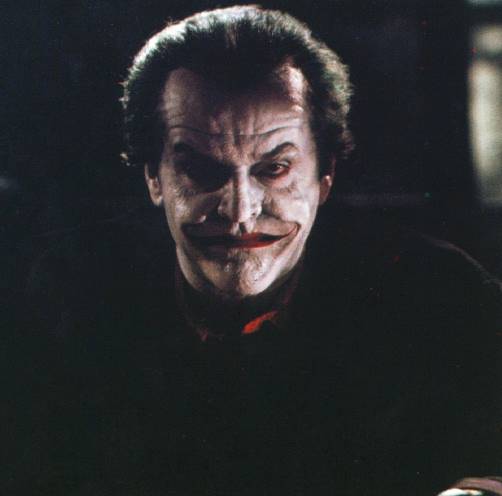
The Outer Edge of Insanity

(Wrong “Joker,” moron!)
A lot of people thought no one could play the Joker after Nicholson, particularly not the star of A Knight’s Tale. Nicholson himself, for one. He said as much, as The Dark Knight was approaching release. I wonder if he repented after he saw the performance.
7 Comments | Pass the Popcorn | Tagged: Batman, Best of Greg, City of the Dark Knight, Greg Forster, Pass the Popcorn, The Dark Knight | Permalink
Posted by Greg Forster

Bad movie, but nice leg-warmers
(Guest Post by Matthew Ladner)
So all the movies I’ve seen lately have been in the fair to mediocre or worse categories, so let’s try something different with the greatest they’re so bad that they are great films. Holding down the number one seed in the Eastern bracket: Xanadu.
Where does one even start in describing the horrible greatness of Xanadu? Perhaps with the plot, such as it is? Okay, why not?
So there is this frustrated album cover artist who tears up a sketch and throws it out the window. The wind takes the pieces across town to a mural of the Twelve Muses, who magically come to life to the sounds of the Electric Light Orchestra!
After dancing around a bit, the Olivia Newton John muse roller-skates off to help her frustrated artist find love and set up a roller disco with the help of Gene Kelly. Along the way there are a few dream sequences, random incidences of characters bursting into song and transforming into animated characters, and a confrontation with the gods of the ancient Greek pantheon.

Totally inexplicable animation sequence complete with ELO tune!
Okay, so this is my guess on how this movie got made. Grease had just made a fortune, but John Travolta was off making another contender for this category Urban Cowboy. The Hollywood guys said, “okay, get ONJ, make up a plot involving roller-disco, don’t sweat the details. That guy from The Warriors can be the lead. No not the ‘Warrrriors!!! Come out to play-ay!’ guy, the strong silent type lead guy! He’s perrrfect for a musical!”
“Oh, and call Gene Kelly and get him out of retirement! Someone in this movie has to be able to dance!”
Words cannot describe what happened next, but in their place, I offer the super-duper unbelievably something final scene from Xanadu. Enjoy if you dare:
6 Comments | Pass the Popcorn | Tagged: Olivia Newton John, Pass the Popcorn, Xanadu | Permalink
Posted by matthewladner

(Guest Post by Matthew Ladner)
[Editor’s note — See new post on “Broader, Bolder” here.]
P.J. O’Rourke once described the early Clinton administration as “running the country by dorm-room bull session.” Some recent ferment among education progressives makes me wonder if they too have fallen back onto some old college habits. Catherine Johnson over at Kitchen Table Math for instance wrote on Randi Weingarten’s first speech as AFT President. Weingarten engages in NCLB bashing, and then lays out a vision for the future of public education:
“Imagine schools that are open all day and offer after-school and evening recreational activities and homework assistance … and suppose the schools included child care and dental, medical and counseling clinics, or other services the community needs,” Ms. Weingarten said. “For example, they might offer neighborhood residents English language instruction, GED programs, or legal assistance.”

Personally, I’m trying to imagine a system of public schools that could teach 4th grade kids how to read after spending $40,000 or more on their education. In 2007, 34% of American public school 4th graders scored below basic in reading on the NAEP. If we can’t trust schools to teach kids how to read, just why would we want them trying to fix our teeth or attempting to resolve our legal issues?
Weingarten echoes the “bigger and bolder” crowd, who seem to believe that schools can become more effective by becoming less focused on academics. Given the AFT opposition to standardized testing, these schools social welfare centers will ideally be free to thrive without the burden of academic transparency.
This of course is precisely the wrong direction to take. Paul Hill recently conducted a series of studies for the Gates Foundation concerning the stubborn lack of academic progress despite increased public school spending. After a series of studies, Hill reached the conclusion:
“…money is used so loosely in public education – in ways that few understand and that lack plausible connections to student learning – that no one can say how much money, if used optimally, would be enough. Accounting systems make it impossible to track how much is spent on a particular child or school, and hide the costs of programs and teacher contracts. Districts can’t choose the most cost-effective programs because they lack evidence on costs and results.” (Hat tip: Nevada Policy Research Institute’s Steven Miller)
Summarizing then, public schools have yet to do a cost-benefit analysis on the nearly $10,000 per year per child they are already spending. They therefore have a very poor idea about which of their activities help achieve the goal of producing a well educated child, and which do not. They, in essence, just do what they do, which certainly helps explain how a school system could burn through tens of thousands of dollars without teaching a child to read.
Let me be specific. In Arizona, 44% of 4th graders score below basic in reading. Despite that fact, we have elementary school days that include a regular coursework in art, music and physical education. These offerings are of course enriching and wonderful for many children. Why however would a 3rd grader who can’t read be taking courses in art or music? We know that children not gaining basic literacy skills in the early grades are all but doomed to academic failure.
Could it be the case that schools should reallocate their resources under the theory that one’s lifelong ability to appreciate music and art would be greatly enhanced by learning how to read?
We’ve got quite a problem to sort out here and I will submit that the last thing we would want to do is get schools even less focused on academic achievement. It isn’t hard to imagine burning through even more money while still failing to teach basic academic skills to large numbers of kids: schools have been doing it for more than 40 years.
(edited for typos)
13 Comments | myth of helplessness, school accountability, teacher union | Tagged: American Federation of Teachers, Cheech and Chong | Permalink
Posted by matthewladner
(Guest post by Greg Forster)
In this recent post, I noted that a blogger had cited a datum for private school tuition levels in the U.S. in 2003-04, attributing it to NCES. Since I knew that tuition levels aren’t collected in the Private School Universe Survey, and that the most recent datum I’d seen from NCES was from 1999-2000, I wondered whether the blogger had mistakenly used an old datum, or if NCES was putting out new private school tuition data and I missed it.
Turns out it was neither! Well, not really.
I’ve been offline for a few days while moving, and when I got back I discovered a very nice note from Bill Evers at IES. He says NCES does indeed still collect private school tuition data, but in the Schools and Staffing Survey, not the Private School Universe Survey. (You can’t tell your surveys without a scorecard.) It’s collected every four years.
But I don’t have to feel bad about missing it, because the updated data haven’t been incorporated into the NCES web tables yet. If you know exactly where to click, though, you can access it.
Many thanks to the good people at IES for 1) collecting the data we need, which is a huge job that they do very well, and 2) taking a minute to straighten me out on this question. I’ve said some hard things about IES’s recent misadventure publishing that HLM study of private schools, but I hope nobody doubts my respect for their work in all other regards.
Leave a Comment » | vouchers | Tagged: Greg Forster, IES, NCES, private school tuition | Permalink
Posted by Greg Forster
Brilliant.
(HT, Stuart Buck and Lydia McGrew at http://www.whatswrongwiththeworld.net/2008/08/great_video_clip_on_government.html#comments )
4 Comments | vouchers | Tagged: Jay Greene, Jay P. Greene, Lydia McGrew, school choice, Stuart Buck, vouchers | Permalink
Posted by Jay P. Greene
Well, not really. But I’ve come across two relatively new Arkansas-based blogs (at least they are new to me). One is The Arkansas Project, written by David Kinkade, Freeman Hunt, and Dan Greenberg. Greenberg is a state representative who shares my interest in the naming of public buildings. The other is the eponymous blog, Freeman Hunt. And speaking of the symbolic power of names, Freeman Hunt appears to be her real name.
They join the extremely high quality blog written by Stuart Buck at The Buck Stops Here.
1 Comment | journalism | Tagged: Dan Greenberg, David Kinkade, Freeman Hunt, Jay Greene, Jay P. Greene, Stuart Buck, The Arkansas Project | Permalink
Posted by Jay P. Greene

 Jay P. Greene's Blog