
Pass the Popcorn: Payback’s a Bitch

December 19, 2008

 vesper-1

(Guest post by Greg Forster)

Last weekend I finally got to see Quantum of Solace. I had heard it wasn’t as good as Casino Royale, so going in, I tried to manage my expectations.

“It doesn’t matter whether it’s as good as Casino Royale,” I told myself. “It’ll be fun, and it’ll probably be better than just fun, and that’s better than most movies. I’ll just enjoy what’s on the screen without worrying about what’s not.” That’s how I try to approach most movies.

It wasn’t enough.

Don’t get me wrong. Quantum of Solace is not a bad movie. I enjoyed most of the two hours I spent watching it. However, not only was there a tremendous amount of lost potential – an approach to the Bond story that could have taken the francise to a whole new level – but there were actually some pretty significant stretches that I couldn’t enjoy even on the level of fun or coolness.

quantum_of_solace-table

These data over here illustrate the precipitious decline of cool gadgets in James Bond films, as measured by both quality and quantity. I’ll move this electronic display across the tabletop just by moving my hand, so the audience will momentarily forget that this table-computer thingy is not an adequate substitute for a buzzsaw wristwatch.


The lost potential here is pretty darn serious. Casino Royale not only gave us a really cool  Bond movie, but the setup for what could have been a two-part (or longer) serious epic story arc- the first real epic storyline in the franchise.

vesper-2

I can’t find it now, but in the runup to the new movie, some fan put together a desktop wallpaper image of Vesper Lynd with the tagline “Payback’s a Bitch.” That got me more excited to see the movie than anything in the official advertising – Bond both loves and hates Vesper (“the bitch is dead”) and thirsts for revenge on her killers even as he hardens his heart against all natural human affection.

bond-and-vesper-shower1

Quantum of Solace does try to redeem that promise, and there are some really good moments. The very last thing Bond does before the end credits roll is a really shocking twist – not so much a plot twist as a “character twist” – that works perfectly. It violates our expectations pretty radically, yet resolves the story perfectly, though not in the way we had thought.

And about two-thirds of the way through the movie, there is a scene that pays tribute to a famous moment in an earlier Bond movie that could have been incredibly cheap and derivative, but is pulled off with note-perfect direction and ends up being extremely effective.

There are also a number of great dialogues in the movie. Bond’s intereactions with M at the beginning are great – Judy Dench is finally permitted to do more than scowl at Bond, and her talents unexpectedly provide real depth to the M character here. And there’s a short but really powerful scene between Bond and Felix Leiter, about which more later.

But while there is some good action, some coolness, and several good moments that show us the epic this movie could have been, the movie not only doesn’t fulfill its potential, it frequently doesn’t even work on the level of standard Bond movie.

It wasn’t just the absence of a decent villain – although that flaw alone is more than enough to shame any director who makes a Bond movie.

 quantum_of_solace-villains

That guy on the left? Literally the instant he came on the screen I was scared of him. He’s in the movie for about five minutes. The loser on the right is the “villain.”

One does wonder just what has to happen to a man to cause him to make a James Bond movie with a lame villain. All action/adventure movies, but especially Bond movies, depend on the personality of the villain; his cunning is needed to test the hero’s wits, his ruthlessness to test the hero’s courage, his power to test the hero’s strength, his evil to test the hero’s good. The lame villain would have prevented the film from reaching anything like its full potential even if there were no other flaws.
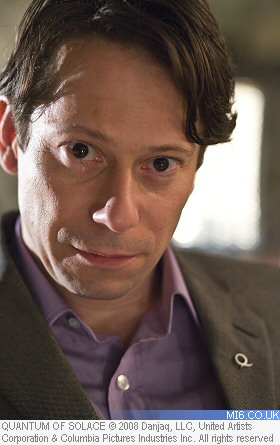
quantum_of_solace-villain

He’s supposed to be scary. I’m told that if you stare long enough you’ll start to see it, like those “magic 3D” posters from the 90s. Anyway, I think they were going for “creepy guy who makes your skin crawl,” but they got “bug-eyed pervy loser.”


It wasn’t just the gaping holes in the plot. In case you’re curious, those holes arise primarily because the filmmakers decided to give the movie an environmental theme. I say “theme” because the movie is not at all didactic about the environment. They were smart enough to avoid that trap. But they wanted the evil scheme to somehow involve the environment, and what they came up with (I won’t spoil it, though really there’s not much to spoil) doesn’t pass the laugh test.

As for the lengthy scene in the middle of the movie that takes place at a radically avant-guarde European opera performance, while many (including my wife) found it annoying, I actually didn’t mind it.

quantum_of_solace-opera

I can see why they put it in – just like they put in that scene at the “dead bodies” museum exhibit in Casino Royale. They’re trying to reintroduce the tone of the older Bond movies that was simultenously highbrow and exotic. Flying off to Brazil (or wherever) used to be something only the rich could do, and for those who couldn’t do it, it was a little like flying to Mars. Today, when the Bond audience is comfortably upper-middle class and airfares to just about everywhere in the world are within their reach, it’s hard to take Bond to esoteric places. While the scene probably doesn’t work as well as the director hoped it would, I think it’s serviceable.

But now back to the flaws.

It wasn’t just the movie’s anti-Americanism. Here the movie is didactic, alas. One winces to hear the mass-murdering psychopath Haitian dictator Aristide discussed (though he is identified by a generic description and not by name) as a saint. And the filmmakers don’t seem to be aware that the Aristide whom they so admire was returned to office by U.S. power after being deposed in a coup.

But the damage here is pretty radically mitigated by several factors. First, it’s obvious that they felt they had to have something left-wing in there to counterbalance the fact that the movie’s villain is a phony environmental philanthropist, which might be taken as a critique of certain real-life phony environmental philanthropists. (“I did learn something about the environment from this movie,” my wife said to me afterward.  “I learned not to trust people who claim to be acting on behalf of the environment.”) There’s a sense, or at least I had the sense, that when they denounce American imperialism, they do so out of a sense of obligation. Second, on some occasions America really has been guilty of the kind of evil attributed to it here – although one wonders whether either the filmmakers or the audience are aware of who the real perpetrators of those evils were (and are), and which of the two political parties they tend to be clustered in.

But most importantly, Felix Leiter is given an opportunity to point out that if America has sometimes done nasty things, it is, on balance, not the world’s worst offender. In a Bolivian bar, Bond snorts, “you guys have carved up this place pretty well,” and Leiter spits back, “I’ll take that as a compliment – coming from a Brit.” Even by the standards of civilized nations, America stands up pretty well.

bond-leiter


In the Bond films, Felix Leiter has always stood for America. He lacks Bond’s air of elegant sophitication and savior-faire, but also Bond’s arrogance and hard-heartedness. Bond is the advanced-but-decadent Old World, Leiter is the plain-but-decent New.

Watch, for example, the first few minutes of Goldfinger, and see how differently Bond and Leiter treat the girl in the bikini by the poolside. If you’ve studied your Tocqueville, you know how to pick out the American in any crowd of men – he’s the one who talks to women like they’re human beings, not property.

On the subject of Felix Leiter as representative of America, it’s almost amazingly appropriate that the Felix Leiter character has switched races – and not for the first time, if you’re prepared to accept the quasi-official Bond film Never Say Never Again, where Bernie Casey took the role. Race is the most distinctive aspect of the American experience, so it’s fitting that the representative American should be alternately black and white. America is as much the slick East Coast sharpness of Jack Lord in Dr. No as it is the wry “aw shucks” Midwestern charm of Cec Linder in Goldfinger; America is also the simultaneous smoothness and bluntness of Jeffrey Wright.

leiter-1

“Felix Leiter – a brother from Langley.”

leiter-2

leiter-3

I’ll go out on a limb and say that if Quantum of Solace had to be the first ever anti-American Bond film, it’s appropriate that the task of sticking up for America’s good name should fall to a black Felix Leiter. Those who hold themselves out as representatives of black America often don’t have much good to say about America, but that was not always the case, and if I may trust my personal experience, I find black Americans to be among the most intensely patriotic. Indeed, they’re almost the last sizeable population group among the core politically left groups who obviously mean it with all their hearts when they protest that they, too, love their country. And that’s not at all surprising – around the world, we are discovering that those who have been deprived of their liberties are the ones who cherish them most, while those who have long enjoyed liberty come to take it for granted. Why should we surprised to discover this at home? True, it was against American oppression that American blacks had to fight to gain their liberties, but now that they have liberty, they cherish it, and will not allow it to be lost. And they know that America, even with all it has done wrong, stands for liberty as no other nation does, or ever has.

But now, again, back to the flaws.

I think the main flaw in Quantum of Solace is the mandate that a sequel must be bigger and flashier than the original. Where Casino Royale centered around a card game and gave us intrigue, cunning, dialouge, and character development, Quantum of Solace is nonstop car chases, explosions, etc. Everything has to be bigger and blow up more spectacularly. That just doesn’t leave any time for the revenge plotline to develop properly.

This flaw is badly exacerbated by the poor editing and bad pacing of the action sequences. Each individual camera shot is too short, while each action sequence as a whole is too long. Because of the rapid-fire editing that spoils so much of the action, someone has called this “Bond for the ADD generation.” But I disagree; no one with ADD would have had the patience to sit through these interminably long action sequences. I barely had the patience to sit through them myself.

I wish I could say that this movie is good but not great. As I said, it’s not a bad movie. I enjoyed watching it, for the most part. But I just can’t bring myself to type that it’s a good movie. Looking at my grand unified field theorem of Bond movies, I’d have to say that where Casino Royale was “Reboot Awesomeness,” Quantum of Solace has skipped right past the “Still Good” phase and landed squarely in “Passable,” alongside The Spy Who Loved Me and The World Is Not Enough. That doesn’t bode well for the next one.

But remember the tagline to the end credits of every Bond movie: “James Bond will return.” And so he shall.


Eformray Ealismray

December 18, 2008

drevil3

(Guest Post by Matthew Ladner)

Well, a few days after I begged my friend Mike Petrilli to ixnay on the averickmay alktay now he has labeled the Fordham position on federal education policy making as “Reform Realism.” Get it- it’s a lot like “smart growth!”

Don’t get me wrong, even a crusty “Local Controller” like me finds things to admire about the Fordham position. But easplay, no more inguisticlay inspay!

In addition, I thought the Senate voted down national standards 98 to nothing in the late 1990s. Perhaps this is a new fantastic version of realism- but who knows what will happen next?


Akili Smith with Tenure

December 18, 2008

(Guest Post by Matthew Ladner)

Malcolm Gladwell weighs in on teacher quality, certification and value-added analysis in a must read article drawing attention to the similarities between teaching and the NFL draft.

Now, lots of people like to bust on the San Diego Chargers for drafting Ryan Leaf with the second overall pick in 1998 (one pick behind the great Peyton Manning btw).

Personally, I think the Bengals taking Akili Smith with a similar high pick the next year represents an even more tremendous screw up, and the Bengals turned down the Ricky Williams deal from the Saints to draft a guy who threw 5 touchdowns and 13 picks before getting cut. Instead, the could have had the Saints entire 1999 draft and a couple of high 2000 picks just to move down a few spots.

But I digress. Gladwell’s point is an excellent one: no one can figure out which college QB will translate into the pros, and no one can seem to figure out who will make an excellent teacher. Get them in the classroom and figure it out, but don’t give Akili Smith tenure.


You have GOT to be kidding me

December 18, 2008

490_3_large

(Guest Post by Matthew Ladner)

Now the Universities, whose costs have been outpacing health care inflation in recent years, are begging for a bailout. There’s gall, and then there is breathtaking gall, and then, there is this nonsense.


PJM on the Incredibly Interesting Uninterestingness of Arne Duncan

December 18, 2008

boring-world-of-niels-bohr1

(Guest post by Greg Forster)

This morning, Pajamas Media carries my column on the selection of Arne Duncan as Obama’s education secretary. At first, I agreed with Jay’s assessment that the choice is a boring subject, but after thinking about how boring it is, I now find it fascinating:

It really is amazing how totally uninteresting — how completely devoid of any possible justification for paying attention to it — the choice of Duncan for education secretary is. In fact, the selection has succeeded in fascinating me by achieving such an unprecedented level of anti-fascinatingness. It repels my interest so strongly that I can’t stop thinking about it.

Not that this means I’m wowed by the pick:

If Duncan is acceptable to everybody, that’s another way of saying he’s the lowest common denominator. And as a great education reformer once said: “Woe to you when all men speak well of you.”


Teacher Certification: Ineffective, Counterproductive and Possibly Racist…

December 17, 2008

(Guest Post by Matthew Ladner)

…but other than that, it’s swell!

Let’s start with ineffective. Super chart! below from the Brookings Institute, you will recall, shows average gain scores in mathematics for three different groups of teachers: traditionally certified, uncertified and alternatively certified:

gordon-1-7398851

The differences between the three groups are far, far, far, far smaller than differences within each of the three groups. Schools keeping out the uncertified and alternative certified teachers on the right side of the curve are doing a grave diservice to their students.

Next, let’s look at evidence from Paul Peterson and Daniel Nadler’s recent Education Next piece on certification.

ednext_20091_70_table1

There is some suggestive evidence that alternative certification programs help state teaching forces look more like the ethnic composition of their states. Another way to put this might be to say that requiring people to take 30 hours of course work for no apparent reason (see Super Chart! above) may have a disproportionate impact on minority students. Or, put another way, genuine alternative certification seems to provide more opportunity for minorities to enter the teaching profession.

Now “racist” is a tricky term. Some argue that the SAT exam is racist, as it has a disproportionate impact on minorities. From what I understand, the SAT does successfully predict college success to a large degree, while teacher certfication does not predict student gains (see Super Chart! above).  If so, by my way of thinking, the SAT is not racist, while teacher certification may be, de facto.

Let’s put it another way: if SAT scores don’t predict college success any better than certfication predicts successful teaching, I’ll happily join the chorus calling to eliminate the exam.

Finally, Peterson and Nadler show that the 21 states who have done more than symbolic alternative teacher certfication have made larger than average gains on NAEP.

ednext_20091_70_fig3

This of course does not prove that alternative certification caused the faster gains, but they certainly didn’t prevent these gains. Florida, a leader in alternative certfication, has about half of their new teachers coming from alternative routes. As you can see, it doesn’t seem to be hurting their academic achievement.

florida-arizonaAs the figure below shows, Florida’s free and reduced lunch eligible students now outperform the statewide average in my home state of Arizona.

As one of Jay’s neighbors once said, it’s time for a change in how we train, recruit and compensate teachers.


Saba: Advance on All Fronts!

December 17, 2008

(Guest Post by Matthew Ladner)

Dave Saba of the American Board for Certification of Teaching Excellence (and of Friday Fish Porn fame) recommends that education reformers adopt a comprehensive education reform plan to improve public schools with as many credible strategies as possible.  A must read.


School Voucher Mythbusters

December 17, 2008

mythbusters_collection3

(Guest post by Greg Forster)

A while back, I posted this to help people find comprehensive lists of the research on various subjects related to school vouchers. It’s a list of lists – in case you’re looking for a list of all the available research on whether vouchers improve education for the kids who use them, or whether they improve public schools, and so forth. Some of the lists are more scholarly and contain a lot of technical information, while some are presented in a more easily accessible format.

Well, here’s a big update on the list-of-lists front: the Friedman Foundation has released a set of “myth buster” guides to the research on the six most common school choice myths. For each myth they’ve provided a brief, handy reference sheet and a slightly longer, more detailed guide to the research. Even the detailed version of each myth buster is still less technical than the other lists on my “meta-list” page, compiled by Jay and other scholars, but it does go over the most important technical issues (how do we distinguish the impact of vouchers from the impact of other factors like family influence?) and provides the references you’ll need to dig further if you wish.


Myth: Vouchers hurt public schools and take the best and brightest.

Research: Short version, detailed version.


Myth: Private schools aren’t really better than public schools.

Research: Short version, detailed version.


Myth: Vouchers will lead to increased segregation.

Research: Short version, detailed version.


Myth: Private schools are hostile to tolerance and democratic values.

Research: Short version, detailed version.


Myth: Vouchers are costly and drain money from public schools.

Research: Short version, detailed version.


Myth: Private schools exclude difficult students.

Research: Short version, detailed version.


Take note that these are true comprehensive lists, including all high-quality studies on each of these questions. I’ve noticed that it’s always voucher supporters who are willing to discuss all the evidence, while voucher opponents typically cherry-pick the evidence, mischaracterize the evidence they’ve cherry-picked, and then falsely accuse voucher supporters of cherry-picking evidence.

So I would say Jay’s theory about why school vouchers keep winning against impossible odds is well supported by the empirical evidence – although in this case I haven’t compiled a comprehensive list.

What stronger breastplate than a heart untainted!
Thrice is he armed that hath his quarrel just,
And he but naked, though lock’d up in steel
Whose conscience with injustice is corrupted.

Henry VI, Part II, Act 3, Scene 2


Most Annoying Education Blog Topics of 2008

December 16, 2008

Here are my top 5:

1) Who will be Obama’s education secretary?  OK, now we know it is Arne Duncan.  Can we stop now?

2) Who is Eduwonkette?  It’s Jennifer Jennings.  Can we now concentrate on whether what she writes makes sense or not?

3) Where will Obama send his kids to school?  It’s Sidwell Friends.  Next the People Magazine-type education bloggers will want to know whether he wears boxers or briefs.  Oh wait.  We’ve been through that before.

4) Should we push choice or instructional reform?  They’re both good together.  Will the next invented, self-destructive fight be about whether we should have Popeye’s chicken or cajun mash potatoes?

5) End of year lists.

UPDATE:  OK, I know that I said I was sick of the ed sec talk, but now that we know who it is I guess there is actually something new to say.  And Mike Petrilli has the best analysis I’ve seen, here.  I especially like that it is a 5 point list.


Al Copeland: Humanitarian of the Year

December 15, 2008

Al Copeland  may not have done the most to benefit humanity, but he certainly did more than many people who receive such awards.  Chicago gave Bill Ayers their Citizen of the Year award in 1997.  And the Nobel Peace Prize has too often gone to a motley crew including unrepentant terrorist, Yassir Arafat, and fictional autobiography writer, Rigoberta Menchu.   Local humanitarian awards tend to go to hack politicians or community activists.  From all these award recipients you might think that a humanitarian was someone who stopped throwing bombs (sort of like the pleasure of stopping to hit yourself in the head) or who you hoped would picket, tax, regulate, or imprison someone else.

Al Copeland never threatened to bomb, picket, tax, regulate, or imprison anyone.  By that standard alone he would be much more of a humanitarian.  But Al Copeland did even more — he gave us spicy chicken.  You see, Al Copeland was the founder of the Popeyes Chicken chain.  Copeland was a humanitarian because he developed a product that people really wanted and voluntarily paid for.  The Dr. John jingle says it best — “Love that chicken from Popeyes!”

By developing a product that people enjoyed, Copeland was able to build a chain of restaurants that served millions of customers while employing tens of thousands over his career.  Making products that people want and giving people opportunities for employment isn’t just a good strategy for making a profit, it’s also a morally desirable activity.

I’ve intentionally selected the founder of something as mundane as a spicy chicken restaurant chain to make this point.  The entrepreneur doesn’t just benefit himself.  He or she also benefits humanity.  Making new and better things improves the human condition.  Even spicy chicken makes life better.

It’s true that the entrepreneur also benefits from making something new or better, but that in no way diminishes from his or her contribution to humanity.  Life is not a zero-sum game in which one person’s improvement necessarily comes at the expense of someone else.  When the entrepreneur succeeds, customers enjoy a good product, employees enjoy their wages, and the entrepreneur enjoys a profit.  The invention of something new or better allows everyone to win.  

Al Copeland  didn’t always win.  When his company acquired Church’s Chicken, they bit off more than they could handle and had to enter bankruptcy.  But bankruptcy doesn’t mean that you put assets in a big pile and blow them up.  Popeye’s restructured and continues to operate, so we continue to enjoy the legacy of Al Copeland’s creation.

Al Copeland enjoyed his legacy as well.  He spent his fortune on a fleet of racing boats and cars.  He decorated his Louisiana mansion with such an elaborate Christmas display that it attracted thousands of visitors as well as a lawsuit from neighbors.  Undeterred by the failure of his first two marriages, Copeland married a third time in a lavish ceremony complete with a fireworks display.  The man lived large.

The fact that he sometimes failed in business, failed in his personal relationships, and often spent his money on frivolous pleasures still does not prevent him from being more of a humanitarian than many who receive such awards.  No matter how he failed or wasted, he still developed something that improved people’s lives.

And let’s remember that the more typical recipients of humanitarian awards are not completely selfless.  Even if they don’t have money squirreled away in Swiss bank accounts like Yassir Arafat, or ego-gratifying constant attention like Bill Ayers, they usually receive some sort of compensation for their actions.  Being rewarded in no way diminishes their accomplishments any more than it does the entrepreneur.  The only question is whether they really do things that help humanity — even with something as mundane as spicy chicken.

Al Copeland passed away this year from a rare form of cancer.  As flawed as he was (and aren’t we all) he was a great humanitarian.