Get Lost 8

January 30, 2009

110898_043

“The name is Faraday. Daniel Faraday.”

(Guest post by Greg Forster)

 I’m finally caught up on the new season of Lost. Some thoughts:

1) From “Libby says hi” to “Nice to meet you,” Lost is worth the investment for the humor value alone.

2) Once again, I rejoiced in the return of the real Hurley.

3) Jay is right that we shouldn’t try to suss out the “rules” of the show’s universe. Unfortunately, the show itself seems to feel the need to gesture in that direction – hence Juliet explains that “whatever you have with you” travels with you through time. That’s just asking for trouble. What counts as something you have with you? Do you have to be touching it? What about the backpacks? Their clothes touch the backpacks but they don’t – and of course if you say that anything touching your clothes also goes, why does “stuff you have with youness” traverse clothing but not other objects (say, for example, the Island itself)?

They’d have been better off taking an attitude more like this:

4) Why was Ben lighting a candle in the church?

5) Did you notice that Richard wears eyeliner? It’s pretty blatant. Maybe that’s the fashion for men some time in the future and he forgot to take it off when he came back. Or maybe he’s not really ageless at all – he just looks permanently youthful (like Dick Clark used to) because he has great makeup.

6) In the Lostverse, judges will issue court orders requiring people to give blood samples without revealing who’s asking for the sample or why – but if you walk into Oxford University off the street and ask to go through their employment records, they’ll open them right up for you.

7) Once again, for a man with unlimited cash and an army of goons who’s made tons of enemies and tampered with terrifying occult powers, Widmore’s security really bites.

But I don’t get that scene. How come Desmond thought Widmore would give him the address? How come Widmore gave it to him? I thought the whole reason Desmond and Penny were on the run was because her father was hunting them down. Why didn’t Widmore grab him and turn him over to the goons to beat Penny’s location out of him? If they’re not running from Widmore, why are they hiding? “Somebody toss me a frikkin’ bone over here!”

8 ) Forster’s Iron Law of TV Nerds: If a merely “recurring” nerdy comic relief character becomes a regular fixture of the show, he will gradually morph into a badass action hero who wins the affections of smoking hot chicks. This law derives its inexorable operation from the fact that all TV shows are written by people who are themselves nerdy comic relief characters in real life.

Mark my words, by the time Lost is over, Daniel Faraday will have killed some bad guys, and at least one other attractive female will demonstrate affection for him.

Also known as the Wesley Wyndam-Price Axiom.

nerdy-wwpwesleywyndampryce

Wesley Wyndam-Pryce, Feb. 1999; Wesley Wyndam-Pryce, May 2004

HT Buffy Guide and Wikipedia


School Unions Impeached, Removed

January 30, 2009

blagojevich

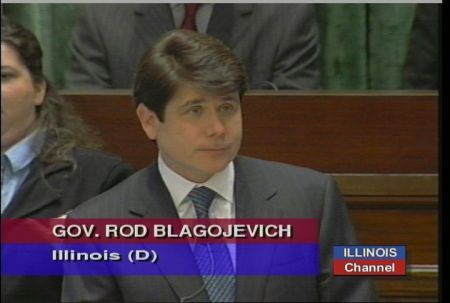
“At least they’re not as corrupt as I am” – Rod Blagojevich gives a dramatic last-minute speech defending the unions.

(Guest post by Greg Forster)

WASHINGTON – In an unexpected turn of events, yesterday morning the U.S. House of Representatives voted to impeach the nation’s teacher and school-staff unions. By the end of the day, the U.S. Senate had convicted on all charges, removing the unions from office.

In the bill of impeachment, the unions were charged with the “high crime and misdemeanor” of “destroying the futures of millions of American children in order to keep the gravy trains running on time.”

“Once we all got together and decided to put our selfish desire for re-election aside and make education policy on the merits, the rest was obvious, so we said, ‘Why wait?’ ” said Speaker of the House Nancy Pelosi (D – Ca.).

Senate Majority Leader Harry Reid (D – Nv.) added that universal vouchers, merit pay, the abolition of tenure, principal control over personnel rules and decisions, and objective evaluation of curricula would all be enacted by the end of the day today.

“They’re all no-brainers,” he said. “We’ve known all along, of course, but at last we can finally say it, and do what’s right for our children.” Pelosi added, “It’s so liberating!”

The sudden change is sending shockwaves through the education policy world.

“What are we going to do with ourselves now?” asked Robert Enlow, president of the Friedman Foundation for Educational Choice, at a press conference. “The battle’s over. I’ve just gotten word from the board that me and all my staff are fired. And nobody can get jobs in this economy.”

“I hear Wal-Mart is hiring,” said noted researcher Jay Greene at the same conference.

Congressional leaders attributed the change of direction to the accumulated power of the idealistic rhetoric of recently-inaugurated President Barack Obama.

“We’ve just heard so much about setting aside partisanship and doing the right thing for so long,” said Pelosi. “Two years of constant bombardment finally broke through our cynical shells. We all just cracked.”

The president was quick to issue a statement on the unions’ removal.

“I am committed to schools,” he announced. “We all must be committed to schools. We must hope for change without changing our hopes. We must bridge the divides without dividing the bridges.”

“Yes, we can!” the president added.


All Hail!

January 29, 2009

all-hail

(Guest post by Greg Forster)

I guess they heard how much money is going to be thrown at schools in the stimulus.

Hat tip to Jim Geraghty, who quips, “I would have preferred a zombie warning.”


Please Ignore the Academic Catastrophe Behind the Neo-Sustainable Curtain of Experiential Innovation

January 28, 2009

(Guest Post by Matthew Ladner)

What is it we want from state universities? I’m a bit confused by things like this clip from Arizona State University: University as Entrepreneur.

The video goes through plenty of buzzwords: innovation, entrepreneur, empowerment, experiential, sustainability and (my favorite) New American University. The proper definition for entrepreneur, however, is “a person who has possession of an enterprise, or venture, and assumes significant accountability for the inherent risks and the outcome.”

Who then is being held accountable for the fact that 72 percent of Arizona State University students fail to graduate on time? The word that comes to mind when I see a 28% four year graduation rate isn’t innovative, empowering or entrepreneurial but rather “unfocused.”

Education Trust identifies six peer institutions for ASU based on a variety of factors: Michigan State, Indiana Bloomington, Purdue, Central Florida, LSU A&M, and the University of Arizona. ASU is tied for last place with a six year graduation rate with (ahem) the University of Arizona at a decidedly underwhelming 56.4 percent.

Michigan State, IU and Purdue all have a six year graduation rate over 70 percent. I therefore strongly suspect that each of these universities are doing substantially more to further economic development in their respective states.

I’m a fan of the Old American University- the kind that would rigorously train students at a small fraction of today’s cost and in a four year time span.


Holy Crap!

January 28, 2009

gregg20ave2011

Fayetteville has been hit by an incredible ice storm that has knocked us out of commission.  Above is a photo taken by Brian Kisida of his street near the university.  Everyone should appreciate power and heat while they have it.


Cincinnati Enquirer on EdChoice: Good Story, Bad Headline

January 28, 2009

(Guest post by Greg Forster)

On Saturday the Cincinnati Enquirer ran a story on how Ohio is sitting on a bunch of student outcome data for the EdChoice voucher program and neither doing anything with them nor releasing them to researchers who could do something with them. I’m told it was picked up by AP.

The story is generally good. Transparency is always preferable. Student privacy concerns do limit the extent to which the state can release data to the general public, but the state ought to be able to release a lot more than it has, and it also ought to license private researchers to use more sensitive data on a restricted basis, just as NCES does.

The story’s author, naturally enough, wanted to provide what little data are available. So she provided the number of EdChoice students who failed the state test in each subject.

Readers of JPGB probably already know this, but any outcome measurement that just takes a snapshot of a student’s achievement level at a given moment in time, rather than tracking the change in a student’s achievement level over time, is not a good way to measure the effectiveness of an education policy. A student’s achievement level at any given moment in time is heavily affected by demographics, family, etc. Growth over time removes much of the influence of these extraneous factors (though obviously it doesn’t remove absolutely all the influence, and further research controls or statistical techniques to remove these influences more are preferable).

Moreover, EdChoice program is specifically targetd to students in the very worst of the worst public schools. These are students who are starting from a very low baseline. We should expect these students’ results to remain well below those of the general student population even if vouchers are having a fantastically positive effect. So the need to track students over time rather than simply take a snapshot of their achievement levels is especially acute here. Only a rigorous scientific study can examine whether the EdChoice voucher program is improving these students’ performance – and to do that we’d need the data that the state is sitting on.

Also, a binary measurement of outcomes (pass/fail) is never as good as a scale. The state is sitting on scale measurements of the students’ performance, but from the Enquirer story it appears that it won’t release them.

And the Enquirer was only able to obtain these pass/fail results for 2,911 students out of about 10,000 served by the program.

All that said, I don’t blame the Enquirer for reporting what few data were available. The story is focused on the state’s stinginess with data, not the performance of the program as such.

But what headline did the paper put on the story?

“Ed Choice Students Failing.”

Of course the story’s author doesn’t choose the headline. And the person who did choose the headline almost certainly had to do so under intense deadline pressure, without much space to work with, and with no knowledge about the issues other than what could be gleaned from a very quick and superficial reading of the story. Still, since the story clearly focuses on the issue of the state’s sitting on valuable data without using them, you would think they could come up with something like “Voucher Data Not Used.”


Excavating the Little Rock

January 28, 2009

the-little-rock

HT Wall Street Journal

(Guest post by Greg Forster)

Continuing the Arkasas theme, the Wall Street Journal has a fascinating story today about the little rock for which Little Rock was named.

And continuing the theme of government spending, the story notes that $650,000 is about to be spent to excavate the remains of the original little rock for public display. $350,000 of the money was privately raised, the city is kicking in $100,000 from bonds, and the county is kicking in $200,000.

My more libertarian-leaning friends may scoff at that, but I’m for it. Even Adam Smith insisted that it’s important for government to spend money to “maintain the dignity of the state.” He meant all the lavish pomp that surrounds the king and Parliament, but this is the American equivalent of that – it’s affirming the role of our shared past (even in the form of a rock we dug up out of the mud of the Arkansas River) in the foundations of our nationhood.

UPDATE: Of course, it’s not my money, so it’s easy for me to support spending it.


Somewhat Disappointed Aggie Fan

January 27, 2009

(Guest Post by Matthew Ladner)


Critical Thinking About Critical Thinking

January 27, 2009

snakeoil553.jpg

Fayetteville Public Schools have been hypnotized by Tony Wagner’s The Global Achievement Gap.  They’ve bought 2,000 copies, which they’ve distributed to administrators, teachers, and members of the community.  They’ve organized three public discussions of the book.  They are bringing in Wagner himself.  And they’ve indicated that they would like to use this book as a guide for planning a new high school and other changes.

My colleague, Sandra Stotsky, applies her critical thinking skills in today’s Northwest Arkansas Times to Wagner’s call for more emphasis on “21st Century Skills,” like critical thinking, adaptability, and creativity, and less emphasis on subject content:

“Who can argue against teaching students ‘agility and adaptability’ or how to ‘ask good questions?’ Yet these ‘skills’ are largely unsupported by actual scientific research. Wagner presents nothing to justify his list except glib language and a virtually endless string of anecdotes about his conversations with high-tech CEOs.

Even where Wagner does use research, it’s not clear that we can trust what he reports as fact. On page 92, to discredit attempts to increase the number of high school students studying algebra and advanced mathematics courses, he refers to a ‘study’ of MIT graduates that he claims found only a few mentioning anything ‘more than arithmetic, statistics and probability’ as useful to their work. Curious, I checked out the ‘study’ using the URL provided in an end note for Chapter 3. It consisted of 17, yes 17, MIT graduates, and, according to my count, 11 of the 17 explicitly mentioned linear algebra, trig, proofs and/ or calculus, or other advanced mathematics courses as vital to their work – exactly the opposite of what Wagner reports! Perhaps exposure to higher mathematics is not the worst problem facing American students!

Similarly, while I agree with Wagner that too many public schools fail to teach ‘effective oral and written communication,’ I am utterly puzzled by his contention that teachers’ obsessions with teaching grammar, test-prep and teaching to ‘the test’ are the problem. Really? Which English teachers? A lot of parents would kill to get their children into a classroom where they knew the teacher cared about grammar, or at least was brave enough to try to teach conventional sentence structure and language usage.

As for too much testing in schools, another of his complaints, Wagner again cites no relevant research. On the other hand my colleague Gary Ritter finds that here in Arkansas public schools the most tested students – those in grades five and seven – spend only 1 percent of total instructional time being tested, probably less time than spent in class parties or on field trips. And without testing, how can we figure out what our students know, and which programs successfully teach them?

Wagner’s book is engaging and sometimes points to real defects in American schools. Yet it fails to use research objectively to ascertain what is truly happening in America’s 90,000 public schools. Moreover, like all too many education ‘reformers’ Wagner is simply hostile to academic content. Wagner does not seem to care if students can read and write grammatically, do math or know something about science and history – real subjects that schools can teach and policy-makers can measure.

Unfortunately, Wagner dismisses measurable academic content while embracing buzzwords like ‘adaptability’ and ‘curiosity,’ which no one could possibly be against, but also which no one could possibly measure. Do we really care if our students are curious and adaptable if they cannot read and write their own names? “

I have my own op-ed on Wagner pending at another local paper.  Meanwhile my colleague Stuart Buck has an excellent blog post on a related topic — Alfie Kohn’s attack on Core Knowledge.  Even worse, Stuart notes, Kohn accuses people who disagree with him of having bad intentions and not just being mistaken.

It is puzzling how this entire industry of education consultants, including Wagner, Kohn, Kozol, and Gardner, manage to have such large followings with such weak arguments.


UAW Creates Jobs – in Demolition

January 26, 2009

the-homer

HT Liberty Is the Middle Path

(Guest post by Greg Forster)

Last week the president of the UAW claimed that workers at auto companies receiving federal bailout money shouldn’t have to take a wage cut because they already make $2 per hour less than Toyota workers if you include bonuses. I was going to point out everything that’s wrong with his argument, but it looks like the contract for this particular demolition job has already gone to Mickey Kaus (possibly as part of the federal stimulus plan).