Where do you even start?

February 26, 2009

(Guest Post by Matthew Ladner)

Hat tip to Mike Antonucci for this gem in his never ending collection of dumb quotes. “The nice thing about reducing class size is that it makes teachers happy in their own right and it’s the one thing that we know how to do.” – Diane Whitmore Schanzenbach, education policy professor at the University of Chicago. (February 22 New York Times)

This quote is revealing on many levels about what is wrong with Colleges of Education, and with public education more broadly. But maybe that’s just me and my silly idea that we ought to be focused on the learning of students rather than the preferences of adults working in the system.


Assassination for D.C. Vouchers?

February 25, 2009

the-assassin

(Guest post by Greg Forster)

In case you haven’t heard, it’s been discovered that the Democrats snuck a provision into the “stimulus” “omnibus”* bill that assassinates the D.C. voucher program.

Dan Lips and Robert Enlow have the story on NRO today; the link on the front page is broken as of this writing, but you can get the story here.

I’m not sure what’s most disgusting – that the Dems are putting union politics ahead of children’s lives, that they’re doing it in this cowardly way, or that the president broke his promise to make the text of the bill available to legislators and the public with plenty of time to review the contents and justified his decision by saying that we had to pass the bill immediately to avert a catastrophe.

What did the president know, and when did he know it? Seems like there’s no answer to that question that makes him look good.

*UPDATE: Thanks to the commenters for correcting my mistake. How could I possibly mix up the “stimulus” bill with the “omnibus” bill? I mean, other than the fact that they’re both nothing but special interest porkapaloozas, they’re so completely different! Even so, I’m leaving in my comment about the president having broken his word on making the text of the stimulus bill available, because he did break his word and it was wrong. And the question of what the president knew about the voucher assassination attempt and when he knew it still seems 1) relevant and 2) not to admit of answers that make him look good.


A is for Average, B is for Being There

February 25, 2009

(Guest Post by Matthew Ladner)

Good stuff from George Leef of the Pope Center and the New York Times on spoiled brat students and declining standards in higher education.


The Chart That Launched a Conference

February 24, 2009


The Quick and the Ed has additional comment on the teacher pension conference I discussed yesterday.  Rather than focusing on the financial sustainability of teacher pensions, Chad Aldeman at QATE focuses on how the odd accrual of pension wealth distorts teacher labor market decisions.  This is also an incredibly important issue.

In particular, he focuses on the work done by my colleagues Bob Costrell and Mike Podgusrky that finds that the convoluted design teacher pensions encourages some teachers to continue working to receive a large increase in the value of their pensions at a particular age, while it pushes other teachers out the door because they would lose an enormous amount of pension wealth if they continued working.

These “peaks and valleys” in pension wealth can have profound effects on teacher quality, by possibly keeping some teachers in the profession too long and by cutting the careers of others too short.  The chart above should give you a feeling for how convoluted teacher pension designs are.  Aldeman calls it “the chart that launched a conference” because the publication of these findings in Education Next sparked a flurry of new research on teacher pensions, much of which was presented last week.


Discounting Teacher Pensions

February 23, 2009

 end-wall-st-bull-collapsed-slide

 I just returned from a great conference co-sponsored by Vanderbilt, U. of Missouri, and my department at the University of Arkansas on teacher pensions.  One of the major issues discussed at the conference was the financial sustainability of those pension systems.  And at the heart of that discussion was a debate over the appropriate discount rate to apply to pension liabilities.  Essentially, the debate was over what we should assume to be the return on pension investments in the future.

This may seem like an arcane and dry issue, but let me tell you that it is incredibly important.  If you don’t care about it now, you will care if those pensions fall short of their assumed rate of return on investments over a long period of time.  If teacher pension plans run out of money, taxpayers are on the hook to make up the difference to the tune of tens of billions of dollars.  I know that in the era of trillion dollar bailouts tens of billions don’t seem like a big deal, but after a few of these trillion dollar bailouts there may not be much left for the teacher pensions if they go kablooey (that’s the technical term).

Public pensions are generally considered well-funded when they have assets that are roughly 80% of liabilities.  Don’t ask me why it is considered OK to know that you are short 20% of what you owe, but most folks who work on these issues just don’t think it’s realistic to have 100%.  Besides, when plans get close to 100% funding of their liabilities they tend to increase the generosity of their benefits to bring that ratio down. 

About 40% of the major teacher pension plans failed to meet the 80% standard for being adequately funded as of 2007 — before the current market meltdown.  But the 60% that did meet this standard did so assuming that they would return 8% on their investments going forward.  Is 8% the right rate to assume?

Remember that teacher pensions are promising to pay teachers a certain amount of money 20, 30, or 40 years from now.  They also expect to receive a certain amount in contributions from the teachers, from their employers (the state or school districts), and from investment returns on those funds.  Whether you have enough money to make the promised payments to teachers is extremely sensitive to the assumed rate of return on investments.

Some folks, often public finance economists, argue that assuming an 8% return is irresponsible.  They say that the market tells us what rate we should use and it is the risk-free rate of long-term US treasury bonds, currently earning a little less than 4%.  To get a significantly higher return one has to take-on significantly more risk, with the distinct possibility that one will earn far less than 8% and even less than 4%. 

If one assumes a 4% return rather than an 8% return, a teacher pension that would have been 70% funded assuming 8% would drop to 44% funded assuming a 4% return.  Just how under-funded teacher pensions are hinges heavily on whether we assume a 4% or 8% return.

Other folks, often pension plan actuaries, argue that the 8% assumption is reasonable.  They point to the historic rate of return on pension assets to support 8% as a reasonable figure.  They also say that risk is different for the government since it is a perpetual entity.  They can endure losses for a long time and eventually make up for them in a way that a private organization cannot.

I find it hard to support the 8% assumption.  Historic rates of return are hardly reassuring.  We may have received an average return of 8% over the last century, but who knows whether the next century will resemble the last one?  And who knows if we might be like Japan, where stock indices are still less than half of the peak they obtained three decades ago.  There is a good reason why investments ads say past returns are no guarantee of future returns.

And being a perpetual entity provides no protection if future rates turn out to be less than 8%.  Being perpetual only means that one can endure a very long period of under-performance.  That assumes that eventually the mean return will revert to being 8%.  But why should that be?  What if the mean return over the next infinite period is only 4%?  No matter how long we wait, we would never get 8%.

If it were really true that the government could be assured an 8% return while private entities can only be assured a 4% return, then it would make no sense to have a private financial industry.  The government could borrow at 4% to buy up the entire private sector and guarantee everyone an 8% perpetual return.  People should give all of their money to the government to invest so that they could be assured the 8% return with no risk.  If they invest it privately they can only be assured a 4% return with no risk. 

But defenders of using an 8% discount rate respond saying that if you assume a 4% rate and end up making 8%, the plans will be grossly over-funded.  That would essentially involve the transfer of wealth from this generation to a future generation, which would be grossly unfair.

Of course, the only way that the pensions could get more than 4% would be if they took on additional risk by investing in equities, real estate, hedge funds, etc…  If you lent me money at 4% and I took it to Vegas and put it all on black, I might also come back with a lot more than the 4% I would owe you.  I just can’t be guaranteed to come back with extra money.  Similarly, the teacher pension plans cannot be guaranteed the 8% return and should not assume extra risk in the attempt to get it.  If pensions switch to a 4% discount rate they should probably be restricted in their investments to mostly risk-free investments, like government bonds.

Switching to a 4% discount rate is going to be painful, especially with already under-funded teacher pension plans and with the recent market meltdown.  But if we don’t do it, eventually we may well face a future financial crisis brought on by pensions rather than by housing.  Let’s spot the bubbles before they burst.

In addition to reading the papers listed at the conference web site, you may also want to check out this new piece by my colleagues Bob Costrell and Mike Podgursky in the current issue of Education Next.


Evidence Shows Vouchers Are a Win-Win Solution

February 23, 2009

win-win-study-large

(Guest post by Greg Forster)

On Friday, the Friedman Foundation released my new report, “A Win-Win Solution: The Empirical Evidence on How Vouchers Affect Public Schools.” It goes over all the available empirical evidence on . . . well, on how vouchers affect public schools.

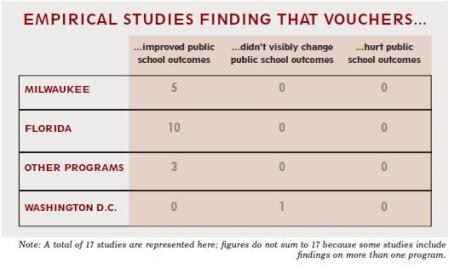
Here’s the supercool graphic:

win-win-study-chart1

Worth a thousand words, isn’t it? I mean, at what point are we allowed to say that people are either lying, or have been hoodwinked by other people’s lies, when they say that the research doesn’t support a positive impact from vouchers on public schools?

There’s always room for more research. What would we all do with our time if there weren’t? But on the question of what the research we now have says, the verdict is not in dispute.

Here’s the executive summary of the report:

This report collects the results of all available empirical studies on how vouchers affect academic achievement in public schools. Contrary to the widespread claim that vouchers hurt public schools, it finds that the empirical evidence consistently supports the conclusion that vouchers improve public schools. No empirical study has ever found that vouchers had a negative impact on public schools.

There are a variety of explanations for why vouchers might improve public schools, the most important being that competition from vouchers introduces healthy incentives for public schools to improve.

The report also considers several alternative explanations, besides the vouchers themselves, that might explain why public schools improve where vouchers are offered to their students. It concludes that none of these alternatives is consistent with the available evidence. Where these claims have been directly tested, the evidence has not borne them out. The only consistent explanation that accounts for all the data is that vouchers improve public schools.

Key findings include:

  • A total of 17 empirical studies have examined how vouchers affect academic achievement in public schools. Of these studies, 16 find that vouchers improved public schools and one finds no visible impact. No empirical studies find that vouchers harm public schools.
  • Vouchers can have a significant positive impact on public schools without necessarily producing visible changes in the overall performance of a large city’s schools. The overall performance of a large school system is subject to countless different influences, and only careful study using sound scientific methods can isolate the impact of vouchers from all other factors so it can be accurately measured. Thus, the absence of dramatic “miracle” results in cities with voucher programs has no bearing on the question of whether vouchers have improved public schools; only scientific analysis can answer that question.
  • Every empirical study ever conducted in Milwaukee, Florida, Ohio, Texas, Maine and Vermont finds that voucher programs in those places improved public schools.
  • The single study conducted in Washington D.C. is the only study that found no visible impact from vouchers. This is not surprising, since the D.C. voucher program is the only one designed to shield public schools from the impact of competition. Thus, the D.C. study does not detract from the research consensus in favor of a positive effect from voucher competition.
  • Alternative explanations such as “stigma effect” and “regression to the mean” do not account for the positive effects identified in these studies. When these alternative explanations have been evaluated empirically, the evidence has not supported them.

Get Lost 316

February 21, 2009

Last week Greg suggested that the Island has a will of its own that trumps the will of humans to direct its powers.  According to Greg’s analysis, the Island is essentially a super-natural being, like God, although he admits the possibility that it is a malevolent super-natural force.  And like God, Greg suggests that faith in the Island involves obeying even when the Island’s reasons are mysterious: “If we understood why the Island demands what it demands, there would be no question of faith (remember, John is the “man of faith”). In theology, “faith” doesn’t mean simply believing in certain facts about God, it means trusting and obeying God. And the supreme test of faith is to trust and obey when you don’t understand.”

Upon first seeing this week’s episode, 316, I thought Control-G (the hot-key for agreeing with Greg).  Greg is right so often that we had to develop a hot-key to make our agreement more efficient (in your heart you know he’s right).  It certainly would be novel to have a TV series entirely built around faith in a super-natural power.  Ben’s suggestion that Jack was similar to the Apostle Thomas, Locke’s note wishing that Jack had believed, Lapidus’ presence as the pilot of Ajira 316, and the allusion of the flight number to John 3:16 made me think — at first — that Greg was entirely right — Control G!  In the most recent episode Lost not only seemed like a story of vindicated faith but almost an explicit Christian allegory. 

That’s when I started doubting this interpretation.  Major TV producers would never make a series of a Christian allegory.  The religious references, whether Christian or Island as super-natural power,  have to be a false lead.  The argument between faith and science will be revived.  Faith has only temporarily prevailed.

The original faith/science debate revolved around pushing the button.  The alleged purpose of pushing the button was to save the world from destruction.  Locke had faith that the button must be pushed.  But what seemed like faith may have just been the prescience of time-loops.  The odd coincidences may just be the necessity of time course-correcting.  Is the purpose and direction of events determined simply by Fate, a power without an independent will or consciousness, or is there a super-natural entity choosing the course of events?  Greg’s theory seems to be the later, but I suspect it is the former.

I suspect that Fate has the world being destroyed.  Humans have detected this Fate through the Numbers and time-travel and are struggling to alter that Fate.  What seems like the will of the Island may just be the actions of humans in time loops attempting to steer Fate away from global destruction.  Whether they succeed or not will revolve around whether humans can change Fate, not the will of a super-natural entity.  I just can’t imagine a TV series emphasizing the will of a super-natural being over the primacy of human “agency.”  It would be gutsy and interesting if they did, but I just can’t see it in mainstream TV. 

The video embedded at the top of this post, suggests that human action to prevent destruction of the world is going to be central.  The video comes from Comicon and I found it on Lostpedia, where it is known as the Dharma Booth Video.  In it, Pierre Chang sends a message through time urging whoever sees it to continue the Dharma research to change time.  The different factions will struggle over who will control the potential power to change Fate, but we will discover that who controls it will be less important than using it to avoid total destruction.


The No Stats All Star

February 19, 2009

(Guest Post by Matthew Ladner)

Michael Lewis strikes again with a must read article about Shane Battier, the greatest professional basketball player you’ve never heard of because all he does is help his team win games.  The article is Moneyball for the NBA, but with several twists- most prominently some very nasty individual versus team dynamics. In short, in baseball, you essentially can’t aggrandize yourself as a player without also helping your team. If you are getting on base, you are padding your stats and helping your team win.

Not so in basketball, where you can get paid millions for padding your individual stats whether or not you help your team win games. An example raised in the article: NBA players don’t like to heave the ball at the end of the half or game because it lowers their percentage. In short, basketball is fraught with perverse incentives, making it much more like most of real life than baseball. The would be sabremetricians of the NBA have only begun to sort through this quandry.

Battier provides Lewis the perfect lense into this world, as a player that simultaneously has statistics that stink and is one of the most valuable players in the league.

Is there an education angle here? Yes indeed. Battier is what business guys call a “white space” employee. The term refers to the space between boxes on an organizational chart. A white space employee is someone who does whatever it takes to achieve organizational goals and makes the organization work much better as a whole.

As we move into the era of value-added analysis for teacher merit pay, this article provides much food for thought. School leaders must consider carefully what they will reward, and give some consideration to how white space behavior is rewarded. Rewards should not just be based on individual learning gains- reaching school wide goals should also be strongly rewarded. Otherwise my incentive as a math teacher will be to assign six hours of math homework a night- and to hell with everyone else (see Iverson, Allen).

Schools are more complex social organizations than basketball teams, so education sabrematicians have a great of work ahead of them. The good news however is that it can’t be hard to improve a system that generally only rewards teachers for length of service and often meaningless certifications and degrees.

There’s no reward for being a white space player OR a superstar in the current system of teacher compensation-just an old player. Imagine a system of compensation for the NBA in which Larry Bird was still riding the pine on NBA squads and getting paid more money than LeBron, Kobe or Battier. Hall of Fame = National Board Certified, but you no longer want Bird in the game if you want to win.

You wouldn’t need to be Bill James to figure out how to make such a system much more effective. Figuring out the right way to reward all the little invisible things that someone like Shane Battier does to make his team win, well, that’s trickier.  Overall we have nowhere to go but up, however. Remember both LeBron and Battier are multi-millionaires, while their equivalents in the teaching world have all too often left the profession in frustration or gone into administration.


Real Men of Accountability Illusion Genius

February 19, 2009

(Guest Post by Matthew Ladner)

Fordham strikes again, following up their great Proficiency Illusion study with the Accountability Illusion. This time, they took 18 elementary and 18 middle schools, and applied the varying accountability rules of 28 different states under NCLB to see which of them would make AYP under which set of rules.

In other words, which states have jimmied the gory details to make it really easy to make AYP? Things like how many students you require to make a subgroup and adopted error margins make a big, big difference.

I can’t tell you how shocking it was to see Arizona as the second easiest state studied in which to make AYP.

That is to say, I was shocked that someone had actually made it easier to do than Arizona. This should be a statewide scandal in Wisconsin.

<Cue cheesy singer and Charleton Heston-like voice about here>

Real men of GENIUS!!!!!!!!!!!!!!!!!!!!!!

Here’s to you, Mr. Wisconsin No Child Left Behind compliance guy.

Mr. Wisconsin No Child Left Behind compliance guy!

When those federal bureaucrats required us to test students in return for federal dollars, you figured out how to how to drop your academic standards lower than anyone. Beating out Arizona…that’s really impressive. They said it couldn’t be done, but you did it!

Watch out! Falling cut scores!

When you’ve got schools making AYP in Wisconsin that don’t make it anywhere else, you deserve the satisfaction of a hard day’s work! We want everyone to feel good about their schools after all, whether the students learn anything or not.

Don’t feel bad-trophies for everyone!!

That partial credit scheme for kids that fail was inspired! Why let the sunbelt states have all the fun with low academic standards? Don’t worry about those darned meddling Fordham kids and their fancy study! You can still get away with it!

Oh YEAH! Where’s my Scooby snack?!?

So here’s to you Mr. Wisconsin NCLB compliance guy!  When it comes to creative insubordination, no one can match your GUSTO! Keep taking those federal dollars and giving them hell!

Mr. Wisconsin I’m Too Scared of Adults to Care About Kids NCLB Compliance guuuuuuy!!!!!!!!!!!!!!!!!


KIPP RIP Continued

February 18, 2009

You…administrator…bastards…still…can’t…fire me!!!!

(Guest Post by Matthew Ladner)

Leo over at EdWize asks “What is it about teacher voice that so frightens the denizens of the far right, that even the prospect of democratic teacher input into decision-making in the educational workplace should be met with such rhetorical ferocity?”

Two words: RUBBER ROOM!

UPDATE: Now Leo disavows any union responsibility for the rubber room. Ohhhhhhh sure…he’s shocked SHOCKED to hear someone suggest that the union’s making it prohibitively expensive  to let a teacher go has anything to do with the rubber room. Round up the usual union baloney and meet me at EdWize…