(Guest Post by Matthew Ladner)
Carey: Universities = Newspapers with a longer death sentence
March 31, 2009
 11 Comments |
  higher education | Tagged: Education Sector, Kevin Carey |
  Permalink
 Posted by matthewladner
John Rawls is Twisting in His Grave
March 31, 2009
(Guest Post by Matthew Ladner)
Philosopher John Rawls’ A Theory of Justice argued that societal ethics ought to be decided as if we were behind a theoretical “veil of ignorance.” Behind the veil, no one would be aware of what his or her position would be in a forthcoming society. You would not know whether you would grow up the child of a billionaire or poor in the inner city. The veil creates an incentive to leave a path out of the latter scenario.
Rawls’ philosophy is hugely influential in left of center thinking. Too often, progressives have used Rawls as a justifying myth, while refusing to examine whether their favored programs live up to the ideals of the philosophy. For example- Rawlsian principles could certainly be used to justify the creation of public schools to attempt to ensure the education of all children, including the disadvantaged. It could also be used to justify, Rawls himself noted, a system of vouchers. Does however today’s system of public education remotely approach the Rawlsian ideal of providing a path out for the least advantaged?
No, not even close. In fact, today’s public education system closely resembles the opposite. Let’s examine the case of special needs children, in light of the recent Arizona Supreme Court decision.
The Arizona Supreme Court struck down a voucher program for children with disabilities last week under a suit brought by the People for the American Way, the American Civil Liberties Union and the teachers union. They used the state’s Blaine Amendment to do so.
To fully explain the true horror of this, alleged progressives using KKK-era language to kill a program to help the least advantaged students in the system, will require three steps. Step one, some background on special education. Step two, some background on the Blaine, and step three, some background on the case.
Special Education as a Rawlsian Half-Measure
Until the early 1970s, public schools simply excluded children with disabilities from attending public schools. When the federal government put an end to this practice, as many as a million students were excluded from public schools.
The federal requirement that public schools accept children with disabilities stands to this day as a landmark piece of civil rights legislation. All however is not well. Parents register enormous dissatisfaction with the lack of services provided to their children; researchers point to the over-identification of minority students and out-of-control costs; and teachers vent their frustration with the amount of red tape and paperwork involved.
The conservative Fordham Foundation and the liberal Progressive Policy Institute teamed up to summarize this situation as follows: “For this program that has done so much is also sorely troubled. America’s program for youngsters with disabilities has itself developed infirmities, handicaps and special needs of its own…we are not educating many disabled children to a satisfactory level of skills and knowledge. Too often we are frustrating their parents, distracting their teachers, hobbling their schools, and making it harder to keep order in their classrooms, all this despite the best of intentions and the most earnest of efforts by families, educators, and policymakers.”
Growth in special education has made IDEA simultaneously costly and ineffective. By some estimates, 40 percent of the increase in K-12 spending has gone into special education. Special education, in short, does too little to help children with disabilities and too much to harm children without disabilities. Jay Mathews of the Washington Post noted that the available research “suggests that the special education system has led to widespread, if well-intentioned, misuse of tax dollars and has failed to help kids.”
The Arizona Blaine Amendment
The amendment which brought down the Arizona program has a very ugly history.
After the failure of the federal Blaine Amendment, anti-Catholic forces began requiring Blaine language in state constitutions in return for their support for admission. Arizona, which joined the union in 1912, included Blaine language in their constitution. Last week at an event at the Goldwater Institute, Arizona State University Paul Bender tried to argue that the framers of the Arizona Constitution went out of their way to include greater liberties than those included in the U.S. Constitution. This is clearly the case. Professor Bender then argued that the Blaine amendment was a part of this yearning for liberty, which was clearly not the case.
Arizona included this language to ease admission, and the origins of the language lie in bigotry, not in a desire for liberty.
Sol Stern wrote on the amendments:
During the mid-nineteenth century, Protestant ministers, regarding Catholic schooling as an abomination, launched a powerful social movement to create exclusive, government-run public schools—controlled by Protestants—that the Catholic kids would be herded into, and where they would be cleaned up and Americanized. The movement succeeded in defunding Catholic schools in New York City, even though the popular, progressive governor, William Seward, stood with the Catholics in demanding equal treatment for religious schools.
The new public school establishment recognized that the first amendment did not rule out government aid for religious schools. That’s why the movement worked for the passage of a separate constitutional amendment prohibiting public funds going to such independent schools. In 1875 the Blaine Amendment fell short by four votes of the necessary two-thirds margin needed for passage in the U.S. Senate. The movement, joined by the nativist Know Nothing Party and the Ku Klux Klan—their anti-Catholicism the only thing uniting them—took the campaign to the states. Eventually, 29 state legislatures, including New York’s, added Blaine Amendments to their state constitutions.
The U.S. Supreme Court has noted the “shameful pedigree,” of Blaine Amendments. Florida adopted their version of Blaine in an 1885 constitutional convention that also banned interracial marriage and required segregated schools.
“In any event, we would be hard pressed to divorce the amendment’s language from the insidious discriminatory intent that prompted it,” the court ruled. Sadly the current court did not feel the same.
The Case before the Arizona Supreme Court
Andrea Weck, a plaintiff in this case, is a single mother of a daughter, Lexie Weck with multiple disabilities. The East Valley Tribune profiled Lexie and Andrea. The disability scholarship program gave Lexie’s mother the opportunity to choose a specialty private school for her, and she has thrived in it.
Lexie’s mother Andrea Weck said “something clicked” for Lexie in her new school: “She’s signing; she’ll make eye contact now. She’s feeding herself. She’s verbalizing sounds . . . She still isn’t speaking, but I know it’s in there. And they’ll find a way to get it out.”
The specialized school Lexie attended cost in the same neighborhood as Andrea’s annual income. With the vouchers and additional assistance, she was able to get her what she regarded as much higher quality care.
In short, Lexie Weck is precisely the sort of person that John Rawls is concerned with. In the lottery of life behind a veil of ignorance, Lexie drew the straw that you do not want. Arizona’s voucher for special needs program helped her, and in a way that didn’t hurt anyone else. Public schools have been complaining for years that they don’t get enough money for special needs children. They howl that they have to shift money out of general education into special education.
In Arizona 85% percent of children who qualify for a free or reduced lunch and have a disability fail to score at the basic or better level on 4th grade reading.
Eighty five percent.
Evidently, the success rate is not so great in Arizona public schools for children in Lexie’s situation. Obviously some children will never learn to read at a 4th grade level, but that is no excuse not to let the people who care most about them choose the program that gives them the best shot at reaching their potential.
The state of Arizona then let children like Lexie Weck walk away with their supposedly inadequate funding-creating a Rawlsian path out for the least advantaged. That is, until the poorly named People for the American Way and American Civil Liberties Unions came and took it away from her using weapons forged by bigots of a bygone age.
Wealthy kids with access to specialized attorneys, of course, will continue to access private schools making full use of their IDEA rights. School choice only for rich kids looks to be the “progressive” way.
8 Comments | vouchers | Tagged: Arizona Supreme Court, Arizona voucher ruling, John Rawls, Know Nothings, Ku Klux Klan | Permalink
Posted by matthewladner
Obama Gets It Right
March 30, 2009
It’s a dramatic reversal over statements last month, but I am glad to see that the Obama Administration seems to be learning. Bankruptcy is not collapse. It is an acknowledgement of failure with a plan to improve.
As the WSJ puts it: “The Obama’s administration’s leading plan to fix General MotorsCorp. and Chrysler LLC would use bankruptcy filings to purge the ailing companies of their biggest problems, including bondholder debt and retiree health-care costs, according to people familiar with the matter.”
Now only if he will exhibit similar bravery in taking on teacher unions, with their large retiree costs and structural inefficiencies.
3 Comments | economics | Permalink
Posted by Jay P. Greene
Another Sensible Voice
March 30, 2009In addition to Greg’s piece in PJM, here is another sensible commentary on the new Milwaukee results.
Patrick McIlheran, a columnist in the Milwaukee Journal Sentinel writes, in part:
The fact is that early results are fairly bright for Milwaukee choice schools. They’re certainly not behind, they’re possibly starting to pull ahead, they’re improving MPS, they’re empowering the poor, they’re saving taxpayer money.
It’s hard to fire a teacher, even when they are bad
March 30, 2009(Guest Post by Matthew Ladner)
A must read article from Ron Matus of the St. Pete Times.
4 Comments | teacher union | Permalink
Posted by matthewladner
PJM Column on Milwaukee Study
March 30, 2009(Guest post by Greg Forster)
This morning, Pajamas Media carries my column on the results of the new Milwaukee studies released last week by the School Choice Demonstration Project:
It’s bad enough that everyone seems to be ignoring the program’s positive impact on public schools. About four-fifths of the students are still in public schools. Why look only at the results for the voucher students, only one-fifth of the total? If you had a medical treatment that would help four-fifths of all patients suffering from some horrible disease — and what else can you call the present state of our education system but a horrible disease? — that would be considered a fantastic result.
But it gets worse. These results don’t just show that the program improves education for students in public schools. They also indicate that the program improves education for the students who are using vouchers.
1 Comment | competitive effects, research reports, vouchers | Tagged: Greg Forster, Milwaukee vouchers, Pajamas Media, School Choice Demonstration Project | Permalink
Posted by Greg Forster
Get Lost – The Island Prime
March 27, 2009
(Guest post by Greg Forster)
Jay was in town here yesterday and of course we talked about Lost. At this point neither of us had seen this week’s episode yet.
He shared with me his theory that 1) Daniel is wrong about the idea that you can’t change the past, and 2) during the flashy thing last week, when Jack, Kate, Hurley, and Sayid vanished off Flight 316 back to 1977, the rest of the plane shifted to an alternate timeline where events had been changed.
Guess that theory got a boost from this week’s episode, huh? We both had the same reaction – too bad he didn’t mention this theory last week. (Jay, you might want to give up your obsession with the lack of narrative unity in what is, after all, a serialized TV drama rather than a book or a movie. It’s distracting you from your true calling as our house NostraGreenedus.)
For discussion of this theory, we’ll call the original timeline T and the alleged new one T prime.
On the question of whether the past can be changed by anyone, I was skeptical. Yes, it’s theoretically possible that Daniel is wrong. But that would require a stunning lack of storytelling integrity on the part of the show’s writers. Jay had already lost enough respect for the writers (see last week’s post) to think that they will play that kind of arbitrary game with the rules of the narrative universe, but I didn’t think so. So far, at least, they haven’t done anything like that (Jay’s critique notwithstanding).
As for Flight 316 shifting to T prime, here was his evidence based on last week’s episode:
1) As the plane approached the Island, you could hear “the numbers” being read over the radio. Somehow, I missed this, even though I saw that episode twice. But last night I checked with my wife and she says she heard them, too. But in T, the transmission of the numbers was changed by Rousseau into a distress call some time after 1988, then shut off entirely in 2004.
2) The plane landed on a runway on the “other island.” But there was no runway on the “other island” in T. We know this because in Season 3, the Others were building it (they made Sawyer and Kate work on it).
3) When Sun and Frank arrive at the abandoned Dharma camp, it’s ruined (as we would expect) but it’s still a Dharma camp rather than an Others camp. It still has Dharma signs all over it. And it still has the old Dharma photographs hanging on the wall (one of which Christian showed to Sun). None of that was present in T.
There’s a problem with the second piece of evidence – there may have been no runway in 2004, but Flight 316 arrived in 2007. The Others could have built it in the interim.
The other evidence, however, seems convincing. It’s theoretically possible that somebody reinstated the radio transmission of “the numbers” between 2004 and 2007. But it seems a lot less likely than that we’re in an alternate timeline. And all the Dharma stuff still being in the camp the Others took over would be a shocking oversight if it were accidental.
And of course Sayid shooting the young Ben in this week’s episode makes it all the more plausible.
My defense of the writers’ integrity as storytellers is looking pretty vulnerable. Shifting the rules this arbitrarily would be pretty lousy craftsmanship on their part.
But remember, Ben may not be dead. Yet.
I’m hoping Desmond will show up and kill him.
2 Comments | Lost | Tagged: Get Lost, Greg Forster | Permalink
Posted by Greg Forster
So You Want More Regulation?
March 27, 2009
Folks advocating more regulation of the economy, education, healthy life-styles, etc… should read this great piece in the Wall Street Journal. It describes the efforts of Washington state’s Department of Licensing to regulate Seatle Semi-Pro Wrestling, which is a spoof of professional wrestling performed in Seattle bars as entertainment. Above you can see a photo of one of the spoof characters, Rondle McFondle.
But the Washington state officials say that this spoof is a professional sport and all professional sports have to be licensed by the state. They need to have medical staff on the premises and post a $10,000 bond, among other burdensome regulations.
As the WSJ describes the issue: “The Seattle league calls itself “fight cabaret” — in essence, theater with singlets, suplexes and sweat, as unworthy of regulation as a Shakespeare play. “It’s a bunch of grown men and women in costumes pretending to be professional wrestlers,” says David Osgood, the league’s lawyer. “It is to wrestling as ‘West Side Story’ is to actual gang relations.”
4 Comments | economics | Permalink
Posted by Jay P. Greene
NR’s Must-Read on Big Business and Big Government
March 27, 2009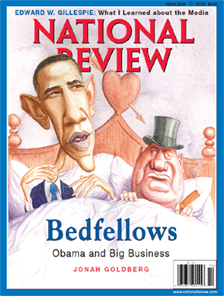
(Guest post by Greg Forster)
Folks, you simply must read Jonah Goldberg’s cover story in the new NR on how big business loves big government.
I know, I know, to most readers of JPGB it is not likely to be news that big business loves big government. But the article contains a whole slew of fascinating information that I never knew before, covering everything from a hundred years ago to the present day. And it’s very powerfully presented and argued – better than I’ve ever seen on this topic. The article is as delightful to read as it is informative.
There are revelations in the article about Upton Sinclair and the creation of government regulations for the meatpacking industry, and about how TR reversed his position on “trusts” after he left office, that floored me. Back when his book came out, Goldberg said he had to cut huge swaths of the original manuscript – I forget how much he said, but if I recall, it was definitely more than half – because the book was just too long. He was lamenting how much fascinating, little-known historical stuff wouldn’t go into the book and hoped that it would eventually be useful elsewhere. I think he’s getting some of that good stuff into circulation with this article.
Here’s a sample, from the opening:
Honesty and marital necessity require me to state that everything I know about prostitution I have learned from a distance. That said, based on what I’ve gleaned from reading and from films of dubious artistic value, it seems to me that the farther you move up the prostitution price range, the more elaborate the lies become….The relationships grow not only more complex but more reciprocal — and, most of all, the real lies aren’t what the hookers tell the johns, but what both parties tell themselves.
That’s something to keep in mind as we watch the spectacle of American big business and the Democratic party seducing each other once again.
It’s for subscribers only, alas. His syndicated column today takes on the same subject but is much, much less interesting – there’s not much in it that JPGB readers won’t already know. Besides, online subscriptions to NR are cheap and you should have one anyway.
Leave a Comment » | economics | Tagged: Greg Forster, Jonah Goldberg, National Review | Permalink
Posted by Greg Forster
Arizona Supreme Court Rules Vouchers Unconstitutional
March 26, 2009(Guest Post by Matthew Ladner)
The dead hand of anti-Catholic Know-Nothing bigotry reached out from the grave to strike down two voucher programs yesterday. The Arizona Supreme Court ruled against voucher programs for children with disabilities, and for children in foster care. The almost 500 children in those two programs, passed in 2006, will be allowed to finish out the current school year under the voucher program.
The Arizona Supreme Court explicitly rejected similar arguments in Kotterman v. Killian, which decided the constitutionality of the Arizona tax credit program. The court recognized the Blaine amendment as a product of 19th century anti-Catholic bias, writing that, “We would be hard pressed to divorce the amendment’s language from the insidious discriminatory intent that prompted it.”
Saddly, the current Arizona Supreme Court felt no such constraints.
I thought I would share one of the idiotic comments made by an anonymous poster on an Arizona newspaper site:
Vouchers was just a scam to give money to parents rich enough to send their kids to private schools.
There is no private school that can compete with public (“no profit motive”) school, hence the voucher cannot fully fund a private school education.
It’s a giveaway, plain and simple, with the bonus side effect of destroying the education system for people too poor to send their kids to private schools.
Nice try, but no cigar!
I’d love to see this ignorant fool explain this to one of the plaintiffs in the case, a single mother of a child with multiple disabilities who works in a beauty salon.
The people who brought this suit should be ashamed of themselves. In the greatest of ironies, these so-called progressives have removed the most direct method for progressive school choice, that is to say, school choice which differentiates between students based upon need. Arizona legislators could pass a personal use tax credit for private school expenses, and it would survive court challenge. We won’t do that, mind you, but it is the corner that these people are trying to paint us.
For years, ideologically blinded idiots like the one quoted above have accused choice supporters of wanting to provide school choice for rich kids, blah blah blah. Don’t confuse us with any facts. Of course, they never blink at shelling out $18,000 for the son of a billionaire to attend a public economic segregation academy in North Scottsdale.
School choice for rich kids? Open your eyes- it’s all around you.
3 Comments | vouchers | Tagged: Arizona Supreme Court | Permalink
Posted by matthewladner

 Jay P. Greene's Blog