WaPo on Florida Reforms

April 2, 2011

(Guest Post by Matthew Ladner)

Nick Anderson of the Washington Post ran a very nice story on Governor Jeb Bush’s education reform efforts.  A couple of quotes, first from our friend Mike Petrilli:

He is the standard-bearer,” said Michael J. Petrilli of the Thomas B. Fordham Institute, a conservative-leaning education think tank. “Those governors who are going to have religion on education reform are looking to him to be their mentor.”

and from Paul G. Pastorek, Louisiana’s superintendent of education:

Arne and Jeb are really the most influential people at the national level right now pushing college and career readiness for our kids and improvement for our schools,” said Paul G. Pastorek, Louisiana’s superintendent of education and a Republican. “Jeb is working with statehouses and state leaders to directly impact the agenda. He is above all others on the issue among Republicans.”

Of course, journalistic ethics require “balance” and this is where it gets fun:

Many Democrats and labor leaders denounce the Bush agenda. They say that vouchers drain funding from public education and that grades of D and F stigmatize schools that need help. Critics also say other policies he espouses — including merit pay — are unfair to teachers and rely too much on standardized tests.

Florida’s academic gains, critics say, could have been much larger if Bush had sought more collaboration.

“He doesn’t believe in bringing people along with him,” said Andy Ford, president of the Florida Education Association, the state teachers union. “He just forces his will on everybody.”

Ford said many teachers were irate that Obama shared a platform in Miami with a former governor who fought the union almost nonstop for eight years. “The White House is on the wrong track by associating with Jeb Bush,” he said.

Don’t worry Andy, Governor Bush is bringing plenty of people along with him. Someday even you reactionary types may come around, but no one has time to wait for that.  As for “the gains would have been much larger if Governor Bush had sought more collaboration” claim,  strangely enough, Florida has had the largest NAEP score gains in the country. Try again. As for the President associating with Governor Bush, well, who wouldn’t want to associate with results like these:

Not to be outdone by Ford, Valerie Strauss over at the WaPo Answer Sheet Blog grasps at some additional straws:

The first is Bush’s own creation of the Florida Reading Research Center, a state technical assistance agency solely focused on providing reading assistance — complete with reading coaches — in elementary schools so that kids could read by the time they graduate third grade.

It would be hard to argue that this wasn’t a big reason for the rise in Florida’s fourth-grade reading scores on the National Assessment of Education Progress, the grade and area where the state saw the highest gains under Bush.

The former governor also never mentions any possible effects from a class-size reduction referendum in the state which he opposed but was approved anyway by voters early in his tenure.

Dorn, in a Q & A I did with him late last year, also noted that Bush was governor during a real-estate boom that allowed per-pupil expenditures in Florida to rise 19 percent. That allowed schools to hire hundreds of reading coaches. But, said Dorn: “That kind of money is not available in any state right now, and I suspect a number of states will be in for a rude shock when they try the symbolic step of assigning letter grades to schools without supporting instruction.”

Let’s take these one at a time:

1. Governor Bush happily acknowledges that the reading improvement effort strongly contributed to the overall effort to improve literacy.  No one necessarily needs to create the State X Reading Research Center. If they want to hit the ground running they can use the Florida Reading Research Center’s research.

2. The class size initiative wasn’t implemented until last year and a Harvard study found it had nothing to do with the improvement in Florida, a result consistent with the vast majority of decades of empirical research.

3. The Digest of Education Statistics shows Florida’s increase in per pupil spending as smaller than the national average during Governor Bush’s term in office, and below the national average in absolute terms.

Bless their hearts, the edu-reactionaries come across as a bit desperate to spin their way to a story that will justify what seems to be their goal: a yet more expensive version of today’s failed status-quo.  No one should take this the least bit seriously, as we cannot afford it, and it wouldn’t work anyway. States around the country are drawing inspiration from the Florida reforms for a reason, and Governor Bush is the first one to emphasize that the Florida cocktail was state of the art, cutting edge reform in 1999. Today’s reformers can take Florida’s reforms as their floor, rather than their ceiling.


Well . . . That Was Easy!

April 1, 2011

(Guest post by Greg Forster)

I made the bet thinking I had three. I turned out I had five. By the time the bet went live on the blog I had seven.

Then, in the comments, Matt brings to my attention that both Utah houses passed a major financial expansion of the Carson Smith voucher program on March 10. And Scott notes that Minnesota’s House passed a new voucher program on March 30.

I won the bet in half a day!


Me and Jay Mathews: IT’S ON!

April 1, 2011

(Guest post by Greg Forster)

Last week I challenged Jay Mathews of the Washington Post to a bet:

Tell you what, Jay. Let’s make a bet. You say there won’t be “a wave of pro-voucher votes across the country”…[W]e’ll set a mutually agreed on bar for the number of voucher bills passing chambers this year. If we hit the bar, you have to buy me dinner at a Milwaukee restaurant of my choice. But if we don’t hit the bar, I buy you dinner at a DC restaurant of your choice. That’s pretty lopsided in your favor, dollar-wise. How about it?

Today I’m proud to announce that Jay has accepted the bet!

The terms, exactly as I offered them to Jay over e-mail:

Here’s what I propose. I win the bet if at least ten legislative chambers pass bills in 2011 that either create or expand a private school choice program. Otherwise you win. Just based on my experience in the movement, I think if we got that many chamber passages, it would mark 2011 as a banner year for choice.

Definitions: A “private school choice program” is a program that funds attendance at private schools using public funds, either directly (by vouchers) or indirectly, through the tax code (as is the case with many school choice programs these days). That means charter schools don’t count. This is the definition we use here at the foundation. “Expanding” a program means increasing the eligible student pool, or increasing the amount of funds available to support the program (on either a per-student or global basis). That’s in your favor because I’m agreeing not to count, say, relaxation of burdensome restrictions on participating schools as an “expansion.”

Jay’s succinct response: “It’s a bet!”

Well, I didn’t plan it this way, but during the time I was working out the details and deciding how many programs to propose for the bet, and then communicating with Jay, there were a few votes on school choice programs!

When I proposed the bet to Jay earlier this week, I had missed the votes in Arizona a couple weeks ago. I thought we only had three of the ten passages needed for me to win the bet – the Virginia House, the Oklahoma Senate and Douglas County, Colorado.

When Matt clued me in on the Arizona votes, I realized that we were already at five out of the ten passages needed for me to win:

    1. VA House new tax-credit scholarship program (February 8 )

    2. AZ Senate tax-credit program expansion (March 8 )

    3. AZ House tax-credit program expansion (March 10)

    4. Douglas County, CO new voucher program (March 15)

    5. OK Senate new tax-credit scholarship program (March 16)

Then what happens?

    6. IN House new voucher program (March 30)

    7. U.S. House voucher expansion (March 30)

We got to seven votes before I even announced the bet! So much for my plans to make this a big, drawn out, suspenseful thing. The whole shooting match is going to be over before I even get three blog posts out of it. And here I made these cool ruler graphics and everything!

Here’s one other thing that’s bothering me. Was it unethical for me to make the bet with Jay without revealing to him that Indian is the official ethnic food of Jay P. Greene’s Blog?


Big Day for Parental Choice

March 31, 2011

(Guest Post by Matthew Ladner)

Yesterday the Indiana House passed  a bill to create what seems likely to become the nation’s largest school voucher program, and to improve and expand their preexisting tuition tax credit law. On the same day, the United States House voted to reauthorize the DC Opportunity Scholarship program.

Indiana is poised to do something very special. Under the leadership of Governor Daniels and Superintendent Bennett, they are on the cusp of pushing through major Florida reforms: transparency with teeth (A-F school grading), action against social promotion and parental choice. The rest of us are going to have to pick up our games to try to keep pace.

The long-suffering DC Opportunity Scholarship Program children have suffered through the trials of Job. Kudos to Speaker Boehner for putting his back into delivering a happy ending for these kids!

Hold tight reform fans…the best is yet to come.


Vouchers Help But Obama Opposes

March 30, 2011

In a new study released today by a team of researchers led by Josh Cowen at the University of Kentucky, we learn that voucher students in Milwaukee are more likely to graduate high school and go to a four year college than their counterparts in the Milwaukee Public Schools.  The report concludes:

MPCP [voucher] students were more likely to have enrolled in a four year college, even after accounting for race, gender and prior achievement.  They were less likely to have dropped out of high school or remained enrolled after four years.  These differences may be partially explained by family background characteristics such as parental education and income.  They do not appear to be related to private school “creamskimming” of students into or out of MPCP between 8th and 9th grade.

Attending a private school with a voucher resulted in about a 7 percentage point improvement in the probability of attending a four year college.  Considering that is a move from about 32% to 39% attending 4 year college, it is a big effect.

And this attainment benefit is consistent with the findings of the U.S. Department of Education’s official evaluation of the DC Opportunity Scholarship voucher program, led by my colleague Patrick Wolf, which found:

The offer of an OSP scholarship raised students’ probability of completing high school by 12 percentage points overall (figure ES-3). The graduation rate based on parent-provided information was 82 percent for the treatment group compared to 70 percent for the control group. The offer of a scholarship improved the graduation prospects by 13 percentage points for the high priority group of students from schools designated SINI in 2003-05 (79 percent graduation rate for the treatment group versus 66 percent for the control group).

Despite these positive results, the Obama Administration issued a statement opposing the continuation and expansion of the DC voucher program, on which the U.S. House is scheduled to vote today.  They boldly (and falsely) declared:

Private school vouchers are not an effective way to improve student achievement. The Administration strongly opposes expanding the D.C. Opportunity Scholarship Program and opening it to new students.  Rigorous evaluation over several years demonstrates that the D.C. program has not yielded improved student achievement by its scholarship recipients compared to other students in D.C.

Given the lack of intellectual honesty on the part of the Obama Administration in declaring that vouchers have no benefits for students even after rigorous research (including the official evaluation they released!) finds otherwise, confirms the danger of entrusting any additional authority over eduction policy in the national government.  They will lie, cheat, and crush their opponents, so why would we want to give these folks control over a nationalized set of standards, curriculum, and testing.


Fordham Responds on Nationalizing Education

March 30, 2011

Over at Flypaper, Fordham’s Kathleen Porter-Magee responds to my post yesterday about the mistake of the current Gates-Fordham-AFT-USDOE effort to nationalize key aspects of our education system.  She writes:

Of course, many people agree that Betamax had the superior technology (the picture was sharper, the cassettes were smaller, it was better at high-speed duplication, etc.). So, in effect, market forces standardized the inferior technology.

But rather than belabor the VHS-Betamax analogy, let’s talk about the actual case of state standards. Is Greene correct in his contention that the market was on its way to standardizing high-quality state standards? Not even close.

In fact, for more than a decade we have been conducting a natural experiment where we let market forces drive standards setting at the state level. The result? A swift and sure race to the bottom. A majority of states had failed to set rigorous standards for their students—and had failed to create effective assessments that could be used to track student mastery of that content. In fact, the whole impetus behind the Common Core State Standards Initiative was to address what was essentially a market failure in education.

That said, I do agree with Greene that too much government intervention will stifle innovation. That’s precisely why I think government “standardization” should begin and end with standards. Let the government define what students should know and be able to do.  Then let market forces determine which curricula and pedagogy will best help students master that essential content.

To which Ze’ev Wurman replies:

I have a lot of respect for Kathleen and hence I am stumped.

She writes that the results of the NCLB’s “natural experiment” with states setting their standards are clear: “A swift and sure race to the bottom.”

Yet just a few years back no other than the Fordham Institute itself examined this exact issue,the behavior of proficiency standards under NCLB, and declared:

“These trends do not indicate a helter-skelter ‘race to the bottom.’ They rather suggest more of a walk to the middle.”

Perhaps Kathleen meant to write about the rigor of content standards rather thanproficiency standards. But there, too, many states have improved their standards, rather than lowering them. This can be clearly visible in — yet again — Fordham’s own recent “State of the Standards” report that shows that in 2010, 27 state ELA standards were graded worse than in 2005 and 11 improved (with 12 grades unchanged). In math only 10 state standards were graded worse and 29 improved, with 11 graded the same. I might add that grading criteria in 2010 were more demanding than in 2005 as can be clearly seen from Massachusetts’ standards that did not change between 2005 and 2010, yet were graded lower in 2010 than in 2005. In other words, by Fordham’s own analysis — of which Kathleen must be aware as she co-authored it — state content standards have improved somewhat over the years.

So which one is it? Is there a race to the bottom, or isn’t there? Based on Fordham’s own research there was an improvement in content standards and no race to the bottom in proficiency standards. Yet Kathleen is unequivocal in claiming a race to the bottom. Is it a simple error, or has Fordham started to twist its own findings in its push to support national standards?

And I add:

In addition to the misleading claim of “race to the bottom” that Ze’ev notes, Kathleen’s post is in error on two other points:

1) VHS was not the “inferior technology.” It was cheaper, had longer tapes, and the market clearly preferred those things over whatever qualities Betamax possessed. Kathleen’s conviction that she and some central government-backed committee of like-minded people know what is best for the country regardless of what the market says is precisely the problem with the Gates-Fordham-AFT-USDOE effort to nationalize key aspects of education policy.

2) The claim that Kathleen and Fordham want no more than to nationalize standards without touching curriculum, pedagogy, or assessment is simply disingenuous. For example, Checker once again made common cause with the AFT, Linda Darling-Hammond, etc… in backing the Shanker Manifesto, which calls for “Developing one or more sets of curriculum guides that map out the core content students need to master the new Common Core State Standards.” Checker may claim that this effort is purely voluntary, but that would only be credible if he and Fordham clearly and forcefully opposed any effort by the national government to “incentivize,” push, prod, or otherwise require the adoption of national curriculum based on the already incentivized national standards. And of course, USDOE (without any opposition from Fordham that I have noticed) is already moving forward with developing national assessments even before national curriculum has been developed. One does not need to be from one of “the more feverish corners of the blogosphere” to recognize the odd coalition of Gates-Fordham-AFT-USDOE as coordinating an effort to nationalize key aspects of our education system.


Mandating Betamax

March 29, 2011

I just returned from the Association for Education Finance and Policy annual conference in Seattle, which was a really fantastic meeting.  At the conference I saw Dartmouth economic historian, William Fischel, present a paper on Amish education, extending the work from his great book, Making the Grade, which I have reviewed in Education Next.

Fischel’s basic argument is that our educational institutions have largely evolved in response to consumer demands.  That is, the consolidation of one-room schoolhouses into larger districts, the development of schools with separate grades, the September to June calendar, and the relatively common curriculum across the country all came into being because families wanted those measures.  And in a highly mobile society, even more than a century ago, people often preferred to move to areas with schools that had these desired features.  In the competitive market between communities, school districts had to cater to this consumer demand.  All of this resulted in a remarkable amount of standardization and uniformity across the country on basic features of K-12 education.

Hearing Fischel’s argument made me think about how ill-conceived the nationalization effort led by Gates, Fordham, the AFT, and the US Department of Education really is.  Most of the important elements of American education are already standardized.  No central government authority had to tell school districts to divide their schools into grades or start in the Fall and end in the Spring. Even details of the curriculum, like teaching long division in 4th grade or Romeo and Juliet in 9th grade, are remarkably consistent from place to place without the national government ordering schools to do so.

Schools arrived at these arrangements through a gradual process of market competition and adaptation.  Parents didn’t want to move from one district to another only to discover that their children would be repeating what they had already been taught or were  inadequately prepared for what was going to be taught.  To attract mobile families, districts informally and naturally began to coordinate what they taught in each grade.  Of course, not everything is synced, but the items that are most important to consumers often are.

That’s how standardization in market settings works and we have a lot of positive experience with this in industry.  VHS became the standard medium for home entertainment because the market gravitated to it, not because some government authority mandated it.  If we followed the logic of Gates-Fordham-AFT-USDOE we would want some government-backed committee to decide on the best format and provide government subsidies only to those companies that complied.

Instead of ending up with VHS, they may well have imposed Betamax on the country, even though market competition would have shown that approach to be inferior.  Sony was the industry leader and if a government-backed committee were in charge they almost certainly would have had the most influence.  The Fordham folks might want to keep this in mind.  A government-backed committee is almost certain to prefer what the AFT wants over what Fordham may envision since the teacher unions are like Sony except only 100 times more powerful.

Even worse, once government-enforced standardization occurs it becomes extremely difficult to change.  If we had a government-backed panel decide on Betamax, we may have been stuck with that format for decades.  We almost certainly would have stifled the innovation that led to DVDs and now Blue-Ray.  Once Sony had entrenched their format, what incentive would they have had to change it?

Similarly, once the Gates-Fordham-AFT-USDOE coalition settles on the details of nationalizing standards, curriculum, and testing, it will become extremely difficult to change anything about education.  Terry Moe and Paul Peterson’s dreams of technology-based instruction may never leave the dream stage because it may fail to comply with certain provisions of the national regime.  If I were the AFT, I’d almost certainly insert those details into the regime to prevent the reductions that technology may bring to the need for teaching labor.  No one should be naive enough to think the Edublob won’t figure out how to use nationalization to block that and other threatening innovations.

I’m also sure that Bill Gates would have preferred being able to get a government-backed committee to enshrine Microsoft-DOS or Windows forever.  But thanks to market competition we have Google innovating with cloud computing.  And I’d bet that Google would love to get government backing for their approach if they could.  Dominant companies almost always favor government regulation.

So I understand why the AFT, USDOE, and Gates favor the current effort to nationalize education.  The mystery to me is why Fordham is protecting the right-flank of this movement or why some conservative governors have gone along.  Don’t they realize that it will enshrine arrangements that favor the teacher unions and are bad for kids?


Fear the Win-Win!

March 25, 2011

(Guest post by Greg Forster)

At the beginning of a very kind column praising my new report on the empirical evidence on vouchers, Jay Mathews indicates that for some strange reason, he’s afraid of me and my school-choice posse:

Do I really want to get beaten bloody again by school vouchers devotees?

Come on, Jay. I’m not a dangerous man. I would never beat anyone bloody. I’m soft and harmless. I’m a perfectly ordinary bunny rabbit. A cute, fluffy, harmless bunny rabbit.

Well, okay, I have been known to bite. With big, sharp, pointy teeth. But just to stretch my repertoire, I’ll take the soft approach this time.

Jay acknowledges the evidence:

Greg Forster, a talented and often engagingly contrarian senior fellow at the Foundation for Educational Choice, has expanded a previous study to show that nearly all the research on vouchers, including some using the gold standard of random assignment, has good news for those who believe in giving parents funds that can be used to put their children in private schools. Students given that chance do better in private schools than similar students do in public schools, the research shows. Public schools who are threatened by the loss of students to private schools because of voucher programs improve more than schools that do not have to worry about that competition, the research also shows.

Yet he thinks we shouldn’t support vouchers because . . . well, I’ll let him explain:

I see nothing morally, economically or politically wrong with vouchers. I have never thought that they drained public schools of vital resources. I think a low-income family that gets the chance to choose a private school that suits their child should do so.

But I think such programs have limited growth potential because there are never going to be nearly enough empty spaces in private schools to help all the students who need them. Forster and other voucher advocates say this will change when voucher programs become universal. Then, entrepreneurs will be able to convince investors that they can create a new generation of private schools with the new wave of voucher students.

I think they are wrong about that. The young educators who have led the robust growth of charters prefer to work in public schools. Many voters will continue to resist sending their tax dollars to private schools, particularly with the pressures to cut back government spending that are likely to be with us for many years.

So that’s two arguments. Entrepreneurial startups won’t attract talented education refomers, and voters won’t support the programs.

It’s true that the leading-edge school reformers, the people Matt calls “the cool kids,” prefer to work in public schools. As I’ve written before, you can already see how that strategic choice is leading to dead end after dead end. The school choice movement needs to start building bridges to these people and showing them that in the long run, only school choice can provide the institutional support they need to sustain the kind of reforms they want.

As for politics, school choice has always polled well (for a discussion of the research and methodological issues, see here). The American people are not, in fact, uncomfortable with allowing religious institutions to participate in publicly funded programs on equal terms alongside other institutions. There was a time when they were (see “amendments, Blaine”) but that bigotry has receded.

Oh, and as for pressure to cut spending, school choice saves money. Tons and tons of it. That has always been one of our biggest assets in the political fight – that’s why the Foundation for Educational Choice produces state-focused fiscal studies year after year, to show each state how school choice would save taxpayer money while delivering better education.

The political obstacle to choice has never been the public at large. It has always been the blob, with its huge piles of cash fleeced indirectly from taxpayers, and (perhaps more important) its phalanx of highly disciplined volunteers and voters. A minority of the voters can control the outcome if they are single-issue voters when the rest of the public takes into account the whole panoply of problems confronting the body politic. And when you threaten to derail a gravy train, it tends to make the passengers into single-issue voters.

But the tide is changing. The cynical selfishness of the blob is more and more visible to more and more people. Reform has already won the war of ideas. That does not mean the ground war is won. The unions are still big, rich, and powerful. But they are no longer sacred. They have lost their mystique. No one thinks the unions speak for kids anymore; no one even thinks the unions speak for teachers anymore. And in the end, that’s what counts.

As Jay has put it, the unions are now the tobacco lobby. Or, as I have put it, they’re Bull Connor. That’s why school choice is now poised for a series of big political wins.

Jay is skeptical – pointing to the greater success of charters, he thinks vouchers won’t make big gains this cycle. As readers of JPGB know, the answer to the charter argument is that vouchers make the world safe for charters. As for whether vouchers make big gains this year, we’re about to find out.

Tell you what, Jay. Let’s make a bet. You say there won’t be “a wave of pro-voucher votes across the country.” Me and my posse at FEC will go back and count up the number of school choice bills (private choice, not charters) that passed state chambers in 2008-2010. Then we’ll set a mutually agreed on bar for the number of voucher bills passing chambers this year. If we hit the bar, you have to buy me dinner at a Milwaukee restaurant of my choice. But if we don’t hit the bar, I buy you dinner at a DC restaurant of your choice. That’s pretty lopsided in your favor, dollar-wise. How about it?

HT


The Choice Genie is out of the Florida Bottle

March 24, 2011

(Guest Post by Matthew Ladner)

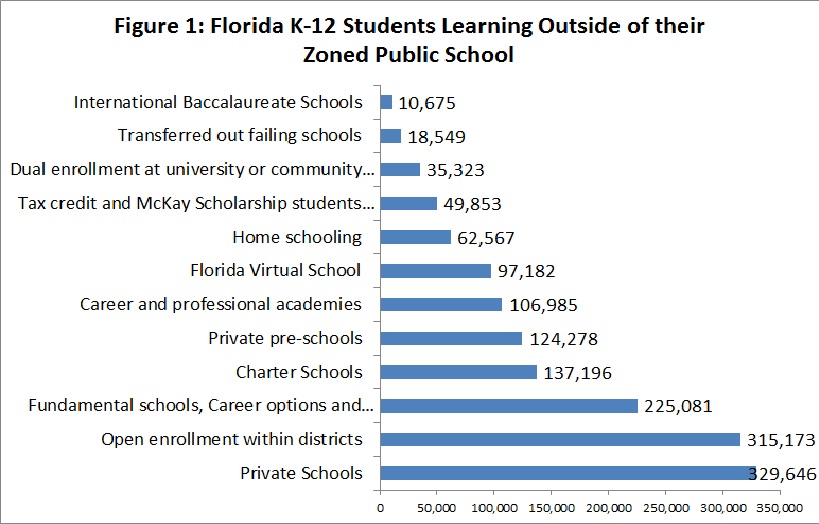
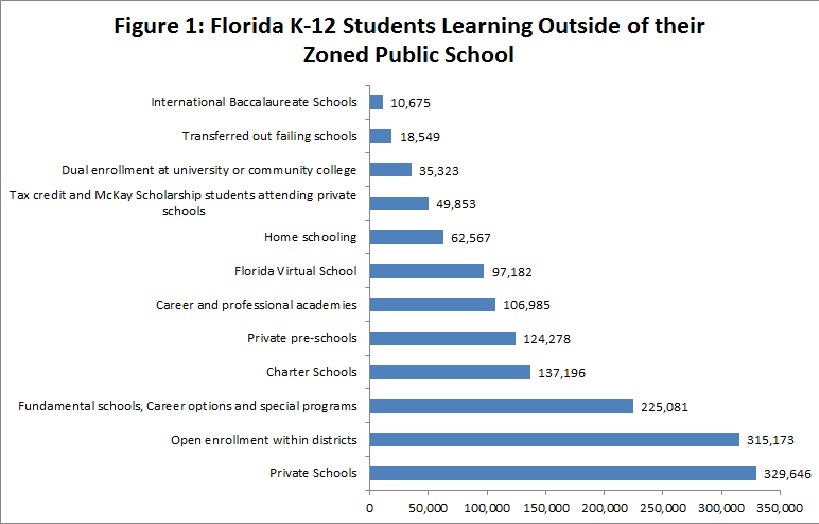
Drawing on data from redefinED and the Digest of Education Statistics, I produced the following chart. With 1.46 million students learning in part or wholly at schools other than their assigned public schools, Florida’s choice students outnumber the total public school population of all but about 8 states.

Okay, so it may be around 12 or 15 or so  if we were to account for some inevitable double counting in the figures (I’ve already separated out the McKay and Step Up for Students from the private school number). The choice programs however are just getting warmed up in the Sunshine State.


Vouchers Are a Win-Win Solution – Updated Edition

March 23, 2011

(Guest post by Greg Forster)

The Foundation for Educational Choice has just released my new report, “A Win-Win Solution: The Empirical Evidence on School Vouchers.” It’s an updated edition of my 2009 report providing a comprehensive overview of, well, the empirical evidence on school vouchers. In addition to incorporating new studies, this edition also expands the scope. The first edition only looked at the evidence on how vouchers impact public schools; this new edition also includes how vouchers impact the students who use them.

As before, I summarize the research with one striking chart. Or, now, two charts – one on how vouchers impact participants, and the other on how they impact public schools:


(Note: This image has been corrected; an earlier version transposed Milwaukee and Florida in Table 2. I apologize for the error.)

I’m not sure I can improve on what I wrote here on JPGB when I posted the first edition two years ago:

Worth a thousand words, isn’t it? I mean, at what point are we allowed to say that people are either lying, or have been hoodwinked by other people’s lies, when they say that the research doesn’t support a positive impact from vouchers on public schools?

There’s always room for more research. What would we all do with our time if there weren’t? But on the question of what the research we now have says, the verdict is not in dispute.

The report surveys all the random-assignment research on participants, and all the research (using all methods) on public school impacts. Readers of JPGB are probably familiar with the reason for this difference: random assignment is so far superior to other methods that when a large body of random assignment research exists, it ought to be given priority. However, since it’s not possible to do random-assignment research on how vouchers impact public schools, we have to cast a wider net – and the research methods being used in this field have been improving over time. Yet the results have remained consistent – how about that?

Here’s the executive summary of the new report:

This report collects the results of all available empirical studies using the best available scientific methods to measure how school vouchers affect academic outcomes for participants, and all available studies on how vouchers affect outcomes in public schools. Contrary to the widespread claim that vouchers do not benefit participants and hurt public schools, the empirical evidence consistently shows that vouchers improve outcomes for both participants and public schools. In addition to helping the participants by giving them more options, there are a variety of explanations for why vouchers might improve public schools as well. The most important is that competition from vouchers introduces healthy incentives for public schools to improve.

Key findings include:

  • Ten empirical studies have used random assignment, the gold standard of social science, to examine how vouchers affect participants. Nine studies find that vouchers improve student outcomes, six that all students benefit and three that some benefit and some are not affected. One study finds no visible impact. None of these studies finds a negative impact.
  • Nineteen empirical studies have examined how vouchers affect outcomes in public schools. Of these studies, 18 find that vouchers improved public schools and one finds no visible impact. No empirical studies find that vouchers harm public schools.
  • Every empirical study ever conducted in Milwaukee, Florida, Ohio, Texas, Maine and Vermont finds that voucher programs in those places improved public schools.
  • Only one study, conducted in Washington D.C., found no visible impact from vouchers. This is not surprising, since the D.C. voucher program is the only one designed to shield public schools from the impact of competition. Thus, the D.C. study does not detract from the research consensus in favor of a positive effect from voucher competition.
  • The benefits provided by existing voucher programs are sometimes large, but are usually more modest in size. This is not surprising since the programs themselves are modest — curtailed by strict limits on the students they can serve, the resources they provide, and the freedom to innovate. Only a universal voucher program could deliver the kind of dramatic improvement our public schools so desperately need.