Edifice Complex Strikes the Gift of the Colorado

July 8, 2019


(Guest Post by Matthew Ladner)

Herodotus called Egypt “the gift of the Nile” and Arizona is the gift of the Colorado (and a canal). Both Egypt and Arizona have alas been afflicted by an edifice complex- giant mountain sized stone tombs in the case of Egypt, very pricey new construction for districts in the case of Arizona, as I detail in a Chamber Business News column. Any chance $330 per square foot schools will attract tourists thousands of years from now? Warning: reading this piece will expose you to earworm Egyptian themed songs.


Nightmare in Providence

July 3, 2019

(Guest Post by Jason Bedrick)

By now, everyone in the ed policy world is aware of the damning report by Johns Hopkins University Institute for Education Policy on Providence’s district schools.  Rhode Island’s Commissioner of Education, Angélica Infante-Green, called it “heart-wrenching” and admitted that she would not send her children there. When asked by Erika Sanzi what Providence families are supposed to do, Infante-Green responded, “We are going to fight and work hard to change decades of neglect.”

Decades. Of. Neglect.

Matt Ladner summarizes the report’s highlowlights:

  • The great majority of students are not learning on, or even near, grade level.
  • With rare exception, teachers are demoralized and feel unsupported.
  • Most parents feel shut out of their children’s education.
  • Principals find it very difficult to demonstrate leadership.
  • Many school buildings are deteriorating across the city, and some are even dangerous to students’ and teachers’ wellbeing.

I guess that’s what $18,000 per pupil gets you in Providence.

Some people roll their eyes when conservatives and libertarians rant about bureaucracy and teachers’ union contracts, but these things really can get in the way of delivering a high-quality education. The report finds that the collective bargaining agreement makes it “next to impossible to remove bad teachers from schools or find funding for more than the one day of contractual professional development per year.” But that’s just the tip of the iceberg.

Take procurement, for example. As Stephen Sawchuk noted at EdWeek, “Nothing is less sexy than procurement, and yet nothing matters more in terms of getting basic supplies, repairs, and textbooks into classrooms.” Yet the procurement process in Providence is practically strangled with red tape and bureaucratic inefficiency:

The “unwieldy” process is compounded by the fact that any request that is more than $5,000, must be voted upon by the City Council and the School Board. Every element of the process came under fire from district leaders and partners:
  • The RFP [request for proposal] process “is onerous; even the form is too long.”
    • Because of this, “it is hard to attract high-quality vendors.”
    • “There is no transparency around RFPs.”
    • “The RFPs don’t even include scoring rubrics.”
  • Small vendors are handicapped, because they don’t have the staff to attend multiple committee and full board meetings.
    • One partner noted, “It took us two years to get a contract under $20,000 approved.”
    • Another noted the outdated requirements, such as presenting proposals in triplicate binders with tabs in a specified order.
  • “[Providence Public School District] can enter into only short-term, reactive partnerships. There isn’t the long-term arc of partnership that a three-year contract would allow.”
  • The volume of paperwork that results is “stunning.”
    • “There are hundreds of contracts, hundreds of purchase orders. Even philanthropic dollars have to go through the process.”
    • “The whole process is cumbersome.”
    • “There are constant meetings.”[emphasis added]

The report even included an image of “a chart of all of the players and steps that any contract must go through before approval” that one of the district leaders had pinned up:

Screen Shot 2019-07-03 at 10.44.02 AM

It’s amazing that anything gets done at all.

One of the central problems is that there are so many cooks in the kitchen. As Sawchuk observes:

Perhaps the headline finding of this report is that there are at least five different, competing entities that are asserting power over the school system, making it difficult to proceed on any set of changes or reforms. (They consist of the mayor, the Providence city council, the school board, the superintendent, and the state department of education). It’s hard to overstate how bizarre this is, but there’s an entire appendix detailing which of these entities view the others as obstacles or competitors.

Not only do the entities get in each others’ way and slow down the process of getting stuff done, but there’s also no sense of accountability. Each entity has enough authority to obstruct the others, but none has the requisite authority to actually run the schools well. When something goes wrong, it’s not clear where the proverbial buck is supposed to stop. Each entity can plausibly point fingers at all the other entities “in charge.”

Chaos in governance is reflected in chaos in the classroom. The report details a complete breakdown of order that is severely undermining learning:

Discipline. Many teachers do not feel safe in school, and most partners and district staff concur. There is a general feeling that actions do not have consequences, and that teachers are at physical and emotional risk. One interviewee feels like “the tired, drained teachers of Providence are dragging kids across the finish line.” A few representative comments:

  • “My best teacher’s desk was urinated on, and nothing happened.”
  • “One of our teachers was choked by a student in front of the whole class. Everybody was traumatized, but nothing happened.”
  • “When we refer a student, we get zero response. Kindergartners punch each other in the face –with no consequences.”
  • “Principals are not allowed to suspend.” [emphasis added]

How could this happen? (Paging Max Eden!) The authors of the report point to misguided policies intended to make the schools look better on paper but actually make them far worse in reality:

Some of these issues likely result from pressure to reduce suspensions. Teachers and district leaders feel that children with behavioral problems are allowed to continue, passed from one classroom and school to another. Several noted that the number of social workers in schools is too modest.
  • Said one district leader, “the data masks what’s happening. We can SAY we’re reducing suspensions, but we’re just churning middle schoolers.”
  • Several teachers note that the plan to implement restorative practices foundered because of lack of PD [professional development], but “we’re still supposed to use them. Restorative practices cannot be done unless everybody in the building is trained.”
The Student Affairs Office (SAO) came up frequently in this issue. Teachers are seldom informed when a child in their classroom has been violent, but “if an SAO student skips my class, I’m in trouble.”
  • Students are passed from one school to another; “some schools have become dumping grounds for kids.”
  • One district leader noted that principals often “bargain” about problem children, doing whatever they can to avoid taking a troublemaker.
  • One district leader said simply, “the students run the buildings.”

It must be noted that support staff, including bus drivers, share these concerns. One interviewee noted that “many bus drivers are getting injured,” but when they bring safety concerns to the district, “it falls on deaf ears.” [emphasis added]

Again: it’s amazing that any learning gets done at all.

Throw good money and good people at a bad process and the process will win every time. Providence’s district school system appears broken beyond repair. The only way to fix it is to fundamentally restructure it, but the only way to do that is to provide families with alternatives. As people flee the system, those running the system will have a huge incentive to make the necessary changes.

In the meantime, kids need alternatives to the nightmare in Providence.


Technocratic and Anti-Patriotic — The NYT Brand

July 3, 2019


My favorite part of this is the invocation of “data” to prove the click-bait opinion that the US is just OK. Technocratic and anti-patriotic is precisely the NYT brand.

Of course, the most relevant data might be net migration (or attempted net-migration).  After all, unlike the Soviet Empire, no one is proposing a wall to keep people in.  But the beauty of technocracy is that the technocrats get to pick the metrics.

Similarly, when it comes to school choice one might think that economists would be persuaded simply by the fact that people choose schools to believe that those are likely better for them — revealed preference. But no. They demand test scores, integration measures, social-emotional learning scales, etc.. to judge chosen school quality. Keep measuring (more likely mis-measuring) until the technocrat can find the metric to show how your own better judgement is mistaken.


You Can’t Make This Stuff Up

July 1, 2019

5240544_041819-kgo-gwhs-murals-img

Image HT ABC7 News

(Guest post by Greg Forster)

1936: New Deal commissions mural in San Francisco public school, painted by a member of the Communist Party, with the purpose of delegitimizing liberal democracy and freedom by reminding America of the terrible crimes it has committed against the principles of liberal democracy and freedom, on the assumption (not yet disproved) that people are foolish enough to think the horror of these crimes undermines rather than reinforces the case for liberal democracy and freedom.

2019: San Francisco will spend $600,000 to paint over the mural in deference to activists whose purpose is to delegitimize liberal democracy and freedom, not because the activists misunderstand the purpose of the mural, but because confronting people with uncomfortable realities is now considered a form of violence.

Kicker: Of the $600,000 it will cost to destroy the mural, $500,000 comes from a mandatory environmental impact statement.

I can’t believe the American Right is actually losing to this idiocy.

Oh, wait, never mind.


A Florida Family’s Multi-generational struggle for K-12 Opportunity

May 30, 2019

(Guest Post by Matthew Ladner)

Amazing story by Ron Matus about one of the original 57 Opportunity Scholarship students and her mother over on RedefinED. I could relate the story but it is better for you to watch it:


The Price of Bigotry

May 19, 2019

american-river-ganges-sept-1871

(Guest post by Greg Forster)

Three cheers for George Will’s column today calling upon the Supreme Court to strike down Blaine Amendments:

Blaine came within 1,047 votes of becoming president when, in 1884, hoping his anti-Catholicism would propel him to victory, he lost New York by that margin to Grover Cleveland. A large multiple of that number of New York’s Irish and other Catholic immigrants had become incensed when a prominent Protestant minister, speaking at a rally in New York City with Blaine present, said the Democratic party’s antecedents were “rum, Romanism, and rebellion.”

Blaine paid a steep price for his bigotry. More than 13 decades later, schoolchildren in Montana and elsewhere should not have to pay for it.

I reach the conclusion by different legal reasoning (I think the key point is that Blaine Amendments inevitably create unconstitutional government discrimination against religious organizations, not that they would have been understood to do so in the 19th century). But it rounds up to three cheers!


Bradford Honored by the Children’s Scholarship Fund

May 14, 2019

(Guest Post by Matthew Ladner)

You know what the best part about working in the education freedom movement? Hands down, it’s the humans you get to know. Derrell Bradford is one of my favorite humans.


Serious Scholarly Research on B.S.

May 13, 2019

fish-546939_640

(Guest post by Greg Forster)

The Institute of Labor Economics brings you a highly scholarly study entitled: “Bullshitters. Who Are They and What Do We Know about Their Lives?”

You see, PISA 2012 included a very interesting test item designed to discover which students would claim to know more than they did. The item listed 16 mathematical concepts (e.g. “exponential function”) and asked test-takers to indicate how familiar they were with those concepts. The catch? Three of the concepts – proper number, subjunctive scaling and declarative fraction – were fictional. (“Subjunctive scaling” is my favorite.)

The ILE researchers coded test-takers who claimed to be highly familiar with these concepts as “bullshitters” and proceeded to analyze their characteristics. The analysis was limited to the nine English-speaking countries in PISA, but that still left them with 40,000 test subjects.

The U.S. and Canada rule the roost as the nations with the most dishonest teenagers. Meanwhile, Ireland, Northern Ireland and Scotland were clustered at the bottom. Apparently the Celts are trustworthy after all – who knew?

Other findings:

  • Teenage boys, you will not be shocked to learn, were more likely to puff themselves up than teenage girls in all nine countries. However, the gender gap was substantially smaller in North America than in Europe.
  • Socioeconomic advantage is also associated with self-fabrication in all nine countries, but with variations in size that follow no obvious pattern (larger differences in Scotland and New Zealand, smaller in England, Canada and the U.S.).
  • There was greater variation in the results for immigrants v. native residents. In Europe, immigrants were more likely to feign expertise; they were less so elsewhere, and there was no visible difference in the U.S.
  • No summary could do this one justice, so I will simply quote: “Finally, in additional analysis, we have also estimated the within versus between school variation of the bullshit scale within each country. Our motivation was to establish whether bullshitters tend to cluster together within the same school, or if bullshitters are fairly equally distributed across schools. We find that the ICCs tend to be very low; in most countries less than three percent of the variance in the bullshit scale occurs between schools. This perhaps helps to explain why everyone knows a bullshitter; these individuals seem to be relatively evenly spread across schools (and thus peer groups).”

Also of interest in ILE’s study is the extensive literature review on the subject, undoubtedly a helpful service in this emerging field of study. The authors point to Harry B. Frankfurt’s pathbreaking inquiry On Bullshit as the reigning theoretical account of the phenomenon.

Hopefully we can expect to see more research on this important topic soon!


Arizona Republic: Wet Streets Cause Rain

May 2, 2019

Image result for wet streets

The Republic’s crack team of reporters have determined that the above streets caused a major rainstorm.

(Guest Post by Jason Bedrick)

Brother Matt’s takedown of the Arizona Republic’s absurdly erroneous and biased reporting reminds me of the Gell-Mann Amnesia Effect, a concept identified by author Michael Crichton:

Briefly stated, the Gell-Mann Amnesia effect is as follows. You open the newspaper to an article on some subject you know well. In Murray’s case, physics. In mine, show business. You read the article and see the journalist has absolutely no understanding of either the facts or the issues. Often, the article is so wrong it actually presents the story backward—reversing cause and effect. I call these the “wet streets cause rain” stories. Paper’s full of them. In any case, you read with exasperation or amusement the multiple errors in a story, and then turn the page to national or international affairs, and read as if the rest of the newspaper was somehow more accurate about Palestine than the baloney you just read. You turn the page, and forget what you know.

The Republic had its own “wet streets cause rain” moment recently when it claimed that Arizona copied its education savings account (ESA) legislation from model legislation at the American Legislative Exchange Council (ALEC). In fact, as Ladner points out, the reverse is true: ALEC’s model legislation was based on Arizona’s law.

Indeed, as Ladner details, the Republic’s “reporting” on “copycat legislation” suffered from several other flaws, including but not limited to the following:

  • The Republic portrayed the use of model legislation as unusual and nefarious when actually it’s commonplace and banal, a tool used across the political spectrum since the late 1800s.
  • The Republic portrayed the use of model legislation as a particularly right-wing plot but excluded all the model legislation from the older and larger left-of-center National Conference of State Legislatures.
  • The Republic hid the fact that only 1% of the bills they analyzed were based on model legislation.

Perhaps the most frustrating thing about the Republic’s “reporting” is that it wasn’t really reporting. Had they any real interest in ascertaining the truth, there are any number of individuals and organizations in Arizona that could have provided them with accurate information had they asked. But they didn’t.

Indeed, their “Gaggle” podcast did not interview anyone from the pro-school choice side. They repeatedly used inferences to determine their “real” motives instead of just, well, asking.

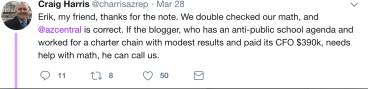
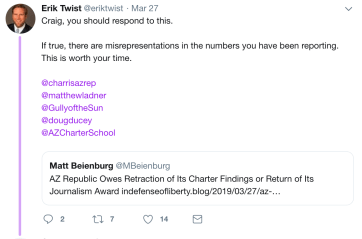
Sadly, this is a part of a longstanding pattern. When the Goldwater Institute’s Matt Beienburg detected some serious flaws in the Republic’s award-winning “reporting” on charter schools, he brought it to their attention but they ignored him. He then wrote about it publicly and one of their most vociferous anti-choice advocates, Craig Harris, personally attacked him rather than engage in any substantive defense of their advocacy piece “reporting”:
Screen Shot 2019-05-02 at 6.25.55 AM

Screen Shot 2019-05-02 at 6.26.03 AM.png

As I noted to Harris, if you add two green apples plus two red apples plus two oranges and get six apples, the math is right but the answer is wrong. Beienburg wanted to know if the Republic had inappropriately included certain schools in its data set when calculating graduation rates (e.g., a school that only serves students through grade 9, or another school that had been closed for two years), but Harris merely insulted him, claimed his math was wrong (without offering any proof) and then stonewalled any public debate.

For weeks afterward, Harris simply ignored any public questions about their reporting — though I know that privately, his team has admitted that they had done exactly what Beienburg had suspected. However, they have still refused to publicly correct their error, demonstrating a complete lack of intellectual honesty or journalistic integrity.

The Republic’s Gaggle podcasters also let their journalistic mask slip with numerous biased statements posing as neutral facts. For example, they claimed that Arizona lawmakers filed at least three ESA “expansions” that all “clearly went against the will of the voters” who rejected Prop 305. First, only one of those bills (making ESAs available to victims of bullying or abuse) was a clear expansion. The others were mere clarifications of existing eligibility categories that would have had a tiny effect on ESA enrollment. For example, students with disabilities are eligible for an ESA if they are entering kindergarten, but the Arizona Department of Education denied children who were age 6 (reading the law the allow only 5 year olds) so the legislation clarified that incoming kindergarteners could also be age 6. To call that an “expansion” is ludicrous, but the anti-ESA group Save Our Schools declared it such and advocates posing at journalists at the Arizona Republic and elsewhere took their side.

Moreover, it’s not at all clear what the “will of the voters” was. They rejected Prop 305, which expanded ESA eligibility to all students but also imposed a cap of about 30,000 ESA students. Some pro-school choice groups that support ESAs, like the American Federation for Children, opposed Prop 305 because it would effectively set the 30,000-student cap in legislative stone (requiring a supermajority to change it due to the Voter Protection Act). Is it the “will of the voters” that they want a universal ESA without a cap? And even if the majority of “No” votes opposed universal expansion, that does not at all imply that the majority of voters oppose, say, expanding ESAs to victims of bullying. To pretend that we can know the true “will of the voters” is sophistry at best. To make such claims as a supposedly neutral journalist is laughably absurd.

It’s time to stop treating the Republic as a neutral journalistic institution. They are openly advocating for one side, and they aren’t even letting the truth get in the way of their agenda. Let’s not let media amnesia make us forget it.


Summarizing the Research on School Choice

May 1, 2019

classroom-2787754_640

(Guest post by Greg Forster)

OCPA has published a new policy brief by yours truly, summarizing the research on school choice. For example, on academic effects:

Academic effects may be the most important empirical question we ask about school choice. At one time, it was by far the most hotly debated, whereas today it is much less frequently mentioned by opponents of choice. Having been in the school choice movement since 2002, I can remember when we constantly heard claims that “there’s no evidence school choice actually helps kids learn” or “the research on outcomes is mixed.” Such claims were a primary focus in the 2005 book Education Myths, which I co-wrote. We almost never hear that kind of thing now, because the research on academic outcomes is so consistently positive.

Readers of JPGB will recognize the concern in this paragraph:

Most of these studies examine test scores, although a handful look at other metrics such as high-school graduation rates and college attendance rates. Recent research has called into question the value of test scores as a measurement of academic outcomes. This research finds little or no connection between improvements in K-12 test scores and improvements in long-term life outcomes, in contrast to high-school graduation and college enrollment (which do seem to be more strongly associated with long-term life outcomes). This limitation is worth keeping in mind.

The brief also looks at the research on fiscal effects and civic concerns (segregation and good citizenship).

You may recall there was some, er, confusion recently in Oklahoma when some local academics published a summary of the research on choice that was, er, less than fully accurate.

Let me know what you think!