Dumb Headline Conceals Smart Story

September 5, 2012

(Guest Post by Matthew Ladner)

A fascinating and revealing NYT story on the impact of charter schools in Harlem is well worth reading despite the utterly absurd headline: School Choice Is No Cure-All, Harlem Finds.

So apparently the straw-man argument generator in the headline writer’s head told him or her that a few charter schools would cure all of Harlem’s problems. I doubt that anyone else did.

Reading the actual story leads one to the conclusion that while there have been difficulties and growing pains, Harlem’s experience with charter schools has been quite positive. The most serious problem pointed to in the article, in fact, is the need for more charter schools.

The NYT story deals with perceived difficulties in school grading. So A-F school grades and parental choice: sounds familiar. How has this been working out for NYC’s low-income Black students? Some day reporters will learn to use the NAEP Data Explorer and use actual evidence to sort through contending clouds of anecdotal fog, but in the meantime I can help out:
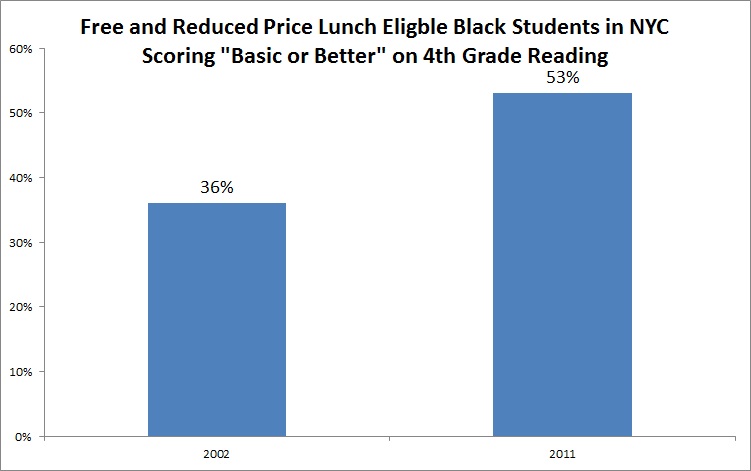
Did the Klein reforms cure all of the education problems of Harlem? Certainly not. They strangely also failed to cure cancer, restore sight to the blind nor did they erase the painful memories of having shelled out money to see Indiana Jones and the Kingdom of the Crystal Skulls.

They have however seen hard fought gains for disadvantaged students. Rather than wringing their hands, the New York Times should be calling for the logical next steps in reform.


Paging Mr. Nottroth, Mr. Wim Nottroth…

September 5, 2012

(Guest post by Greg Forster)

I think the JPGB post I’m most proud of is my nomination of Wim Nottroth for the Al Copeland award. I was deeply honored, of course, to have my nominee go on to win “the Al.” But I was even more honored to help more people learn about Nottroth and what he did for all of us.

Readers interested in similar threats to liberty may have been following the case now pending in Germany, where a rabbi is under criminal investigation for the “offense” of circumcising children. For those who are interested, over on the new group blog I edit called Hang Together, I offer four lessons Americans can learn from the German circumcision case as we wrestle with our own struggles on religious freedom.


If Teachers are Underpaid, Why Don’t They Earn More When They Move to Other Professions?

September 4, 2012

[Note — AEI’s Jason Richwine noticed my post urging people to read the debate in Education Next over how to assess teacher compensation.  He asked if he could submit this post to address an argument raised by Mishel and Roy that he did not have the space to respond to in Ed Next.]

(Guest Post by Jason Richwine)

The fall issue of Education Next features a debate: “Are Public School Teachers Underpaid?” Andrew Biggs and I contributed an argument based on our report released last year, while Lawrence Mishel and Joydeep Roy from the Economic Policy Institute (EPI) offer a rebuttal. Unfortunately, Andrew and I had only 300 words for our subsequent rejoinder, so much of their critique went unaddressed.

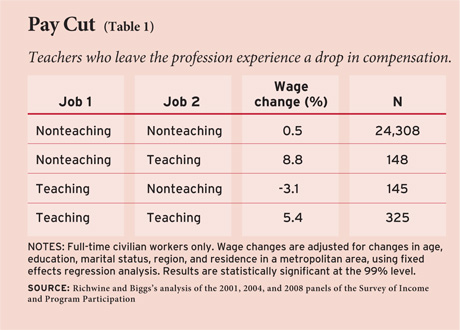
One of the points we made in our original piece is that EPI’s underpaid-teacher hypothesis generates a testable prediction: If teachers are underpaid relative to their skills, teachers who leave the profession should, on average, earn more in their new jobs. Likewise, new workers coming into teaching should, on average, take a pay cut from their previous jobs.

Andrew and I showed that, if anything, the opposite is true: Individuals get an average salary increase of 8.8 percent when they enter the teaching profession and a pay cut of around 3.1 percent when they leave.

Mishel and Roy confirm our empirical finding. In fact, they add that ex-teachers typically do not become engineers or chemists—they often become “librarians, cashiers, secretaries, and clergy.”

This would seem to cast strong doubt on the underpaid-teacher hypothesis, but Mishel and Roy don’t interpret it that way. They point out that just 1 percent of teachers actually leave for a different profession each year, and those who do leave tend to be making the lowest salaries. Therefore, they argue, we can hardly make inferences about the skill level of the average teacher based on this tiny, unrepresentative fraction. They don’t explicitly say that leavers have below-average skills, but the implication is needed for their argument to make sense.

I agree that teachers who stay could be more skilled than teachers who leave, but possessing these allegedly greater skills clearly does not compel them to seek higher salaries in the private sector. That was our point. If teachers are insufficiently compensated for their skills, we would observe teachers – particularly those with greater skills – leaving for higher-paying jobs. But despite all the anecdotes, the data just don’t show that happening.

In fact, Mishel and Roy’s response to us on job switchers is something of an own-goal. They are saying that, despite their own claims about teaching being underpaid relative to other professions, just 1 percent of teachers actually leave for a different profession each year. And that 1 percent may be made up of the least-skilled teachers. So tell me again why we need to raise teacher pay across-the-board…


Walter Mead Russell on the Plight of the Black Middle Class

August 30, 2012

(Guest Post by Matthew Ladner)

Every now and then you read something that just sits with you for a long time. My mental processor has been working on this provocative piece from Walter Mead Russell for weeks now.

Go read it. I’ll be here when you get back. Plenty of edu-implications here, and some obvious crucial points that WMR omitted, but tell me what you think in the comments section. I’m still trying to decide how I would try to tackle this if I were a billionaire philanthropist.


Charters v. Private Schools: Urban and Suburban Differences

August 28, 2012

(Guest post by Greg Forster)

Cato has new research out from Richard Buddin, examining where charter schools draw their students from. Adam Schaeffer offers a summary, emphasizing the dangers of charter schools: “On average, charter schools may marginally improve the public education system, but in the process they are wreaking havoc on private education.”

I agree with the basic premise: charters don’t fix the underlying injustice of government monopolizing education by providing “free” (i.e. free at the point of service, paid for by taxpayers) education, driving everyone else out of the education sector. As Jay and I have argued before, vouchers make the world safe for charters; that implies you can view charters as a response by the government to protect its monopoly against the disruptive threat of voucher legislation.

But what interests me more are the urban/suburban and elementary/secondary breakdowns of these data. It appears that charters are only substantially cutting into private schools in “highly urban” areas. In the suburbs, the charter school option is framed much more in terms of boutique specialty alternatives (schools for the arts, classical education, etc.) rather than “your school sucks, here’s one that works.” If you’d asked me, I would have guessed that would also cut heavily into the private school market – it would appeal to parents of high means who are looking for something out of the ordinary for their children, and that demographic would be most likely to already be in private schools. Yet the data show otherwise; apparently the families choosing boutique suburban charters weren’t much impressed with their private school options. And what’s up with this weird distribution on the elementary/secondary axis? Apparently public middle schools really stink in urban/suburban border areas.

Discuss!


Random Pop Culture: Arena Rock Sing Along

August 25, 2012

(Guest Post by Matthew Ladner)

Enlow the Barbarian and I were in Austin Texas Thursday to testify to the Senate Education committee Friday morning. Despite being travel weary geezers, Enlow and I hit some Reb Bull and skipped over to the Alamo Drafthouse for

!!!!!!!ARENA ROCK SING ALONG!!!!!!!

So here’s how it works: you buy your ticket, and they give you an inflatable guitar, a tambourine and of course a cigarette lighter. Then they proceed to blast hair band/arena rock classics so that you can scream along in tune, or your best approximation thereof.

Here is a few of the songs:

and…

and…

and of course…

Needless to say, no celebration of hair-band nation could possible exclude:

God Save the Queen of Arena Rock:

and everyone burnt their fingers with this classic of cheesy goodness:


Another School Choice Random Assignment Study

August 23, 2012

A student just brought to my attention another random-assignment experiment on school choice that was recently released.  The results are, again, positive.  The study was conducted by Justine Hastings, Christopher Neilson, and Seth Zimmerman of Brown and Yale Universities and was released by NBER.  I’ll let their abstract explain the findings:

Using data on student outcomes and school choice lotteries from a low-income urban school district,
we examine how school choice can affect student outcomes through increased motivation and personal
effort as well as through improved school and peer inputs. First we use unique daily data on individual-level
student absences and suspensions to show that lottery winners have significantly lower truancies after
they learn about lottery outcomes but before they enroll in their new schools. The effects are largest
for male students entering high school, whose truancy rates decline by 21% in the months after winning
the lottery. We then examine the impact attending a chosen school has on student test score outcomes.
We find substantial test score gains from attending a charter school and some evidence that choosing
and attending a high value-added magnet school improves test scores as well. Our results contribute
to current evidence that school choice programs can effectively raise test scores of participants. Our
findings suggest that this may occur both through an immediate effect on student behavior and through
the benefit of attending a higher-performing school.

School choice has to be the most rigorously studied education policy and has a relatively consistent set of positive findings.


New Study on Vouchers and College Enrollment

August 23, 2012

Matt Chingos and Paul Peterson have a new study based on a random-assignment experiment of the effects of privately funded vouchers on college enrollment.  They followed the students who had received a private school scholarship in New York City.  Earlier research found significant achievement benefits from that program for African American students but there was some controversy over whether those findings were robust to reasonable alternative specifications.

Now the students are old enough for college and Chingos and Peterson went back to see if achievement gains translated into higher college enrollment.  They did.  African American students who received a private school scholarship were 24% more likely to enroll in college.  The improvement was more dramatic in the chances that African American students would attend private 4 year colleges and even selective private colleges.

No significant effects were observed for Latino students nor for the very few white students in the sample.  It appears that choice has the biggest effect on those whose options would have been the worse in the absence of a choice program. It is also worth remembering that the scholarship was good for only half of private school tuition, so it is possible that a more generous program would have a broader effect.

You can read Chingos and Peterson’s summary of their findings in the Wall Street Journal.


Teacher Compensation Debate in Education Next

August 21, 2012

Education Next has an excellent debate about teacher compensation.  On one side Jason Richwine and Andrew Biggs argue that teacher compensation is significantly higher than similarly skilled workers in other occupations.  Lawrence Mishel and Joydeep Roy are on the other side arguing that teacher compensation is lower than for comparable workers.  It’s a great debate, so be sure to check it out.


Juan Williams: Fixing Our Schools

August 20, 2012

(Guest Post by Matthew Ladner)

If you missed Juan Williams’ news special Fixing Our Schools last night on Fox News (shame on you!) you can catch some of it on the web here. Great feature on Carpe Diem, School of One, digital learning and interviews with Jeb Bush and Joel Klein.