Some Initial Thoughts…

November 7, 2012

(Guest Post by Matthew Ladner)

Football analysts tend to narrow explanations for why one team prevails to a handful of plays whereas in reality every play is of equal importance-it just doesn’t seem that way. Likewise elections are incredibly complex and we focus on a single factor only at our peril.

Nevertheless…

First let’s note that the Obama campaign worked their math problem with masterful precision. Needing blue-collar White votes in Ohio, they found a way to get them, for example. The narrow national popular vote majority plus the lopsided electoral college result is a testament to the effectiveness of the Obama campaign. George W. Bush’s team pulled off a similar victory in 2004- incumbent Presidents are tough to beat.

Having said that, the Republican ticket pulling in 27% of the Latino vote is nothing short of a dumpster fire. Moreover, note that Romney only won Texas by a little over 8 percent.

Every day between now at 2016 will involve older and predominantly Whiter Texans going off to the Rodeo in the Sky, and more and more Hispanics coming of voting age in the Lone Star State. You don’t need to spend hours fiddling around with the Real Clear Politics “Build Your Own Electoral College Map” to imagine what even a Purple Texas would do to national politics, much less a Blue one.

This of course is hardly set in stone. Republicans do have dynamic young Hispanic leaders in the Senate from Florida and Texas. Republicans however are in for a spell of finger-pointing and self-reflection. Rethinking the position of immigration deserves a spot near the top of the to-do list…

https://jaypgreene.com/2012/06/26/after-sb-1070-time-to-itune-illegal-immigrations-napster/

…but it doesn’t end there. Republicans should be developing an opportunity agenda that appeals not only to Hispanics, but also to others.

Congratulations to President Obama and his team. I will be very curious to see what happens next.


Appetite for Disruption

November 5, 2012

(Guest Post by Matthew Ladner)

Be sure to take time out of your busy schedule of fretting about tomorrow’s election by reading the New York Times article “Year of the MOOC.” Word Press is acting up, so here is the link:

http://www.nytimes.com/2012/11/04/education/edlife/massive-open-online-courses-are-multiplying-at-a-rapid-pace.html?pagewanted=1&_r=0&ref=business

Interesting bits: survey of students finds a majority of students judged MOOCs to be of higher quality than a regular course, and an overwhelming majority found it to be of better or equal quality:

And in a vote of confidence in the form, students in both overwhelmingly endorsed the quality of the course: 63 percent who completed Dr. Agarwal’s course as well as a similar one on campus found the MOOC better; 36 percent found it comparable; 1 percent, worse.

The story also concludes on the right note: the best is yet to come.


And the Winner of the 2012 “Al” is… George P. Mitchell

October 31, 2012

We had many excellent nominations for this year’s Al Copeland Humanitarian Award.

I nominated Banksy, the graffiti artist whose works promote free speech, provide thoughtful social criticism, and beautify public spaces.  But Banksy’s influence is not widespread enough to have done the most to improve the human condition.  And I think we have already acknowledged the importance of free speech and public art by honoring Wim Nottroth.

Anna nominated the auto pioneer and believer in consumer choice, Ransom E. Olds.  Having faith in the consumer rather than central planning does improve the human condition, but as Greg noted in the comments, the essence of consumer choice is among providers, not within them.  But to his credit we can say that at least Olds was not the anti-Semite and general bigot, Henry Ford.

Collin re-nominated Stan Honey, the inventor of the yellow first down line in TV broadcasts of football games.  Collin’s post was hilarious, especially the bit about how “Stan Honey made watching football with football novices tolerable.”  But I’m afraid that Honey fell short again.  The Al isn’t just about quirky inventors of novel and useful products, even though those do improve the human condition.

And this is the same reason that Greg’s nomination of Alfred Fielding and Marc Chavannes, the inventors of bubble wrap, doesn’t make the grade.  The Al should recognize something more transformative — like spicy chicken.

I’m proud to announce that the winner of the 2012 Al Copeland Humanitarian Award is George P. Mitchell, the natural gas entrepreneur who commercialized fracking and horizontal drilling techniques that have made cheap, clean natural gas plentiful.

A common theme in all Al honorees is how they improved the human condition through individual freedom, not government control.  Earle Haas liberated women from several days of confinement each month by developing the modern, hygienic tampon.  This expanded women’s economic and political power by given them full access to public life.  This advance in civil liberties came from a private businessperson, not from a government mandate.  And the fact that he and the Tampex Company made a fortune in the process in no way sullies the benefits they produced for women.  In fact, that profit motive made the advance possible by incentivizing them to develop and market it.  And contrary to the vaguely Marxist critique of advertising as creating false and unnecessary desires, the marketing of the tampon was an essential part of making women aware of the tampon’s benefits and helping women overcome the ignorance and stigmas that hindered widespread use of tampons.

Similarly, Wim Nottroth’s improvement to the human condition came from his embrace of individual liberty.  He stood up to an Orwellian government edict that denouncing killing was the equivalent of hate-speech against Muslims.  As I’ve argued before, the most serious threats to liberty come from small-minded government officials and their enablers surrendering our freedom in the name of promoting something good, not the big scary dictators whose threats are self-evidently menacing and more easily resisted.

And Debrilla M. Ratchford, the inventor of the rollerbag, won the first Al in recognition of how important the quirky inventor of something useful could be to improving the human condition.  But inventing knick-knacks and doo-dads is not the only, or even necessarily the most important, way to improve the human condition.

George P. Mitchell didn’t even invent the techniques that he commercialized to extract significantly more natural gas.  Mitchell’s efforts didn’t just reduce carbon emissions by making clean energy plentiful, as Matt documents in his nomination.  Mitchell demonstrated how improving the human condition, including improving the environment, is more likely to come from individual freedom and capitalism than from government coercion.

Yes, Mitchell was richly rewarded financially for his accomplishments, but we’ve already established that making money in no way undermines one’s case for having improved the human condition.  Besides, I had never heard of him before, so the recognition that comes with winning the Al is appropriate.  And yes, some people have publicly recognized the great things that fracking and horizontal drilling have done, but as far as I know Mitchell’s contribution has never been highlighted before.

And just to prove that no good deed goes unpunished, Hollywood is organizing the anti-fracking campaign with a forthcoming movie featuring Matt Damon about how fracking poisons a town.  Here’s the trailer, which really puts the capital B in subtle:

And here’s the Oscar winning moment for Damon in the film:

Mitchell’s Al beats any Oscar any day for actually recognizing something that makes our lives better.


Defending the Ohio Reading Guarantee

October 31, 2012

(Guest Post by Matthew Ladner)

Tracy Craft from BAEO, Terry Ryan from Fordham and yours truly from the Foundation for Excellence in Education have teamed up to push back on attacks on Ohio’s reading guarantee policy. Just as a quick reminder of just how radically successful this effort has been in Florida, the chart below shows the trend of students reading at the lowest level of reading achievement (FCAT 1) at the 3rd grade level:

Edited for Clarity


Alfred Fielding and Marc Chavannes for The Al

October 30, 2012

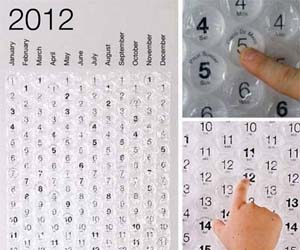
Bubble wrap calendar

(Guest post by Greg Forster)

Pop! Alfred Fielding and Marc Chavannes invented bubble wrap in 1957. Pop! If that doesn’t deserve The Al, I don’t know what does. Pop! Pop!

If you’re like me, reading those little pops! gave you a vicarious thrill by bringing to mind all the times you’ve popped bubble wrap and loved it. It’s a visceral joy. If you consider both quality and quantity of enjoyment, there’s not a lot out there that beats bubble wrap.

Like many Al nominees, Fielding and Chavannes benefitted humanity through a combination of innovative thinking, entrepreneurial drive, guts, and some serenedipity. Working in a New Jersey garage, they were trying to invent a new kind of wallpaper – paper on the bottom where it sticks to the wall, plastic on the top where people see it. I can’t seem to determine whether they were actually envisioning something we would describe as “bubble wrap wallpaper” or if they were just trying to get a layer of plastic on top of a layer of paper, but Wikipedia says the product they were working on was “three dimensional wallpaper,” so hey, I say that’s good enough. It was bubble wrap wallpaper.

Bubble wrap wallpaper? Hey, it was 1957. But our intrepid heroes realized – to their credit – that bird wouldn’t fly. But they realized that their process for injecting air into plastic would provide a revolutionary packaging material. They founded the Sealed Air Corporation in 1960 and the rest is history.

Let’s look at bubble wrap as a helpful product first. Bubble Wrap is actually a name brand; Sealed Air Corporation holds the trademark. The product is manufactured in 52 countries and the company reported revenue of $4.2 billion in 2009. And then of course you have to add all the copycats. I can’t find information on the total amount of “plastic bubble packaging” used in the world, but it must be enormous.

Bubble wrap helps a lot of people do a lot of things. In addition to keeping your great-grandmother’s china safe during a move, a variety of special kinds of bubble wrap serve industry (and thus all of us) in a number of ways. For example, they make a special anti-static bubble wrap for shipping computer chips.

But you don’t want to hear about any of that. I know what you want. Pop!

Just add up all the pleasure everyone has ever gotten from popping those bubbles. Just the other day my daughter got a birthday present in the mail, and we had to get her to stop popping the bubbles before she would open the present!

Here’s a good test of the value of bubble wrap. You can buy hand-held, key fob sized bubble wrap simulators. You pop the little bubbles and they reinflate. And these days, bubble wrap has gone cloud. That’s right – there’s an app for that.

What makes popping bubble wrap so fun? Is it about power – the thrill of destruction? Maybe for some, but I doubt that’s the main attraction. Is it the excitement of steadily building the pressure, not knowing when the threshold will be crossed, until suddenly pop! – essentially a hand-held roller coaster or scary movie. That’s more plausible. But people who don’t care for roller coasters or scary movies – me, for example – seem to get as much out of bubble wrap as everyone else. In the end, I think it’s a mystery. Why do lots of people like chocholate and few people like anchovies? They just do.

So in addition to sheer quality and quantity of enjoyment, there’s another reason bubble wrap embodies The Al. It’s an improvement to the human condition that no central planner or philosopher could ever have dreamed up. It reminds us that at the deepest level, the universe is the way it is simply because it is that way. That doesn’t mean the universe is irrational or amoral at its core; it means that the deepest mind and morality of the universe are what they are independent of whether we understand or approve. And so also with beauty, which is the third of the three classical Aristotelian transcendent experiences (the good, the true and the beautiful) – including the beauty of popping bubble wrap.

Pop!


Nominated for the Al Copeland Award: Stan Honey

October 26, 2012

[Editor’s Note — Here is a nomination for the 2012 Al Copeland Humanitarian Award by Guest Blogger, Collin Hitt]

Stan Honey invented the yellow first down line for televised football games. His remarkable invention was in fact an improved version of his own, failed highlighted hockey puck. The company he founded and the techniques he invented are key to the electronic strike zone seen in every baseball broadcast.

I nominated Stan Honey two years ago for the Al Copland Humanitarian Award. I am renominating him for the second and final time. In the time since his first nomination, he has made my life better by making televised football impervious to distractions, something I greatly appreciated yet still underestimated two years ago; I’ve since become a father.

I’ve discovered something else in the meantime. Stan Honey changed how Americans get from place to place. But more on that later. First, I must again remind everyone of what Stan Honey did for the game of football.

Americans, of their own free will, watch sports. None is more the family sport than football. There is no cosmic necessity to watching football – plenty of countries don’t care for it, or even know about football. But making football more enjoyable is something that improves the lives of almost every American.

Football is a simple game: keep getting first downs until you score. The end zone is instantly recognizable. So are the uprights. So a touchdown or a field goal are easily noticeable, at a glance. Not so for first downs.

Most of the game is spent trying to get a first down. Games are won and lost between the chains. And yet, until Stan Honey, the first down mark was often impossible to track for those watching from home or a bar.

Football is America’s game because it is television friendly. At most, 750,000 people are watching the NFL from the stands. The rest of America is either working or watching from home. A broken play, a sack, an end-around, a nine-and-a-half yard run, a muddy junked-up field – all can leave the at-home viewer disoriented, confused about the play’s relevance to the all-important first down. In time, yes, the announcers and the referees let us know where things stood. But this is America, and we want our information now. Instant answers, Stan Honey gave us that.

With the yellow first down line, football is also now watchable at a glance. Before Stan Honey, it’s not inconceivable that I might have been reaching for a spicy chicken leg, or a clean diaper, when the ball was snapped. Yes, I knew it was 3rd and 4, but now I’d lost my frame of reference. Jay Cutler is scrambling. Where is the line of scrimmage? The first down marker? It is a big moment in the game and I’m disoriented. Thanks to Stan Honey, the feeling of frameless cluelessness is now gone.

I might miss the snap, but at a glance I know the situation. I’ll know the millisecond the play ends whether it was a failure or a success.

Moreover, the stupid questions from the peanut gallery (some people call these folks their family), have become fewer. “How far do they have to go?” “Did he get it?” “He got eight yards. That’s good right?” When is the last time you heard someone ask one of those questions? (It was before 2001.) Everyone now knows: get past the yellow line. Stan Honey made watching football with football novices tolerable. It has made distractions less distracting. It has allowed people to pour earnest effort into snacking between commercial breaks. It allows certain people to read Elle Decor while watching the game. It has made an all American sport more American.

In case you question the impact that Stan Honey has had on America, think back to the last time that the announcers said “We’re having some trouble with the yellow first down line you usually see across your screen at home.” Technology being technology, the yellow line machine breaks from time to time, and when it does, life is awful.

When I last nominated Stan Honey, I focused exclusively on his invention of the yellow first down line. I’ve still done that here. But Honey’s pioneering work in fact began in electronic navigation hardware. The Garmin or the TomTom – even the navigation software used on your smartphone – they either directly descended from or directly inspired by the Etak Navigator that Stan Honey first brought to market in 1985.

From People Magazine, in 1986.

Start up a Navigator-equipped car, and a local map appears on a computer screen mounted near the dash. A green arrow marks the car’s location. Punch in a destination, and it is displayed as a flashing star.

Now begin your drive and turn a corner. The arrow representing the car remains centered, pointing straight ahead, while the map pivots and scrolls around the arrow, matching every turn you make. Approaching a cross street, there’s no need to crane to read a street sign when a glance at the screen reveals the street name, a feature that’s doubly helpful at night. You can even touch a button and zoom to a wide view showing a whole city or shift down to the neighborhood scale, where only a few blocks appear. When the arrow on the screen meets the flashing star, you’ve arrived within 50 feet of your destination.

Over the years, Honey’s Navigator surrendered market share to other products, but that’s no matter. Invention is followed by innovation. His device and software inspired imitators and improved versions that are commonly recognizable.

This has changed your life. Think of where you’re sitting right now. Did you use a navigation device to find the place, the first time you went there? When family or others come to visit, how do they find the place? I’ll bet their quest, and yours, would have been different if not for Stan Honey.

It’s fitting to place Honey’s contributions next to those of previous winners, as well as the award’s namesake.

As I write this entry for an award named after Al Copland, I’m getting hungry for Popeye’s Chicken. My first thought – I’ll pick up a bucket for the game this Sunday. Now I’m searching on my iPhone for the nearest Popeye’s. Great. I know where I’ll go for chicken on Sunday and how I’ll get there. And when I get home, I’ll be able to keep track of the game from the dinner table, where my son and I will be twenty feet away from the TV (and our new couch). Thank you, Stan Honey.

The 2009 winner was Debrilla Ratchford, inventor of the rollerbag suitcase. The next time I fly somewhere will be before the end of the football season. I’ll pack my rollerbag and get in the car. Using my handset, I’ll find the best route to the airport. I’ll get there early. I’ll roll my bag up to the bar and watch three different games on muted televisions, which is feasible because of the yellow lines on each screen. When I reach my destination, I’ll pull out my handset and find my hotel and the restaurants nearest to it, where I again might watch a football game or two. Thank you, Stan Honey.

Wim Nottroth was the 2010 winner. He is a pacifist and an anti-terrorist. Life is sacred. Peace is a precondition for a fun and enjoyable life. Spicy chicken, the yellow first down line and the rollerbag are enjoyable only in times of peace. Sure, they are trivial in a sense. But they are things that make the good life good. And so, in their own small ways, they are proof that Peace, and Wim Nottroth, are right.

Last year’s winner is the inventor of the tampon. I’m glad I didn’t nominate Stan Honey last year.

So, in closing, we have to ask ourselves, why did Stan Honey do what he did? He invented the yellow first down line for us, but really he invented it for himself. He is now a wealthy man. He has now retired to full-time yacht-racing, a lifelong passion that inspired his interest in triangulation, the foundation of his inventions. The literature on Stan Honey is scant. Few know his name outside of yachting, where he has won multiple awards for transoceanic navigation. Self-interested yachtsmen are not models for adulation. So don’t expect him to win a medal of freedom or genius award anytime soon. Yet he made every American’s life better. And that’s why he deserves the Al.


Baumol by Design

October 25, 2012

(Guest Post by Matthew Ladner)
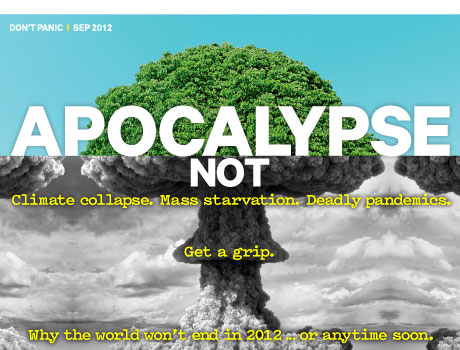
Part four of the Baumol Disease series is up over at the EdFly Blog, including spectacular new Baumol charts from the Heritage Foundation and an excerpt from Terry Moe’s book Special Interest regarding the history of the Florida Education Association hijacking the Florida Democratic Party during the 2002 election.

Also be sure to check out the Friedman Foundation’s incredibly cool K-12 Baumol Map by State. How bad is the disease where you live?


And You Thought Administrative Bloat in Higher Ed Was Bad…

October 24, 2012

When Brian Kisida, Jonathan Mills, and I released our study of administrative bloat in higher education through the Goldwater Institute, we thought it was bad that universities had increased their hiring of administrators (professional staff who are not faculty) at twice the rate of faculty.

I now realize that the perpetrators of waste in higher ed are mere amateurs.  The administrative bloat pros can be found in K-12 education.  According to a new report from the Friedman Foundation released today, student enrollment has increased 96% since 1950, but the growth in “administrators and other non-teaching staff [was] a staggering 702 percent.”

The report provides results state by state, highlighting the growth in staffing in recent years.  Even in the few states where enrollment has declined, staffing levels have grown dramatically.  Check it out.


Nominated for the Al Copeland Award: Ransom E. Olds

October 24, 2012

[Editor’s Note — Here is a nomination for the 2012 Al Copeland Humanitarian Award by Guest Blogger, Anna Jacob]

My nominee for the much-coveted 2012 “Al” is a gentleman with a profound respect for consumer choice. Ransom E. Olds, born in 1864 in Geneva, Ohio, got an early start to his professional life, helping out in his father’s machine shop when he was still a schoolboy. Olds’ talents for mechanical work were developed in this environment under the tutorship of his father and his creative flair was apparent in his inventions. The first car Olds developed was a three-wheeled, one-horsepower, steam turbine fueled with a gasoline burning engine, which offered a healthy competition to the coal or wood burning vehicles being developed around the same time in the nascent auto industry. As early as 1892, Olds attached a pair of these engines to a carriage, each connected to a driving wheel creating a vehicle that performed well on level ground but struggled to climb hills.

An 1893 trip to the Chicago World’s Fair the following year inspired Olds to experiment with fully gas-powered cars. Three years later, Olds’ engine manufacturing firm had an in internal-combustion engine under production and a patent application pending. Enlisting the financial support of Detroit capitalist, Samuel L. Smith, Olds started a new venture, the Olds Motor Works, in 1899. The company’s plant and offices were Detroit’s first permanent auto manufacturing enterprise, located on the Detroit River.

Smith was eager to target consumers at the upper end of the market and pushed Olds to develop an expensive, high-end model but Olds preferred to develop a product that could be sold to a mass market.  Olds understood that consumers wouldn’t all necessarily want the same thing.  And he also understood that it was exceedingly difficult for any one person, like himself, to anticipate exactly what others would want.

So, rather than committing himself to a single, expensive car design, as Smith wanted, Olds created eleven different prototypes, featuring a dizzying number of innovative technologies including steam-powered, electric, and gasoline-powered internal combustion engines. Olds wanted to let a thousand flowers bloom (actually, eleven) and then let the market sort it out.

But as it happened, an accident of fate selected Olds’ initial model when a fire destroyed all but one of his eleven prototypes, the gasoline-powered Curved Dash Oldsmobile Runabout. The company concentrated its efforts on fully developing this model. Although it had never been a foregone decision that gasoline-powered engines would be the dominant automobile type, Olds’ company wound up dominating the era of automobile production. In 1901 his company produced 425 gasoline-powered Curved Dash Oldsmobile Runabouts at $650 apiece, well within the grasp of the average American. Four years later, his company sold 6,500 cars. It appeared that Olds had produced the first mass-produced automobile in the U.S.

Olds’ success came amidst fierce competition as hundreds of producers, including such notable individuals as Thomas Edison and Henry Ford, were designing prototypes at this time. Yet Olds’ remarkable success is not the reason for his nomination; rather the humility of this early pioneer and his discomfort with choosing on the consumer’s behalf which model should be the dominant automobile design made him an obvious nominee. Instead of firmly defining what an automobile should look like, Olds embraced the innovative messiness that was the hallmark of the first half of the twentieth century, contributing his inventions to an already bewildering array of options. Above all, Olds displayed a respect for diversity and trust in the market to winnow out the winners and losers.   Unlike, Ford, who is reported to have quipped that consumers could buy any color car they wanted as long as it was black, Olds dreamed of a market where consumers could buy whatever they wanted…. Period.


George P. Mitchell for the Al Copeland Humanitarian Award

October 18, 2012

(Guest Post by Matthew Ladner)

I nominate Texas oilman George P. Mitchell for the Al Copeland Humanitarian Award.

Mitchell studied at Texas A&M University, where he graduated first in his class with a degree in Petroleum Engineering. Born to Greek immigrant parents in Galveston Texas in 1919, George P. Mitchell built a Fortune 500 energy business Mitchell Energy and Development Corporation.

George P. Mitchell’s was both a deliberate and perhaps an inadvertent environmentalist. A philanthropic supporter of environmental causes, Mitchell ironically made a far greater positive impact on the environment through his market activities. More ironic still, many environmentalists somewhere on the ya-hoo to yay-hoo spectrum (a man from Wyoming once tried to explain the difference to me- but it is awfully complex) hate Mitchell’s fantastic environmental triumph.

Mitchell combined and developed the techniques of horizontal drilling and hydraulic fracturing (aka fracking) that is in the process of revolutionizing the energy business.

A biography page of Mr. Mitchell notes just how long and hard Mitchell and company worked to develop this process:

Mitchell Energy sunk a lot of money over a long period into learning how to stimulate the rock so it would flow,” says Potter. Their first attempts were expensive “massive hydraulic frac jobs.” They would pump a very large volume of fluid and sand down a well bore to crack the rock and give it more permeability. At first, they got the gas flowing, but the methods and materials were expensive. So they wondered if they could pump less fluid and get the same effect.

They arrived at something called a light sand frac,” says Potter. “Suddenly it was economical and at the same time-in the mid-1990s-the price of gas was rising. By the late 1990s, they had perfected the technique in vertical wells and started applying it to several hundred wells. That’s when it came to the attention of industry.”

“Then it was realized, oh, if you scale that up to the whole area and then to the whole county and up to the whole Basin, the amounts of gas are really quite prodigious,” says Potter. “People became aware of that in 2002 and 2003 and that really got the ball rolling.”

“It took George Mitchell 18 years to make it work,” notes Larry Brogdon, partner and chief geologist for Four Sevens Oil Company. “He is the father of the Barnett Shale. He was tenacious. He started in 1981 and it really didn’t take off until 1999. And even then, it took a long time to develop it.”

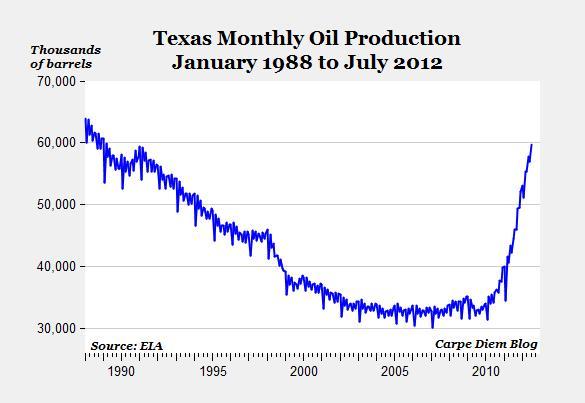
So what have been the benefits of Mitchell’s steadfast pursuit of this technology? Mark J. Perry provides the answers:

Let’s start with oil production in Mitchell’s state of Texas:

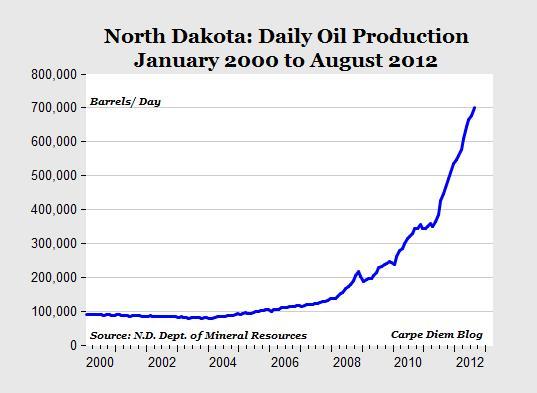
Peak what? North Dakota is booming as well:

And the energy sector is close to the only hot thing going in our depressed economy..

Most prominently on the environmental side of things, he has radically increased the supply of Natural Gas in America and a growing number of elsewhere, and this is killing the use of coal.

Natural gas produces less pollution than coal and it is cheap in America, so you see trends like this:

Leading to this:

The United States is going to meet Kyoto carbon emission goals despite the fact that we never signed the treaty. As it turns out, George P. Mitchell took care of things for us.

Casting their credibility out the window of a 100 story building, some environmentalists have gone to political war with Mitchell’s technology. The Washington Post is not confused about the desirability of fracking, blasting New York Governor Andrew Cuomo for delaying the use of the technique in his state in an editorial:

… anti-fracking activists who hope delay begets delay and eventually prohibition are doing the environment no favor. Burning natural gas produces only about half the carbon emissions as burning coal, which produced 42 percent of America’s electricity in 2011. With the increasingly common use of fracking, natural gas prices have plummeted, encouraging a switch from coal to gas, and the country’s emissions trajectory has improved.

A suite of technologies has brought vast supplies of previously unrecoverable shale gas within reach of humans, dramatically expanding natural gas reserves in the U.S. and around the world. Horizontal drilling and hydraulic fracturing have produced a fuel that can at once promote a cooler planet and an expanded economy, essentially eliminating the tradeoff between climate change mitigation and the pursuit of other public projects and, perhaps, economic growth.

Compare all of this to the epic boondoggle of President Obama’s attempt to push solar power before its time (if it is ever going to have a time). The Wall Street Journal gives you the blow-by-blow on that one.

George P. Mitchell’s influence on the world is set to grow ever larger. With the new technologies for instance, Israel now has recoverable fuel reserves comparable to Saudi Arabia. Foreign Policy attempted to forecast the winners and losers of the new energy abundance and on balance, it is looking very good overall.

Mitchell has supported sustainability and even the deeply misguided Club of Rome report as a philanthropist, but in a deeply telling twist of fate, it was his determined entrepreneurial activities that have produced not only environmental benefits but also enormous prosperity and hope for the future. This Texas Wildcatter turns out to have been the ultimate environmentalist, as is implied in the Washington Post’s editorial linked to above:

True, half the emissions does not mean no emissions. But the United States does not have to eliminate its carbon footprint all at once, nor should it. Doing so would cost far too much. Instead, natural gas can play a big role in transitioning to cleaner energy cheaply. A recent analysis from Resources for the Future, a think tank, shows that low, fracking-driven natural gas prices combined with efficiency measures and a serious carbon tax would result in a massive increase in the use of natural gas, nearly eliminating America’s coal dependence by 2035 and cutting emissions from the electricity sector by more than half. Renewable technologies, meanwhile, would have time to lower costs and address other hurdles to widespread deployment before picking up more of the load later in the century.

Environmentalists, in other words, should hope fracking is safe — and permitted.

George P. Mitchell’s triumph proves Milton Friedman’s point perfectly and illustrates that it even applies to environmentalism:

I therefore place Mr, Mitchell’s name in nomination for the Al: an Aggie who has earned an enthusiastic Thumbs Up from this Longhorn and deserves one from  everyone.

Okay, almost everyone…