Education Isn’t Entirely About Economic Utility

December 4, 2012
 2002-the-box-sm.jpg

As some of you may know, I’ve been working on a large-scale random assignment experiment of the effects of school tours of an art museum on students and their learning.  We spend hundreds of millions of dollars each year on school field trips and billions more on art museums, but we have relatively little rigorous evidence on how field trips and art museums affect students.  Soon we are going to have a lot more information.

Since the world of art and museum education is new to me, I’ve been trying to learn about how people in that field think about what they are trying to accomplish and what kind of evidence they present to justify the resources required.  Some  people try to justify the place of art in education by claiming that art positively affects achievement in math and reading — subjects whose importance is a matter of broad consensus.  Unfortunately, the evidence linking art education to improved math and reading achievement is generally weak and unpersuasive.

Why do people bother trying to justify art in terms of math and reading achievement?  Math educators don’t try to frame their accomplishments in terms of reading or vice versa.  Why do people in art try to frame the benefits of their field in terms of other subjects?

The problem is that a good number of  policymakers, pundits, and others who control the education system seem to think that the almost-exclusive purpose of education is to impart economically useful skills.  Math and reading seem to these folks to be directly connected to economic utility, while art seems at best a frill.  If resources are tight or students are struggling, they are inclined to cut the arts and focus more on math and reading because those subjects are really useful while art is not.

This economic utility view of education is mistaken in almost every way.  Most of what students learn in math and reading also has no economic utility.  Relatively few students will ever use algebra, let alone calculus, in their jobs.  Even fewer students will use literature or poetry in the workplace.  When will students “use” history?  We don’t teach those subjects because they provide work-related skills.  We teach algebra, calculus, literature, poetry, and history for the same reasons we should be teaching art — they help us understand ourselves, our cultural heritage, and the world we live in.  We teach them because they are beautiful and important in and of themselves.  We teach them because civilized people should know them.

Most parents understand that education is not entirely about imparting economically useful skills.  Yes, they want their children to get good jobs but they also want to have their children develop good characters, appreciate the good life, and generally be civilized human beings.  Of course, different parents may want a different mix of economic and cultural education for their children and school choice would allow them to find the schools that offered the mix that suited their needs and tastes.

But policymakers, pundits, and others suffering from PLDD who control our increasingly centralized education system focus almost exclusively on economic utility as the criteria for making education policy decisions.  Math and reading test scores are the only clubs they have to beat their opponents in establishing their preferred policies.  And economic payouts are the only objective measures they can use to justify expenditures.  Parents don’t think about education this way, but they have less and less say over what happens in the rearing of their children to become what they hope will be civilized human beings.

Some policymakers, pundits, and other PLDD sufferers have noticed that not everything taught in math and reading is economically useful and want to fix that.  You have folks like Tony Wagner and the 21st Century Skills movement suggesting that we cut algebra because students won’t “need” it.  Instead, students would be better off learning communication skills, like how to prepare an awesome Power Point (TM).  And you have Common Core cutting literature in English in favor of “informational texts.”

Of course, the logical culmination of the idea of school as job-skills provider is that we would do away with school altogether and just have apprenticeships.  I see nothing wrong with apprenticeship but it is not what I or most parents view as an “education.”

People in the art world can justify what they do by arguing for art in its own right.  They can rigorously measure art outcomes, as we are in our random-assignment field trip study.  In fact, as part of our study we had 4,000 students write short essays in response to Bo Bartlett’s painting, The Box (pictured above).  It may be harder to code and analyze essays about paintings than to run another value-added regression on the math and reading scores that the centralized authorities have collected for us, but that doesn’t mean it’s any less important.  The purpose of education isn’t only what the centralized authorities decide it is and bother to measure.


The Way of the Future: Unbundling K-12

December 3, 2012

https://i0.wp.com/photo.epg.co.kr/photo/movie/28269/282696.jpg

(Guest Post by Matthew Ladner)

We have a new contender in the education reform race: Michigan! Very interesting proposal.

Michigan has an iron-clad constitutional prohibition on public money going to private schools, so it is hilarious to see some of the usual suspects in the above article calling this a “voucher proposal.” Nevertheless, this raises some interesting questions. Is a student taking a Massachusetts Institute of Technology (public institution) class online through EdX (a private 501 c3) taking attending a “private school?”

What if they are taking a Harvard course through EdX? What about a University of Michigan course through Coursera?

Luckily it doesn’t much matter because they are free and don’t require much in the way of public funding.  It would be highly desirable to allow students to use public money to pay for the $89 testing fee in order to receive college credit, especially for children of limited means, but not necessary. Presumably Michigan is going to develop their own system of end of course exams in order for purposes of transparency and accountability. College credit will be a bonus.

Note that while the usual conspiracy theorists have already donned their tin-foil hats about evil profit driven plots that for-profit providers while they will in fact be in direct competition with brand names like Stanford and Princeton who will be providing courses free of charge.

Let me also note that rather than providing $2500 per semester of early graduation, it would make more sense to put all education funding into an Education Savings Account and let the providers compete on both the basis of quality and cost.  A greatly reformatted system of in-person schooling customizing their offerings to meet individual needs would result. All providers would need to compete on the basis of quality and cost, updating the 19th Century Prussian factory model of schooling in the process.

This however is simply an optimizing detail-congratulations to Governor Rick Synder and his team of visionaries for reimagining K-12 education for the 21st Century.

HT: Adam Emerson.


Introducing “The Higgy”

November 28, 2012

William Higginbotham

As someone who was recognized in 2006 as Time Magazine’s Man of the Year, I know a lot about the importance of awards highlighting people of significant accomplishment.  Here on JPGB we have the Al Copeland Humanitarian Award, but I’ve noticed that “The Al” only recognizes people of positive accomplishment.  As Time Magazine has understood in naming Adolf Hitler, Joseph Stalin, and Ayatullah Khomeini as Persons of the Year, accomplishments can be negative as well as positive.

(Then again, Time has also recognized some amazing individuals as Person of the Year, including Endangered Earth, The Computer, Twenty-Five and Under, and The Peacemakers, so I’m not sure we should be paying so much attention to what a soon-to-be-defunct magazine does.  But that’s a topic for another day when we want to talk about how schools are more likely to be named after manatees than George Washington.)

Where were we?  Oh yes.  It is important to recognize negative as well as positive accomplishment.  So I introduce “The Higgy,” an award named after William Higinbotham, as the mirror award to our well-established “Al.”

Just as Al Copeland was not without serious flaws as a person, William Higinbotham was not without his virtues.  Higinbotham did, after all  develop the first video game.  But Higinbotham dismissed the importance of that accomplishment and instead chose to be an arrogant jerk by claiming that his true accomplishment was in helping found the Federation of American Scientists and working for the nonproliferation of nuclear weapons.  I highly doubt that the Federation or Higinbotham did a single thing that actually advanced nonproliferation, but they sure were smug about it.  Here, I think, is a video of one of their meetings:

I suspect that Al Copeland, by contrast, understood that he was a royal jerk.  And he also understood that developing a chain of spicy chicken restaurants really does improve the human condition.  Higinbotham’s failing was in mistaking self-righteous proclamations for actually making people’s lives better in a way that video games really do improve the human condition.

So, “The Higgy” will not identify the worst person in the world, just as “The Al” does not recognize the best.  Instead, “The Higgy” will highlight individuals whose arrogant delusions of shaping the world to meet their own will outweigh the positive qualities they possess.

We will invite nominations for “The Higgy” in late March and will announce the winner, appropriately enough, on April 15.  Thanks to Greg for his suggestions in developing “The Higgy.”


Once Again, Dr. Mathews…

November 26, 2012

(Guest post by Greg Forster)

At what point does refuting Jay Mathews’ lame rationalizations of his politically chosen position become bad sportsmanship? Well, I suppose I left that exit behind miles back, having shamelessly run up the score on him during last year’s humiliating wager, and then followed up with this.

So if he were flogging the same old lame arguments in his recent column, I’d leave it alone. But he’s not. He’s got all new lame arguments!

The main thing I want to point out is that Mathews isn’t even pretending that vouchers are politically dead. That used to be his main argument (see Wager, Last Year’s Humiliating for more information). Now he doesn’t even gesture towards it.

See this?

That’s the trophy case I just bought because I ran out of room to store all the arguments my opponents stopped making.

So now that he’s abandoned his old lame rationalization for his politically selected position, what’s his new one? Apparently, a shocking Washington Post article recently “revealed” that parents, not the corrupt D.C. school bureaucracy, are in charge of deciding whether schools taking vouchers are doing well. No, seriously, that’s his argument.

In other news, a shocking post here on JPGB recently “revealed” that water runs downhill.

Mathews goes on at some length about one (1) voucher school that isn’t up to snuff. As opposed to the D.C. public school system! Mathews himself opens the column by admitting that “if I were a D.C. parent with little money and a child in a bad public school, I would happily accept a taxpayer-supported voucher to send my kid to a private school.” So that’s pretty much the only answer I need for that.

He also waves around some big dollar figures trying to create the impression that vouchers cost a lot of money, never comparing them to the amount we spend on D.C. public schools – twice as much (or more, depending on whose figures you use). Arrest that man for flagrant violation of the Denominator Law.

And he argues that if vouchers ever got big enough to serve lots of kids, they’d have no choice but to accept government control over voucher schools comparable to what charter schools have now. Tell that to Indiana and Louisiana, which just enacted gargantuan new voucher programs. Honestly, you would think by now he’d learn to check first.

Once again, Dr. Mathews, we see there is no lame rationalization for your politically chosen position you can possess which I cannot take away.

HT to unofficial honorary Al recipient George Mitchell


The Anti-Al

November 25, 2012

We have now given 4 Al Copeland Humanitarian Awards to recognize people who have made significant contributions to improving the human condition.  I am wondering whether it is time we start giving Anti-Al Awards to recognize people who significant worsen the human condition.  Maybe shaming the bad is as important as praising the good.

The problem with an Anti-Al is that it may be too hard to narrow the field since so many people harm the human condition.  And unlike the Al, which heralds the unheralded, the likely candidates for an Anti-Al are so well known that there may be little point in recognizing them with awards.

The most obvious type of candidate for an Anti-Al would be the ruthless tyrants who rule over large portions of the globe.  But it is already widely understood that the likes of Kim Jong-un or Mahmoud Ahmadinejad are awful people who, along with their armies, bureaucrats, and fellow-government thugs, crush liberty, tolerance, and prosperity.  Then again, even in civilized societies one will occasionally hear about the need to understand, engage, and work with ruthless tyrants.  These same advocates for engagement of ruthless dictators are also often the same people who find Chick-Fil-A or Walmart too morally objectionable to frequent.  Perhaps the Anti-Al is necessary to remind people to have an appropriate moral perspective.  The real threats to liberty, tolerance, and prosperity are the folks being feted at diplomatic receptions, not retailers with disputed employment practices or objectionable views.

If ruthless tyrants are too obvious for an Anti-Al, then perhaps the most likely category of candidates would be those afflicted with Petty Little Dictator Disorder.  These tiny tyrants who populate the middle levels of government agencies, think-tanks, and cocktail parties everywhere are certainly not already recognized for their corrosive effect on liberty, tolerance, and prosperity.  The greater difficulty with using an Anti-Al to highlight these detractors from the human condition would be: how could we possibly choose among them?  They are so numerous and parrot each others’ ideas so much that I can hardly tell them apart let alone choose to highlight only one of them.  They are like a herd of zebras — a blur of proposed regulations, laws, and mini-dictatorial fantasies — that the lion cannot identify one to take it down.

Maybe there are other categories of likely candidates for an Anti-Al that would not have these same difficulties.  Or maybe others have more elegant solutions to the problems I’ve raised.  So, what do folks think?  Should we start an Anti-Al?


Yahoo, yayhoo or patriot? You be the judge…

November 20, 2012

(Guest Post by Matthew Ladner)

A reader of this blog has taken me to task for not spelling the word “yahoo” correctly. This is deeply distressing and unfair! An expert in such things (a man from Wyoming) once imparted to me lore regarding the distinction between a “yahoo” and a “yayhoo.” Perhaps it is spelled the way it is pronounced: “yay-hoo.” I can’t be certain.

The distinction was very fine-I think “yahoo” might have made reference to people who don’t know as much as they think they do, whereas “yayhoo” might refer to someone far-gone on the ideological spectrum as to have lost touch with reality. I find it all a bit confusing, so I tend to use the terms interchangeably.

Now the writer also makes her case against Tony along the way. “With the advent of President Bush’s No Child Left Behind in 2001, followed by President Obama’s Race to the Top, Common Core and NCLB waiver programs, we have been under constant pressure to surrender education decision-making to Washington and its trade association partners. Every aspect of voter disdain can be traced to the requirements imposed by federal programs such as the Race to the Top Fund Assessment Grant and the NCLB waiver.”

So the people of Indiana rose up in long-suffering anger regarding federal interference in schools and chose to take it out on Tony Bennett. This is plausible if we take “the people” to mean “the writer” but not so much otherwise.

Tony didn’t have anything to do with NCLB, and Indiana pulled out of the Race to the Top competition. I’d be willing to wager by left big-toe that if we administered a survey to the Indiana public and asked them to explain the elements of Indiana’s NCLB waiver that all but a small percentage would likely reply “what NCLB waiver?”  or something similar. People are rational actors and the vast majority of them won’t make time in their lives to learn anything more about NCLB waivers than studying Mayan hieroglyphs absent some good reason to do so. I’m also willing to bet that the new Superintendent will lose her real or imagined federalist fervor and choose not to nullify the waiver so as to have almost every public school in Indiana facing NCLB sanctions.

Never mind any of that- we mustn’t let mere logic or facts get in the way of a good conspiracy theory, especially if the conspiracy is thwarting the will of the public. Tony Bennett was controlled by Arne Duncan and special interests, and this NEA candidate will serve as Tribune to the People. Let’s see how that works out. Tuttle concludes “As for Ladner and his ilk, I note that long ago, the British disdainfully called the patriots ‘Yankee Doodles,’ and they mocked George Washington as an ignoramus. So go ahead. Call me a yahoo. But if you paint my portrait, make sure you show me holding the Declaration of Independence in one hand and the Constitution in the other.”

For my part, I’m content to allow Tuttle to continue to draw her own self-portrait and for readers to reach their own conclusions.


Brother Bob Smith Retires from Messemer

November 16, 2012

(Guest Post by Matthew Ladner)

Citing health issues, Brother Bob Smith has announced that he is stepping down from Messemer schools. Brother Bob was a leading light of the Milwaukee school voucher movement in addition to being a successful educator and school leader. Keep Bob in your thoughts and prayers as he faces additional surgery.


Read ‘Em and Weep Edureactionaries

November 14, 2012

(Guest Post by Matthew Ladner)

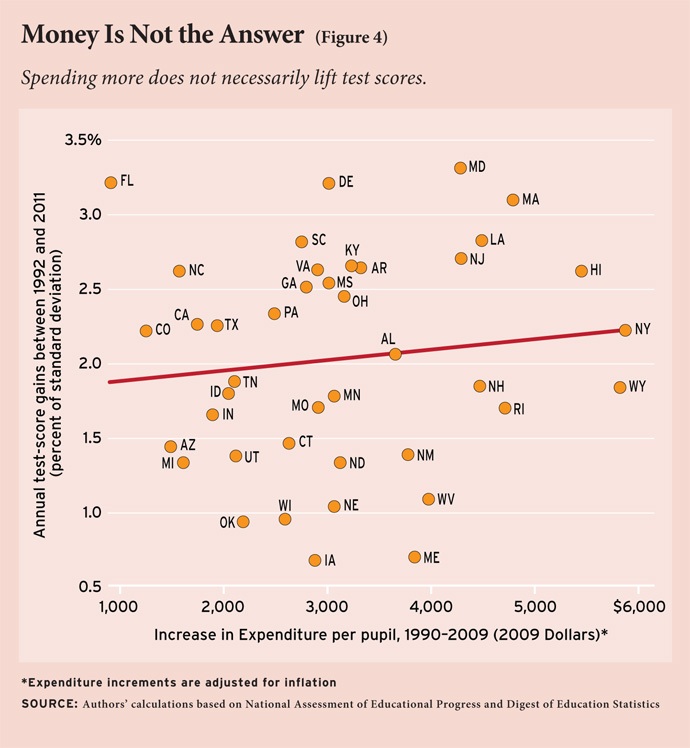
There is a great deal of interesting material in the Hanushek, Peterson and Woessmann study on international/American state academic achievement. Below however is the chart from the Ed Next version that I found most interesting:

Focusing on the 4th Grade Mathematics exam between 1992 and 2009, the authors found that increasing spending does not have a strong relationship with improved student learning. Par for the course.

Take a close look at the top of the chart however in terms of the states making large gains and how much additional revenue per pupil they spent to get them.

The states showing the top gains (in order) are Maryland, Florida, Delaware and Massachusetts. MD, FL and DE essentially tie with MA slightly behind.

Notice however that the inflation adjusted spending per pupil increase in Florida between 1992 and 2009 was $1,000. In Delaware it was $3,000. Maryland looks near the midpoint between $4,000 and $5,000 so lets roughly call it $4,500. Massachusetts looks to be $5,000.

So Florida managed first class gains with a much smaller increase in funding. If I were to go and look up the numbers, we would find that Florida’s smaller increase also came from a smaller base- MD, DE and MA were all likely to have been outspending Florida in 1992 and then really outspending them in 2009.

It is also worth noting that Florida faces considerably greater demographic challenges than MD, DE or MA- far more free and reduced lunch eligible children, more ELL kids, and to the extent you want to factor race/ethnicity into the equation it is a far more diverse state with a majority-minority student population.

So conflict-adverse state policymakers with extra billions of dollars burning a hole in their pocket and very wealthy and pale complected students should study MD, DE and MA for clues on how to improve their student outcomes.

If however you live in a state with average or above student diversity, real budgetary constraints on the amount you can spend on K-12 and strong competing demands for any additional revenue you are likely to scrape up, you should study Florida. In fact you should study Florida regardless unless you lack the guts for a good tussel.

P.S. Notice that NY and WY both had gigantic spending increases (an inflation adjusted $6k per student) only to achieve average and below-average gains respectively. At least WY is just wasting money they are pumping out of the ground. NY seems intent to drive their citizens out of state. Taxpayers and especially students are the losers in both cases.


Hoosier Fiasco a Wakeup Call to Both Sides of Common Core Debate

November 9, 2012

(Guest Post by Matthew Ladner)

Let me start by noting that what I write here, as always, is my own personal view. It does not reflect the views of my employer or any other group with whom I collaborate. It is my hope, for reasons I will explain below, to serve as an equal opportunity offender. Three days later I can speak only daggers to both sides of our currently idiotic Common Core debate.

A few days before the election some polling data was released from Indiana showing that Superintendent Tony Bennett had a problem with-of all people-conservative Republicans. It has quickly passed into the Conventional Wisdom that Tony’s support for Common Core cost him re-election. This result is an insult to a dumpster fire for both sides of the Common Core debate.

Let’s get two things clear from the outset: no one has yet to convince me that Common Core is a good idea and Common Core opponents have revealed themselves to be unsophisticated ya-hoos as easily led by weak arguments as any Ravitch-zombie. Whether Indiana adopts or chooses not to adopt Common Core is ultimately of trivial to modest importance in driving academic outcomes in Indiana. Neither side of the argument in Indiana seemed to appreciate this stunningly obvious fact.

Supporters claim that CC is a little better than Indiana’s existing standards, opponents a little worse. This is all subjective and thus there is no truth to discern here.  Should Mississippi adopt Common Core-yes states where the stock picking chicken can pass the test have nothing to lose. Should Massachusetts? Certainly not-a state with the highest NAEP scores on all four main tests has much to lose. The correct response to “should Indiana adopt Common Core?” is “why should I care?”

Common Core in Indiana thus was not a hill worth dying on to defend, nor anything worth putting a teacher union puppet in charge of your Department of Education to prevent. If you think otherwise you have earned a spot carved in stone on my “Drooling Idiots” tablet that I keep out in the rock garden.

My ESP detects objections from Common Core opponents reading this now. What about the Obama administration interfering in state/local control of schools? States adopted CC voluntarily and can leave voluntarily. Yes Duncan put points into Race to the Top for CC adoption but note that participation in that was purely optional and RTTT it is now long gone. Virginia also got a waiver from NCLB despite not adopting CC, busting another cherished myth. There was some chatter about conditioning Title I on CC adoption, but that was all it was thus far-chatter.  Everyone should be on guard against this, but let us be rid of all illusions in noting that the reality of the situation “federal takeover” remains such an exaggeration that it constitutes a tin-foil hat argument.

Think the federal government violated a law from the 1970s to bankroll Common Core? Maybe they did-how would I know? Either put up by going to court to prove it or shut up because you don’t really believe it.

Mark however that the fact that Indiana’s adoption of Common Core is relatively unimportant cuts both ways. An Indiana school board official said something to the effect that rather than picking his battles, Tony never saw a mosh-pit that didn’t make him want to jump in and start breaking noses of punks who deserve it. True enough- one of the many qualities that I love about Tony. Tony believed in Common Core and he fought for Common Core. Tony however gave a great deal more to the Common Core effort than it gave back.

The pitiful weakness of the Common Core nexus in making a coherent and visible case for Common Core against unsophisticated attacks like “federal takeover” and “Obamacore” means that Common Core does not deserve champions like Tony Bennett. This effort needs to be more convincing that “ummmm……….high standards are good or something” and needs to move beyond the Beltway blogo-echo chamber into the public quickly. If Common Core supporters have a persuasive case to make, now would be a great time to start making it.

The reason is simple: the reactionaries now have a play book to peel off uninformed conservative voters and add them to their coalition. This lesson seems unlikely to be lost on teacher unions or upon either political party in states with elected Superintendents.  It remains to be seen whether some enterprising group of reactionaries will successfully scale this model up to a Governor’s race, but I can’t see any reason for them not to give it a try.

In short, the combined ineptitude of the Common Core effort and the mouth-breathing stupidity of Common Core opponents stands as a risk to the broader education reform agenda. Love Common Core or hate it, let’s be perfectly clear that Tony Bennett was up to far more things, and far more important things in order to equip Indiana children with the academic skills they need. This farce has ended in tragedy with an entirely avoidable setback.

A plague on both houses! I hope both sides will accept my invitation to pull their heads out of their asses. This is very serious business we are engaging in here and we do not have the luxury of this kind of pointless stupidity.

P.S. Just in case no one else was going to say in public what many are saying in private, I hope that Governor Daniels enjoys those faculty teas discussing the finer points of Mechanical Engineering  because his decision to opt out of races is looking terribly misguided right about now. Tony deserved much better from all of us, but I am trying to imagine a better person than a popular and successful conservative Indiana Governor to talk sense to right-wing Hoosier yayhoos.

If any of you take offense at any of this, regardless of the tribe you hail from, feel free meet me by the bike racks in the comments section.  I will be happy to make further efforts to beat sense into you.


Romney State. Obama State. Charter States.

November 7, 2012

(Guest Post by Collin Hitt

A Romney red state and an Obama blue state both went for charter schools yesterday. Georgia and Washington faced statewide ballot initiatives to create and expand charter schools. Both measures passed.

The past two years have been years of school choice. As Greg has noted, vouchers and tax credit scholarship programs have seen a renaissance and massive growth. Charter schools have grown in turn, often receiving little notice while voucher programs and tenure reforms draw the attention of a dwindling number of anti-reformers.

Here’s a bit of policy background for understanding yesterday’s elections. Two laws must be in place in order for charter schools to open in meaningful numbers. There needs to be a law that allows charter schools to exist, obviously. And there needs to be a law giving charter schools a realistic chance of being approved by those overseeing the application process.

Forty-one states had created charter school laws, before yesterday. But several of those laws, like Virginia’s, are practically meaningless since they entrust the entire approval process for charter schools to school boards and union-dominated interests. This issue – that of charter school “authorizing” – is most important now facing the charter school movement.

Some states have created independent commissions to vet charter school proposals. Others have entrusted colleges to approve charter schools. These entities don’t need local school district say-so in order to approve a charter school in a given area. Independent authorizers bring impartiality to a process otherwise dominated by special interests. Charter commissions and universities aren’t crusading change agents either, just less partial authorities that in many states have allowed the charter school sector to bloom.

Georgia has had a charter school law on the books for years. It had an independent charter school commission for a time, as well, until the state supreme court ruled that a constitutional amendment was needed in order to bypass school district authority when approving charter schools. So the legislature placed an amendment on the ballot to do just that. Amendment One was up for a vote last night.

Washington was, before yesterday, the largest state to not have a charter school law. Through the state’s ballot initiative process, a new charter school law was proposed. This “Initiative 1240” would create a charter law, legally allowing charter schools to open. It would also create a statewide commission like that debated in Georgia, which would realistically approve applications to open charter schools. According to the Washington Policy Center’s Liv Finne, “Initiative 1240 would give Washington the best charter school law in the country.”

Both Georgia and Washington approved the measures. Georgia and Washington are not similar states. Georgia is reliably red and Romney carried it by 8 points. Washington is blue; Obama won there by 12. Georgia approved the charter school measure by 16 points, while Washington adopted the charter law by 2.4 points.

There were, of course, some common factors in both states, mainly the fierce union and bureaucratic opposition to charter schools. Both initiatives were on the one hand attacked as part of an elitist agenda of corporations and billionaires; this was supposed to incite the Occupy and labor union crowds. The teacher unions tried to hide behind the usual smokescreen of local control, as well, hoping to turn the Tea Party and rural voters against a market driven reform. The tactics – devoid of policy substance – didn’t work in either place.

Charter schools prevailed. And not just that, they prevailed on a day that was a mixed bag for other education reform voters. Between candidates and ballot initiatives, there were a number of notable elections, and the results were all over the place. Idaho rejected merit pay and tenure reforms. Michigan rebuked the teachers unions’ attempt to constitutionally guarantee collective bargaining. Republicans retook the Senate in Wisconsin.Tony Bennett lost in Indiana; Mike Pence won in Indiana.

Jay has noted that the status quo has no more intellectual defenders. Elites have bailed on the old way of doing things. There’s disagreement about which reforms are best. And the unions will still block reforms whenever they can, while remaining a potent force in elections.

But when it comes to whether American needs more school choice, the debate is over. Yesterday was evidence of that. Washington and Georgia agree, charter schools are good. Mitt Romney and Barack Obama agree, we need more school choice. There is still disagreement over how much school choice is appropriate, whether charter schools are sufficient, or whether private school options should be expanded as well. That debate will be important, but it was the thoughtful conversation that anti-reformers never wanted America to have.