Who Needs High School?

July 11, 2013

(Guest Post by Collin Hitt)

My introductory college courses were far better than the pap I was offered junior and senior years of high school. I remember wondering as a freshman at Southern Illinois University, why didn’t they offer these classes at Springfield High?

Now enter early college high schools, where kids take college courses at their high schools, which are often located on college campuses. A new gold standard study of ten early colleges finds that they raise reading scores, high school graduation rates, college attendance and – 7 years after high school began – college attainment. It turns out, making senior year more useful makes high school better for everyone.

The study, from the American Institutes for Research, uses gold-standard random assignment methods to evaluate the Early College High School Initiative that was launched by the Gates Foundation over a decade ago. The study looked at early college high schools, which offer kids the opportunity to earn college credit – even a two year college degree – while still in high school. The schools are typically formed in partnership with colleges and big-name employers, like IBM.

The AIR evaluation looked at 10 early college high schools that received Gates Foundation support. All were schools of choice that used lotteries to admit students, a majority of whom were low income. All of the schools were small; four of them were charter schools. We already have some evidence that small schools and charter high schools improved high school graduation and college going rates. The findings from the AIR evaluation are consistent with that literature; they find that early colleges increase graduation rates by 6-10 points and ever enrolling in college by 9 to 17 points.

The study mainly focused on “intent to treat” effects, i.e. whether the offer of a seat in an early college increased student achievement. The effects of actually attending an early college were buried in Appendix E. The effects are quite large.

The remarkable difference in early colleges is that 26.9 percent of early college students had completed a postsecondary degree by the time of the study, compared to 0.9 percent of the control group. Time will tell if those differences persist. But even if the control group eventually matches the early college students in educational attainment, the early college students will have likely entered the workforce much earlier and with far fewer student loans.

One of the most interesting developments in education today is the blurring line between secondary and postsecondary education. Colleges are increasingly doing the work of high schools. In early colleges, they are helping to offer college content. On the other hand, in remedial education, community colleges are teaching material that high schools failed to teach. Also, colleges will be expanding the online offerings available to high school students, which will be disruptive to the high school model. Where are we headed? A brave new world of neo-secondary education? I don’t know – hopefully towards a world where senior year of high school isn’t a complete waste of time.


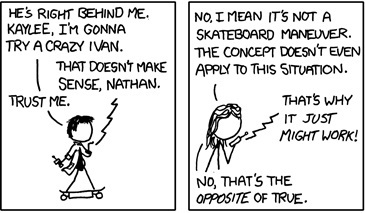
True vs. the Opposite of True at Ed Next

July 10, 2013

xkcd the opposite of true

HT xkcd

(Guest post by Greg Forster)

Education Next hosts a throwdown between Jay and Kate Walsh on the NCTQ teacher training standards. Backfill here.

What strikes me most about the exchange is that Walsh begins her response by essentially giving away the store to Jay:

The idea of encouraging experimentation in the education sector makes sense: if you don’t know what works, let a thousand flowers bloom. And the field of teacher education would appear to be particularly fertile ground. After all, there’s been a common presumption that no one knows what works.

Then, bizarrely, she argues that because Jay is right that we need to have more experimentation and “let a thousand flowers bloom,” we should impose regulations that restrict experimentation and limit how many kinds of flowers are allowed to bloom:

Teacher prep is the Wild West of higher education…This level of disarray raises an important question:  How much experimentation should we tolerate, given what’s at stake?…No doubt there is a difference between the kind of experimentation that Jay is calling for and teacher prep’s current modus operandi of throwing anything against a wall and seeing if it sticks—or worse, not even caring if it sticks, just doing it because a professor has decided he’s right, no matter the evidence to the contrary. But since the field itself is not rigorously gathering data on what works — and the risk for the students of new teachers is so great — it makes sense to establish reasonable guidelines as to what should go into teacher training to ensure, at the very least, that new teachers “do no harm.”

No, that’s the opposite of true. If we don’t know what works because we aren’t collecting data, and our top priority is to do no harm, the very last thing we should do is impose new regulations! The whole point of regulations is to prevent people from doing things that we know do harm. We impose lead regulations on paint manufacturers because we know putting lead in paint does harm. We impose medical trial regulations on medicine companies because we know selling untested medicines does harm. We impose broken glass regulations on fast food restaurants because we know putting broken glass in hamburgers does harm. (At least until you grind it up so fine that it’s no longer sharp, like they do in McDonald’s milkshakes.)

Imposing regulations when you don’t know what works is the quickest path to doing lots and lots of harm – and, by the way, it also prevents you from collecting data to find out what works (which is what we ought to be doing) because you can’t collect data on methods you aren’t allowed to try.


Correct Answers Are So Passé

July 8, 2013

(Guest Post by James Shuls)

In a recent interview, Douglas McCollum, senior vice president and general manager of education publishing company Pearson was asked, “What’s wrong with the way that we do K-12 assessment now?” His response:

We are going from the world of No Child Left Behind, where all of the assessments were objective, multiple-choice items, very cut-and- dry. They really don’t demand as much from students. [They’re] not really demanding that you be able to write, demonstrate your thinking skills, and so forth.

You know, I’ve often said to myself, “The problem with these tests is that their all too objective. What we need is a little subjectivity.” It seems I’m not alone. When asked what testing will look like in five years, McCollum responded:

It’s really all about being able to demonstrate your process of thinking. It’s about types of assessments that don’t necessarily have right or wrong answers, but that ask that students be able to defend a position. We’re moving more towards performance tasks, higher-order thinking, synthesis, comparisons.

I too have often thought that getting the right answer was so passé. After all, everyone knows that having the correct thinking is where it’s at. Although, what happens if I have the right answer with the wrong thinking?


James Shuls is the education policy analyst at the Show-Me Institute


You Never Can Have Enough Choice

July 5, 2013

(Guest Post by Matthew Ladner)

Matthew Ridley helpfully debunks the notion that modern society has “too much choice.”

P.S. Has Saturday Night Live spoofed TED yet?


Gone Fishing

July 3, 2013

I’m going to be taking a break over the next month to get some other stuff done, so I don’t plan on posting during July.  I’ve asked a few friends to join Matt and Greg in putting up some posts, just so that the blog is not completely inactive.

See you in August.


Oops, Sorry, Turns Out Common Core is Anti-Choice

June 28, 2013

octopus

(Guest post by Greg Forster)

Well, folks, I have to recant my recantation from yesterday. Turns out Common Core really does destroy parental options.

At Heritage, Brittany Corona points out that the SAT, ACT and GED are all competing to see who is most “aligned” to Common Core. As the College Board begins a major overhaul of the SAT, prompted by the ACT recently surpassing it as the most-used college exam, the Board is bragging that “in its current form, the SAT is aligned to the Common Core as well as or better than any assessment that has been developed for college admission and placement.” The revisions will seek even stronger “alignment” between the SAT and Common Core. No doubt the SAT feels like it has to play catch-up because the ACT has been boasting for some time that it “pledges to work with other stakeholders to develop strategies and solutions that maximize the coverage of the Common Core State Standards to meet the needs of states, districts, schools, and students.” Meanwhile, the GED cites “the shift to the Common Core standards [that] is happening nationwide” as one reason it has to make major changes to its test.

Corona points out that private schools and homeschoolers are impacted by these changes. Private schools are already under pressure from short-sighted and/or cowardly system leaders to adopt (or pretend to adopt) Common Core, so that they won’t be stigmatized as dissenters from the One Best Way. If college entrance exams are Common-Core-ized, it will be virtually impossible for private schools and homeschoolers to maintain any kind of alternative to the One Best Way. As for the GED, Corona points out that homeschoolers often use it for external validation of their education.

Now, just like everything else associated with Common Core, there is less here than meets the eye. That’s because the claims that these tests are, or will be, “aligned” to Common Core are all meaningless BS (just like so many other claims associated with Common Core). As Jay has pointed out, it’s overwhelmingly unlikely that anybody is ever really going to align anything to Common Core in a meaningful way. You can see that just from what the College Board people are saying. “In its current form, the SAT is aligned to the Common Core as well as or better than any assessment.” What the heck does that even mean? What can that mean? The federal government’s contractors haven’t finished developing their official federal-government-designed assessments “aligned” to Common Core. We don’t even have the standards themselves yet! These people are simply talking out of their bodily orifices (just like…).

Moreover, as Corona points out, the deadening hand of dictatorial control by cynical elites is a constant wellspring of opportunity for entrepreneurial innovators: “Thankfully, tests like the SAT and ACT can be changed or replaced, even though they have begun a transition to Common Core. If a significant number of states pull out of Common Core, these exams can be modified, or there could be an opening in the market for other college entrance exams to take root.”

But although Common Core is unlikely to do the kind of extensive damage to parental control and educational diversity that the bragging of the College Board, ACT and GED would imply, nonetheless it is increasingly clear that Common Core represents the technocratic spirit of the One Best Way, to which all families should (in principle) bow the knee and conform. The inability of the technocrats to achieve their dream of forcing all parents into the One Best Way should not blind us to the fact that this is, in fact, their dream. Or that is what is implied by their behavior, at any rate.

My apologies for the wrong turn yesterday, folks. I was right the first time – Common Core is bad for school choice.

HT Bill Evers and Breitbart


Greg Earns Even More Style Points Just Moments After Recanting

June 27, 2013

(Guest Post by Matthew Ladner)

Mere moments after recanting his Common Core opposition, Greg ran up the score on Jay Mathews even more with news that Ohio lawmakers have passed a new statewide voucher program for low-income students.

Don’t stop now Greg! Find something else to recant quick! Tell everyone that you think Firefly was the worst show in the history of television, and maybe we would get nationwide universal school choice!

P.S. BOOOOOOOOOOOOOOOOOOOOOOM!!!!


I Recant! Common Core for All!

June 27, 2013

Greg loves CC cropped

(Guest post by Greg Forster)

Just like Jay did a little more than a year ago, I am recanting my opposition to Common Core. I’m all for it! Never mind everything we said about how there’s no one best way to teach children, and even if there were, we don’t know what it is yet; never mind everything we said about how unions would inevitably get control of the standards or how they would reignite the culture wars; never mind everything we said about how the standards are already being set too low, how they’re being put together by people with conflicts of interest, how they’re being illegally pushed from Washington.

Never mind all that. I’m all for Common Core. Why? Because Common Core is good for school choice!

Yes, I just wrote a big post about why Common Core is bad for school choice. I take it all back. Every word of it.

As Matt has just pointed out, 2013 is turning out to be the third big year in a row for school choice. Now here’s the thing. Back when 2011 was a big year for school choice, you heard about it everywhere. I mean every-frikkin-where. And don’t get me wrong, that was sweet. But 2012 and 2013 have been good years for choice, and for some reason, nobody’s noticing.

What gives? Well, for years we’ve been saying that “vouchers make the world safe for charters.” Whenever vouchers get on a roll, the unions have to train all fire on vouchers – leaving charters to slip through with less opposition. Meanwhile, mushy-middle politicians, academics and journalists can triangulate by opposing vouchers but supporting charters. It was Jay’s idea originally, but I wrote about it at some length in the Freedom and School Choice book a while back.

It would appear that just as vouchers make the world safe for charters, Common Core makes the world safe for vouchers. Everyone is so busy running around fighting over Common Core – especially the unions – that voucher supporters seem to have a freer hand. A while back, Jay wrote that one reason Common Core is a problem is “because it is a gigantic distraction from other productive reform strategies….Common Core is consuming the lion’s share of reform oxygen and resources.” But it’s also consuming the anti-reform oxygen and resources!

And when money and muscle cancel out, there’s nothing left to determine the outcome but the merits – a debate we’ve already won.

So lock the government collar around my neck and break out the Gates Foundation checkbook, because starting now I’m all for Common Core.

PS Yes, that is St. Milton watching over me in the background.


Greg goes Three-Peat on Jay Mathews

June 27, 2013

(Guest Post by Matthew Ladner)

I think Greg has three-peated on his bet with Jay Mathews regarding school choice expansion. Here is my count, with a few of these not being totally done deals yet (but close enough):

Alabama new tax credit program

Arizona ESA expansion

Indiana voucher program expansion

Indiana tax credit program expansion

Iowa tax credit expansion

South Carolina new tax credit program

Utah voucher program funding increase and formula funding

Wisconsin voucher program expansion

New program discussions are still ongoing in North Carolina and Ohio.  Even before knowing how these turn out, 2013 already represents a very solid year for the movement with two new states added to the choice family and some significant improvements to existing programs.

UPDATE: Paul Diperna wrote me to note that Alabama passed both a refundable and a scholarship credit- meaning two new programs. Extra style points for Greg.


Less Sex, Drugs and Crime. Religious Private Schools, Better Roads, and School Choice.

June 26, 2013

(Guest Post by Collin Hitt)

Attending a private religious school lowers the likelihood that students will use cocaine, have sex or get arrested. That, according to a new study from David Figlio and Jens Ludwig.

They find that decreased sexual activity is found primarily among females, accompanied by a decreased likelihood of “fecundity.” Decreased cocaine use and arrests were found primarily among boys, who were also less likely to smoke tobacco.

Overall, private schools had little effect on adolescent drinking and marijuana use. This might be due to the fact that while some students were led to avoid drugs and alcohol altogether, students who otherwise would have used hard drugs instead just smoked pot and drank booze – in my view.

Figlio and Ludwig’s data comes from the late 1980s and early 1990s. They find that the effects of private school were focused primarily in two-parent households. They also find that the effects were concentrated in the suburbs, though the definition of suburb in their dataset is overly broad, which unnaturally decreases the accuracy of their estimates in urban areas.

Studies of private schools are typically fraught with selection problems: students who select into private schools might have selected, in the case at hand, to avoid hard drugs and have less sex no matter where they attended school. Figlio and Ludwig eliminate this bias from their study by using a clever instrumental variables model in which transportation infrastructure differences between cities are shown to have an effect on the likelihood that parents will send their children to private religious schools.

Figlio and Ludwig point to character education in religious private schools. I can’t think of a better explanation.

Religious private schools are often organized with family life in mind. They seek to help families raise children who will be good parents and good citizens; their definitions of good parenting and citizenship are, of course, colored by their varying religious beliefs. All religions are not the same. But most religious schools share the overlapping belief that students should abstain from sex and should not use drugs. Figlio and Ludwig show that they’re doing a better job than public schools and non-religious private schools at achieving those goals; is this because religious schools have more rigorous abstinence and drug resistance programs than public schools? I doubt it. Private religious schools largely were established with a private community purpose in mind – which is very different from a public policy purpose. They are able to make broader pleas to their communities.

Perhaps most importantly, private religious schools are less afraid to discuss the consequences of bad, selfish behavior. They encourage kids to think over the long-term, the very long-term.