It’s a Pass the Popcorn so big, I couldn’t fit it onto JPGB. Head over to Hang Together for 3,300 words on The Lego Movie and Frozen, which offer the two great moral worldviews of our time.
If you haven’t seen The Lego Movie, go see it. It’s hilarious. The entertainment value is well worth your money. I expect that some of the pop culture gags in this movie will be referenced by nerds around their digital water coolers for some time to come. And the gags are almost all visual, so it’s going to be a lot funnier on the big screen than it will be in your living room.
Don’t go expecting deep wisdom, just go expecting a great time, and you’ll have one.
The Lego Movie and Frozen are both examining what may well be the most important question facing our culture. They are not about the culture war as such, but they are about the core question of the meaning and purpose of human life that lies behind the culture war…
We had a bit of a fauxtroversy here in Arizona last week as some quarters got riled up over Superintendent of Public Instruction John Huppenthal’s decision to record a message for parents whose children attend D/F rated Arizona schools about the Empowerment Scholarship Account program. Superintendent Huppenthal serves as the legally designated administrator of the ESA program- it is quite a shock that he might work with private groups to raise awareness of the program. Quelle horreur! This is surely going to lead to the destruction of public education in Arizona right?
Well, no actually not so much. More on the NBC news show Sunday Square Off:
As I wrote last month: “I hate the Olympics. I hate everything about them… their show-casing of murderous authoritarian regimes, their graft and corruption, their promotion of obscure sports that generate little genuine interest, their hypocritical claim of being non-commercial and non-political, their subordination of athletic excellence to soap-opera story-telling… everything.”
I can tell from the Twitter blather that Team USA must have won something in hockey that some people are excited about. While I still hate the Olympics I find some of the comic responses to the Olympics and Team USA’s victory hilarious.
Both the Mississippi Senate and House passed ESA legislation for children with disabilities today. Check the FF for details, bills now head to conference. Congrats to Mississippi’s choice champions…not counting chickens yet but….can’t……….resist……..
!!!BOOOOOOOOOOOOOOOOOOOM!!!
Mississippi may be first to pass a new private choice bill in 2014. If so, who will be next?
While there’s still time, go see Frozen while it’s still in theaters. The Pixar conquest of Disney has been an uneven battle up to now, but this move is an unqualified victory and it may turn the tide of the war. It’s a profound movie on many levels.
The most obvious lesson of Frozen – the one that’s made explicit in the movie – is that love is not about how you feel. It’s about putting other people’s needs ahead of your own. This by itself would make Frozen a profound inversion of the old Disney culture by the Pixar invaders. But Frozen not only makes this point, it traces some wide-ranging consequences. Such as: people invest too much importance in romantic love relative to other kinds of love. The responsible grown-ups who tell you not to burn down everything else in your life for the sake of “true love” (quote unquote) are not your enemies, they’re your friends. They’re the people who really love you.
When Enchanted subverted these same fairy-tale conventions – e.g. getting engaged to someone you just met – it was just going for laughs. Don’t get me wrong, there are a lot of laughs in Frozen. It’s the funniest movie I’ve seen in years. But there are no laughs on this particular subject. Frozen is not subverting the Disney view of marriage for fun. Frozen is playing to win.
That alone would be enough to make Frozen an early contender for the most culturally regenerative movie of the year. But there’s more going on.
Under the surface, Frozen is dealing with two other subjects that are, if anything, even tougher for our culture. One is the corruption of human nature. It used to be that pretty much everyone agreed there was a systematic moral dysfunction in human nature. This is a teaching held by Christians in an especially strong form, of course, but it is by no means a peculiar Christian doctrine. Aristotle believed it, as did Kant. There is a whole song in Frozen about how nobody is what he ought to be: “Everybody’s a Bit of a Fixer-Upper.” While there are villains in Frozen who are willing to kill, the main threat to the heroine’s life comes from the selfish actions of a sympathetic character – someone who loves her. We are explicitly told at one point that the explanation is simple: everyone is like that.
This is, of course, related to the main message. It’s because other people are so disappointing that we prioritize our own feelings rather than other people’s needs. And it is because we are ourselves so disappointing that our lives fall apart when we prioritize our own feelings.
The other theme in Frozen, one buried even deeper, is the tension between social rules and individual freedom. Without giving too much away, I can say that Frozen is the movie Brave was trying to be, but couldn’t be. Brave was trying to deal with the fact that society needs rules, and individuals who are not well served by the rules need to learn to subordinate their own desires to the good of their neighbors as embodied in the rules; at the same time, social authorities need to recognize that the rules must accommodate the needs of individuals – including the needs of those unusual individuals who are not well served by the same rules that serve everyone else.
There was internal conflict over Brave at Disney, and it shows. Frozen pulls off the same angle brilliantly – better, perhaps, than Brave could have. Because in Frozen we are shown what happens to individuals who try to flee from society in order to escape its rules. They fall apart. Their lives become arbitrary and meaningless – and they learn to hate. “The cold never bothered me anyway” sings Queen Elsa as she builds an ice castle for herself at the top of a remote mountain, but she doesn’t realize how the cold is seeping into her heart.
Mike McShane hosted an event last week at the American Enterprise Institute, and I had the opportunity to serve on a panel with Mike, Andy Smarick and Kara Kerwin. During the discussion, Andy confessed that what he found the “disaggregation” of K-12 unsettling. This came up in the context of a discussion of Arizona’s ESA program and students like Jordan Visser:
“How do you assign a teacher of record?” I recall Andy asking. For Jordan, such a question is already antiquated. Should his tutor be classified as the teacher of record? Or the physical therapists? Mr. or Mrs. Visser? What if Jordan is taking a MOOC from Stanford is a few years? Should the state of Arizona attempt to hold Stanford “accountable” for what Jordan learns?
Personally I choose “none of the above.”
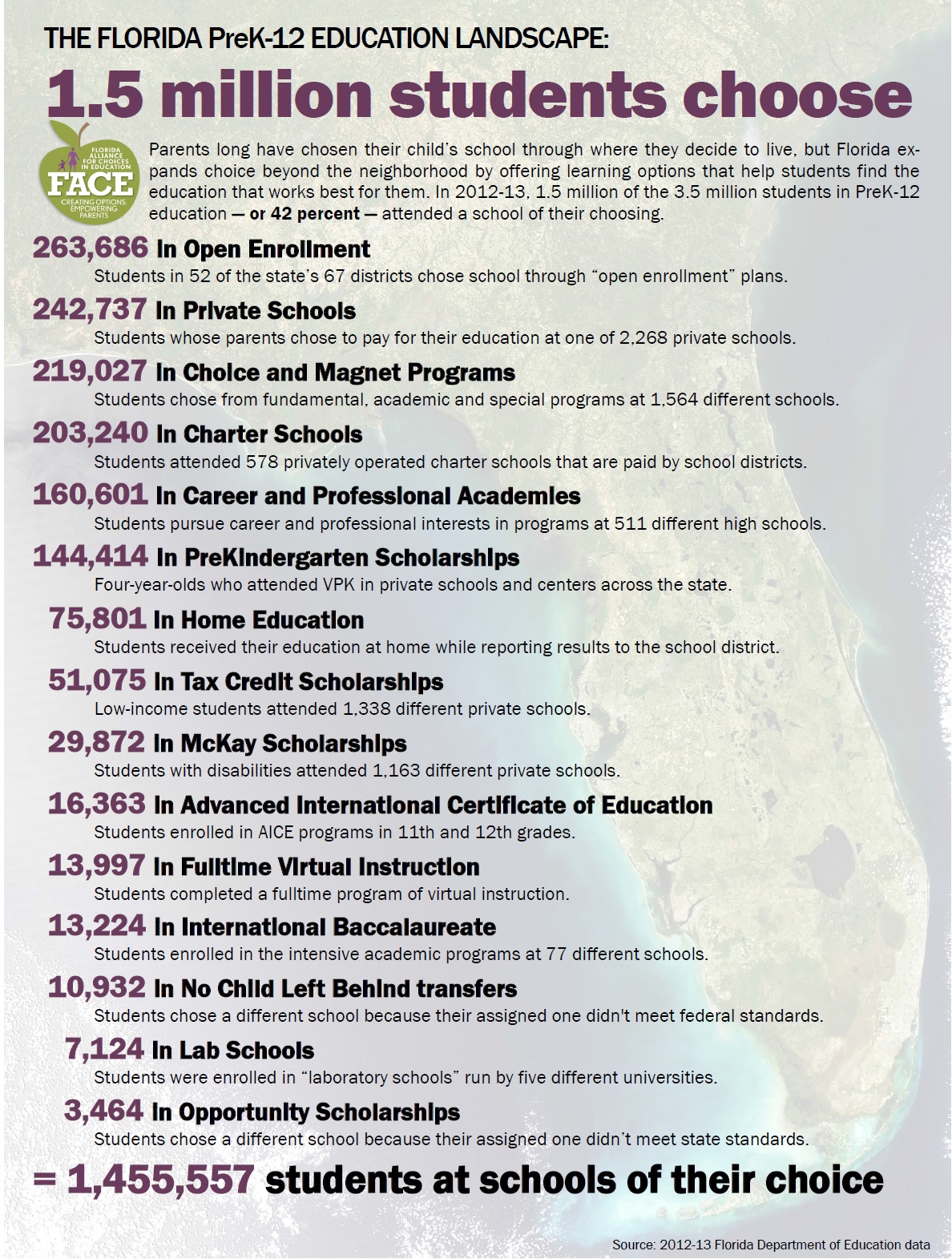
The trend towards disaggregation in K-12 predates Arizona’s still tiny ESA program. The ESA program can in fact simply be viewed as the best vehicle for managing a customization trend as a quasi-market mechanism that gets us as close as possible to realizing the benefits of markets while preserving the public funding of K-12. The disaggregation trend however has been moving out into the bloodstream for decades. Consider the following program data from Florida:
This is a snapshot of traditional “school choice as you knew it at the end of the 20th Century.” Most but not all of these choices are mutually exclusive such that they are something any one student does to the exclusion of others. You don’t expect to find many students for instance enrolled in a private school full-time and doing full-time virtual instruction, for instance. Most of these options are either/or propositions you are either sitting in this type of seat, or that type of seat. Major avenues of part-time education, such as dual college enrollment and virtual education, are not included, so we are just getting warmed up.
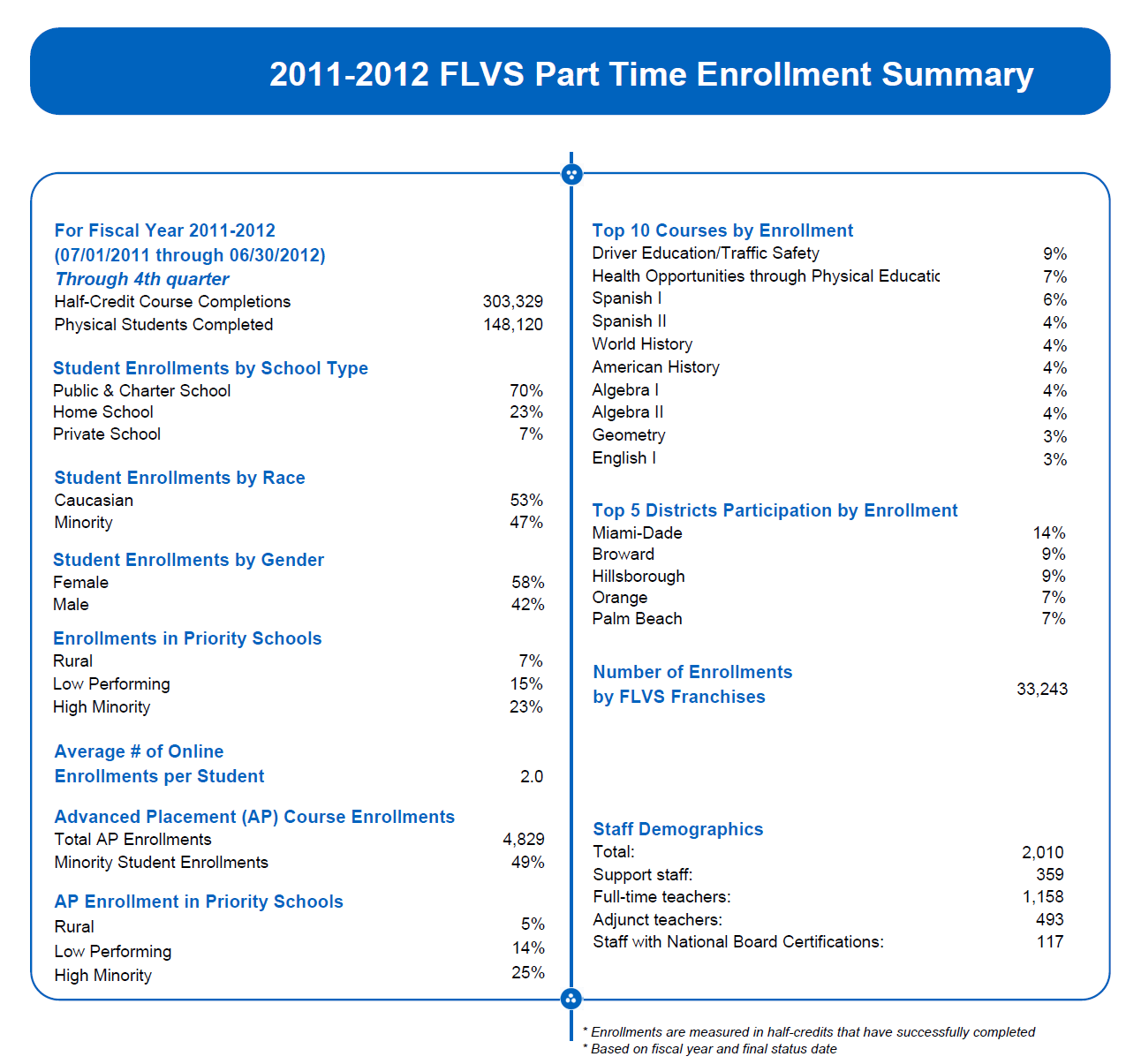
Let’s take virtual education on next:
The Florida Virtual School is not the only supplier of accredited virtual courses in Florida, so the 148,000 or so courses they provided in 2011-12 underestimates the strength of the trend. Nevertheless FLVS long ago begged the question: if a child takes an online Mandarin course from an approved online provider, just what, if anything, does this have to do with the results on the host schools’ accountability scores?
“I’ll take ‘Absolutely Nothing at All’ for a Thousand, Trebek!
Needless to say, FLVS found it necessary to develop alternative methods for measuring student achievement related directly to course content. High-school students have been taking classes at community colleges for decades with what appears to be an entirely understandable disinterest in sorting through just how much responsibility, if any, the Community College holds for what happens on the high-school students minimal skills accountability exam.
So what happens when we mix dual enrollment with virtual education?
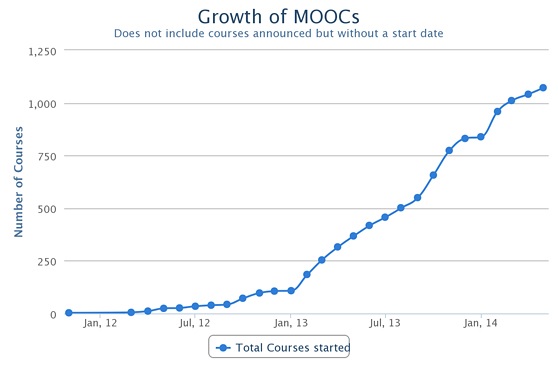
Since we live in an age of wonders, we have over a thousand Massive Open Online Courses provided by some of the finest universities in the world available for free. Oh and the number of courses keeps growing. Did I mention that it has already been worked out for MOOC students to take third-party proctored final exams and receive college credit for them? Yes, right, that too. Has anyone thought through the fact that the $89 cost for a third-party end of course exam may prove incredibly attractive for both families but also to schools who don’t enjoy having a portion of their budget sent off to an online provider?
Let’s not get ahead of ourselves Trebek! I’ll take ‘Months that begin with Oct’ for five hundred…
So, let us imagine a 15-year-old taking a Calculus class from, say, the Massachusetts Institute of Technology. He or she successfully completes a third-party end of course exam, he or she either is or in the near future will be eligible for college credit from a large number of universities around the world. Obviously provision for this student to receive high-school calculus credit will need to be made as well if we are to maintain any semblance of sanity. Should authorities in Arizona disallow this because MIT’s Calculus course doesn’t precisely fit the state of Arizona’s state standards?
I’ll take “Seriously, you have got to be kidding me!” for a thousand Alex.
In short, the disaggregation genie is out of the bottle, and the trend looks set to accelerate in the coming years. As our system of education evolves it will be necessary to update our thinking regarding transparency and accountability: they are already out of date and will be increasingly so moving forward. It would be absurd to require Jordan Visser to take the AIMS test. The AIMS has nearly played itself out for the 19th Century factory model school system in Jordan’s home state and has nothing to do with Jordan. Regarding the ESA program, the public’s interest in transparency would be better served by collecting national norm reference exam data and having them analyzed by a qualified academic researcher. Regarding the broader education system, Texas has already moved to replace minimal skills tests with subject specific end of course exams at the high school level. If a student takes a Physics class, shouldn’t we be curious as to whether or not they learned any “Physics”?
Creative destruction usually kills outdated ideas before outdated organizations. Our notions about how to provide transparency in a changing K-12 world have been running behind schedule.
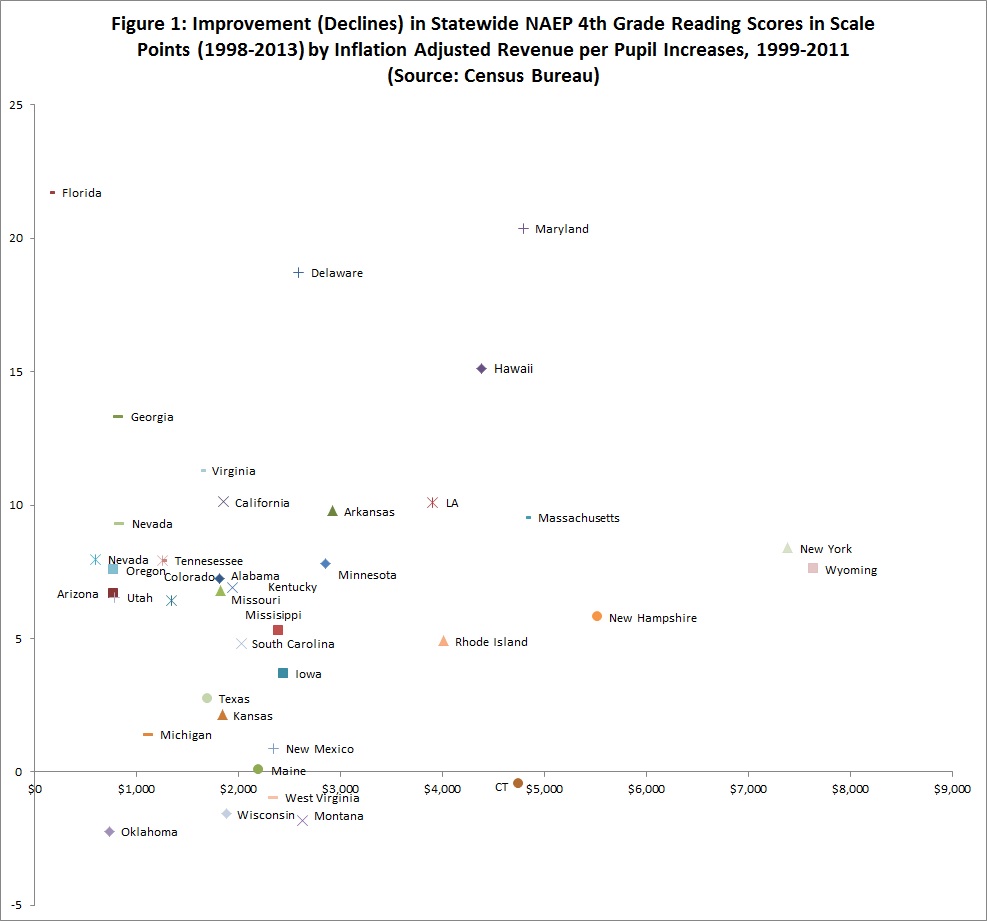
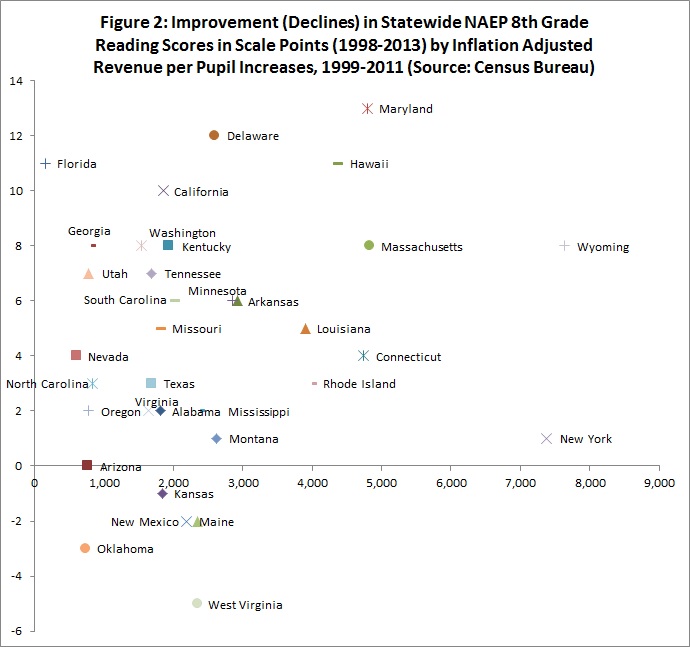
I decided that it would be a bit easier to digest to do the chart by individual subjects and use points rather than percentages of a standard deviation and combined tests as an axis. Also revenue per pupil was easier to find than expenditures. So what you see up there is a first crack at 4th grade reading between 1998 and 2013. No shock- money is still not the answer (yes I am looking right at you New York and Wyoming).
8th Grade Reading Chart looks pretty similar:
Wyoming at least scores meh improvement this time for their gigantic increase in spending, New York- fuggedabouit. Florida just blew you a kiss from the top left quadrant and said that you should come up and see her sometime.
In any case, these are prototype charts that have as yet been double checked by no one other than our family cat Charlie. Treat them accordingly for now, just putting them up for fun and feedback.
Mississippi legislators are considering a statewide choice program for children with special needs. Florida pioneered choice for special needs students in 1999, passing a pilot program that went statewide in 2001. Since 2001, all of Florida’s special needs students attending public schools have been eligible to take a McKay Scholarship to a public or private school of their choice.
More than a decade later, we find that 6 percent of special needs students use the McKay Scholarship Program directly by using it to transfer. Special needs students choosing to remain in the public school system however still benefit from the McKay program because it is there if they need it.
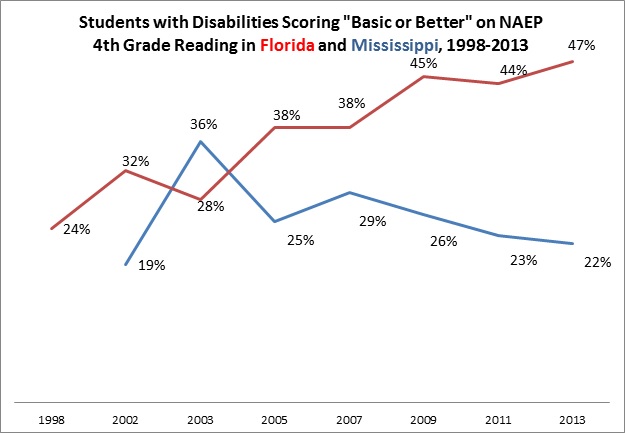
The charts below show that special needs students in Florida have made remarkable academic progress since McKay went into law. The first chart shows the progress for public school students with disabilities in Florida and Mississippi on 4th grade reading:
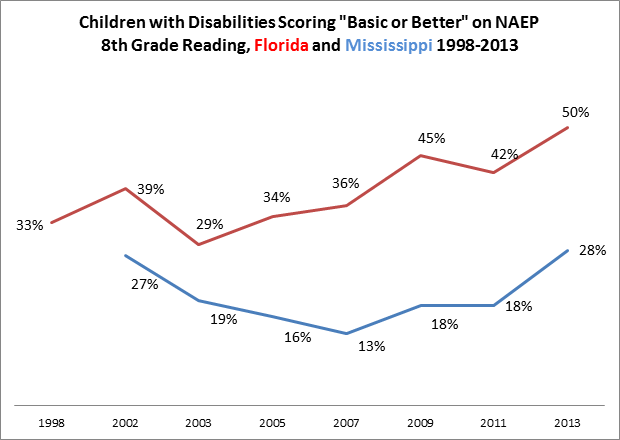
Today Florida children with disabilities are now more than twice as likely to show basic reading skills as their peers in Mississippi. You find the same pattern in the 8th grade reading scores:
Math scores show the same trend: narrow gaps opening to larger gaps over time. The point of these charts is not to brag about Florida, but to note a crucial source of improvement for special needs students in Mississippi. In the end, choice is no threat to the public schools in Mississippi but rather an opportunity. Florida’s public schools have more students (including students with disabilities), spend more and employ more people than before the onset of choice programs. That’s not the issue. The most important thing of all for special needs children is that the public school system now does a much better job in meeting their needs.
Florida enacted multiple reforms during this same period, so we cannot attribute all of these improvements to the choice program. Statistical analysis of variation in trends among special needs scores in individual Florida schools however confirmed that the McKay program contributed to the improvement. Florida’s other reforms are also available for consideration.
Choice is not a threat to public schools in Mississippi, but rather a mechanism of the improvement of outcomes to the most disadvantaged students. We can and should judge policies in large part with regard to how they treat the most vulnerable in our society. Look at the charts above and ask yourself the following question: if you had to be born as a child with a disability, would you want to grow up in Florida’s system of choice or Mississippi’s system of school assignment by zip code? Would you want choice, or something much closer to “take it or leave it” in your schooling?
If you answered that question the way I expect, the next question is: what can Mississippi do to move ahead of Florida?
When the federal government passed what became the Individuals with Disabilities Education Act in the 1970s, a million special education students nationwide had been denied access to public schools. That was wrong, and IDEA stands as an important pillar of civil rights legislation. The law however promised an “Individual Education Plan” for every special needs child, and it failed to deliver the substance of this promise for far too many children. More than a decade ago, the center-left Progressive Policy Institute and the center-right Thomas B. Fordham Foundation used the analogy of a maze to describe the bog of federally mandated paperwork emphasizing process over results to the frustration of both educators and parents.
You can’t really have an individual education plan without choice over who delivers what sort of education. Today it is time for the states, not the federal government, to take the lead in truly delivering the ability for parents to deliver a really meaningful individual education plan for students. Students, parents and the public school system will all win as a result.


 Posted by Greg Forster

 David Malki ! @malki
 Jon Bergdoll @jbergdoll
 Recovering ninja kat @Kouban
 James Webber @james_t_webber
 Andrew J. Plant @AndrewJPlant











 Jay P. Greene's Blog