Changing the Conversation is Not the Same as Changing the World

January 20, 2015

Last week I noted that attention is not influence.  When foundations and others reward reform organizations for clicks, tweets, hits, etc… they are not actually rewarding influence.  If foundations really want to influence policy they have to reward actions that really lead to policy change.

Today I am extending that argument by emphasizing that changing the conversation is not the same as changing the world.  There are times when everyone around us seems to agree on something and we are liable to feel a sense of accomplishment.  “We did it,” we think to ourselves.  “We won.”

But having people around you change what they say is not the same as accomplishing it in the world.  Perhaps it is a result of pervasive post-modern thinking, but our representation of the world is not the world.  Mass rallies with #bringbackourgirls or #jesuischarlie did not free girls in Nigeria or establish the right to produce images of Muhammad.  There really is a world out there and what we say about it does not necessarily lead to changing it.  We also have to do something to make our talk real.

In education reform the conversation has been dominated by discussion of Common Core.  It was amazing how easy it was for supporters to accomplish this.  Getting a bunch of DC-based organizations to write some reports, hold conferences, and engage in advocacy for Common Core doesn’t take all that much money or effort.  It’s not that these organizations are saying things that contradict their beliefs.  They just don’t have a lot of deeply held beliefs and are eager to remain relevant and active on whatever everyone else is talking about.

It wasn’t even that hard to get state boards of education to endorse Common Core.  While they don’t say it out loud, many state officials (rightly) see standards as a bunch of vague and empty words in a document that have little effect on what really happens in schools.  If someone is offering them grants from the Gates Foundation and the possibility of millions from Race to the Top in the midst of an economic crisis, why not declare fealty to these standards?  In addition, state officials regularly get drawn into fights over standards.  Why waste political capital on something that hardly matters?  It’s much easier to just join the Common Core crowd and hide behind the skirts of “experts,” national organizations, and the federal government than to defend and constantly revise their own crappy state standards.  Besides, they could always change their mind later when it came to actually doing something, like adopting tests or imposing consequences on schools and teachers based on their actual implementation of Common Core.  Even state officials who embraced Common Core understood, on some level, that what they were doing was just talk.

Don’t get me wrong.  Standards could matter.  Determining what students should learn and when could have a profound effect on education.  And the difference between excellent and lousy schools has a lot to do with whether they have high expectations for their students and seek to teach worthy content.  The problem is that in a large and diverse society we  have little agreement on what constitutes worthy content or appropriate expectations.  To obtain democratic support for state (let alone national) standards, they have to be written at such a level of generality that they are largely meaningless.  That is why multiple studies show no relationship between the judged quality of standards and academic outcomes.  And to the extent that standards actually stand for anything, they draw opposition from those who disagree.  In a democratic country that opposition has plenty of opportunities to block, dilute, or co-opt standards, preventing the “talk” of Common Core from becoming reality.

I’ve been making this point that Common Core “talk” will not result in real educational change for years now.  When I do, I hear things like, “At last count, 1 state out of 45 has repealed the standards.”  And DC-based folks take comfort from the fact that everyone they meet at receptions agrees that Common Core opposition is crazy, paranoid, hysterical, political,  [insert your preferred empty pejorative here].  They all falsely believe that they have won the conversation and therefore have won the policy.  They continue to hold their hashtag signs.

But since I am not a post-modern and still believe that there is a world out there that is not changed simply by our words, I have developed a wager with Morgan Polikoff as an imperfect indicator of whether Common Core really is changing the world:

In ten years, on April 14, 2024, I bet Morgan that fewer than half the states will be in Common Core.  We defined being in Common Core as “shared standards with shared high stakes tests-even if split between 2 tsts.”  Given 51 states and DC, Morgan wins if 26 or more states have shared standards and high stakes tests and I win if the number is 25 or less.  The loser has to buy the winner a beer (or other beverage).

Well, it didn’t take long but I think am already ahead on that bet.  Mississippi just voted to withdraw from using PARCC, one of the two Common Core-aligned tests.  In addition, Chicago is refusing to administer PARCC to all of its students.  And governor Walker in Wisconsin just re-iterated  his desire to withdraw the state from Common Core standards and testing.  A bill to that effect failed last legislative session, but the dike will only hold for so long.  It’s hard for me to find a current count of what tests states are using, but I believe we have dropped below half using one of the two Common Core tests.  If nothing changes over the remainder of our 10 year bet, I will win.  But I expect more states will abandon Common Core standards and/or tests.  The talk was easy.  The implementation is hard.


Attention is not Influence

January 15, 2015

As any parent can tell you, children will do things, including negative things, to attract attention.  Attention is the currency of childhood.  Children tend to do more of whatever attracts attention.  This is why effective parents and teachers devise strategies to attend to desirable behavior and ignore (to the extent possible) undesirable behavior.

Unfortunately, the adult world of policy analysis has become like the playground of children.  There is a competitive race for attention among a growing group of think-tankers, academics, and journalists.  They aren’t competing for attention by doing the most professional work with the most thoughtful analysis and clear-headed conclusions.  They are competing by saying ridiculous things, saying them loudly, and saying them repeatedly

Of course, these attention-starved policy analysts occupy the world of Twitter.  Where else can they satisfy their obsessive need to blurt out an endless string of superficial claims?  Unfortunately, they are not confined to Twitter.  They increasingly occupy the halls of academia, control the institutions of journalism, and dominate the beltway.

The problem is that like the poor parenting of an ill-behaved toddler, they are receiving a lot of attention for their outbursts.  Diane Ravitch tops Rick Hess’ ranking of “influential” edu-scholars not because of her balanced reasoning and careful consideration of evidence but because of her hyperbolic and outrageous claims.  Vox has 193,000 followers on Twitter despite its error-plagued, shoddy journalism precisely because of its reckless desire to offer “click-bait” instead of responsible analysis and information.

These out-sized toddlers may be attracting a lot of attention, and even a lot of money, but that doesn’t mean they actually have influence.  I highly doubt Diane Ravitch has altered any policy outcome given that she is unlikely to have changed anyone’s mind about anything.  She may occasionally mobilize her army of angry teachers, but those teachers were likely to be mobilized anyway by the more grown-up teachers unions.

And Vox may get clicks and even raise large sums from venture capitalists, but who in the world cares what Ezra Klein, Matt Yglesias or the rest of the Vox crew think about anything?  For the most part these people have never done anything, never seriously studied anything, and too rarely offer responsible analysis for anyone in real authority to heed their advice.

Attention, clicks, and money are not the same as influence.  If they were, Kim Kardashian would be the one of the most influential people in the world.

Real policy influence is achieved in two, much less loud and less easily measured ways.  First, people can have policy influence by engaging in serious empirical analysis that shapes elite thinking about policy questions over long periods of time.  Take, for example, how serious intellectual work shaped the policy context regarding crime and law enforcement in the 1980s.  In particular, James Q. Wilson and George Kelling wrote a series of pieces articulating the evidence and reasoning behind their “broken windows” theory of crime-prevention.  Prior to that time, policy elites thought about crime largely as a function of poverty that needed to be addressed through social programs.  But Wilson and Kelling influenced elites into thinking about crime as an issue of public disorder that could be addressed through innovations in policing techniques.  Their influence was gradual and never completely accepted, but it established the context for later policy action.

Second, people can have policy influence by quietly whispering in the ears of decision-makers about how to act within the elite understanding of the policy context.  Behind the scenes George Kelling advised Bill Bratton, who implemented broken windows policing techniques in Boston and New York City.  These approaches proved successful and the idea spread to other police departments around the country as the nation experienced a dramatic decline in violent crime.

These are examples of real policy influence, both through laying the intellectual groundwork for change and by quietly advising policymakers to pursue those changes.  Neither would be captured easily by the silly “metrics” that increasingly drive foundation and venture capitalist funding.  Foundations and VCs are paying for attention and clicks, not actual influence.


Choice for Foster Kids

January 13, 2015

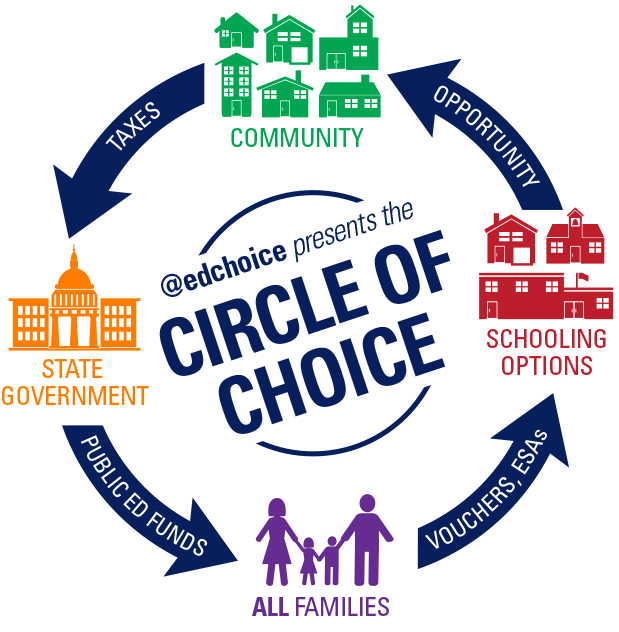
2013-10-Circle-of-Choice

(Guest post by Greg Forster)

The new issue of OCPA’s Perspective carries my article on school choice for the 12,000 foster children in Oklahoma. The state is now adopting massive fixes to address its broken, abusive foster care system:

If Oklahoma is going to adopt sweeping reforms to serve these children better, it shouldn’t just think about homes. It should think about schools. Having failed to care for these 12,000 children when they needed it most, Oklahoma owes them something.

The state wouldn’t have to create a new program:

Oklahoma already has two school choice programs: a special needs voucher modeled on McKay, and a tax-credit scholarship program serving low-income students. Either or both of these programs could accommodate foster children with a slight modification – just write a line into the law saying foster children are eligible regardless of disability status or family income.

Other states have already adopted this practice. Foster children are automatically eligible for two school choice programs in Arizona. “Lexie’s Law,” which is Arizona’s answer to McKay, includes foster children alongside special education students. So does Arizona’s innovative new education savings account law, which gives parents control of their children’s education funding to direct to a school of their choice. Meanwhile, in Florida, foster children of any income level are eligible for the state’s tax-credit scholarship program for low-income students.

And since choice saves money, it wouldn’t cost a dime – an important consideration given that Oklahoma is on the hook for $150 million to clean up its foster care mess.

Of course, only universal choice will get us where we need to go. But it’s not a perfect world, and few people know that better than foster kids in Oklahoma. One line in a new law could give 12,000 kids access to choice on better terms than the ones that prevail in some other programs already.


An interesting NYT column that would have been better titled “Stop Trying to Impose Good Ideas from the States on Everyone from Washington”

January 12, 2015

(Guest Post by Matthew Ladner)

Read it for yourself and see what you think. I’m struck by two things- first the assumption that it takes additional state funding to pull off reform at the state level. I think that the handwriting is on the wall that the types of reform states and the feds will need to focus on now and going forward. The focus will need to be on the “how do we get a bigger bang for the bucks we are already spending” rather than “now, NOW we are smart enough to know how to spend this new money much better than that frozen in place money, so give us more.”

The writer makes an interesting point about partisan control and policy diffusion, but failed to note that one party is in control of a much larger number of states than the other party- mostly due to one party blowing up the lab on health care btw. Given the type of reform needed (those that make better use of existing resources) and the philosophical leanings of the party in control of a large number of states, I’m expecting to see a healthy amount of policy diffusion.


School Choice News from Maranto, Van Raemdonck, Chingos, and Peterson

January 9, 2015

We do not have any additional breaking news to report on Europe once again descending into Jew-hating, illiberal fascism.  But we do have some good news to report on school choice.  My colleagues, Bob Maranto and Dirk Van Raemdonck, have a piece in the Wall Street Journal on how the US and Belgium made different choices about how to handle religious conflict over education in the 19th century.  The US chose to persecute its minority Catholic population by imposing a vaguely Protestant monopoly system on all students while Belgium created a competitive system allowing for choice across different religious and secular school systems.  The Belgian system is less repressive and has produced better outcomes.  Perhaps the US could give that approach more of a try.

Separately, Matt Chingos and Paul Peterson have an article in the Journal of Public Economics (also available without pay wall here) that supports the claim that the US would produce better long-term outcomes if it expanded school choice.  Chingos and Peterson are able to track long term outcomes of a privately-funded school choice program in New York City that gave students small scholarships to attend a private school.  As Chingos describes the results on the Ed Next blog:

Minority students who received a school voucher to attend private elementary schools in 1997 were, as of 2013, 10 percent more likely to enroll in college and 35 percent more likely than their peers in public school to obtain a bachelor’s degree.

Keep in mind that this is an enormous return on a very small investment.  The privately funded voucher was only worth $1,400, which is $2,080 in 2014 dollars.  And the Chingos and Peterson results are particularly important because they track long term outcomes that we know really matter, like attending and completing college.  Most studies of school choice focus on short term effects on standardized tests, which may not capture as well or as completely the benefits of a quality education.

(edited to correct typo)


Florida Court Dismisses ESA Suit, FEA opts not to appeal

January 8, 2015

(Guest Post by Matthew Ladner)

One of the Florida choice lawsuits is over, specifically this one. Chalk up another school choice victory for our man Clint Bolick.


National Freedom Museum High School Essay Contest

January 7, 2015

(Guest Post by Matthew Ladner)

Change does not roll in on the wheels of inevitability, but comes through continuous struggle. And so we must straighten our backs and work for our freedom.

-Martin Luther King Jr.

This year marks the 50th anniversary of the Selma march. The National Liberty Museum is sponsoring an essay contest for high school students in response. The topic:

“The movie Selma tells the story of how Martin Luther King, Jr. and others peacefully protested to advance voting rights. What do you think needs to be done today to protect individual freedom and self-determination? What are you doing or will you do to peacefully advance those rights?”

The contest is open to students aged 14-18 in public, private and home school programs. Details about the prizes and contest requirements can be found here.


Pass the Popcorn: Luck Is for Suckers!

January 6, 2015

2014-03-07-annie

(Guest post by Greg Forster)

How do I love the new Annie movie? Let me count the ways:

1) It’s really entertaining, as long as you don’t expect too much from it. It’s not saccharine and treacley like the original Annie. In fact, the very first thing you see on the screen is a huge, completely unsubtle, on-the-nose message from the filmmakers announcing: “This Annie will not be saccharine and treacley like that other Annie!” It’s a hilarious gag.

There’s a real artistry to the way this movie does the Annie story without treacle. I think half my enjoyment of the movie was admiring how they pulled this off.

Consider how they handle “Tomorrow.” You can’t have Annie without “Tomorrow.” But audiences in the post-Seinfeld culture are not going to sit still for “Tomorrow.” Not unless you do something that forces them to. How to do it? By putting the song in an unhappy scene. Annie gets a major disappointment – life basically kicks her in the teeth. The sad moment just lingers on screen quietly for a bit. And then Annie half-says, half-sings to herself, quietly, “the sun will come out tomorrow.” And a moment later she’s singing “Tomorrow” and it’s slowly but surely building steam. And you’re rooting for her.

These people actually know how to make a frikkin’ movie. Can you believe it? Where have they been for the last twenty years?

2) It has a fantastic set of core values. After the opening scene, Annie is racing out of school to get somewhere she needs to be on time. Her friends call out: “Hope you make it!” “We’ll cover for you!” “Good luck!” And to this last statement she turns around and shouts back: “Luck is for suckers!” We then follow her through the city as she uses her ingenuity (and several prominent product placements) to get where she needs to be on time.

The basic message of this movie is: “Yes, life often sucks, but if you work hard and have guts, you can get ahead. Once you do, remember that you need people, too.” And we can’t have too much of that these days.

The Daddy Warbucks character – who for obvious reasons can’t be called “Warbucks” anymore so he is now, cleverly, “Will Stacks” – takes Annie on a helicopter ride above the city. The following exchange occurs (I quote from memory):

Annie: So how did you get to be the king of the city?

Stacks: I don’t think I’m the king of anything. I just work my butt off. The harder I work, the more opportunities I have. In life you have to play the hand you’re dealt, no matter how bad the cards are.

Annie: What if you don’t have any cards?

Stacks: You bluff.

He then sings her a song – a song! – about how anyone can get ahead if they work hard and have “heart.” To some extent it even oversells the point; in fact, not everyone can get mega-wealthy and become famous and have a helicopter. But like I said, you can’t have too much praise for hard work these days.

Praise for hard work is basically hope.

3) The core values are wrapped in a (mild and relatively unobtrusive) progressive political veneer. Some of my conservative friends are put off by the movie’s occasionally bowing toward the idols of contemporary liberal fashion. To the contrary, that enhances my enjoyment. If the work ethic is exclusively “conservative,” only conservatives will have the work ethic. If praise for hard work is hope, seeing hard work affirmed across ideological lines provides some justification for that hope. And this leads me to my next point.

4) What I think I enjoyed most is that the makers of this movie felt responsible to the story of Annie. I almost wrote, to the “franchise,” but the “franchise” is essentially the business value of the Annie story to its copyright owners, and while that is considerable, this is about more than that.

Most remakes or reboots pay relatively little attention to the heart of the story they’re handling. They keep the superficial stuff the same – the names of the characters and so on – but they want to “update” the franchise, make it marketable today. So they swap out the old engine (the heart of the story) for a new one, and keep the chassis more or less the same for the sake of brand recognition.

This movie keeps the engine and swaps out the chassis. That’s what a remake ought to do.

So of course there are some mild liberal pieties. The Annie story is about rich and poor; there used to be a time when you could tell that story without politics, but not now. Of course there are several major plot twists that would never have worked in the original Annie. They do work with this Annie. The point is, this Annie is still Annie.

And of course the millionaire is now black and has an interracial love interest. That’s the world we live in now, everyone.

Annie is all the more Annie – she is more Annie than she ever was before – for being black. Who has more right to sing “It’s a Hard Knock Life”? And who has had more occasion to learn that life means looking toward “Tomorrow” by faith rather than by sight?

The story of Annie has always been America’s ideal of itself at its best. I’m not sure a black Annie isn’t a greater sign of triumph over historic injustice than a black president.

Now why on earth didn’t they name him “Bill” Stacks?


Arizona Governor Doug Ducey calls for expansive parental choice in inaugural address

January 5, 2015

(Guest Post by Matthew Ladner)

“It will be a first principle of my agenda that schools and choices available to affluent parents must be open to all parents, whatever their means, wherever they live, period.”


Burke and Bedrick Discuss the Next Step for School Choice in National Affairs

January 2, 2015

(Guest Post by Matthew Ladner)

Jason Bedrick and Lindsey Burke take to the pages of National Affairs to discuss Education Savings Accounts in a very informative article. I share the author’s interest in a tax credit funded ESA model. In fact I hope that some of our preexisting tax credit programs will move to an account model. Enthusiasts such as myself however will eventually need to address the limits to scale soon to appear in the largest tax credit program- but quite frankly this is the type of problem you want to have, and it may not prove insurmountable.

Lindsey and Jason earn the first BOOOOOOOOOOOOOOOOOOOOOOOOOM of 2015.