CPS Officials Admit Vouchers Are No Problem

April 23, 2010

(Guest post by Greg Forster)

The new Chicago Tribune editorial buries the lede in a major way.

The editors praise the Illinois House Executive Committee for passing the voucher bill 10-1. But tucked away in paragraph eight we find this little stick of dynamite:

Chicago schools would wind up with less money, but also with fewer children to educate. CPS officials tell us privately that they could handle that. [ea]

That would certainly be consistent with the large body of high-quality research consistently finding that vouchers improve rather than harm public schools, as well as with the fiscal track record that shows vouchers leave public schools with more dollars per student because their costs fall faster than their revenues.

But I don’t think I’ve ever seen public school officials admit that before, even “privately.” The public school system can handle vouchers, but it can’t handle the truth.


Reformer’s Disease

April 14, 2010

I think I’ve discovered a new medical disorder that I call Reformer’s Disease.  Good and smart people involved in education reform can easily be stricken with this disorder in which they visualize a desirable reform policy and then imagine that they can simply impose that policy on our education system and that it will come out as they want.

In particular, I’ve noticed instances of Reformer’s Disease in discussions with folks over national standards as well as in Mike Petrilli’s recent post on Flypaper about teacher tenure reform. Advocates for national standards tend to imagine that the national standards that will be adopted are the ones they prefer.  And they further imagine that people whose vision of national standards they oppose will never take control of the standards in the future.  National standards advocates don’t seem to have any theory about how political systems operate, what kinds of standards those systems are likely to adopt, or how those systems are likely to alter standards in the future.  Instead, these victims of Reformer’s Disease have grown tired of politics and simply imagine that they will be the puppeteers who will get the educational system to do the right things without having to think about how the incentives and structure of that system may well thwart or pervert their efforts.

Similarly, Mike Petrilli shows signs of Reformer’s Disease in his post on teacher tenure reform.  He asks, “Rather than use choice to set in motion a chain reaction that ends with the removal of bad teachers from the classroom, why not go right at the bad teachers themselves?”  Why focus on structures, incentives, and politics when we can just get schools to do the right thing — remove bad teachers, adopt the right standards and curricula, etc…?

Perhaps Mike’s question can best be answered by transplanting this discussion to a different industry.  Why should we bother with all of this choice and competition among restaurants when we can just get right at ensuring that bad chefs are removed?  Why have all of these different restaurants with their varying style and quality when we can just ensure quality through national restaurant standards?

Of course, when we transplant the discussion to restaurants the answer to Mike’s question seems obvious.  We need choice and competition because it helps impose the proper incentives on decision-makers within the educational system to make the right choices.  With stronger choice and competition bad teachers are more likely to be removed because keeping bad teachers would harm the interests of their bosses by causing schools to lose students and revenue.  The main barrier to removing bad teachers is not tenure, per se; it is the lack of incentives to remove bad teachers that allows the tenure system to be adopted and continue.  Just removing tenure would not rid the system of bad teachers because principals, superintendents, and others up the chain have little to no incentive to fire bad teachers.

Yes, schools need to get rid of bad teachers and the tenure that protects them.  Yes, schools need solid standards and curricula.  But people need to avoid Reformer’s Disease and remember that they can’t simply impose solutions on an unwilling system governed by perverse incentives.  Choice and competition are not at odds with tenure reform or standards reform.  Competition is a necessary part of how one actually accomplishes and sustains those other reforms.


Conscience Asks the Question, ‘Is it Right?’

April 9, 2010


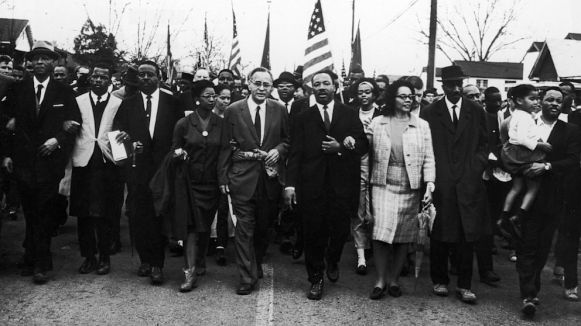
gty_martin_luther_king_nt_130823_16x9_992

(Guest Post by Matthew Ladner)

Charles Miller, former Chairman of the University of Texas Board of Regents, sent out the following email to hundreds of people on Easter Sunday, which was also the 42nd anniversary of the assassination of Rev. Martin Luther King Jr. We reprint the email here with Mr. Miller’s permission:

Early in the Obama administration I was surprised and deeply disappointed by their decision to kill the “DC Voucher” Program.  I wrote most of the piece below at that time and the decision brought me back into the public K-12 debate.  The U.S. Senate recently voted 55-42 to confirm that decision, essentially on a party line vote, so I am sending this to go on record about something I think is horrendously wrong. –Charles Miller
————————————————————————————————————————————————–
April 4, 2010

What Martin Luther King Said About Speaking Out

“Our Lives Begin to End the Day We Become Silent About Things That Matter”
(Martin Luther King)

The Obama administration, through stimulus funding, the Race to the Top program, its presentation of budgets and proposals for reauthorization of NCLB/ESEA , has moved fast and furiously in the public education policy arena.  It seems very unlikely to me that high aspirations—and hasty action— equate to effective public policy.  In fact, these efforts seem to amount quite clearly to an overreach–strategically, systemically, politically, and culturally

However, what bothers me the most personally is what I consider the most unprincipled action in public education policy since the existence of segregated schools:  The willful decision by the Obama administration, supported by the Democrats in Congress, to kill the D.C. Opportunity Scholarship Program, also called “D.C. Vouchers”

The Obama administration has tied its education policy declarations to a mantra of being non-political and non-partisan, choosing instead a policy focus only on “what works”.  This principle has been repeated incessantly.

However, the D.C. Opportunity Scholarship Program (OSP) is a successful program.

The Department of Education’s official evaluation using rigorous “gold standard” experimental evaluations determined that the OSP has produced significant achievement gains.

The OSP is serving those families and children most in need in one of the worst school districts in America.  Average income of participating families  is less than $24,000 annually and more than 85% of participating students would otherwise be attending a failing school under NCLB guidelines.

D.C. residents polled by three unaffiliated firms in ’07, ’08, and ’09 showed between 66 and 75% support for the OSP.  The D.C. superintendent and the Mayor support the program.

The decision to kill the program is contradictory to anything the administration claims to be its guiding principle.   The cost of the successful OSP is financially very small by comparison to any K-12 standard while at the same time there has been a gigantic increase in education spending nationally— to support status quo systems which are widely considered failures. Strong evidence of success, academically and financially, clearly makes the decision to kill OSP unprincipled.

The reason for killing OSP is the intense opposition of national teachers unions to a voucher program of any kind, anywhere, anytime—even if it is academically successful, financially responsible and so popular with the community served that there are long waiting lists.

If this successful program had been able to be replicated—a fear obviously driving the decision to kill OSP—the number of students from the most disadvantaged families whose life prospects could have been enhanced could be quite large.  This consideration makes the decision to kill OSP even more egregious, although even helping a small set of students is the principled thing to do.

Notably, from the Washington Post, “Duncan had the temerity to admit that OSP students ‘were safe and learning and doing well…but we can’t be satisfied with saving 1 or 2 percent of children and letting 98 or 99 percent down’.”

The effect of the decision to kill OSP on the lives of the students who could have benefited from its continuation is extremely negative.  There is no way to avoid this conclusion. If a social scientist extrapolated the trends of two sets of students, one in OSP and one in a typical DC school, the loss of life opportunities would be stark for the typical set of students.

The inescapable conclusion I reach is that killing OSP is a despicable and unconscionable decision made for political purposes and with cynical disregard for the lives of the children affected.  “Obama could have stood up for these children, who only want the same opportunities that he had and that his daughters now have.  Instead his education secretary, Arne Duncan, proffered an argument that would be funny if it weren’t so sad:  Scholarships for poor students aren’t worth supporting because not enough of them are given out” (Washington Post, 3/8/10)

This when joblessness for 16-to-24-year-old black men has reached Great Depression proportions — 34.5 % last October and estimated to having exceeded 50% by last year end.

The other conclusion I reach is that policy advocates or officials who turn their face away or avoid taking a strong stand against the decision to kill OSP because it is not pleasant or not convenient to their own activities have a hand in the ignoble results of the decision.  “In the end, we will remember not the words of our enemies, but the silence of our friends” (Martin Luther King)

So, for me personally, I can’t justify supporting such an administration or its policy makers even if some of their other policy choices are more productive, nor can I see believing anything they say or trusting anything they do.  It can no longer be acceptable to be principled just some of the time.   No Mas.

“Cowardice asks the question, ‘Is it safe?’  Expediency asks the question, ‘Is it politic?’  Vanity asks the question, ‘Is it popular?’  But conscience asks the question,  ‘Is it right?’  And there comes a time when one must take a position that is neither safe, nor politic, nor popular, but one must take it because one’s conscience tells one that it is right.”  (Martin Luther King)

Charles Miller


Ravitch is Wrong Week, Day #5

April 9, 2010

[Editor’s Note — This is the fifth and final installment in Stuart Buck’s critique of Diane Ravitch’s new book “The Death and Life of the Great American School System: How Testing and Choice Are Undermining Education.”  Below is a list (with hyperlinks) of all five posts for our Ravitch is Wrong Week. 

The only conclusion I can draw after reading Stuart’s critiques is that Diane Ravitch’s new book is not a serious piece of scholarship.  I do not know (and I do not care) why a normally serious education historian would write such a book.  The only thing that matters here is that much of what she has to say is wrong.  Unless and until she or someone on her behalf addresses the issues that Stuart has raised, I think we can dismiss this unserious book and the people who peddle it.]

  1. Ignoring or selectively citing scholarly literature;
  2. Misinterpreting the scholarly literature that she does cite;
  3. Caricaturing her opponents in terms of strawman arguments, rather than taking the best arguments head-on;
  4. Tendering logical fallacies; and
  5. Engaging in a double standard, such as holding a disfavored position to a high burden of proof while blithely accepting more problematic evidence that supports one’s own position (or not looking for evidence at all). ]

(Guest post by Stuart Buck)

DOUBLE STANDARDS:

The final problem endemic to Ravitch’s book is that she engages in a double standard — holding one side to a high burden of proof while putting forth positions or supposed facts that do not meet a high burden of proof (or that are completely unsubstantiated).

A typical pattern throughout Ravitch’s discussion of vouchers and charter schools is that she demands overwhelming proof of astonishing gains. For example, she sneers that vouchers did not produce “dramatic improvement for the neediest students or the public schools they left behind.” (p. 132).

But as for her own affirmative claims, Ravitch often proceeds with little or no empirical evidence, and many of her own policy prescriptions do not come with any proof of improvement, even of the undramatic sort.

For example, Ravitch claims that “most districts . . . relentlessly engage in test-prep activities.” (p. 159). Most? Relentlessly? Ravitch presents no evidence for these claims.

Ravitch claims that “regular public schools are at a huge disadvantage in competition with charter schools,” in part because “charters often get additional financial resources form their corporate sponsors.” (p. 136). Ravitch has no systematic evidence for any claim that charters are financially better off than public schools. Even in New York, which is home to many of the educational philanthropists that Ravitch seems to despise, charter spending in 2008-09 had a citywide average of $14,456 — including private giving. This compares to $16,678 for students in traditional public schools.

To be sure, these two figures aren’t directly comparable — the charter figure included all expenses for all students but without calculating the benefit of free space provided to certain charter schools, while the traditional public school figure came from a report that excluded large categories, such as special education or fringe benefits, but that did include the value of debt service to pay for facilities.

The point, in any event, is that Ravitch makes unsubstantiated and convenient claims about charter school financing without even attempting the difficult work of piecing through educational finance matters like these. Moreover, Ravitch’s claim is wrong as to the country as a whole. Charter schools nationwide receive an average of 61% of the funding given to traditional public schools, mostly because states usually refuse to let charter schools have funds for facilities.

Ravitch says on page 220, “If we are serious about narrowing and closing the achievement gap, then we will make sure that the schools attended by our neediest students have well-educated teachers, small classes, beautiful facilities, and a curriculum rich in the arts and sciences.” To be sure, having “well educated teachers” or “a curriculum rich in the arts and sciences” is common sense. But Ravitch has zero evidence that “beautiful facilities” would do anything about the achievement gap. Nor does she seem familiar with the Jepsen/Rivkin study finding that California’s initiative to lower class size ended up harming minority children (because their teachers find more job opportunities elsewhere and schools fill the gaps by hiring less qualified and more inexperienced teachers).

For another example, Ravitch says (p. 238) that “every state should establish inspection teams to evaluate the physical and educational condition of its schools.” Ravitch offers no evidence that such inspection teams make any difference whatsoever.

For another example, Ravitch says, “If we are willing to learn from top-performing nations, we should establish a substantive national curriculum that declares our intention to educate all children in the full range of liberal arts and sciences . . . .” (pp. 231-232). This sounds fine and well. But Ravitch has no evidence that pushing for a “national curriculum” would accomplish any of her putative goals, rather than being watered down and misdirected by all of the same interest groups that (a) distort the textbook adoption process (as Ravitch herself has documented) and (b) have prevented any such national curriculum from being established to date.

Another double standard lies in Ravitch’s treatment of the scholarly literature. For example, while Ravitch nitpicks to death any study with a pro-charter finding she dislikes (when she bothers to mention such studies at all), she credulously cites the Lubienskis’ study purporting to find that students in public schools do as well or better than those in private schools. (p. 140). She claims that this study “demonstrated the superiority of regular public schools.” It did no such thing: It was merely a cross-sectional snapshot of students in public and private schools, and the authors admitted that “we cannot and do not make causal claims from cross-sectional studies such as NAEP.”

Finally, Ravitch’s rosy depiction of public schools has no evidentiary support. E.g.: “The neighborhood school is the place where parents meet to share concerns about their children and the place where they learn the practice of democracy. . . . As we lose neighborhood public schools, we lose the one local institution where people congregate and mobilize to solve local problems . . . . For more than a century, they have been an essential element of our democratic institutions. We abandon them at our peril.” (pp. 220-21).

It’s hard to fathom how a historian could write such lofty rhetoric about the past century of public schools, while not even giving passing mention to the fact that during much of that century schools were officially segregated by race and steeped in anti-Catholic bigotry, and to this day are often unofficially segregated by class and race. (Ravitch seems to have forgotten all of the historical knowledge on display in this article.)

Of course, Ravitch’s words are literally correct: during the past century, public schools “have been an essential element” of society’s democratic attempt to solve the “local problem” of keeping out black people. If that’s not what Ravitch intends to endorse, then she shouldn’t write such unqualified paeans to schools of a century ago.

Moreover, what exactly does it mean to suggest that people “congregate and mobilize to solve local problems” at the school? That surely isn’t a routine function of the vast majority of public schools; when my kids were at the local public school, the only mobilization I saw was all the minivans accelerating after leaving the car line. In fact, the practice of grouping people into a single public school probably causes more “local problems” than it solves (consider the furious debates that arise over curricular issues alone — evolution, sex ed, phonics and math instruction, etc.).


Ravitch is Wrong Week, Day #4

April 8, 2010

[Editor’s Note — This is the fourth installment in Stuart Buck’s critique of Diane Ravitch’s new book “The Death and Life of the Great American School System: How Testing and Choice Are Undermining Education.”  Earlier this week he documented how Ravitch ignored or selectively cited scholarly literature, misinterpreted the research she did cite, and turned her opponents arguments into strawmen.  Today he focuses on how Ravitch’s book contains a series of logical fallacies.  Below is a guide to what you can expect (with hyperlinks as they become available) for our entire Ravitch is Wrong Week.

  1. Ignoring or selectively citing scholarly literature;
  2. Misinterpreting the scholarly literature that she does cite;
  3. Caricaturing her opponents in terms of strawman arguments, rather than taking the best arguments head-on;
  4. Tendering logical fallacies; and
  5. Engaging in a double standard, such as holding a disfavored position to a high burden of proof while blithely accepting more problematic evidence that supports one’s own position (or not looking for evidence at all). ]

(Guest post by Stuart Buck)

LOGICAL FALLACIES:

Non Sequitur.

Ravitch claims that her “support for NCLB remained strong until November 30, 2006 ,” which is when she attended an AEI conference at which various conservative scholars agreed that NCLB’s choice provisions were “not working.” (p. 100-01). This is because only a small percentage of parents asked to transfer to a different public school — although, as Ravitch herself concedes, this may have been because of the schools’ own failure to let parents know that transfer was an option, the lack of nearby public schools to which to transfer, and/or the pre-existence of generous public school choice programs.

In any event, if one thinks that school choice is generally a good thing — as Ravitch did at one time — it is completely incoherent and illogical to switch to the opposite position based on what Ravitch now claims was her rationale. Based on what Ravitch learned at the 2006 conference, she could logically have concluded that NCLB’s choice provisions were being thwarted by obstreperous school officials, or that NCLB’s choice provisions were not likely to work a revolution in public education. But she could not have logically concluded that choice was actually a bad idea that was undermining education. That belief about choice had to have arisen from other motivations, not the post hoc story that Ravitch puts forth.

The Law of Non-Contradiction

The most pervasive logical fallacy in Ravitch’s book is the self-contradiction. When it comes to curricular issues, Ravitch repeatedly throws out arguments that strongly imply, if not require, support for choice, vouchers, and charter schools — things that Ravitch otherwise tries to paint in a negative light.

For example, Ravitch praises Catholic schools for providing “a better civic education than public schools because of their old-fashioned commitment to American ideals.” As well, she laments the fact that “many Catholic schools have closed,” in part because of “competition from charter schools, which are not only free to families but also subsidized by public and foundation funds.” (p. 221).

So one would think that Ravitch would continue to support voucher programs wholeheartedly, as she so eloquently did in The New Republic once upon a time. Vouchers level the playing field by offering inner city kids the choice of Catholic or other private schools along with charter schools. But Ravitch doesn’t say anything about vouchers other than to credulously report a couple of studies that failed to find test score gains for voucher students while nitpicking over the recent DC voucher study that did find test score gains. Not only does this suspicion of vouchers contradict Ravitch’s claim to support Catholic schools, it more fundamentally contradicts Ravitch’s claim everywhere else that it’s not right to judge policies or schools based on test scores alone.

Another contradiction is in Ravitch’s claim that NCLB’s goal of 100% proficiency by 2014 is a “timetable for the demolition of public education in the United States ,” because “thousands of public schools [are] at risk of being privatized, turned into charters, or closed.” (p. 104). Notably, what little evidence she discusses directly disproves her dire predictions. On page 105, she notes that in a 2007-08 study, more than 3,500 schools were “in the planning or implementation stage of restructuring,” but that “very few schools chose to convert to a charter school or private management,” instead choosing the “ambiguous ‘any-other’ (i.e., ‘do something’) clause in the law.” In other words, thousands of schools are NOT at risk of being privatized or turned into charter schools; as Ravitch’s own meager evidence shows, those thousands of schools will almost all find a way around such a fate.

Another serious contradiction arises from Ravitch’s praise for the Core Knowledge curriculum. She notes that “students who have the benefit of this kind of sequential, knowledge-rich curriculum do very well on the standardized tests that they must take. They do well on tests because they have absorbed the background knowledge to comprehend what they read.” (p. 236). She similarly contends that “ironically, test prep is not always the best preparation for taking tests. Children expand their vocabulary and improve their reading skills when they learn history, science, and literature.” (p. 108).

But this point contradicts more than one of Ravitch’s other arguments. First, if students given a broad and rich curriculum in fact do better on reading and math tests, then it makes no sense to blame accountability (as Ravitch elsewhere does) for supposedly forcing schools to limit the curriculum to just reading and math. If Ravitch is right about Core Knowledge, she should spread the wonderful news that school leaders’ best bet is to adopt a broad and rich curriculum, rather than peddling the misinformation that testing inherently leads to a narrow test-prep curriculum.

Second, Ravitch ignores the fact that charter schools are nearly TWENTY times more like to adopt Core Knowledge as a curriculum than other public schools. (True, the percentage of charter schools that adopt Core Knowledge is still fairly small, but the percentage of public schools that adopt Core Knowledge is barely discernible at all.) Indeed, Ravitch herself previously documented in detail (“The Language Police”), so many entrenched interest groups play tug-of-war over the public schools that textbooks usually end up as the lowest common denominator. Given Ravitch’s previous work here, it’s quite odd for her, of all people, to fall back on the naïve hope that traditional public school systems will suddenly start adopting Core Knowledge or any similarly rigorous curriculum.

In any event, it is incoherent for Ravitch to disdain the one type of school that is most likely to adopt the curriculum she claims to favor. And again, it is an especially bizarre flight of illogic for Ravitch to disdain charter schools based on their test scores, which she elsewhere ridicules as an unfair way to judge the merit of a school.


Vouchers and the Rising Tide

April 7, 2010

“A rising tide lifts all boats.”

(Guest post by Greg Forster)

I haven’t had a chance to read the details yet, but from the executive summary of the new results released today by the School Choice Demonstration Project, it looks like vouchers have done a good job of improving education for all students in the city of Milwaukee.

What? That’s not the way you heard it?

Of course not. Because the new result, taken in isolation from other information, simply says that after two years, the voucher students are making learning improvements about the same as public school students. The scores for the voucher students are higher, but the difference is not statistically certain.

However, let’s plug that into the larger universe of information. We know – from the very same research project – that vouchers are improving education in Milwaukee public schools. The positive incentives of competition and the improved matching of student needs to school strengths are causing public schools to deliver a better education.

So if the voucher students and the public school students are doing about the same, and vouchers are improving results for public school students, it follows that vouchers are improving results for everybody.

That, of course, is the consistent finding of a large body of research. The overwhelming research consensus is that vouchers improve public schools.

Also, let’s not forget that in several previous longitudinal studies, the results from the first one or two years were similar – the voucher students ahead, but the difference not statistically certain – and in those cases, in later years the difference always became statistically certain. It just took the accumulation of more data to reach the high bar of statistical certainty.

So here’s a toast to the great news that vouchers in Milwaukee are making everybody better off!


Ravitch is Wrong Week, Day #3

April 7, 2010

[Editor’s Note — This is the third installment in Stuart Buck’s critique of Diane Ravitch’s new book “The Death and Life of the Great American School System: How Testing and Choice Are Undermining Education.” Over the last two days he documented how Ravitch ignored or selectively cited scholarly literature and then often misinterpreted the evidence she did cite. Today he focuses on how Ravitch frequently attacks straw man arguments rather than seriously addressing opposing views. Below is a guide to what you can expect (with hyperlinks as they become available) for our entire Ravitch is Wrong Week.

1)  Ignoring or selectively citing scholarly literature;
2)  Misinterpreting the scholarly literature that she does cite;
3)  Caricaturing her opponents in terms of strawman arguments, rather than taking the best arguments head-on;
4)  Tendering logical fallacies; and
5)  Engaging in a double standard, such as holding a disfavored position to a high burden of proof while blithely accepting more problematic evidence that supports one’s own position (or not looking for evidence at all). ]

(Guest post by Stuart Buck)

STRAW MAN:

Ravitch’s book often caricatures her opponents’ arguments. For example, she writes (p. 229): “There are no grounds for the claim made in the past decade that accountability all by itself is a silver bullet, nor for the oft-asserted argument that choice by itself is a panacea.” She claims that choice and accountability were sold as “panaceas and miracle cures,” as an “elixir that promised a quick fix to intractable problems.” (p. 3).

Apart from one line that two authors (Chubb and Moe) wrote some 20 years ago, Ravitch does not identify anyone who has ever claimed that “choice by itself is a panacea.” Describing this claim as “oft-asserted” is simply untrue. Nor does Ravitch identify anyone who has ever claimed that “accountability all by itself is a silver bullet.” (I wonder if anyone has ever claimed that anything was a “silver bullet” — it’s a phrase that seems to be universally used only in denial.)

Another example: Ravitch writes that “reformers imagine that it is easy to create a successful school, but it is not.” (p. 137). She identifies no one who thinks that such a task is easy.

Another example: “Testing is not a substitute for curriculum and instruction.” (p. 111). Who ever said it was? And why can’t we have both?

Ravitch also claims that NCLB “assumed that higher test scores on standardized tests of basic skills are synonymous with good education.” (p. 111). Ravitch doesn’t cite anyone who has argued that test scores are literally “synonymous” with good education. The point of testing is that even though it’s not synonymous with good education, it can be a useful proxy that gives a quick determination of whether children have received any education at all. For example, if 8th graders can’t decipher a few written paragraphs and can’t solve straightforward math problems, then it’s a pretty good bet that they haven’t learned any higher skills either. And if schools couldn’t even teach simple math and reading skills — despite, according to Ravitch, focusing like a laser beam on those skills for several years now — can those schools really be trusted to teach the broad and rich curriculum that Ravitch wants?

Ravitch claims that “unionization per se does not cause high student achievement, nor does it cause low achievement.” (p. 175). Opponents of teacher unions do not argue that unionization “per se” causes some absolute value of low or high achievement, but that unions — by protecting the jobs of bad teachers or by opposing the high academic standards that Ravitch herself favors– can depress academic achievement from what it otherwise would have been. What’s worse, Ravitch supports her claim by noting that “ Massachusetts , the state with the highest academic performance, has long had strong teacher unions.” But as Ravitch well knows, the very academic improvement that she admires in Massachusetts was won only over tenacious union opposition. As Robert Costrell says, even if unions failed to prevent academic achievement in Massachusetts , “it was certainly not for lack of trying.” (By the way, we have here yet another example of Ravitch ignoring contrary scholarly literature even when it was specifically brought to her attention nearly a year ago.)


Ravitch is Wrong Week, Day #2

April 6, 2010

[Editor’s Note — This is the second installment in Stuart Buck’s critique of Diane Ravitch’s new book “The Death and Life of the Great American School System: How Testing and Choice Are Undermining Education.”  Yesterday he documented how Ravitch ignored or selectively cited scholarly literature.  Today he focuses on how she misinterprets the research she does cite.  Below is a guide to what you can expect (with hyperlinks as they become available) for our entire Ravitch is Wrong Week.

  1. Ignoring or selectively citing scholarly literature;
  2. Misinterpreting the scholarly literature that she does cite;
  3. Caricaturing her opponents in terms of strawman arguments, rather than taking the best arguments head-on;
  4. Tendering logical fallacies; and
  5. Engaging in a double standard, such as holding a disfavored position to a high burden of proof while blithely accepting more problematic evidence that supports one’s own position (or not looking for evidence at all). ]

(Guest post by Stuart Buck)

MISREADING OR MISDESCRIBING SCHOLARLY LITERATURE

Another source of bias is that Ravitch’s book is often inaccurate or selective in how it interprets particular scholarly studies. What follows are several examples:

1. Ravitch cites a paper by Cecilia Rouse and Lisa Barrow that supposedly reviewed “all the existing studies of vouchers in Milwaukee, Cleveland, and the District of Columbia.” (p. 129). Ravitch’s description is untrue: Rouse/Barrow did not even purport to review “all the existing studies,” instead stating that they would “present a summary of selected findings from publicly-funded voucher programs with formal evaluations.” Sure enough, Rouse and Barrow left out several studies, as this site has previously documented.

2. In describing an evaluation of the Milwaukee voucher program, Ravitch writes, “In the first year of the study, they found that students in the regular public schools and those in the voucher schools had similar scores.” (p. 129). It seems that Ravitch must have read only the newspaper account that she cited, which was so misleading that the study’s co-authors were forced to write a lengthy letter to the Milwaukee newspaper refuting the claim that Ravitch is now repeating:

To start the five-year study, we had to place the voucher and MPS students in our sample on an equal footing, academically. The test scores of the two groups were closely matched to each other, by design.
We have essentially placed the two groups at a common starting point. It would be absurd to determine the winner of a race based on the positions of the competitors at the starting line. Similarly, no one should draw conclusions about the performance of the voucher program based on information from the initial baseline year of a longitudinal study.

3. Ravitch cites a 2007 Center for Education Policy study as having found that “62 percent [of school districts] had increased the time devoted to reading and mathematics in elementary schools, while 44 percent reported that they had reduced the amount of time spent on science, social studies, and the arts.” (p. 108).

What the CEP report actually found was that 44 percent of districts claimed to have cut “time from one or more other subjects or activities (social studies, science, art and music, physical education, lunch and/or recess) . . . the decreases reported by these districts were relatively large, adding up to a total of 145 minutes per week across all of these subjects, on average, or nearly 30 minutes per day..”

It’s a bit different, isn’t it, to know that out of a 6-7 hour school day, these schools were actually reallocating merely 30 minutes per day away from 4 academic subjects plus physical ed, lunch, and recess? And why is this necessarily so bad anyway? If these schools were failing at the minimal task of teaching kids how to read and do basic math, then why shouldn’t they spend just a little more time on those subjects and a little less time on recess or even “social studies”?

[UPDATE: What I have in mind here are kids who can’t decode but are wasting time in other classes making posterboards and the like.  If the kids actually do know how to decode, then I agree that a substantive curriculum like Core Knowledge would be much better than more hours of “reading” instruction . . . but then again, I’d bet that the schools reallocating time like that aren’t competent enough to have such a curriculum in the first place.]

4. Ravitch discusses Florida’s practice of assigning letter grades (A to F) to schools. She says that she “abhor[s]” the practice, and notes with seeming disapproval that the state “sanctioned F-rated schools by giving vouchers to their students, who could use them to attend a private or better-performing public school.” (p. 164). Notably, she cites the Rouse/Hannaway/Goldhaber/Figlio paper on the Florida voucher program, but without mentioning the crucial fact that Rouse et al. found that “student achievement significantly increased in elementary schools that received an “F” grade by between 6 to 14 percent of a standard deviation in math and between 6 to 10 percent of a standard deviation in reading in the first year. Three years later the impacts persist.”

This finding directly contradicts Ravitch’s arguments against accountability systems, not to mention her skewed and inaccurate claim that vouchers fail to pressure public school systems to improve (pp. 129-132).


Ravitch is Wrong Week, Day #1

April 5, 2010

Diane Ravitch’s new book “The Death and Life of the Great American School System: How Testing and Choice Are Undermining Education” has been burning up the charts. Ravitch has been ubiquitous, writing op-eds in support of her book, doing lectures and interviews all over the place, and being reviewed in all sorts of high-profile venues.

As an overall matter, the book says little, if anything, that is actually new on the subjects of testing and choice. What Ravitch is really selling with this book is the story of her personal and ideological conversion. Not so long ago, she was writing articles like “In Defense of Testing,” or “The Right Thing: Why Liberals Should Be Pro-Choice,” a lengthy article in The New Republic that remains one of the most passionate and eloquent defenses of school choice and vouchers in particular. Now she seems to be a diehard opponent of these things. But she’s not saying anything that other diehard opponents haven’t already said countless times.

The book does score a few points in critiquing the charter school movement (e.g., charter schools have an unfair advantage in competing with Catholic schools in the inner cities, and charter test results haven’t been as promising as might have been expected), or in critiquing testing and accountability (e.g., states have been watering down their standards, as shown by wide discrepancies between NAEP and state tests).

But these few good points are outweighed by the bad arguments and leaps of illogic that permeate much of the book. The book’s faults fall into five general categories, each of which will be the subject of a blog post this week:

  1. Ignoring or selectively citing scholarly literature;
  2. Misinterpreting the scholarly literature that she does cite;
  3. Caricaturing her opponents in terms of strawman arguments, rather than taking the best arguments head-on;
  4. Tendering logical fallacies; and
  5. Engaging in a double standard, such as holding a disfavored position to a high burden of proof while blithely accepting more problematic evidence that supports one’s own position (or not looking for evidence at all).

IGNORING SCHOLARLY LITERATURE

An endemic problem with Ravitch’s book is the tendency to cite only one or two studies on a disputed empirical question as if that settled the matter, while ignoring other (often better) studies that undermine or refute her claims.

For example, Ravitch claims that vouchers don’t pressure traditional public school systems to improve (pp. 129-32), even though the scholarly consensus is precisely the opposite. Ravitch also highlights a couple of studies that failed to find achievement gains from vouchers, but ignores the fact that “9 of the 10 [random assignment studies] show significant, positive effects for at least some subgroups of students.“

One of the most egregious examples arises from Ravitch’s repetitive claim that charter schools tap into the most “motivated” students. This claim appears practically every time Ravitch mentions charter schools. See, e.g., p. 145 (“charter schools are havens for the motivated”); p. 156 (“A lottery for admission tends to eliminate unmotivated students”); p. 212 (“two-tiered system in urban districts, with charter schools for motivated students and public schools for all those left behind”); p. 220 (“Charter schools in urban centers will enroll the motivated children of the poor, while the regular public schools will become schools of last resort for those who never applied or were rejected.”); p. 227 (“Our schools cannot improve if charter schools siphon away the most motivated students”).

Notably, Ravitch doesn’t highlight any actual evidence for this claim. She treats it as definitionally true (“by definition, only the most motivated families apply for a slot,” p. 135). But that is wrong: The only thing that could be true by definition here is that parents who sign up their children for charter schools are the most motivated to sign up their children for charter schools, which is a trivial observation (and one that probably isn’t true anyway: some motivated parents might easily fail to hear about a charter school opportunity, while other parents might sign up on a whim).

But that’s not the “motivation” that Ravitch means. What Ravitch tries to imply — and what she lacks any evidence for — is that charter schools all over the country are over-enrolling those students who are the most motivated to succeed academically. That’s the only thing that could possibly lead to an unfair charter school advantage. To be sure, there are undoubtedly some charter students who are the most academically well-prepared and who are leaving the public school to seek a greener pasture elsewhere. But, Ravitch has zero evidence that these children are in the majority.

Nor would such a contention be consistent with the actual evidence, which Ravitch doesn’t bother to investigate (having presumed to settle the motivation issue “by definition”). In fact, a recent paper by Zimmer et al. analyzed data “from states that encompass about 45 percent of all charter schools in the nation.” They found: “Students transferring to charter schools had prior achievement levels that were generally similar to or lower than those of their [traditional public school] peers. And transfers had surprisingly little effect on racial distributions across the sites.” Similarly, Booker, Zimmer, and Buddin (2005) found that in California and Texas — both huge charter states — students who transferred to charter schools had lower test scores than their peers at public schools.

Given this evidence, it is more plausible to suspect that many charter school entrants have been struggling to get by in the public school, and they (or their parents) are “motivated” only in the sense that they’re trying to find something that might work. It’s hard to see how that sort of motivation would create an unfair advantage on the part of charter schools, as Ravitch wants the reader to believe.

There are numerous other examples of Ravitch ignoring scholarly literature that she finds inconvenient:

1. Ravitch focuses on a few studies about whether charter schools increase test scores. Leaving aside the fact that this is completely incoherent (given that Ravitch’s whole point elsewhere is that test scores shouldn’t be used to tell us the worth of a school), Ravitch ignores the recent study showing that charter schools increased the likelihood that a student will graduate and go to college. These are worthy goals.

2. Ravitch cites Walt Haney’s study asserting that “dramatic gains in Texas on its state tests” were a myth. (p. 96). But she ignores the Toenjes/Dworkin article contending that Haney’s article was biased and unreliable.

3. Ravitch attacks NCLB for failing to bring about its intended goal: improved test scores. For this argument, she relies on snapshots of NAEP scores during the 2000s. (pp. 109-10). But one looks in vain for Ravitch to cite Hanushek and Raymond’s paper noting that it is “not possible to investigate the impact of NCLB directly” — that is, it is not possible to do exactly what Ravitch purported to do. This is because “the majority of states had already instituted some sort of accountability system by the time the federal law took effect . . . 39 states did so by 2000.”

Hanushek and Raymond went on to find that “the introduction of accountability systems into a state tends to lead to larger achievement growth than would have occurred without accountability. The analysis, however, indicates that just reporting results has minimal impact on student performance and that the force of accountability comes from attaching consequences such as monetary awards or takeover threats to school performance. This finding supports the contested provisions of NCLB that impose sanctions on failing schools.” This finding is similar to Carnoy and Loeb 2002 (another paper left uncited by Ravitch), who found that “students in high-accountability states averaged significantly greater gains on the NAEP 8th-grade math test than students in states with little or no state measures to improve student performance.”


The World Turned Upside Down: Vouchers Pass Illinois Senate

March 25, 2010

(Guest Post by Matthew Ladner)

Senator Meeks’ voucher bill for Chicago just passed the Illinois Senate 33-20.

Color me amazed.