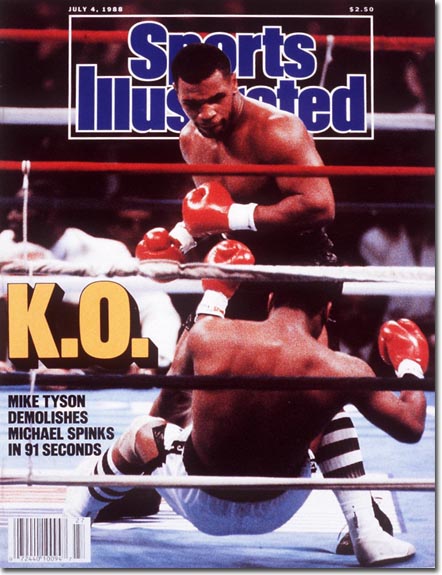
Well . . . That Was Easy!

April 1, 2011

(Guest post by Greg Forster)

I made the bet thinking I had three. I turned out I had five. By the time the bet went live on the blog I had seven.

Then, in the comments, Matt brings to my attention that both Utah houses passed a major financial expansion of the Carson Smith voucher program on March 10. And Scott notes that Minnesota’s House passed a new voucher program on March 30.

I won the bet in half a day!


Me and Jay Mathews: IT’S ON!

April 1, 2011

(Guest post by Greg Forster)

Last week I challenged Jay Mathews of the Washington Post to a bet:

Tell you what, Jay. Let’s make a bet. You say there won’t be “a wave of pro-voucher votes across the country”…[W]e’ll set a mutually agreed on bar for the number of voucher bills passing chambers this year. If we hit the bar, you have to buy me dinner at a Milwaukee restaurant of my choice. But if we don’t hit the bar, I buy you dinner at a DC restaurant of your choice. That’s pretty lopsided in your favor, dollar-wise. How about it?

Today I’m proud to announce that Jay has accepted the bet!

The terms, exactly as I offered them to Jay over e-mail:

Here’s what I propose. I win the bet if at least ten legislative chambers pass bills in 2011 that either create or expand a private school choice program. Otherwise you win. Just based on my experience in the movement, I think if we got that many chamber passages, it would mark 2011 as a banner year for choice.

Definitions: A “private school choice program” is a program that funds attendance at private schools using public funds, either directly (by vouchers) or indirectly, through the tax code (as is the case with many school choice programs these days). That means charter schools don’t count. This is the definition we use here at the foundation. “Expanding” a program means increasing the eligible student pool, or increasing the amount of funds available to support the program (on either a per-student or global basis). That’s in your favor because I’m agreeing not to count, say, relaxation of burdensome restrictions on participating schools as an “expansion.”

Jay’s succinct response: “It’s a bet!”

Well, I didn’t plan it this way, but during the time I was working out the details and deciding how many programs to propose for the bet, and then communicating with Jay, there were a few votes on school choice programs!

When I proposed the bet to Jay earlier this week, I had missed the votes in Arizona a couple weeks ago. I thought we only had three of the ten passages needed for me to win the bet – the Virginia House, the Oklahoma Senate and Douglas County, Colorado.

When Matt clued me in on the Arizona votes, I realized that we were already at five out of the ten passages needed for me to win:

    1. VA House new tax-credit scholarship program (February 8 )

    2. AZ Senate tax-credit program expansion (March 8 )

    3. AZ House tax-credit program expansion (March 10)

    4. Douglas County, CO new voucher program (March 15)

    5. OK Senate new tax-credit scholarship program (March 16)

Then what happens?

    6. IN House new voucher program (March 30)

    7. U.S. House voucher expansion (March 30)

We got to seven votes before I even announced the bet! So much for my plans to make this a big, drawn out, suspenseful thing. The whole shooting match is going to be over before I even get three blog posts out of it. And here I made these cool ruler graphics and everything!

Here’s one other thing that’s bothering me. Was it unethical for me to make the bet with Jay without revealing to him that Indian is the official ethnic food of Jay P. Greene’s Blog?


Big Day for Parental Choice

March 31, 2011

(Guest Post by Matthew Ladner)

Yesterday the Indiana House passed  a bill to create what seems likely to become the nation’s largest school voucher program, and to improve and expand their preexisting tuition tax credit law. On the same day, the United States House voted to reauthorize the DC Opportunity Scholarship program.

Indiana is poised to do something very special. Under the leadership of Governor Daniels and Superintendent Bennett, they are on the cusp of pushing through major Florida reforms: transparency with teeth (A-F school grading), action against social promotion and parental choice. The rest of us are going to have to pick up our games to try to keep pace.

The long-suffering DC Opportunity Scholarship Program children have suffered through the trials of Job. Kudos to Speaker Boehner for putting his back into delivering a happy ending for these kids!

Hold tight reform fans…the best is yet to come.


Vouchers Help But Obama Opposes

March 30, 2011

In a new study released today by a team of researchers led by Josh Cowen at the University of Kentucky, we learn that voucher students in Milwaukee are more likely to graduate high school and go to a four year college than their counterparts in the Milwaukee Public Schools.  The report concludes:

MPCP [voucher] students were more likely to have enrolled in a four year college, even after accounting for race, gender and prior achievement.  They were less likely to have dropped out of high school or remained enrolled after four years.  These differences may be partially explained by family background characteristics such as parental education and income.  They do not appear to be related to private school “creamskimming” of students into or out of MPCP between 8th and 9th grade.

Attending a private school with a voucher resulted in about a 7 percentage point improvement in the probability of attending a four year college.  Considering that is a move from about 32% to 39% attending 4 year college, it is a big effect.

And this attainment benefit is consistent with the findings of the U.S. Department of Education’s official evaluation of the DC Opportunity Scholarship voucher program, led by my colleague Patrick Wolf, which found:

The offer of an OSP scholarship raised students’ probability of completing high school by 12 percentage points overall (figure ES-3). The graduation rate based on parent-provided information was 82 percent for the treatment group compared to 70 percent for the control group. The offer of a scholarship improved the graduation prospects by 13 percentage points for the high priority group of students from schools designated SINI in 2003-05 (79 percent graduation rate for the treatment group versus 66 percent for the control group).

Despite these positive results, the Obama Administration issued a statement opposing the continuation and expansion of the DC voucher program, on which the U.S. House is scheduled to vote today.  They boldly (and falsely) declared:

Private school vouchers are not an effective way to improve student achievement. The Administration strongly opposes expanding the D.C. Opportunity Scholarship Program and opening it to new students.  Rigorous evaluation over several years demonstrates that the D.C. program has not yielded improved student achievement by its scholarship recipients compared to other students in D.C.

Given the lack of intellectual honesty on the part of the Obama Administration in declaring that vouchers have no benefits for students even after rigorous research (including the official evaluation they released!) finds otherwise, confirms the danger of entrusting any additional authority over eduction policy in the national government.  They will lie, cheat, and crush their opponents, so why would we want to give these folks control over a nationalized set of standards, curriculum, and testing.


Fear the Win-Win!

March 25, 2011

(Guest post by Greg Forster)

At the beginning of a very kind column praising my new report on the empirical evidence on vouchers, Jay Mathews indicates that for some strange reason, he’s afraid of me and my school-choice posse:

Do I really want to get beaten bloody again by school vouchers devotees?

Come on, Jay. I’m not a dangerous man. I would never beat anyone bloody. I’m soft and harmless. I’m a perfectly ordinary bunny rabbit. A cute, fluffy, harmless bunny rabbit.

Well, okay, I have been known to bite. With big, sharp, pointy teeth. But just to stretch my repertoire, I’ll take the soft approach this time.

Jay acknowledges the evidence:

Greg Forster, a talented and often engagingly contrarian senior fellow at the Foundation for Educational Choice, has expanded a previous study to show that nearly all the research on vouchers, including some using the gold standard of random assignment, has good news for those who believe in giving parents funds that can be used to put their children in private schools. Students given that chance do better in private schools than similar students do in public schools, the research shows. Public schools who are threatened by the loss of students to private schools because of voucher programs improve more than schools that do not have to worry about that competition, the research also shows.

Yet he thinks we shouldn’t support vouchers because . . . well, I’ll let him explain:

I see nothing morally, economically or politically wrong with vouchers. I have never thought that they drained public schools of vital resources. I think a low-income family that gets the chance to choose a private school that suits their child should do so.

But I think such programs have limited growth potential because there are never going to be nearly enough empty spaces in private schools to help all the students who need them. Forster and other voucher advocates say this will change when voucher programs become universal. Then, entrepreneurs will be able to convince investors that they can create a new generation of private schools with the new wave of voucher students.

I think they are wrong about that. The young educators who have led the robust growth of charters prefer to work in public schools. Many voters will continue to resist sending their tax dollars to private schools, particularly with the pressures to cut back government spending that are likely to be with us for many years.

So that’s two arguments. Entrepreneurial startups won’t attract talented education refomers, and voters won’t support the programs.

It’s true that the leading-edge school reformers, the people Matt calls “the cool kids,” prefer to work in public schools. As I’ve written before, you can already see how that strategic choice is leading to dead end after dead end. The school choice movement needs to start building bridges to these people and showing them that in the long run, only school choice can provide the institutional support they need to sustain the kind of reforms they want.

As for politics, school choice has always polled well (for a discussion of the research and methodological issues, see here). The American people are not, in fact, uncomfortable with allowing religious institutions to participate in publicly funded programs on equal terms alongside other institutions. There was a time when they were (see “amendments, Blaine”) but that bigotry has receded.

Oh, and as for pressure to cut spending, school choice saves money. Tons and tons of it. That has always been one of our biggest assets in the political fight – that’s why the Foundation for Educational Choice produces state-focused fiscal studies year after year, to show each state how school choice would save taxpayer money while delivering better education.

The political obstacle to choice has never been the public at large. It has always been the blob, with its huge piles of cash fleeced indirectly from taxpayers, and (perhaps more important) its phalanx of highly disciplined volunteers and voters. A minority of the voters can control the outcome if they are single-issue voters when the rest of the public takes into account the whole panoply of problems confronting the body politic. And when you threaten to derail a gravy train, it tends to make the passengers into single-issue voters.

But the tide is changing. The cynical selfishness of the blob is more and more visible to more and more people. Reform has already won the war of ideas. That does not mean the ground war is won. The unions are still big, rich, and powerful. But they are no longer sacred. They have lost their mystique. No one thinks the unions speak for kids anymore; no one even thinks the unions speak for teachers anymore. And in the end, that’s what counts.

As Jay has put it, the unions are now the tobacco lobby. Or, as I have put it, they’re Bull Connor. That’s why school choice is now poised for a series of big political wins.

Jay is skeptical – pointing to the greater success of charters, he thinks vouchers won’t make big gains this cycle. As readers of JPGB know, the answer to the charter argument is that vouchers make the world safe for charters. As for whether vouchers make big gains this year, we’re about to find out.

Tell you what, Jay. Let’s make a bet. You say there won’t be “a wave of pro-voucher votes across the country.” Me and my posse at FEC will go back and count up the number of school choice bills (private choice, not charters) that passed state chambers in 2008-2010. Then we’ll set a mutually agreed on bar for the number of voucher bills passing chambers this year. If we hit the bar, you have to buy me dinner at a Milwaukee restaurant of my choice. But if we don’t hit the bar, I buy you dinner at a DC restaurant of your choice. That’s pretty lopsided in your favor, dollar-wise. How about it?

HT


The Choice Genie is out of the Florida Bottle

March 24, 2011

(Guest Post by Matthew Ladner)

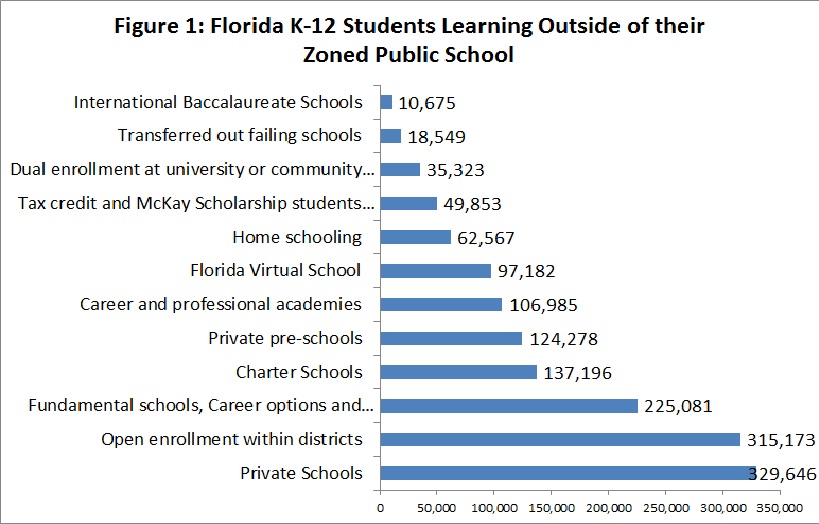
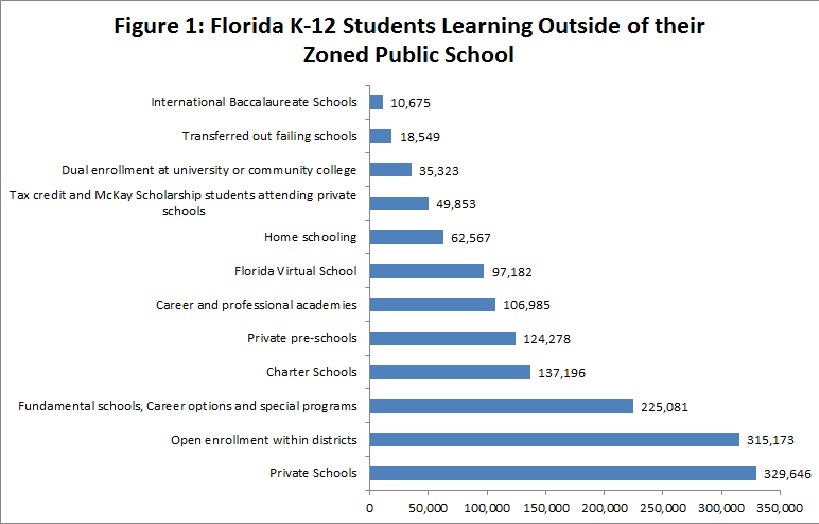
Drawing on data from redefinED and the Digest of Education Statistics, I produced the following chart. With 1.46 million students learning in part or wholly at schools other than their assigned public schools, Florida’s choice students outnumber the total public school population of all but about 8 states.

Okay, so it may be around 12 or 15 or so  if we were to account for some inevitable double counting in the figures (I’ve already separated out the McKay and Step Up for Students from the private school number). The choice programs however are just getting warmed up in the Sunshine State.


Vouchers Are a Win-Win Solution – Updated Edition

March 23, 2011

(Guest post by Greg Forster)

The Foundation for Educational Choice has just released my new report, “A Win-Win Solution: The Empirical Evidence on School Vouchers.” It’s an updated edition of my 2009 report providing a comprehensive overview of, well, the empirical evidence on school vouchers. In addition to incorporating new studies, this edition also expands the scope. The first edition only looked at the evidence on how vouchers impact public schools; this new edition also includes how vouchers impact the students who use them.

As before, I summarize the research with one striking chart. Or, now, two charts – one on how vouchers impact participants, and the other on how they impact public schools:


(Note: This image has been corrected; an earlier version transposed Milwaukee and Florida in Table 2. I apologize for the error.)

I’m not sure I can improve on what I wrote here on JPGB when I posted the first edition two years ago:

Worth a thousand words, isn’t it? I mean, at what point are we allowed to say that people are either lying, or have been hoodwinked by other people’s lies, when they say that the research doesn’t support a positive impact from vouchers on public schools?

There’s always room for more research. What would we all do with our time if there weren’t? But on the question of what the research we now have says, the verdict is not in dispute.

The report surveys all the random-assignment research on participants, and all the research (using all methods) on public school impacts. Readers of JPGB are probably familiar with the reason for this difference: random assignment is so far superior to other methods that when a large body of random assignment research exists, it ought to be given priority. However, since it’s not possible to do random-assignment research on how vouchers impact public schools, we have to cast a wider net – and the research methods being used in this field have been improving over time. Yet the results have remained consistent – how about that?

Here’s the executive summary of the new report:

This report collects the results of all available empirical studies using the best available scientific methods to measure how school vouchers affect academic outcomes for participants, and all available studies on how vouchers affect outcomes in public schools. Contrary to the widespread claim that vouchers do not benefit participants and hurt public schools, the empirical evidence consistently shows that vouchers improve outcomes for both participants and public schools. In addition to helping the participants by giving them more options, there are a variety of explanations for why vouchers might improve public schools as well. The most important is that competition from vouchers introduces healthy incentives for public schools to improve.

Key findings include:

  • Ten empirical studies have used random assignment, the gold standard of social science, to examine how vouchers affect participants. Nine studies find that vouchers improve student outcomes, six that all students benefit and three that some benefit and some are not affected. One study finds no visible impact. None of these studies finds a negative impact.
  • Nineteen empirical studies have examined how vouchers affect outcomes in public schools. Of these studies, 18 find that vouchers improved public schools and one finds no visible impact. No empirical studies find that vouchers harm public schools.
  • Every empirical study ever conducted in Milwaukee, Florida, Ohio, Texas, Maine and Vermont finds that voucher programs in those places improved public schools.
  • Only one study, conducted in Washington D.C., found no visible impact from vouchers. This is not surprising, since the D.C. voucher program is the only one designed to shield public schools from the impact of competition. Thus, the D.C. study does not detract from the research consensus in favor of a positive effect from voucher competition.
  • The benefits provided by existing voucher programs are sometimes large, but are usually more modest in size. This is not surprising since the programs themselves are modest — curtailed by strict limits on the students they can serve, the resources they provide, and the freedom to innovate. Only a universal voucher program could deliver the kind of dramatic improvement our public schools so desperately need.

Douglas County Offers Vouchers to Students

March 16, 2011

The school board in Douglas County, Colorado voted unanimously to offer vouchers worth $4,575 to as many as 500 students who were not previously enrolled in private school.  The measure would save the district between $402,500 and $2.2 million and would greatly expand options for those families, including religious and secular private schools.

The teacher unions and their allies will almost certainly try to tie the program up in court and run their own board candidates in the hopes of rolling back the policy.  But with choice and other ed reforms being pushed all over the country and with the ability of unions to automatically deduct dues from payrolls being eliminated in a number of states, the ability of the unions to fight every battle in every location is limited.

The most effective political strategy for adopting ed reform is to “flood the zone.”  Propose a lot of ideas in a lot of places and the unions find it nearly impossible to block every one.  That’s what Jeb did in Florida and now reformers are adopting that strategy nationwide, enhancing its effectiveness.


Georgia Lawmakers Considering Scholarship Expansion

March 15, 2011

(Guest Post by Matthew Ladner)

As Greg noted earlier, school choice is back this year, with major proposals under consideration in many states. Potentially lost amidst the sturm und drang of places like Wisconsin and Indiana, some important pieces of legislation have been introduced and have been advancing through the legislative process.  Georgia lawmakers for instance are considering SB 87, a proposal to expand the highly successful special needs law, to include a number of new and worthy student populations.

The law expands eligibility of the Georgia program to include children with disabilities who do not have an IEP (Section 504) children, the children of military families, and foster care children. One can make a compelling case for each of these student populations to have the ability to exercise parental choice in education.

The case for parental choice for foster care children is extremely compelling. Goldwater Institute Senior Fellow Dan Lips made the case for this program by noting that foster care children frequently move between foster care homes. Changing addresses takes them across school district boundaries, obliging them to transfer between schools. Repeated bouncing between schools fatally disrupts the ability of students to learn.

A scholarship program for foster children creates the possibility creating a school as an island of stability for foster care children. Arizona lawmakers passed such a program in 2006, and then Governor Janet Napolitano signed it into law.

The Department of Defense runs a highly regarded system of schools for military students. Sadly, the demand for spaces routinely exceeds the number of available seats. Georgia lawmakers may see fit to expand the schooling options for our parents in uniform, and I certainly will salute them for doing so.

Section 504 of the Rehabilitation Act of 1973 requires schools to provide to students with disabilities appropriate educational services designed to meet the individual needs of such students. The ability to choose who provides education services to a child must be a part of generating a truly individualized education, and one that has already been extremely successful for children with disabilities.

Stay tuned to this station for further developments…


MJS Showdown: Enlow Annihiliates

March 10, 2011

(Guest post by Greg Forster)

I’m late getting this up, but check out yesterday’s battle royale on the op-ed page of the Milwaukee Journal Sentinel.

In this corner, the title holder – the champion of choice, the vizier of vouchers, the BMC of ESAs – Robert Enlow!

And in this corner, the challenger – the canard kid, the defenestration of education, the unionbomber – O. Ricardo Pimentel!

The subject: Gov. Walker’s proposal to lift the income restriction on the Milwaukee voucher program from 175% of the poverty level to 325%, or $72,635 for a family of four. Walker has an eye toward eventually lifting both the income restriction and the cap on the number of participants – which would make Milwaukee a universal voucher program.

They’re getting mental in the Sentinel!

There’s the bell, and here comes the champ!

CHOICE PLAN PUTS KIDS FIRST

Looks like he’s confident. Now we’ll see what the challenger’s got.

YES, YOU WERE ALL DUPED BY CHOICE

Ouch! That snooty condescention is going to cost him. But he’s on fire and the hits start coming: 

Now, $72,635 is not what it used to be, but it’s not low-income…

 The champ fires back:

There are almost 210,000 households in Milwaukee, with more than 90% of them earning less then $100,000. That’s less than the average Milwaukee Public Schools teacher earns in annual compensation, according to the Journal Sentinel.The point isn’t to attack teachers but to show that what many consider “poverty” to qualify for a school voucher is not the same amount of income it actually takes to survive – and thrive – in America.

The challenger’s reeling under the punishment. But he comes back with another attack!

If schools need fixing, the community needs to pull together to do that. Walker’s budget cuts $834 million in school aids. MPS says it will have to cut $74 million from its preliminary budget.

This prompts a round of stunning brutality from the champ:

School choice saves taxpayers big bucks. The per-pupil cost to educate a child in Milwaukee is $13,229, according to the National Center for Education Statistics. Yet the voucher program funded by the state is about half that at $6,442, which covers a good portion of tuition at many parochial and private schools.

The challenger’s down! No, wait, sorry, he’s just looking for his teeth.

Okay, now he’s back in the fight.

Bet on it: If families that aren’t precisely low-income “need” help here in Milwaukee, it is just a matter of time that he’ll reason they need help in other communities with challenged school districts or perhaps even those in higher-performing districts.

So, this begs the question: Were low-income students – mostly youngsters of color – just useful pawns for the right?

Wow, he must really be hurting to play the race card so flagrantly. Still, there’s something vaguely resembling an argument in there somewhere. Let’s see how the champ handles it.

With a ceiling on the number of students who can participate, the program’s impact has been limited although still positive. That’s why Walker’s plan to open the program to all students is welcome news, as unrestricted freedom will work even better to improve MPS and increase the academic achievement of children.

For example, if a large grocer has a monopoly in a neighborhood and a convenience store opens on the corner selling milk and bread, there isn’t enough competition to force the large grocer to offer better products. However, if three convenience stores and two other larger grocery stores open, customers suddenly will see an improvement in the products available. The same happens in education, as parents always win with multiple education choices. Such will be the case in Milwaukee when all parents have the choice of a private or public school.

How is the challenger still on his feet? An amazing sight, ladies and gentlemen!

I never would have thought Robert Enlow was capable of brutalizing another human being so totally. Why isn’t the ref putting a stop to this inhumanity?

It looks like the challenger can’t even see where he’s punching. He’s just flailing now.

Gov. Scott Walker is on the cusp of making the much desired entanglement of public dollars and private schools – many of them religious – an unassailable reality.

Yes, unassailable. See what happens if middle-class folks are given vouchers and some subsequent governor or Legislature tries to take them away. Won’t happen…

Choice made sense as a matter of equity for low-income children with no options in a district that demonstrably served them poorly…

Yes to choice – but for those who really have none. And if extended for families beyond that? We can consider ourselves duped.

Did I hear that right? Vouchers violate the separation of church and state – but only when rich white kids use them. When poor black kids use them, they’re fine. And remember, it’s voucher supporters who are using poor black kids as political props.

And, sure enough, the challenger’s self-contradictory idiocy has prompted the ref to step in. Clearly this is one fighter who’s taken a few too many hits.

Enlow is carried out of the ring by a cheering throng of supporters!

No, wait – that’s the mob of union protestors who were bussed in from Madison to watch the fight. I guess Robert is headed for an “undisclosed location.”

And now over to Jay and Matt for the post-match show.