Archbishop Charles Chaput Calls for Action to Expand PA Parental Choice

January 31, 2012

(Guest Post by Matthew Ladner)

Philadelphia Archbishop Charles Chaput released the following statement last Friday and published in today’s Philadelphia Archdiocesan publications, including every parish bulletin being distributed at Mass and published online.

Archbishop’s weekly column: Catholic Schools Week – How you and I can help

Monday, January 29, begins Catholic Schools Week. It’s a time to honor the unique value of Catholic education. Here in the Archdiocese of Philadelphia, we have a long record of dedicated service by the women and men who teach in our classrooms and run the “business” of Catholic schools. That record includes the legacy of thousands of women and men religious and diocesan clergy. In the single academic year of 1963-64, more than 4,100 religious and 1,600 laypersons taught more than 263,000 students enrolled in our schools. Today, scores of our pastors make extraordinary commitments of parish funds to keep our schools open and excellent.

Unfortunately, schools run on resources, not simply good will and heroic service. Our schools can no longer count on unlimited Church support. The resources simply don’t exist. Many of our parishes are financially strained. The archdiocese itself faces serious financial and organizational challenges that have been developing for many years and cannot be ignored.

So where does that leave us? We can honor Catholic Schools Week this year by actually doing something about the fiscal problems hurting our schools. We need to press our lawmakers, respectfully but vigorously, to pass school choice.

First, we need some clarity: School vouchers do not mean “government support for religious schools.” That argument is flatly false. No vouchers go to any school, religious or otherwise. Vouchers do, however, return the power of educational choice to parents, where it belongs. In doing so, vouchers make all schools more accountable for the quality of education they deliver. Parents get the voucher. Parents choose the school. This makes perfect sense. And if a school offers a poor education for young people, parents will rightly vote with their feet — and their vouchers. Of course, most Catholic schools do the opposite: They offer a strong education, in a safe environment, with a focus on developing good moral character. That’s why parents are so upset when they close.

Some people argue that school choice legislation only helps families in poor areas. Helping the poor is obviously vital, and vouchers would accomplish that. But vouchers would also assist many more families than the poor. If vouchers are approved, they will free up what’s known as EITC funds — Educational Improvement Tax Credit funds — along with other grant and scholarship monies for many thousands of other school families. In effect, the positive impact of vouchers translates to millions of dollars of additional educational resources potentially available to a wide range of school families each year — including Catholic school families.

Now here’s an unhappy fact: In 2011, the bishops of Pennsylvania made the passage of vouchers one of their priority legislative issues. People like Bob O’Hara in our statewide Catholic bishops’ conference and Jason Budd in our archdiocesan Office of Catholic Education worked hard to mobilize Catholic support. Their efforts failed — and not because they didn’t try, but because too few people in the pews listened. Very few Catholics called or wrote their state senators and representatives. Even fewer visited their offices to lobby as citizens. Despite this, vouchers passed in the state senate, before stalling in the house. One non-Catholic school choice activist — who has poured years of his time and millions of dollars of his own resources into fighting for vouchers as a social justice issue — was baffled at the inability of Catholics to mobilize around an issue so obviously vital to the public interest and so clearly helpful to the survival of their own schools.

In the coming week I’ll be writing every state senator and representative in the territory of the Archdiocese of Philadelphia to press them to support school vouchers. And I’ll continue doing it until vouchers pass. I hope my brother bishops and pastors across the state will do the same. More importantly: Our Catholic people need to do the same. Elected officials do listen, and they act when the noise gets loud enough. If nothing else, the crisis of Philadelphia’s Catholic schools is an unpleasant but finally very healthy wake up call. The bill for our failure to pass school choice over the past decade has come due. Now we’re paying for it.

When vouchers stalled, yet again, in the Pennsylvania house last fall, a frustrated Catholic school teacher friend of mine said “Catholics are suckers.” I don’t believe that. But then, I’m new in town. If we Philadelphia Catholics love our Catholic schools, and we obviously do, then the time to get active and focused is now. We need to begin pressing our state lawmakers to pass the school choice legislation — including vouchers and expanded EITC credits — that’s currently pending in Harrisburg. And we need to do it this week, today, right now. I plan to do that. I hope you’ll join me.

For more information on school choice, and to contact your legislator, please visit:  http://tinyurl.com/PASchoolChoice


Kevin Carey Gets the Facts Wrong

January 30, 2012

(Guest post by Patrick J. Wolf)

In The Atlantic Online resident cool-kid Kevin Carey sings the “vouchers-are-all-bad-but-charters-are-all-good” song that is the official anthem of the beltway crowd of education reform hipsters.  Carey repeats some points from my own research that school choice results would be even better if parents had more extensive information about schools (but see here for how the mere availability of choice improves parent knowledge about schools) and the supply of choice schools was of consistently higher quality.  Fine.  Carey also claims that private school administrators are rapacious (tell that to the nuns that still run many Catholic schools) and politicians who support school vouchers do so for “obviously partisan reasons” while Mr. Carey only cares about the children.

Unlike Kevin Carey I don’t purport to possess the ability to look inside of people’s souls and conclusively discern their true motives.  Still, his broad-brush claim that all voucher backers are merely trying to “club Democrats” (his words) seems demonstrably inconsistent with the behaviors of voucher supporters such as retiring Independent Senator Joe Lieberman, Senator Diane Feinstein (yeah, she loves to club Democrats), former Democratic Mayor Anthony Williams, Wisconsin State Representative Jason Fields (yet another African-American Democrat who supports vouchers), etc.  I really could go on and present a much longer list, but Kevin Carey only uses single examples to make sweeping generalizations so I’ll simply outperform him by using multiple counter-examples to disprove his universal and unqualified claims.

What disturbs me more than Carey’s reckless accusations is his lack of knowledge of the basic facts surrounding school vouchers.  For example, he states casually that, “To this day, vouchers are only available to small handful (sic) of students.”  The facts are that 27 different voucher or tax-credit funded voucher-like programs serve over 210,000 students.  Even Paul Bunyan’s hands couldn’t hold that many kids.

Carey goes on to state boldly that, “Unlike private schools that pick and choose their pupil (sic), charters are open to all students and allocate scarce openings via lotteries.”  The facts are that many voucher programs do not allow private schools to discriminate in admissions.  In Milwaukee, for example, private schools participating in the voucher program must admit students by lottery but public charter schools in the city can pick and choose their pupils — the exact opposite of what Carey claims.

The D.C. voucher program is “a small, benign, and not particularly effective effort that at its core is nothing more than its name suggests: a program that awards scholarship (sic) to a small group of poor families to partially offset the cost of attending private school”, according to Kevin Carey.  Ignore the fact that this is yet another grammatically incorrect sentence from Mr. Carey.  Is it true?  Well, I know a few things about the District of Columbia Opportunity Scholarship Program, having served as the U.S. Department of Education’s independent evaluator of the program and having written six detailed reports on our nation’s only federally-funded school voucher initiative.

Did the D.C. voucher only “partially offset the cost of attending private school” for families, as Carey claims?  In over 99 percent of cases, the D.C. voucher of up to $7,500 was accepted by schools as full payment from the family.  The private schools accepted less than half the per-pupil government resources allocated to D.C. public schools and either provided a highly efficient education to voucher students or, in many cases, covered the extra costs themselves.  Wait a second, I thought Kevin Carey said that private school operators are greedy and avaricious?

Is the D.C. voucher program “not particularly effective”?  Our gold-standard experimental evaluation concluded that the voucher program increased the high school graduation rate of students by 12 percentage points from the mere offer of the voucher and 21 percentage points if a student actually used it.  That makes the D.C. voucher initiative the most effective drop-put prevention program ever evaluated by the U.S. Department of Education.  The same Milwaukee evaluation that Carey references as showing no net achievement benefits for voucher students also reports that Milwaukee voucher students are graduating from high school and enrolling in college at higher rates due to access to private schools through the program.

President Obama proposed in his State of the Union address that teenagers be compelled to remain in school until they turn 18 or graduate.  Who needs such Big-Brother-like compulsion?  When the government provides more students with access to private schools through vouchers the kids stay in school willingly.

Does Kevin Carey ignore the clear and large graduation rate benefits of the D.C. and Milwaukee voucher programs because he thinks it isn’t desirable for low-income minority children to graduate from high school?  If so, then human compassion and a wealth of research proves him wrong.  More likely, Carey ignores the compelling evidence that school vouchers help disadvantaged students go further in school because it is an inconvenient fact that undermines his argument.  He doesn’t want to admit that voucher programs are effective at promoting the most important student educational outcome there is, and he certainly doesn’t want to share that uncomfortable information with his readers.  Move along, nothing to see here.

After lauding school choice only through public charter schools, Carey states that, “…the market will still require strong oversight from public officials to grant the ‘approved’ status Friedman envisioned over a half-century ago–and the willingness to revoke that approval when performance is sub-par,” which is exactly how the Milwaukee voucher program is designed and operates.

Doesn’t Carey read anything?  A report released last year documented that the Wisconsin Department of Public Instruction, the government agency that oversees the Milwaukee voucher program, has kicked 35 schools out of the program since 2006.  The average student performance in those schools was dramatically lower than the achievement numbers for the schools allowed to remain in the program.  Voucher programs in the U.S. have exactly the kinds of government accountability mechanisms that Carey falsely claims are missing from them, plus market accountability to boot.

After Kevin Carey’s litany of factual errors, he grandly proclaims the path forward for people, like himself, who actually care about the children.  “We can start by purging the worst rhetoric from the school choice conversation.”  Well, Mr. Carey, before you criticize the splinter in your brother’s eye you might want to work on removing the log from your own.  Meanwhile, readers who want accurate information about school vouchers should, like the Titanic, steer clear of The Atlantic.


Friedman Foundation Releases 2012 ABCs

January 24, 2012

HT Brandon Peat Design

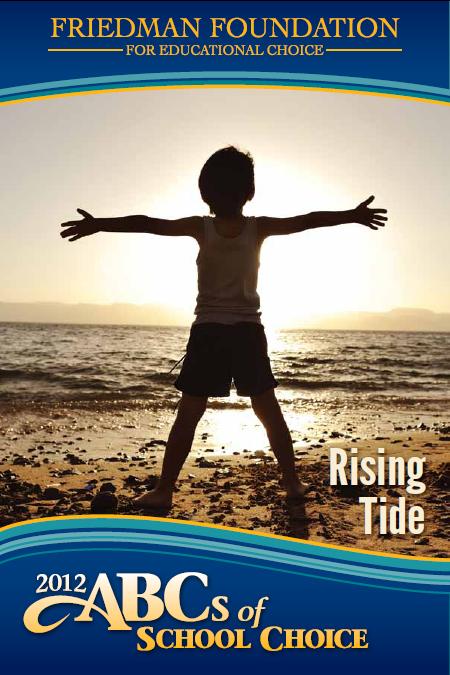
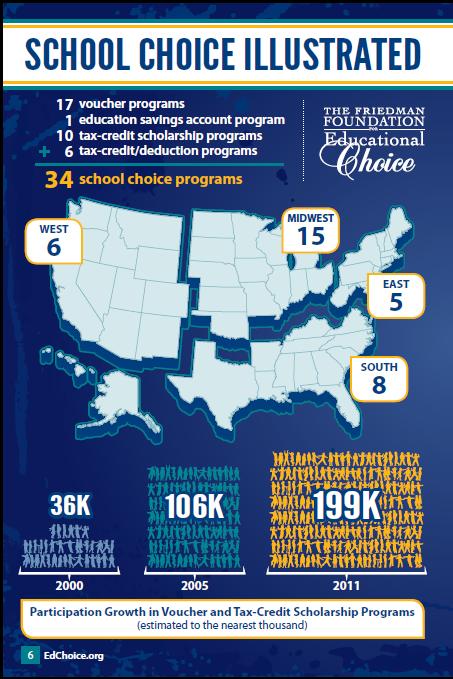
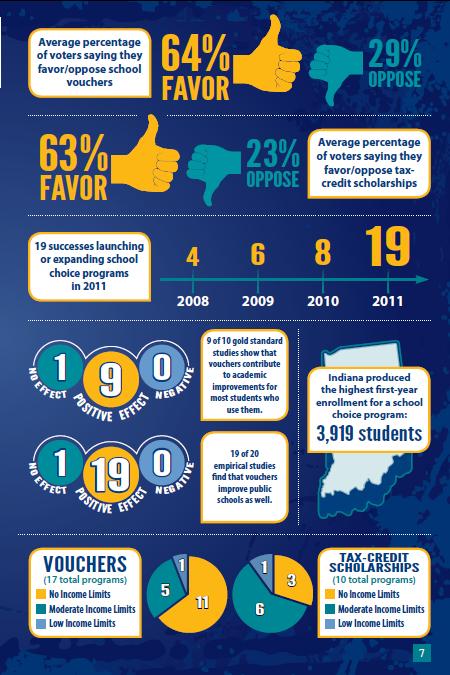
The Friedman Foundation has just released the 2012 edition of its annual publication ABCs of School Choice. It’s a busy week for releases!

There’s much to celebrate this year:

Milton and Rose D. Friedman envisioned a true revolution in American education. Their ideal was simple but powerful: give every parent the power and freedom to choose their children’s education. Unquestionably, 2011 was a breakthrough year in the quest to see that vision achieved in the United States. Thirteen states enacted school choice programs (this includes Washington, D.C., and Douglas County, Colorado). A total of 19 programs were enacted or improved—including the creation of eight new programs and the expansion of 11 existing ones.

Appropriately, this year’s report is subtitled Rising Tide. Check it out!

That’s a pretty big improvement over the plain text and little silhouettes of states it used to consist of when I edited it. Kudos!


School Choice on Learning Matters TV

January 19, 2012

(Guest post by Greg Forster)

And now, for a change of pace, JPGB is proud to present a post that doesn’t need to be shipped in a plain brown wrapper.

Learning Matters TV just posted an online forum on school choice, building on a segment they did for PBS NewsHour back in November. Eight experts got to lay down 300 words each on school choice. Your humble servant makes an appearance, as well as perennial school choice faves Andrew and Clint, plus Jay’s U.Ark. colleague Mike McShane.

I feel cleaner already.

Our new sponsor!

Why Do Reporters Get it Wrong?

January 13, 2012

It’s really frustrating, but some reporters continue to mis-represent the scholarly literature on the effects of private school choice programs.  We devoted an entire chapter in Education Myths to debunking “The Inconclusive Research Myth.”  But like an un-dead vampire that won’t die even after you’ve driven a stake through it’s heart, reporters keep repeating as fact things like the following:

Studies have generally found no clear advantage in academic achievement for students attending private
schools with vouchers.

That statement was the conclusion of the famously unreliable and partisan Center on Education Policy.  And reporter Tom Toch embraced it as an accurate summary of voucher research in his recent article in the Kappan.  What do we have to do to stop reporters from repeating this falsehood?

This blog post from Adam Emerson at the newly launched Fordham blog, Choice Words, is a great start.  Here’s a taste:

School voucher critics generally approach their job reviewing the research on school choice with unfair assumptions, and otherwise insightful commentators risk recycling old canards. This is true with Thomas Toch’s critique of vouchers in the newest edition of Kappan, which concludes that voucher programs haven’t shown enough impact to justify their position in a large-scale reform effort. Questions of scale can lead to legitimate debate, but we’ll get nowhere until we acknowledge what’s in the literature.

And Adam doesn’t even reference all of the gold standard (random assignment) research showing positive effects for students who participate in voucher programs, not to mention all of the rigorous studies finding that entire school systems improve in response to vouchers.

So why do people like Tom Toch, who’s not stupid or mean, fail to acknowledge this wealth of evidence showing benefits from voucher programs and just focus on crappy and mistaken summaries from hacks at CEP?


The Value-Add Map Is Not the Teaching Territory, But You’ll Still Get Lost without It

January 11, 2012

(Guest post by Greg Forster)

Since we’re so deep into the subject of value-added testing and the political pressures surrounding it, I thought I’d point out this recently published study tracking two and a half million students from a major urban district all the way to adulthood. (HT Whitney Tilson)

They compare teacher-specific value added on math and English scores with eventual life outcomes, and apply tests to determine whether the results are biased either by student sorting on observable variables (the life outcomes of their parents, obtained from the same life-outcome data) or unobserved variables (they use teacher switches to create a quasi-experimental approach).

Finding?

Students assigned to high-VA teachers [i.e. teachers who produce high “value added” on test scores] are more likely to attend college, attend higher- ranked colleges, earn higher salaries, live in higher SES neighborhoods, and save more for retirement. They are also less likely to have children as teenagers. Teachers have large impacts in all grades from 4 to 8.

Let’s bring that down to reality:

Replacing a teacher whose VA is in the bottom 5% with an average teacher would increase students’ lifetime income by more than $250,000 for the average classroom in our sample.

But here’s what I want to pay the most attention to. Note the careful wording of the conclusion:

We conclude that good teachers create substantial economic value and that test score impacts are helpful in identifying such teachers.

Note what they don’t say. They don’t say that increasing math and English test scores by itself leads to improved life outcomes. They say good teachers lead to improved life outcomes, and value-add is one relatively good way to identify good teachers.

You’ve heard the saying that the map is not the territory? (If not, that means you haven’t seen Ronin, in which case shame on you.) Well, it’s true. What raises life outcomes is good teaching, and good teaching can’t be reduced to test scores. (See here, here, here, here, here, here, here and here.)

But if you want to find your way around the territory, you need a map. If you want to help those kids stuck with lousy teachers who are out a quarter million, you’re going to need a tool that identifies them. Value added analysis is the best tool we’ve come up with yet – other than parental choice, of course.

And where the tests are freely selected and voluntarily adopted by schools, the tests provide helpful data for parents, so parent choice is strengthened by voluntary testing. That’s why over 90% of private schools use testing in some form. On the other hand, forcing teachers to use a test they don’t believe in is a self-defeating proposal.

But how do you get schools to want to use a test? Parent choice, of course! Choice is what creates the external standard of performance that makes assessment tools seem legitimate rather than illegitimate. So testing and choice are like chocholate and peanut butter – they’re two great tastes that taste great together.


PA lawmakers fail to expand school choice

December 16, 2011

 (Guest Post by Matthew Ladner)

As predicted, Big-10 country led the nation in expanding school choice this year. Just to recap, Indiana created the what will become the nation’s largest voucher program and expanded their tax credit. Wisconsin expaned the Milwaukee Parental Choice Program and created a new program for Racine. Ohio expanded their failing school voucher and created a new voucher program for special needs students. Michigan removed the cap on university sponsored charter schools after a decade plus long struggle.

Pennsylvania had proposed vouchers, a large expansion of their tax credit program and an expansion of their charter school law. It appears however that the PA legislature will choose to do nothing to expand parental options.


Choice Is Not Chaos

December 14, 2011

(Guest post by Greg Forster)

Commenters on Jay’s outstanding post seem to be under the impression that the only alternative to national standards is chaos. If the national government doesn’t impose standards, there will be no standards at all. I think this is really what lies behind a lot of people’s support for that policy.

But, as we’ve discussed at some length here on JPGB, there are two ways to create order. One is to impose an order by raw power. The other is to allow people to organize their own orders around what they think works best (within just boundaries – your order isn’t allowed to include killing me, for example). Some forms of order need to be imposed – theives need to be locked up, not permitted to construct an alternative theiving order.

But content standards ought to follow the choice model. Currently, schools can’t create any kind of order or standards because they have to accomodate a great number of contituencies who don’t choose to be there. If every school were a school of choice, each school would have not only the freedom, but also the social support, to organize around a clear standard and impose it in every classroom. All the constituencies would be aligned.

Different schools would select different standards, of course. But that is not chaos. That is what ordered freedom looks like. The pretense that there is one clearly correct best approach to education, such that any deviation is illegitimate, looks a lot like religious fundamentalism – and that’s because it is religious fundamentalism. And it has the same dangerous tendency toward political authoriarianism that religious fundamentalism often creates.

To revisit an old post:

People need to be persuaded to adopt reform as part of their truth – something they experience as legitimate, necessary, and empowering.

“But wait!” I hear you cry. “That’s what we’ve been trying for decades, and it hasn’t worked!”

That’s right, so let’s ask why it hasn’t worked. I mean, isn’t it a little odd that 1) the system is so overwhelmingly dysfunctional that it’s destroying millions of children’s lives, 2) the people in the system are normal people, not psychotic or anything, people who by all accounts care about children’s education at least as much as the average person if not, you know, a lot more, and yet 3) the people in the system can’t be brought by any means to see reform as necessary?

What is it about the system as currently constituted that ensures reform is never embraced as something legitimate, necessary and empowering?

The system is moribund because it is a monopoly. When any institution has a captive client base, support for innovation vanishes. Reform requires people and institutions to do uncomfortable new things. Thus it won’t happen unless people are even more uncomfortable with the status quo than they are with change. So we need institutional structures that make the need for change seem plausible and legitimate. A captive client base ensures that such structures never emerge. An urgent need for change never seems really plausibile. An institution with captive clients can – or at least it will always feel like it can – continue to function, more or less as it always has, indefinitely. So why change, when change is uncomfortable, even painful?

This is why even small reforms that seem like they would be easy to implement have consistently failed to scale, and the attempt to impose such reforms through national command structures will fail even more spectacularly. Institutional culture in the existing system is hostile not just to this or that reform, but to reform as such, because it excludes the only institutional basis for making the need for change seem plausible and legitimate: the prospect of losing the client base.

This is what school choice advocates are talking about when they talk about the value of competition. “Competition” does not mean a cutthroat, ethics-free environment where individuals and institutions seek their own good at the expense of the good of others. Rather, competition is the life-giving force that drives institutions to become their best and continuously innovate, because it is the only way to hold institutions accountable for performance in a way that is both productive (because it aligns the measurement of institutional performance with people’s needs) and humane (because it creates accountability in a decentralized way rather than through a command-and-control power structure)…

This is the most important reason school choice has consistently improved educational outcomes for both the students who use it and for students in public schools. Studies of school choice programs consistently find that students using choice have better outcomes, and also that public schools improve in response to the presence of school choice. The explanation is simple: school choice puts parents back in charge of education, freeing the captive client base and creating an institutional environment in schools that makes the need for change seem plausible and legitimate.

Educators experience the urgency of the need for change when families not being served can leave for other schools – and they will never experience it any other way. Discomfort with change is also reduced for parents, because school choice restores their control over their children’s education.

HT People vs State


Parenting Advice from Sara Mead

December 12, 2011

Sara Mead takes issue with my recent post that puts misconduct by some McKay schools in perspective.  I noted that those reacting to reports of misconduct by calling for the elimination or heavy regulation of McKay do not similarly react to incidents of misconduct in traditional public schools.  She likens this to a misbehaving child saying “he did it first.”  Sara urges us to be tough parents who don’t accept such weak excuses:

I was a very naughty child. When I was inevitably caught misbehaving, I often tried to justify it by saying “So-and-so (usually my sister or a classmate) did it first!” Not surprisingly, that argument never won the day or kept me from being punished.

I was reminded of this by Jay Greene’s recent blog post about reports of malfeasance and fraud by operators participating in Florida’s McKay Scholarship program for children with disabilities. Jay cites a series of examples of abuses in public school districts–basically a grown-up “he did it first!”–before stating that “existence of misconduct in traditional public schools in no way excuses the misconduct that has been uncovered in the McKay program.”

Glad we agree on that one!

Let’s ignore that I clearly said (in the comment she quoted!) that misconduct by McKay providers is inexcusable.  And let’s ignore that she mis-characterizes my call for perspective.  And let’s ignore my argument that the direct operation of schools by the government or heavy regulation of private providers unfortunately does not eliminate misconduct.

Instead, I would like to offer some parenting advice of my own.  When I was a child I sometimes tried to persist in making an argument, even when the evidence contradicted it.  My parents correctly taught me that when you are wrong, you should admit it.

I was reminded of this when thinking about Sara Mead’s repeated claim that the McKay Scholarship program provides incentives to increase the over-identification of students as disabled.  In 2003 she and Andy Rotherham released a report that made a series of speculative allegations against McKay, including:

special education vouchers may actually exacerbate the over-identification problem by creating  a new  incentive for parents to have children diagnosed with a disability in order to obtain a voucher. In fact, if special education identification led to funding for private school attendance, it would be unusual if this did not create an incentive to participate in special education in many communities, particularly those with low-performing public schools.

And in 2007 Sara Mead repeated the claim:

Offering vouchers to children with disabilities—and only children with disabilities—creates an incentive for parents to seek out a special education diagnosis in order to get a voucher. Anecdotal evidence suggests that some parents seek out diagnoses of learning disabilities or attention deficit hyperactivity disorder (ADHD) to get their children additional help and accommodations on tests. McKay’s offer of a voucher for students with disabilities creates an even stronger incentive for parents to “game the system.” And Florida psychologists who diagnose youngsters with ADHD and other disabilities have told reporters that they see some Florida parents who are seeking these diagnoses just so they can get a McKay voucher.

But in 2009 Marcus Winters and I released an empirical examination of the issue that actually found the opposite.  McKay actually provided incentives to reduce the excessively high rate at which students are identified as disabled.  And in June of this year, the leading quantitative AERA journal, Education Evaluation and Policy Analysis, published our article with this finding.

Nowhere has Sara Mead said that she was mistaken.  And last week Education Sector responded to reports of misconduct in McKay by urging people to read the 2007 report with this (and other) false or unsubstantiated claims.  People shouldn’t persist in repeating false claims.

I hope we can agree on that one.


Perspective on McKay

December 10, 2011

Ed Week, Ed Sector, and others are picking up on a hyperventilating story from the free weekly Miami New Times about misconduct in Florida’s McKay Scholarship voucher program for disabled students.  The piece is actually a re-hash of a story the New Times ran 5 months ago about private schools participating in McKay that mishandled money, hired incompetent staff, or failed to provide adequate services.

The stories were embarrassing, but the reaction by the New Times and others has been completely lacking in perspective.  Organizations receiving government funds are unfortunately even more prone to misconduct than typical organizations.  This is also true of public schools.  For example in the Detroit Public Schools we see:

 Five Detroit Public Schools employees have been charged with embezzlement in an ongoing probe into the “culture of corruption” that took hold in the state’s largest district, a prosecutor said Wednesday….

A series of audits into district finances have been ordered. Two separate audits announced last week revealed the district has been paying $2.1 million per year for health coverage for ineligible dependents, and bought 160 unused BlackBerries and 11 motorcycles.

“It has been said that the accomplice to corruption is frequently our own indifference, and I agree wholeheartedly with that,” Worthy told reporters in announcing the charges.

“My office was not surprised about the culture of corruption that we’ve been seeing in the past in the Detroit Public Schools system,” she said. “What did surprise even us, though … is how rampant, how overt and how conspicuous and downright bold-faced the corruption is, allegedly, in some of the cases that we’ve been looking at.”

And from Springfield, MA public schools we learn:

A 13-month audit recently concluded at Putnam Vocational Technical High School found that some employees abused a student association checking account that operated independently from the city and school system in apparent violation of Massachusetts law.

McCaskill was in charge of that unauthorized account, which averaged about $200,000 annually in transactions since late 2005, but was managed with a manual ledger that never matched bank statements, according to the report from Springfield’s Office of Internal Audit….

“There is no excuse for the disgraceful, dishonest practices that appeared to have run rampant among a group of employees at the school for several years,” Ingram also wrote in a post on his official blog.

And right in the backyard of the Miami New Times we find the mysterious absence of $3.8 million from the Broward County teacher union accounts, the prior head of the Broward teacher union in jail for soliciting sex from a minor, and the former head of the Miami-Dade County teacher union in jail for corruption and embezzlement.

And while the New Times was repeating the complaints of Miami-Dade superintendent  Alberto Carvalho about McKay, they somehow failed to mention Carvalho’s own history of manipulating newspaper coverage through a reporter with whom he was reportedly having an affair.

But these are just selected anecdotes.  In a systematic study of scandals in public and private schools, Greg Forster and Matthew Carr found that misconduct was actually slightly more likely in regulated public schools than in largely unregulated private schools.  That is, some amount of scandal is unfortunately unstoppable and increasing regulation or government operation of schools is unlikely to eliminate the problem.

Of course, the existence of misconduct in traditional public schools in no way excuses the misconduct that has been uncovered in the McKay program.  But then again no one calls for the public school system to be shut down as a result of these scandals like folks are calling for an end to McKay.  And Diane Ravitch, in her typical, scholarly fashion, responds to the McKay reports by tweeting “Legalized child abuse in Florida?”, but appears to have no reaction to similar reports from traditional public schools.

My point is that the reaction to reports of misconduct in the McKay program are lacking perspective.  Yes, abuses need to be stopped.  And the regulations on the books, if enforced, could keep those abuses to a minimum.  As former Senator John McKay told a Florida newspaper in response to calls for more regulation:

Kriseman suggested nine issues to increase accountability, including mandatory site inspections of facilities. He said the Department of Education should review and sign off on personnel criminal background checks in facilities seeking to receive McKay dollars. And teachers in a school accepting McKay dollars should have a state teaching certificate.

Former State Senate President John McKay — who created the law — agrees. McKay listened to Kriseman’s full list of suggestions.

“A number of his suggestions are quite positive,” McKay said. “Many of the things he’s asking for are already in the statute.”

McKay suggested asking officials with the Department of Education to enforce the law.

“It’s nice to have words in a statute,” McKay said. “Unless someone does something, it’s kind of meaningless.”

And of course, all of these criticisms of McKay fail to mention the proven positive effects of the program.  It improves student achievement for disabled students, reduces the rate of new identification of disabilities, increases the chances that students will receive needed services, and is overwhelmingly loved by parents.  I wish we could say the same about all traditional public schools, including those riddled with misconduct.