Welcome Back to School!

August 8, 2014

Lorie Ann Hill

I know it’s early August but in some areas of the country they are already heading back to school.  And in Wagoner, Oklahoma we have a report of a special education teacher who was arrested on the first day back “after she showed up at school under the influence of alcohol and without her pants.

Andy Rotherham dryly observed: “I blame Common Core.

But hasn’t Oklahoma committed to withdrawing from Common Core?  Maybe he means that he blames the absence of Common Core.  I, as a believer in incentives, blame the relatively low cost of booze and the relatively high cost of pants. Or something like that.


Keeping Score in the Greene-Polikoff Wager

August 7, 2014
The unraveling of Common Core makes this flop the most obviously ill-conceived and doomed-to-fail reform effort since the Annenberg Foundation threw $500 million away in the 1990s.
Morgan responded:
At last count, 1 state out of 45 has repealed the standards.
So we agreed to make a wager:
In ten years, on April 14, 2024, I bet Morgan that fewer than half the states will be in Common Core.  We defined being in Common Core as “shared standards with shared high stakes tests-even if split between 2 tsts.”  Given 51 states and DC, Morgan wins if 26 or more states have shared standards and high stakes tests and I win if the number is 25 or less.  The loser has to buy the winner a beer (or other beverage).
It hasn’t even been four months, but I thought it might be useful to report the current score on our bet.  With the withdrawal of Iowa this week from the Smarter Balanced testing group, there are only 26 states that plan to use one of the two national tests to assess their students during the 2014-15 school year.  It’s true that 35 states remain part of the two testing consortia and some of the 9 states that have delayed implementation of the common tests may begin using one of them in the next few years.  But it’s safe to say that several of those 9 delayed start states will never follow through.  And some of the 26 states actually using a common test in 2015 are already making noises about withdrawing.  See for example reports coming out of Wisconsin and South Carolina.
If one more state that is currently using one of the common tests drops it than decides to follow through on implementation, I will have won the wager.  And we have more than 9 years to see that happen.  Mmmmm.  I’m thinking that a nice Belgian ale would be a delicious prize for victory.

School Breakfast Research

August 6, 2014

Education is dominated by “do-gooderism.”  Everybody wants to help children.  But sometimes the desire to help is seen as sufficient proof that one is actually helping.  And too often little thought is given to how trying to help might do some harm.

Which brings us to school breakfast programs.  Who could be against helping kids by making sure they start their day with a healthy breakfast provided in school?  Well, it is possible that those programs don’t do much good.  And it is possible they do some harm.

Last month Diane Whitmore Schanzenbach and Mary Zaki of Northwestern University released their analysis of a randomized experiment in which access to free school breakfast was expanded.  You can read the abstract and full report on the National Bureau of Economic Research web site.  Schools that offer free breakfast often have low participation rates.  So to learn about how to increase participation 70 matched pairs (or triplets) of schools participated in an experiment in which they could offer universal free school breakfast regardless of individual student eligibility for subsidized meals or breakfast in the classroom (BIC), where all students are given breakfast in their classroom at the start of the school day.

Schanzenback and Zaki conclude:

We find both policies increase the take-up rate of school breakfast, though much of this reflects shifting breakfast consumption from home to school or consumption of multiple breakfasts and relatively little of the increase is from students gaining access to breakfast. We find little evidence of overall improvements in child 24-hour nutritional intake, health, behavior or achievement, with some evidence of health and behavior improvements among specific subpopulations.

Providing breakfast in the classroom, not surprisingly, has a very large effect on whether students participate in the breakfast program because it’s given to every student in the classroom.  Pretty much the only way you could not participate is by not being in school.  Universal breakfast has a more modest effect on increasing participation in the program (about 10 percentage points) because students have to arrive early to get the breakfast.

So if the goal of the program is to have people participate in the program, BIC is a huge success and universal breakfast is a modest success.  But if the point is to increase the amount or quality of calories students consume or to alter their behavior or learning in school, these programs don’t seem to be effective.  Universal breakfast does not even seem to have an effect on whether students eat breakfast or not.  It only shifts whether students eat breakfast at home or at school.  BIC does increase whether students eat breakfast (or have two breakfasts), but has no effect on total caloric intake.  Students just shift their eating so that they have fewer calories at other meals.

But when students eat might affect their health, behavior, and learning outcomes, so the researchers looked at whether the BIC program helped by increasing the likelihood that students would have breakfast even if those calories were offset by a reduction in eating at other times.  Unfortunately it didn’t.  They conclude: “The BIC treatment does not statistically significantly improve any outcome.”

So, expanding access to school breakfast does not seem to have any meaningful benefits.  Where’s the harm?  Leaving aside the cost to taxpayers, the greatest potential harm to these programs is that they alter the relationship between families and their schools by displacing the family’s traditional role of feeding their own children.  Doing so may make the families and students feel more dependent on the government and make school teachers and administrators view families and students as generally incompetent.  The state becomes the new Daddy and the parents become children incapable of providing for themselves or their own children.

This all makes me think of the new book by Jason Riley of the Wall Street Journal: Please Stop Helping Us.  We need to hold in check our desire to do good by remembering first to do no harm.


Abracadabra

July 31, 2014

Ancient mystics believed that one could have the magical power to create reality simply by uttering certain words.  This is the origin of “magical words” like abracadabra, which means “I create as I speak” in Aramaic.  But the belief in using magical words to create reality continues to this day, and not just among cheesy stage illusionists.  The Gates Foundation and their various grant recipients have “in a series of strategy sessions in recent months… concluded they’re losing the broader public debate [over Common Core] — and need to devise better PR.

Common Core supporters haven’t considered the possibility that their political strategy is flawed because they are trying to impose a top-down reform on a hostile and well-organized opposition of teachers and affluent parents.  Nope.  It must be that they just aren’t using the right words.  In particular, they think they need to shift from talking so much about “facts” and “evidence” and start using more “emotional” words.  If only they say the right words, people’s interests will change and the opposition will melt.  Abracadabra!

This faith in magical words is a symptom of a larger disease.  Education reformers have invested way too much in people who do almost nothing except craft political messages.  They try to coin just the right soundbite to fit in their dozens of daily tweets.  But they don’t just repeat these soundbites on Twitter, they use this “messaging” at policy conferences, in essays, and in conversations with each other.  They have put so much energy into perfecting the Twitter-bite that they can no longer think in any way other than in short bursts of spin.  It is rotting their brains.

Unfortunately, I think the rot starts at the top.  The Gates Foundation not only funds a large amount of this messaging nonsense, but engages in this type of slogan-speak themselves.  I’ve been reviewing their own descriptions of the purposes of their grants and have found poetry, like “to support organizations in a strategic visioning engagement to develop their innovative professional development theory of action and implementation strategies” or “to bring together a coalition of thought leaders, policy-makers, consultants and practitioners as part of the Global Education Leaders’ Program (GELP) and support them through a convening.”  Ugh.  

Here on JPGB we’ve been warning about the abuse of the English language in education reform for a while now.  And Rick Hess has joined the party, alerting readers to common phrases that should raise alarms with your BS-detector.  As Orwell understood, the problem with slogan-speak is not just that it muddles debates by obscuring the substance of what people are really saying.  And the problem is also not limited to the fact that degrading policy discourse with this gibberish undermines the credibility of future attempts at serious policy discussion.

The worst problem of slogan-speak may be that it is distorting the thinking of the ed reformers themselves.  They are usually completely sincere when they spout this slogan-speak.  They believe it.  And so their analysis of education reform issues is stunted and superficial.  They can’t think through an issue much more than how it sounds in a Twitter post.  And perhaps this is why they are doubling-down on a top-down standards reform that has no political logic to it.  They just can’t think it through.  So, when it runs into trouble they revert to what they know — more messaging.


The Siren’s Call of Policy Influence

July 22, 2014

I’ve written several times before about education policy analysts who confuse the constant sound of their own voice for actual influence over policy.  There are many faux education experts who have never really done anything or studied anything that would support their self-proclaimed status as experts.  And the foundations that fund them are making a foolish mistake in thinking that the non-stop chattering of these faux experts actually influences anybody.  Education policymaking is a long game that requires investment in serious inquiry.  Solid evidence, not an insular circle of blabbering, moves the elite consensus and creates the conditions for enduring policy changes.

The problem is that not only are foundations remarkably under-funding serious inquiry, but the academics who should be engaging in that research are increasingly drawn to the siren’s call of policy influence.  Yes, it is a proper goal of policy research to have influence, but that influence is the end-product of serious work, not the thing for which the quality of one’s work and intellectual standards should be sacrificed.

The latest example of academics attempting to trade their integrity for influence can be found in Ray Fisman’s Slate article on vouchers in Sweden.  Fisman is a Harvard-trained economist who has rapidly risen to a named professorship at Columbia University’s business school.  He rose so rapidly because he has done some excellent work published in leading journals.

But even highly capable scholars have difficulty resisting the temptation to abandon their standards for their imagined ability to influence policy.  So, Fisman has also become a columnist for Slate.  His columns are nothing like his scholarship.  In particular, his recent piece on vouchers in Sweden was filled with glaring errors of fact as well as obvious flaws in causal reasoning.  Andrew Coulson has an excellent take-down of Fisman’s piece over at Education Next.  You should read Andrew’s entire piece, but some highlights of Fisman’s sloppiness include:

  • Fisman claims “more Swedish students go to privately run (and mostly for-profit) schools than in any other developed country on earth.”  In fact, only about 14% of Sweden’s students attend private schools, significantly less than the 68% in Belgium as well as higher numbers in a host of other developed countries.
  • Fisman’s only “evidence” that vouchers have harmed achievement in Sweden is that PISA scores have dropped in that country over the last decade.  The Razorback football program has also gotten a lot worse over the last decade.  By Fisman’s causal reasoning, perhaps Swedish vouchers are responsible for my poorly performing Hogs.  This is the type of mis-NAEP-ery we expect of Marc Tucker or Diane Ravitch, not a Harvard-trained economist in a named professorship at Columbia.

Fisman would never make such sloppy mistakes in a journal submission or conference presentation.  His colleagues would laugh at him.  But nothing seems to deter Fisman or other would-be Paul Krugmans from making laughable claims in the popular press.  Maybe academics should not be given such a free pass for whatever they write outside of journals.  Maybe the credibility of their scholarly work and their status within the academic community should also be called into question if they are willing to be so reckless.

Look, I know from personal experience the lure of policy influence.  I’ve been in the think-tank world and taken part in the silly collection of “metrics” of influence to get foundation funding.  And I’ve felt the temptation to claim expertise in areas beyond my scholarship.  But we all have to resist these temptations if we are to maintain the standards of academic work.  We need to maintain those standards so that research can remain credible and be the source of true, long-run policy influence.


Money-Ed

July 22, 2014

(Guest Post by Patrick J. Wolf)

“Any other team wins the World Series, good for them. They’re drinking champagne, they get a ring. But if we win, on our budget, with this team… we’ll have changed the game. And that’s what I want. I want it to mean something.” – Billy Beane, Moneyball

The cost of baseball players once was largely ignored by the media and fans.  It was crude and destroyed the fun of the game, many thought, to inject hard-nosed considerations of efficiency into America’s pastime.  Then came Billy Beane’s “Moneyball” and the transformation of the Oakland A’s from perennial losers to a competitive and highly efficient professional baseball team, all due to careful consideration of how much bang players delivered for the buck.

Fast forward almost 25 years to the present day.  The cost of public education is largely ignored by both the media and education policymakers.  Many people think it is awkward, complicated or destroys the intrinsic and infinite worth of public education to inject hard-nosed considerations of efficiency into America’s schools.  Then came 2012, the first school year in history in which total U.S. government spending on public education went down.  Suddenly, money has to matter in public education, because apparently there isn’t an endless supply of it.

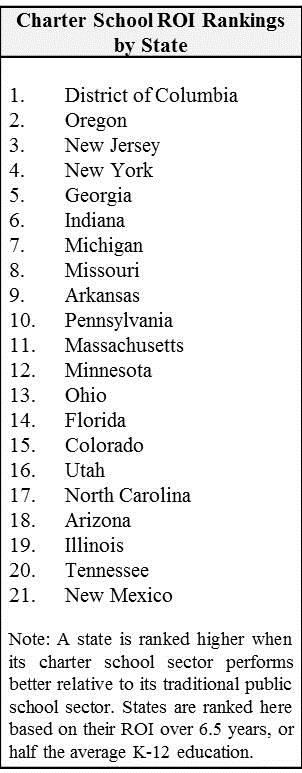
Today my colleagues and I at the School Choice Demonstration Project at the University of Arkansas released The Productivity of Public Charter SchoolsThe report is the first national study of the efficiency of charter schools relative to traditional public schools, and to tie funding to student achievement.  Across all 28 states in our study we found that public charter school sectors were more cost effective and/or generated a higher return on investment (ROI) than traditional public schools.  Public charter schools are like the Oakland A’s of public education — and last time I checked, the A’s had the best record in baseball.

Let’s start with cost effectiveness, or the amount of output generated per unit of input.   The charter school sectors in 21 states and D.C. all produce higher math and reading scores on the National Assessment of Educational Progress (NAEP) per $1,000 of per-pupil revenue than do the traditional public schools sectors in their respective states.  On average across our national sample, charters put up 17 more NAEP points in math and 16 more points in reading for every Cleveland they receive, which amounts to charters being 40 percent more cost effective in math and 41 percent more cost effective in reading.

pat post 1

What really matters, though, is how learning translates into future economic rewards for the student and society, commonly measured as ROI.  The charter sectors in 20 states and D.C. all outperform traditional public schools.  The weighted average ROI advantage from charter schooling across the national sample is almost 3 percent for a single year in a charter school and 19 percent if students spend half of their K-12 education in a charter.

Skeptics might say, “Charters gain their efficiency advantage by disproportionately admitting advantaged students.”  The data show this is not so.  A majority of the states in our sample have charter sectors that enroll a higher percentage of low-income students than their traditional public schools peers.  Although most of the charter sectors trail traditional public schools regarding the notoriously unreliable measure of special education enrollments, that gap is so small (3 percentage points) that it can’t plausibly explain the greater productivity of charters.  We used carefully matched samples of charter and traditional public school students from Stanford’s CREDO National Charter School Study to ensure that differences in student characteristics were unbiased.

pat post 2

Then what is behind the Money-Ed success of public charter schools?  Mathematically, the answer is simple.  Charters nationally are producing student achievement gains that are very similar to the levels in traditional public schools but receive about 30 percent less money per pupil.  Similar results at a lower cost explain the advantage for charters.  We can’t say for sure that charters would retain their productivity advantage over traditional public schools if they were funded on par with district-run schools, but it sure would be interesting to see what happens under something close to funding equity.  Instead of the Oakland A’s of the 2000s, playing competitively with 30 percent less payroll, equitably-funded charters might be the A’s of 2014, who look like world champions.


Common Core Political Naivete and the Enemies List

July 2, 2014

The entire Common Core enterprise has been characterized by shocking political naivete and over-reach.  Despite investing a fortune in political operatives and holding weekly conference calls “directed by Stefanie Sanford, who was in charge of policy and advocacy at the Gates Foundation,” the folks pushing Common Core did not anticipate that the Unions would betray them and oppose the implementation of Common Core as soon as it suited their purposes.  They did not anticipate that there was no authentic constituency for the proper implementation of the new standards and aligned high stakes tests.  They did not anticipate that the combined forces of the Unions and conservative opponents of centralized control would overwhelm the largely paid mercenaries they had on their side.  For people who imagine themselves politically sophisticated they look like a pack of amateurs.

And as the Common Core effort crumbles, its supporters are not just failing, but losing ground on previous accomplishments.   If you liked accountability testing, Common Core has done more to set back your efforts than Randi Weingarten ever could have done on her own.  As Rick Hanushek points out in the Wall Street Journal, the Unions are using Common Core not only to block new tests, but to eliminate high stakes testing altogether.  Several states will soon have no high stakes testing while they adopt a moratorium on stakes in their supposed transition to new tests.  The Gates Foundation has backed a two year delay in the hopes of rescuing their effort from collapse.  Like a retreating army suggesting a cease fire, they will find their opponents have little reason to keep the delay temporary.

In the hopes of achieving a total victory (changing standards and testing everywhere), the Common Core folks are going to end up with weaker testing and standards in many places.  As I suggested in my post on the Paradoxical Logic of Ed Reform Politics, seeking total victory often produces stunning defeat.

The other unintended side-effect of Common Core crumbling is that it is producing abusive efforts by its supporters to rescue it.  The whole enterprise depended on putting it into place quickly so that anyone who opposed the fait accompli could be dismissed as a kook or extremist.  The standards were adopted rapidly, but implementation of the high stakes tests has taken long enough for strong opposition to materialize.  Common Core may have captured Nijmegen, but the Arnhem of high stakes testing has proved a bridge too far.

This has not stopped the attempt to characterize opponents as kooks and extremists.  To be fair, some opponents are kooks and extremists, but many are not and Common Core supporters have had a bad habit of avoiding substantive debate by trying to dismiss their opponents as crazy.  There is something vaguely authoritarian about trying to centralize all education standards and testing, so not surprisingly Common Core supporters have also resorted to authoritarian tactics.  Taking a page from Tricky Dick, they have begun to use the power of the government to identify and punish opponents.

No, I’m not just talking about the threat that NCLB waivers and RTTP money would be more available to those who played ball with Common Core.  I’m talking about going after individuals who dissent.  Check out this story about  Brad McQueen, a teacher in Arizona, who published an op-ed against Common Core.

The state’s Associate Superintendent, Kathy Hrabluk, alerted her subordinates to this teacher’s dissent and asked them to “check your list of teacher teams (from which teachers are selected to work on tests at the Dept of Education)” so that he would not be involved in future teacher workgroups on state tests and other matters.  McQueen had been on those workgroups for the previous five years for which he received extra compensation.  No more.  As the Deputy Associate Superintendent for Assessments, Irene Hunting, replied to her boss, “We have made a note in his record.”  Another state official replied, “This was such a surprise for Arizona as Brad has been on many committees…  Let’s make sure he is not going to Denver later this month [to work on the new tests]. Please remove Brad McQueen from the list.”

Another Arizona education official, displaying all of the political sophistication of the Common Core movement, then replied on her government email, saying: “What a f*cktard.”

State education officials, doing their best to be the Common Core equivalent of the White House Plumbers, then proceeded to work on identifying one of McQueen’s fellow teachers to lend his or her name to a rebuttal op-ed that they would ghost write.  The bureaucrat in charge of PARCC for Arizona also called McQueen in his classroom to challenge him on why he opposed her test and quiz him about whether he was teaching the required standards.  McQueen feared they were fishing for grounds to terminate him and got off the call feeling like he has been threatened by a senior state official.

It’s an ugly story.  But this is what happens when you flirt with authoritarian reforms of education.  You start acting like an authoritarian.

(updated as described in comments)


It’s a Rookie Mistake

July 1, 2014

NCTQ has another report out ranking ed schools on whether they meet NCTQ’s ideas of what makes ed schools effective.  As I pointed out last year, NCTQ purports to have a strong research basis for claiming that ed schools should adhere to their standards, but that research is actually quite thin and often doesn’t support what NCTQ advocates.  I share NCTQ’s concern about improving the quality of teacher preparation, but I do not share their confidence that we know what works and certainly do not share their willingness to impose their preferences on everyone.  Unfortunately, we do not know the correct recipe for making better teachers even as NCTQ tries to make everyone cook the way they prefer.

Part of the advocacy campaign for NCTQ’s efforts is to lambaste ed schools for the fact that 1st year teachers tend to be less effective in the classroom as measured by valued-added on test scores.  According to the NCTQ narrative, if teachers do worse in their first year or two in the profession, it must be that ed schools are doing a lousy job of preparing them.  If ed schools were doing it correctly, there would be no negative effect for first year teaching.

In last year’s report NCTQ described how the shortcomings of novice teachers motivated their ranking system:

Should first-year teaching be the equivalent of fraternity hazing, an inevitable rite of passage? Is there no substitute for “on-the-job” training of novice teachers? The answers are obvious. We need more effective teacher preparation. Our profound belief that new teachers and our children deserve better from America’s preparation programs is the touchstone of this project.

And in pimping this year’s report, NCTQ’s tweeter feed repeats this same message: “If training & cert are mandatory, should be no reason to accept 1st yr as hazing ritual”  and “Novice struggle = struggle. Every year matters!”

This, of course, is a faulty argument.  Even when professionals are well-prepared, they may still improve with experience.  It is so widely recognized as a normal phenomenon that we even have a saying for people who are less good when they start — we say that they make “rookie mistakes.”  No one blames the minor leagues for the fact that big league rookies tend to be less effective.  No one denounces the Cavaliers for the fact that LeBron James got better with experience after moving to Miami.  It is normal for people to improve with experience, not necessarily evidence of their poor preparation.

But some see rookie mistakes as unacceptable in education because the stakes are too high.  Deborah Loewenberg Ball, the Dean of the Ed School at Michigan opines, with approving retweets from NCTQ, that: “Airline pilots don’t say, ‘My first few years of flying I was a wreck.’  That needs to be gone.”  We would never tolerate rookie mistakes among important professions, like airplane pilot or doctor.

In fact, we do tolerate rookie mistakes among doctors, pilots, and just about every profession.  A review of airline accidents reports that “inexperienced pilots have a 2-3 times increased incidence of mishaps due to pilot error.”  And this study of doctor errors in writing prescriptions found: “The overall detected error rate was 3.13 errors for each 1000 orders written…. First-year postgraduate residents were found to have a higher error rate (4.25 per 1000 orders) than other prescriber classes.”  In almost every profession there are returns on experience.  The striking thing about teaching is not that novice teachers are less effective, but that the improvement with experience is so small and basically flattens out by the third year.

All of us wish that doctors, pilots, teachers and other professionals would make no mistakes.  And we hope that improved training would reduce those errors.  But no matter how much NCTQ waves around the Flexner Report to justify its activities, teaching is not medicine and in teaching we do not have a scientific basis for saying how every teacher should be prepared.  NCTQ is not helped in its attempt to be the Flexner of education by mis-describing what research exists and by making sloppy errors of logic like claiming that the relative weakness of novice teachers is proof of poor teacher preparation.

These are the sorts of errors that people may be more likely to make without doctoral training and academic experience in the social sciences, which most of the staff at NCTQ and most other DC think tank/advocacy groups are lacking.  You might even call these rookie mistakes by novice researchers.


The Sweet Agony of Victory

June 30, 2014

(Guest Post by Matthew Ladner)

This has to be one of the most priceless photographs of all time- Faye Dunaway post Oscar victory, 1977. It will have to supplement

BOOOOOOOOOOOOOOOM!

from now on.  Go score some victories so I can post Faye again soon.


Additional Thoughts on Vergara Decision

June 12, 2014

I don’t want to throw cold water on the excitement many folks have expressed abut the ruling in Vergara v. California ending teacher tenure protections, but I do think it is important to cool some of the heated enthusiasm.  Matt was appropriately cautious, noting that the decision will certainly be appealed and will take years to play out, but not everyone has been so measured.

I see the decision as more important as a symbol of the political challenges facing unions than as a change in policy that will significantly advance student achievement.  I’m skeptical of the educational impact of the ruling because:

1) It may well be reversed on appeal.  I’m also no lawyer, but I’m enough of a political analyst to see that the Courts are reluctant to make major policy changes without broad support from elites.  As Matt notes, the Courts tend to be lagging indicators of elite opinion, not cutting edge agents of change.  And this is as it should be.  We shouldn’t want unelected judges making too many big policy decisions without enough support from the democratically elected branches to ensure that the decisions can stand and be implemented.  It is an impressive sign of the fading political influence of teacher unions and the intellectual incoherence of some of their central policy positions that a judge was willing to strike down teacher tenure.  But I don’t think there is broad enough support for higher courts to stick with this policy stand.  They’ll find a way to walk back from the ledge.

2) Even if laws protecting tenure are struck down, it is unclear how broadly it will really be used to remove ineffective teachers.  There is a good amount of evidence that principals can distinguish between effective and ineffective teachers, but there isn’t a lot of evidence that principals will exercise that judgment very often even when they are empowered to do so.  Brian Jacob examined a program in Chicago that made it very easy for principals to dismiss teachers.  The good news is that when they dismissed teachers those teachers tended to be much less effective (as measured by VAM).  The bad news is that they rarely used their power to get rid of teachers.  Jacob wrote:

this analysis reveals that many principals – including those in some of the worst performing schools in the district – did not dismiss any teachers despite how easy it was under the new policy. This result is consistent with the fact that existing teacher contracts in many large urban school districts actually provide considerably more flexibility than is commonly believed and yet administrators rarely take advantage of such flexibility (Ballou 2000, Hess and Loup 2008, Price 2009). The apparent reluctance of many Chicago principals to utilize the additional flexibility granted under the new contract may indicate that issues such as teacher supply and/or social norms governing employment relations are more important factors than policymakers have realized.

To change those norms we need to address the motivation of principals to dismiss ineffective teachers even when they are empowered to do that.  Of course, when schools have to attract students and revenue in competitive systems, principals are more active in replacing teachers they deem ineffective.  Choice really does matter for other reforms to work well.

————————————————————-

My former student and soon to be a professor of education, James Shuls, sent me his thoughts on Vergara.  Here is what he sent:


Back in April, I posted a series of quotes from Marcellus McRae’s closing argument in Vergara v. California to Jay Blog. Yesterday, the court handed down its decision and it appears that McRae was right, “You can’t make sense out of nonsense.”

Today, I have a piece on the Daily Caller summarizing the ruling and highlighting my take-a-way from the case.

On its face, this was a legal case that considered whether teacher tenure and other job protections violated California’s state constitution. At a more fundamental level, however, this was an evaluation of policies lauded by teachers unions throughout the country – teacher tenure, due process, and last-in, first-out provisions. For these policies to be found unconstitutional they first had to be proven to have an adverse effect on disadvantaged students; and indeed, they were.

I go on to say:

Legally, there are still many questions to be resolved. In the court of public opinion, however, the ruling could not be clearer: Teacher tenure has been tried and it has been found wanting. You simply cannot make sense out of nonsense.

I invite you to check out the full piece here.

——————————

James Shuls is the Director of Education Policy at the Show-Me Institute. Follow on Twitter @shulsie