Some of my current and former students, along with a colleague from the Economics department, have a new article in Education Economics called Risky business: an analysis of teacher risk preferences. Daniel H. Bowen, Stuart Buck, Cary Deck, Jonathan N. Mills & James V. Shuls used techniques from experimental economics to measure the risk aversion of graduate students seeking degrees in education, business, and law. They found that people training to become teachers are significantly more risk-averse than those seeking careers in business or law.
The greater risk-aversion among prospective teachers was a function of two forces. First, women make up a much larger proportion of prospective teachers and women tend to be more risk-averse across all graduate students. Second, the smaller group of men seeking to become teachers are significantly more risk-averse than men pursuing other professions.
This article captures the first part of Dan Bowen’s dissertation. Dan followed-up this experiment by using the same technique to measure whether teachers drawn to schools after merit pay plans are adopted tend to be more risk-prone than the teachers previously working at those schools. He found that they were — merit pay attracts more risk-prone teachers. He then linked these measures of risk-aversion to test score growth achieved by the students of each teacher. Somewhat unexpectedly, he found that the more risk-prone teachers attracted by merit pay tended to be less effective in producing student test score gains.
Dan’s dissertation raises important questions about the composition of the teaching workforce and what is likely to be effective in motivating them. In general, his work casts doubt on the appeal of merit pay given that generally risk-averse teachers are not attracted by merit pay and risk-prone teachers who are attracted by potential bonuses may not do well in a workplace where non-monetary goals appear more prominent. This work is consistent with an earlier article that Stuart Buck and I published on how merit pay is not a promising reform strategy.
Dan is currently a post-doc at Rice University and is on the job market. In addition, to his work on teacher risk-aversion and merit pay, Dan and I have collaborated on research on the effects of field trips to art museums and the effects of sports programs on student achievement. At Rice Dan is continuing to work on merit pay evaluations and is assembling a study of the effects of student field trips to a Holocaust Museum. Dan has a variety of rigorous and innovative studies that are generating grant support. He would make for an excellent hire.
I’ve never played Minecraft. My son and daughter play enough for the three of us, though, and I haven’t even bought the computer version of the game for them. I bought the iPad edition, which, I’m constantly reminded, is completely inferior to the computer version.
Despite most parents’ ignorance of how to play it, and in spite of graphics that look better suited to a first-generation Atari console, Markus Persson sold Minecraft and its parent company to Microsoft for $2.5 billion last month. And then he walked away.
Persson told the New York Times, “I don’t want to be a symbol, responsible for something huge that I don’t understand, that I don’t want to work on, that keeps coming back to me. I’m not an entrepreneur. I’m not a C.E.O. I’m a nerdy computer programmer who likes to have opinions on Twitter.”
Persson created a video game that doesn’t rely on eye-popping graphics or bloody combat scenarios. Yes, in survival mode you can fight zombies, and there are “mobs” to avoid (loosely defined as anything that can harm your character). However, the game revolves around the player’s imagination. In Minecraft, you create your own world, complete with buildings of any shape and size and then go on adventures, with or without players from other worlds.
What are most impressive are the add-ons that make the game interesting. Your creations can be as real or fictitious as you choose. In one YouTube how-to video, a player created a Home Depot, complete with supplies to build things. In another, a player created a replica of Disneyworld. You can change the weather, add minions from Despicable Me, drive a dirt bike, or swim in the ocean.
Schools are using the game to teach subjects like math, architecture and science. Minecraft is simple, versatile, fun (or so I’m told), and the creator shows no intention of making a sequel.
“Basically, Persson is tired,” says Wired magazine. Persson says that he wants to work on smaller web projects, and he says that if any of them become as popular as Minecraft, “I’ll probably abandon it immediately.”
Minecraft can be as unique and player-centric as a player can make it, and its creator is just fine to leave it at that and do something else. Yes, $2.5 billion is plenty to be content with, but the Copeland award doesn’t penalize for making a lot of money. Time will tell if Persson is true to his word about leaving well enough alone, but for now, he’s created something that allows others to use their imaginations the way they want to, made his money, and gone on his way.
Americans prize personal space. And nowhere are infringements upon personal space more insufferable than 30,000 feet above Earth, in an airplane in which the confines of your chair – and heaven forbid if you’re in a middle seat – and your armrests, and the miniscule amount of “legroom” in front of you, are the only things that separate you from your neighbor and his delusions of airline Manifest Destiny.
Until recently. In 2003, Mr. Ira Goldman recognized this injustice, and invented the Knee Defender.
The concept is simple. You simply slide the Knee Defender, which fits in the palm of your hand, onto the arm of your lowered tray table, then slide it down the arm of the tray table until it fits flush against the seat in front of you. As one website selling the Knee Defender explains:
“Whether you are intent on protecting yourself from being crunched, want to maintain enough leg room to do some in-seat exercises because of health concerns – such as Deep Vein Thrombosis (DVT), sometimes called “economy class syndrome” – or you just want some warning so you can move your notebook computer out of the way before the seat is reclined, Knee Defender™ works ‘like a charm’.”
The product even comes with a Knee Defender courtesy card, which the user can hand to the passenger in front of him to let him know he’s using the leg-saving tool. “If you would like to recline your seat at some point during the flight, please let me know and I will try to adjust myself and my Knee Defender so that it can be done safely,” the card reads.
Had Ben Franklin lived during the time of aviation and been able to fly to Paris, he would have surely invented the knee defender.
This humble piece of plastic has been the cause of derision from opponents and cheers from proponents. “The person who wants it most will end up owning the rights, but the person with the recliner button holds an advantage. The Knee Defender reallocates the rights. Now I can claim the four inches in front of my face,” wrote Damon Darlin recently in the New York Times.
Indeed. Is there nothing more callous than a passenger who chooses, without any regard to the poor soul behind him, to recline his seat, without the slightest regard as to what pain and inconvenience he might be bringing upon his fellow traveler? Is nothing – kneecaps, lap tops, small vodka tonics – sacred? For the person bent on reclining – because a modest change in the angle of his spine is more important than every aspect of the flying experience for the person behind him – nothing is.
And for us lowly folks who ride coach to spread the word about education reform – Mr. Goldman, we salute you. Indeed, it’s the little things in life that make the biggest differences.
Like Al Copeland, Ira Goldman surely invented the knee defender out of his own 6 foot 3 inch necessity. But in so doing, has made the flying experience that much more comfortable for thousands of long-legged travelers.
Our study of what students learn from seeing live theater is now available at Education Next.
We randomly assigned school groups to see live performances of Hamlet and A Christmas Carol. We found large increases in knowledge about the plots and vocabulary of those plays — much larger than students experienced from being assigned to read or watch movie versions of those works. We also observed increases in tolerance and the ability to read the emotions of others among students assigned by lottery to see the plays.
Here is a snippet from the article:
If teachers want students to learn plays, it is much better for them to take students to a live theater performance than to have them read the material or watch a movie. Plays are taught best by seeing them performed live.
and the conclusion:
Culturally enriching field trips matter. They produce significant benefits for students on a variety of educational outcomes that schools and communities care about. This experiment on the effects of field trips to see live theater demonstrates that seeing plays is an effective way to teach academic content; increases student tolerance by providing exposure to a broader, more diverse world; and improves the ability of students to recognize what other people are thinking or feeling. These are significant benefits for students on specific educational outcomes that schools pursue and communities respect. Especially when considered alongside our previous experiment on field trips to art museums, this research shows that schools can draw upon the cultural institutions in their communities to assist in producing important educational outcomes. Not all learning occurs most effectively within the walls of a school building. Going on enriching field trips to cultural institutions makes effective use of all of a community’s resources for teaching children.
Finally, this research helps demonstrate that schools produce important educational outcomes other than those captured by math and reading test scores, and that it is possible for researchers to collect measures of those other outcomes. If what’s measured is what matters, then we need to measure more outcomes to expand the definition of what matters in education.
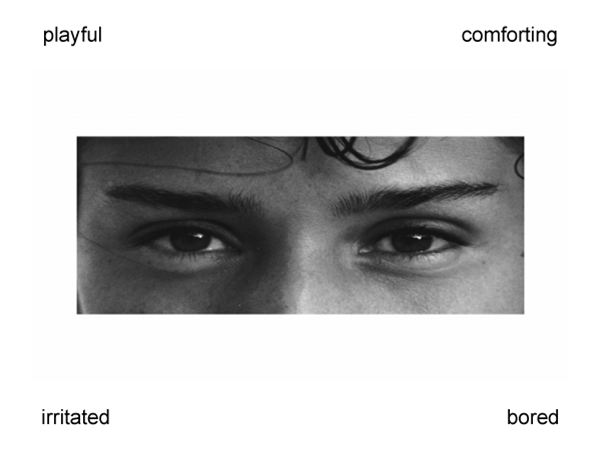
Tomorrow Education Next will be publishing our new random-assignment experiment on what students learn from seeing live theater. One outcome we examined is whether students assigned by lottery to seeing live performances of Hamlet or A Christmas Carol developed a stronger ability to read the emotions of others.
To test this we used the adolescent version of the Reading the Mind in the Eyes Test (RMET), which was developed by British psychologist, Simon Baron-Cohen, and his colleagues. RMET consists of photos, like the one pictured above, cropped so that just a person’s eyes are showing. Subjects are then asked to choose from a set of four possible answers to identify what the pictured person is thinking or feeling. Baron-Cohen (who is actually Sacha’s cousin) originally developed this measure to study people with autism, who tend to have a harder time reading the emotions of others. More recently research published in the journal, Science, found that people who were assigned by lottery to read literary fiction performed better on the RMET. Literature appears to strengthen our Theory of Mind, as it is called. Theory of Mind is an incredibly important social skill (as any parent of someone with autism could tell you), and is an important precursor to other useful outcomes, like empathy and effective use of language.
We suspected that seeing live theater might have an effect on RMET similar to reading literature. We also looked at whether seeing live theater altered student tolerance as well as improved their knowledge of plots and vocabulary more than if they read or watched movies of works. And we looked at whether seeing live theater altered student desire to attend or participate in theater in the future.
Along with Collin Hitt, Anne Kraybill, and Cari Bogulski, I have a new study coming out Wednesday in Education Next on what students learn from seeing live theater. We randomly assigned school groups to receive free tickets to see performances of Hamlet or A Christmas Carol at TheatreSquared, an award-winning professional theater. We then collected measures on a variety of outcomes from students several weeks later in their classrooms.
We also compare what students learn from seeing live theater to what they learn from being assigned to read or watch movies of those same works. Do students learn the same things from reading or watching a movie of Hamlet that they get out of seeing it performed live?
This is the first randomized experiment of what students learn from seeing live theater, so check it out when it is released on Wednesday.
Advertising is the bogeyman of the Left. It makes you desire things you never wanted. It confuses wants and needs. It brainwashes you to make you believe things that you otherwise would not. In short, advertising, in this view, turns you into a slave. By hijacking your preferences, advertising turns you into the instrument of other people’s interests.
But this negative view of advertising is mistaken in two ways. First, it denies that you are ultimately responsible for your own thoughts and actions. No advertising can convince you to believe or do something unless you choose to believe or do that. You are free to ignore or disbelieve advertising, so advertising can never turn you into a slave.
Second, all communication — whether it is called advertising or not — is attempting to convince you to believe or do something. Even warning you that advertising is trying to brainwash you is itself an effort to convince you of something. How is that message any more pure than dirty advertising? In fact, what would innocent, non-coercive communication look like? Even art is a form of communication that is attempting to convince its audience of something. So if advertising is evil I have no idea what good would be.
I love advertising. I love it because it is a form of communication that is more self-conscious of its efforts to convince others and therefore tends to be more accountable for its success or failure in doing so. That accountability tends to make it more engaging, meaningful, and beautiful. If advertising isn’t these things, it fails in its effort to be persuasive.
Let’s take for example the McDonalds ad at the top of this post. That ad manages to tell an entire story in just 30 seconds. And it’s a really good story. It captures the anxiety of a first kiss as beautifully as the Odyssey captures the longing to return home. The moment when the boy realizes that her request for “no onions” on the burger means that she wants him to kiss her is as universal and essential to the human experience as anything I have seen in a museum.
Yes, I understand that McDonalds is just trying to get me to buy its products. Everyone understands that. But they are also providing me with useful information. They are telling me that McDonalds is a cheap and easy place to stop on a date in case you are hungry. And most importantly, they are telling me that McDonalds will make my burger to order so that I can enjoy their product and still kiss without onion-breath. So, the ad provides me with useful information. But because it seeks to be persuasive, the ad is also compelling in its story-telling, engages its audience in a meaningful way, and is beautiful to watch.
Because I think advertising is wrongly disparaged, I am nominating Thomas J. Barratt for the Al Copeland Award. Barratt is known as the father of modern advertising. He married into the A&F Pears’ soap company in 1865. As Wikipedia describes it:
Under his leadership the company instituted a systematic method of advertising its distinctive soap, in which slogans and memorable images were combined. His slogan “Good morning. Have you used Pears’ soap?” was famous in its day. It continued to be a well known catch phrase well into the twentieth century.
Barratt was keen to equate Pears with quality and high culture through his campaign methods. He acquired works of art to use in the advertisements, most famously John Everett Millais’ painting Bubbles, which he turned into an advertisement by adding a bar of Pears soap in the foreground. Millais was said to be unhappy about the alteration, but could do nothing since Barratt had acquired the copyright. Barratt followed this with a series of adverts inspired by Millais’ painting, portraying cute children in idealised middle-class homes, associating Pears with social aspiration and domestic comfort….
Barratt was not a systematic theorist of marketing, but introduced a number of ideas that were widely circulated. He was keen to define a strong brand image for Pears while also emphasising his products ubiquity with saturation campaigns. He was also aware of the need for constant reinvention, stating in 1907 that “tastes change, fashions change and the advertiser has to change with them. An idea that was effective a generation ago would fall flat, stale, and unprofitable if presented to the public today. Not that the idea of today is always better than the older idea, but it is different – it hits the present taste.”
Barratt was not only a genius and innovator because he was the first to develop advertising practices that are common today, but because he recognized the connection between art and advertising. They are both engaging, meaningful, and beautiful forms of communication. Both are trying to convince you to believe or do something. And one does not sully the other. If Andy Warhol can turn a can of soup into art, I can’t see why Barratt couldn’t turn a work of art, like the painting “Bubbles“, into an advertisement. Unlike Warhol, Barratt actually owned the rights for the image he used.
So, whenever you hear someone rant about the evils of advertising, just think about how much free entertainment, useful information, and beautiful images you get to experience from advertising. Think about how much the human condition is improved by plentiful and free advertising that everyone gets to enjoy. And rest assured that advertising is no more an effort to brainwash you than an Andy Warhol painting or the blowhard ranting about advertising.
I know Al Copeland recognized the art of advertising. That’s why he had New Orleans jazz/blues legend Dr. John sing in his early commercials. And that’s why Thomas J. Barratt is worthy of The Al.
Al Copeland may not have done the most to benefit humanity, but he certainly did more than many people who receive such awards. Chicago gave Bill Ayers their Citizen of the Year award in 1997. And the Nobel Peace Prize has too often gone to a motley crew including unrepentant terrorist, Yassir Arafat, and fictional autobiography writer, Rigoberta Menchu. Local humanitarian awards tend to go to hack politicians or community activists. From all these award recipients you might think that a humanitarian was someone who stopped throwing bombs… or who you hoped would picket, tax, regulate, or imprison someone else.
Al Copeland never threatened to bomb, picket, tax, regulate, or imprison anyone. By that standard alone he would be much more of a humanitarian. But Al Copeland did even more — he gave us spicy chicken.
Like Al Copeland, Weird Al may not have changed the world, but he has certainly improved the human condition. He’s done so by making us laugh at the the absurdity of many who think highly of themselves.
In 2011 “The Al” went to Earle Haas, the inventor of the modern tampon. Thanks to Anna for nominating him and recognizing that advances in equal opportunity for women had as much or more to do with entrepreneurs than government mandates. Haas beat his fellow nominees: Charles Montesquieu, the political philosopher, David Einhorn, the short-seller, and Steve Wynn, the casino mogul.
The 2010 winner of “The Al” was Wim Nottroth, the man who resisted Rotterdam police efforts to destroy a mural that read “Thou Shall Not Kill” following the murder of Theo van Gogh by an Islamic extremist. He beat out The Most Interesting Man in the World, the fictional spokesman for Dos Equis and model of masculine virtue, Stan Honey, the inventor of the yellow first down line in TV football broadcasts, Herbert Dow, the founder of Dow Chemical and subverter of a German chemicals cartel, and Marion Donovan and Victor Mills, the developers of the disposable diaper.
Nominations can be submitted by emailing a draft of a blog post advocating for your nominee. If I like it, I will post it with your name attached. Remember that the basic criteria is that we are looking for someone who significantly improved the human condition even if they made a profit in doing so. Helping yourself does not nullify helping others. And, like Al Copeland, nominees need not be perfect or widely recognized people.
I attended a debate last night between gubernatorial candidates Doug Ducey (R) and Fred Duval (D) on K-12 policy. Unfortunately what would have otherwise been a civil exchange of ideas between two candidates who pass the “would like to have a beer with” test was marred by protesters in the audience who attempted to hijack the event by screaming invective on entirely unrelated matters from the audience.
It seems almost unnecessary to say that the protesters were uniformly on the far left. I’m 47 years old, have seen this happen several times, and have yet to see a right of center group behave in such an anti-democratic fashion. I’m not saying it has never happened, just that I have never once seen it happen.
The person who should be most upset by this is Fred Duval. Duval is obviously a decent guy and I would put the odds that he had anything to do with this squarely at zero. Nevertheless, when a group of people shouting random hostility at his opponent act like a group of brown-shirt fascists, it’s nothing but bad. This was Duval’s best chance to make his points with the public on the subject that he has emphasized more than any other, and that chance was essentially lost. Ducey handled the situation well, receiving a thunderous round of applause in elegantly rebuking the protestors. Game, set match Ducey.
Attempting to shout down opponents is contemptible and against the most basic tenets of democracy. I would say exactly the same thing if a group of conservatives disrupted a debate by attempting to shout down the Mr. Duval. Notice the muted reaction of the Arizona Republic. If a group of Russell Pearce supporters had shown up in force to scream at Fred Duval I hate to say that I strongly suspect that it would have been a top of the fold front page story rather than a buried note in page three. Seeing this unfold made me wonder if the era of public debates might not be drawing to a close. It is much easier to keep things under control in a studio. The only other alternative is to hire a ton of security, which raises the cost of public events considerably. Either way, we will have fewer civil and public exchanges so long as a vocal minority of Americans lack a basic commitment to civility.
If so, illiberal forces will have stolen something from us. I took my sons aged 14 and almost 13 to the debate last night, and I wonder how many more such events they will have the opportunity to attend. The soft bigotry of low expectations seems very much at work here. We’ve grown to expect some left-wing groups to behave like fascists. We should have much higher expectations.
The misguided people engaging in brown-shirt tactics should remember an old slogan of the left- the whole world is watching. You may have deluded yourself with some complex rationalization justifying attempting to shout down opponents, but don’t expect decent people of either the left or right to believe it.


 Posted by Jay P. Greene


 Jay P. Greene's Blog
