Russ Whitehurst Throws Cold Water on the Grit Craze, But Is the Water Too Cold?

June 11, 2016

Russ Whitehurst, one of the most cool-headed education researchers, throws cold water on the grit craze seizing some quarters of the ed reform world.  As I warned in my recent review of the Angela Duckworth and Paul Tough books, “This new attention to character skills has many of the markings of previous failed fads…. In short, school and educator practice with respect to character skills is running far ahead of knowledge.” I wanted to cool grit fever, but in his recent piece Russ throws icy cold water on it.  He raises excellent points but I wonder if Russ is too cold on the importance of character skills.

Russ makes three arguments: 1) A recent study that compared grit scores among fraternal and identical twins suggests that grit may be heritable to a large degree, which would make it unrealistic to expect schools or others to be able to alter it; 2) The twin study as well as a meta-analysis of grit research found that grit only explains about 2-3% of the variance in achievement scores, which Russ thinks makes it a poor predictor of other outcomes; and 3) The meta-analysis suggests that grit may be highly correlated with conscientiousness, one of the Big 5 personality traits that psychologists have been studying for a long time.

I think Russ is most persuasive on the last point.  Grit may be more of an effective marketing brand than a new contribution to the field.  But whether it is really distinct from conscientiousness or not, this does not establish whether grit and other character skills are important for education reform.

Russ is much less persuasive with his second argument.  The fact that grit or other character skills may not be strongly predictive of achievement test results is not surprising if these non-cog measures capture something that is important independently of cognitive ability.  That is, the true test of the predictive power of “noncog” measures is not whether they are correlated with cognitive measures (like achievement scores), but whether they are correlated with later life outcomes.  As it turns out out, they are.  As this recent piece in Economics of Education Review by Collin Hitt, Julie Trivitt, and Albert Cheng shows, their character skill measure collected in middle or early high school is predictive of later educational attainment, employment, and earnings in 5 different longitudinal panel data sets, even after cognitive ability and other factors are controlled.

Russ’ first argument is the most important for educational reform.  If grit or other character skills are not malleable, then why bother devoting a lot of energy to trying to address them in schools?  Russ is correct to point out that about 37% of the perseverance component of grit is heritable, but that does not establish that educational policy and practice are unable to alter the non-heritable factors that form grit and other character skills.

There is a growing body of evidence that suggests character skills are malleable and that education plays an important role in shaping and altering character.  Albert Cheng and Gema Zamarro have a new study that shows students randomly assigned to teachers who possess stronger character skills experience an increase in their own character skills.  And Albert Cheng has another study using a student fixed-effect research design that has the same finding.  This would not be possible if character skills were not malleable.

In addition we have an entire literature on pre-school and school choice suggesting that educational interventions can produce long-term success without improving short term achievement test scores (and vice versa).  It’s not well-understood exactly how these benefits are being produced, but a reasonable explanation is that early childhood and effective school choice programs may improve character skills without also increasing test scores.  And in the long-run the improvement in character skills may be more important for success.

Russ Whitehurst is right to warn us about the irrational exuberance some have about grit, but he shouldn’t throw out the baby with ice cold bath water.  There seems to be something very important about character skills in education even if we do not fully understand how to define, measure, or alter them.

(edited for typos)


Fordham’s Economics Malfunction

June 9, 2016

68773636

(Guest Post by Jason Bedrick)

Yesterday, Checker Finn and Brandon Wright of the Fordham Institute published an essay highlighting three “market malfunctions” in the charter school sector. What they highlighted instead were primarily government malfunctions.

The first “market” malfunction they identify is the apparent lack of congruence between supply and demand:

As rapidly as it’s grown (6,800+ schools at last count), the supply of charters has not keep up with demand in most places. (Estimates of the total waiting list go as high as a million kids.) All sorts of political, budgetary, and statutory obstacles have limited the number, size, and locations of charter schools.

Political, budgetary, and statutory obstacles… these are market malfunctions?

Skipping number two for a moment, their third supposed “market” malfunction is the problem of what they call “distracted suppliers”:

Many charters are strapped for funds. They feel overregulated by their states, heckled by their authorizers, and politically stressed, so the people running them often struggle to keep their heads above water (which includes keeping enrollments up). They have little energy or resources to expend on becoming more rigorous or investing in stronger curricula and more experienced instructors.

Strapped for funds when the law prevents them from charging their customers anything. Overregulated by their states. Politically stressed.

Again, my Fordham friends, these are market malfunctions?

Their second concern is the closest they come to identifying a market malfunction: weak consumer information.

Even where parents are mindful of school quality and try their best to be discerning, consumer information in this marketplace remains incomplete, hard to access, and difficult to understand. State report cards are ubiquitous yet lacking. Even when they adequately display academic achievement in tested subjects, they cannot begin to convey all the other information that goes into a sound school choice. What, for example, does the school truly value? Are its classrooms quiet and orderly or lively and engaged? How does it handle character development? Discipline? Disabilities? Do students and teachers like it there or flee as soon as possible? The list goes on.

Yes, the market (as well as the government) has failed thus far to provide bountiful, accessible, and high-quality information about most schools. I’ve explained how the market could accomplish this (e.g., a combination of private certification, expert reviews, and consumer reviews) and there are some organizations already trying to fill this gap (e.g., GreatSchools), but there’s still much more to do.

Of course, one reason that there are so few third-party organizations providing such information is that the government crowds them out, both by providing their own scorecards (which Finn and Wright find wanting) and by operating a massive system of “free” district schools that crowd out private alternatives.

So again: you call these market malfunctions?


Send in the Nimitz!

June 6, 2016

Most interesting man

(Guest Post by Matthew Ladner)

Every so often you just have to ask yourself “What would TMIMITW do?” Given that TMIMITW is actually from New York, maybe he can be persuaded to run! His substantive political accomplishments already approximately equal and perhaps greatly exceed those of the two nominees combined and let’s face it- who do you want to be stuck with on your television set for the next four years?  In addition, his position of the two party system has been long-established, so he cannot be accused of opportunism:

Christopher Buckley eerily predicted this election back in 2008 and disguised his prophecy as satire. Send in the Nimitz!


Win-Winning in the Oklahoman

June 4, 2016

2016-5-Win-Win-Solution

(Guest post by Greg Forster)

Today the Oklahoman carries my latest op-ed on the research showing school choice is a win-win solution. The op-ed is adapted from my recent OCPA article on school choice myths in Oklahoma. There was no space in the Oklahoman to discuss those Oklahomans who believe that the reason school choice doesn’t work is because poor parents are lazy and shiftless. My focus instead was on claims that choice is “unproven”:

The Oklahoma Education Coalition (OEC), for example, repeats a large number of long-discredited myths about school choice. Here’s one: “Vouchers are unproven as a means of consistently or significantly improving student achievement for all students…. Research on voucher programs in other states shows vouchers have been costly but offers no confidence that vouchers will improve achievement among participating students.”

In case you’re wondering about the terminology, OEC insists for some reason that we must refer to ESAs as “vouchers.” Their arguments are so bankrupt on the merits that their only hope of persuading people to reject ESAs is by changing the label to something they think has negative emotional associations. Fortunately, the word “vouchers” has never really been a liability for the school choice movement.

Attentive readers of JPGB won’t be surprised at what follows. Your comments, as always, are welcome!


Gay Pride in the Middle East

June 3, 2016

Pride_Gay_Parade_2012_No.132_-_Flickr_-_U.S._Embassy_Tel_Aviv

Today more than 200,000 people are marching in support of Gay Pride in Tel Aviv.

Here is how Gay Pride is celebrated in Gaza:

The New York Times describes the Gazan celebrations a few months ago:

Mr. Ishtiwi, 34, was a commander from a storied family of Hamas loyalists who, during the 2014 war with Israel, was responsible for 1,000 fighters and a network of attack tunnels. Last month, his former comrades executed him with three bullets to the chest. Adding a layer of scandal to the story, he was accused of moral turpitude, by which Hamas meant homosexuality.

And earlier this week Israel crowned its first “Miss Trans Israel.”  There is no word yet on when Miss Trans Israel will compete against Miss Trans from other countries in the Middle East.   Here she is:

Israeli Arab Talleen Abu Hanna, 21, poses on stage after she was announced as the first Miss Trans Israel beauty pageant, at HaBima, Israel's national theater in Tel Aviv, Israel, Friday, May 27, 2016. Abu Hanna, an Israeli from a Catholic Arab family has been crowned the winner of the country's first transgender pageant. (AP Photo/Oded Balilty)

Time Magazine profiles the winner:

For those who wish to showcase the relative freedom and tolerance enjoyed by Israel’s LGBT community, Talleen Abu Hanna is an ideal model. Born and raised in Nazareth, the childhood home of Jesus Christ, Abu Hanna is a Catholic Israeli Arab. Like many of Israel’s 1.6 million Arab citizens, she calls herself Palestinian as well. But ask her where she’d rather live, and her response is swift.

“I wouldn’t be alive if I grew up in Palestine,” she says in perfect Hebrew. “Not as a gay man, and definitely not as a transgender woman.”

She recalls how in Thailand, where she completed her gender transition surgery just one year ago, she met many transgender women from Arab countries. Their occasional trips to Thailand — known in the trans community as the best place for transitional surgery –were the only times when these women felt safe to be themselves, wearing makeup and dressing as women. Back home, they told her, they had to disguise themselves as men. “It’s something you need to keep a secret in Arab countries, and even then it’s forbidden,” she says.

Homosexuality is considered a crime in many countries. Iran, Saudi Arabia and Yemen are just a few whose penalties for homosexuality include death and lashings.

While all countries fall short, it’s important to keep in perspective where the rare and delicate flower of liberty is cultivated.  If people forget which countries, on balance, are friends to liberty, no friends of liberty will remain.


Talking School Choice “Win-Win”

June 1, 2016

2016-5-Win-Win-Solution

(Guest post by Greg Forster)

I’m grateful for the attention to the recently released fourth edition of my report A Win-Win Solution, reviewing the evidence on school choice programs.

You can now hear a podcast of yours truly discussing the report here.

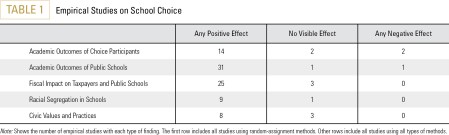
As in past years, the table in the executive summary kind of says it all:

Table 1

If that graphic doesn’t show well on your monitor, here’s the scorecard on what empirical studies have found for school choice programs:

  • Academic Outcomes of Choice Participants: 14-2-2
  • Academic Outcomes of Public Schools: 31-1-1
  • Fiscal Impact on Taxpayers and Public Schools: 25-3-0
  • Racial Segregation in Schools: 9-1-0
  • Civic Values and Practices: 8-3-0

Poor Parents Are Lazy and Shiftless

May 29, 2016

image

(Guest post by Greg Forster)

In OCPA’s Perspective I respond to unions and their allies in Oklahoma spreading myths about school choice – that it’s costly, unproven, etc.

My personal favorite is the guy who argues choice is bad because poor parents are lazy and shiftless:

Those children blessed with engaged and motivated parents will take their public tax dollars to whatever education venue they choose. The exodus of privileged children from the public school system, particularly in urban areas, will exacerbate the growing gap between the haves and have-nots, and restore an era of separate and unequal schools which will do irreparable harm to our nation.

Any similarity to racial stereotypes is no doubt purely coincidental.

But remember, the fact that the technocrats spent the last ten years working to build a coalition with these kind of people in no way reduces Peter Meyer’s moral authority to lecture Jay Greene about the evils of racism to distract from his inability to respond to Jay’s argument!


Stacey Childress Misses the Point

May 27, 2016

Stacey Childress, the head of New Schools Venture Fund, whose conference sparked the current row over the Left/Technocratic takeover of the ed reform movement, penned a reply to Robert Pondiscio.  While Stacey deserves credit for the level-headed nature of her response, which stands in stark contrast to much of the reaction Robert has received elsewhere, she unfortunately misses the point of Robert’s piece.  Robert is not questioning the desirability of diversity in the ed reform movement.  To the contrary, he is expressing concern about the development of a new Left/Technocratic orthodoxy in the movement that would, among other things, harm the political prospects of maintaining support from state Republicans who have and will continue to be essential for passing and implementing reform policies.

Stacey denies the charge.  She argues that it promotes rather than hinders diversity to have a panel discussing other important “social movements”:

The purpose of the session was to learn more about movements in general and hear directly from some people who are part of a couple of them…. Yes, the session included Black and Latino leaders working in ed reform (TFA alums and staff) who also are part of current social movements they view as intertwined with urban education issues.

Her reply reveals the problem. Let’s leave aside the fact that neither Robert nor I are concerned solely with that panel.  Frankly, I found Arne Duncan to be the most insufferable speaker at the Summit.  When asked to describe his three greatest failures as Secretary, he listed his failure to convince Republicans to spend more on pre-K, his inability to get Republicans to solve problems for undocumented college students, and the refusal of Republicans to adopt new gun control legislation following Sandy Hook.  Notice that all of his greatest failures were his inability to get Republicans to do the right things.  And notice that none of these are even K-12 issues.  And as a prime example of groupthink, Duncan was being interviewed by his former deputy, Jim Shelton.

And let’s leave aside that neither Robert nor I are concerned solely with New Schools Venture Fund or its conference.  We both argued that the ed reform movement as a whole has taken a dramatic turn.  If Stacey doesn’t think her conference is an example of that, then she can surely find confirmation in the hyperbolic reaction to Robert on social media.  More than 100 people, representing a broad swath of foundation-fueled ed reform organizations, have co-signed an “open letter” rebuking Robert and his essay.  Just a brief review of the Twitter feeds of these co-signers should convince anyone of the accuracy of Robert’s concerns about groupthink, ideological litmus tests, and lack of intellectual diversity in the new ed reform movement.

The main problem with Stacey’s contention that learning “more about movements in general” is beneficial is that it fails to grasp how broad and diverse coalitions are actually maintained.  The way you hold together a coalition of people who agree on some core issues while strongly disagreeing on other issues is by not raising or focusing on the issues on which people do not agree.  It’s like politically diverse families trying to get along at the Thanksgiving dinner table.  It’s best not to bring up or dwell on certain topics if your goal is to maintain family harmony.

Stacey may be right that some members of the broad coalition see a variety of “social justice” issues “as intertwined with urban education issues,” but other, conservative members of that coalition may have their own issues that they see as “intertwined.”  For example, conservatives might want to talk about their concerns about Affirmative Action, abortion, and promoting intact families as issues they see as related to urban education.  Panels on those topics at ed reform conferences would almost certainly hurt the building of a broad and diverse coalition, so those issues rarely come up and are almost never part of ed reform conference planning.

Most conservatives within the ed reform movement have the good sense not to plan panels around these tangential conservative movements.  Evidence for the Left/Technoratic takeover can be found in the fact that Stacey and other ed reform leaders no longer feel any restraint in highlighting tangential “social justice” movements in their conferences, organizational activities, writings, Tweets, and other activities.  They would be right to find efforts to highlight “conservative” tangential issues as a divisive distraction, but they are unable to see how the tangential issues they view as good might produce the same reaction in others.

Let me be clear, that by “tangential” I mean issues on which there is not broad consensus among those we wish to include in the ed reform coalition.  I am not offering any opinion here on whether institutional racism, poverty, police brutality, affirmative action, abortion, and two-parent households are educationally important or not.  My point here is not whether these are valid and related concerns or not, but that they are likely to divide and shrink the ed reform coalition if they are highlighted.

I am also not trying to silence anyone, hinder their free speech, or demand “safe spaces” in which people do not have to confront issues.  People should feel free to talk about whatever they want and organize conferences in any way they think best.  But people have to understand that if they choose to focus on certain issues, they will narrow their coalition.  This would be as true if you wanted to emphasize alleged problems with affirmative action as alleged problems with police brutality.

You can decide to be the family member at the Thanksgiving table who lectures your uncle on the errors of his ways, but you will do so at the expense of family harmony.  And he will be less likely to accept invitations to future family gatherings or offer help on family needs.

It’s possible that Stacey and the co-signers of the “open letter” have just had enough of their uncle and don’t care about alienating him.  That’s fine.  But as I’ve argued in much more snarky fashion elsewhere, the adoption and implementation of ed reform depends heavily on support from state Republicans. You can’t alienate them and those to whom they listen in the ed reform movement without seriously weakening the political prospects for ed reform.  I am also puzzled by why the largest donors will continue paying for organizations, conferences, and staff who would rather lecture their uncle than maintain family harmony.


WSJ Editorial on the Voucher Meta-Analysis

May 27, 2016

The Wall Street Journal has an editorial today praising the voucher meta-analysis you read about on JPGB by Patrick J. Wolf, M. Danish Shakeel, and Kaitlin Anderson.

Here’s a highlight:

Today 26 states and the District of Columbia have some private school choice program, and the trend is for more: Half of the programs have been established in the past five years. That hasn’t stopped opponents from arguing there’s no proof vouchers help students learn. But a new study from the Department of Education Reform at the University of Arkansas shows otherwise.

The study’s most important news is that voucher students show “statistically significant” improvement in math and reading test scores. The researchers found that vouchers on average increase the reading scores of students who get them by about 0.27 standard deviations and their math scores by about 0.15 standard deviations. In laymen’s terms, this means that on average voucher students enjoy the equivalent of several months of additional learning compared to non-voucher students.


Where Do Ed Reform Victories Come From?

May 26, 2016

It’s time, fellow ed reformers, that we sit down and have a little talk about where ed reform political victories come from.  The bizarre Social Justice/Technocratic tilt to the ed reform movement has me a little concerned that maybe you don’t understand how this really works.  Maybe you’re getting bad information from the other kids on the social media playground.  So let’s make sure we understand the ed reform facts of life.

Ed reform largely happens in states and localities.  They spend the bulk of the money, have the legal responsibility, and have operational control over what happens on the ground.  Your friends on the social media playground may talk a lot about ESSA, NCLB, and other aspects of federal policy, but the action is mostly in states and localities.

The vast majority of state legislators and governors who vote to adopt and implement meaningful ed reform policies are Republicans.  I know the kids are all excited about appealing to Democrats by narrowly targeting reforms toward disadvantaged students, heavily regulating those programs to ensure social justice goals are protected, and so on.  But the reality is that very few Democratic state legislators and governors are won over by these appeals because they are too dependent on the unions.  You need almost all of the Republicans on board to win most state policy battles.

So, turning the national ed reform movement into a Social Justice/Technocratic rally is not a way to adopt and expand ed reform policies.  You need the Republicans to support you, but you won’t keep their support if you regularly denounce and alienate them.  And you will hardly win over any Democrats to make up for their loss. I know Republicans can be stinky and gross, but you can’t make a baby ed reform policy without them.

Whatever the merits of the Social Justice/Technocratic view, it is a losing political strategy.  If your goal is to feel righteous and engage in mutual-congratulations in your giant fish bowl, then by all means keep up the current trends.  If your goal is to make progress — even if it is imperfect and partial progress — then you have to make sure that you keep opponents of Social Justice/Technocratic approaches in the coalition.

When ed reformers and state Republicans love each other very much…