Shanker Institute Scholar Bounded in a Nutshell but Counts Himself a King of Infinite Space

January 15, 2013

(Guest Post by Matthew Ladner)

Matthew DiCarlo of the Shanker Institute has taken to reviewing the statistical evidence on the Florida K-12 reforms. DiCarlo reaches the conclusion that we ultimately can’t draw much in the way of conclusions regarding aggregate movement of scores.  He’s rather emphatic on the point:

In the meantime, regardless of one’s opinion on whether the “Florida formula” is a success and/or should be exported to other states, the assertion that the reforms are responsible for the state’s increases in NAEP scores and FCAT proficiency rates during the late 1990s and 2000s not only violates basic principles of policy analysis, but it is also, at best, implausible. The reforms’ estimated effects, if any, tend to be quite small, and most of them are, by design, targeted at subgroups (e.g., the “lowest-performing” students and schools). Thus, even large impacts are no guarantee to show up at the aggregate statewide level (see the papers and reviews in the first footnote for more discussion).

DiCarlo obviously has formal training in the statistical dark arts, and the vast majority of academics involved in policy analysis would probably agree with his point of view. What he lacks however is an appreciation of the limitations of social science.

Social scientists are quite rightly obsessed with issues of causality. Statistical training quickly reveals to the student that people are constantly making ad-hoc theories about some X resulting in some Y without much proof. Life abounds with half-baked models of reality and incomplete understandings of phenomena, which have a consistent and nasty habit of proving quite complex.

Social scientists have developed powerful statistical methods to attempt to establish causality techniques like random assignment and regression discontinuity can illuminate issues of causality. These types of studies can bring great value, but it is important to understand their limitations.

DiCarlo for instance reviews the literature on the impact of school choice in Florida. Random assignment school choice studies have consistently found modest but statistically significant test score gains for participating students. Some react to these studies with a bored “meh.” DiCarlo helps himself along in reaching this conclusion by citing some non-random assignment studies. More problematically, he fails to understand the limitations of even the best studies.

For example, even the very best random assignment school choice studies fall apart after a few short years. Students don’t live in social science laboratories but rather in the real world. Random lotteries can divide students into nearly identical groups with the main difference being that one group applied for but did not get to attend a charter or private school. They cannot however stop students in the control group from moving around.

Despite the best efforts of researchers, attrition immediately begins to degrade control groups in random assignment studies. Usually after three years, they are spent. Those seeking a definitive answer on the long-term impact of school choice on student test scores are in for disappointment. Social science has very real limits, and in this case, is only suggestive. Choice students tend to make small but cumulative gains year by year which tend to become statistically significant around year three, which is right around when the random assignment design falls apart. What’s the long-term impact? I’d like to know too, but it is beyond the power of social science to tell us, leading us to look for evidence from persistence rates.

So let’s get back to DiCarlo, who wrote “The reforms’ estimated effects, if any, tend to be quite small, and most of them are, by design, targeted at subgroups (e.g., the “lowest-performing” students and schools). Thus, even large impacts are no guarantee to show up at the aggregate statewide level.”  This is true but fails to recognize the poverty of the social science approach itself.

DiCarlo mentions that “even large impacts are no guarantee to show up at the aggregate statewide level.” This is a reference to the “ecological fallacy” which teaches us to employ extreme caution when travelling between the level of individual and aggregate level data. Read the above link if you want to know all the brutally geeky reasons why this is the case, take my word for it if you don’t.

DiCarlo is correct that connecting the individual level data (e.g. the studies he cites) to aggregate level gains is a dicey business. He however fails to appreciate the limitations of the studies he cites and the fact that the ecological fallacy problem cuts both ways. In other words, while generally positive, we simply don’t know the relationship between individual policies and aggregate gains.

We know for instance that we have a positive study on alternative certification and student learning gains. We do not and essentially cannot know however how many if any NAEP point gains resulted from this policy. The proper reaction for a practical person interested in larger student learning gains should be summarized as “who cares?” The evidence we have indicates that the students who had alternatively certified teacher made larger learning gains. Given the lack of any positive evidence associated with teacher certification, that’s going to be enough for most fair minded people.
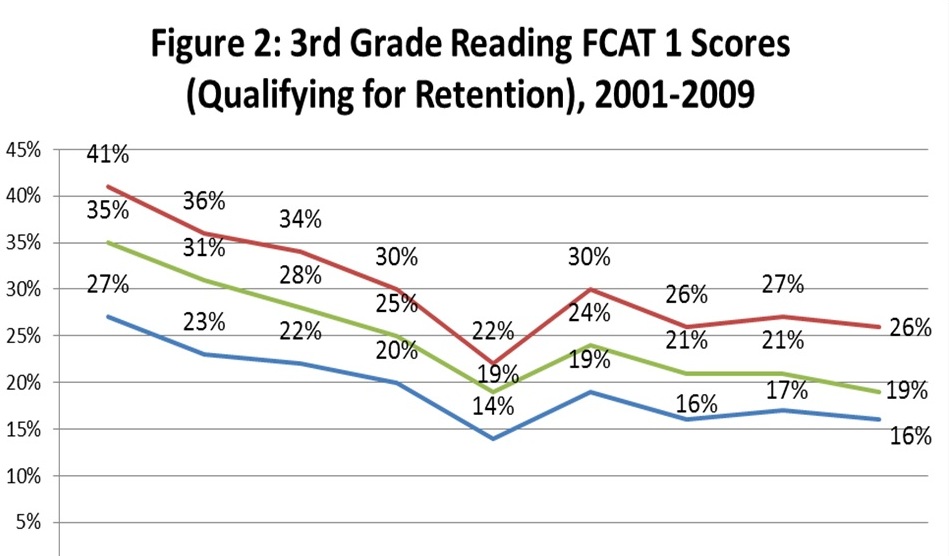
FCAT 1

The individual impact of particular policies on gains in Florida is not clear. What is crystal clear however is the fact that there were aggregate level gains in Florida. You don’t require a random assignment study or a regression equation, for instance when considering the percentage of FCAT 1 reading scores (aka illiterate) above. When you see the percentage of African American students scoring at the lowest of five achievement levels drop from 41% to 26% on a test with consistent standards, it is little wonder why policymakers around the country have emulated the policy, despite DiCarlo’s skepticism.

I could go on and bomb you with charts showing improving graduation rates, NAEP scores, Advance Placement passing rates, etc. but I’ll spare you. The point is that there are very clear signs of aggregate level improvement in Florida, and also a large number of studies at the individual level showing positive results from individual policies.

The individual level results do not “prove” that the reforms caused the aggregate level gains. DiCarlo’s problem is that they also certainly do not prove that they didn’t. It has therefore been necessary from the beginning to examine other possible explanations for the aggregate gains. The problem here for skeptics is that the evidence weighs very much against them: Florida’s K-12 population became both demographically and economically more challenging since the advent of reform, spending increases were the lowest in the country since the early 1990s (see Figure 4) and other policies favored by skeptics come into play long after the improvement in scores began.

The problem for Florida reform skeptics, in short, is that there simply isn’t any other plausible explanation for Florida’s gains outside of the reforms. They flailed around with an unsophisticated story about 3rd grade retention and NAEP, unable and unwilling to attempt to explain the 3rd grade improvement shown above among other problems. One of NEPC’s crew once theorized that Harry Potter books may have caused Florida’s academic gains at a public forum. DiCarlo has moved on to trying to split hairs with a literature review.

With large aggregate gains and plenty of positive research, the reasonable course is not to avoid doing any of the Florida reforms, but rather to do all of them. In the immortal words of Freud, sometimes a cigar really is just a cigar.


Weingarten Has a Great Idea!

December 10, 2012

Lisa Simpson keep out sign

(Guest post by Greg Forster)

What a shock – Randi Weingarten wants to solve the teacher quality crisis with higher barriers to entry. Because unions never erect barriers to entry for a profession in order to fatten themselves by exploiting the weak and vulnerable.

Weingarten’s article opens with yet another sign that we’re winning: “Every profession worth its salt goes through such periods of self-examination. That time has come for the teaching profession.” Yes, it sure has!

But you know, maybe this is a good idea. Hey, Randi, how about this: we institute a bar exam for teachers and then anyone who passes the exam is allowed to teach. What do you say to that?


Randi Weingarten and Friends Respond to My WSJ Piece

October 15, 2012

I’ve long argued that the teacher unions are hardly better at running their political interests than they are at running schools.  They compensate for lousy ideas and poorly made arguments with the brute force of mountains of cash and an army of angry teachers.

My view of the teacher unions was confirmed by their mangled reaction to my piece in the Wall Street Journal noting the trade-offs between the number of teachers we hire and their quality.  The boss of the American Federation of Teachers, Randi Weingarten, tweeted her response: “They don’t want to pay teachers comp salaries…”

Now, I should say that anyone who attempts to engage in a substantive debate on Twitter is an idiot and so I fully confess that I was an idiot for trying to do so.  I responded: “we could have increased teacher salaries by 50% instead of increasing their number by that amount.”  And then I reiterated the point: “you seem to prefer having 50% more teachers over 50% higher salaries. Why is that?”

Having raised the issue, Randi Weingarten obviously had not thought through where the argument might go.  She couldn’t offer the obvious answer: “Because the teacher union cares more about power than about teachers, so having 50% more of them gives us a larger army on election day while 50% more pay might create more satisfied professionals who are less dependent on the union.”

No, thinking things through is not exactly the union’s forte.  They are more accustomed to crushing opponents with ad hominem attacks or distracting the audience with emotional and irrelevant appeals.  So, that’s exactly what they did.  Teacher union flak, Caitlin McCarthy, chimed in with: “Jay Greene shld model how an XL class size would work w/ Randi sitting in back taking notes for us. LOL.”  Randi Weingarten agreed with Caitlin McCarthy, adding to the joke: “I wld have to be in front-so I cld see the board.”

I responded that it is obviously possible to have higher student-teacher ratios since we used to have them and without getting worse results: “student teacher ratios from 40 years ago were modeled 40 years ago. If impossible how did they?”

McCarthy replied with a “these go to 11” argument, repeating that I needed to model how it was possible to have higher student-teacher ratios, tweeting: “Jay, again I suggest u actually model this & not just write/imagine it. Practice what u preach.”  This was followed by a series of tweets from McCarthy all of which were based on the notion that only teachers have standing to hold opinions about education policy.  She wrote: ” I understand & respect teaching b/c I walk the walk. I’m not all talk. Model ur ideas, Jay” and “Jay, have you ever subbed in an urban area for a wk? Not being snarky. A legit question.” and “Never take advice from someone who hasn’t been there.”  Randi Weingarten again joined McCarthy in her argument, tweeting: “Good Q Jay-have u ever taught high school in an urban/rural setting.”

I was struck by the anti-intellectualism of their line of argument.  What kind of educator would believe that the only way to know something is by having done it?  If that were true, we should dispense with schools and just have apprenticeships.  I tweeted: “so the only way to know something is to have done it? Shows no faith in abstract learning” and “As an educator you believe in abstract learning, right? Or do we only learn by apprenticeship?”

Mentioning abstract learning to the teacher union’s army of angry teachers must be like waving a red cape in front of a bull.  Caitlin McCarthy charged with all of her bovine might: “I would expect this kind of comment from an ‘abstract thinker’ out of touch w/ reality. Go sub.”

McCarthy threw in some additional ad hominem just to complete her stereotype as a teacher union flak unable or uninterested in discussing the substance of arguments.  She tweeted: “Jay was born circa ’67. He never lived firsthand the schools of yore & has a pol agenda.”  Oh, the substance of my argument can be ignored because I have a political agenda while she and Weingarten have no agenda at all other than their love of children.  And when Texas Parents Union tweeted Randi Weingarten and Caitlin McCarthy “While we wait on @jaypgreene to respond, what is your specific concern with article? Just curious…” McCarthy replied ” Hmm…u link to StudentsFirst & Stand For Children on ur site, so it’s safe to assume u agree w/ Jay?”  Never mind the argument, let’s talk about who you link to and who’s side you’re on.

I would like to think that the anti-intellectual, non-substantive, and ad hominem nature of the teacher union response was simply a function of the stupidity of trying to have an argument on Twitter.  But unfortunately, this is the main way I have seen them argue for more than two decades.  Fortunately for those opposed to the union’s policy agenda, their bullying and mangled arguments only continue to erode their credibility in policy discussions.  As I’ve said before, the teacher unions are already starting to be treated like the Tobacco Institute, a well-financed and well-organized special interest that has no legitimacy in policy debates.


Conspiracy Theory Time!

October 2, 2012

(Guest post by Greg Forster)

Check out this delicious teacher-blogospheric reaction to Bill Moyers’ new ALEC story:

The education stuff starts at around the 14 minute mark, with the main example being the overthrow public education in Tennessee by a virtual school operator.

What I’ve been too lazy to determine on my own is this: is our new unelected state charter school authority based on an ALEC template? Or is that something that came out of Race to the Top? Or is there even a difference?

ALEC, President Obama’s Education Department – what’s the difference?

Not that there aren’t some real conspiracies. Thankfully, they tend to fail due to their internal contradictions and inability to control their own actors. But these people live in a world where literally everyone is out to get them and there are no other agendas besides teachers versus the world. Wonder how that mindset gets cultivated?


This is How You Pay for That 16% Pay Raise

September 25, 2012

How will virtually bankrupt Chicago pay for the 16% pay raise over 4 years that is in the new teacher contract?

As I suggested last week, this headline in the Chicago Tribune answers the question:

Pushing the charter school agenda

With the CTU strike over, Mayor Rahm Emanuel pushes to grow charter schools
If you reduce the unionized teacher work force by 20% over the next four years by continuing to open new charter schools and close under-enrolled traditional public schools, the city might even come out ahead.  The new contract does nothing to stop this process from continuing and yet the unions are crowing like they scored a major victory.

Chicago Charter Students aren’t just in school today, they are learning more than their district peers

September 13, 2012

(Guest Post by Matthew Ladner)

So I was curious as to how charter schools in Chicago compare academically to the district. I ran the NAEP numbers from the Trial Urban District Assessment for free and reduced lunch eligible general education students. This is about as close to an apples to apples comparison as you can get in the NAEP data-much smaller range in variation in family income, general education students.

Here are the results:

This is the part where edu-reactionaries will start to stare at their feet to mutter stories about how these differences must be all about the differences in motivation between parents. The random assignment studies have consistently demonstrated however that charter school students perform better on charter schools for inner city kids. The whole “motivated parents” question is irrelevant until such time that charter schools don’t have a waiting list in any case, unless of course you are willing to sacrifice the interests of children over those of adults.

The Economist recently reviewed the evidence on charter schools and concluded:

In rich countries, this generation of adults is not doing well by its children. They will have to pay off huge public-sector debts. They will be expected to foot colossal bills for their parents’ pension and health costs. They will compete for jobs with people from emerging countries, many of whom have better education systems despite their lower incomes. The least this generation can do for its children is to try its best to improve its state schools. Giving them more independence can do that at no extra cost. Let there be more of it.


Diane Ravitch, Super-Villain…. And Related News

September 10, 2012

I’ve avoided writing about Diane Ravitch recently because I think it’s now clear to all sensible people that she has gone completely nuts, lacks credibility, and was probably never much of a scholar.  But I just couldn’t resist noting that in addition to all of her previous vices, Ravitch is now seeking to play the part of a super-villain.  She always had the megalomaniac dimension of a super-villain, but has now added the dimension of making threats if her demands are not met.  In a recent post [UPDATED], she declared:

The election, I hear, will be decided in Ohio and Michigan.  As it happens, I have a very large following of teachers and principals in both states.  My decision could swing several thousand votes in both of these key states.  I hold the election in my hands.  Bwahahahaha! And if my demands are not met within 24 hours I will reverse the Earth’s gravitational pull and everything will go flying into space. Bwahahaha!

Actually she didn’t say the last bit, but she did say that President Obama should “read this and heed my advice… while you still can, puny Earthling.”  Again, she didn’t actually say the last bit, but I think you get the picture.

And in related news… The Chicago Teachers Union has decided to go on strike.  In their own effort to play the part of a super-villain, they are demanding that virtually bankrupt Chicago and its Democratic mayor Rahm Emanuel transform all matter in the universe into currency to pay for increased teacher salaries,  gold-plated pension and health benefits, and a hot tub for each teacher filled with KFC gravy.

And in related news… the Chicago Tribune has reacted to the demands of these super-villains by calling for vouchers for Chicago students.


The Way of the Future in Ed Reform Advocacy

August 11, 2012

Matt has been a leader in noting how technology will change the way we educate students in the future.  But technology is already fundamentally changing how people advocate for their preferred reforms.  Documentaries and movies are displacing print forms of advocacy at a rapid clip.

We’ve seen documentaries like Waiting for Superman and Race to Nowhere have far greater impact than any blog, article, or book.  And now dramatic films, like Won’t Back Down are making the case for parent trigger laws more powerfully than any print argument.  For better or worse, ed reform is going Hollywood.

In part this shift of ed reform advocacy to film is a manifestation of my earlier argument that the intellectual debate over the broad principles of education reform is over.  A broad consensus among elites has developed that lack of resources is not the central problem with our education system and that simply pouring more money into schools will have little effect.  There is also a broad consensus that parents should have some choice in where their children go to school and that those choices are not only fair to parents and children but also the competition they produce will help improve schools.  These ideas have been found in speeches given by President Obama, in the Democratic Party’s platform, and in liberal establishment newspapers like the Washington Post and not just in the conferences organized by the American Enterprise Institute.  And the collection of athletes and other celebrities joining the ed reform party is rapidly growing.

In addition, the teacher unions are finally being treated as the special interest group they are rather than as credible players in the discussion over the merits of various education policies.  When Campbell Brown takes on the unions the game is over.   

Of course, the unions are still quite powerful and the battles over each policy and the regulations that are appropriate will continue for a long time, but the big intellectual war over ed reform is over.  Similarly, Brown v. Board of Education marked the end of the big intellectual war over racial equality in America, but the battles over the best policies to promote equality have and will continue to rage.

The end of the big intellectual war over education reform has opened the door to Hollywood’s elites to join the fray.  Guess Who’s Coming to Dinner came along after the dust from Brown had settled, not before.  Similarly, the wave of Hollywood films on ed reform is just starting.

And it’s not just Hollywood that’s getting into the ed reform act.  Last night I watched a Bollywood film, Three Idiots, that makes the case for a more student-centered education.  I’m not saying that it is a great film or that it’s argument is well-made.  I’m just saying that technology is being brought to ed reform advocacy and movies are playing an increasingly important role.  And it is worth noting that Three Idiots broke records for the highest grossing Bollywood opening and highest overseas revenues.

You can watch the entire movie for free on YouTube, but here was the most entertaining part.  Don’t worry about the lack of subtitles in the clip since the words don’t really matter.  Once people can see the beautiful colors and fun of ed reform advocacy in a film, why will they ever read a blog post again?


McShane on Louisiana Teacher Union Thuggery

August 1, 2012

One of our super best friends, AEI’s new hotshot, Michael McShane, has a piece in National Review Online on teacher union efforts in Louisiana to intimidate private schools from participating in the state’s voucher program with a letter to each  threatening that those schools will individually be sued if they participate.  This despite the unions losing the first round in courts to stop the program.  If they can’t win in court, the unions hope to at least scare schools away from offering opportunities to kids the threat of legal harassment.

Here’s a taste of McShane’s piece:

While the union’s behavior is disgusting, it certainly isn’t shocking.

Unfortunately, this is just another example of unions choosing to harass educators when they have lost a political or legal battle. It was just about a year ago that the pro-union protesters who were attempting to recall Scott Walker put on a shameful display in Wisconsin. At Messmer Prep, a private non-union school in Milwaukee, protesters super-glued doors shut, creating a fire hazard that endangered children; they berated Brother Bob Smith, the school’s leader and an anchor to Milwaukee’s black community; and they denigrated the school’s teachers who had done nothing more than show up to work that day.

If unions do not like vouchers, there are plenty of outlets for them to voice their distaste. If they wish to change the law, they should lobby their legislators. If they don’t like the governor, they should try and vote him out in the next election. If they don’t like the way the court rules, they should camp outside in protest. Any of these remedies are well within both their rights and the scope of appropriateness and decency.

What they shouldn’t do is badger, demean, or harass people that are working hard every day to educate children. When they do that, they look less like an organization with the best interests of children in mind and more like a power-hungry interest group that will stop at nothing to maintain its hegemony.

I’ll pre-empt Ladner…  BOOOOOOOOOM!!!!!!!!!!!!


Class Warfare

June 13, 2012

 (Guest Post by Matthew Ladner)

I finally got the chance to read Steven Brill’s Class Warfare: Inside the Fight to Fix America’s Schools. Brill, a noted journalist and entrepreneur, has written the first draft of recent ed-reform history, mostly from the perspective of the Cool Kids and those associated with Democrats for Education Reform.

Class Warfare is both interesting and readable. I did sometimes find myself wondering if there was much anything going on in education reform in the last few years outside of the Northeast corridor. I also suspect that some of the reforms praised in the book might struggle to maintain their reputations with a close reading of the fine print of the statutes.

Brill confesses his liberal leanings, and the epic battles over education reform in places like New York City and Washington DC deserve the level of detail they receive. Someone else will have to write the conservative version of this book, Brill’s book makes an important contribution by documenting the struggle going on in the American Left over education policy. Brill interviewed a long list of key players for this book, and his sympathies clearly lie with reform-minded Democrats. Very bold reforms led by Republicans after 2010 don’t receive the attention they deserve.

These however are quibbles. Brill provides a blow-by-blow of the struggle for power within the Democratic Party over K-12 policy between reformers and reactionaries. Brill’s account proves especially rich in documenting Joel Klein’s tenure in New York City. New York City won’t have an independent reform-minded billionaire as mayor forever, meaning that DFER and company will have their hands full going forward.

Barack Obama and Arne Duncan come across quite well in the book, so long as you are willing to mentally air-brush the shameful Washington Opportunity Scholarship episode out of your memory. The teacher unions went all-in for Hillary Clinton in 2008. President Obama came to office without owing the unions much, and he made use of this flexibility. If President Obama fails to win reelection, it seems clear that his “Nixon to China” leadership on teacher evaluation and support of charter schools will likely prove major elements of his legacy. This may be the case even if he wins relection in 2012.

Brill insightfully poses crucial questions towards the end regarding the maximum scale of reforms based upon the limited pool of idealistic Ivy leaguers going through the TFA pipeline. We are going to need new school models to overcome these challenges. We need to increase the opportunity for students to learn from our most effective instructors. We need to increase the attractiveness of the teaching profession to ambitious college students, and as Brill notes, we need to do this without burning our high achievers and making the average teacher more effective as well.

Ummm….not so much.

Some of Brill’s sources make reference to Randi Weingarten as a possible F.W. de Clerk figure. This is a bit rich after Brill documents a number demostrably false , hollow and deliberately deceitful Weingarten statements. Brill identifies Weingarten as his main source and expresses a grudging admiration for her, but I’m at a loss as to why. I hope she’ll prove me wrong, but it seems plausible to me that the “Randi as a secret reformer” story is simply a myth that serves emotional needs for both Democrats and the AFT.

Deeds, not words.

Class Warfare is too rich to attempt to summarize- read it for yourself and see what you think. I found it well worth the time.