A Once Proud People Begin a Fight Against Hopelessness

April 30, 2013

(Guest Post by Matthew Ladner)

The Arizona Republic ran a fantastic story on their front page of this Sunday’s edition on Navajo schools in Arizona and the efforts underway to turn them around. The story shows how school grading, digital learning and immigration reform can help people who have taken a courageous decision to help themselves.

Background: schools located on the reservations in Arizona face enormous challenges and have truly abysmal test scores to show for it. Isolation, poverty and rampant alcoholism probably constitute the top three problems, though not necessarily in that order. Arizona has the lowest Native American scores on NAEP and they are not only abysmal they have been declining.

In K-12 policy discussions in Phoenix, the subject of “the Res” comes up frequently. Often people will claim that you can’t do this, that or the other thing because of “the Res.” Problems as deep as those caused in large part by a century of having the federal government “take care” of you don’t lend themselves to quick or easy solutions.

It is a long article that focuses on the personal story of Harold Begay, the Navajo Superintendent who returned to run Tuba City school district determined to turn things around. Here are the policy related parts of the story:

When the State Department of Education started assigning letter grades two years ago, Tuba City High School got a D.

It could fall to the bottom or head higher. Begay chose to go higher.When he was named superintendent, he pledged that the district would achieve the top letter grade of A.

Skip ahead….

Last summer, Tuba City High School’s grade improved from a D to a B. In addition to a better performance on standardized tests, the school showed more improvement than other low-performing schools. Navarre was honored at the state Department of Education’s office in Phoenix.

People are starting to believe what Begay told them two years ago”‘We’re going to become an ‘A’ district'” 

As a card-carrying member of the K-12 policy discussion going on in Arizona’s capital, let me be the first to confess that not me nor anyone else down in Phoenix could have ever dreamed up the policy solutions that Begay implemented in Tuba City. That is as it should be – A-F school grading was intended to put a focus on problems and call them by their proper names. Solutions come as a decentralized process.

Most of the conversations I have heard about “Res schools” have involved a sad air of resignation. The article mentions that Arizona Superintendent of Public Instruction John Huppenthal, who carried the A-F bill in the Arizona Senate and implemented it as Superintendent, became the first person in his position in twenty years to visit schools on the reservation. I don’t know whether that is accurate or not, but I think it is fair to say that if anyone has had a serious plan about what to do about reservation schools in Phoenix it has been well concealed for a very long time.

Read the article however and you’ll the solutions that Superintendent Begay developed on his own: a new emphasis on Navajo culture, hiring teachers from the Philipines and use of a digital learning platform know as Beyond Textbooks. Beyond Textbooks is a product developed by the incredibly impressive Vail Arizona school district, located at the opposite end of Arizona from Tuba City in southern Arizona.

Recruiting teachers to extremely isolated and troubled areas is a real challenge. Tuba City is 75 miles north of Flagstaff out in the middle of a very desolate nowhere. If you want a small vignette into the idiocy of our immigration laws, note that Begay is losing half of his Filipino teachers to expiring visas. We ought to be throwing these teachers a ticker-tape parade, but instead we’ve decided to boot them out of the country.

By the way, don’t hold your breath waiting for American nativists to rush to Tuba City to provide the instruction these children need.  They are ummm busy, or something. But I digress.

Tuba City High Schools jump from a D to a B grade was possible because of the emphasis on student learning gains. Twenty-five percent of a school’s grade comes from the gains of the overall student body, and another 25% from the gains of the lowest performing quartile from the previous test. If you get gains your grade gets moving. Arizona will need to nudge up the grading standards in the future but for now the system just may be working as intended by meeting the worst schools where they are at the moment.

Tuba City schools face many challenges and have a long, long way to go, but don’t make the mistake of betting against them- they are back in the fight.


Extremism in Defense of Mediocrity is Quite a Vice

January 31, 2013

(Guest Post by Matthew Ladner)

So Michelle Malkin recently wrote columns of an alarmed tone warning of the dangers of the Common Core. Here is a taste:

Under President Obama, these top-down mal-formers — empowered by Washington education bureaucrats and backed by misguided liberal philanthropists led by billionaire Bill Gates — are now presiding over a radical makeover of your children’s school curriculum. It’s being done in the name of federal “Common Core” standards that do anything but set the achievement bar high.

Substitute the word “conservative” for “liberal” and the paragraph reads like Diane Ravitch. Ms. Malkin proceeds to repeat various anti-Common Core assertions as facts-but are they facts? Having read that last bit about “standards that do anything but set the achievement bar high” I decided to put it to a straightforward empirical test.

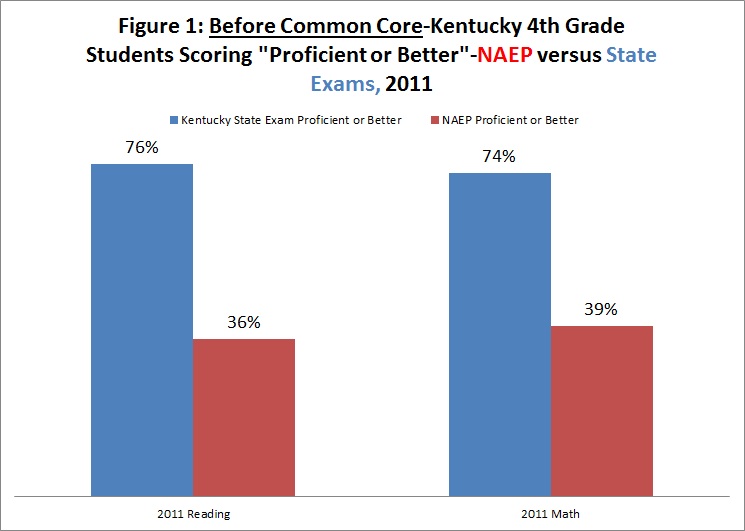
Kentucky was the earliest adopter of Common Core in 2012, and folks from the Department of Education sent some before and after statistics regarding 4th grade reading and math proficiency. I decided to compare them to NAEP, first 2011 KY state test and 2011 NAEP for 4th Grade Reading and Math. NAEP has four achievement levels: Below Basic, Basic, Proficient and Advanced. Kentucky also has four achievement levels: Novice, Apprentice, Proficient and Distinguished. The first figure compares “Proficient or Better” on both NAEP and the state test in 2011:

KY CC 1As you can see, Kentucky’s definition of “Proficient” was far more lax than that of NAEP. In the Spring of 2012 however they became the first state to give a Common Core exam. How did the 2012 state results compare to the 2011 NAEP?

KY CC 2Kentucky’s figures are strongly suggestive that the new test is a good deal more rigorous than the old one- it tracks much closer to NAEP than the previous test. While it is possible that Kentucky had item exposure that explains some of the difference, but let’s just say there is an awful lot of difference to explain. We would expect somewhat lower scores with a new test, but if the new test were some dummied down terror…

There will also still be honest differences of opinion over standards independent of the rigor of the tests. Moreover, just because it is an obnoxious pet-peeve of mine, it is worth noting that starting out more rigorous doesn’t guarantee that they will stay that way…

A formal study could definitively establish the rigor of the new Kentucky test definitely vis-a-vis NAEP, but it is well worth considering where KY’s old test ranked in such a study by NCES. Short answer: Kentucky’s old standards were high-middle when compared to those of other states. Ergo we can infer that the proficiency standard on the KYCC test is far closer to those of NAEP than a large majority of current state exams.

There is room for honest debate regarding Common Core as a sustainable reform strategy, but we should have that debate rather than the present one.

UPDATE: Reader Richard Innes detected an error in the NAEP proficiency rates in the first version of this post. I made the mistake of looking at the cumulative rather than the discrete achievement levels and then treating the cumulative as discrete-thus double counting the NAEP advanced. If you have any idea of what I am talking about give yourself a NAEP Nerd Gold Star. Getting instant expert feedback is one of the best things about blogging, and I have updated the charts to correct the error.

In terms of substance, both sets of KY tests were further apart from NAEP proficiency standards, but the new ones are still far closer than the old ones.


A Modest Proposal on State Standards

December 19, 2012

You can check in any time you like, and you can always leave.

(Guest Post by Matthew Ladner)

A few years ago while serving as a VP at the Goldwater Institute I received a request to come out hard against the adoption of Common Core standards in Arizona. I didn’t know whether it would have mattered or not but the request originated from people who I continue now to hold in a great deal of respect. I considered the matter very carefully.  I had deep misgivings regarding Common Core at the time, the most serious of which was the governance of the standards over time. At the time I was of the opinion that unless Ben Bernanke took up the task of governing the standards that it would inevitably follow that Common Core would eventually result in the Great American Dummy Down.

Nevertheless in the end I decided not to oppose Arizona’s adoption of Common Core standards.  Regardless of how bad Common Core started out or later became, Arizona simply had nothing to lose.  Arizona had just about every testing problem you could imagine- dummied down cut scores, massive teaching to test items, and something at least in the direct vicinity of outright fraud by state officials regarding the state’s testing system. Our state scores had “improved” substantially through a combination of lowered cut scores and teaching to the test items, but NAEP showed Arizona scoring below the national average on every single test and precious little progress. The status quo was worse than a waste of time.

I spent some years repeatedly pointing out this enormous flaws in the Arizona testing system. I was not willing to turn around and wrap myself in the Arizona flag to pretend these tests and standards were somehow sacred because they were developed out here in our humble patch of cactus. Now if I were living in one of the states with high and rising NAEP scores with cut scores near NAEP proficiency, my calculus would have been quite different. I would have died on a hill fighting the adoption of Common Core.

Very few states however qualify for this lofty status. Most state standards and tests qualified as meh or worse than meh. I decided that if I were to draw up a list of the top 10 education problems facing Arizona, that Common Core adoption wouldn’t make the list.

Arizona adopted Common Core as a direct response to the prospect of getting Race to the Top money which we did not ultimately win. Common Core remains however the default, and quite frankly, the main arguments being made against it these days are not compelling enough to make many reasonable people want to reject it. To briefly summarize:

1. The United States Supreme Court Decision on Obamacare fundamentally altered the odds of a “lock in.” A few years ago murmuring in Washington raised the eery prospect of making major federal education spending programs like Title I contingent on Common Core adoption. Not only did this not happen, the Supreme Court enormously complicated the already dim prospect for such a move. My understanding of the Obamacare decision would in fact make it unconstitutional to deny Title I funds to a state choosing not to participate in Common Core.

The Congress could in theory come up with a new funding stream for purposes of bribing/incentivizing state action or could even perhaps pass a tax upon the citizens of states not adopting Common Core a la the individual mandate. Let’s face it though, one can only describe the prospects of either of these things happening as quite dim-somewhere in the vicinity of an extinction inducing asteroid strike in the short to medium term.

States therefore remain free to drop Common Core at their leisure. The dozen or so states having won RTTT money might face some delays in doing so, but Common Core is hardly an issue that any President is likely to call out the National Guard over.  States voluntarily joined (albeit with many seeking RTTT money) but they also remain free to withdraw. This is fundamentally different from the old “Fiscal Blackmail” scenarios of 55 mile per hour speed limits and 21-year-old drinking ages. States can leave Common Core without federal penalty.

The Obamacare decision also largely addresses the chief concern that I have expressed: a great national dummy down of the Common Core. If it happens, states can leave. It’s not clear whether the threat of states leaving will lean against the dummy down.

2. The latest fad to sweep the Common Core debate involves horrified concerns that Common Core is going to drive literature out of schools. I don’t however presume to know the “right” balance of fictional and informational texts and like most scare stories there is less to this one than meets the jaundiced eye seeing everything as yellow.

People do have varying preferences over such things though, making these sorts of disagreements inevitable. Still, nothing close to compelling enough to make me want to switch Arizona back to the failed AIMS regime.

Common Core opponents therefore have a fundamental problem: Common Core is now the default in 45 states and superficial scare stories may be jolly good fun to spread but aren’t likely to prove to be of much utility. Common Core opponents therefore should consider a new strategy. I suggest a Constructive Vote of No Confidence.

Common Core opponents have painted themselves into a corner of being defacto in favor of preserving joke standards and tests, including some that you can pass by signing your name while blindfolded. The way to escape this trap is not just to be against Common Core but in fact in favor of something else. Something better.

In short, if I were sitting on the State Board of Education in Arizona and someone brought a motion to pull Arizona out of the Common Core effort in preference to our bad joke status quo, I would vote no. If however the suggestion was that we pull out of Common Core and instead adopt the Massachusetts standards, I could very comfortably vote yes.

Mind you, it would be a struggle to adopt MA standards in AZ, and we might not prove up to the task. The same it true of Common Core. Plus the MA standards are battle tested and I would prefer to have a group of people running the show that I can actually talk to, beat up in the press and vote against. Democracy has it’s faults, but I’ll take my chances with it.

Regardless of which side of the Common Core debate you stand on, you should not labor in defense of the indefensible status-quo of many state testing regimes. Last year for instance, the Mississippi legislature debated charter school legislation. Suburban superintendents were able to exclude their districts and then ultimately kill the legislation based upon the rather incredible notion that their fantastic districts did not need charter schools. Suburban Mississippi imagines itself to be in possession of “good schools” which would be threatened by charters, you see.

Examination of the studies comparing NAEP and state tests however shows that you can pass the Mississippi 4th grade reading test as “proficient” with a score the equivalent of 163 on the NAEP. This score is far lower than the lowest recorded NAEP score in the recorded history of the troubled Washington DC district (179) which is itself unbelievably pathetic.  The Mississippi testing system is not only failing to produce improvement, it can be best understood as a gigantic fraud in which taxpayer dollars are actively used to deceive Mississippians into a false sense of security.

Common Core is hardly an ideal strategy to deal with this problem and there are any number of ways that it could fail. Opponents should not mistake the fact that horrible state tests and standards represent a very real problem. A constructive vote of no-confidence has the potential to create a respectable alternative to Common Core which in fact would fulfill the main purpose of Common Core.


Global Report Card 2.0

December 10, 2012

With help from my colleagues, Josh McGee and Jonathan Mills, we’ve produced for the George W. Bush Institute an updated version of the Global Report Card.  The Atlantic is hosting the Global Report Card 2.0 on their web site and has a nice piece about its release today.

And click here to see coverage of last year’s Global Report Card 1.0.  And here is a video of Bob Costrell and me discussing the GRC.


El Paso Cheating Scandal

October 15, 2012

(Guest post by Greg Forster)

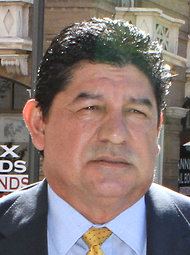
One guy who isn’t going to be nominated for this year’s Al Copeland award is Lorenzo Garcia, disgraced ex-superintendent of El Paso schools. He’s at the center of the latest major cheating scandal connected to NCLB. From the New York Times:

Students identified as low-performing were transferred to charter schools, discouraged from enrolling in school or were visited at home by truant officers and told not to go to school on the test day. For some, credits were deleted from transcripts or grades were changed from passing to failing or from failing to passing so they could be reclassified as freshmen or juniors…

In 2008, Linda Hernandez-Romero’s daughter repeated her freshman year at Bowie High School after administrators told her she was not allowed to return as a sophomore. Ms. Hernandez-Romero said administrators told her that her daughter was not doing well academically and was not likely to perform well on the test.

Ms. Hernandez-Romero protested the decision, but she said her daughter never followed through with her education, never received a diploma or a G.E.D. and now, at age 21, has three children, is jobless and survives on welfare.

“Her decisions have been very negative after this,” her mother said. “She always tells me: ‘Mom, I got kicked out of school because I wasn’t smart. I guess I’m not, Mom, look at me.’ There’s not a way of expressing how bad it feels, because it’s so bad. Seeing one of your children fail and knowing that it was not all her doing is worse.” [ea]

Accountability systems don’t work when those being held accountable percieve the system as political and illegitimate. Schools need these systems but they’re not going to work as long as education is a government monopoly. More on that here and here.

Via Bill Evers


What happens when we can’t give people choice?

October 1, 2012

(Guest Post by Mike McShane)

Over the weekend, Washington Post education writer Jay Matthews posed a great question on his Class Struggle blog.  He asks, in not so many words: why do education reformers fight so hard for test-based accountability systems that the charter schools they also support do not use?  If these systems are so great, the argument goes, why don’t charter schools use them?

The best way I can think to respond is to put it in terms of college football.

As a diehard Notre Dame fan I cheer for two teams every weekend, the Fighting Irish and whoever is playing Michigan.  I share the same view as an education reformer who most directly supports school choice as the means for reforming the system.  I like charters, vouchers, tuition tax credits and anything that works to dislodge the entrenched interests that prevent leaders from giving people choice.

As I have written elsewhere, the American education system has seen decades of middling performance at ever increasing cost because of the reform-resisting iron triangle formed between teachers unions, the state and local bureaucrats charged with their oversight, and the elected officials that are supposed to represent the interests of the community.  To meaningfully reform the system, we need to disrupt this power structure.

To borrow from Paul Manna’s insightful 2006 book School’s in: Federalism and the National Education Agenda, if you want to upset the power of an interest group, you can either decrease its license or its capacity.  A group’s license is its argument for action.   A group’s capacity is its ability to act.

Teachers have traditionally enjoyed substantial license.  In fact, in the recent Phi Delta Kappan/Gallup Poll, 71% of Americans had “trust and confidence in the men and women who are teaching children in the public schools”.

Why are teachers so popular?  There are many reasons, but it doesn’t hurt that when evaluated under current systems 99% of them are rated as satisfactory.  Informally, parents might have an understanding of whose classroom they would like their child in, but they lack any kind of systematic performance evidence to make their case.

When teachers are more accurately evaluated and parents are made aware that their children will be assigned to that school or classroom regardless of their wishes, it should encourage them, and the greater public, to demand more options for students.    To put a finer point on it, more accurate evaluation decreases the iron triangle’s license.  Does it decrease license as well as choice does?  Not at all.  Does the iron triangle have ample opportunity to water-down or co-opt it?  Absolutely.  But it is a step in the right direction.

Look, I’m no great fan of the one-size fits all accountability systems that many urban school reformers are implementing, but I’m not a fan of Ohio State either.  However, on that Saturday in November when the Buckeyes take on the Wolverines in the Horseshoe, you can believe that I’ll answer “–IO” to anyone that starts “OH-“, because cheering for the Buckeyes (like supporting evaluation systems) is better than the alternative.


School Choice Equals Higher Accountability

October 1, 2012

(Guest Post by Matthew Ladner)

Patricia Levesque, veteran of the school reform wars in Florida, cautions edu-reactionaries in Louisiana against making the same mistakes that their compatriots in Florida made (and continue to make) in the Shreveport Times.

Florida lawmakers instituted K-12 reform in 1999, and efforts were rewarded with strident opposition from a vocal minority. Die-hard skeptics grew increasingly isolated, however, as Florida’s childhood illiteracy rate plunged, high-school graduation rates improved and the number of black and Hispanic students passing advanced placement exams tripled. There is still much more to do in Florida, but the progress is undeniable.

Louisiana reform skeptics should take care not to repeat the mistakes of the past. Rather than resisting reform, Louisianans of all backgrounds should be working together to maximize opportunities and achievement for students. Louisiana’s public school system will enjoy much brighter days once parents routinely match the needs of their child with the strengths of their schools.

As the debate over reform continues in Louisiana, remember that a century from now the vast majority of Louisiana students will still be attending public schools. Nothing has been done that will change that basic fact. Students can and should attend their public school by choice rather than simply by zip code.


Florida Education Association Bemoans their Self-Imposed Exile

September 24, 2012

(Guest Post by Matthew Ladner)

Andy Ford, President of the Florida Education Association wrote a piece for the Orlando Sentinel complaining about Florida’s accountability system. Ford’s piece connects the usual dots- complaining about the status-quo while offering no specifics for how a system of academic transparency should operate. Mr. Ford warms up with this doozy of a paragraph:

The former education commissioner, Gerard Robinson, recently resigned after a year on the job. Robinson inherited a flawed and punitive accountability system laden with standardized tests that was put in place 13 years ago by Gov. Jeb Bush, overseen by Patricia Levesque at his Foundation for Florida’s Future and endlessly promoted by legislators who favor for-profit schools, and the Florida Chamber of Commerce.

Before I get to the accountability system, let me briefly address the Jeb Bush/Foundation for Florida’s Future conspiracy theory bit. Florida operates as a democracy, complete with elections in which citizens choose their officials who then make decisions regarding K-12 and other sorts of state policy. The voters twice chose Jeb Bush to serve as their governor, but he has been a private citizen since **ahem** 2007.

The Foundation for Florida’s Future does indeed seek policies to improve Florida public schools. This however occurs within a typical system of democratic pluralism in which many groups contend for influence, including of course Mr. Ford’s Florida Education Association. Guidestar reveals that the FEA had revenues more than twenty times larger than those of the Foundation in 2010 (the latest year available).

The FEA’s difficulties originate with their suspect ideas rather than their flush bank account. Ford’s characterization of Florida’s accountability system as “flawed and punitive” is a fine example. This “flawed” system has in fact produced remarkable results, especially for disadvantaged children. The chart below for instance compares the literacy gains on the Nation’s Report Card for Free and Reduced lunch eligible Florida students in 1998 (the year before Florida’s reforms) and 2011 (the most recent results available).

Notice that the “good ole days” in Florida (pre-reform) were a disaster for low-income children. A whopping 37% of Florida’s low-income 4th graders had learned to read according to NAEP’s standards in 1998. A lack of transparency and accountability may have suited the FEA fine, but it was nothing less than catastrophic for Florida’s low-income children. Thirteen years into the “flawed” system, that figure was up to 62 percent. The goal of Florida policymakers should clearly be to accelerate this impressive progress rather than to go back to the failed practices of the past.

Put another way, if Mr. Ford considers this system “flawed” then Florida lawmakers should quickly implement something that he would judge to be “catastrophically flawed.” Note also that Florida’s public school teachers deserve to celebrate these gains as much as anyone. The FEA however opposed the reforms that produced them tooth and nail, costing them credibility (especially when they continue to complain today).

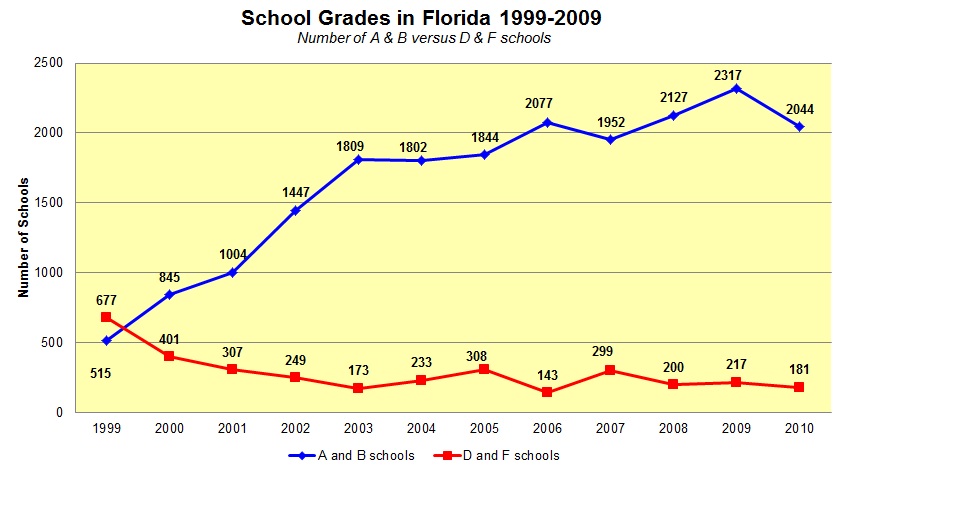
As for “punitive” well…Florida’s school grades have improved along with their NAEP and FCAT scores. Just how “punitive” can a system be when it delivers 10 times as many A/B grades as D/F grades?

If and when the FEA matches coherent child-centered policy with their massive financial and human resources, there can be little doubt that they will exercise a large amount of influence over Florida K-12 policy. Until then they can continue to bemoan their self-imposed exile from the adult conversation over how to provide Florida children with a genuine shot at the American Dream.


New Column on Florida’s Anti-Testing Nihlists

July 16, 2012

(Guest Post by Matthew Ladner)

I authored a column in response to anti-testing extremists in Florida. Here is a sample:

A recent problem with the FCAT writing test drew a great deal of attention from FCAT opponents. We should take care not to miss the forest for the trees. NAEP gave a writing exam in 1998 (just before Florida’s reforms) and again in 2007. Florida students achieved the largest gain of any state and more than three times larger than the national average during this period.

Sadly, leading the nation in writing gains on the highly respected NAEP exam seems to mean little to Florida’s testing opponents. One of the anti-testing groups seized upon the FCAT writing dispute to proclaim: “These abysmal FCAT Writes scores are proof that Tallahassee’s ‘education reforms’ are an unmitigated disaster.”

Against the highly credible NAEP score gains, testing opponents offer up a grab-bag of complaints and recently even a publicity stunt. A college-educated testing opponent recently claimed to have taken and failed a test similar to the 10th-grade FCAT. Whether this person actually took anything like the FCAT, or actually made any effort, is unknown but of little consequence. The vast majority of Florida 10th-graders did pass the FCAT on their first try last year.

Daniel Patrick Moynihan once stated that while everyone is entitled to their own opinion, no one is entitled to their own facts. Here are some facts: Since the advent of testing and reform, the nation’s most highly respected measure of academic achievement shows strong gains in Florida. Standardized test scores and graduation rates have both improved substantially since the late 1990s, which means Florida’s residents and students are getting more of what they want, need and deserve from the public education system today.


Bipartisan Group of NC Legislators Override Veto, Enact K-12 Reform

July 3, 2012

(Guest Post by Matthew Ladner)

The North Carolina legislature voted to override the budget veto of Governor Purdue, enacting significant K-12 reform in the process. Reforms included in the budget include A-F school grading, curtailment of social promotion and merit pay for teachers.

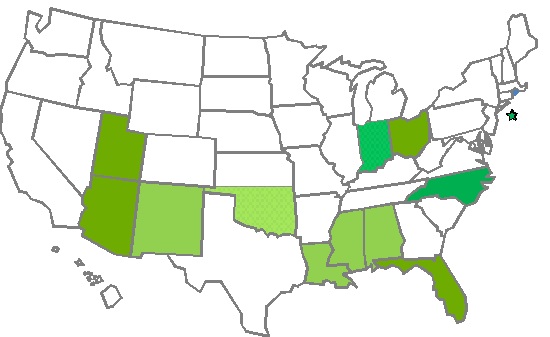
I think that the map of states having adopting A-F school grades now looks like this, although I may have missed a state. The star represents New York City: