Wonks of the World Unite!

January 22, 2014

Ah the undergrad years….ok, yes, that’s me with the lampshade hat. Hook ‘Em Horns!

(Guest Post by Matthew Ladner)

My email inbox has been filling up since Mike P. let loose with the “comrade” reference.  Bob Bowden interviewed me over differences in dogma between myself and Commissar Petrilli here, wherein I attempt to correct ересь in an effort to restore harmony within the Politburo. Glasnost and perestroika must continue comrades, but with a human face.


Fordham vs. Fordham on Private Choice Transparency

January 14, 2014

(Guest Post by Matthew Ladner)

The Fordham Institute has a new white paper out on accountability in private choice programs.  The headline will be that Fordham supports requiring students participating in voucher and tax-credit programs to participate in state accountability testing.  Adam Emerson, the author of the study and the new charter school chief in Florida (congrats btw Adam) wrote:

Surely there are risks associated with drawing private schools into public accountability systems, but empirical evidence shows that
downsides can be mitigated if policymakers are smart about how they design results-based accountability in choice programs of this kind.

The two key words in this sentence: risk and if.

Emerson believes that the risk of self-defeating homogenization of the school offerings available to parents can be managed by state officials being smart. Even the most insulated policymakers on the planet (say the Federal Reserve Board, which can more or less print its own budget) make decisions on far more than a technocratic basis. Even to the extent they do stick to their best judgement, they sometimes get things wrong in a spectacular fashion. Democratically elected lawmakers drift in and out of what Edmund Burke described as delegate and trustee roles of representation. The results, far from smart, are sometimes very messy and even counterproductive.

To gain an appreciation of the limited influence of technocrats in K-12 testing policy, I would suggest reading some of the Fordham Institute’s voluminous work making the case of what a complete hash a great many states have made of their testing systems for public schools. Here is a useful quote from the Proficiency Illusion:

Standards-based education reform is in deeper trouble than we knew, both the Washington-driven, No Child Left Behind version and the older versions that most states undertook for themselves in the years since A Nation at Risk (1983) and the Charlottesville education summit (1989). It’s in trouble for multiple reasons. Foremost among these: on the whole, states do a bad job of setting (and maintaining) the standards that matter most—those that define student proficiency for purposes of NCLB and states’ own results-based accountability systems.

Something far more than the I.Q. of policymakers seems to be at work here. The theme goes on in another brilliant Fordham report, the Accountability Illusion (emphasis added by yours truly):

As currently implemented, NCLB is not a discriminating system. A tremendous amount of money and energy has been spent to create the impression that there is accountability, and there are large numbers of schools throughout the United States that are in some phase of sanctions. But the accountability is not coherent. We found states where most schools failed to make AYP and others where nearly every school made it. We found demonstrably good schools that failed to make AYP far too often, and some pretty mediocre ones that slide by in some states.Thus what seems like accountability is an illusion. Good schools get sanctioned, bad schools get off, and ultimately students get shafted, since maintaining this illusion has a cost. When good schools get sanctioned, resources are wasted and we risk causing quick-fix, panic driven, counterproductive change in schools that may ultimately hurt students. When bad schools get off, their students are denied opportunities (what we unfortunately now call “sanctions”) that might lead to a better education, including the chance to attend a different school, or receive supplemental services, or simply obtain assurance that the workings of a perennially dysfunctional school will be addressed and corrected.

If those policymakers had been “smart” then thing may not have turned out this way. Many of the state testing systems that Fordham is now anxious to impose on private choice students have been previously described as costly frauds by, well, Fordham itself.

I don’t have a problem with private schools choosing to take the state test if it is done voluntarily.  Personally I wouldn’t want anything to do with a private school that lacked the self-confidence to have their own curriculum, but to each their own.  I like national norm reference testing as a light-touch method of providing transparency while leaving curricular choices up to schools.  If policymakers are so inclined, using such data to exit bottom-feeder schools could be undertaken without imposing state tests.

The whole idea of creating a parental choice program however is to provide parents with the broadest possible array of meaningfully varying options so that they can choose a great fit for the needs of their child. Accordingly, we should never make the mistake of viewing the job of a private school participating in a choice program as teaching the state’s curriculum or giving their tests. Rather their job is to satisfy the individual needs of the student to the satisfaction of parents. Parents will find schools following the state’s curriculum and giving the state’s test in abundant supply.  The whole purpose of private choice options is to create a diversity in the menu of choices available to parents and students.

It isn’t the lack of I.Q. that created the mess in state testing systems, rather the natural limitations of technocrats operating within a pluralistic democracy.   We would be wise to recognize these limits and to craft our choice programs accordingly.


What’s So Funny ‘Bout Peace, Rawls and Understanding Update on RedefinED

November 11, 2013

(Guest Post by Matthew Ladner)

I updated the “forced reincarnation with the chance to pick your state” thought experiment with NAEP 2013 data over at RedefinED.

Bonus Elvis C:


Many States Show Shameful Records in Holding Schools Accountable for the Progress of Special Needs Students

October 23, 2013

Special Ed inclusion

(Guest Post by Matthew Ladner)

The No Child Left Behind Act required student testing and reporting of data in return for continuing receipt of federal education dollars. The law however left granular details to the states, most of whom happily went about abusing them.

This chart is from a new study about the inclusion of special needs children in state testing regimes. As you can see from the third column, states held a glorious 35.4% of schools accountable for the academic performance of special needs children during the 2009-10 school year.  This ranged from a glorious 100% in Connecticut and Utah to a sickening 7% in Arizona.

I have heard through the grapevine that addressing this national scandal has been a major point of emphasis in Arne Duncan’s waiver process. As someone who views this process skeptically overall and suspects that it is creating a mess that will be difficult to unwind, let me say bully for Duncan on this score.

Those of us who have a preference for state and local control over K-12 policy need to recognize data like this and shamefully low cut scores as a major problem.  I’m not an enthusiast for Washington by any means. You won’t however be hearing me sing the glories of devolving K-12 power to Arizona as long as the Wall Street stock picking chicken can pass the AIMS test on a good day and 93% percent of the schools are not held accountable for the academic progress of special needs children.


AP Reporter Tom LoBianco Smeared Tony Bennett

September 10, 2013

(Guest Post by Matthew Ladner)

Just in case there is any lingering doubt out there about just what happened in the faux Indiana grading “scandal” the Sunshine State News very helpfully dispels it:

It was Tony Bennett’s successor in Indiana, state Superintendent of Public Instruction Glenda Ritz, formerly head of the teachers union in Washington Township schools, who turned over Bennett’s entire Outlook file — six months of emails, four years of calendar items, everything — to Associated Press reporter Tom LoBianco, according to two of Ritz’s employees.

Ritz beat Bennett in the 2012 Indiana general election, becoming the first Democrat to win the job in 42 years. Bennett had been a favorite of former Republican Gov. Mitch Daniels and the GOP-controlled Legislature.

Two employees in Ritz’s office spoke late Monday to Sunshine State News on condition of anonymity. “Glenda is Tony’s sworn enemy,” said one of the employees. “She approached Tom (LoBianco) and cooperated with the press right down the line.”

“I think the idea was to destroy what Tony stands for by tainting him with a little dirt,” the second employee added, saying what offended Ritz was his hard-driving agenda of charters, vouchers and high-stakes testing.

So you take someone’s entire Outlook file, sift through it, put out a few emails without any context whatsoever. Oh and you make up a story to go along with your out of context emails, and you don’t even bother to learn whether your story holds up to the most basic levels of scrutiny. Questions like “were the changes made reasonable given the circumstances and did they apply across the board?” don’t carry the slightest bit of relevance if your aim is to smear someone, which of course is precisely what Ritz and LoBianco accomplished.

I’m curious where have the rest of the Indiana press been during all of this. Why did it take a news outlet from Florida to reveal what ought to have been immediately suspected from the outset?

UPDATE: While I have a difference of opinion regarding “super-subgroup” and other details RiShawn Biddle’s analysis on this subject is a must read.


Tony Bennett Cleared in A-F grading controversy

September 9, 2013

(Guest Post from Matthew Ladner)

We now have a bipartisan analysis of what actually happened in Indiana grading-gate scandal. Rick Hess covers the subject here:

Flash-forward five weeks, and we finally have a resolution. The headline: Bennett exonerated. That’s the conclusion of a 56-page official report, requested by Indiana’s legislative leaders, and released Friday.  Authored by Democrat John Grew, executive director of state relations and policy analysis at Indiana University, and Republican Bill Sheldrake, president and founder of Indianapolis-based research firm Policy Analytics, the report finds that Bennett acted appropriately and fair-mindedly.  Grew and Sheldrake spent the past month or so investigating what happened and reviewing the data.  They concluded that Bennett and his staff made “fair” and “plausible” changes to Indiana’s school rating system before releasing 2012′s A-F grades.  They found that a lack of planning and capacity had forced Bennett and his team to make a series of on-the-fly “interpretations” and judgments, but that  Bennett and his staff “consistently” applied changes to Christel House and 180 other affected schools.  In short, nothing to see here.

Since Tony’s critics are on the whole fair-minded people with only a tiny minority suffering from some sort of derangement syndrome, I’m sure Tony’s inbox will be filling up with apologies. Some analysts who were willing to pontificate much with little in the way of facts just might be feeling a bit sheepish today as well. Pundits are extremely responsible after all and never just shuffle on to the next subject when they are way off base on something.

I have believed from the outset that no one from Diane Ravitch to Charles Murray sitting in Tony’s position would have told 16 schools without junior and senior students to simply eat getting zero points from graduation rates and AP completion categories. “Would you shut up already and get some juniors and seniors” is simply not a response that any half-way reasonable person was going to utter.  I have also believed from the outset that if the changes made applied to only one school then it was a scandal, but that if they evenly applied the changes across schools then this was a hatchet-job.

For the record it was a hatchet-job.


New York Releases Common Core Scores

August 7, 2013

(Guest Post by Matthew Ladner)

So purely in the interests of keeping your fighting skills sharp just in case some Common Core supporting crazy old man in a brown robe intrudes on the anti-Common Core cantina, note that a second state after Kentucky released Common Core test results. The results look eerily similar to what happened in Kentucky.

Those guys over there! They said something about cut scores!

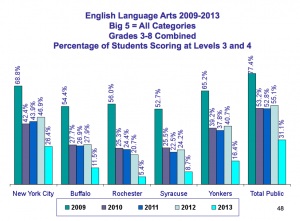
Hat tip to Gotham Schools, here is what happened in Reading:

NYCC

The math chart looks pretty similar. Proficiency rates, in short, crashed across New York and are now far closer to the proficiency rates of NAEP.

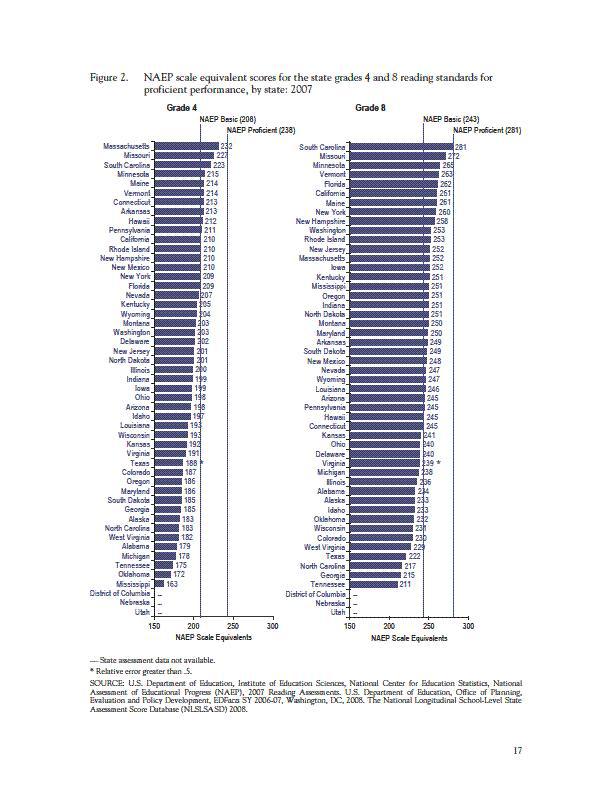
How did the old New York tests compare to NAEP? High middle and high in 4th and 8th grade reading respectively:

naep-table1

Note that neither Jay nor Greg have ever to my knowledge based any argument on the notion that Common Core standards were low or that the tests would be simple. Your humble blogger noted some years ago that even if the tests start out well, that he’d like to hear the plan for keeping them that way. I’ve heard realistic plans for states to pull out if (yes I heard you yell “WHEN!!!” all the way from the Raven Coffee Bar in Prescott Arizona-try the London Fog btw) the bad guys take them over but nothing yet on a broad strategy.

I’m, umm, not famous for paying close attention but my ears do remain open on that front.

Anyway the dummy down narrative however should be (at least for the time being) mothballed, as it is starting to look increasingly unsupportable by that pesky empirical reality stuff. Forewarned is forearmed, and you wouldn’t want to end up like, well, you know…


Choice First, Standards Second

August 1, 2013

cart-before-the-horse

(Guest post by Greg Forster)

The Miami Herald and Tampa Bay Times are now reporting that Tony Bennett is expected to resign.

As I’ve said all along, this is not about Tony Bennett. This is about whether educational standards should be formulated by politicians and their allies behind closed doors and then presented as the One Best Way to which all schools ought to conform.

Does that mean there can be no standards? Of course not! It means school choice must come first, standards second. Common Core and its allies are putting the cart before the horse.

Creating standards and accountability measures requires judgment. Judgment requires trust. What trust requires is a huge metaphysical subject we don’t have space to get into today, but let’s cut to the chase – people don’t trust the government to do this job by itself, behind closed doors and with no alternatives permitted, and they are right not to do so.

That is not because one particular person or one particular party is corrupt. It is written into nature of things, it is woven into the very fabric of the universe, that human social systems don’t work that way. Not even Denethor, the most virtuous man in Gondor, could be trusted to hold the ring without using it: “If you do not trust me to endure the test, you do not know me yet.” “‘Nonetheless I do not trust you…Nay, stay your wrath! I do not trust myself in this.”

So if that’s not where standards come from, where do they come from? We obviously do have standards, for everything from technical specifications for smart phones to English grammar to the scientific method. Right now we don’t have standards for education. How do we get them?

We get them from the only place standards ever really emerge from: the open, free interaction of civil society, where people are allowed to try whatever makes sense to them and see what works.

Take the scientific method as an example. The early pioneers of modern science – Descartes and Bacon and that crowd – went down all kinds of ridiculous blind alleys. They tried things we would never bother with today. They set down rules for what you’re not allowed to do in science that we would now laugh at. Poor Bacon died from a pneumonia he caught while pursuing a cockamamie experiment, invented on the spur of the moment while travelling during the winter, to test the efficiency of snow as an agent for preserving meat.

So how did we get from there to here? Did the Royal Society convene the smartest smarties in the land and impose order on this chaos? No, we got here by giving scientists the freedom to try what made sense to them and seeing what worked.

They had endless debates. They disagreed about how to do science, about why they did science, about what science could and could not do. The debates were not a part of the chaos, the debates were the method by which order was eventually imposed on the chaos.

That’s what we need today. Instead of cooking up a One Best Way and then demonizing anyone who dissents, we need a forthright admission that we don’t have a consensus about what works, and to give people not only the freedom to experiment, but a social legitimization of their experimentation. Then we can have some really heated debates where we argue with each other over what works. This, and only this, can ultimately create consensus about what works.

I am not saying that government and political power play no role. I am saying government should play its proper role – as a servant of our civilization, not its master. I even think government has more of a job to do than simply forbidding force and fraud. That is why I favor school choice policies on their own merits, not merely as a stepping stone to “the separation of school and state,” as my libertarian friends would prefer.

A thriving marketplace of diverse options, where people are not only empowered to choose but also respected and honored for making their own choices, is the only path to standards. It is the only thing that can make standards legitimate and widely accepted. Of course this means giving up on the desire to impose them on everyone by force, but then, force is wrong and it doesn’t work anyway.

As long as the government runs a school system, it will need to set standards for that system. But it cannot even do that very effectively in the current environment, as we are seeing. A thriving marketplace of options would ultimately create standards with legitimacy and widespread acceptance. Those standards could then be imposed on the government system much more effectively than at present.

People who think standards are everything must choose – is it your goal to have the law tell everyone they must use your standards, and have everyone ignore the law; or to get everyone actually using some standards, even if they’re not yours? You can’t have both.


Correct Answers Are So Passé

July 8, 2013

(Guest Post by James Shuls)

In a recent interview, Douglas McCollum, senior vice president and general manager of education publishing company Pearson was asked, “What’s wrong with the way that we do K-12 assessment now?” His response:

We are going from the world of No Child Left Behind, where all of the assessments were objective, multiple-choice items, very cut-and- dry. They really don’t demand as much from students. [They’re] not really demanding that you be able to write, demonstrate your thinking skills, and so forth.

You know, I’ve often said to myself, “The problem with these tests is that their all too objective. What we need is a little subjectivity.” It seems I’m not alone. When asked what testing will look like in five years, McCollum responded:

It’s really all about being able to demonstrate your process of thinking. It’s about types of assessments that don’t necessarily have right or wrong answers, but that ask that students be able to defend a position. We’re moving more towards performance tasks, higher-order thinking, synthesis, comparisons.

I too have often thought that getting the right answer was so passé. After all, everyone knows that having the correct thinking is where it’s at. Although, what happens if I have the right answer with the wrong thinking?


James Shuls is the education policy analyst at the Show-Me Institute


TUDA and School Grading

May 2, 2013

(Guest Post by Matthew Ladner)

I had the opportunity to discuss A-F school grading with a thoughtful skeptic yesterday. Sadly my doubting Thomas remained a skeptic at the end of our discussion.  I showed him data about the trend for improving grades in Florida, and he produced data to show improving fuzzy labels from his state. I told him that Florida’s progress is confirmed by improving NAEP data, whereas his state has flatlined on NAEP over the last decade despite improved state scores. He wasn’t buying it.

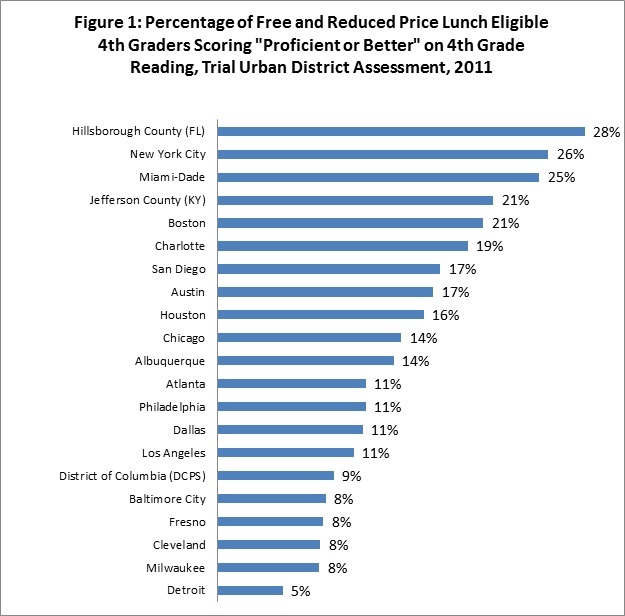
My failure to persuade however got me to thinking about the Trial Urban District Assessment NAEP data. I ran the proficiency numbers for free and reduced lunch eligible students in all the districts and found the following for 4th grade reading:

TUDA 4thNote that the top 3 performers all operate under an A-F school grading system Hillsborough (Tampa), Miami-Dade and New York City (NYC has operated under A-F longer than any non-Florida district). Obviously there are plenty of other factors at play than school grading, but note that a poor child in Tampa is almost six times more likely to be reading at a proficient level than a poor child in Detroit.

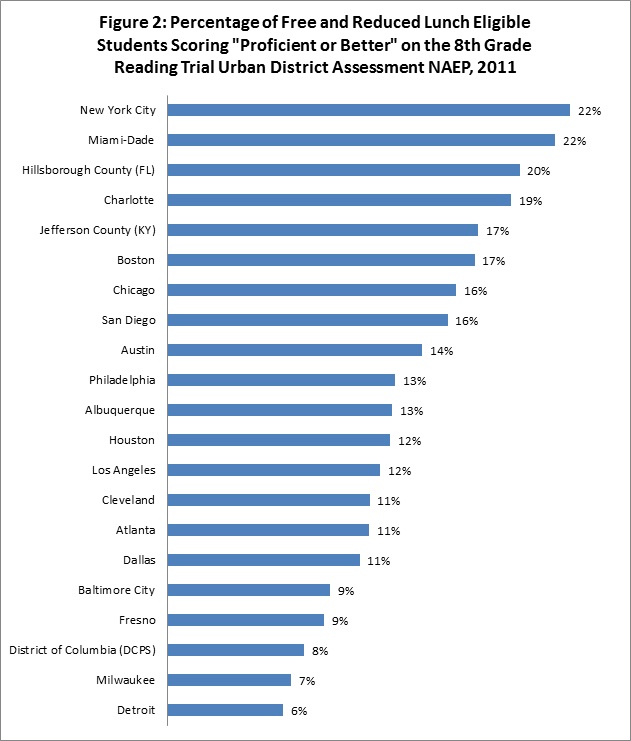
So I decided to run the numbers for 8th grade reading, and found the same basic result, with the same top 3 districts, just in a slightly different order. Top performers NYC and Miami have 8th grade students more than three times more likely to read proficiently than students in the lowest performer (again Detroit).

TUDA 8th

Why do the A-F districts top the list? A 2007 study by the Urban Institute is quite suggestive:

We analyze the impact of the accountability system on Florida’s students and schools using a three-part analysis. First, we estimate the effect of the accountability system and the threat of becoming voucher eligible on student test score performance, both in the short-run and in the longer term. Second, we study the effects of the reform on school policies and practices. Finally, we attempt to determine if the policies appear to affect student achievement or explain the change in student performance. We find that student achievement significantly increased in elementary schools that received an “F” grade by between 6 to 14 percent of a standard deviation in math and between 6 to 10 percent of a standard deviation in reading in the first year. Three years later the impacts persist.

Importantly, we also detect specific school policy changes implemented by the schools that explain part of these increases. Specifically, when faced with increased accountability pressure, schools appear to focus on low-performing students, lengthen the amount of time devoted to instruction, adopt different ways of organizing the day and learning environment of the students and teachers, increase resources available to teachers, and decrease principal control. These, combined with other policies, explain more than 15 percent of the test scores gains of students in reading and over 38 percent of the test scores gains of students in math, depending on the model specification. As such we find evidence that schools respond to accountability pressure in educationally meaningful ways.

So if the powers that be mandated that you were going to come back as an urban poor child, would you want to take your chances in Miami Dade or Dallas or Detroit?

Me too- and school grading is a part of the reason why.