National Standards, Welfare Reform and the Dream of the One True Way

March 16, 2010

(Guest Post by Matthew Ladner)

So why not national academic standards?  Many states, after all, have awful standards. Some with decent standards have nevertheless dropped their cut scores to the point of undermining those standards. Surely the states have proven that they cannot be trusted with this responsibility.  A set of high quality national standards could replace this balkanized mess and improve the sorry state of American education.

Actually, not so much.  First however we should consider the scale of the problem with state accountability tests.
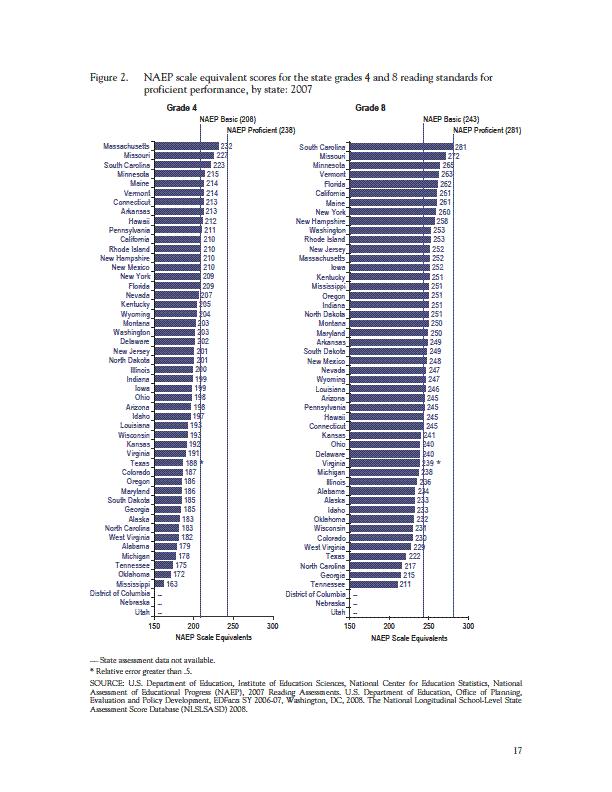
Above is a table from a NAEP study which used an equating procedure to determine where the “proficiency threshold” for each state’s exam would compare to the NAEP 4th and 8th grade reading exam. As you see, many states have proficiency cut scores which would merit a child a “below basic” score on NAEP. No state makes the equivalent of proficient on a 4th grade reading test equivalent to the 4th grade NAEP, and only one state does so on the 8th grade exam.

In Mississippi, one can “pass” the 4th grade reading test with a score which is 25% lower than “Basic” on NAEP, never mind proficient. This is a c*r*u*e*l j*o*k*e to play on children.

American welfare policy provides an insight into why it is not however a good idea to have the federal government take this over. Political scientists have established a strong relationship between shifts in public opinion and trends in federal spending. When the public decides they want more of something, like defense spending, they get it. Two exceptions had been foreign aid and welfare (AFDC). This spending endured despite widespread public hostility as a result of a Burkean elite consensus that this spending had to go on despite the fact that the people providing the funds, by large margins, didn’t want the money spent.

Much ink was spilled back in the late 20th century regarding whether the American public ought to have hated welfare as much as they did. Welfare queens- myth or reality…etc. etc. etc. Ultimately, this didn’t matter other than as a justifying myth to those who wanted elites to continue to ignore public opinion on the subject. America had a welfare program run out of Washington, and lacked a consensus about what to do about it, even after it was widely viewed as a failure.

Eventually an elite consensus formed around the notion that in the long run, welfare was cruel to the recipients, creating a powerful disincentive to work and develop job skills. This new consensus could be seen as early as the late 1980s, but for the most part, the national welfare Gosplan went on as usual, with minor tinkering at the edges.

Given the lack of a national consensus on what to do about AFDC, the Republican Congress and President Clinton eventually agreed to devolve welfare to the states. Different states tried different approaches, but by and large in did not prove terribly difficult for states to reach a consensus about how to deal with the issue. Nor did it prove difficult for the states to (mostly) do a better job than the federal government. The Personal Responsibility Act of 1996 is widely viewed as having been a rare social policy success.

In K-12, the long-term increase in the role of the federal government has coincided with a long-term collapse in the productivity of American K-12 spending. Federal involvement did not drive this collapse, but did contribute to it, and certainly did not prevent it. Secretary of Education Rod Paige lamented the billions spent on Title I with next to nothing to show for in terms of improved academic performance at the start of the George W. Bush administration. Sadly, not much has changed in terms of performance, but spending continued to rise.

Why not national testing? Given that there is no national consensus on what constitutes a high quality education, there is no prospect for an enduring national consensus on high quality standards. In fact, it seems fairly obvious to me from the figure above that there is a national consensus for LOW QUALITY ACADEMIC STANDARDS AND TESTS.

The danger in creating “common core standards” and then forcing states to adopt them through NCLB is that when they get dummied down, and they will, they drag the entire nation with them. Despite the fact that the status-quo is awful, it could be worse: we could have the entire country saddled with bad standards and tests.

Federalism has not been a cure for K-12 because all states have essentially the same problem: large politically powerful special interest groups in every state who prefer the status-quo. In recent years, however, we have not lacked for “labs of reform” out in the states. Jeb Bush’s reforms in Florida have significantly improved academic outcomes for disadvantaged children. The NAEP needle seems to be moving in the right direction in Washington DC. Massachusetts is proud of its standards led reforms and highest overall NAEP scores. Indiana has a reform-minded governor and schools chief determined to learn the lessons from these examples, and to take the next steps.

To be sure, these examples are few and far between, but they do exist. Just as Tommy Thompson led the way on welfare reform by seeking federal waivers from a federal “one true way” on AFDC, those few states that have departed from the “throw more money at schools and wring our hands” consensus fostered by the teachers union have shown progress as well.

It is however NOT likely to be the case that there will be any sort of sustainable national consensus on using high quality standards or tests in Washington DC. The same political forces which dummied down most of the state tests will eventually, if not from the start, dummy down a national effort. The genius of federalism is that a state consensus can be developed much easier in a state than in the nation as a whole. As more states enjoy success, we can expect other states to copy their practices through the normal process of policy diffusion. This process is already under way.

We could however suspend the laws of political dynamics. We could skillfully impose strong tests and standards on states against their wills, and resist their efforts indefinitely to undermine such tests until such time as the public grew to accept, love and defend them from special interest attack. Riiiight. It is also worth noting that while a DC elite consensus fended off AFDC from the public will for decades, they *ahem* got it WRONG…

Sorry kids, but the road to K-12 reform is a long, hard slog that primarily leads through 50 state capitols. We already have a national test for gauging the effectiveness of  state K-12: NAEP. The only reason that NAEP wasn’t dummied down is because no one’s school label or job performance hangs on the results. It is hard enough to maintain a consensus for decent standards in a handful of states. The chance that it will happen at the national level is vanishingly small and the danger of such an attempt very real.


The Dam Continues to Crack

March 15, 2010

(Guest post by Greg Forster)

Over the weekend, Pajamas Media carried my column on the Rhode Island teacher firing flap:

That leads us to the second question: why does Obama think he can advance himself by gratuitously hacking off the teachers’ unions? Answer: because the unions are on the way down, and he wants to ingratiate himself with the people who are taking them down.

On the left, the dam continues to crack. How long before it breaks?

And what happens when it does?

In the long term, I’m as optimistic as I ever have been about the prospects for real reform — especially for vouchers, the only reform that will make any of the other reforms sustainable. In the Cold War, the Russians had more men, more missiles, more tanks, and (let’s be honest) more guts. The only things we had that they didn’t were the entrepreneurial spirit and a just cause. And guess what? It turns out that in the long run, that’s what you really need.


National Standards Nonsense

March 10, 2010

The national standards train-wreck is pulling into the station, again.  This time it is a completely voluntary set of national standards in the same way that complying with a 21-year-old drinking age is completely voluntary for states to receive federal highway money.  States had to commit to a rushed and largely secretive national standard setting process as part of the Race to the Top application.

Well, now the draft standards have been released for a hurried public comment period before they try to cram them into place.  In the end they’ll probably fail to get all the states on board for anything meaningful, but it won’t be for lack of arm-twisting.  The Gates Foundation has sprinkled money on just about every education policy organization to ensure their support or at least muted opposition.

Even people and groups that should have no interest in these national standards and even expressed skepticism of them in the recent past are now embracing them.  Barely two weeks ago Checker Finn wrote:

This is enormously risky and, frankly, hubristic, since nobody yet has any idea whether these standards will be solid, whether the tests supposed to be aligned with them will be up to the challenge, or whether the “passing scores” on those tests will be high or low, much less how this entire apparatus will be sustained over the long haul.

But today he is quoted in the New York Times expressing his enthusiastic support:

I’d say this is one of the most important events of the last several years in American education… Now we have the possibility that, for the first time, states could come together around new standards and high school graduation requirements that are ambitious and coherent. This is a big deal.

What gives?  Nothing in the draft standards should have put Checker at ease about their rigor.  And nothing has happened that has addressed his earlier concerns about aligning tests, setting high cut scores, or sustaining rigor over time.

Similarly the folks over at Core Knowledge have decided to drink the Kool-Aid.  Just a few months ago I expressed frustration with national standards advocates:

Every decade or so we have to debate the desirability of adopting national standards for education.  People tend to be in favor of them when they imagine that they are the ones writing the standards.  But when everyone gets into the sausage-making that characterizes policy formulation, it generally becomes clear that no one is going to get what they want out of national standards.  What’s worse is that the resulting mess would be imposed on everyone.  There’d be no more laboratory of the states, just uniform banality.  Of course, some people always hope that they’ll somehow manage to sneak their preferred vision into place without having to go through the meat grinder.

At the time Core Knowledge’s Robert Pondiscio linked to that post and added “I’m inclined to agree.”  But today he is the press contact for a statement from Core Knowledge declaring that the new draft national standards are a “not-to be-missed opportunity for American education.”

What’s even more amazing is that the draft national standards are being guided by the same 21st Century Skills nonsense articulated by Tony Wagner.  Core Knowledge supporters should recoil in horror at this approach unless they fantasize that they will “somehow manage to sneak their preferred vision into place” without the edublob noticing and blocking them.  Good luck.

I’ve seen this movie before and it doesn’t end well.  The standards will inevitably be diluted and made even more 21st century skill-like to gain sufficiently broad support.  The standards-based reformers at Fordham and Core Knowledge will end up renouncing the final product, but will continue to believe that if only the right standards were adopted all would be well.  And we’ll start this all over again in about a decade.

Wash.  Rinse.  Repeat.


Little Ramona Delivers the Fail

March 9, 2010

(Guest post by Greg Forster)

My response to the article in today’s Journal by Little Ramona is mostly the same as Whitney Tilson’s response to her book. From his e-mail blast today:

So far I’m hugely unimpressed.  She does a nice job of capturing the failures of the existing system and takes delight in poking holes at reform efforts over the past decade (while playing fast and loose with the facts and/or only presenting one side of the story), yet there is a shocking, gaping void when it comes to any thoughtful ideas for alternatives.

In other words, her attempt to say anything that is either new or interesting has failed.


Checker’s Journey toward Enlightenment Begins

February 24, 2010

(Guest post by Greg Forster)

I see Checker is belatedly starting to realize that any national standards for curricular content will be produced by a horribly politicized sausage-making process that will inevitably be hijacked by the Dark Side and produce a result that does more to serve political agendas hostile to students’ interests than to promote better curricula.

He’s only just starting to realize the truth. He still thinks the process can be gotten back on track if only people would just be reasonable and work together and keep the good of the children in mind. So clearly he remains in the Vale of Illusion. But his journey on the path to Enlightenment has begun.


I’ll Have Some More of What Florida’s Having

January 11, 2010

(Guest Post by Matthew Ladner)

The Education Trust has released a new analysis of ethnic and income based achievement gaps using NAEP data. They take a fairly comprehensive view, noting that some gap narrowing (with overall improvement) is much better than others (with the gaps narrowing due to stagnation or declines among advantaged students). Overall performance matters as well, etc.

Overall, they have a winner’s circle of states: Delaware, Florida, Massachusetts, Texas and Vermont. Also a “bottom states” category: Arizona, California, Michigan, Mississippi and Rhode Island.

I wonder what the flat-earthers few remaining opponents of Florida’s reforms will have to say about this study. I’ll check in at the Gradebook Florida ed policy blog to find out, as the comments section is a haunt for this very interesting group of people. I wonder if they have heard the story about the Japanese soldier who hid in a swamp and defended a Pacific Island from Allied invasion until the early 1970s… 

Having looked at Florida’s NAEP scores from the 1990s, which were both very low and flat, it seems likely to me that had this analysis been done in 1998, Florida would have been either in or near the loser’s circle.

Speaking as an Arizonan, well, let’s just say we have a lot of work to do out here in the desert.


Marcus on Tenure & Test Scores

December 2, 2009

HT Education Week

(Guest post by Greg Forster)

On NRO today, Marcus soldiers on through the endless New York test score tenure wars, reporting on a gutsball move by Mayor Bloomberg:

New York’s state legislature gave teachers a gift last year by banning the use of student test-score data in tenure decisions. Many expect the legislature to allow the law to expire next year, but Mayor Bloomberg refuses to wait. Last week, he ordered schools chancellor Joel Klein to use the data anyway, arguing that the teachers up for tenure this year were hired in 2007, and a careful reading of the law suggests it applies only to teachers hired after July 1, 2008.

I’m not a Bloomberg fan on any other issue, but on education he’s a cut above most mayors. And remember, he does this in a town with a City Council so thoroughly corrupted by the unions that legislators actually read from union cue cards during hearings.


Ed Schools Take the FCAT

November 25, 2009

(Guest post by Greg Forster)

Good gravy! Never mind the debate on using test scores to evaluate teachers. Florida is actually using test scores to evaluate teacher colleges:

It determined what percentage of graduates from each program had 50 percent or more of their students make a year’s worth of progress [on the FCAT]. USF’s College of Education — a huge pipeline for teachers in the Tampa Bay area — had 76 percent of its graduates reach that bar, putting it ninth among the 10 state university programs. Florida International University in Miami topped the field at 85 percent. The University of West Florida in Pensacola was last at 70 percent.

The only problem I can see here is that this just compares education schools to one another. All education schools are part of the problem. Still, I can see a lot of value in knowing which ones are more a part of the problem or less – not least because if they start competing with one another on the basis of results, maybe someday one of them will actually produce a radical transformative revolutionary breakthrough and actually become a value-adding rather than value-subtracting part of the education system.

62% of a hat tip goes to Flypaper’s Andy Smarick. I’m penalizing Andy by withholding 38% of the hat tip because he claims, with no justification, that Arne Duncan must somehow deserve some credit for this move. First of all, as Andy sort of sheepishly admits, a move like this must have been in the works for a while before reaching fruition.

But more important is that Florida has been the nation’s leader in this field for a long time now. Florida doesn’t follow the USDOE on this issue, the USDOE follows Florida. The only effect the USDOE has ever had on Florida’s interest in using test scores for evaluation purposes is to prevent it from going further faster.


Stop the National Standards Train

November 16, 2009

As I’ve said before (here, here, and elsewhere), I can’t understand the enthusiasm of education reformers for national standards and testing.  Advocates for the status quo and/or pure nonsense are much better positioned to control the process of national standard-setting and test-writing than are advocates for meaningful reform grounded in evidence-based approaches.

In case you had any doubts, the current round of national standards and testing craze is once again being hijacked by the Dark Side.  My colleague, Sandra Stotsky, has an excellent piece in the current issue of City Journal ringing the alarm bells:

A distinct lack of interest in allowing mathematicians a major voice in determining the content of the high school mathematics curriculum isn’t confined to educational research publications or presentations. A new effort is under way to develop national math standards for K–12. The two organizations running the effort—the National Governors Association and the Council of Chief State School Officers, with support from both the Department of Education and the National Education Association—have not yet invited a single mathematical or science society to ensure that the high school mathematics standards and “college-readiness” standards they propose in fact prepare American high school students for the freshman calculus courses that serve as the basis for undergraduate majors in engineering, science, and mathematics (as well as other mathematics-dependent majors and technical/occupational programs). The effort, which is being pushed very quickly, seems determined to do an end run around the country’s mathematical and scientific organizations and the panel’s recommendations on the major topics for school algebra.

Who controls this process?  Advocates of “constructivism” and  “cultural-historical activity theory” do.  If you don’t know what this gobbledy-gook means, Sandy helpfully explains: 

Two theories lie behind the educators’ new approach to math teaching: “cultural-historical activity theory” and “constructivism.” According to cultural-historical activity theory, schooling as it exists today reinforces an illegitimate social order. Typical of this mindset is Brian Greer, a mathematics educator at Portland State University, who argues “against the goal of ‘algebra for all’ on the grounds that . . . most individuals in our society do not need to have studied algebra.” According to Greer, the proper approach to teaching math “now questions whether mathematics as a school subject should continue to be dominated by mathematics as an academic discipline or should reflect more fully the range of mathematical activities in which humans engage.” The primary role of math teachers, constructivists say in turn, shouldn’t be to explain or otherwise try to “transfer” their mathematical knowledge to students; that would be ineffective. Instead, they must help the students construct their own understanding of mathematics and find their own math solutions.

We need to stop this national standards train before we all go off the rails.


Borsuk: Democrats on Both Sides of K-12 Wars

September 15, 2009

(Guest Post by Matthew Ladner)

Good stuff from MJS veteran Alan Borsuk. Remember, you read it here first.