Looking Abroad for Hope

November 5, 2008

hope

HT despair.com. Looking for a Christmas idea to suit the new reality? Why not a despair.com gift certificate – “For the person who has everything, but still isn’t happy.”

(Guest post by Greg Forster)

Looking around for something to give me hope this morning, I find the best place to turn (for today, at least) is outside the U.S. Specifically, I turn to the recently released study in Education Next by Martin West and Ludger Woessmann finding that around the world, private school enrollment is associated with improved educational outcomes in both public and private schools, as well as lower costs.

Well-informed education wonks will say, “duh.” A large body of empirical research has long since shown, consistently, that competition improves both public school and private school outcomes here in the U.S., while lowering costs. And the U.S. has long been far, far behind the rest of the world in its largely idiosyncratic, and entirely irrational, belief that there’s somthing magical about a government school monopoly.

And private school enrollment is an imperfect proxy for competition. It’s OK to use it when it’s the best you’ve got. I’ve overseen production of some studies at the Friedman Foundation that used it this way, and I wouldn’t have done that if I didn’t think the method were acceptable. However, that said, it should be remembered that some “private schools” are more private than others. In many countries, private school curricula are controlled – sometimes almost totally so – by government. And the barriers to entry for private schools that aren’t part of a government-favored “private” school system can be extraordinary.

That said, this is yet another piece of important evidence pointing to the value of competition in education, recently affirmed (in the context of charter schools, but still) by Barack Obama. Who I understand is about to resign his Senate seat – I guess all those scandals and embarrasing Chicago machine connections the MSM kept refusing to cover finally caught up with him.


Why I Vote on Election Day

November 4, 2008


A bunch of my friends and family have voted early.  Not me.  I’m voting on election day.  Why?

Look, let’s be clear that it doesn’t make any sense to vote if your goal is to determine the outcome of the election.  The probability that the outcome would be tied in the absence of your vote is so remote as to not be worth your time bothering.  And even in the extremely unlikely event that the margin in a presidential election were 1 vote, the outcome would almost certainly be decided by a handful of unelected judges rather than your vote.  We’ve already seen that even if the margin is a few hundred votes, there is enough imprecision in the casting and counting of votes that the courts will really determine the outcome. 

I know, I know, you can say that if everyone thought that way, no one would vote.  But that’s entirely beside the point.  The self-interested rational thing to do if you are only concerned with determining the outcome is to urge everyone else to vote and save yourself the effort. 

So why vote if it is irrational to expect that your vote will be the deciding one?  Rational people don’t vote to break what they otherwise expect to be a tie.  They vote because it is part of a social, communal experience. 

And that is exactly why I am voting on election day and not early.  I want to go to the polling place, visit with my neighbors, and drink some bad coffee.  Voting is like doing the wave at a football game.  It almost certainly has no effect on the game.  It’s purpose is to participate and enjoy the social feeling of being part of something.  It makes no more sense to vote early than to do the wave while watching the game at home on your TV.  Voting, like doing the wave, is a social experience whose benefits depend upon context.

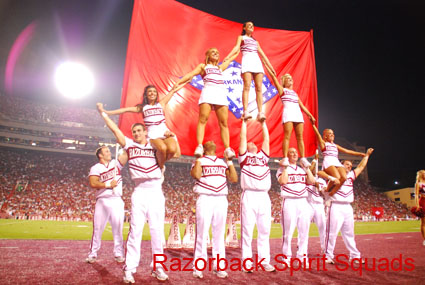
Besides, politics is becoming more like sports everyday.  People choose teams and root for them, even if there is no obvious benefit to them for doing so.  They watch the returns like looking at the boxscore.  So, I want to be at the game when I vote, just like I’m going to be at Bud Walton Arena, the basketball palace of mid-America, to watch the Razorbacks.  I want to call the Hogs with the crowd.  I want to see them raise the Arkansas flag banner behind the pyramid of cheerleaders (it brings a tear to my eye, everytime).


PJM on Candidates’ Education Flip-Flops

November 3, 2008

(Guest post by Greg Forster)

Over the weekend Pajamas Media carried my column on how Obama and Palin have flip-flopped on education:

Suppose I told you Candidate A has supported rigorous academic standards, has stood up to the teachers’ unions — even been booed by them at their convention — and proclaimed the free-market principles that schools should compete for students and better teachers should get higher salaries. On the other hand, Candidate B says that competition hurts schools, that kids should be taught a radical left-wing civics curriculum, that we should throw more money at teachers’ unions — excuse me, at schools — and that rigorous academic standards should be replaced with the unions’ old lower-the-bar favorite, “portfolio assessment.”

Candidate A is Barack Obama. So is Candidate B.

Meanwhile, Candidate C has made an alliance with the teachers’ unions, opposed school choice, thrown money at the unions — excuse me, at schools — and even helped undermine a badly needed reform of bloated union pensions. On the other hand, Candidate D has broken with the teachers’ unions, demanded that schools should have to compete for students, and endorsed the most radical federal education reform agenda ever proposed by a national candidate, including a national school choice program for all disabled students.

Candidate C is Sarah Palin. So is Candidate D.

Important disclaimer:

None of this implies anything about the overall merits of any of these candidates. One can love a candidate overall while hating his or her stand on education, and vice versa.


Obama Wins Arkansas!

October 31, 2008

… at least in the mock election held in many Arkansas schools.  According to the Northwest Arkansas Times, “Statewide, Obama won the mock election for Arkansas with 49, 088 votes, compared to 34, 393 for McCain.”  Does this mean anything for Tuesday’s outcome in the state?  I doubt it.  McCain holds a double-digit lead in multiple polls in the state.  But who knows?


Palin Backs Special Ed Vouchers

October 24, 2008

In a speech in Pittsburgh today, Governor Palin endorsed the idea of special ed vouchers saying, “In a McCain-Palin administration, we will put the educational choices for special needs children in the right hands — their parents’. Under reforms that I will lead as vice president, the parents and caretakers of children with physical or mental disabilities will be able to send that boy or girl to the school of their choice — public or private.

Under our reforms, federal funding for every special needs child will follow that child. Some states have begun to apply this principle already, as in Florida’s McKay Scholarship program. That program allows for choices and a quality of education that should be available to parents in every state, for every child with special needs.”


Keegan vs. Darling-Hammons debate webcast

October 17, 2008

(Guest Post by Matthew Ladner)

The chief education advisors for the McCain and Obama campaigns debate next week online. Check it out.


The Rawlsian Path Out

October 15, 2008

Perhaps children will read better by the light of my Broader/Bolder money bonfire…

(Guest Post by Matthew Ladner)

John Rawls’ influential work A Theory of Justice argued that societal ethics ought to be decided as if we were behind a theoretical “veil of ignorance.”

Behind the veil, no one would be aware of what his or her position would be in a forthcoming society. You would not know whether you would grow up the child of a billionaire or poor in the inner city. The veil creates an incentive to leave a path out of the latter scenario.

Matthew Miller’s reading of Rawls calls for the aim of public policy to be the creation equality of opportunity, rather than equality of condition. But how much of a path do public schools actually represent for disadvantaged children?

Gauging opportunity is tricky, given that we really only have information on the equality of condition. Let’s be brave and speculate. The percentage of free or reduced price lunch students scoring “Advanced” on the 4th grade NAEP reading test in 2007 was — drumroll – two.

That’s right. Two percent- two point zero. While this was double the one point zero from 1998, it is hardly satisfying.

Mind you, total per pupil spending as of 2004-5 was $10,725. So, a child that has been in the average public school in this country since kindergarten will have had somewhere in the neighborhood of $55,000 spent on their education by the time they reach 4th grade.

Might we not get two percent scoring advanced in the complete absence of a public school system? If we spend $55K per kid to improve their opportunities, shouldn’t we be doing a lot better than 2%?

Some of course will grumble that the Advanced level on NAEP is simply too high a bar to expect an economically disadvantaged child to clear. So, let’s go down a level- 15% of free and reduced lunch kids score “Proficient” on 4th grade reading. Add in your two scoring Advanced, and you have 17% of low-income children reading at a high level.

In return for the taxpayer’s $55,000, we get 83% of our low-income children reading at less than a high level. Half of these children score “Below Basic.” Here is NAEP’s definition of Basic in 4th Grade Reading:

Fourth-grade students performing at the Basic level should demonstrate an understanding of the overall meaning of what they read. When reading text appropriate for fourth-graders, they should be able to make relatively obvious connections between the text and their own experiences and extend the ideas in the text by making simple inferences.

That doesn’t sound like a great deal to ask for $55,000 and five years of schooling- but half of the nation’s low-income children didn’t get there in 2007.

Now, we actually have NAEP data for one urban school district- Washington DC. DCPS shells out over $20,000 per year per student. So, a 4th grader has “benefited from” more than $100,000 of funding. Or, at least someone has benefited. DCPS had exactly zero point zero low-income students scoring at the advanced level in 2007. Well, not precisely zero- the NAEP footnotes note that the number “rounds down to zero.”

Six percent of DCPS low-income 4th graders scored Proficient or better, 29% at Basic or better, and 71% at Below Basic.

Regardless of your philosophical viewpoint, these results simply cannot be credibly defended. When the Texas Rangers overpaid for Alex Rodriquez and found themselves in last place, the General Manager noted that he could be in last place with the lowest rather than a sky-high payroll. DCPS is in the same boat. Give me half of the DCPS budget as an incentive program for kids to read books at the library, and I’ll get you more than zero kids scoring as advanced readers.

Education is the key to social mobility. Those who believe in Rawlsian ideals will be facing the reality that they can either have an alliance with the defenders of the status-quo, or they can have an effective K-12 path out of poverty, but they cannot have both.


Huckabee Believes Aliens Caused Market Crash

October 13, 2008

Actually, he doesn’t.  But what he does suggest is almost as crazy. 

In an interview with Chuck Norris on his new Fox News show, Huckabee says that a friend of his in the financial business told him that the pattern of trading suggests that the crash may be the result of “economic terrorism.”  The Huckster emphasizes that his friend is not just some guy on the internet and that the theory is a “plausible argument.”  Norris then adds that the Chinese may have received some secret deal in exchange for our trade deficit with them that allows the Chinese to drill for oil off of the Florida coast without our knowing it. 

I’m not sure my summary could capture the full craziness of it, so David Kinkade at that great new blog, The Arkansas Project, has found a video of the exchange.

I hope stuff like this drives a stake through the vampire heart of Huck in ’12 talk. 

Why would Huck suspect the market dive to be caused by economic terrorists rather than the more obvious popping of the housing bubble and a credit-quality panic among banks?  Why is he asking Chuck Norris for his opinion?  Why does Norris offer an additional conspiracy involving the Chinese and drilling off of the Florida coast?  Why was this man ever considered a serious presidential candidate?

I have to add that it is especially scary when people who ought to be responsible start spinning conspiracy theories on TV.  The popularity of conspiracy-obsessed web sites, like Daily Kos, and Andrew Sullivan’s promotion of conspiracies about Palin show that “elites” are increasingly comfortable with conspiratorial thinking. 

Unfortunately, when elites peddle conspiracies, it lends credibility to all of the run-of-the-mill wacko-conspiracy theorists out there who feel legitimized.  In just the last month I’ve had two people freely offer their conspiracy theories to me about the Trilateral Commission, the neo-cons, etc… 

When will people learn that we have a hard enough time pulling off normal, openly-stated goals, like winning a war or regulating banks, to pull-off elaborate secret missions?  Human beings can barely walk upright let alone control global events.


Palin’s Palein’ on Education

October 3, 2008

(Guest post by Greg Forster)

I didn’t bother watching the debate, but from the comments around the web it looks like my prediction that there would be nothing really worth watching was accurate.

Cruising through the commentary, though, I came across this from Mickey Kaus:

Palin sounded like she was campaigning in Iowa for the teachers’ union vote when she talked about education. We need to spend more money. Pay teachers more. States need more “flexibility” in No Child Left Behind (“flexibility” to ignore it). I didn’t hear an actual single conservative principle, or even neoliberal principle. Pathetic.

So much for all that talk about how the McCain staff was overcoaching her. It’s remarkable – yet few seem to be remarking upon it, which is also remarkable – that Barack Obama is more of an education reformer than Palin. (At least, on paper he is. In practice they’re probably both about the same, which you can take as a compliment to Obama or as a criticism of Palin according to preference.) At any rate, her approach to education is pretty hard to square with McCain’s.

The lack of attention to this rather glaring contradiction, even by Palin detractors (and McCain/Palin detractors) who presumably have a motive to pay attention to it, shows just how irrelevant education has become as a national issue, at least for this cycle. Remember how big education was in 2000?

Good thing real reforms like school choice are winning big at the state level. The movement was wise not to bother showing up in DC for the big NCLB hulaballoo eight years ago. Now they’re not tied to NCLB or in general to the fortunes of education as a federal issue. I’ve heard some conservatives bash NCLB because it lacks serious choice components. But NCLB was never about choice. It seems clear that the choice components in Bush’s original proposal were only there to be given away as bargaining chips. The important question is, where would the school choice movement be now if it had tied itself to NCLB?


Stop Congress Before They “Help” Again

October 1, 2008

Greg and Matt had some excellent posts yesterday on the bailout.  Matt described how we got into this mess and Greg outlined the issues in dispute.  Today I want to talk about where we go from here.

I do not believe that a Congressional bailout is necessary to avert a catastrophe nor do I believe that it will effectively stop the economic damage that remains to be inflicted.  All that Congress is likely to do is shift the cost of the economic damage to a broader pool and hinder future growth with unwise regulations and new programs.

Despite scare-mongering to rush a bill through Congress, the reality is that the current turmoil is a normal popping of a speculative bubble fueled by Fannie and Freddie (government) guarantees on mortgages and artificially low Federal Reserve interest rates.  No matter what Congress does, a fair number of people are in homes they cannot afford and a number of banks own mortgages that will never be repaid. 

Shifting those bad mortgage securities from financial institutions to the government balance sheet changes nothing.  Someone is going to have to eat those losses.  If the bailout pays the banks above the market value for those securities, then the taxpayers will bear those losses, either in the form of raised taxes or higher inflation.  If the bailout pays market value, then the banks will not have any additional capital on their books and they will be no better off.  Either way, the economic damage of these bad mortgage securities on the economy will remain the same.

The only way that the government bailout could help is if the government pays above market value for the mortgages, strengthening bank balance sheets, but the amount that is paid turns out to be less than the intrinsic value of those securities, so the mortgages can later be resold without a loss to taxpayers.  But there is no reason to believe that the market value of those securities is less than their intrinsic value or that the government knows what the true intrinsic value of those securities is and will pay less than that amount.

To believe the case for the bailout you would have to believe that the government is the smartest hedge fund out there.  Keep in mind, there are potential buyers with capital willing to buy the bad mortgage securities, but not at a price that banks are currently willing to sell.  The banks don’t want to sell for the price that buyers would buy because they would have to write down the losses and be forced to raise capital themselves, which they are currently unable to do easily.  Instead, the banks are holding on, hoping that the government will pay them a higher price or that the market for these mortgages will somehow improve.

Instead of a bailout we should allow the market to work out these losses.  The government cannot stop the losses; it can only move them around.  And it can do some extra damage in the process, such as imposing new regulations and introducing moral hazard for future financial mistakes.

Despite elite opinion in the media and from many on Wall Street that a bailout is necessary, the passing of each day without a catastrophe demonstrates otherwise.  Sure, the markets have been volatile, but short-term market movements don’t indicate the long-term wisdom of policies. 

And let’s put things in perspective.  The economy grew last quarter.  Credit-worthy consumers can still get mortgages, car loans, and business loans.  The stock market is still higher than where it was a decade ago.  Things are painful but they are not catastrophic.

As Peter Robinson over at National Review’s The Corner says, “it has become impossible—simply impossible—to dismiss opponents of the bailout as mere hayseeds and (what to a lot of people amounts to the same thing) House Republicans.”  And a group of 200 academic economists from all ends of the political spectrum have come out against the bailout.

The hardest thing to do in a moment of crisis is to do nothing.  But in this case nothing is probably exactly what we need.

UpdateAlan Reynolds has a great piece at Forbes in which he documents that consumer lending has not declined.  He writes:

“On CNBC Monday, Democrat majority leader Steny Hoyer said the objective of the rescue package is to “unlock the credit” for consumers and business. And a Wall Street Journal editorial writer told CNBC, “Until we get the banks lending again, the economy will continue to contract.”

Such alarming comments never mention any facts. Why not? As Neil Cavuto recently noted on Fox Business News, the Fed reports bank loans every week.

U.S. Bank Loans (Billions of Dollars)

Week Ending Wednesday Business (Commercial & Industrial) Real Estate Consumer Interbank (Other Than Fed Funds)
Aug. 13 1,514.5 3,639.4 841.6 77.6
Aug. 20 1,509.1 3,653.3 845.6 75.3
Aug. 27 1,515.1 3,650.6 848.0 76.3
Sept. 3 1,514.8 3,631.3 846.8 77.2
Sept. 10 1,512.0 3,630.3 850.5 74.0
Sept. 17 1,531.2 3,625.2 847.1 72.3
         
Year Ago:        
Aug. 2007 1,311.1 3,498.4 774.0 82.7


Federal Reserve Board, “Asset and Liabilities of Commercial Banks in the United States” (H.8).

In August, bank loans to consumers were 9.5% higher than they were a year earlier–the fastest increase since 2004. The year-to-year increase in consumer and industrial loans was 15.5%, down only slightly from a recent record high of 21.6% in March. Real estate loans were up 4.1% for the 12-month period ending this August–flat lately, but not down…

Contrary to many comments, consumer and industrial loans actually increased in the latest week. Troubled giant banks have cut back on lending, but smaller banks have picked up the slack. Consumer and real estate loans dipped insignificantly through Sept. 17, remaining much higher than they were a year earlier. “