Cox: South and West surge without California

December 23, 2010

(Guest Post by Matthew Ladner)

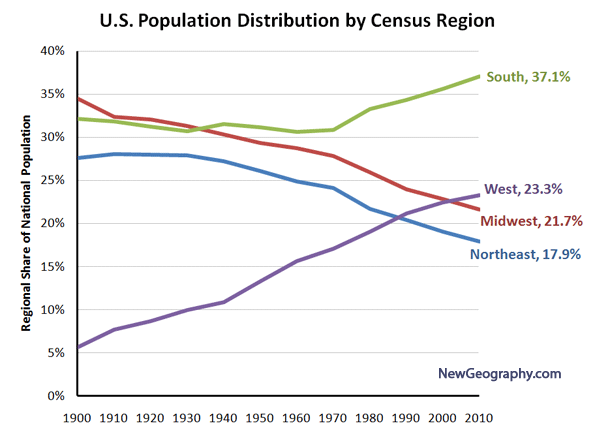
Violating Jay’s hiatus post yet again, just wanted to pass along Wendell Cox’s write up on the new Census numbers. Texas will be gaining **ahem** 4 new Congressional seats after the 2010 Census, Florida will get two, and a variety of Western and Southern state will pick up one, with the notable exception of California, which scored a goose egg.  The sclerotic states of the Midwest and Northeast lost seats yet again.

Two graphics from Cox tell the story:

and:

And for the Northeast and Midwest:


Susana Martinez appoints Hanna Skandera for NM Education Secretary

December 21, 2010

(Guest Post by Matthew Ladner)

Governor-elect Susana Martinez of has nominated Hanna Skandera to lead the Department of Education in New Mexico. Skandera served as Deputy Commissioner in Florida during Jeb Bush’s time in office, and Governor-elect Martinez campaigned on implementing reforms based on the Florida reforms during the campaign. An outstanding choice, and a great signal that Governor Martinez is very serious about reform.


Does Parent Trigger Cut the Gordian Knot?

December 8, 2010

(Guest post by Greg Forster)

The editorial in yesterday’s Journal covering the “parent trigger” earthquake in Los Angeles – at McKinley Elementary in Compton – argues that this could be a revolutionary new mechanism for advancing parental control of schools:

The biggest obstacle to education reform has long been overcoming the inertial forces of unionized bureaucracy. Parent trigger is a revolutionary shortcut, and bravo to the parents in Compton for making the leap.

The model is set to spread, argue the editors:

Parent trigger has support from Democrats including Sacramento Mayor Kevin Johnson, Los Angeles Mayor Antonio Villaraigosa, former Washington, D.C., schools chief Michelle Rhee and even Rahm Emanuel now that he’s running for mayor of Chicago. Legislators in Georgia, Indiana, Michigan, New Jersey, West Virginia and Maryland tell us they will introduce versions of parent trigger in the coming months.

Last time I looked in on the state of school governance reform in LA, I was skeptical. But that was more than a year ago, when the parent trigger mechanism wasn’t yet a part of the reform package. Last fall they were setting themselves up to have the public system hire private managers – which hasn’t worked in the past.

The parent trigger model is different. At a school that hasn’t made Adequate Yearly Progress ™ four years running, get a majority of parents to sign a petition and you can close the school, change administrators, or turn over the school to charter operators. The key difference is that the parents signing the petition decide what happens.

The district will fight them in court, of course, and they may win on a bogus technicality. As we learned in Florida in 2006, when the unions demand obeisance from their slaves you can’t count on a court to follow even the most tranparently clear meaning of the letter and spirit of the law.

But that’s not really relevant to the real policy question. All school reform policies are exposed to the naked assertion of thuggish power from union-bootlicking judges, and I don’t see much reason to think this one is more exposed (at least in principle) than any others.

So, that aside, is the Journal right that parent trigger is a way to cut the Gordian knot? Here are the advantages and disadvantages as I see them.

Advantages:

  1. School choice as a consequence of school failure is a proven way to improve public school performance. Even where the threat is never actualized, the mere threat produces clear gains.
  2. The parent trigger system may overcome the serious procedural obstacles that have dogged other “failing schools” models. The system for activating choice is (with an exception I’ll discuss below) simple, clear and not under the control of the government bureaucracy – and informing parents about their choices is easier because the system for creating choices involves getting parents informed and involved.
  3. The system is politically attractive, and partly for the right reasons. If a majority of the actual parents in the school want the school handed over, it’s really hard to be the people who say it shouldn’t be handed over.

Disadvantages:

  1. For the moment, the system is only promoting management change, at best involving charter operators, which is an improvement but is inadequate. But that’s less important because you could always use a parent trigger to activate vouchers.
  2. Petitions carry some problematic issues as a vehicle. Phrasing can be unclear, and/or people may not understand what they’re signing. Worse, the blob could organize its own counter-petitions to create confusion. It’s unlikely they could actually seize control of a school this way, but they could disrupt the process.
  3. More seriously, the system is only available at a small number of schools (those that don’t make AYP four years running). You could always fight to expand that, but the question is how far you could expand it. In theory you could do a parent trigger everywhere, but it’s not clear whether that would be politically viable. Maybe it would be if you did it in the right state. The larger question here is how wedded we are to a “failing schools” model that assumes schools are only failing if they’re populated by kids who are poor and dark-skinned. It’s an important question whether the parent trigger could be used to transition to a “failing schools” model that says any school repudiated by its parents is a failing school, or if it only reinforces the worst of our existing prejudices about what constitutes educational failure.
  4. Along a smiliar line, in its current form the parent trigger (like all previous “failing schools” models) reinforces government’s right to decide what constitutes a good education, because it relies on state testing as a parent-choice gatekeeper. In addition to my recent movement toward stronger critique of accountability testing for what are essentially pedagogical reasons, on an even more basic level it’s imperative that we not validate the idea that a good education is what government says it is. This, and #3 above, are what I meant when I said that parent trigger is politically attractive “partly” for the right reason. 
  5. Carrying on the theme of #3 and #4, most Americans wrongly believe there’s nothing wrong with their own schools; after all, the kids are middle-class whites and the schools are run by the government – nice, clean suburban government, not those icky urban machines – so how bad could they be? So suppose you give everyone a parent trigger and don’t get enough schools where you overcome all the obstacles of perception (to say nothing of the logistics) and get a majority to sign off. That would only validate the illusion that the status quo in the great suburban Middle America is A-OK.

So color me ambivalent. Parent trigger is certainly an improvement over Florida’s A+ model, where near-insuperable bureaucratic obstacles stood between parents and the actual excercise of choice. And I see some potential to use this as a path to making parents’ judgments the standard for what counts as a good school. But there are serious dangers here as well, if we don’t take seriously the omnipresent temptation to slide back toward liberal paternalism.


Now The Wheels Are Really Coming Off the National Standards Train

November 17, 2010

Back in March I predicted, prematurely, that the wheels were coming off of the national standards train.  Andy Rotherham had declared that the adoption of national standards was “close to a done deal,” but then the Wall Street Journal came out with an editorial strongly opposing national standards.

I thought that would derail the Gates-fueled and Obama/Duncan enforced train, but it did not.  As it turns out, states in the midst of a severe budgetary pinch are inclined to promise a lot in exchange for federal and Gates dollars now.

But all of those state promises to revise their standards, change their curriculum, change their professional development, and adopt new tests were all about steps that would occur far in the future.  Now that the federal money was already handed out and new money is unlikely to be forthcoming given the midterm election, the states may change their tune.  The states are like the kind of person who, when you stop buying her all of those flowers and expensive dinners, may not keep telling you how handsome and smart you are — and the wedding plans are probably in jeopardy.

To see how the tide is turning, check out this piece by Jim Stergios of the Pioneer Institute in the Boston Globe.  As Jim writes:

With Rick Perry said to be a shoo-in for the head of the Republican Governors Association, the Council of Chief State School Officers (CCSSO), which was one of a handful of lead groups pushing states to adopt national standards, may find itself in deep trouble. In fact, Perry, as the head of the RGA, may force the National Governors Association, which together the CCSSO, Achieve Inc., and the Gates Foundation, acted as cheerleaders for national standards, to revisit its position in support of national standards….

The opening that Governor Perry has on this issue is obvious and rumor has it that he is thinking very seriously about actions that reassert state control over the education agenda (and leverage the RGA to do so). The clearest place for Perry to begin is with the dozens of states that did not participate in Race to the Top. There are also key states that did participate, and in the case of New Jersey, California and Indiana even adopted the national standards, but did not win any RTT money.

The key states to watch are California, Indiana, Minnesota, New Jersey, Texas and Virginia. In addition to being states that either did not adopt the national standards, or adopted them and did not win federal funds, they have one additional and important commonality among them: They have had higher standards than most other states in the nation.

I think Jim Stergios is spot-on.  And as I’ve written before, getting agreement on national standards is almost politically impossible given that we are a large and diverse country with legitimate and competing visions of what schools should look like.  You could get states to pledge their support but as we are now seeing, getting the details in place is inevitably very difficult.


Chinese Interpretation of Waiting for Superman

November 12, 2010

I love how even Chinese communists understand the problems with local government monopolies and teacher union control of schools.

Update — As Chan noted in the comments, this was probably made in Taiwan, not communist China.  No matter, I was just trying to be as over-the-top as the video.  Gotta love Adrian Fenty with a machine gun.


NY Post Op-Ed on Klein

November 10, 2010

In addition to reading Matt’s post on the retirement of Joel Klein as New York City’s school chancellor, check out the op-ed I wrote with Stuart Buck that appeared in today’s New York Post.  Here’s a taste:

In 2003, when Klein became chancellor, only 21 percent of the city’s fourth-grade students were proficient in math, trailing the national average of 31 percent. By 2009, 35 percent of Gotham’s students were proficient at math, nearly catching the national average of 38 percent. New York City’s 14-percentage-point gain was twice as large as the 7-point gain nationwide.

The improvement in fourth-grade reading was similarly strong. Between 2003 and 2009 the percentage of the city’s fourth graders who were proficient at reading jumped from 22 percent to 29 percent. That 7-point gain far outstripped the national improvement, up just 2 points from 30 percent to 32 percent.

The performance of New York City’s eighth graders was less dramatic: Proficiency in the math NAEP rose from 20 percent to 26 percent, tracking the US rise from 27 percent to 33 percent. In reading, city eighth graders remained statistically unchanged, mirroring the national rate.

The large gains in fourth-grade performance and more modest improvements among eighth graders didn’t win over Klein’s fierce critics. The vitriol with which they denounced him was severe, even by New York standards.


Joel Klein Did Matter

November 9, 2010

(Guest Post by Matthew Ladner)

NYC Chancellor Joel Klein has announced his resignation to be replaced by Cathie Black of Hearst Newspapers.

I don’t know much about Ms. Black other than the fact that she apparently does not shy away from tremendous challenges. Newspapers in the age of a print death spiral and urban schools. What does one do for an encore- Middle East peace?

Early in the JPGB days, I wrote a post on Klein and his critics. I took a skeptical view of the Superheroic Superintendent model of reform.  I have changed my mind.  His run lasted 8 years, and NAEP scores improved by impressive margins.  Mayoral takeovers still don’t strike me as a very promising strategy, but Klein did produce results.

I wish Klein had another 8 years in him, but he leaves NYC schools significantly better than when he found them- a rare accomplishment for an urban superintendent.


2010 Election Results…big edu-implications

November 2, 2010

(Guest Post by Matthew Ladner)

Republicans take the U.S. House but the Democrats manage to hold the Senate. Paging Dr. Gridlock…

I just heard Larry Sabato just predict that as many as 10 state House chambers will switch from Democratic majorities to Republican majorities. The Indiana House is one of those chambers, giving Governor Mitch Daniels Republican majorities in each chamber.  Wisconsin may follow suit. Ditto for Ohio– where Kasich is now Governor elect, and Republicans recaptured a House majority and added to their majority in the Senate.

Not all the news is bad for the Democrats, most notably Harry Reid’s victory in Nevada. The majority leader’s son Rory Reid however fell short in the Nevada Governor race against Republican Brian Sandoval. This was an especially interesting race from an education angle, as Sandoval called for Florida reforms, and Reid proposed weighted student funding. Sandoval read Reid’s education plan, and declared that it was a good plan, so he was going to do it and the Florida reforms.

Susana Martinez will be the nation’s first Latina governor after winning the Governor’s office in New Mexico. Governor-elect Martinez platform also incorporated Florida reforms.

Speaking of Florida, the Governor’s race there between Democrat Alex Sink and Republican Rick Scott is very close. Current Florida Governor Charlie Crist is close to being very unemployed. Illinois governor’s race is also neck and neck.

Jerry Brown has won in California over Meg Whitman. Pray for him- the Democrats now control all the levers in Sacramento. The USA will never make progress moving up the education tables with California hanging as an a huge academic albatross around our neck.

Time to sleep. More later.

UPDATE 19 state legislative chambers flipped to the Republicans including full control of Pennsylvania to go along with IN, OH and WI and Michigan. Very tough night for Midwest Dems.

P.S. Republican Rick Scott has narrowly won the Florida governor race.


Election Coverage Later Tonight

November 2, 2010

(Guest Post by Matthew Ladner)

(Too) little noticed among the all-consuming drama of watching President Obama and Speaker Pelosi drive their Congressional majority off of a cliff are a number of governor and legislative races with education implications. Governorships and legislative chamber majorities are in play all over the place. Will try to pass on information here as I get it tonight.


UFT: If You Close Your Eyes, the Schools Look Fine!

October 22, 2010

HHGTTG on the many uses of towels: “wrap it round your head to … avoid the gaze of the Ravenous Bugblatter Beast of Traal (a mindboggingly stupid animal, it assumes that if you can’t see it, it can’t see you – daft as a bush, but very ravenous)”

(Guest post by Greg Forster)

The Journal reports that the New York City DOE, at the bidding of the UFT, is withholding teacher data that would allow the public to evaluate 12,000 teachers the same way the LA Times did in Los Angeles earlier this year. The data were to be released in response to public record requests by the Journal and other organizations, but the UFT sued. Now a court will have to pry the data loose.

Can you say “the new tobacco lobby,” boys and girls? Can you say “FINISH HIM?” I knew you could!

HT Whitney Tilson