Pass the Popcorn: Point Break

September 18, 2008

Like Trick or Treat Banker Dudes!

(Guest Post by Matthew Ladner)

Number one seed in the west so bad they’re good movies tournament: Point Break.

Point Break is a sublimely absurd action flick starring Keanu Reeves, Patrick Swayze and Gary Busey.

So, Keanu Reeves plays FBI Special Agent Johnny Utah (no, I’m not making that up), a former all Big 10 defensive back who didn’t make the pros due to a knee injury. Gary Busey plays the plantonic ideal of the grizzled-veteran-who’s-upset-to-have-to-train-a-damn-rookie stereotypical cop character.

If you guessed that Johnny Utah’s knee injury reappears at an inopportune moment, you’ve been watching too many bad movies. Give yourself a gold star.

Bank-robbers known as the Ex-Presidents are giving our FBI heroes fits. Barging into banks wearing rubber masks of Nixon, Carter, Reagan etc, the Ex-Presidents have pulled off a series of heists.

Busey notices that one of the ex-Presidents has a tan line, leading Johhny Utah to go undercover as a (real stretch here) surfer to find them out, leading to the following confrontation:

In this scene, Johnny Utah chases Ronald Reagan after a robbery. Unfortunately, this clip starts after Ronald Reagan (Swayze) has used a cigarette lighter and a gas pump as a flamethrower, and has some random song imposed on it. Nevertheless, you will see what has got to be the greatest a pied chase scene ever:

Point Break has Johnny Utah jumping out of a plane without a parachute in a fit of rage and even Ronald Reagan throwing a bulldog in anger, and the authorities killing the lead singer of the Red Hot Chili Peppers.  But most of all, it has the best Keanu-rific line delivered line of all time.

Now, in most Keanu Reeves movies, there is at least one line delivered with laughter inducing awkwardness. One of the brilliant things about The Matrix was that the Wachowski brothers made no effort to suppress the insuppressable, and instead brought on the Keanurific moment on purpose: I KNOW KUNG FU.

Sure, there are other candidates for greatly awful Keanu lines. In Something’s Got to Give for instance, Keanu tells Diane Keaton You smell good. I knew you’d smell good!

Point Break however takes the prize. In the priceless finale Swayze is captured by Johnny Utah, handcuffed on the beach, preventing him from going out to commit surfer suicide on the most bitchin’ wave of all time. Johnny explains:

YOU’RE GOING DOWN!!! IT’S GOTTA BE THAT WAY!!!!!!!!!!!!!!!!!!!!

Swayze then begs Utah into letting him off himself like a true SURFER-ZEN-DOOFUS, crushed by the super tsumami. Johnny’s FBI badge washes away in the tide, roll credits.

But did Swayze actually die? Believe it or not- there is a sequel planned.


Pass the Popcorn: In Praise of Sequels . . . But Not These Sequels!

September 12, 2008

Good Will Hunting 2: Hunting Season! (It’s Kevin Smith, so use caution)

(Guest post by Greg Forster)

Sequels are a good thing. Why does everybody complain about them?

Do they represent a new trend, one whose influence might be negative? No, they’ve been around since the medium of film began. If you’re going to assert that sequels have ruined the movies, what’s your control group?

Are sequels on average lower in quality than non-sequels? It seems unlikely. Sure, most sequels are bad. So are most other movies. That’s just the way it is.

And that’s the starting point, I think, for why people get this bee in their bonnets about sequels. The one thing sequels have in common is that they all follow upon, and thus invite comparisons to, a successful movie – the one that started the franchise. Since the first movie in the series is always one that a lot of people thought was good, and most movies are bad, statistically it will always be unusual for a sequel to live up to the standard set by the original. And since that’s the metric we judge them by, we dislike them.

But sequels do for movies what brands do for other consumer products: they convey information about the content of the product, thus helping consumers make a more informed choice.

It’s true that the imperatives of the movie business create much stronger incentives for filmmakers to “dilute the brand” than are present for other consumer goods. Thus, the extremely strong trend for movies to get worse as a franchise ages. In some of the older francises, you can actually trace the life cycle from awesome to mediocre to brain-numbingly stupid to the franchise reboot that brings you back to awesome. (Cue Elton John: “It’s the ciiiiiiiiiiiiiircle of liiiiiiiiiife . . .”) Occasionally you get a fallow period between the end of one cycle and the start of the next, where the filmmakers have realized something is wrong, so the quality gets somewhat better again, but they’re still trying to figure out how to get back to where they should be. And, of course, sometimes there’s a failed reboot.

By my count, James Bond has had six reboots since its debut. I include Goldfinger as a reboot because the previous two movies just don’t have the winning Bond formula down yet (in contrast to the books, where the Bond formula was actually in place from the very start). And Dr. No is in the “awesomeness” category solely because it was first – I dare you to sit all the way through it now. Few movies have aged worse.

Reboot Awesomeness Dr. No Goldfinger Live and Let Die The Living Daylights GoldenEye Casino Royale
Still Good From Russia with Love   The Man with the Golden Gun   Tomorrow Never Dies  
Passable     The Spy Who Loved Me   The World Is Not Enough  
Please Kill Me Now!   Thunderball Moonraker Licence to Kill Die Another Day  
Fallow Period   You Only Live Twice, Diamonds Are Forever For Your Eyes Only, Octopussy, View to a Kill      
Failed Reboot   On Her Majesty’s Secret Service        

And if that doesn’t get a comment thread going, nothing will.

But, having praised the phenomenon of sequels in general, let me balance the scales by making fun of some upcoming sequels that the world really, really does not need:

Huh? Of all the movies Pixar could be making a sequel to, they’re going with this?

All the world’s a racetrack as racing superstar Lightning McQueen zooms back into action, with his best friend Mater in tow, to take on the globe’s fastest and finest in this thrilling high-octane new installment of the ‘Cars’ saga. Mater and McQueen will need their passports as they find themselves in a new world of intrigue, thrills and fast-paced comedic escapades around the globe.”

Do you like that? Cars is now a “saga.” Wonder how many they’ll make before the well runs dry.

Uh . . . they all died. That’s the point of the story. What’s the sequel going to be about?

Movieinsider.com dryly notes of “Untitled 300 Sequel Project” that “no plot details have been announced.”

Maybe we get to watch them bury all the bodies.

The sequel will be shot in the Smithsonian. The perfect pair – a brainless movie franchise and the museum conglomerate that actually manages to make American history boring.

The project was started by Disney without Pixar’s involvement, solely to gain bargaining leverage over Pixar. In other words, they started it because they knew it was a bad idea and they wanted to hold Pixar’s baby hostage. The first thing the Pixar people did when they merged with Disney was kill this project.

Now they’re really making it. Check out the plot. Can even Pixar pull this off?

Where have you gone, Steve Martin? A nation turns its lonely eyes to you . . .

Rambo 5. Yes, Rambo 5. I would never make that up.

But after making fun of all these sequels, let me end on a positive note: Power of the Dark Crystal. See you in 2009.


Pass the Popcorn: City of the Dark Knight (Issue #5)

September 5, 2008

(Guest post by Greg Forster)

Okay, okay, okay, okay, okay.

I saw it for a third time last night and now I just have to post one more City of the Dark Knight before letting this movie go (as promised two weeks ago).

You may not be surprised to hear that after three viewings within three months, the “pencil trick” has lost all its magic (so to speak). As the Joker walks into the room, I’m sitting there thinking, “here comes the pencil trick.” And of course that sucks all the life out of it.

But much more important, every time I see this movie the story of Harvey Dent comes across more fully and more believably. Since Dent has been mostly in the background in my posts on this movie, today we’re going to be all Dent all the time.

Part of the reason the Dent story made less of an impression on me during the first viewing is just my own idiosyncratic way of experiencing movies. I generally don’t “look ahead” mentally while watching a movie. I know lots of people do that, and God bless them. Among regular moviegoers, those who look ahead are probably in the majority. One very dear friend of mine, who has worked in Hollywood full time for about twelve years now, looks ahead so diligently and is so intimately familiar with the conventions of the medium and the imperatives of storytelling that she claims no movie ending has ever surprised her – yet she also claims this has no impact on her enjoyment of movies. (And I guess the latter claim must be true, or she wouldn’t work in Hollywood.)

But that just isn’t how I’m built. It isn’t a conscious decision; I just don’t do it. I experience the movie as it comes. In some ways it’s better, in some it’s worse. Despite my friend’s testimony, I can’t help but think that plot twists and surprises must be much more enjoyable for me than for her. And I have a lot more patience for slow-paced movies like Heat, Unbreakable and Ghost Dog. I’m not sitting there thinking, “come on, come on, get on with it,” because I’m not looking at where we’re going, just at where we are. On the other hand, foreshadowing has to be pretty blatant before I’ll notice it. (One clever little movie, The Opposite of Sex, has the main character – a teenage girl – narrating the movie as it happens, on the pretense that she’s in control of what’s on the screen. In the first scene she’s packing up to run away from home, and she puts her father’s pistol in the backpack. Narration: “Oh, and this part where I take the gun? That’s like, duh, gonna be important later! My English teacher says that’s called foreshadowing.”) And if things happen early in a movie that turn out to have more significance later, I’m slower to catch up.

On second and subsequent viewing, however, you can’t help but look ahead. And when you do that, the Dent narrative comes across much better. The second time, when things happened like Dent saying “you either die a hero or you live long enough to see yourself become the villain,” I noticed them and said, “oh, I see what they’re doing here.” But it was still coming across all in bits and pieces. The third time was the charm – I saw the whole Dent narrative pull together. On the third viewing you’re bearing these things in mind from beginning to end – for example, one of the keys to the Dent narrative is that Dent knew all the time that Wertz and Ramierez – the cops in Gordon’s unit who got Rachel killed and him disfigured – were dirty. I don’t think I realized the full importance of that until the third viewing.

Obviously Chris Nolan was counting on you to look ahead. From the moment you hear the name “Harvey Dent,” you’re supposed to be thinking, “oh, he’s going to become evil.” And given the core audience for this movie, I’m sure that was a very sound decision. The movie is much more economical this way – sound economy being a precondition of artistic achievement.

It also helped that I now understand the Joker’s plan better. (Yes, in spite of his claims, he has a plan.) When he says to Dent “introduce a little anarchy” and hands him a gun, he’s not mainly inviting Dent to go out and kill Maroni – which is what I thought the first time. Obviously he does hope that Dent will go out and kill Maroni, which is why he plants the idea with Dent that killing Rachel was all Maroni’s idea. But what he mainly wants is for Dent to kill him, just as he previously wanted Batman to kill him. That makes the whole scene make a lot more sense.

The Joker tells Dent that the world is controlled by “schemers” who make “plans,” and that everybody organizes their lives around the “plans” even if the plans are horrible. Now let’s look at this from Dent’s persepective. All his career he’s been fighting to clean up Gotham. And what has been his primary obstacle? Not the bad guys, but the system. He has Maroni dead to rights, and Maroni walks. For that matter, years ago he had Wertz and Rameriez dead to rights on corruption and racketeering charges, and they walked, too. And then the system let Gordon set up his own little unit and put these dirty cops to work on Dent’s cases. And even after Gordon and Dent round up a whole city of full of bad guys by taking advantage of the broad racketeering laws, and Dent gets a judge to sign off on it, he still has to go to the mayor and beg for permission to prosecute the cases – over the vocal objections of the police commissioner (Gordon’s predecessor). Examples like this could be multiplied.

After a track record like that, is it any surprise that Dent, lying in that hospital bed, was receptive to the Joker’s message that the legal system’s “schemers” with their “plans” are not essentially different from the mafia’s “schemers” with their “plans”? That the real problem is the futility of trying to do things by “plans” at all?

But – and here I’m sort of half expositing the movie and half speculating to fill in the blanks – Dent is not the Joker. Dent will not become simply an “agent of chaos.” He resents the system because it stands in the way of justice, and he’s still motivated by a desire to see justice done. So when he rejects the system, he doesn’t (at least from his perspective) simply set himself up as prosecutor, judge, jury, and executioner, because that’s not how justice works. Instead, he sets up a new “judge and jury” system of his own, one that will substitute for the real judges and juries who have proven so ineffective (their “plans” are “horrible,” as the Joker puts it). This leaves him to serve simply as prosecutor (he decides whose “cases” will come to the bar) and executioner. And the system he sets up – “chance,” as embodied in the coin toss – is “fair” not only in that it has no favorites but also in that it is not subject to all the other forms of human weakness and corruption. There will be no crazy, arbitrary rewriting of the rules by ideologically blinded judges or by self-serving, scheming politicians and police. How could there be, when chance by definition has no plans?

The temptation to set aside all civilized procedure in the pursuit of justice is a perennial one, inherent in the nature of a human race whose members are each good enough to desire justice yet evil enough not to be able to carry it out without the need for checks and balances. It is partly this temptation that makes Batman so popular in the first place, as this movie clearly understands. (“What gives you the right?” demands the Batman imitator. “What makes you different from me?” The crushing rejoinder “I’m not wearing hockey pants” is good for a laugh, yet the question remains.)

It’s a temptation that must be strictly avoided, because it never ends according to plan, as the Joker knows only too well – that, of course, is why the Joker starts Dent down this road in the first place, because he knows that Dent will end up an agent of injustice rather than of justice. He wanted to do the same with Batman. When Batman throws him from the building, he laughs with glee on the way down because he thinks he’s won. When Batman ropes him and hauls him back up, he says “you really are incorruptible, aren’t you?” That line is his admission of defeat, at least as far as Batman is concerned. But a moment later he drops the hammer: he admits defeat with respect to Batman, but (correctly) claims victory over Harvey Dent.

And in this game, the good guys have to win every time. The bad guys only have to win once.

Unless, of course, the good guys break the rules.


Pass the Popcorn: Urban Cowboy

August 28, 2008

Mia says there is a twist contest going on down at Jack Rabbit Slim’s. How about we blow this joint?

(Guest Post by Matthew Ladner)

So I grew an hour and a half to the east of Houston in Southeast Texas, near the border of Louisiana. Despite this fact, I had never seen Urban Cowboy well into my late 30s. I suppose I lacked an appreciation for country and western music in my youth, and more or less avoided the film.

In my late 30s however, I chanced upon the flick while flipping channels. A&E had a “Pop Culture Weekend” and had included the John Travolta-Debra Winger masterpiece. The movie was near the end, and I happened into it just as John Travolta told Debra Winger:

“Sissy, I wanna ‘poligize to you clear back to the first time I hitcha!”

My jaw dropped.

I asked Mrs. Ladner, who grew up in the Houston area, had seen the film, and had even rode the mechanical bull at Gilly’s in high school “Did he just say I want to apologize to you clear back to the first time I hit you?”

Mrs. Ladner said yes, indeed, that is exactly what he said.

I was speechless.

Next, A&E ran a commercial: coming up next on A&E Pop Culture Weekend: Urban Cowboy with John Travolta and Debra Winger!

I told Mrs. Ladner “I’m going to make pop-corn- this is a train-wreck I have got to see!”

What can I say? Urban Cowboy did not disappoint.

So, here’s the basic plot: John Travolta plays a small-town Texas good ole boy (Bud) who moves to Houston during the oil boom of the early 1980s to work in a refinery. Bud starts hanging out at the eponymous Gilley’s dance hall. Along the way, Bud meets Sissy, played by Debra Winger. Bud and Sissy get married on the dance floor at Gilley’s and begin a brief period of marital bliss.

Ah, but turmoil soon strikes the House of Bud. A dispute soon ensues over who can ride Gilley’s mechanical bull better. When Sissy claims that she can ride it better, Bud views it as justifiable homicide, but lets Sissy off with a mere beating out of the pure goodness of his heart.

The couple begins a period of estrangement. Bud hooks up with an Oil Princess, Sissy with Bud’s wicked rival, a prison rodeo villain Wes played by the great Scott Glenn (who you will remember as the Captain of the Dallas in The Hunt for Red October).

Despite the fact that they are, well, divorcing, Bud and Sissy both still spend each night at Gilly’s, which seems to have the property of drawing them like moths to a flame, regardless of the situation in their personal lives. This makes for a number of evil glares and dramatic grudge fulfillment episodes on dance floors, bedrooms and mechanical bulls.

In the end, Bud recognizes the error of his way; Wes turns out to be an even bigger woman beating pig than Bud. Bud not only wins the mechanical bull riding contest, but foils his evil rival’s attempt to rob Gilley’s and make off to Mexico with the loot and a kidnapped Sissy.

Bud spits out his regrets, and Sissy says something to the effect of “You had me at ‘pologize!”

Wow. Just Wow.

A few items of note- as a Texan, I can report that Travolta’s accent wanders in and out of authentic. Debra Winger received a Golden Globe nomination, and was in fact pretty convincing as a wild Texas honky-tonk woman.

Overall, this movie is chock full of stereotypes. As The Quiet Man is to the Irish, Truck Turner was to 1970s urban America so too is Urban Cowboy to Texas. Not that there isn’t some fire to that smoke, mind you, but this movie goes waaay over the top.

Urban Cowboy was the last of a string of trend-setting movies for Travolta, with Grease and Saturday Night Fever also inspiring pop-culture fads. Of course, Travolta revived his moribund career from movies about talking babies with Pulp Fiction but sent it back into a funk somewhere around Battlefield Earth.

The time between Urban Cowboy and Pulp Fiction (made in 1980 and 1994, respectively) happens to equal the time between Pulp Fiction and now.

So get ready, America is overdue for another Travolta pop-culture phenomenon. In the meantime, watch Urban Cowboy, the number one seed in South in the “so bad that it is good” tournament.

Careful though: if you suggest that Xanadu or Starship Troopers might be even more delightfully awful, Bud is likely to get medievel redneck on you and beat you to a pulp.


Pass the Popcorn: City of the Dark Knight (Issue #4)

August 22, 2008

(Guest post by Greg Forster)

After my two initial Pass the Popcorn entries on The Dark Knight, outlining what I thought was the main theme of the movie, I decided to let that go for a while rather than harp on it after I had already said my piece. But I always knew that after I had spent a while meandering around other topics, I would circle back around to the heart of the movie – the moral hypocrisy of all human beings and all civilization.

In the interim, the death of Aleksandr Solzhenitsyn has provided a reminder of just how perennially true and relevant the movie’s observations are. If any man of our time was ever entitled to treat his enemies as simply evil and his own side as simply good, surely that man was Solzhenitsyn. But, to the contrary, he made a point of not losing sight of the real basis of evil in the moral corruption that is endemic to our species, and that is one of the reasons his intellectual legacy will live on well beyond the context of the particular historical conflict in which he participated. To say it again, if any man was entitled to treat some people as “basically good” and other people as “basically bad,” he was – but the whole point is that no man is in fact entitled to do so.

Solzhenitsyn expressed the key insight succinctly yet beautifully:

“The line between good and evil passes not through states, nor between classes, nor between political parties either – but right through every human heart.”


I anticipate (without ruling anything out) that this will be my last PTP entry on The Dark Knight, at least for a good while. I’d like to end where the movie ended.

To recap the central point of my first post quickly: All human beings are both good and evil, but it isn’t in their nature to admit this about themselves; hence the ubiquitous fiction that “people are basically good.” People tell themselves this ultimately because it allows them to avert their gaze from their own corruption. The outcome of this is the outrageous extreme of moral hypocrisy that is easily observable (provided we’re willing to look without flinching) both in every individual person (no exceptions) and in society as a whole. In this movie, we see it play out on the individual level with the Joker’s desire to induce Batman to kill him, and at the social level with the fact that the whole restoration of Gotham City rests on the reputation of Harvey Dent – because people need heroes. Why do people need heroes? Because they’re not “basically good.” If people were basically good they wouldn’t make their support for civic justice conditional on the moral purity of some fallen human being. The very fact that people need to be rallied to support justice shows how far from real righteousness they are.

The Joker has our number:

“When the chips are down, these . . . these ‘civilized people’ . . . they’ll eat each other.”

So did Harvey Dent, in his way:
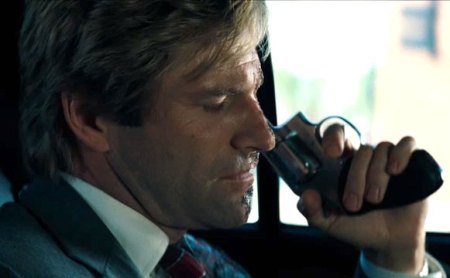
“You either die a hero or you live long enough to see yourself become the villain.”

One thing I didn’t comment on earlier is what Gordon says at Dent’s funeral. I noticed it especially the second time I saw the movie. If memory serves, Gordon says of Dent that “he was the hero we deserved – no more.” No more? Shouldn’t that be no less? Or is Gordon slyly reaching out to the few people in Gotham who know the truth, reassuring them that at least somebody realizes what’s really going on – that Dent was the hero Gotham deserved in the sense that Gotham deserved a man who really, really wanted to be good but ultimately failed to live up to his own standards, because that’s exactly how Gotham itself behaved?

As I wrote before, one of this movie’s biggest strengths is that it doesn’t attempt to convince us that it’s a good thing that people need hypocrisy. It’s a bad thing – it’s a sign of how evil we are – that people need hypocrisy.

But since people do in fact need it, it may not be wrong to supply it.

That last assertion is the thought the movie ends on, and it’s where I stopped my first post, saying “hold that thought.” Well, I’ve been holding that thought for a month and a half now. It’s time to unpack it.

Is it wrong to supply hypocrisy? We might answer by saying that if it is, we’re all totally screwed. On the evidence, it appears that no civil order of any kind can long survive without falling back on collossal heaps of hypocrisy.

I’m not even talking about the kind of rank everyday hypocrisy that hits you in the face every time you pick up a newspaper. Although there’s always plenty of that – obviously. Take the frenzy over the past month against “speculators” who have, according to both presidential candidates and most of our other leaders, driven up the price of gas. It’s an old social science maxim that you should never posit malice if ignorance covers the facts, but can John McCain and Barack Obama and all the rest of them really be as ignorant as all that? As Chrales Krauthammer wrote recently: “Congressional Democrats demand . . . a clampdown on ‘speculators.’ The Democrats proposed this a month ago. In the meantime, ‘speculators’ have driven the price down by $25 a barrel. Still want to stop them? In what universe do traders only bet on the price going up?”

It beggars belief that our leaders don’t know exactly what they’re shoveling here. And this is just one issue out of hundreds where the same dynamic occurs. Is there a single political issue where the public discourse isn’t dominated by claims that can’t possibly be believed by those who make them? Not for nothing did Michael Kinsley define a “gaffe” as when a politician accidentally tells the truth. But Mickey Kaus strikes nearer to the mark when he says that Kinsley’s definition ought to be expanded to include all cases where a politician accidentally says what he really thinks, whether true or not.

But that kind of hypocrisy doesn’t go to the roots of social order. Although its omnipresence would be sufficient to prove the universality of some type of corruption in human nature, from a standpoint of the political system it’s an epiphenomenon.

The real hypocrisy runs deeper. It was well captured a while back by an old college acquaintence of mine who subsequently served for a while as a small-town prosecutor. Please read this brutally honest essay in which he reflects, after having left the job, on the nature of his service representing the people in our courts:

We who deal in the laws of a free people are puppeteers. We must be so . . . because our system works better than any other, and because we have no choice but to make it work. We have to give the appearance that we possess the wisdom and authority needed to make our society function. We have to make believe that our culture possesses an exclamation point as strong and as firm as the question mark of [classical] liberalism. So on with the courtroom pomp and ceremony, on with the bluster and posturing! . . .

Men who doubt themselves need puppet shows. They need little passion plays to affirm the dignity of a frequently silly and corrupt form of governance, lest something more dignified but less humane rise to power. Ours is a system of laws administered by flawed and small-souled lawyers to foolish and wicked men; such a system cannot survive without the pantomimes of solemnity.

And note that he has (as far as I can tell) no regrets about having chosen to serve in this capacity. As he says, our system is better than the alternatives (i.e. “something more dignified but less humane”) and given the realities of fallen human psychology this is what it takes to sustain it.

It was with this in mind that I chose the title “City of the Dark Knight” for my mini-series on this movie. The title is meant as a tribute (an obscure one, no doubt) to Augustine, whose political theory I was reminded of by The Dark Knight’s unflinching meditation on society’s hypocrisy. Augustine works so hard to puncture the Romans’ ridiculous charade of virtue and honor not because he hates them – he loves Rome dearly – but because penetrating the mask of society’s pretense of righteousness is for him (as it was for Plato) the first step to any serious wisdom about justice. The fundamental political reality is that people are neither “basically good” or “basically bad.” We tend to associate the observation that if people were “basically good” there would be no government with Madison’s Federalist #10, but I think (though I’m open to argument) that Augustine is the real source of the insight. And there would equally be no government if people were “basically bad,” since people with no natural idea of justice would never develop a system for enforcing justice (however intellectually impressive Hobbes’s attempt to argue the contrary may be). Though Augustine doesn’t put it in exactly these words (or not that I recall), I think we can say that for him politics is a manifestation of the ongoing tension between the image of God that was planted in all men at creation and the moral corruption that was planted in all men at the fall.

And this, if I may be autobiographical for a moment, is why I fled screaming from Washington after spending a year between college and grad school working there. When people with little experience of academia hear that I have a Ph.D. in political science, about 50% of the time they immediately ask me “so are you going to run for president?” Set aside for a moment the charming naivete that associates the pursuit of a Ph.D. in political science with ambition to public service. More to the point is the fact that I could never serve in public office because I couldn’t practice the hypocrisy that all public servants, seemingly without exception, must practice on a regular basis to do their jobs.

Yet though I am not the man to do it, I can see clearly the necessity of maintaining the hypocrisy. Classically, “prudence” was identified as one of the four cardinal virtues. We have a moral responsibility to consider the outcomes of our choices and act so that we aim for those outcomes to conform to the proper ordering of ends (i.e. goals or purposes). Can it really be our responsibility to rank candor above the preservation of humanity? For a long time I was spellbound by Kant’s iron declaration “let justice be done though the heavens fall.” It would be a worthy resolution if “justice” meant simply “goodness” or “righteousness,” that is, virtue as such – including prudence. But “justice” is not virtue as such, it is only one of the virtues. And as Aristotle observed, only virtue as such can be pursued without limit. You can’t go “too far” in the right direction. But any partial good, as opposed to good as such, can be pursued too far – that is, to the exclusion of other partial goods that ought not to be excluded. Hence Kant was actually driven to the insane extreme of preferring the destruction of the universe to the utterance of a single false statement.

The healthy conscience recoils from Kant’s famous statement that if a man intending to murder your friend asks whether your friend is home, and he is, you should tell the truth. (For a while I wondered whether this claim was misunderstood – in the 18th century, gentlemen were usually armed, so when Kant said that you shouldn’t compromise your honor by lying, was he assuming that you would just shoot the guy instead? But when I shared this speculation with a friend, he pointed out that while gentlemen in 18th century England were usually armed, that wouldn’t have been the case in 18th century Prussia.)

And Kant’s dilemma of whether to lie to the murderer is, ultimately, the choice Batman and Gordon must make at the end of the movie. The “murderer” in this scenario is Gotham City itself – which threatens to give up on its own salvation unless it is told the lie that Batman and Gordon choose to tell it.

With that, I’ve said my piece. (Again.) Next week, on to other movies.

UPDATE: Well, I hadn’t quite said my whole piece. See here for the next chapter.


Pass the Popcorn: Starship Troopers

August 15, 2008

I’ll be redeeming myself in Harold and Kumar. I don’t know about you two.

(Guest Post by Matthew Ladner)

Last week, we had the number one seed in the East for the greatest so-bad-its-good movie: Xanadu.

This week, the number one seed in the North: Starship Troopers.

Starship Troopers was actually an interesting book, written by a libertarian but denounced as totalitarian. The book raises a number of interesting questions about the obligation of the individual to the state and whether citizenship should be earned rather than automatically granted.

Forget all of that in the movie though, this movie should have been called 90210 Pretty Kids vs. The Giant Space Roaches from Hell.

You get it all in this one folks: violence galore, hearbreak and drama, arms and legs chopped off by cgi bug-monsters, casual use of tactical nuclear weapons, Doogie Hauser MD as a pyschic kid who dresses like a Gestapo agent, and more. Did I mention violence?

So the basic plot is that humanity fights a war against a race of killer bugs from outer space. It’s kill or be killed pretty kids, so wipe them all out! The movie is moved along by a series of faux war propaganda pieces. In this one, you more or less get the beginning of the film:

Hollywood cheese galore is worked into the plot, including a romantic triangle or two and a high-school teacher turned psychopath alien killer. Life is too short not to watch movies like this, that is if you like movies about Dawson’s Creek trying to wipe out an entire species with machine guns and nukes.


Isaac Hayes RIP: the loss of an American Original

August 11, 2008

(Guest Post by Matthew Ladner)

A few weeks ago I wrote a Pass the Popcorn on an underappreciated cinematic gem: Truck Turner. Now we have the sad news that Isaac Hayes has passed away at the age of 65.

I had the chance to see Isaac Hayes perform in Las Vegas about 5 years ago. He brought the house down. One song he sang, more spoke really, was about his intention to give his woman a back massage, a foot rub and a warm bath. I have never seen so many middle aged women go bananas in my life.

Some standing advice I give to people is that if you have the chance to see a legendary performer on stage, do it. I’ve yet to be disappointed by an Isaac Hayes, Tony Bennett, Tom Jones or Ramones concert. You just don’t know that you’ll ever get the chance again, and longevity is a strong predictor of greatness.

Happy trails Mr. Hayes. You’ll be missed.


Pass the Popcorn: City of the Dark Knight (Issue #3)

August 8, 2008

(Guest post by Greg Forster)

We’re now on our fourth issue of the series and we haven’t said anything yet about Heath Ledger. That was intentional, for three reasons.

First and most important, there’s not much interesting to say, or at least not that I can say. It’s obviously a virtuoso performance, and would have been a career-making breakthrough. Ledger was clearly one of the most talented performers of his generation, and it’s a shame he never reached his potential until the end of his abbreviated career.

Beyond that, what’s to say? If I were in the acting business, I could no doubt analyze the performance and say more about what makes it great. But I lack even the rudamentary ability to do so, and I’m not interested in bluffing.

Second, too much of the chatter about Ledger and this performance is shallow and feels exploitative of his death, and I don’t want to contribute to that.

And third, I think Ledger’s masterpiece contribution is overshadowing other contributions. I don’t want to take away any of the honor Ledger has justly earned, but for this movie to be what it is, a whole lot of people had to turn in top-flight performances.

Back in Issue 1, commenter Captain Napalm mentioned Aaron Eckhart and Gary Oldman – both of whom were indeed outstanding. I’ve just praised Morgan Freeman in Issue 2, and Michael Caine’s contribution shouldn’t be overlooked – one of the most important differences between a good film and a great one is that all the little things are done right, as well as the big ones. Caine and Freeman didn’t get the big drama, but they delivered fantastic little gems – “We burned down the forest” is one of the most memorable moments in the movie. So is “You have no idea.”

Everyone – by which I mean the handful of movie geeks whom I personally know – seems to agree that Christian Bale had essentially nothing to do in this movie. The first movie was about Batman, not the villains, so the villains were (as I mentioned last time) unmemorable. This movie was about the Joker, so Batman was unmemorable. But serving as the Joker’s foil is something. The Joker carries the movie, but he can’t do that if Christian Bale doesn’t act well his part, wherein all honor lies. Imagine this movie with Ledger playing opposite George Clooney – or even Michael Keaton, who I thought did surprisingly well as Tim Burton’s Batman, but would have been totally inappropriate as Chris Nolan’s. (And let’s also acknowledge that “I’m not wearing hockey pants” was well delivered.)

And naturally we should be crediting Chris Nolan. Having done a little amateur acting, I know how much a director contributes to an actor’s performance – or doesn’t. When any six actors, even six really good ones, all deliver a top-notch ensemble performance, it’s as much the director’s work as theirs.

Above all, though, we should be thanking the writers. Think about every scene you remember of Ledger. Isn’t it the brilliant lines as much as the brilliant performance that make this movie so amazing? “When you think about it, I knew your friends better than you did. Would you like to know which of them were cowards?” That’s really brave writing. And of course, all those clever one-liners we’ve been taking notice of in this and previous issues had to come out of somebody’s keyboard before they could come out of Morgan Freeman, Michael Caine, etc.

You do know who wrote the movie, don’t you?

Chris Nolan shares the screenplay credit with his brother Jonathan Nolan, and shares the story credit with David Goyer. The Nolan brothers also co-wrote Memento and The Prestige (which came out between Batmans). Goyer has a long track record on comic book movies that includes Blade and co-writing Batman Begins with Chris Nolan, as well as sole story credit on Batman Begins. And of course Frank Miller should get a nod for his influence.

All that said, Ledger did pull off an amazing feat. In addition to what’s on the screen, consider how much prior baggage he had to overcome with the Joker character:

First Appearance!

The Clown Prince of Crime

The Ultimate Psychopath: “Whatever’s in him rattles as it leaves.”

The Outer Edge of Insanity

(Wrong “Joker,” moron!)

A lot of people thought no one could play the Joker after Nicholson, particularly not the star of A Knight’s Tale. Nicholson himself, for one. He said as much, as The Dark Knight was approaching release. I wonder if he repented after he saw the performance.


Pass the Popcorn: Xanadu

August 8, 2008
Nice leg-warmers

Bad movie, but nice leg-warmers

(Guest Post by Matthew Ladner)

So all the movies I’ve seen lately have been in the fair to mediocre or worse categories, so let’s try something different with the greatest they’re so bad that they are great films. Holding down the number one seed in the Eastern bracket: Xanadu.

Where does one even start in describing the horrible greatness of Xanadu? Perhaps with the plot, such as it is? Okay, why not?

So there is this frustrated album cover artist who tears up a sketch and throws it out the window. The wind takes the pieces across town to a mural of the Twelve Muses, who magically come to life to the sounds of the Electric Light Orchestra!

After dancing around a bit, the Olivia Newton John muse roller-skates off to help her frustrated artist find love and set up a roller disco with the help of Gene Kelly. Along the way there are a few dream sequences, random incidences of characters bursting into song and transforming into animated characters, and a confrontation with the gods of the ancient Greek pantheon.

Totally inexplicable animation sequence complete with ELO tune!

Totally inexplicable animation sequence complete with ELO tune!

Okay, so this is my guess on how this movie got made. Grease had just made a fortune, but John Travolta was off making another contender for this category Urban Cowboy. The Hollywood guys said, “okay, get ONJ, make up a plot involving roller-disco, don’t sweat the details. That guy from The Warriors can be the lead. No not the ‘Warrrriors!!! Come out to play-ay!’ guy, the strong silent type lead guy! He’s perrrfect for a musical!”

“Oh, and call Gene Kelly and get him out of retirement! Someone in this movie has to be able to dance!”

Words cannot describe what happened next, but in their place, I offer the super-duper unbelievably something final scene from Xanadu. Enjoy if you dare:


Pass the Popcorn: City of the Dark Knight (Issue #2)

August 3, 2008


(Guest post by Greg Forster)

Okay, and now for something completely different! Today we’re going to talk about Bat Gear.

What was the one thing in The Dark Knight that just didn’t work? So far, everyone I’ve talked to has the same answer, even if you don’t ask them the question – it’s the citywide “sonar.” Lame.

The first time through, it was really obtrusive – for a few minutes. One of the greatest innovations in storytelling in the last ten years is that movie and TV people have learned the value of throwing a lot of story at you and trusting you to keep up; among many other virtues, this means badly done moments in the narrative get left behind more quickly.

The second time through, I didn’t really mind. That was partly because dumb plot elements are always less obtrusive the second time around, because you aren’t being hit with the shock of recognizing their stupidity. This, for example, is why it is possible to watch the Lord of the Rings movies repeatedly without their being spoiled by a bunch of friggin’ elves marching into Helm’s Deep, or the army of the dead effortlessly wiping out the beseiging force at Minas Tirith (which means all those Rohirrim who gave their lives on the Pelannor died for nothing).

But it was also partly because the second time I saw how it was supposed to fit into the movie. Somehow, the first time through, I totally missed the “like a submarine” gag. You remember, when Lucius comes out of the evil corporation’s building in Hong Kong and shows Bruce the sonar readout:

“Sonar? Just like a . . .”

“Like a submarine, Mr. Wayne – just like a submarine.”

It just flew by and I missed it completely. (How am I supposed to catch all these little things when they throw so much at you and expect you to keep up with it all?)

Obviously they were thinking that we would buy the “sonar” because sonar fits with the bat theme. And it’s not a crazy theory. When a plot element fits the theme of the movie, artistic liberties with reality are much less obtrusive (a subject I’ve had occasion to discuss at greater length before).

But it didn’t work. And that got me thinking about the gadgets in this movie. F’rinstance, does the Bat Cycle (apparently to make it seem less fruity they’re telling us to call it a Bat Pod) belong in this movie? I mean, honestly – doesn’t it just look like the suits in the marketing department demanded that they throw in something new that would sell toys? After all, the twelve year old boys of America – who should never be permitted to see this movie under any circumstances whatsoever – are not going to shell out for another Batmobile unless it’s different from the last one.

He’s prob’ly fighting for freedom! Buy all our playsets and toys!

And the skyscraper-assault gadgets (in the Hong Kong scene and again in the assault on Fortress Joker) feel artificial, too.

But that’s not what you’d expect, is it? Gadgets belong in a Batman movie. They’re an integral part of the franchise – even more so than in the James Bond franchise.

Consider the first Batman movie – well, okay, not absolutely the first, but the first one that counts. The Tim Burton one. (The Tim Burton one that counts.) That movie doesn’t get its propers anymore, in large part because we now take for granted so much of what Burton did to define the modern comic book movie. Much of what was radical in Burton’s Batman is now so expected that it’s not even noticed.

It was a much more uneven movie than Nolan’s Batmans are – parts just didn’t work, but parts worked brilliantly. And that movie was just brimming with gadgets. The Batmobile actually did stuff – and no, going really fast and changing the driver position from Standard Seated Position to Lying Down for No Reason Position doesn’t count as doing something. Yes, okay, in the first Nolan movie the Batmobile jumped rooftops. But Burton’s Batmobile did so much more. And Batman himself used gadgets more often and it felt more natural. One of those brilliant moments that really worked was when Batman swooped in, foiled one of the Joker’s plans, and swooped out on one of his flying wires (or something) and the Joker was just so impressed that he didn’t even think about how badly he’d been beaten – he just stood there and asked: “Where does he get those marvellous toys?”

Or consider what must be the best gag ever done in a comic – from the Batman/Planetary crossover.

(If you don’t know what Planetary is . . . well, how are you even alive?)

Anyway, the Planetary crew are in Gotham chasing a man whose mind keeps opening dimensional rifts, and of course they run into Batman, who of course is chasing the same guy. But every time the guy opens a dimensional rift, they shift to an alternate reality where Batman is slightly different:


HT Planetary. How many can you identify? How many will you admit you can identify? (No fair peeking at the URLs!)

Here’s the gadget gag: Jakita Wagner, a superpowered female hero, is about to throw down with one of the badass Batmans. Then a rift opens and suddenly it’s not a badass Batman, it’s the Adam West Batman from the supercamp sixties TV show. And . . . he would never hit a girl!

So when she rushes him, he avoids compromising his honor by whipping a spray can out of his utility belt and dousing her in the face. (I always suspected the Adam West Batman was really a sucker-punching bastard.) She falls back, clutching her eyes, and Batman drops the can and springs away to chase after the rift-opening guy. As she curses him, we see the can roll into the frame.

The label on the can reads: Bat Female Villain Repellent.

I swear I Googled for probably half an hour looking for that panel, so I could share it with you. I guess you’ll have to buy the crossover instead.

But back to our subject. Gadgets not only belong in Batman, they ought to belong in Chris Nolan’s Batman. After all, this is the first movie version to include Batman’s “Q”, and he’s used to outstanding effect in both movies. What are the most memorable moments in the first movie? Liam Neeson blathering on about destroying Gotham? Dr. Crane attacking people with his fear drug? No, that movie had some of the least interesting villains ever to appear in a comic book movie. (Not a criticism – that movie was about Batman, not about them.) What you remember is: “Oh, the tumbler? You wouldn’t be interested in that.” And: “Just don’t think of me as an idiot.”

And Chris Nolan clearly knows how to get the best out of Morgan Freeman, because he’s used just as well in the new one. That “your plan is to blackmail this person?” speech is priceless.

Come to think of it, in the first movie Batman used a “bat caller” gadget to produce a swarm of bats where he needed it. It was ridiculous, of course – but it fit the theme of the movie, especially in that it was trying to explain why Bruce Wayne chose to dress up like a bat when fighting crime. Being attacked by a swarm of bats would tend to put the fear in you.

So why didn’t the gadets work in this one? The first thought to occur to me was that they were trying to force the citywide sonar to perform an awkward plot function – they wanted to abruptly set up a little mini-debate between Batman and Lucius on the whether it’s OK to spy on the whole city. But frankly, I don’t really think that’s it. I think citywide sonar would have failed even without that scene. (Speaking of which, when I first saw it, I thought that Lucius’s position was “This is wrong, but I’ll do it just this once,” which of course is a contemptable position. But that’s not what he says, as I discovered upon seeing the scene a second time. I think his position is really “This is OK as a one-time deal, but it would be wrong to use it on an ongoing basis.” I’m inclined to think that if it’s OK as a one-time deal, it’s hard to justify throwing it away, especially in a city that seems to attract supervillains like a magnet – but it’s not a contemptable position.)

Maybe – and I’m not sure about this – maybe it’s just that they obviously could have accomplished the same thing with less tampering with reality. Batman could have simply set up a computer to scan all phones for the Joker’s voice. And they could still have worked in the bat/sonar theme by equipping the Batsuit with its own sonar, which he could then have used in the Assault on Fortress Joker scene.

Like I said, I’m not sure. Theories?

(Oh, and I’m still hoping somebody can help me with the tally on Dent’s body count. I’m one cop short.)