
(Guest post by Greg Forster)
I know it’s a bit late for Aughts-in-Review type stuff, but here goes.
Note that it says “favorites” rather than “best.” That’s partly because I didn’t get to see all the movies I wanted to, and I don’t want to snub any really good movies that I may have missed; and partly because I wasn’t sure I knew which ones were “best” but I was sure which ones were my favorites.
One man’s opinion. Results not typical. Your mileage may vary.
Comedy (Wit)
Essentially optimistic narrative that generates humor through clever dialogue and/or plot manipulation.

Winner: Chicken Run
There are so many unbelievable lines in this movie I can’t begin to pick a favorite.
Oh, who am I kidding? Of course I have a favorite!
“You mean you never actually flew the plane?”
“Good heavens, no! I’m a chicken! The Royal Air Force doesn’t let chickens behind the controls of a complex aircraft.”
(Although “pushy Americans, always showing up late for every war” comes in a close second, followed by the dialogue at the end about what item, exactly, you would need to start a chicken farm.)

Also Nominated: Amelie
Everyone has a talent; Amelie Poussin’s is practical jokes. Amelie realizes that her calling in life is to use her gift for practical jokes to improve the human condition. (Talk about a candidate for the Al Copeland award!) Fortunately, she’s surrounded by a bunch of severely disfunctional people! Getting duped by Amelie’s clever schemes is just what they need to get their heads on straight. But the tables are turned after Amelie becomes fascinated with a handsome young man and uses a series of practical jokes to attract his affections. A lifelong loner, Amelie abruptly realizes that she’s bought more than she bargained for – the risks and sacrifices of real love are no joke. Is anyone shrewd enough to figure out how to get Amelie’s head on straight?
The first of two foreign films (French, in this case) to make my list. Someday I’ll compile a list called Foreign Films Actually Worth Watching.

Also Nominated: Down with Love
In form, this is a spoof of the old 1960s Rock Hudson/Doris Day sex comedies. But what makes it work so brilliantly is the filmmakers’ ambition – in which they are totally successful – to update the humor in light of subsequent developments in sex relations. Casual sex, and all the comprehensive overturning of traditional roles and expectations accomplished in its name, turned out not to be everything its disciples cracked it up to be. Yet, miserable as we are, nobody wants to go back to the old system, with its demeaning subordination of the female to the male. Can we re-domesticate sex without re-domesticating women? This movie answers with a resounding “yes,” and does so with some of the sharpest wit I’ve seen on the screen.
Comedy (Satire)
Essentially optimistic narrative that uses humor to create a critique of familiar human foibles (and vice versa).
Not sure why, or what this might say about the historical moment we were living through, but satire was the strongest category of the Aughts. All four of these movies are not just exceptional, but are standouts even among the decade’s exceptional movies. I’d put the “also nominateds” in this category ahead of most of the winners in the other categories. (I say this even though the single best movie of the decade wasn’t in this category; after you get past that particular movie, satire is where most of the big standouts are.)

Winner: Barbershop
Barbershop owner Calvin barely manages to ride herd on his feisty retinue of wisecracking barbers. He’s been breaking his back to keep the shop propped up for years, all out of a sense of obligation to the dead father from whom he inherited it. But all that time, he’s been dreaming of scoring big in a series of get-rich-quick schemes, and his irresponsible pursuit of easy riches has finally caught up with him – he doesn’t have the money to keep the shop open any more. As his final day of business unfolds, his madcap barbers (and clients) bicker and lecture each other about what really matters in life. Through all the verbal duelling and tomfoolery, Calvin comes to understand why his father was more interested in running a barbershop than in getting rich.
Obviously this movie has a lot to say about issues that are of particular concern to black Americans. The filmmakers ruffled some feathers – one of the customers says to a barber “You’d better not let Jesse Jackson hear you talking like that” and the barber replies, with relish and gusto, and yet also with very deep seriousness, “F$%# Jesse Jackson!” John Podhoeretz wisely commented that this whole movie, really, is just one long “F$%# Jesse Jackson!” from beginning to end.
But the deepest theme here is really universal – responsibility, courage, honesty and decency are more valuable than any worldly success.

Also Nominated: Lilo & Stitch
The greatest concept for a family movie ever. A genetically engineered alien monster designed in every aspect of his being to maximize his ability to create destruction and chaos meets a typical human child, and it turns out that except for their appearance they’re exactly the same in every possible way. There’s lots of other great satire here – Earth is spared from destruction by an alien armada because the aliens’ environmental bureaucrats believe the mosquito is an endangered species (and just wait until the end when you find out why they think that) – but the heart of this movie is the central insight that people are not naturally civilized. And that is a really funny fact. As if that weren’t subversive enough, the real message of the movie is that families are the only thing that civilize people. And this is a Disney movie!
Bonus points for the big-hearted ending, too. I’m not ashamed to admit I choke up during the climactic speech – exactly twenty words long – in which Stitch explains the basis of his loyalty to Lilo. It’s the only movie on this list that I always choke up at.

Also Nominated: 13 Going on 30
Mistakenly pigeonholed as a “female version of Big,” this is actually the opposite of Big in many ways. In Big, a thirteen-year-old boy who’s miserable and can’t wait to be an adult wakes up one morning to find that he is one. He discovers that the grown-up world is even more messed up than the kid world, and he teaches those around him to find their inner child. Everyone ends up happy because the hero teaches them all not to be so mature, and he’s happiest of all because in the end he gets to go back and be a kid – which, we now know, is oh so much better than being an adult and having lame stuff like obligations and responsibilities.
In 13 Going on 30, a thirteen-year-old girl who’s miserable and can’t wait to be an adult wakes up one morning and finds that she is one. And in this version, she gets to live exactly the life she wants – she’s a world-famous fashion magazine editor with a pro athlete boyfriend, etc. etc. And she discovers that that grown-up world, the world of adults who live in a perpetual adolescent fantasy, is more messed up than the kid world – it’s messed up because it wants perpetual adolescence. She’s miserable as a world famous fashion magazine editor with a pro athlete boyfriend – but her old high school pal who had more serious, more mature – more grown up – plans for himself is now happy and enjoying life.
She teaches the people around her the error of their ways not by helping them to find their inner children but by calling on them to grow the heck up. And the movie ends with her as an adult, living an adult life and happy with it.
Like Barbershop, this movie speaks from within the perspective of a particular segment of the population – in this case, teenage girls and young women. But the deepest theme is again universal; you might say this movie has the same core message, but focused on sex rather than money.
Also Nominated: Millions
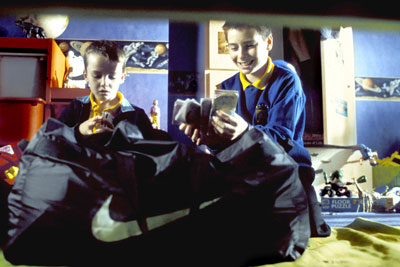
A young boy finds a duffel bag full of money that was tossed off a train during a robbery. He tries in vain to find a way to give the money away to charity, but each time he brings the money to a new person, that person’s greed subverts his efforts. Even the professional UN do-gooder turns out to be on the take. He is sustained by visitations from saints, who encourage him not to give up hope and to keep trying to do the right thing. Yet the more he tries to rely on the goodness of those around him, the more deeply he’s disappointed. This whimsical movie won’t be for everyone, but if you’re looking for a movie that affirms the good even in the face of a very clear-eyed and sober reckoning with the dark side of human nature (the director’s previous movie was 28 Days Later, a lighthearted and cheerful flick about how the only thing more evil and repulsive than flesh-eating zombies is humans), this is the one to see.
Comedy (Situational)
Essentially optimistic narrative that derives humor from specific combinations of characters and plotlines.
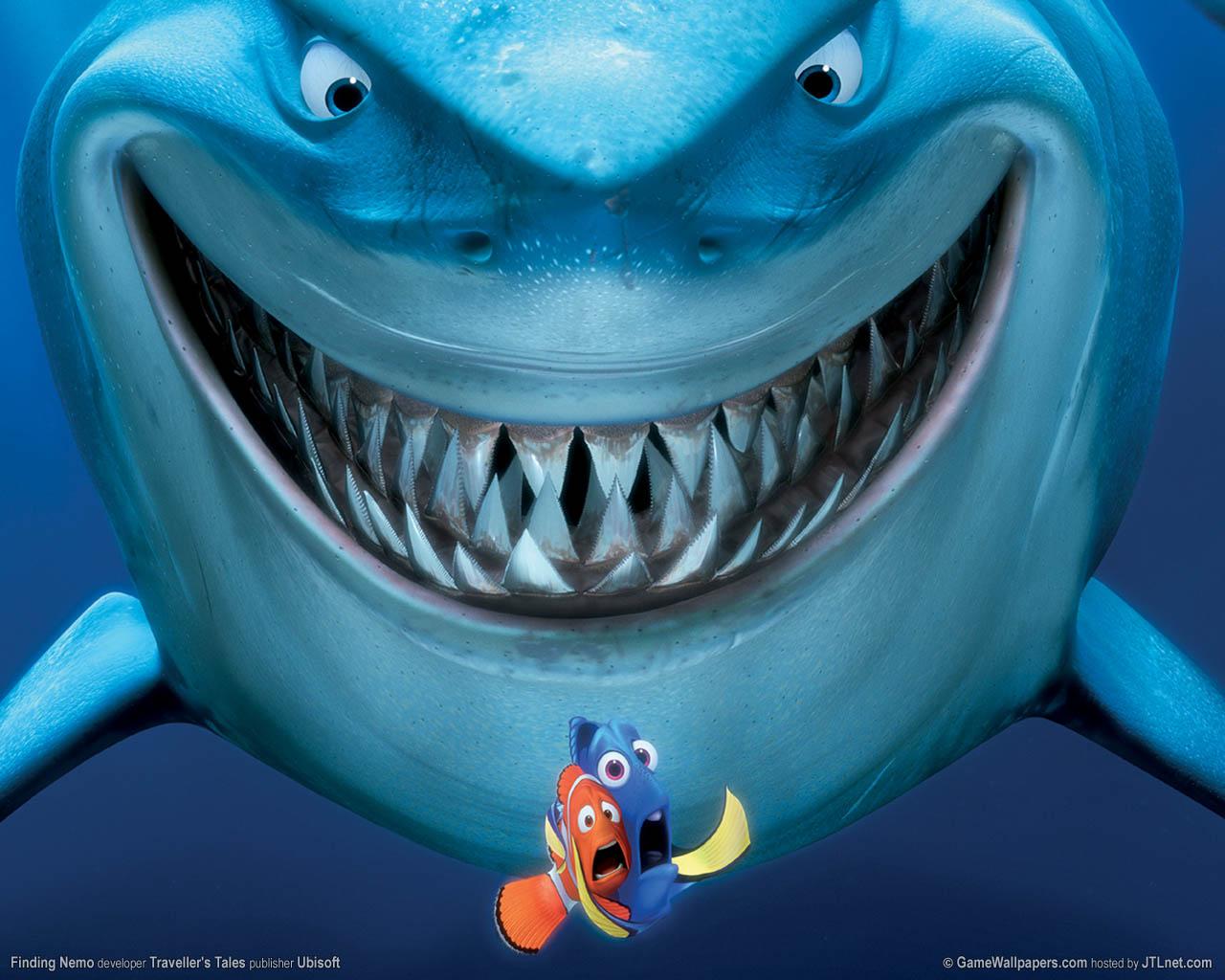
Winner: Finding Nemo
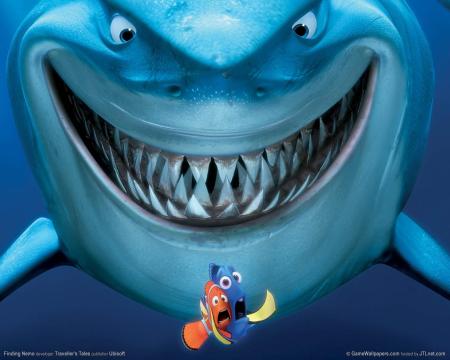
Good gravy, what is there to say that hasn’t been said a thousand times?
Also Nominated: Return to Me
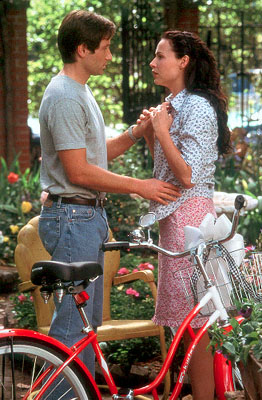
The only conventional romantic comedy on the list. This movie has many merits – the laugh-out-loud moments are frequent – but the most amazing thing to me is the way it solves the inherent problem of the romantic comedy. Most romantic comedies are mediocre at best because of the contradiction inherent in the form: the leads must be perfect for one another, yet there must be some obstacle preventing them from falling in love (at least fully and without reservation) until the very end. It’s not sufficient to simply keep them apart – if they fall in love but can’t be together for some reason, that’s not a romantic comedy, it’s a drama.
The problem is, almost all of the obstacles you can place between them require one or both of the leads to come across as either stupid or evil. Sometimes they don’t realize they’re perfect for each other, in which case we spend the whole moive watching them not see what is, to us, obvious (i.e. stupid). Most often, one or both of them have an existing “serious” or “committed” relationship. This requires the existing relationship to end in a way that provides emotional closure to clear a path for the happy ending – but this can only occur in one of three ways:
- The lead’s current partner is cheating or otherwise exploitative (i.e. the lead is stupid)
- The lead’s current partner is heartless enough to dump him/her, even though he/she is obviously a fantastic catch (i.e. the partner is stupid, meaning the lead is stupid for having been with him/her)
- The lead dumps the current partner even though the partner is not cheating or otherwise exploitative and doesn’t want the relationship to end (i.e. the lead is evil)
The best romantic comedy ever made, Next Stop Wonderland, brilliantly sidesteps the problem by not having the leads even meet one another until the very end. As we get to know them, separately, we see that they’re perfect for each other and each will be miserable until they meet, and they keep almost meeting but not quite, and then finally they meet, whereupon they fall for each other instantly. But that’s a one-shot deal; once someone has the audacity to make a Next Stop Wonderland, nobody else can make it. So what do you do?
You start the movie by having the male lead’s wife die in a car crash, and the female lead, who has heart disease, recieves her heart as a transplant. Genius. And very well executed.

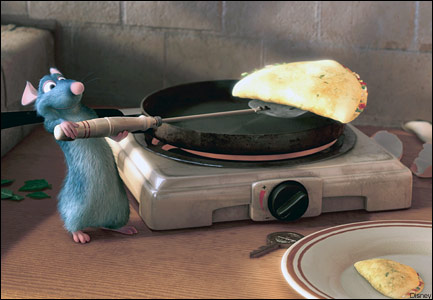
Also Nominated: Ratatouille
Having already written about the movie’s substance…
It not only has sharp dialogue (consider, for example, the duel of wits between Linguini and Anton Ego in the press conference scene) and great humor (in its context, the moment where Ego is transported back to childhood by his first bite of Remy’s ratatouille is every bit as funny as the “I am your father” line in Toy Story 2), but also philosophical depth (the whole movie is basically Plato’s Ion in cartoon form, with cooking as a proxy for art and creativity generally – as Ego’s climactic monologue makes clear).
I’ll add one new comment. Situational comedy requires implausible situations. This movie embraces that and runs with it all the way. Halfway through the movie, just when you think they can’t cook up anything more outrageous, we find out that in the Ratatouilleverse rats can control people’s actions by yanking their hair. And they’re completely shameless about it. “That’s disturbingly involuntary!” I think that’s part of why this movie succeeds – it has the sheer audacity to set up the situations it wants.
Drama (Tragic)
Essentially anti-optimistic (though not necessarily pessimistic) narrative illuminating the nobility of human struggles against challenges that are too great for merely human capacities to reliably overcome.

Winner: Magnolia
An absolutely unflinching movie (seriously, don’t watch it if there are children anywhere within five hundred miles of your television) about the universal human phenomenon of guilt. Is there any escape from its unbearable burden? Vaclav Havel got down to the crux of the matter in his prison letters – the only thing that makes human beings at all meaningful is the fact that they are morally responsible. But . . . responsible to what? Or whom?
Unsurpassed performances from at least a dozen major stars, including a truly breathtaking performance by Tom Cruise that can stand without shame next to any other acting job ever filmed.

Also Nominated: Garden State
I never feel quite sure I’ve correctly identified what this movie is “about.” But it moves seamlessly between hilarious comedy and profound meditation. I think – but again, I’m never quite sure – that the “point” is that we’ve spent so much time and energy running away from disturbing emotional experiences that we’ve flattened our souls. The main thing that’s keeping us from being emotionally healthy is that we fuss and fret so much about whether we’re emotionally healthy – we’re psychological hypochondriacs. In the end, if man makes his own psychology the point of his life, then there’s no “there” there – just a bottomless void. You can scream into it all you want and never hear an echo. Better to just go home and get on with your life.

Also Nominated: Pieces of April
Yes, having already lavished extremely high praise on Tom Cruise, I’m now going to praise Katie Holmes. But she really is good – and Laura Linney is phenomenal – in this very raw and heartfelt movie about dysfunctional families.
Drama (Epic)
Narrative featuring high-stakes conflicts between titanic characters who evoke or represent transcendent forces.

Winner: The Dark Knight
Movie of the decade. (Duh.)
I’ve said it before, I’ll say it again: See here, here, here, here, here, and here. Nuff said.

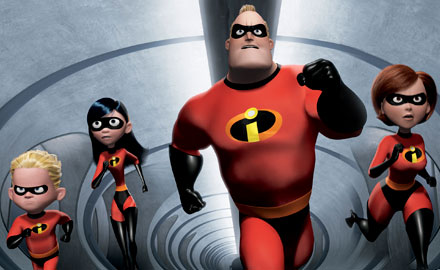
Also Nominated: The Incredibles
Lots of the movies on this list are delightfully subversive, but this one? Forget about it. “When everyone is special…”
Yet it’s not just here for that; in fact, none of them is just here for that. Simply as an epic drama, this movie succeeds – dare I say it – incredibly.

Also Nominated: Casino Royale
Another movie I’ve probably said enough about already.
Category Killers
Movies that don’t fit comfortably into established genres, but that I really like and want to include on the list.
The Passion of the Christ
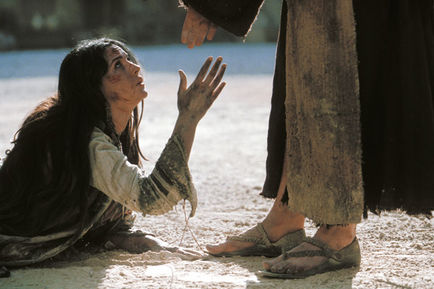
I know, I know. I understand. I feel you about this, I really do. But I’m sorry, I can’t leave the greatest work of devotional art produced in probably a century (What’s the competition for that title? This? Seriously?) off my list just because of the guy who produced it. Whatever is really in Gibson’s heart, there’s none of that kind of crap up there in the movie. It’s just not there. (My theory is that people like Charles Krauthammer see that kind of crap in the movie because they’re very good at detecting it in people, and they smelled the stench of it on Gibson and interpreted the movie through that lens.)
As a colleague of mine once said, the key to understanding this movie is that it’s not fundamentally a narrative drama, as most movies are, but a work of devotional art that just happens – by coincidence, as it were – to take the form of a movie. It’s much more like “a religious painting in movie form” than it is like a regular movie. The events happening on the screen are not the point. The point is that the experience of seeing this movie reminds the believing audience – a work of devotional art is not designed to create belief in those who lack it but to engage with the belief of those who already have it – of everything they already know and feel about Jesus. And for Christians – here comes the really key point – the events depicted here have a completely different meaning than a similar set of events would have in any other context. If you see the movie without that angle, as most of the critics did, you just aren’t seeing the movie. Of course all the extreme violence and the gore and the focus on his excruciating suffering would be bizarre and possibly pathological if they had no theological meaning. But they do, which is why Christian devotional art has always dwelled at length on them.

Adaptation
Director Spike Jonze at the peak of his career thus far. Nicholas Cage delivers a delightful performance as belagured author Charlie Kaufman, opposite an equally appealing performance by Nicholas Cage as Charlie’s twin brother Donald.
Charlie Kaufman also happens to be the movie’s real-life scriptwriter, a fact you’ll want to know going into the movie. Donald is fictional. But, in keeping with the concept of the movie, the script is officially attributed to “Charlie Kaufman and Donald Kaufman.” And when it won was nominated for an Oscar for best screenplay, the award nomination was duly conveyed upon both authors, making Donald Kaufman the only fictional character ever to win be nominated for an Academy Award.
Update: Oops. The movie did win an Oscar, but not for screenplay (HT Marcus, below). Donald is listed as a nominee, though. He also has his own page on IMDB!
Jonze is notorious for his mind-bending plots, and Adaptation can’t really be adequately explained in fewer than about 800 or 1,000 words. But for our purposes it’s enough to say that this movie delivers plenty of laughs to keep you entertained while it’s in the process of gradually building a truly amazing plot architecture, which (when considered as a whole) asks the question: Why do movies tell stories? And answers it to tremendous effect, merging philosophical depth with a narrative tour de force.
A lot of people didn’t like the ending. I’m with Roger Ebert, who put it succinctly: “If you didn’t like the ending, you didn’t understand the movie. Go back and watch it again until you get it right.”
American Splendor
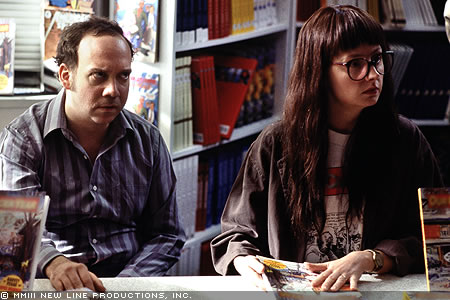
The “category killer” to end all category killers. Two of Hollywood’s most talented actors (Paul Giamatti and Hope Davis) deliver outstanding performances as Harvey Pekar and Joyce Brabner, whose amazing true story is depicted in the movie. Interspersed with this narrative is documentary footage of interviews with the real Harvey Pekar and Joyce Brabner, who talk to us about the events we’re watching – why they did what they did, how they felt, etc. Is it a documentary or a drama? Call it the only dramentary ever made.
Like Adaptation, American Splendor is about storytelling itself. By inserting interviews with the real-life subjects into the story, the movie invites us to experience the “story” part consciously as a story. It’s a good thing Giamatti and Davis are talented enough to carry this weight; anything short of virtuoso performances on their parts would have turned this whole project into a huge turkey. But they’re up to the challenge, and the result is fascinating.
Like Charlie Kaufman in Adaptation, Harvey Pekar (creator of the comic American Splendor) doesn’t want to tell “stories” because they’re not like life. But unlike Charlie, Harvey succeeds in making his non-stories interesting. This is in large part because Harvey encouters so many interesting people and has a gift for observing them – with characters like this, who needs plot?
Yet . . . a good deal of interesting plot does actually happen to Harvey. (The incredible true story of Harvey and Joyce’s first date is worth the price of admission by itself.) And that’s another layer to the movie – while the real Harvey has made a career out of simply documenting life as he experiences it, the movie picks out only the interesting parts of his life and arranges them in order to artificially create a satisfying story arc with a beginning, middle and ending that work seamlessly. Exactly the opposite of what the real Harvey does!
And yet, the real Harvey doesn’t seem to mind. Unlike Charlie, he’s never given himself airs about what he does and why he does it. He’s too jaundiced to be a prima donna.
Come to think of it – how many biopics have the guts to put the subject himself up on the screen and give him the chance to critique their movie version of his life? Talk about keeping you honest!
Too Soon to Tell
Recently released movies that I feel like I may later look back on as “favorites of the aughts,” but don’t yet feel fully confident including on the list because not enough time has passed to be sure.
Ponyo
UP
Star Trek
Speed Racer
Juno


 Posted by matthewladner













 (Guest Post by Matthew Ladner)


 Jay P. Greene's Blog