Get Lost: Final Approach

January 5, 2010

(Guest post by Greg Forster)

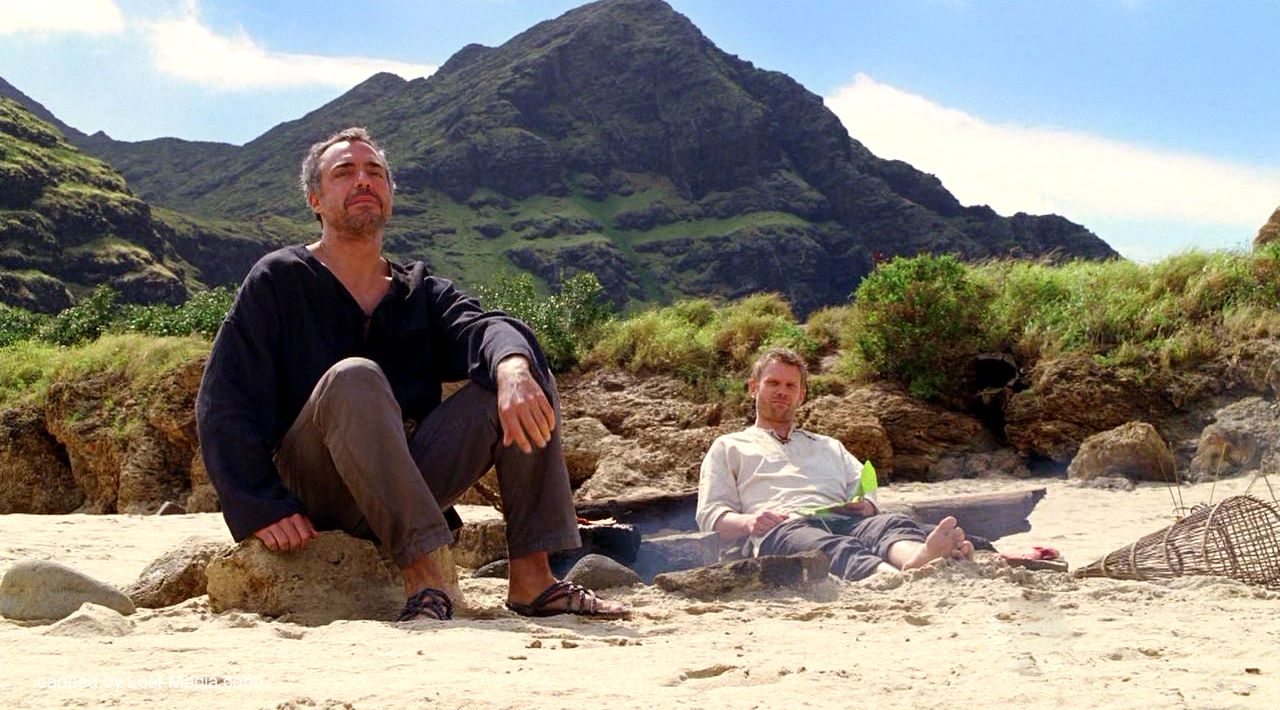
As Lost makes its final approach, ABC has offered a delightful tidbit to tide you over during the extra-long wait.

Notice:

  • The table is an airplane wing and the seats are airplane seats.
  • Locke appears to have a first-class seat while everyone else is sitting coach.
  • The cups and bowls are coconuts.
  • Claire is still in the cast.
  • Richard and the Brazillian assassin both seem to have been promoted to full cast.
  • There are skulls on the ground, partially concealed among the debris and plants.
  • Sayid is Judas.

(HT Christian D’Andrea)


Get Lost for Good

May 18, 2009

File:5x16 Jacob and nemesis.png

OK, I won’t gloat (too much) about how I correctly predicted that Locke was actually dead and was possessed by some evil force.

Instead I’m going to make new predictions for next season.  The secret to my success at Lost prognostication is just to make a lot of predictions and hope you all forget the majority that I get horribly wrong.

So, here is what I see for next season —  There are two supernatural beings Jacob and his nemesis, who I bet will be called Essau. 

Jacob is the god of life and Essau is the god of death.  Jacob can bring people to life simply by touching them.  We see him bring Locke back to life after he is thrown out of the window.  He brings Illana back from grave injuries in her Russian hospital.  I’m guessing that it was Jacob that saved Ben from death when Richard brought young Ben into the Temple.  In fact, I’ll wager that all of The Others are Jacob’s people because he has saved all of them from death.  That’s why they are so loyal to him and do not fear death.

Essau is the god of death.  All of the dead people we’ve seen around walking around the island are really Essau, including John Locke, Christian Shephard, Eko’s brother, Harper, etc…

Jacob and Essau have been through human history countless times, each working on their superpower of life or death.  They are also playing out a disagreement they have about whether human beings have free will and whether Fate can be changed.  Essau thinks that there really is no free will and Fate cannot be changed.  The details change but Time course-corrects and, as he puts it, “it always ends the same way.”  The way it ends is with death for the individual and global destruction for all of humankind. (Remember the Vanzetti numbers that the Dharma project is working to alter?)

Jacob thinks there can be progress.  He also seems convinced that human beings can make choices and change Fate.  He tells Hurley that he can choose when they ride together in the taxi.  He tells Ben that Ben has a choice before Ben stabs him.

The difficulty is that Jacob promotes the idea of free will at the same time that he manipulates the characters.  He saves Katie from being caught stealing.  He gives Sawyer the pen he uses to finish his revenge letter.  He saves Locke from death.  He save Illana in the hospital and recruits her for her mission.  And he steers Hurley back to the island.

The only flashback in the finale episode that did not involve Jacob manipulating the characters was the one involving Juliet.  And it was Juliet who chooses to let go and fall  into the drill shaft.  And it was Juliet who chooses to detonate the nuke.  She is the variable.  Her choices are different this time through history and that will lead to a change in Fate.

My guess is that the next season will begin on the Oceanic 815 flight to LA and it won’t crash this time.  So, we will think that Fate has changed.  But then all of the main characters will reconnect and find their way to the island.  We will begin to suspect that Time has course-corrected and we’ll think that we are back to things always ending the same way.  But is the grande-finale Jacob and his view of free will will prevail.  The characters will make important choices that avert global destruction.  And I’ll bet that their choices have to do with the affirmation of love, just as Juliet did.


I’m My Own Grandpa — Lost Version

May 4, 2009

It didn’t dawn on me until Patrick’s comment on Greg’s last Lost post, but I’ll bet that little Charlie, Penny and Desmond’s child, is in fact Charles Widmore.  Little Charlie will be whisked to the past on the Island where he can then grow up to be the Charles Widmore we know.  He is, as the song says, his own grandpa.

The reason why Ellie and Charles are so determined not to change the course of events is not that it is impossible, but because it allows Charles to exist.  So Ellie goes around convincing people, including Desmond and Daniel, that time cannot be changed because she doesn’t want time changed.

I’d further guess that the coming war will be between those who are trying to change the course of time and those who believe that it can’t or shouldn’t be changed.  Jack will lead the change faction and John will lead the destiny faction.  That’s why Charles Widmore needed back on the island to ensure that the right side is going to win.

Update — And I’ll bet that Charlie has already been kidnapped by Charles and Ellie.  The nurse oddly told Penny to leave her child while visiting Desmond.  You wouldn’t bother having that bit of dialogue unless it mattered.

(edited to add link, correct typo, and add update)


Get Lost – Do You Know What “Blocking” Is?

May 4, 2009

faraday-underground

Add “undercover agent” to his list of mad skills

(Guest post by Greg Forster)

Late is better than never – thoughts on last week’s Lost:

1) Waaaaaay back in the day, I used to play “theater sports.” If you’ve seen the show Whose Line Is It Anyway? you’ve got the general idea of what it’s like – actors do it for recreation and practice. Basically you’re given an outline of a scene and you have to start playing it immediately.

The cardinal sin of theater sports is “blocking.” This is what they call it when you violate the narrative cues you’ve previously laid down. It generally happens when two members of the team want the scene to go in different directions. One will say something like, “hey, check out that funny-looking bird up there!” and the other will say, “that’s not a bird, it’s a Chinese bomber – run!”

Blocking is the supreme sin because audiences need narrative structure. Surprise twists are one thing. But they need to take place within the context of a narrative universe that has “rules.” If absoultely anything can happen at any time, there’s no drama. So, for example, if it was previously established that the first character had bad eyesight, the dialogue in the paragraph above would not be blocking, it would be a gag. But you can’t just change the rules of the narrative every time you have a new idea for where you want it to go.

This issue has come up before on our Get Lost feature. So let me just admit that Jay has been vindicated – Lost is blocking big time. First they worked really hard to establish the one supreme rule of time travel – whatever happened, happened. Then they pull the rug out.

Even if it turns out that Dan was right the first time and you really can’t change the past – after all, he now thinks you can, but we haven’t seen him actually do it yet – last week’s episode was still blocking.

“Do you know what destiny is?” More like, do you know what good narrative structure is?

2) He’s a tortured artist, tragic lover, philosopher of time and space, undercover agent and cool-under-fire action hero. Oh, and he’s the son of the major villain! (Whoops – spoiler alert.)

I see the inexorable operation of the Wesley Wyndham-Price Axiom is well underway.

Daniel was shot at the end of the episode, but we know he’s not dead because the Axiom states he has to kill some bad guys and win the affections of at least one more smoking hot chick before he goes.

I had Matt hook me up with a Vegas bookie, who gave me the official odds (for entertainment purposes only) on which female will be the next to “notice” Daniel:

Juliet          1 to 5
Relationship with Sawyer is on the rocks; they’re both eggheads

Kate             1 to 20
Recently revised from 1 to 40 because she’s now stranded in the jungle with him

Claire         1 to 25
Remember Claire?

Naomi         1 to 50              
It could happen in a “flash forward” showing Dan’s recruitment

Sun               1 to 100           
A long shot, I know, but we’re running out of females here

Eloise           1 to Ewwwwwwwwwwwwwwwwwwwwwwwww.
Hey, Leia kissed Luke. (Bet you wish I hadn’t reminded you.)

3) Looks like Jay was right the first time when he expressed doubt that the past was really unchangeable.

4) I’ve noted twice before that for a guy with unlimited cash and an army of goons who’s made tons of enemies and tampered with terrifying occult powers, Widmore’s security really stinks. I wondered the first time whether there was some unknown reason Widmore couldn’t be killed. Now that time travel has been introduced on the show, perhaps that explains it.

But given that on last week’s episode, Dan just walked right into the Others’ camp with gun drawn and managed to take them all napping – well, it’s looking more like Widmore is just not a super-genius on the security front. I assume the Others got much more badass after Ben took over, which is why they’re all deadly forest ninjas in 2004.

5) How did Richard know Dan wouldn’t shoot him? Advance knowledge of the timeline? Or is he just a good judge of character? (Or perhaps he’s a lousy judge of character and Dan really would have shot him!)

6) Apparently Eloise knows the future – she apparently knew that Theresa is going to get the whammy from Dan’s Frankenstein-of-Time routine, and at the end she says that it’s the first time in a long time that she didn’t know what was going to happen. Does she have advance knowledge of the timeline, or a superpower? And why doesn’t she know the future now? Maybe because the timeline changed?

7) Dan unsuccessfully tried to persuade Dr. Chang that he was from the future. Afterward, he didn’t seem disappointed that he had failed. He tells Miles he was just trying to ensure Dr. Chang would do what he was supposed to do. What’s he supposed to do? Does Dan have a hidden agenda?

8 ) At a critical moment, Jack notices grey drums labeled FUEL. Wow, good thing Dharma labels absolutely everything with big, huge capital letters!


Get Lost Daddy Issues

April 19, 2009

Lost Images - Lost Season Two - A Tale of Two Cities

Last week I suggested the theory that the Island in Lost is actually an evil supernatural force and that the walking dead (Locke, Christian, etc…) are not themselves but actually representations of that evil force.  This week’s episode, “Some like it Hoth” provides further evidence of that theory. 

Hoth is a reference to the ice planet in Empire Strikes Back.  As Hurley tells us, the unresolved conflict between Luke and his father, Darth Vader, leads to all sorts of problems as well as a lame Return of the Jedipopulated with ewoks.  If only they had worked out those “daddy issues” much suffering could have been avoided. 

Similarly, Lost is filled with unresolved daddy issues.  Just about every parent/child relationship that has been introduced is a troubled one: Jack and Christian; Kate and her dad; Locke and his dad, Ben and his dad; Sun and her dad; Penny and Charles; and now Miles and his dad.  Hurley is the exception.  He’s worked things out with his dad and in doing so has changed the negative fate of unresolved daddy issues, just as he urges Miles to do and just as he does in his rewriting of Empire Strikes Back.


The further evidence that the Island is evil is that it appears to demand or favor those who have failed to resolve conflicts with their fathers or have even killed their fathers.  Richard told Locke that he would have to kill his father because the Island demanded a sacrifice.  Until now I thought he was misrepresenting the will of the Island.  But now I can see that Richard is a faithful servant of the Island’s will.  And we’ve seen that Ben (who killed his father) was spared by the Island as long as he follows Locke (who is probably just Smokey and who himself arranged to have his father killed). 

It’s an inversion of the binding of Isaac.  Rather than sparing the son, the evil Island demands the sacrifice of the father.

Other bits of evidence to support my theory — When Charlotte says this island is death, she really means it.  And that was the title of that episode.  I think the titles are telling us the truth.  And what was Eko doing when Smokey killed him?  Building a church.


Get Lost Penance

April 12, 2009

It’s as if the writers of Lost have been reading this blog.  They seem aware that there are problems with time travel and bringing people back from the dead without clearly defined rules to govern those exceptional plot devices.  Lost has not fully resolved these concerns but the show has clearly acknowledged the difficulties.  Perhaps for TV shows confession will bring absolution.

Two episodes ago (I know I skipped posting on Lost last week) in “Whatever Happened, Happened” Hurley and Miles articulate for us the paradoxes involved with time travel.  Hurley stares at his hand expecting it to disappear like in Back to the Future. 

And in the most recent episode, “Dead is Dead,” they directly discuss how strange it is to have people come back from the dead.  Ben alternatively tells John that he predicted John would be resurrected and tells Sun that he had never seen the Island do something like that and that it scared the living hell out of him.  John also admits to Sun that the idea of someone coming back from the dead is strange.

I suspect that the last two episode titles provide the Lost rules on time travel and resurrection.  Whatever happened, happened tells us that time cannot be changed.  And dead is dead tells us that people cannot come back from the dead.  I know that Locke appears to have come back from the dead, but I suspect that he is no longer Locke.  His emphatic statement to Sun that he is still the same person seemed strange and unnecessary, so perhaps he is lying.  Perhaps he is not the same person, but an incarnation of the smoke monster or whatever supernatural force inhabits the island.

That is one other thing that Lost has made clear:  there is a supernatural power on that Island that has a will of its own.  Greg correctly described this weeks ago and correctly predicted that the central questions will become: 1) what is the will of this supernatural force? and 2) is what that force wants good or bad?

There is still ambiguity about the answers to both questions, but I’ll offer my predicted answers.  I suspect that the Island may actually be evil.  This may be the big twist of the show.  The Island may be some Egyptian god that is intent on preserving itself and then eventually destroying the world.  When the Island judges it doesn’t appear to punish evil and reward good.  It lets Ben go despite his atrocities.  It destroys Eko despite his apparent innocence.  Its leaders, Charles and Ben, have been ruthless.  As Charlotte said, “This place is death.”  It, the Island, is evil and will eventually bring death to the whole world.

Ben and Charles may be struggling to be the Island’s representative, but there is a third group out there that is seeking to destroy the Island.  They are the good people because only by destroying the Island will the rest of the world be saved.


Get Lost – The Island Prime

March 27, 2009

horace-young-ben

(Guest post by Greg Forster)

Jay was in town here yesterday and of course we talked about Lost. At this point neither of us had seen this week’s episode yet.

He shared with me his theory that 1) Daniel is wrong about the idea that you can’t change the past, and 2) during the flashy thing last week, when Jack, Kate, Hurley, and Sayid vanished off Flight 316 back to 1977, the rest of the plane shifted to an alternate timeline where events had been changed.

Guess that theory got a boost from this week’s episode, huh? We both had the same reaction – too bad he didn’t mention this theory last week. (Jay, you might want to give up your obsession with the lack of narrative unity in what is, after all, a serialized TV drama rather than a book or a movie. It’s distracting you from your true calling as our house NostraGreenedus.)

For discussion of this theory, we’ll call the original timeline T and the alleged new one T prime.

On the question of whether the past can be changed by anyone, I was skeptical. Yes, it’s theoretically possible that Daniel is wrong. But that would require a stunning lack of storytelling integrity on the part of the show’s writers. Jay had already lost enough respect for the writers (see last week’s post) to think that they will play that kind of arbitrary game with the rules of the narrative universe, but I didn’t think so. So far, at least, they haven’t done anything like that (Jay’s critique notwithstanding).

As for Flight 316 shifting to T prime, here was his evidence based on last week’s episode:

1) As the plane approached the Island, you could hear “the numbers” being read over the radio. Somehow, I missed this, even though I saw that episode twice. But last night I checked with my wife and she says she heard them, too. But in T, the transmission of the numbers was changed by Rousseau into a distress call some time after 1988, then shut off entirely in 2004.

2) The plane landed on a runway on the “other island.” But there was no runway on the “other island” in T. We know this because in Season 3, the Others were building it (they made Sawyer and Kate work on it).

3) When Sun and Frank arrive at the abandoned Dharma camp, it’s ruined (as we would expect) but it’s still a Dharma camp rather than an Others camp. It still has Dharma signs all over it. And it still has the old Dharma photographs hanging on the wall (one of which Christian showed to Sun). None of that was present in T.

There’s a problem with the second piece of evidence – there may have been no runway in 2004, but Flight 316 arrived in 2007. The Others could have built it in the interim.

The other evidence, however, seems convincing. It’s theoretically possible that somebody reinstated the radio transmission of “the numbers” between 2004 and 2007. But it seems a lot less likely than that we’re in an alternate timeline. And all the Dharma stuff still being in the camp the Others took over would be a shocking oversight if it were accidental.

And of course Sayid shooting the young Ben in this week’s episode makes it all the more plausible.

My defense of the writers’ integrity as storytellers is looking pretty vulnerable. Shifting the rules this arbitrarily would be pretty lousy craftsmanship on their part.

But remember, Ben may not be dead. Yet.

I’m hoping Desmond will show up and kill him.


Get Lost — The Pause that Refreshes

March 21, 2009

In the most recent episode, Namaste, Jack comes to Sawyer to figure out what they are supposed to do next.  Sawyer, who is reading a book, says that he is going to think.  The problem, he says, with Jack’s previous leadership was that he was always reacting and not really thinking about what to do.  Sawyer was going to read his book and think.

It almost felt as if this was a discussion among the writers.  One asks, “What are we supposed to do with the plot now?”  The other replies, “I have no idea how to unravel this mess.  The writers have just been reacting, making stuff up as they go.  But I’m going to have a pause in the plot so we can think about where to go with it next.”

So, not too much happened in this episode but perhaps the writers are pausing to figure out how to make sense of everything.  Don’t get me wrong.  I still really enjoy Lost.  The characters are well-written and engaging.  The drama within each episode is exciting.  And the overall mystery cries out for resolution.  I just hope that the writers take some time to read a good book and think about where to go next.


Get Lost – For the Defense

March 7, 2009

kate_on_trial

“On the charge of ruining a really cool show, how do you plead?”

(Guest post by . . .

Greg Forster for the defense, your honor.

Ladies and gentlemen of the jury, last week District Attorney Greene read you a very serious and sobering indictment. There is no denying that the charges, if proved, would justify a severe sentence against my client, the television program Lost. But during the forthcoming trial I intend to show you that the prosecutor cannot prove his charges.

The charge, in a nutshell, is this: that with the resurrection of John Locke, my client has 1) irreversably committed itself to containing “fantasy” elements as well as “sci-fi” elements, and 2) that this means the rules of the story’s narrative world are not stable but subject to arbitrary interference, which ruins the drama.

Ladies and gentlemen, there can be no denying the first element of the prosecutor’s theory of the crime. With Locke’s resurrection, my client is irreversably committed to having one foot in the fantasy genre as well as one foot in the sci-fi genre. The possibility that the show might end up with both feet on the sci-fi side of the divide is effectively foreclosed.

And it is also true that stable narrative rules are indispensable to good drama. Drama depends on moral agency, moral agency depends on choice, choice depends on actions having consequences, and actions having consequences depends on events obeying stable rules. In a universe where events were arbitrary, I couldn’t possibly make choices – I would have no way to connect my actions to any consequences. For all intents and purposes, there would be no alternatives to choose from.

But ladies and gentlemen, the prosecutor is wrong – “just plain wrong,” as he himself might put it – to assert that fantasy fiction, which is defined in the relevant statute as fiction containing supernatural elements, must necessarily have narrative rules that are unstable or subject to arbitrary interference.

Not only is this not true, ladies and gentlemen, I submit for your consideration that sci-fi fiction has historically been more guilty than fantasy fiction of presenting us with narrative worlds that have unstable or arbitrarily broken rules. Thus, I submit that when my client, having placed one foot firmly in the sci-fi camp, proceeds to place the other foot firmly in the fantasy camp, it increases rather than decreases the probability that we will ultimately get a narrative universe with stable rules.

No doubt there is much fantasy fiction that lacks stable narrative rules. You will all be familiar with the Harry Potter series, for instance.

But is there not also much fantasy fiction with admirably stable narrative rules? Whatever you may think of the Lord of the Rings, nobody accuses it of taking place in an insufficiently structured narrative universe.

As you will see when we introduce LOTR into evidence during the forthcoming trial, the text of the books is quite clear that Gandalf was not simply in a coma on the mountaintop, but died there, and “returned from death.” Did this leave anyone with the feeling that henceforward anything was possible and there were no rules in the LOTR universe? Was it not just the opposite, ladies and gentlemen – that the resurrection of Gandalf was the highest and most sublime manifestation of the story’s underlying narrative unity? It would be one thing if anyone, under any circumstances, could come back from the dead. But Gandalf’s return from the dead was not like that. It was a unique event, one that could only have happened to that particular character – and for a reason that was not arbitrary, but was clearly an integral part of the narrative universe. And his death and resurrection were connected to a series of consequences – connections which again were an organic part of the narrative.

One may summarzie the case by saying that Gandalf would not be Gandalf if he did not come back from the dead. The perfectly stable and uninterrupted narrative rules of the Tolkien universe demand that Gandalf come back from the dead.

Again, ladies and gentlemen, you may like the LOTR story or hate it. But will anyone really say that J.R.R. Tolkien was insufficiently concerned with the stability of his narrative universe?

One could cite other examples besides LOTR – the fantastic element in Star Wars comes to mind – but this is going to be a long trial with a full-dress media frenzy accompaniment, and I don’t want to make it any longer.

The question is not whether LOTR or Star Wars, or fantasy in general, is good fiction or bad. The question is whether the presence of supernatural powers, including resurrection, implies narrative rules that are unstable or subject to arbitrary interference. It does not.

The reason is simple: supernatural powers, even including power over death itself, may transcend the stable orderliness of nature, but that does not mean they transcend all orderliness. There can be a supernatural order that stands above the natural order. This supernatural order may take many forms, and need not imply anything religious. The only point is that supernature can be just as orderly as nature.

On the other hand, ladies and gentlemen, what has been more common than sci-fi fiction that lacks stable narrative rules? The arbitrariness of the rules of the Star Trek universe has been a running joke for decades. The defense will introduce into evidence several examples of people mocking Star Trek for the cavalier manner in which it disregards its own narrative rules.

For the purposes of narrative, ladies and gentlemen, there is no functional difference between highly advanced technology and supernatural powers. What are “dilithium crystals” if not the Star Trek equivalent of magic? Sci-fi and fantasy are both defined as genres by their reliance on powers – which is another way of saying “technologies” – that are inexplicable. The only thing that separates the two genres is why the powers are held to be inexplicable.

And surely, ladies and gentlemen, that distinction has no relevance for the charge that has been brought against my client. Both sci-fi and fantasy involve inexplicable powers that “do the impossible” from our perspective. Why should one method of doing the impossible still allow for a stable narrative, but not the other?

Here’s another way to put that point. Before Locke’s resurrection, the prosecutor did not bring charges in spite of all sorts of “magic” events that took place in my client. If the prosecutor thought that Locke’s getting up out of a wheelchair was at least potentially reconcilable with a stable narrative universe, why does he not think the same about Locke’s resurrection?

Even now, what is it that the prosecutor wants to see in lieu of resurrections? Time travel. Time travel, ladies and gentlemen! Apparently the prosecution thinks you can travel through time and still be subject to some sort of orderly rules. Well, why can’t resurrection be subject to some sort of orderly rules? Of course, any set of orderly rules governing resurrection would have to be different from the rules of nature that we now live under. But the same is true of time travel!

I would like you to ask yourselves a question during this trial, ladies and gentlemen: Has the prosecutor introduced any actual evidence of narrative arbitrariness on the part of my client? Does my client actually exhibit the breakdown of narrative structure that the prosecution attributes to it?

Surely not. The resurrection of John Locke fits the established narrative seamlessly and perfectly. Of course Locke was resurrected when he returned to the Island. He would not be Locke – and the Island would not be the Island – if it were not so.

The prosecutor also brought a charge of promise-breaking, but on this charge no serious defense is needed, since the prosecutor has failed to introduce any evidence that my client’s creators promised that dead characters would never come back to life. On the evidence so far introduced in this court, they promised only that 1) the characters on the island who appear to be alive are really alive, and 2) when those characters appear to die, they really die. None of this amounts to a promise that dead characters will not be resurrected, ladies and gentlemen. So on this charge we will be submitting a motion for summary judgment.

It is also worth noting, ladies and gentlemen, that the prosecutor confuses the question of genre (sci-fi or fantasy) with the role of faith in the narrative. “Faith” is not necessarily faith in something supernatural. That word means the same thing whether we’re talking about trusting God or trusting in another person, or even a machine. Indeed, the question of whether we should (with John) have faith in the Island, or (with Jack) doubt it was the central plot device on my client long before it was clear whether the Island was supernatural. The whole issue of faith is irrelevant to the prosecutor’s charge; the issue here is whether a narrative world can simultaneously allow for supernatural powers and have stable rules. And on that point I trust you will now see my client’s innocence.

And if all that doesn’t convince you, we have one more argument to offer.

Ladies and gentlemen of the supposed “jury” . . . this is Chewbacca.


Lost Jumps the Death Shark

February 28, 2009

(This is  actually Jeremy Bentham.  He’s preserved and kept at Oxford, where they bring him out for certain occasions.  True story.  But he doesn’t come back to life, unlike another Jeremy Bentham we know.)

Our Friday Lost commentary was again exposed to negatively charged exotic material and shifted through time to today.  And that makes about as much sense as Lost lately.  You could say that I am starting to lose it with Lost.

The problem is that Lost has clearly committed itself to having dead people come back to life.  We’re not just seeing ghosts of dead people.  And we aren’t just seeing time-loops to when people were still alive.  People seem to die and then not be dead.

We know with certainty that this happened to John Locke.  We saw him get killed and then later come to life.  And he wasn’t just a ghost or time-looped.  He remembered dying.  He ate a mango.  He was alive after being dead.

Keep in mind that the producers of the show swore that dead people were dead in the Lostverse.  They told Entertainment Weekly: “These people have hearts, and when those hearts stop beating, they die.” This was part of their explicitly debunking the theory that the Island was Purgatory.  No, they swore, the people on the Island are alive and when they are dead they are dead.  They added to E! Online: “”If we did such a thing after repeatedly stating otherwise, we’d be tarred and feathered!”

Well, get out the tar and feathers.  I guess they did not technically break their pledge that the Island was not purgatory, but it is clear that they misled us about whether being dead means that you stay dead. 

Why does this matter?  I’ve been concerned for a while that Lost has turned from a science-fiction story into a faith-based fantasy.  In science-fiction there are “natural” rules and the plot is constrained by those rules.  Those rules aren’t science as we know it, but they resemble science and must be consistent and logical within the universe of the plot.  In a faith-based fantasy there is a power outside of and exempt from the “natural” rules.  Those stories largely revolve around the desirability of faith in this power.

Now, I have no problem with stories that affirm the desirability of faith, per se.  It’s just that they tend to be less compelling as stories.  Dramatic tension in most stories occurs by bumping against the constraints of the rules.  But if the rules within the story can be broken or suspended at any time or if there is a mystery that is never resolved because it lies outside of the rules, then the drama is undermined.  The book of Job may be a great read and provoke a lot of interesting discussion, but it is hardly great drama.  The explanation is that you are not entitled to an explanation.

If Lost has an Island with a conscious purpose (not the unconscious purpose of Fate, as we discussed last week) and if death does not mean you are dead, then we are breaking outside of a natural system with rules.  It’s true that zombie movies involve the un-dead, but they are always explicit about their rules upfront so that they clearly stay within a natural order.  But in Lost we are trying to figure out what the rules are and it is becoming clear that the rules are mystical and not natural.  Sure, they may explain the rules before the end, but it will seem post hoc and unsatisfying.  We can’t even infer the rules from what we are seeing since clearly anything can happen.

Don’t get me wrong.  I’m still going to watch because I’m addicted and need to get the answers.  But I am preparing myself for the fact that the answers will be unsatisfying because they will come from outside of any natural order that we can observe in the Lostverse.