Tuscon versus Columbus: Round Two

February 16, 2018

(Guest Post by Matthew Ladner)

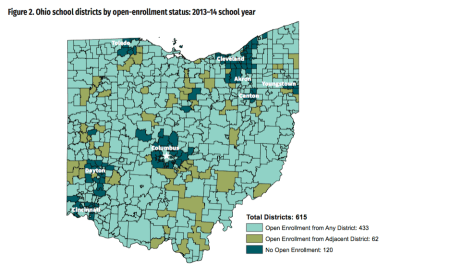
Yesterday I presented statewide NAEP information contrasting urban schooling achievement trends in Arizona and Ohio, and specifically in Tucson and Columbus. Columbus is surrounded by suburban districts choosing not to participate in open enrollment (typical I fear) while Tucson is surrounded by suburban districts who do participate in open enrollment-and actively so.

Today I remembered the cool data tool that the NYT developed using Sean F. Reardon’s data.

Let me start by saying that if I had to pick a district to showcase Arizona, it would not be Tucson. While I am fully aware of some outstanding schools in TUSD, the district’s reputation (fairly or not-I am no authority on the subject) usually involves enrollment decline, empty school buildings, union sway in school board elections and controversy over some sort of voluntary “La Raza” curriculum in the high schools. A decade ago you could peer into the state’s AIMS data and watch student cohorts fall further behind as they “progressed” through the system.

Arizona however has been leading the nation in academic gains, and Tucson continues to face steady and considerable competition for students not only from charter schools and private choice programs, but also from nearby suburban districts. It is my contention that this broad competition enables the bottom up accountability that results in Arizona’s average charter school closing after only 4 years despite receiving 15 year charters from the state. Reardon’s data includes both district and charter school trends, but how did Tucson fare between 2010 (3rd grade scores) and 2015 (8th grade scores) in terms of academic growth?
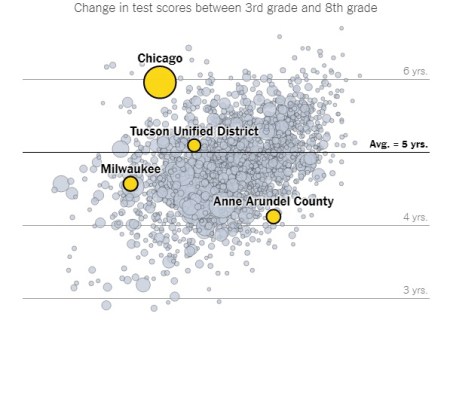
Tucson Unified (and charters operating within district boundaries) scored at the 64th percentile for growth during this period. Columbus Ohio meanwhile also had a charter school law active, but no suburban districts willing to allow transfers, per the Fordham map:
How did Columbus fare in the Reardon data?
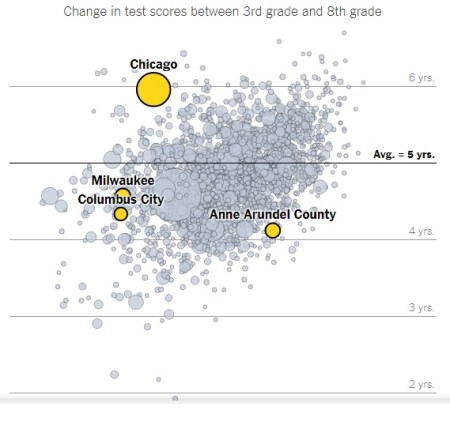
Columbus scored in the 22nd percentile in academic growth during this period. The news is also grim in Cleveland, Toledo and Dayton although Cincinnati stands out as the Ohio urban progress champion during this period. Overall however things look like in NAEP for the two states.

Now if you want to see something really cool:
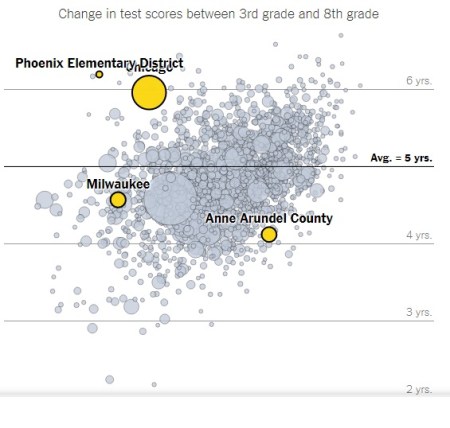
The east-west on these columns indicate the relative wealth of the district, and Phoenix Elementary and charters sit at the tip of the gains spear.


Eden and Burke on DCPS Fraud

February 13, 2018

Behold my BROOM ye mighty and DESPAIR!

(Guest Post by Matthew Ladner)

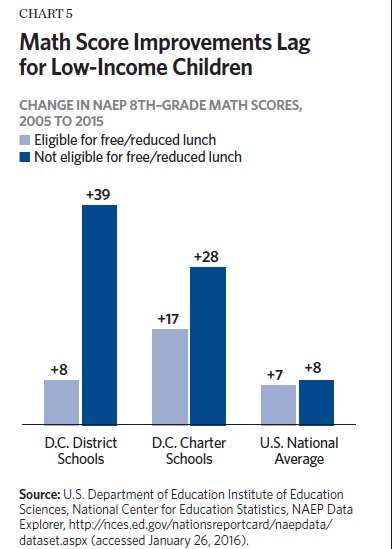
Jayblog readers of a certain tenure may recall the case being made here that outside of the DC Opportunity Scholarship Program and DC charter schools, there was little to celebrate for disadvantaged kids attending DCPS. Over the last decade of available NAEP data, it seemed clear that advantaged students were primarily driving the overall improvement in scores, with DC charters at least showing much larger rates of improvement for disadvantaged students compared to the national average. DCPS, not so much:

Well it turns out that my view of DCPS as being largely inept outside of educating advantaged kids in carefully guarded pockets of excellence was excessively benign: DCPS also developed a systemic approach to academic fraud.

Prosecutors Eden and Burke hit the pages of National Review yesterday to bring us up to speed on the various forms of metric-driven academic fraud recently uncovered in DCPS. DCPS has been engaging in systemic fraud in order to “improve” graduation rates. DCPS “improved” graduation rates by giving diplomas to huge numbers of ineligible students, and “improved” suspension rates by taking them off the books. The FBI is on the case. It’s not pretty. Money quote from Eden and Burke:

When former D.C. Public Schools chancellor Michelle Rhee assumed leadership, she had a searing critique, and a clear argument: Urban schools were paralyzed by collective-bargaining agreements and inertia, so the best path forward was to have expert-designed systems for a new generation of leaders to implement. The unions, in turn, warned that administrators would weaponize these new systems to force teachers to go along with dishonest schemes that would harm true education reform in the service of posting meaningless numerical improvements.

It turns out both sides had a point.

Meet the new boss, same as the old boss.


Brookings Hamilton Project to the Rescue on Charter Rankings

February 12, 2018

(Guest Post by Matthew Ladner)

Over the weekend I thought to myself- what if we just used the Hamilton Project’s Access map to rank state charter laws? The Hamilton map measures the percentage of students who have access to a charter school within their zip code. It’s not a perfect measure- some students after all have access to multiple charter schools within their zip codes and others nearby. The measure could be improved upon in theory, but let’s just run with it for a moment. What would a top 10 list look like?

  1. District of Columbia
  2. Arizona
  3. Utah
  4. Alaska
  5. Colorado
  6. New Mexico
  7. Florida
  8. Idaho
  9. Delaware
  10. Michigan

So a quick check finds only Alaska as a state with too few charter students to have made the NAEP sample in 2015. Alaska may be a bit of an anomaly due to the fact that half of the state’s population lives in a single city, meaning that a relatively small number of charter schools in a relatively small number of zip codes could cover a large percentage of the population in the Hamilton project.

So the Hamilton rankings have one state that has yet to produce enough charter students to make the NAEP sample in the top 10, while the National Alliance for Public Charter Schools ranking has six (Indiana, Alabama, Mississippi, Kentucky, Maine and Washington). There is some overlap between the lists (CO, DC and FL) but generally speaking the Hamilton list looks like flourishing charter sectors, while the NAPCS list is full of charter-light charter sectors.

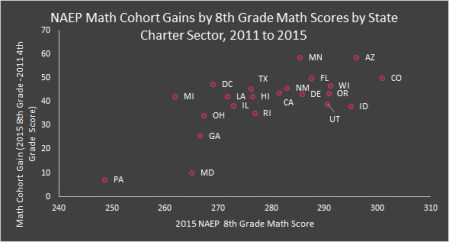
Sector performance is an obsession of wonks, but is of limited significance to parents, who have every incentive to concern themselves more with the fit of individual schools for their child. Nevertheless, if we indulge the wonkiness for a moment, the Hamilton list looks pretty good on NAEP math- most having either high scores or high growth or both. Even number 10 ranked Michigan has this to hang their hat on:

I’ll take the actual Michigan charters over the largely unicorn charter schools of Alabama, Kentucky, Mississippi and Washington any day of the week and twice on Sunday.


Ziebarth Defends the Pageant

February 9, 2018

Miss Indiana crowned as Miss America

(Guest Post by Matthew Ladner)

Todd Ziebarth from the National Alliance for Public Charter Schools has responded to criticism from yours truly, Max Eden and others regarding the soundness of judging charter school laws based on adherence to a model bill, rather than by their results. I encourage you to read Todd’s response.

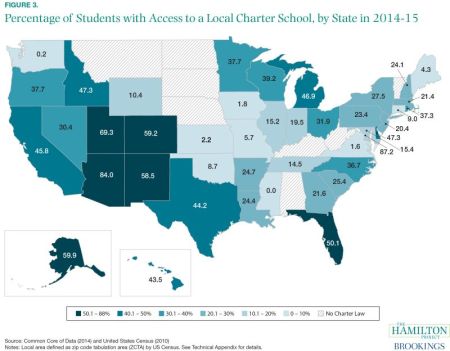
Ziebarth in essence claims that facts on the ground in the last five laws passed rather than flaws in the laws themselves have dampened the impact of otherwise good laws. I have no reason to doubt that differences in circumstances from state to state will influence speed out of the gate. I however do not share Ziebarth’s preference for ranking charter laws by their adherence to a model bill when it is possible to judge them by their results, like the Brookings Institute did in this map:

This map measures the percentage of students by state who have access to a charter school in their zip code. It’s not a perfect measure- after all some zip codes have multiple charter schools. Perhaps the measure could be improved upon. When however you see states with near zero percentages on this map near the top of a ranking list, something seems out of sorts with the rankings. Yes circumstances can influence how well you come out of the gate, five new laws in a row failing to produce many schools isn’t a fluke, it looks more like a pattern.

Ziebarth notes that if we don’t include the recent charter bills that have yet to produce many charters, then you get a list like (each state listed along with the % of charter students). This revised list however remains problematic.

1 Indiana 4%
2 Colorado 13%
3 Minnesota 6%
4 District of Columbia 46%
5 Florida 10%
6 Nevada 8%
7 Louisiana 11%
8 Massachusetts 4%
9 New York 5%
10 Arizona 17%

Ok, so the top rated law (Indiana) only produced charter schools within the zip codes of 19.5% of Indiana students, and enrolls 4% of the student population. The law has been in operation for a long time, but you as yet cannot even get a NAEP score for their schools because of the wee-tiny size of the population. If one is a utilitarian sort, any set of criteria that ranks Indiana as having the top charter school law seems in need of revision.

Minnesota has the oldest of all charter school laws, but only six percent of the kids, and 37.7% of kids having access to a charter in their zip code for a law that passed in 1991. There is a word for that: contained. Minnesota gets a ton of credit for inventing charter schools, but their law doesn’t seem to be doing a whole lot to provide families with opportunities, or producing competitive pressure to shake things up.

DC meanwhile has 46% of total kids and 87% of kids have access to a charter school in their zip code. It’s also easy to find evidence of academic success for DC charters. Judging by results, this certainly looks like a much better charter law than Indiana or Minnesota. Ironically, the main reason NAPCS dings the DC charter law in their scoring metric is for a lack of equitable funding. DC charters however seem to be funded at a high enough level to capture 46% of the market, to provide access to 87% of kids, and to produce better results than DCPS. They also receive more generous funding per pupil than most (all?) states. There is no contest between DC and either Indiana or Minnesota in terms of outcomes in my book.

Ok I could go on but I think the horse is dead. We’ve reached the point where it is possible to judge charter sectors by outcomes, rather than by a model bill beauty pageant criteria.

In the end charter school laws either produce seats or they don’t. Laws that fail to produce seats are failures. Laws that produce only a few seats are disappointments. Philanthropists should carefully reexamine their grant metrics to guard against the possibility that they have created a powerful incentive for groups to seek the passage of charter laws regardless of whether they ever produce many charter seats. I haven’t seen grant agreements, but I have watched as the last five laws failed to produce many schools. We are supposed to be creating meaningful opportunity for kids rather than merely colored maps.


Wild West Podcast

February 7, 2018

(Guest Post by Matthew Ladner)

Yours truly joins Marty West for the Ed Next Podcast on charter schools in the Wild West. My favorite bit is our discussion of Marty’s study using 2012 data showing meh results for Arizona charters. I’m confident that this result was accurate. In fact the 2013 NAEP also showed lower 8th grade scores in both Math and Reading for AZ charters than AZ districts. What gives?

In 2012 the Philadelphia Eagles went 4-12, but earlier this week they won the Superbowl. This doesn’t shock us much in sports as we understand that player turnover in sport is high and one year’s team can be very different from the previous year’s squad. Likewise in a charter sector as dynamic as Arizona’s you literally have had hundreds of charters open and close since 2012. Also during this period you had a large number of young schools mature (the survivors the crucible of their formative stage). The Great Recession was a period of rapid charter school growth in Arizona as many high quality CMOs seized the opportunity to obtain bargain priced properties. That also however meant lots of young schools going through their shakedown cruise periods.

If the Eagles had been playing a large number of rookies in 2012, their record would look bad, but come back a few years later and those former rookies have grown into grizzled vets. The guys who couldn’t cut it are off the squad. So too in 2015 Arizona charter students crushed the ball on all six NAEP exams, and their AZMerit scores have improved subsequently improved in both 2016 and 2017 along with the scores of districts.


I wish I had seen the above Brookings map before writing the Ed Next piece, as it kind of sums up the four corner charter phenomenon in a nice visual. The higher percentage of kids that have access the charters, the more likely it is that your suburban districts will participate in open enrollment. We you have access to suburban (and/or private schools) your willingness as a parent to put up with a dysfunctional charter school moves closer to zero and they get very quick on the draw. Result: Yippie kai yay!


It’s Time for Technocratic Beauty Pageant Charter Rankings to End

February 2, 2018

(Guest Post by Matthew Ladner)

The National Alliance for Public Charter Schools released their new rankings of charter school laws. I gave NACSA grief for their rankings, so I need to be an equal opportunity offender in the interests of consistency I need to do the same for NAPCS. Both sets of rankings rate state charter laws against a model bill, and as a consequence, both wind up ranking relatively weak charter laws in their top 10. There is an obvious problem here- we may not know what a good charter law is, and this may be especially the case given the diversity of needs and cultures across states. Best then to judge charter laws by their outcomes, and here is where you find difficult to justify patterns in the model bill rankings.

Both NACSA and NAPCS have ranked Indiana as the top ranked charter law. There’s a problem with this however as Indiana’s charter school law has not produced many “charter schools.” The Brookings Hamilton project provided this handy map that shows the percentage of students per state that have a charter school operating in their zip code:

A reasonable way to judge the quality of a charter law in my book would be some combination of the following factors-how many charter school seats has your law produced, what does the average achievement of charter school students look like, and the degree of competitive pressure is being generated on the district system. Indiana appears meh on all three fronts, except with regards to academics where they have been too small to show up in the NAEP samples thus far.

So if a judging against a model bill puts Indiana on top, is it possible that there is something wrong with the model bill itself? Yesterday during a lively conversation on social media Max Eden made the following observations regarding states landing in the top 10 of the NAPCS rankings:

Mississippi is 5 years old. There are two charter schools there.

Maine is 8 years old. There are nine schools there.

Washington state’s law is six years old. They have 8 schools. And what, then, are the rational grounds for believing that these newer laws are superior?

So, three of your top 10 states have produced 20 schools in 20 years. There is no rational case for why this is a better approach. If state policymakers follow your model law, charter growth will be strangled.

You need to be very innocent with lots of solid alibis if Max Eden is prosecuting a case against you, and well, things are looking pretty grim for the model bill approach. Referencing the handy Brookings map above we see only 4.3% of Maine students have a charter school operating in their zip code. Less than one percent in Washington, and then you Mississippi…zero point zero.

This map is from 2015 so things are somewhat better now, but not much and the point remains. Kentucky passed a charter law, and it also landed in the NAPCS top 10. I read a late (not final) version of the bill, and based upon that reading I would say we should expect the sort of pace that Eden noted in Maine, Mississippi and Washington. The draft I read greatly empowered school districts to interfere with the operations of charter schools to an extent that struck me as likely to dissuade rational actors from coming in from out of state, and all but the most gung-ho in-state operators.

If charter school laws that fail to produce charter schools are topping your rankings, it is time to reexamine the bill. There looks to be something or somethings deeply wrong with it. In meantime, congratulations to Indiana for winning what amounts to a technocratic beauty pageant.

OMG! I knew that one year default closure provision would impress the judges!

If you’d like to see the states whose students are actually benefiting from their state’s charter laws, the Brookings map is a good place to start. The first duty of a charter school law is to provide charter school seats- any charter law is somewhere on the boutique curiosity to abject failure spectrum without them. Summing up it is best to always remember:

Godzilla 1998 Fishing
Size does matter…


Wild West Parents to Ineffective Schools-DRAW!

January 25, 2018

(Guest Post by Matthew Ladner)

Yours truly has a new piece at Ed Next today called “In Defense of Education’s Wild West: Charter Schools in the Four Corner States.” Here’s the punchline:

Just as the country benefits from political diversity, we also benefit from a diversity of policy approaches at the state level. There are those who seek greater uniformity among state charter-school policies—urging that all charters should be for five years and that default closure provisions should be spelled out, among other guidelines. Such advocates should consider the success of these western states, which have chosen not to adopt such policies. The 50 states will become less useful as laboratories of reform if we adopt a single set of policies everywhere.

Many states—including three of the four featured here—have experienced high rates of overall K–12 enrollment growth, which raises the opportunity cost of imposing a stringent charter-authorizing process. It does not follow that every state should rush to amend its charter policies to match those of Arizona, Colorado, New Mexico, or Utah, but the obvious flourishing of the charter sectors there offers food for thought. Questions to consider and debate include: What factors have led to success in these states? What steps can policymakers and philanthropists take to enable parents to take the leading role in closing undesired schools? How important a role does open enrollment in suburban districts play in creating a successful bottom-up accountability system?

We don’t know the answers to these questions. But we do know that relatively freewheeling charter-school systems have prospered in multiple states. Surely we have as much to learn from these success stories as we do from the cautionary tales from states that have experienced difficulties.

Check it out and let me know what you think.


Education Freedom is…a Millennial

January 4, 2018

(Guest Post by Matthew Ladner)

So the recent closing of BAEO has me reflecting a bit. The Milwaukee Parental Choice Program passed in 1990, followed by the first charter school statute in 1991 in Minnesota. This makes the choice movement a millennial. Like many millennials, the education choice movement is still a little rough around the edges, still a little up in the air about whether she’s going to pull it all together. She does show promise, but just might be holding herself back despite some lessons learned the hard way that she does not quite, really want to confront and accept. Lessons like:

  1. It’s counter-intuitive but if you want to help poor kids with choice it is best to include everyone.
  2. Central planning efforts can and do backfire, even when your intentions are good.
  3. When you go outside and talk to normal people you learn important things away from the reformosphere bubble.
  4. Politics has some basic rules-know them.

Needless to say, there are more, which you can add in the comments. I for one am optimistic that our sometimes out of sorts millennial is going to make it after all.


2017 in review

December 29, 2017

(Guest Post by Matthew Ladner)

So…let’s start with the good news: despite dire predictions of apocalypse, human civilization is still alive and kicking. No global trade wars broke out, the economy shows signs of life. If you google around a bit you can learn things like that the Trump administration is running at about half of the pace for deportations from the Obama administration peak.

That’s all I have to say about that. Ok I take it back-you should also read this. Keep your fingers crossed.

The early days of 2017 looked like the year might be a complete K-12 dumpster fire as (too) much of ed reform world went into a Patty Hearst level of Stockholm Syndrome. The response to the K-12 version of the polarization trap went in the direction of “Gaghghghghgh!!!! The sky is falling!!!!! Quick make something up about Detroit charter schools!”

It should be obvious now that this was overwrought. As it happens 2017 goes into the books as a mixed year on the choice front, contra the fears of DeVosaphobes. Advances in Illinois, North Carolina and Wisconsin were offset by a setback in Nevada and a cliffhanger in Arizona. The initial drama surrounding the prospect for federal legislation eventually simmered towards an incremental approach sans apocalypse. Kentucky passed a charter school law, but not one likely to produce many charter schools. There are people getting excited for and against the 529 provision, but color me mostly meh. Other provisions of the tax bill may wind up being more significant.

There was a lot of discussion of ESSA plans. I’m not sure why. Perhaps 2018 will see more of the ESSA cottage industry think through the implications of NGO school rating systems. What’s that? Okay I’ll mark my calendar for 2084. Later?!? Fine. Meanwhile approximately 3,650,000 additional Baby Boomers reached the age of 65 in 2017. No one on either side of the aisle in DC seemed to notice. Arguments over inaugural crowd sizes and Russian conspiracy theories took precedence. Excuse me 2018? I’ll have another 3.65m please! Oh and send the check over to the kiddie table.

Perhaps the most encouraging news I heard this year came from the Modern States Project. MSP developed MOOCs and free online textbooks designed to allow students to pass AP/CLEP courses for only the cost of the exam (~$85.) This looks like a straightforward solution to the credit problem, at least in lower level courses and inches the ball closer to free.

The 2017 NAEP will be released in a few months. Election years don’t usually serve as the setting for broad K-12 reforms, but my money is on Greg beating Mathews yet again.

Let’s see what happens next.


Chicago Mystery Solved?

December 27, 2017

(Guest Post by Matthew Ladner)

Large scale out-migration of low-income students may help explain Chicago’s apparent status as a value added champ.