I’m betting Derrell Bradford is off of Randi Weingarten’s Christmas Card list after this MSNBC exchange. Weingarten is babbling about wrap-around services while Derrell Bradford is telling the truth about about urban districts spending $30,000 per kid getting 22% graduation rates.
I can’t figure out how to embed the video- so go check it out:
“Governor Bush has been at the forefront of education reform,” said Michael W. Grebe, president and chief executive officer of the Bradley Foundation. “During his administration and since, Florida students have made incredible gains. He has also been a vocal advocate for school choice.”
Congratulations to Governor Bush and to the entire Florida reform team!
Yesterday the Arizona Senate gave the final passage for SB 1553, Arizona Empowerment Scholarship Accounts, the nation’s first system of public contributions to education savings accounts as a choice mechanism, 21 to 7. The bill is now on Governor Brewer’s desk. Designed to replace Arizona’s special needs voucher program lost to our Blaine amendment, the ESA program will allow the parents of a child with a disability to withdraw their child from a public district or charter school, and receive a payment into an education savings account with restricted but multiple uses. Parents can then use their funds to pay for private school tuition, virtual education programs, private tutoring or saving for future college expenses.
Congratulations and thanks to sponsors Senator Rick Murphy and Represenative Debbie Lesko, my colleagues at the Goldwater Institute especially my coauthor for the ESA paper Nick Dranias. The tireless hard work of Arizona’s school choice coalition resulted in this passage, including but not limited to: A+ Arizona, the Arizona School Tuition Organization Association, the Arizona Catholic Conference, the Center for Arizona Policy, the Goldwater Institute and the Institute for Justice in additional to national partners such the Alliance for School Choice, the Foundation for Educational Choice and the Foundation for Excellence in Education.
This has been quite the week for parental choice in Arizona. First, the United States Supreme Court dispatched a challenge to the tax credit program that had been bouncing around in the 9th circuit for many years. Somehow in the fevered imagination of the ACLU an entirely voluntary program in a state which subsidizes secular options at a much higher rate than the tax credit scholarship compels parents to send their children to religious schools. It would be nice if these guys would follow the lead of the ACLU in Los Angeles and do something useful like suing against tenure policies that really damage the education of children.
Instead, they will probably go straight into court on the ESA program. Sigh. Nick and I followed the lead of very perceptive questioning in the Arizona Supreme Court’s deliberation over special needs voucher programs to make the case for the constitutionality of the ESA concept under the restrictions of the Arizona Constitution. Attorneys on both sides of the case agreed that a program allowing multiple uses of funds would not violate a restriction on providing aid to private or religious schools. Otherwise, we can argue that it is unconstitutional to pay state workers salaries out of the public treasury: some of that money winds up paying private school tuition in religious schools.
Quelle horreur!
Parents will be using this program for things other than private school tuition, and parents have an incentive to look for education programs which deliver strong results and a low-cost due to the possibility of saving for college expenses. Paging Dr. Technology! As I’ve argued here before, this is a superior design for a parental choice program, and I’ll go further by saying that when we get any kinks worked out, choice supporters should seriously consider converting voucher programs into a system of public contributions to ESAs.
Next the legislature expanded the maximum size of an individual tax credit contribution from $500 for an individual and $1,000 for a married couple filing jointly to $750 for an individual and $1,500 for a couple in addition to the ESA bill. The legislature also voted to eliminate the statewide cap on the corporate credit.
Great team wins all. Now we need to roll up our sleeves and get these programs to work for the kids who need them.
So I ran the NAEP learning gains for free and reduced lunch eligible children for the entire period in which all 50 states have data available on all 4 main NAEP exams.
West Virginia, you’ve got some ‘splaining to do!
What has Maryland been up to? Underrated?
North Carolina…you really let yourself go!
Florida wins despite the fact that starting the clock in 2003 ignores large gains between 1998 and 2002.
Discuss amongst yourselves…I’m feeling a little verklempt.
“He is the standard-bearer,” said Michael J. Petrilli of the Thomas B. Fordham Institute, a conservative-leaning education think tank. “Those governors who are going to have religion on education reform are looking to him to be their mentor.”
and from Paul G. Pastorek, Louisiana’s superintendent of education:
“Arne and Jeb are really the most influential people at the national level right now pushing college and career readiness for our kids and improvement for our schools,” said Paul G. Pastorek, Louisiana’s superintendent of education and a Republican. “Jeb is working with statehouses and state leaders to directly impact the agenda. He is above all others on the issue among Republicans.”
Of course, journalistic ethics require “balance” and this is where it gets fun:
Many Democrats and labor leaders denounce the Bush agenda. They say that vouchers drain funding from public education and that grades of D and F stigmatize schools that need help. Critics also say other policies he espouses — including merit pay — are unfair to teachers and rely too much on standardized tests.
Florida’s academic gains, critics say, could have been much larger if Bush had sought more collaboration.
“He doesn’t believe in bringing people along with him,” said Andy Ford, president of the Florida Education Association, the state teachers union. “He just forces his will on everybody.”
Ford said many teachers were irate that Obama shared a platform in Miami with a former governor who fought the union almost nonstop for eight years. “The White House is on the wrong track by associating with Jeb Bush,” he said.
Don’t worry Andy, Governor Bush is bringing plenty of people along with him. Someday even you reactionary types may come around, but no one has time to wait for that. As for “the gains would have been much larger if Governor Bush had sought more collaboration” claim, strangely enough, Florida has had the largest NAEP score gains in the country. Try again. As for the President associating with Governor Bush, well, who wouldn’t want to associate with results like these:
The first is Bush’s own creation of the Florida Reading Research Center, a state technical assistance agency solely focused on providing reading assistance — complete with reading coaches — in elementary schools so that kids could read by the time they graduate third grade.
It would be hard to argue that this wasn’t a big reason for the rise in Florida’s fourth-grade reading scores on the National Assessment of Education Progress, the grade and area where the state saw the highest gains under Bush.
The former governor also never mentions any possible effects from a class-size reduction referendum in the state which he opposed but was approved anyway by voters early in his tenure.
Dorn, in a Q & A I did with him late last year, also noted that Bush was governor during a real-estate boom that allowed per-pupil expenditures in Florida to rise 19 percent. That allowed schools to hire hundreds of reading coaches. But, said Dorn: “That kind of money is not available in any state right now, and I suspect a number of states will be in for a rude shock when they try the symbolic step of assigning letter grades to schools without supporting instruction.”
Let’s take these one at a time:
1. Governor Bush happily acknowledges that the reading improvement effort strongly contributed to the overall effort to improve literacy. No one necessarily needs to create the State X Reading Research Center. If they want to hit the ground running they can use the Florida Reading Research Center’s research.
Bless their hearts, the edu-reactionaries come across as a bitdesperate to spin their way to a story that will justify what seems to be their goal: a yet more expensive version of today’s failed status-quo. No one should take this the least bit seriously, as we cannot afford it, and it wouldn’t work anyway. States around the country are drawing inspiration from the Florida reforms for a reason, and Governor Bush is the first one to emphasize that the Florida cocktail was state of the art, cutting edge reform in 1999. Today’s reformers can take Florida’s reforms as their floor, rather than their ceiling.
Indiana is poised to do something very special. Under the leadership of Governor Daniels and Superintendent Bennett, they are on the cusp of pushing through major Florida reforms: transparency with teeth (A-F school grading), action against social promotion and parental choice. The rest of us are going to have to pick up our games to try to keep pace.
The long-suffering DC Opportunity Scholarship Program children have suffered through the trials of Job. Kudos to Speaker Boehner for putting his back into delivering a happy ending for these kids!
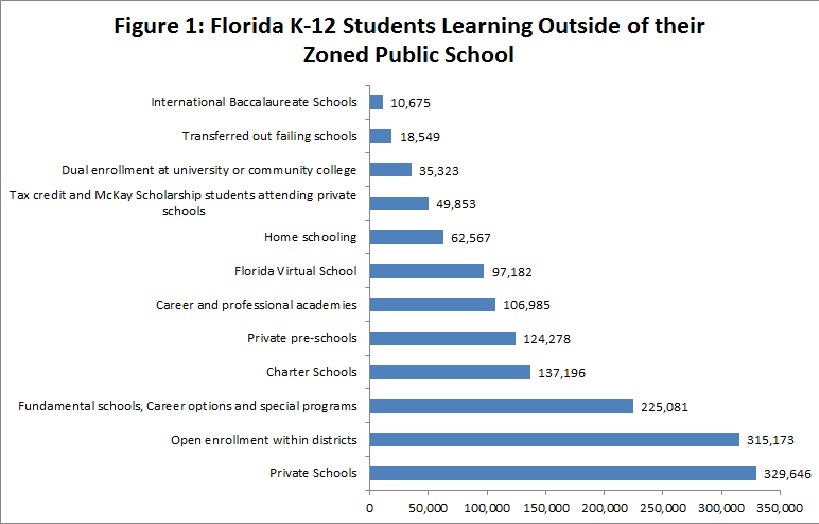
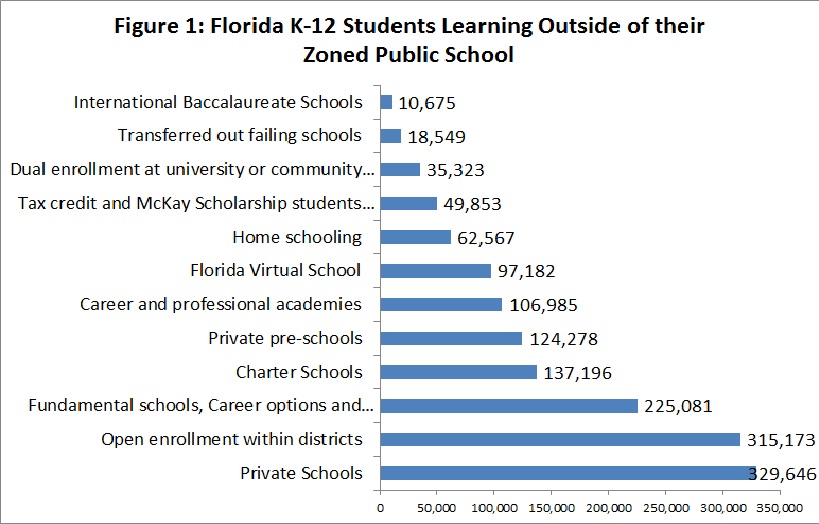
Drawing on data from redefinED and the Digest of Education Statistics, I produced the following chart. With 1.46 million students learning in part or wholly at schools other than their assigned public schools, Florida’s choice students outnumber the total public school population of all but about 8 states.
Okay, so it may be around 12 or 15 or so if we were to account for some inevitable double counting in the figures (I’ve already separated out the McKay and Step Up for Students from the private school number). The choice programs however are just getting warmed up in the Sunshine State.
Lately I have found myself watching more Netflix than television. Yes the content is limited (but growing) and it is on my schedule (which usually means just before I go to sleep).
• Requires 50 percent of a teacher’s evaluation to be based on state standardized tests or other national, local, or industry measures for those subjects not gauged at the state level;
• Requires evaluations to consider four levels of teacher performance;
• As of July 1 of this year, ends the awarding of “continuing” and “professional service” contract status (the Florida equivalent of tenure) and puts all new teachers on annual contracts;
• Permits districts to extend annual contracts only to teachers with good evaluations; those with two “unsatisfactory” ratings in a row, or two “needs improvement” ratings within a three-year period, could not be renewed;
• “Grandfathers” in teachers who now have tenure but allows them to be dismissed for the performance reasons stated above;
• Requires districts to establish performance-based salary schedules by July 1, 2014, for all new hires, and to phase existing teachers onto the new schedules as student-growth measures are developed; and
• Does away with layoffs based on reverse seniority.


 Posted by matthewladner
  (Guest Post by Matthew Ladner)




 (Guest Post by Matthew Ladner)


 Jay P. Greene's Blog