
(Guest Post by Matthew Ladner)
It turns out that after a full day of smashing supervillians, the Hulk loves to kick back and rap about technology based learning. Who knew?
(Guest Post by Matthew Ladner)
It turns out that after a full day of smashing supervillians, the Hulk loves to kick back and rap about technology based learning. Who knew?
 2 Comments |
  Digital Learning | Tagged: Adam Renfro |
  Permalink
 Posted by matthewladner

(Guest Post by Matthew Ladner)
Khan Academy has announced next evolutionary steps: 5 new faculty members to extend into the arts and humanities, a crowdsourcing project for videos and blended learning experiments, starting with summer camps in the Summer of 2012. The O’Sullivan Foundation provided a $5m grant to get these projects underway.
I have wondered for some time whether Khan would choose to add new faculty. Despite the fact that Sal Khan is bright, talented and works diligently to research his topics for videos, there are limits to what a single person can do. I’ve noticed for instance that over the last few years I have gravitated towards reading multi-author blogs more than single-author blogs. The reason why is pretty simple: they tend to have more content and differences in perspective. The first two of the five new faculty are already at it: Dr. Steven Zucker and Dr. Beth Harris have begun to produce content on art, history, and the humanities. Dr. Zucker was formerly Chair of Art and Design History at Pratt Institute while Dr. Harris was Director of Digital Learning at the Museum of Modern Art in New York. You can watch their early videos here.
The crowd sourcing project is obviously very interesting, if a little baffling to me. If you can start a global encyclopedia through crowd sourcing, I guess there will be a way to sort high quality videos from drek.

Although Khan Academy makes for one of the most potentially powerful remedial and supplemental tools that one can hope to access for free, I find myself most interested in the progress of blended learning models. If you haven’t read the Wired Magazine article on Khan Academy, shame on you. Go read it now! There you will read about a 10-year-old who has mastered Trig. Or was well on his way to mastering Trig when the article was written. He might be into calculus these days. Those trig equations are giving me a bad flashback to 1985, but Matthew Carpenter is having fun with them.
After reading the Wired article, ask yourself if there is any reason why Matthew Carpenter ought not to be able to take a trigonometry end of course exam. If he passes, it seems rather self-evident to me that he ought to be given credit for content mastery, and allowed to plow ahead. A future in which content mastery determines course credits and education funding, rather than mere seat-time, makes so much sense that it will surely be fiercely resisted. Unsuccessfully.
Keep up the good work Sal. How long can it be until we see some similar platforms built for more specific niche purposes? Stay tuned…
10 Comments | Digital Learning | Tagged: Dr. Beth Harris, Dr. Steven Zucker, Khan Academy, Matthew Carpenter, Sal Khan | Permalink
Posted by matthewladner

(Guest Post by Matthew Ladner)
So does the data in this chart look fishy to anyone but me? What about after you read this?
7 Comments | NAEP | Tagged: 2011 NAEP, Kentucky NAEP Scores, NAEP exclusion rates | Permalink
Posted by matthewladner

(Guest Post by Matthew Ladner)
Ted Forstmann, co-founder of the Children’s Scholarship Fund and Wall Street pioneer, passed away after a battle with cancer. Forstmann played a big role in the early stages of the parental choice movement and will be missed.
2 Comments | tributes | Tagged: Ted Forstmann | Permalink
Posted by matthewladner
 (Guest Post by Matthew Ladner)
So if you measure the learning gains for children with disabilities on the four main NAEP exams for the entire period all 50 states and the DC have participated, you get the information in the above chart. Last week, the Bluegrass Institute’s Richard Innes alerted me in the comments and by email about fishy exclusion rates for children with disabilities and English Language Learners. I had only casually examined the exclusion rates, but having examined them more closely, I’m concerned.
The 2011 NAEP included standards for inclusion, which include 95% of all students selected for testing, including 85% of students with disabilities or classified as English Language Learners. One might possibly infer that some states were playing games and tricks with excluding such students in the past, and that simply listing the rates wasn’t doing the trick. This year, they listed expected standards and provided the gory details in an Appendix. On the conference call regarding the results, the NAEP team took pains to note this innovation.
So, as you can see, half of the states in the Top 10 gainers for children with disabilities just so happen to be states that violated the inclusion standards on one or more NAEP exam. Hmmm. Moreover, some of them didn’t just barely miss these standards, but instead chose to commit violence against them.
Maryland led the nation in gains among children with disabilities….or did they? Maryland’s inclusion rate for children with disabilities on the 4th grade reading test in 2011: 31%, which though completely pathetic actually beat the 30% rate for children with disabilities on the 8th grade reading test. The ELL rates were almost as bad.
The only other state to sink into the 30s? That would be second place Kentucky, which also excluded an enormous number of ELL students from NAEP examination. The math exams were better than the reading, but lo and behold- there is Maryland again falling below inclusion standards. Maryland failed to meet the 95% overall inclusion standard on 3 out of the 4 exams in 2011.
I have run the numbers for gains among children who are neither disabled nor ELL, and something real and positive is happening in Maryland: scores are up. It is however obvious that the NAEP created these standards for a reason, and have invited people to make up their own minds about whether to throw a skeptical flag in the air.
I’m throwing my flag. I don’t know if it explains all of the gains in Maryland and Kentucky, but it seems pretty obvious to me the results from those two states and perhaps others ought not to be considered comparable to the other states.
I’ve been told and I find it credible that these exclusions have only a small impact on the statewide numbers. Can we imagine however that very high exclusion rates for ELL students will not heavily bias the Hispanic number? Or that sky-high special ed exclusions won’t inflate a variety of subgroup scores? Or that excluding many of both of these subgroups won’t impact your Free and Reduced lunch eligible sample?
So given that the Congress mandated participation in NAEP as a part of NCLB, a mandate which all the federalist bones in my body find quite reasonable, perhaps it would be a jolly good idea for Congress to mandate minimum inclusion rates along with participation when reauthorization finally rolls around. Caesar’s wife must be above suspicion.
4 Comments | research reports, school accountability | Tagged: 2011 NAEP, Bluegrass Institute, Inclusion rates for NAEP, NAEP exclusion rates, NAEP inclusion rates, Richard Innes, Special Education inclusion | Permalink
Posted by matthewladner

(Guest Post by Matthew Ladner)
I mentioned a couple of weeks ago that the 2011 NAEP would be the first real book on Michelle Rhee’s tenure running DCPS. The 2009 NAEP was a little early, and the 2013 numbers and those going forward will be owned increasingly by those in charge after Rhee, for better or worse.
So this morning I tried to devise a rough and ready analysis that would be informative (if certainly not definitive) and that I could run before making breakfast for the kids (Mrs. Ladner is off on a well-deserved vacation, daddy is gasping for air).
Here is what I came up with: Rhee took command in 2007, so I use the 2007 NAEP scores as the baseline. We all know the level of academic achievement is terrible in DC, but it was when Rhee got there as well, so I decided to focus on growth in scores.
Finally, DC has experienced a good amount of gentrification in recent years, so I chose to focus on the growth of free and reduced lunch eligible children on all four main NAEP exams (4R, 4M, 8R, 8M) for the 2007-2011 period.
Here’s what came out:
 That’s pretty close to the top. Rhee’s critics will be quick to note that DC’s gains between 2003 and 2007 were also large. We of course can never know the counterfactual DC’s scores may have been due for a stall, or they may have kept up the same pace whether Rhee had shaken the District up or not. We’ll never know.
The most important point is: DC scores are still a disaster despite the large gains before, during and after Rhee. Rhee has moved on, but the rotten scores are still there.
DC policymakers, in my opinion, should now look to take a deeper dive on reform. Why does the District’s budget continue to swell when the enrollment continues to shrink? If money were allowed to truly follow the child, you’d see an even more robust charter school movement in the District.
When will the District finally clean up the special education disaster? Many blame it on the lawyers, but go and look at the scores in the post below: these guys are shooting fish in a barrel. Special needs vouchers could play an important role in a comprehensive plan to clean up the special needs mess in DC (no litigation, no ultra-Cadillac placements).
While the needle is moving in the right direction in DC, I believe that the Cool Kids came out of the experience sadder, wiser and undeterred. That’s for the best.
14 Comments | competitive effects | Tagged: DC 2011 NAEP scores, DC NAEP scores, Michelle Rhee | Permalink
Posted by matthewladner
(Guest Post by Matthew Ladner)
So how did my English to Spanish translator website do? I studied French while a student, which has come in handy about three times in my life, and may never do so again.
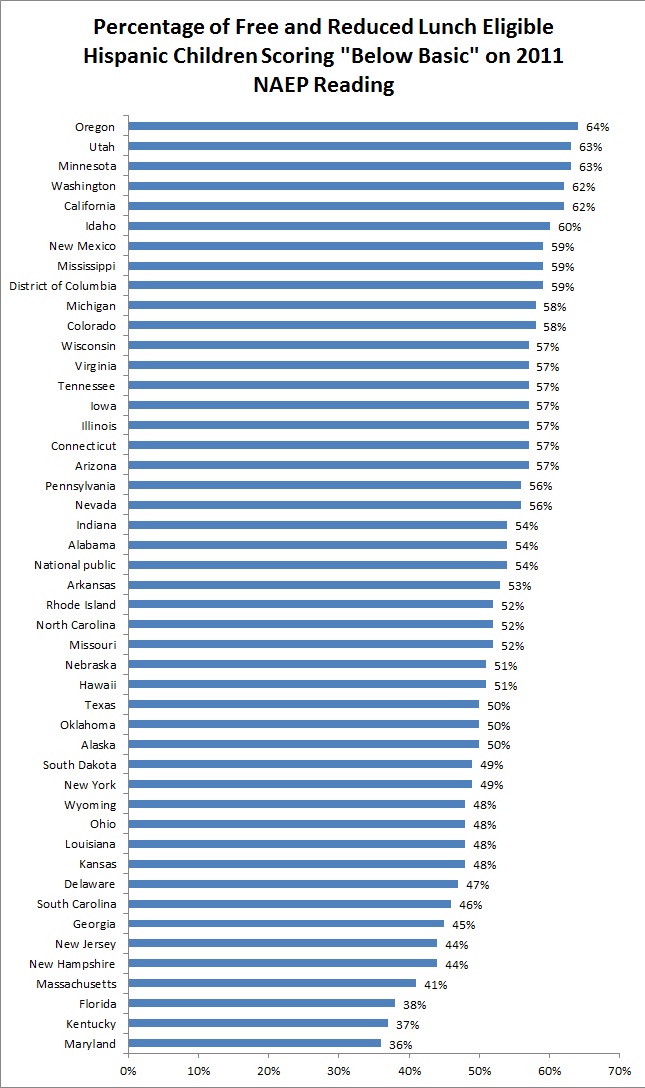
But I digress. The chart here ranks states by the percentage of low-income Hispanic students scoring “Below Basic” on the 4th grade NAEP reading exam in 2011.
Like any of these reincarnation charts, there are any number of factors to bear in mind. Some states have more ELL students than others, generational effects are important, and Hispanics are far from monolithic.
Nevertheless, isn’t it interesting that Oregon yet again makes an appearance in the hall of shame. Last time I visited, Oregon was way up in the Pacific Northwest and far from the southern border.
Now that the mandatory Oregon mocking is complete, let’s talk serious business: California is a disaster. The sheer size and low scores of the California Hispanic population ought to be a national concern. While it is fun to poke at Oregon for a being even worse than California, California’s Hispanic population is a sea to Oregon’s pond.
Matters are far better in Texas, the home of the second vast Hispanic population in America, but still very much in need of improvement.
California and Texas educate more than half the nation’s Hispanics, almost 5.5 million students. We need California to wake up, and for Texas to step up.
Leave a Comment » | research reports | Tagged: 2011 NAEP, California NAEP, Oregon NAEP, Texas NAEP | Permalink
Posted by matthewladner
(Guest Post by Matthew Ladner)
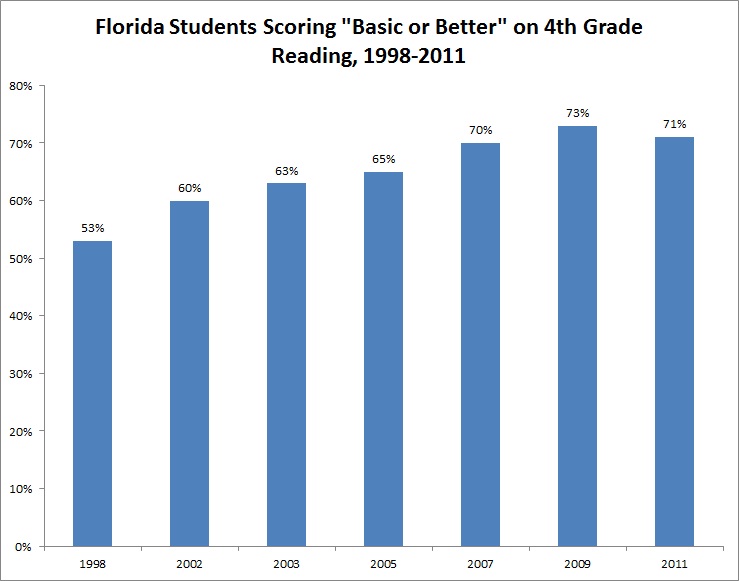
The Florida Age of Public School Improvement hit a wall in the 2011 NAEP. This should not be terribly surprising, as Florida’s improvement seemed certain to plateau in the absence of additional reforms.
Governor Jeb Bush relentlessly pursued a dual strategy- transparency with teeth from the top down, parental choice from the bottom up. Together these reforms drove improvement in the public schools for a number of years. Accountability measures included school grading (A-F) and earned promotion in the early grades. Parental choice measures included Opportunity Scholarships for children attending F rated schools, the nation’s first special needs voucher program (McKay Scholarships), the nation’s largest scholarship tax credit program (Step Up for Students), a decent charter school law and the nation’s most robust system of digital learning. Florida lawmakers also attempted to thoughtfully incentivize success.
Governor Bush took office in 1999 and left office in 2007. It would be nice if these efforts could indefinitely push progress forward, but there have been plenty of bumps and problems along the way. In 2006, the Florida Supreme Court rendered a logic-free ruling abolishing Opportunity Scholarships (failing school vouchers) for private schools, and followed that up by ruling against a state authorizer for charter schools. Tax-credits, McKay and digital learning continued to incrementally advance, but not at an earth-shattering rate.
The larger problem may have come in the top down measures. The chart below presents the distribution of district and charter school grades, with one line being the A/B grades and the other D/F grades. The dotted lines represent instances when the state board raised school grading standards.

The setting of these standards represents far more of an art than a science. Set them far too high and disaster follows (this happened in Arizona). Set them too low, and you remove the tension in the system needed to drive improvement. Even after the last increase in grading standards, more than 10 times as many Florida schools received A/B grades as D/F grades.
Florida’s policymakers raised standards four times, and last year (wisely) put in an automatic trigger to raise standards by a preset amount when a certain ratio of schools get A or B grades. In addition, a fresh set of reforms passed the Florida legislature in 2011, revamping teaching and increasing charter school and digital learning options.
Just as it is impossible to exactly pinpoint how much of what caused the gains, it is likewise impossible to say exactly what made them stall. Note however that one of the favorite explanations of the anti-reform crowd, the pre-school, finally saw the advent of children old enough to have participated in the program and age into the 4th grade NAEP sample. I hope that someone is carefully studying variation in participation and corresponding trends in FCAT data, but the results at the aggregate level thus far seem underwhelming.
Plenty of other things, however, have been going on- including the collapse of a housing bubble, cutbacks in public school funding (including of some of the incentive funding programs) and a variety of other very bad things. My advice to Florida policymakers: roll up your sleeves and get back at it. Despite the enormous amount of progress seen on NAEP (and no one loves celebrating it more than me) too great of a gulf lies between a state system awarding ten times as many top grades as low grades but still suffering from large minorities of students scoring below basic on the NAEP exams.
Governor Bush has consistently said for years that success is never final, and reform is never finished. The 2011 pause in progress demonstrates that he called it correctly. Moving the needle on student learning on a meaningful scale and at a sustained basis represents one of the greatest public policy challenges of our times. Governor Bush has passed the torch to a new generation of Florida reformers, and they must now find new ways, and fine-tune the old ways, to push academic progress forward.
Edited for typos
4 Comments | personal tax credits/deductions, school accountability, social promotion, vouchers | Tagged: 2011 NAEP, Florida 2011 NAEP scores | Permalink
Posted by matthewladner
 (Guest Post by Matthew Ladner)
So the plot thickens, as many JPGB readers (including this author) was born as an American White kid who was not eligible for a Free or Reduced Lunch. In the Great Reincarnation to Come, maybe that is always how it works out!
Or maybe not.
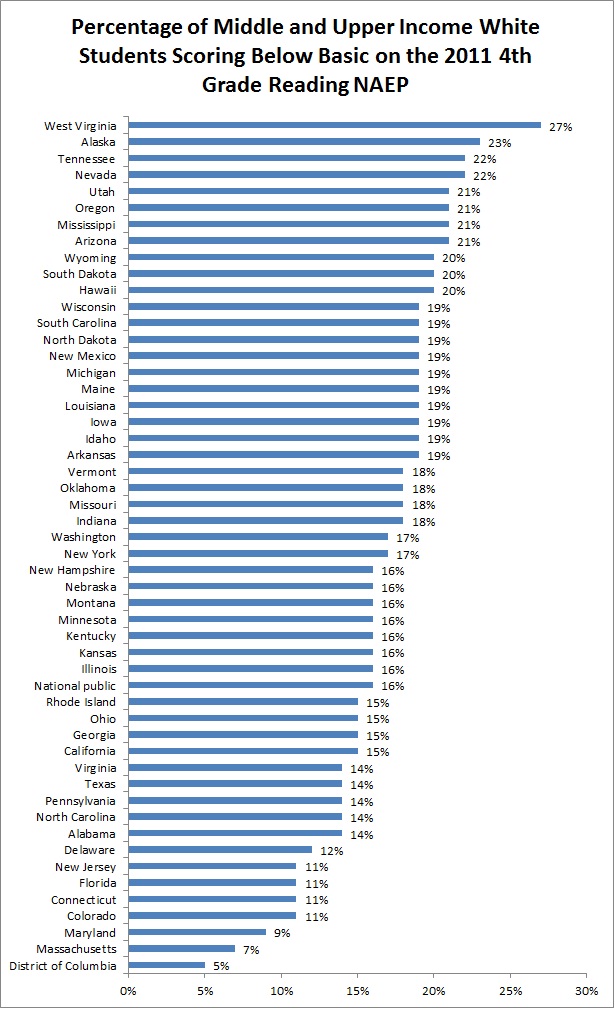
In any case, you ought not to feel overly reassured. Assuming again that you want to learn to read, the above chart shows achievement levels from the 2011 NAEP for non-FRL eligible White students.
Before proceeding to dwell on West Virginia and others, I should note that DC has finally come in first place in something! If you are an ultra-wealthy White student going to one of the highly exclusive public schools in Georgetown, your reading ability rocks. Congratulations to the portion of the DC school into which few poor kids ever step foot much less attend.
Something has been going wrong in West Virginia, as their NAEP scores have been declining. Alaska is a different sort of place that obviously needs to get their act together on K-12. Tennessee can’t be happy to see themselves near the top of this list, and Nevada needs to let go of the idea that you don’t need to be well-educated to deal blackjack.
And then, there’s Oregon. Someone please explain to me why 21% of middle and upper income Anglos in Oregon should be illiterate.
7 Comments | research reports | Tagged: 2011 NAEP | Permalink
Posted by matthewladner
 (Guest Post by Matthew Ladner)
I’m back from SLC, where I had the honor of serving as the opening act to Indiana Superintendent of Public Instruction Tony Bennett. Getting back to the mad science of exploring the 2011 NAEP, and keeping with a sudden OCD fear that I have developed over the possibility of being reincarnated, I present to you the states you want to avoid and those you want to pray to be born into in the next go-around if you happen to be born as a child with a learning disability, and you would like to learn how to read by the 4th grade.
So, whatever you do, try to load the dice to stay out of Washington DC, Hawaii, South Carolina, Alaska and Arizona if you think you might be coming back as a child with a disability.
Conversely, you’ve hit the relative jackpot if you land in Maryland, Massachusetts, Kentucky,New Jersey or Florida.
Seriously DC? 153?!? A mere 60+ point difference between next door neighbor Maryland?
My Cosmic Awareness/Spidey Sense just told me that you were just thinking “yeah, but hey no fair, because Maryland is far wealthier than DC.”
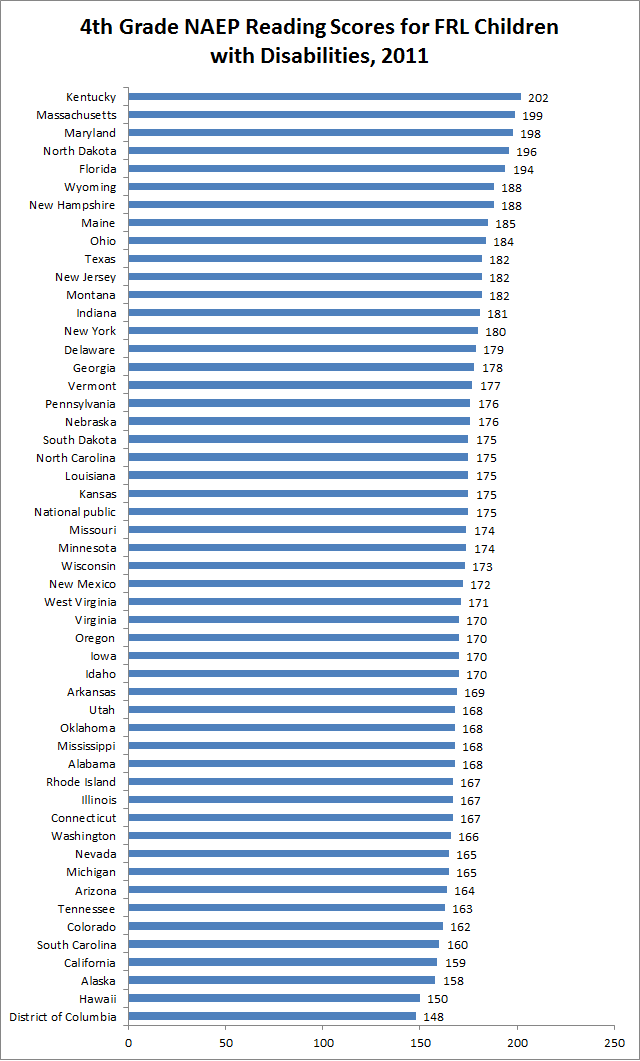
Except, well, it doesn’t really matter so much in terms of the gap. Below you will see a chart for Free and Reduced Lunch Eligible students with disabilities. The top 5 get shuffled a bit, but there is still an appalling gap between DC and the top performing states.
So as you make your reincarnation plans, just remember to stay away from DC, whereas if you have the misfortune of being born with a disability the chances of being academically warehoused seem to approach a near certainty.
Sadly, DC has plenty of company at the bottom.
9 Comments | myth of helplessness | Tagged: 2011 NAEP, NAEP scores for children with disabilities | Permalink
Posted by matthewladner

 Jay P. Greene's Blog