A Green Revolution for K-12 Education

January 20, 2012

 (Guest Post by Matthew Ladner)

The remarkably successful effort to introduce improved agricultural technologies into developing world agriculture stands as one of the most underrated technological and philanthropic achievements. India is now a major rice exporter, and the average calories consumed per person in the developing world has increased by 25 percent. If you were hoping that I was referencing an effort to put solar panels on schools, go ahead and stop reading now.

The Green Revolution in the developing world extended a similar pattern established in the Industrial Revolution in substituting technology for labor. Producers making continually improving products at steadily falling prices drives material improvement improving quality of life and reducing poverty.

Substituting technology for labor causes serious social disruption. China’s decades long mass migration of subsistence farm workers into the coastal urban centers for instance holds broad similarities to share croppers moving to industrial areas of the United States decades ago.

We humans have a perfectly understandable desire for stability, and we are easily made victim to nostalgia. Think for instance of Willie Nelson’s “Farm Aid” project aimed at protecting the family farm. The sad fact of course is that many family farms had been made obsolete and were no longer economically viable despite considerable government support. Many cling to the reactionary notion that the world was a better place back during some happy golden age, but certainly from a material standpoint this is just silly. Would anyone in their right mind wish for a world in which Bill Gates and Steve Jobs (and you) would have died at the age of 30 as a subsistence farmer? Why not yearn for the days of living in a cave? China doesn’t need as many people to produce far more food. Rather than bewailing the closing of the coal mine like U2 or Sting, these people have moved into other activities to make a much better life for themselves.

Education which has remained exempt from the productivity improvements experienced by most other human activities. Higher education costs have been racing ahead of even health care inflation for decades, and yet we lack even a drop of evidence to suggest that the average college student of today is meaningfully better educated than his or her peers from 1980. Likewise, after the emergence of education unions as major political powers in the 1960s, American K-12 schools have suffered from an efficiency implosion, with average achievement scores rising at a profoundly slower rate than the inflation adjusted spending per pupil.

Philanthropists played a leading role in bringing the Green Revolution to the developing world- a fantastic and frankly underappreciated success. The focus of philanthropists in American education should likewise be in researching models that can successfully substitute technology for labor in order to produce a better service for a lower cost. They should invest not just in developing the products, but also in the means to bring them to scale through things such as charter school, voucher and digital learning statutes. They should as Jay put it attempt to build new rather than to reform old.

Charter schools have become the skunk works for new school models- taking the lead in both digital and blended learning models. These experiments are very young, and will experience a number of failures. Encouraging and expanding this primordial soup of innovation, however, is of the utmost importance. My only disappointment at this point is that we don’t see more attempts at innovation in the private school sector like Christo Rey. If someone can develop a high quality, low-cost private school model which can survive and thrive outside of public subsidy, the battle for education reform will be much closer to finished.

The  ability to substitute technology for labor in education may have opened the door to such a possibility. We are in only the earliest stages of such experiments, and they are happening with considerable public subsidy, but if India can go from famine in 1961 to a major agricultural exporter today, anything is possible. Clayton Christensen warned that organizations cannot disrupt themselves, often even when they recognize a dire need to do so, so new entrants will likely be necessary.


Tennessee Teachers Ignore 20 years of Tennessee K-12 Research to Demand Status-Quo

January 17, 2012

 (Guest Post by Matthew Ladner)

This would be funny if it weren’t sad.


Jonathan Butcher debates the Arizona Education Association on ESAs

January 16, 2012

(Guest Post by Matthew Ladner)

GI’s Butcher debated Andrew Morrill, President of the Arizona Education Association on Education Savings Accounts. Check it out.


A Closer Look at DC NAEP Scores

January 12, 2012

(Guest Post by Matthew Ladner)

A few months ago, I provided a quick analysis of DCPS NAEP scores under Michelle Rhee. Having looked into the fine details, I believe that I underestimated the positive trend in DCPS reading scores during the 2007-2011 period.

NAEP has long dealt with a tricky issue with varying inclusion rates for special education and English language learners between jurisdictions. In 2011, the NAEP adopted inclusion rate standards for ELL and SD students, and notified readers of jurisdictions that violated those standards in an appendix.

Some states and jurisdictions had far more successful efforts to comply with these efforts than others. As you can see from the figure below, DC would have been far out of compliance with these standards (had they been in place) during the 1990s and (especially) in 2007. In 2007, DCPS had excluded nearly three times as many students as permissible under the 2011 standards.

So in 2007, DCPS officials excluded 14% of students from 4th Grade NAEP testing, and in 2011 that figure fell to 3% (the inclusion for all students standard in 2011 was 95%). In 2007, DCPS stood far out of compliance, but came well within compliance in 2011. This is all well and fine, other than the fact that it complicates our ability to assess the recent history of DC NAEP gains.

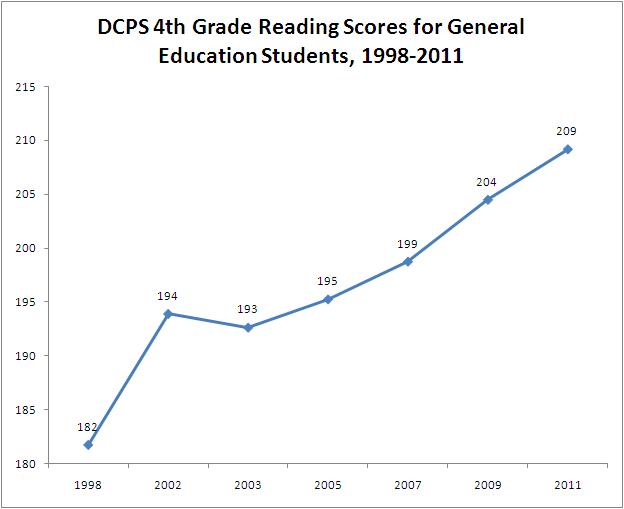
In order to get a clearer picture on this, I decided to run 4th Grade NAEP scores for students outside of ELL or special education programs. This should minimize the impact of inclusion policy changes. Examined in this fashion, you get the following results:

Recall that the unadjusted total scores for 4th grade reading jumped from 197 in 2007 to 202 in 2009 but dropped back a point to 201 in 2011. That is a four point gain in four years, which ranks in meh territory. Given Figure 1 above, I am not exactly inclined to trust those scores, and in fact out second table tells quite a different story: general education students in DC made a 10 point gain between 2007 and 2011 on 4th grade reading. Ten points approximately equals a grade level worth of progress, so it is fair to say that DCPS general education 4th graders were reading approximately as well as 2007 general education 5th graders. Ten points ranks as the largest reading gain in the nation during this period for these students. Mind you, a 209 score for non-Ell and non-special ed students is still terribly low. Only gains will get DC out of the cellar, however, and DC banked solid gains during this period.

If you combine 4th and 8th grade reading gains for general education students, and only look at Free and Reduced lunch eligible students for a bit of socio-economic apples to apples, here is what you find:

DC students had the largest general education 4th grade reading gains in the country, and tie for first in the combined 4th and 8th grade reading gains. The District of Columbia, in short, made very substantial reading gains during the 2007-2011 period.


NYT on Clint Bolick

December 26, 2011

 (Guest Post by Matthew Ladner)

The New York Times has a very nice feature on Clint and the GI litigation team.  That scorpion may have to hunt and peck to type, but the sting packs a wallop!


The Way of the Future: MITx

December 19, 2011

 (Guest Post by Matthew Ladner)

Remember when some crazy blogger whose stuff you occasionally read predicted that someone would eventually be making university coursework available over the internet for free? We still aren’t there yet, but MIT made an announcement today which looks like a rather large step in that direction.


PA lawmakers fail to expand school choice

December 16, 2011

 (Guest Post by Matthew Ladner)

As predicted, Big-10 country led the nation in expanding school choice this year. Just to recap, Indiana created the what will become the nation’s largest voucher program and expanded their tax credit. Wisconsin expaned the Milwaukee Parental Choice Program and created a new program for Racine. Ohio expanded their failing school voucher and created a new voucher program for special needs students. Michigan removed the cap on university sponsored charter schools after a decade plus long struggle.

Pennsylvania had proposed vouchers, a large expansion of their tax credit program and an expansion of their charter school law. It appears however that the PA legislature will choose to do nothing to expand parental options.


Michigan Eliminates Dunce Cap on Charter Schools

December 15, 2011

(Guest Post by Matthew Ladner)

The Michigan legislature has voted to eliminate caps on charter schools. This has been a long, hard-fought victory for parental choice supporters.

Over a decade ago, I wrote a study for Mackinac looking at public choice policies in Michigan, focusing on the Detroit area. It proved to be an interesting project. I interviewed a number of suburban superintendents, and they laid out a pattern whereby districts began participating in open enrollment once they felt an enrollment pinch from charter schools. District participation in open enrollment then put pressure on neighboring districts to participate, and so it started a bit of a domino effect.

I’ll never forget interviewing a superintendent from an elite inner-ring suburban district who told me quite boldly that in his district, private schools constituted his true competition, and that he wasn’t worried about charter schools or open enrollment. When I asked him why his district chose not to make seats available through open enrollment, he paused and thoughtfully said “I think the feeling historically around here has been that we have a good thing going on, and there has been a desire to keep the unwashed masses out.”

I appreciated his honesty, but I found myself stunned nevertheless. I mean there was no way to see this statement in some sort of racial context.

Personally, I am very happy that the cap has been lifted on charter schools in Michigan. I hope that the day will come when complacent check-book choice districts might reconsider their decision not to admit students whose parents happen not to be able to afford a $400,000 mortgage. Likewise I hope that increased competition will result in closure of some poorly performing charter schools.

The only sad note is that Michigan’s Blaine amendment will continue to prevent any sort of private school choice, and that Catholic schools in Detroit, which have already been disappearing, may very well go extinct entirely, perhaps along with other private schools. Catholic schools can survive, but the outlook in Detroit is grim indeed. These schools stood as nearly the only high quality options in a once great city for many decades, and is a pity to lose them. If anyone is ever going to develop new low-cost high quality private school models, Detroit seems likely to be a greenfield in the future.

The bigger picture however is that Michigan parents will be gaining new school options. Hopefully the Michigan legislature will continue to pursue additional measures to improve K-12 education outcomes in addition to choice, but today the are to be congratulated for this important step.


Arizona Republic Series on Digital Learning

December 12, 2011

(Guest Post by Matthew Ladner)

The Arizona Republic began publishing a multipart series on digital learning here in our humble patch of cactus on Sunday. You can read installments one and two online.

Thus far, here is what I have learned for this series: Arizona is a wild west in terms of regulatory oversight, the main online providers in Arizona earned C grades, pure online learning works for some kids and not for others, Gene Glass dislikes online learning, and some people are uncomfortable with for-profit companies being involved in education.

Perhaps they are pacing themselves by backloading the stuff we didn’t already know into the latter part of the series.

The Wild-West bit is par for the course out here and it may be just as well. It isn’t like an extra bureaucrat or three would be likely to do anything productive. What is needed in my view is a system of 3rd party administered end of course exams. A good portion of the funding should be conditioned on how the student performs on these exams. At the moment, Arizona law provides an incentive for students to sign up for online courses rather than to educate students. The same of course can be said for the traditional districts. The river needs to flow both ways on this, as I have no more interest in funding mere seat time in a brick and mortar than I do academic failure in a digital setting. If someone needs to go first, I nominate the digital providers.

He likes it! Hey Mikey!

At the moment, Arizona has neither end of course exams developed, nor any infrastructure for 3rd party administration of such exams. Neither to my knowledge does anyone else. Time to get cracking on that.

I could write an entire post on how silly it is to implicitly expect for-profit companies to spend more money than they receive. Maybe later in the week. In the meantime, I’ll be curious to see what the Republic has to say next.


2011 Trial Urban NAEP-Which Districts to Avoid When Reincarnated as a Poor Child…

December 9, 2011

(Guest Post by Matthew Ladner)

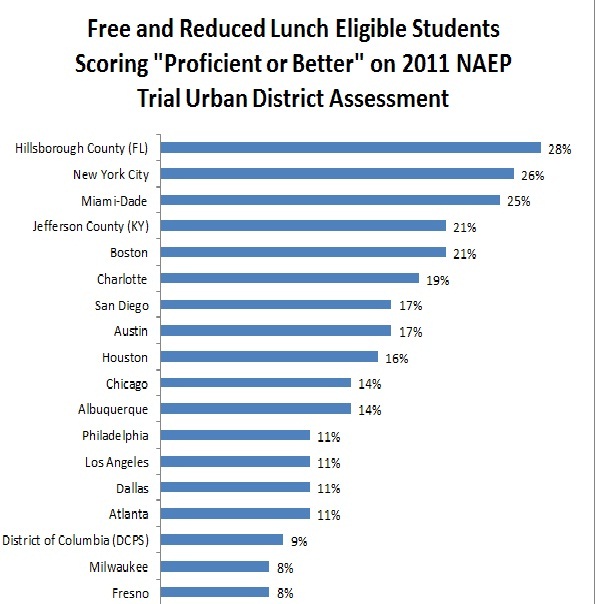
…if you want to learn how to read. In the great reincarnation to come, you want to request Tampa, New York City or Miami. You are three or more times more likely to learn to read at a high level than in Fresno. DC has improved but is still horrible.

I haven’t read the appendix about the inclusion/exclusion rates but the burden of proof lies on Kentucky rather than the other way around on that Jefferson County number. Tied with Boston? Color me skeptical.

Everyone in Wisconsin ought to be horrified by the abomination that is the Milwaukee Public Schools. These awful results make me all the more grateful that kids have the possibility of choosing a charter or private school, and the results may have been even worse in the past (can’t track them very far back) but it is time for something far more drastic.

There should be no bullets left in the gun when it comes to Milwaukee. Policymakers should correct the bad joke of an accountability system the state has employed for starters. Lawmakers expanded appropriately expanded choice last year (can’t get too many lifeboats for that sinking ship) but ought to consider a different governance structure as well.

Meh results from former reform luminaries North Carolina and Texas. The low-hanging fruit has been picked off the tree.

Discuss amongst yourselves…