Jordan Increased Income Inequality on the Bulls while Making All the Players Wealthier

July 11, 2012

(Guest Post by Matthew Ladner)

Fun piece by Matthew Schonfield in the Journal today. Strangely the guys riding the pine on the Bulls in 1998 making four times as much as their equivalents in 1984 did not feel the need to bang on drums to protest income inequality. Also read Iowahawk’s particle physics/health care mashup.


New Mexico Governor Susana Martinez on School Grades, Social Promotion and Teacher Policy

July 10, 2012

(Guest Post by Matthew Ladner)

New Mexico has released their first official A-F school report cards. They have more Fs than As, more Ds than Bs. Given New Mexico’s current standing near the bottom of the rankings on NAEP, that sounds about right. In the clip above, New Mexico Governor Susana Martinez explains why they adopted letter grades, and the next steps she would like to see for reform.

Congratulations to Governor Martinez and New Mexico’s education reformers. Far more remains to be done than has been done to date, but school grading represents a critical first step which reformers can build upon in order to create a more effective system of public education.


Ohio Superintendent to Lawmakers-Please Ignore the Illiterates Behind the Curtain

July 5, 2012

(Guest Post by Matthew Ladner)

Ohio recently passed a law to curtail social promotion from the 3rd grade for students requiring extra help in reading. Not everyone is thrilled as a Ohio Newspaper recently reported “Pike-Delta-York Superintendent Ken Jones thinks the state is overstepping its boundaries with the mandate.   ‘School administrators and parents are smart enough to figure all that out. We don’t need the state coming in and telling us how to operate or telling us how to move kids through our system,’ he said.”

Hmmmm

I’m sure Ohio school administrators are plenty smart, but they might want to go look at some data before making their mind up about the need for this policy. The figure below draws data from the NAEP data explorer, showing the percentage of Ohio students scoring “Below Basic” and “Proficient or Better” on the 2011 4th grade reading NAEP by ethnicity.

Superintendent Jones does seem to have one thing right- he and his fellow Ohio Superintendents apparently know all about “moving kids through the system”- even the students who desperately need more help in mastering basic literacy skills. Note that among Ohio’s Black students that four times as many scored Below Basic as Proficient. The fact that fifty-four percent of Ohio’s Black 4th graders couldn’t read in 2011 hardly constitutes a firm basis for a “steady as she goes!” declaration.

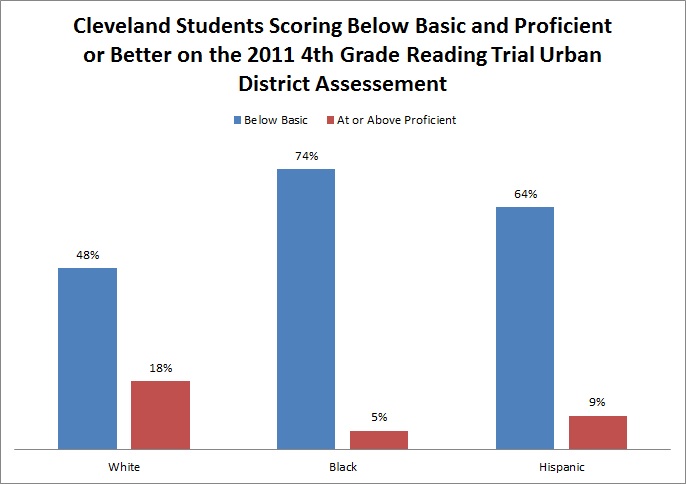
Superintendent Jones may feel confident that he and his compatriots have this whole reading thing figured out, but it is little wonder why Ohio legislators and Governor Kasich saw things a bit differently. If I really wanted to be cruel I would go look up the numbers for Cleveland in the TUDA…err…wait….too late!

More than twice as many White students scoring Below Basic as Proficient,  almost 13 times as many Black students scoring in the illiterate area as Proficient, seven times as many among Hispanics. Little wonder that Ohio lawmakers also decided to depart from the status-quo again and turn the district over to the Mayor.

What makes anyone think that this policy will make things better? Well there are no guarantees that Ohio will implement it as well as Florida, but here is what happened in Florida:

I’m sure that life would be easier for Ohio Superintendents if lawmakers would just keep sending the money to the districts without asking any questions. I’m also however certain that it would not make life for students any easier if Ohio continued to ignore what is plainly a literacy crisis.


Bipartisan Group of NC Legislators Override Veto, Enact K-12 Reform

July 3, 2012

(Guest Post by Matthew Ladner)

The North Carolina legislature voted to override the budget veto of Governor Purdue, enacting significant K-12 reform in the process. Reforms included in the budget include A-F school grading, curtailment of social promotion and merit pay for teachers.

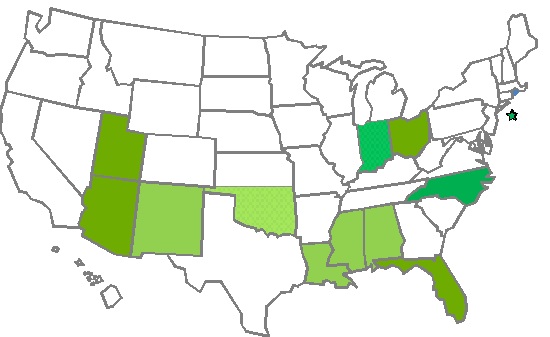
I think that the map of states having adopting A-F school grades now looks like this, although I may have missed a state. The star represents New York City:


PA enacts new choice program and expands EITC

July 2, 2012

(Guest Post by Matthew Ladner)

Pennsylvania lawmakers have enacted a new private school tax credit for children attending low-performing public schools. In addition, they expanded the existing scholarship tax credit.

When compared to some of the propsals under consideration last year, these programs seem quite modest. In comparison to what was actually achieved last year, they seem substantial.


Random Pop Culture: Victor and Penny

June 29, 2012

 (Guest Post by Matthew Ladner)

Last night I went to catch a two person band known as Victor and Penny at the Raven in Prescott Arizona. With a guitar and a ukulele they perform “antique pop” including a song that is 101 years old. I found them to be completely delightful and entertaining:

They will be playing at Fiddler’s Station in Phoenix Saturday night and then are heading up the west coast. They have an interesting background as artists that include a role in Up in the Air and a stint in the Blue Man Group. Catch them if you can!


Anrig’s Premature Epitaph Four Years Later

June 27, 2012

 (Guest Post by Matthew Ladner)

Some of you will recall Greg Anrig’s Washington Monthly article combining a teacher union talking point reading of the evidence on school choice with some grousing in the school choice ranks to declare school vouchers as “An Idea Whose Time Has Gone.”

Having trouble remembering? Fortunately the Century Foundation. Mr. Anrig’s employer, has quite helpfully preserved a record on youtube. You can be the 125th or so person to watch the video:

Hmmm….”grinding to a halt…” But wait, there is more-part deux!

There’s even more video on youtube, but these two constitute plenty of rope. I’ve never met Anrig, but I’d be willing to bet that he’s a decent chap who loves his mother, his country and his alma mater. He isn’t the first person nor will he be the last to make a bold but utterly mistaken prediction. I almost feel bad about writing this post.

Almost but not quite…

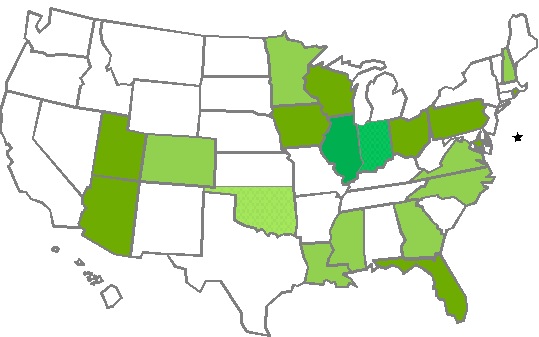
After all, Andrew Rotherham sagely predicted at the time that Anrig would regret writing the article. So here is a map of the states with private choice programs on the date of Anrig’s Washington Monthly piece:

After the win in New Hampshire yesterday, the map looks something like the one below. Mind you, this underestimates the progress of the parental choice movement, as several states created multiple programs.


New Hampshire Legislators Override Veto, Create School Choice Tax Credit for Low and Middle Income Students

June 27, 2012

(Guest Post by Matthew Ladner)

Both houses of the New Hampshire legislature have voted to override Governor Lynch’s veto of a new parental choice tax credit for low and middle-income families.

BOOOOOOOOOOOOOM!

Congratulations to New Hampshire’s lawmakers and choice advocates. By my count, this means that Greg has defeated Jay Mathews for a second year in a row with seven new programs or program expansions: Arizona tax credit expansion, Arizona Education Savings Account expansion, Florida tax credit expansion, Louisiana new voucher program, new Louisiana tax credit program, new Virginia tax credit, new New Hampshire credit.

Year a’int done yet!


After SB 1070-Time to iTune Illegal Immigration’s Napster

June 26, 2012


(Guest Post by Matthew Ladner)

I’m not a constitutional law scholar, and I don’t play one on TV, but I will tell you what I think anyway. My reading of the news coverage on the Supreme Court’s ruling on the constitutionality of Arizona’s SB 1070 decision leads me to believe that rather than a “mixed decision” that the court essentially overturned the majority of the law, and opened the door for further legal challenge for what little remains of it. Three of the four major provisions have been struck down, leaving the rest fairly meaningless. Some here in Arizona are trying to put a brave face on this, but it clearly a crushing defeat.

I moved to Arizona from Texas in 2003. When I arrived, the vehemence of the immigration debate was startling. Arizona’s economy was booming, the state government was on the verge of running sizeable surpluses, and property values were on the rise and the term “property bubble” had yet to enter into the political discussion.  Despite all of this, some Arizonans had clearly convinced themselves that the end of Western Civilization was at hand.  I listened for instance to a radio interview with my jaw agape as the guest explained in muddled fashion how the current difficulties over illegal immigration made the United States “exactly like the late Roman Empire” and was even more stunned as the radio host ate it up.

Luckily I have yet to see any Visigoths, nor have I been fed to any lions at the University of Phoenix Stadium…at least not yet.

Asking around a bit, I learned that a San Diego border fence built earlier in the decade had redirected traffic through Arizona. The abundance of housing and construction jobs obviously had something to do with it as well. Somewhere about this time I recall reading a blog post from Virginia Postrel. Postrel addressed the question “why is illegal immigration such a hot topic in California and Arizona, but not in Florida and Texas?” Postrel’s response was something close to “Simple-Arizona and California finance their state governments on income taxes while Florida and Texas do not.”

This struck me as a highly plausible partial explanation. Taxpayers do incur costs with regards to illegal immigration, and public schooling is probably the largest of them. In Texas, no one can escape taxation, as the vast majority of Texas taxes come in the form of sales and property tax.  Everyone buys stuff, and everyone pays property taxes either directly or indirectly. California relies heavily on an income tax that undocumented workers paid in cash can avoid paying. California seems to have entered into a spiral of increasing income tax rates and losing income tax payers. This isn’t going well for them and only looks to get worse. Memo to California- Nevada has no income tax, nor do six other states, including the one happy to feast on your misfortune:

Those most outraged by illegal immigration have an unfortunate and consistent habit of substituting the balance sheet of state government with that of society as a whole. The nation enjoys benefits to immigration as well as costs. I would certainly prefer legal to illegal immigration, and I am not an open-borders type. If however illegal immigration were a fraction as damaging to the economy as some imagine, it would be quite impossible for Texas to be beating other states up and stealing their economic development lunch money. The last time I checked about 36% of Texas K-12 students were Anglo, and the state’s economy is on like Donkey Kong.

In my opinion, the federal government (or else states- see below) needs to do to illegal immigration what iTunes did to Napster- bring a black market under the law with a combination of a liberal guest worker policy and increased enforcement. Something like a guest worker program and strong employer sanctions for those going outside of it seems like a good start. A single state attempting a heavy-duty enforcement approach seems doomed to have an effect similar to the San Diego fence at best. At worst, it will damage the image of your state on the way to defeat in the courts.

My suggestion for Arizona lawmakers would therefore be two-fold. First, change Arizona’s tax structure to reflect the fact that the state plays host to two large groups of people unlikely to play income taxes (undocumented workers and Snowbird retirees). Illegal immigrants and Snowbirds both consume public services and ought to pay their share for them. This could help turn the heat down on the issue here in Arizona, which is badly needed.

Second, given the completely understandable frustration with the inability of our Capitol Hill Olympians to do anything with the issue, border states should explore the possibility of engaging in an inter-state compact regarding immigration policy.  Once ratified by Congress,  an inter-state compact has the force of federal law in the participating states.

An enforcement-only policy seems doomed to simply pass off immigration problems to other states, would not likely find willing partners in other states, and would be unlikely to be ratified by Congress. If however border states could agree to a mixed iTunes approach with a good prospect of working, I find a hard time seeing the navel-gazing set in Washington turning down something the border states badly need- sane and humane immigration policy.

This issue has become far too bitter and divisive. We need some leaders to step up and fix a badly broken status-quo.


Governor Bush on NH Tax Credits: A Good Deal for Poor Students

June 26, 2012

 (Guest Post by Matthew Ladner)

New Hampshire lawmakers will convene tomorrow in special session, with one of the items on the agenda being an attempt to override Governor Lynch’s veto of a scholarship tax credit. Governor Bush explains in the Concord Monitor today why the program deserves support.

Money quote:

Americans of all philosophical backgrounds desire schools designed to give all children – even those who start with the least – the best possible chance at success. The American dream of equality of opportunity will not be nearly fulfilled unless those less advantaged are given more power over where their children go to school.

New Hampshire will be a better and stronger state if the Legislature overrides the governor’s veto.