
(Guest Post by Matthew Ladner)
I have a series going on the Foundation for Excellence in Education Blog on Baumol’s Disease and American Public Education. Catch Part One and Part Deux here.
(Guest Post by Matthew Ladner)
I have a series going on the Foundation for Excellence in Education Blog on Baumol’s Disease and American Public Education. Catch Part One and Part Deux here.
 Leave a Comment » |
  Uncategorized | Tagged: Baumol's Disease |
  Permalink
 Posted by matthewladner
 (Guest Post by Matthew Ladner)
Patricia Levesque, veteran of the school reform wars in Florida, cautions edu-reactionaries in Louisiana against making the same mistakes that their compatriots in Florida made (and continue to make) in the Shreveport Times.
Florida lawmakers instituted K-12 reform in 1999, and efforts were rewarded with strident opposition from a vocal minority. Die-hard skeptics grew increasingly isolated, however, as Florida’s childhood illiteracy rate plunged, high-school graduation rates improved and the number of black and Hispanic students passing advanced placement exams tripled. There is still much more to do in Florida, but the progress is undeniable.
Louisiana reform skeptics should take care not to repeat the mistakes of the past. Rather than resisting reform, Louisianans of all backgrounds should be working together to maximize opportunities and achievement for students. Louisiana’s public school system will enjoy much brighter days once parents routinely match the needs of their child with the strengths of their schools.
As the debate over reform continues in Louisiana, remember that a century from now the vast majority of Louisiana students will still be attending public schools. Nothing has been done that will change that basic fact. Students can and should attend their public school by choice rather than simply by zip code.
Leave a Comment » | school accountability, vouchers | Tagged: Patricia Levesque | Permalink
Posted by matthewladner
 (Guest Post by Matthew Ladner)
So a few years ago when Sol Stern decided to attack parental choice for reasons that are still largely only known to him, City Journal posted an online debate concerning Sol’s article, which included a full-throated endorsement of Sol’s position by E.D. Hirsch.
I had a hard time making much sense of the Hirsch critique. It seemed to read much more as an indictment of bad state standards than of the parental choice movement. The parental choice movement’s original sin seemed to be in being a “structural reform” that ignored the vital importance of imposing Core Knowlege on everyone.
Or something to that effect, near as I could tell. I was and still am confused with exactly how this is supposed to happen, but I’m sure someone has a fail-safe plan this time.
My own contribution to the debate attempted to make the point that of course the political constraints facing parental choice programs keep them from being some sort of miracle-drug cure-all, but that was hardly a reason to oppose it. I haven’t seen any other miracle cures either. Moreover, there is no reason to imagine that the parental choice movement and the standards movement need to necessarily be at odds.
In any case, above is a picture of the district middle school in my neighborhood-Shea Middle School in the Paradise Valley School District. Shea is proudly announcing that Hirsch’s Core Knowledge Curriculum will begin in August 2013 in a 9000 point font banner you see above. At least one of the elementary schools that feed in to Shea Middle School has also adopted Core Knowledge.
Of course it could be the case that these new schools opening in the neighborhood had nothing to do with the decision to adopt Core Knowledge, or to hang a giant banner advertising the adoption for that matter. Other Paradise Valley schools have used the Core Knowledge curriculum for years. It is within the realm of the plausible that Shea Middle School would have been adopting Core Knowledge in 2013 whether facing competition from BASIS and Great Hearts or not. If I were to have the opportunity to ask PV officials about this, they might very well make such a claim with conviction.
And if I hadn’t seen an email from a Parent-Teacher group from one of the feeder elementary schools full of steely determination not to lose students to the new charter schools, I might have even believed them. The email expressed (rational) concern about losing students and listed a number of possible strategies including the adoption of IB, foreign language immersion and (yes) Core Knowledge as reform strategies….and now the banner.
Smoking gun? No. Enough to convince a reasonable person? Certainly.
Parental choice mechanisms have done a great deal to satisfy parental demand for Core Knowledge and CK type schools. If we had more of it, we would also have a higher use of CK and similar curriculum both in district and non-district schools. Hopefully it will prove useful for Shea Middle School. Alternatively, we could dream of a master plan that transforms millions of public school teachers into Allan Bloom in one great non-incremental stroke, but I think we all know how that story ends.

Oh well, back to the old super-genius drawing board…
Personally I am a fan of traditional curriculum and want it to be available to those who desire it. I’m also leery of imposing it on those who don’t. I view American schools as having serious curriculum problems, but plenty of other problems as well. Dirigisme got us into this mess, and some of us are naturally skeptical that a new and improved version is going to get us out of it all by itself.
* Disclosure: I serve on the board of a BASIS school (not the one discussed here) and two of my children very happily attend a Great Hearts Academy (but not the school alluded to here).
Edited for Typos
11 Comments | charter schools, instructional reform | Tagged: BASIS schools, Core Knowledge, ED Hirsch, Great Hearts Academies, Sol Stern | Permalink
Posted by matthewladner

(Guest Post by Matthew Ladner)
Andy Ford, President of the Florida Education Association wrote a piece for the Orlando Sentinel complaining about Florida’s accountability system. Ford’s piece connects the usual dots- complaining about the status-quo while offering no specifics for how a system of academic transparency should operate. Mr. Ford warms up with this doozy of a paragraph:
The former education commissioner, Gerard Robinson, recently resigned after a year on the job. Robinson inherited a flawed and punitive accountability system laden with standardized tests that was put in place 13 years ago by Gov. Jeb Bush, overseen by Patricia Levesque at his Foundation for Florida’s Future and endlessly promoted by legislators who favor for-profit schools, and the Florida Chamber of Commerce.
Before I get to the accountability system, let me briefly address the Jeb Bush/Foundation for Florida’s Future conspiracy theory bit. Florida operates as a democracy, complete with elections in which citizens choose their officials who then make decisions regarding K-12 and other sorts of state policy. The voters twice chose Jeb Bush to serve as their governor, but he has been a private citizen since **ahem** 2007.
The Foundation for Florida’s Future does indeed seek policies to improve Florida public schools. This however occurs within a typical system of democratic pluralism in which many groups contend for influence, including of course Mr. Ford’s Florida Education Association. Guidestar reveals that the FEA had revenues more than twenty times larger than those of the Foundation in 2010 (the latest year available).
The FEA’s difficulties originate with their suspect ideas rather than their flush bank account. Ford’s characterization of Florida’s accountability system as “flawed and punitive” is a fine example. This “flawed” system has in fact produced remarkable results, especially for disadvantaged children. The chart below for instance compares the literacy gains on the Nation’s Report Card for Free and Reduced lunch eligible Florida students in 1998 (the year before Florida’s reforms) and 2011 (the most recent results available).

Notice that the “good ole days” in Florida (pre-reform) were a disaster for low-income children. A whopping 37% of Florida’s low-income 4th graders had learned to read according to NAEP’s standards in 1998. A lack of transparency and accountability may have suited the FEA fine, but it was nothing less than catastrophic for Florida’s low-income children. Thirteen years into the “flawed” system, that figure was up to 62 percent. The goal of Florida policymakers should clearly be to accelerate this impressive progress rather than to go back to the failed practices of the past.
Put another way, if Mr. Ford considers this system “flawed” then Florida lawmakers should quickly implement something that he would judge to be “catastrophically flawed.” Note also that Florida’s public school teachers deserve to celebrate these gains as much as anyone. The FEA however opposed the reforms that produced them tooth and nail, costing them credibility (especially when they continue to complain today).
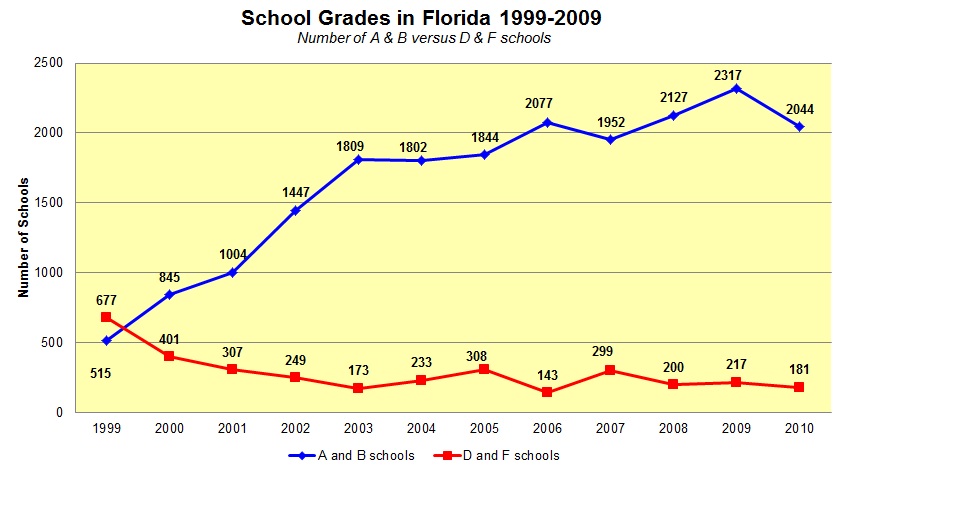
As for “punitive” well…Florida’s school grades have improved along with their NAEP and FCAT scores. Just how “punitive” can a system be when it delivers 10 times as many A/B grades as D/F grades?
If and when the FEA matches coherent child-centered policy with their massive financial and human resources, there can be little doubt that they will exercise a large amount of influence over Florida K-12 policy. Until then they can continue to bemoan their self-imposed exile from the adult conversation over how to provide Florida children with a genuine shot at the American Dream.
14 Comments | school accountability | Tagged: Andy Ford, Florida Education Association | Permalink
Posted by matthewladner

(Guest Post by Matthew Ladner)
The Foundation for Excellence in Education has launched a new blog, and kicked it off with a great post by Mike Thomas explaining how an examination of evidence led him from being a reform skeptic to a reform supporter.
Lightbulb!
Welcome to the fight Mike!
1 Comment | Uncategorized | Tagged: Ed Fly Blog, Mike Thomas | Permalink
Posted by matthewladner
 (Guest Post by Matthew Ladner)
So I was curious as to how charter schools in Chicago compare academically to the district. I ran the NAEP numbers from the Trial Urban District Assessment for free and reduced lunch eligible general education students. This is about as close to an apples to apples comparison as you can get in the NAEP data-much smaller range in variation in family income, general education students.
Here are the results:
 This is the part where edu-reactionaries will start to stare at their feet to mutter stories about how these differences must be all about the differences in motivation between parents. The random assignment studies have consistently demonstrated however that charter school students perform better on charter schools for inner city kids. The whole “motivated parents” question is irrelevant until such time that charter schools don’t have a waiting list in any case, unless of course you are willing to sacrifice the interests of children over those of adults.
The Economist recently reviewed the evidence on charter schools and concluded:
In rich countries, this generation of adults is not doing well by its children. They will have to pay off huge public-sector debts. They will be expected to foot colossal bills for their parents’ pension and health costs. They will compete for jobs with people from emerging countries, many of whom have better education systems despite their lower incomes. The least this generation can do for its children is to try its best to improve its state schools. Giving them more independence can do that at no extra cost. Let there be more of it.
7 Comments | charter schools, teacher union | Permalink
Posted by matthewladner

(Guest Post by Matthew Ladner)
Udasity and EdX have set up a system for proctored final exams for their Massive Open Online Courses. The NYT reports that Colorado State University has become the first institution to accept such a proctored courses for university credit. The NYT reports that several European universities have already done so. Given that hundreds of thousands of people are taking MOOCs, expect more to follow.
Kevin Carey turned in an interesting report on the Silicon Valley higher-ed tech revolution for Washington Monthly.

Time to switch back to you, K-12 brain…
I’m starting to wonder whether the K-12 Reactionary and the Higher-Ed Revolutionary voices can continue to coexist peacefully inside Carey’s head, but I digress. Massive Open Online Courses are going to productively disrupt both higher education and K-12 while putting a great education at the fingertips of billions.
5 Comments | Digital Learning | Tagged: Colorado State University, edX, Kevin Carey, Massive Open Online Courses, MOOCs, Udasity | Permalink
Posted by matthewladner

(Guest Post by Matthew Ladner)
A fascinating and revealing NYT story on the impact of charter schools in Harlem is well worth reading despite the utterly absurd headline: School Choice Is No Cure-All, Harlem Finds.
So apparently the straw-man argument generator in the headline writer’s head told him or her that a few charter schools would cure all of Harlem’s problems. I doubt that anyone else did.
Reading the actual story leads one to the conclusion that while there have been difficulties and growing pains, Harlem’s experience with charter schools has been quite positive. The most serious problem pointed to in the article, in fact, is the need for more charter schools.
The NYT story deals with perceived difficulties in school grading. So A-F school grades and parental choice: sounds familiar. How has this been working out for NYC’s low-income Black students? Some day reporters will learn to use the NAEP Data Explorer and use actual evidence to sort through contending clouds of anecdotal fog, but in the meantime I can help out:
 Did the Klein reforms cure all of the education problems of Harlem? Certainly not. They strangely also failed to cure cancer, restore sight to the blind nor did they erase the painful memories of having shelled out money to see Indiana Jones and the Kingdom of the Crystal Skulls.
They have however seen hard fought gains for disadvantaged students. Rather than wringing their hands, the New York Times should be calling for the logical next steps in reform.
5 Comments | charter schools | Tagged: Joel Klein, New York Times, School Choice is No Cure-All | Permalink
Posted by matthewladner
(Guest Post by Matthew Ladner)
Every now and then you read something that just sits with you for a long time. My mental processor has been working on this provocative piece from Walter Mead Russell for weeks now.
Go read it. I’ll be here when you get back. Plenty of edu-implications here, and some obvious crucial points that WMR omitted, but tell me what you think in the comments section. I’m still trying to decide how I would try to tackle this if I were a billionaire philanthropist.
2 Comments | politics | Tagged: Living Colour, The Plight of the Black Middle Class, Walter Mead Russell | Permalink
Posted by matthewladner
 (Guest Post by Matthew Ladner)
Enlow the Barbarian and I were in Austin Texas Thursday to testify to the Senate Education committee Friday morning. Despite being travel weary geezers, Enlow and I hit some Reb Bull and skipped over to the Alamo Drafthouse for
So here’s how it works: you buy your ticket, and they give you an inflatable guitar, a tambourine and of course a cigarette lighter. Then they proceed to blast hair band/arena rock classics so that you can scream along in tune, or your best approximation thereof.
Here is a few of the songs:
and…
and…
and of course…
Needless to say, no celebration of hair-band nation could possible exclude:
God Save the Queen of Arena Rock:
and everyone burnt their fingers with this classic of cheesy goodness:
1 Comment | random pop culture | Tagged: Alamo Drafthouse | Permalink
Posted by matthewladner

 Jay P. Greene's Blog