Hoosier Fiasco a Wakeup Call to Both Sides of Common Core Debate

November 9, 2012

(Guest Post by Matthew Ladner)

Let me start by noting that what I write here, as always, is my own personal view. It does not reflect the views of my employer or any other group with whom I collaborate. It is my hope, for reasons I will explain below, to serve as an equal opportunity offender. Three days later I can speak only daggers to both sides of our currently idiotic Common Core debate.

A few days before the election some polling data was released from Indiana showing that Superintendent Tony Bennett had a problem with-of all people-conservative Republicans. It has quickly passed into the Conventional Wisdom that Tony’s support for Common Core cost him re-election. This result is an insult to a dumpster fire for both sides of the Common Core debate.

Let’s get two things clear from the outset: no one has yet to convince me that Common Core is a good idea and Common Core opponents have revealed themselves to be unsophisticated ya-hoos as easily led by weak arguments as any Ravitch-zombie. Whether Indiana adopts or chooses not to adopt Common Core is ultimately of trivial to modest importance in driving academic outcomes in Indiana. Neither side of the argument in Indiana seemed to appreciate this stunningly obvious fact.

Supporters claim that CC is a little better than Indiana’s existing standards, opponents a little worse. This is all subjective and thus there is no truth to discern here.  Should Mississippi adopt Common Core-yes states where the stock picking chicken can pass the test have nothing to lose. Should Massachusetts? Certainly not-a state with the highest NAEP scores on all four main tests has much to lose. The correct response to “should Indiana adopt Common Core?” is “why should I care?”

Common Core in Indiana thus was not a hill worth dying on to defend, nor anything worth putting a teacher union puppet in charge of your Department of Education to prevent. If you think otherwise you have earned a spot carved in stone on my “Drooling Idiots” tablet that I keep out in the rock garden.

My ESP detects objections from Common Core opponents reading this now. What about the Obama administration interfering in state/local control of schools? States adopted CC voluntarily and can leave voluntarily. Yes Duncan put points into Race to the Top for CC adoption but note that participation in that was purely optional and RTTT it is now long gone. Virginia also got a waiver from NCLB despite not adopting CC, busting another cherished myth. There was some chatter about conditioning Title I on CC adoption, but that was all it was thus far-chatter.  Everyone should be on guard against this, but let us be rid of all illusions in noting that the reality of the situation “federal takeover” remains such an exaggeration that it constitutes a tin-foil hat argument.

Think the federal government violated a law from the 1970s to bankroll Common Core? Maybe they did-how would I know? Either put up by going to court to prove it or shut up because you don’t really believe it.

Mark however that the fact that Indiana’s adoption of Common Core is relatively unimportant cuts both ways. An Indiana school board official said something to the effect that rather than picking his battles, Tony never saw a mosh-pit that didn’t make him want to jump in and start breaking noses of punks who deserve it. True enough- one of the many qualities that I love about Tony. Tony believed in Common Core and he fought for Common Core. Tony however gave a great deal more to the Common Core effort than it gave back.

The pitiful weakness of the Common Core nexus in making a coherent and visible case for Common Core against unsophisticated attacks like “federal takeover” and “Obamacore” means that Common Core does not deserve champions like Tony Bennett. This effort needs to be more convincing that “ummmm……….high standards are good or something” and needs to move beyond the Beltway blogo-echo chamber into the public quickly. If Common Core supporters have a persuasive case to make, now would be a great time to start making it.

The reason is simple: the reactionaries now have a play book to peel off uninformed conservative voters and add them to their coalition. This lesson seems unlikely to be lost on teacher unions or upon either political party in states with elected Superintendents.  It remains to be seen whether some enterprising group of reactionaries will successfully scale this model up to a Governor’s race, but I can’t see any reason for them not to give it a try.

In short, the combined ineptitude of the Common Core effort and the mouth-breathing stupidity of Common Core opponents stands as a risk to the broader education reform agenda. Love Common Core or hate it, let’s be perfectly clear that Tony Bennett was up to far more things, and far more important things in order to equip Indiana children with the academic skills they need. This farce has ended in tragedy with an entirely avoidable setback.

A plague on both houses! I hope both sides will accept my invitation to pull their heads out of their asses. This is very serious business we are engaging in here and we do not have the luxury of this kind of pointless stupidity.

P.S. Just in case no one else was going to say in public what many are saying in private, I hope that Governor Daniels enjoys those faculty teas discussing the finer points of Mechanical Engineering  because his decision to opt out of races is looking terribly misguided right about now. Tony deserved much better from all of us, but I am trying to imagine a better person than a popular and successful conservative Indiana Governor to talk sense to right-wing Hoosier yayhoos.

If any of you take offense at any of this, regardless of the tribe you hail from, feel free meet me by the bike racks in the comments section.  I will be happy to make further efforts to beat sense into you.


Some Initial Thoughts…

November 7, 2012

(Guest Post by Matthew Ladner)

Football analysts tend to narrow explanations for why one team prevails to a handful of plays whereas in reality every play is of equal importance-it just doesn’t seem that way. Likewise elections are incredibly complex and we focus on a single factor only at our peril.

Nevertheless…

First let’s note that the Obama campaign worked their math problem with masterful precision. Needing blue-collar White votes in Ohio, they found a way to get them, for example. The narrow national popular vote majority plus the lopsided electoral college result is a testament to the effectiveness of the Obama campaign. George W. Bush’s team pulled off a similar victory in 2004- incumbent Presidents are tough to beat.

Having said that, the Republican ticket pulling in 27% of the Latino vote is nothing short of a dumpster fire. Moreover, note that Romney only won Texas by a little over 8 percent.

Every day between now at 2016 will involve older and predominantly Whiter Texans going off to the Rodeo in the Sky, and more and more Hispanics coming of voting age in the Lone Star State. You don’t need to spend hours fiddling around with the Real Clear Politics “Build Your Own Electoral College Map” to imagine what even a Purple Texas would do to national politics, much less a Blue one.

This of course is hardly set in stone. Republicans do have dynamic young Hispanic leaders in the Senate from Florida and Texas. Republicans however are in for a spell of finger-pointing and self-reflection. Rethinking the position of immigration deserves a spot near the top of the to-do list…

https://jaypgreene.com/2012/06/26/after-sb-1070-time-to-itune-illegal-immigrations-napster/

…but it doesn’t end there. Republicans should be developing an opportunity agenda that appeals not only to Hispanics, but also to others.

Congratulations to President Obama and his team. I will be very curious to see what happens next.


Appetite for Disruption

November 5, 2012

(Guest Post by Matthew Ladner)

Be sure to take time out of your busy schedule of fretting about tomorrow’s election by reading the New York Times article “Year of the MOOC.” Word Press is acting up, so here is the link:

http://www.nytimes.com/2012/11/04/education/edlife/massive-open-online-courses-are-multiplying-at-a-rapid-pace.html?pagewanted=1&_r=0&ref=business

Interesting bits: survey of students finds a majority of students judged MOOCs to be of higher quality than a regular course, and an overwhelming majority found it to be of better or equal quality:

And in a vote of confidence in the form, students in both overwhelmingly endorsed the quality of the course: 63 percent who completed Dr. Agarwal’s course as well as a similar one on campus found the MOOC better; 36 percent found it comparable; 1 percent, worse.

The story also concludes on the right note: the best is yet to come.


Defending the Ohio Reading Guarantee

October 31, 2012

(Guest Post by Matthew Ladner)

Tracy Craft from BAEO, Terry Ryan from Fordham and yours truly from the Foundation for Excellence in Education have teamed up to push back on attacks on Ohio’s reading guarantee policy. Just as a quick reminder of just how radically successful this effort has been in Florida, the chart below shows the trend of students reading at the lowest level of reading achievement (FCAT 1) at the 3rd grade level:

Edited for Clarity


Baumol by Design

October 25, 2012

(Guest Post by Matthew Ladner)

Part four of the Baumol Disease series is up over at the EdFly Blog, including spectacular new Baumol charts from the Heritage Foundation and an excerpt from Terry Moe’s book Special Interest regarding the history of the Florida Education Association hijacking the Florida Democratic Party during the 2002 election.

Also be sure to check out the Friedman Foundation’s incredibly cool K-12 Baumol Map by State. How bad is the disease where you live?


George P. Mitchell for the Al Copeland Humanitarian Award

October 18, 2012

(Guest Post by Matthew Ladner)

I nominate Texas oilman George P. Mitchell for the Al Copeland Humanitarian Award.

Mitchell studied at Texas A&M University, where he graduated first in his class with a degree in Petroleum Engineering. Born to Greek immigrant parents in Galveston Texas in 1919, George P. Mitchell built a Fortune 500 energy business Mitchell Energy and Development Corporation.

George P. Mitchell’s was both a deliberate and perhaps an inadvertent environmentalist. A philanthropic supporter of environmental causes, Mitchell ironically made a far greater positive impact on the environment through his market activities. More ironic still, many environmentalists somewhere on the ya-hoo to yay-hoo spectrum (a man from Wyoming once tried to explain the difference to me- but it is awfully complex) hate Mitchell’s fantastic environmental triumph.

Mitchell combined and developed the techniques of horizontal drilling and hydraulic fracturing (aka fracking) that is in the process of revolutionizing the energy business.

A biography page of Mr. Mitchell notes just how long and hard Mitchell and company worked to develop this process:

Mitchell Energy sunk a lot of money over a long period into learning how to stimulate the rock so it would flow,” says Potter. Their first attempts were expensive “massive hydraulic frac jobs.” They would pump a very large volume of fluid and sand down a well bore to crack the rock and give it more permeability. At first, they got the gas flowing, but the methods and materials were expensive. So they wondered if they could pump less fluid and get the same effect.

They arrived at something called a light sand frac,” says Potter. “Suddenly it was economical and at the same time-in the mid-1990s-the price of gas was rising. By the late 1990s, they had perfected the technique in vertical wells and started applying it to several hundred wells. That’s when it came to the attention of industry.”

“Then it was realized, oh, if you scale that up to the whole area and then to the whole county and up to the whole Basin, the amounts of gas are really quite prodigious,” says Potter. “People became aware of that in 2002 and 2003 and that really got the ball rolling.”

“It took George Mitchell 18 years to make it work,” notes Larry Brogdon, partner and chief geologist for Four Sevens Oil Company. “He is the father of the Barnett Shale. He was tenacious. He started in 1981 and it really didn’t take off until 1999. And even then, it took a long time to develop it.”

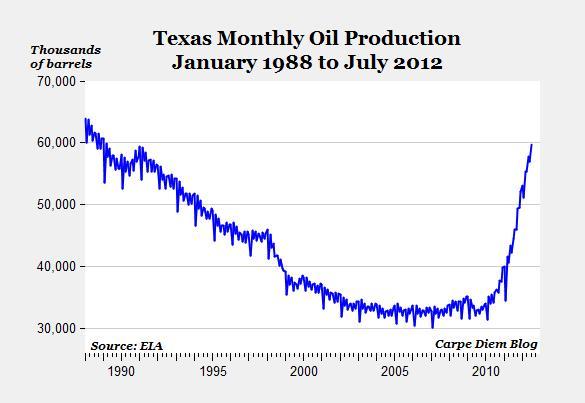
So what have been the benefits of Mitchell’s steadfast pursuit of this technology? Mark J. Perry provides the answers:

Let’s start with oil production in Mitchell’s state of Texas:

Peak what? North Dakota is booming as well:

And the energy sector is close to the only hot thing going in our depressed economy..

Most prominently on the environmental side of things, he has radically increased the supply of Natural Gas in America and a growing number of elsewhere, and this is killing the use of coal.

Natural gas produces less pollution than coal and it is cheap in America, so you see trends like this:

Leading to this:

The United States is going to meet Kyoto carbon emission goals despite the fact that we never signed the treaty. As it turns out, George P. Mitchell took care of things for us.

Casting their credibility out the window of a 100 story building, some environmentalists have gone to political war with Mitchell’s technology. The Washington Post is not confused about the desirability of fracking, blasting New York Governor Andrew Cuomo for delaying the use of the technique in his state in an editorial:

… anti-fracking activists who hope delay begets delay and eventually prohibition are doing the environment no favor. Burning natural gas produces only about half the carbon emissions as burning coal, which produced 42 percent of America’s electricity in 2011. With the increasingly common use of fracking, natural gas prices have plummeted, encouraging a switch from coal to gas, and the country’s emissions trajectory has improved.

A suite of technologies has brought vast supplies of previously unrecoverable shale gas within reach of humans, dramatically expanding natural gas reserves in the U.S. and around the world. Horizontal drilling and hydraulic fracturing have produced a fuel that can at once promote a cooler planet and an expanded economy, essentially eliminating the tradeoff between climate change mitigation and the pursuit of other public projects and, perhaps, economic growth.

Compare all of this to the epic boondoggle of President Obama’s attempt to push solar power before its time (if it is ever going to have a time). The Wall Street Journal gives you the blow-by-blow on that one.

George P. Mitchell’s influence on the world is set to grow ever larger. With the new technologies for instance, Israel now has recoverable fuel reserves comparable to Saudi Arabia. Foreign Policy attempted to forecast the winners and losers of the new energy abundance and on balance, it is looking very good overall.

Mitchell has supported sustainability and even the deeply misguided Club of Rome report as a philanthropist, but in a deeply telling twist of fate, it was his determined entrepreneurial activities that have produced not only environmental benefits but also enormous prosperity and hope for the future. This Texas Wildcatter turns out to have been the ultimate environmentalist, as is implied in the Washington Post’s editorial linked to above:

True, half the emissions does not mean no emissions. But the United States does not have to eliminate its carbon footprint all at once, nor should it. Doing so would cost far too much. Instead, natural gas can play a big role in transitioning to cleaner energy cheaply. A recent analysis from Resources for the Future, a think tank, shows that low, fracking-driven natural gas prices combined with efficiency measures and a serious carbon tax would result in a massive increase in the use of natural gas, nearly eliminating America’s coal dependence by 2035 and cutting emissions from the electricity sector by more than half. Renewable technologies, meanwhile, would have time to lower costs and address other hurdles to widespread deployment before picking up more of the load later in the century.

Environmentalists, in other words, should hope fracking is safe — and permitted.

George P. Mitchell’s triumph proves Milton Friedman’s point perfectly and illustrates that it even applies to environmentalism:

I therefore place Mr, Mitchell’s name in nomination for the Al: an Aggie who has earned an enthusiastic Thumbs Up from this Longhorn and deserves one from  everyone.

Okay, almost everyone…


University of Texas System to Join EdX

October 16, 2012

(Guest Post by Matthew Ladner)

The University of Texas system will be joining EdX today. This makes the lineup the Massachusetts Institute of Technology, Harvard University, the University of California Berkeley and the nine universities of the University of Texas system (it is not clear whether the six health institutions of the UT system will eventually participate). The Texas schools plan to concentrate on general education and introductory courses in developing Massive Open Online Courses.

This is interesting for a number of reasons. First, because EdX has set up a system for third-party administered final exams. EdX not only includes not only two of the nation’s premier private institutions, but also the flagship institutions of the nation’s largest and second to largest states.

Given that the Chronicle of Higher Education story linked to above notes that the UT system is actually paying $5m to join EdX,  they must have obviously considered the decision carefully. I cannot imagine an intellectually coherent argument that any of the UT system schools could muster to deny students credit for successfully completed EdX courses, so the UT system seems to be embracing the future with both arms.

Second, how ironic is it that this announcement comes on the heels of the Supreme Court arguments over UT Austin’s affirmative action policy? Soon people from all over the globe will be taking University of Texas courses, making the scarcity of university spots underlying such policies potentially obsolete, almost certainly less severe.

Finally, the University of Texas system pioneered a system for measuring value added measures under the leadership of UT Board of Regents Chair Charles Miller using a broad test of cognitive skills. To the suprise of approximately no one who graduated from UT Austin that I know, the flagship did not lead the way in value added.

A refinement of this system may allow for a formal evaluation of MOOCs and student learning. I’m willing to bet that they improve student learning.

EDITED TO CORRECT HYPERLINK


Forbes on Education Savings Accounts

October 12, 2012

(Guest Post by Matthew Ladner)

Forbes magazine on the ESA update to the voucher concept. I like the iPhone analogy as the first generation of phones were only designed to do one thing, whereas a modern smart phone expands capabilities and options considerably. Likewise, our first generation of choice programs were essentially designed to allow children to transfer into a pre-existing stock of non-profit schools, whereas Education Savings Accounts open many more options.

Meet the new and improved brick!

Take a look- but before any of you conspiracy theorists get started, please note that the financial services fees from similar accounts such as college savings accounts and HSAs went below 1% years ago and have continued to fall. If only the “management fee” for public education were heading in the same direction…


So We Meet Again Baumol…

October 12, 2012

(Guest Post by Matthew Ladner)

Part 3 of the Baumol series at the Ed Fly blog is posted, and James Shuls weighs in with an illustration of Baumol from Missouri.


The University of Texas versus the Future

October 10, 2012

(Guest Post by Matthew Ladner)

Fascinating article in Texas Monthly by Paul Burka about the battle between reformers on the UT Board of Regents and the skeptics on the faculty. Well worth a read.