Less Sex, Drugs and Crime. Religious Private Schools, Better Roads, and School Choice.

June 26, 2013

(Guest Post by Collin Hitt)

Attending a private religious school lowers the likelihood that students will use cocaine, have sex or get arrested. That, according to a new study from David Figlio and Jens Ludwig.

They find that decreased sexual activity is found primarily among females, accompanied by a decreased likelihood of “fecundity.” Decreased cocaine use and arrests were found primarily among boys, who were also less likely to smoke tobacco.

Overall, private schools had little effect on adolescent drinking and marijuana use. This might be due to the fact that while some students were led to avoid drugs and alcohol altogether, students who otherwise would have used hard drugs instead just smoked pot and drank booze – in my view.

Figlio and Ludwig’s data comes from the late 1980s and early 1990s. They find that the effects of private school were focused primarily in two-parent households. They also find that the effects were concentrated in the suburbs, though the definition of suburb in their dataset is overly broad, which unnaturally decreases the accuracy of their estimates in urban areas.

Studies of private schools are typically fraught with selection problems: students who select into private schools might have selected, in the case at hand, to avoid hard drugs and have less sex no matter where they attended school. Figlio and Ludwig eliminate this bias from their study by using a clever instrumental variables model in which transportation infrastructure differences between cities are shown to have an effect on the likelihood that parents will send their children to private religious schools.

Figlio and Ludwig point to character education in religious private schools. I can’t think of a better explanation.

Religious private schools are often organized with family life in mind. They seek to help families raise children who will be good parents and good citizens; their definitions of good parenting and citizenship are, of course, colored by their varying religious beliefs. All religions are not the same. But most religious schools share the overlapping belief that students should abstain from sex and should not use drugs. Figlio and Ludwig show that they’re doing a better job than public schools and non-religious private schools at achieving those goals; is this because religious schools have more rigorous abstinence and drug resistance programs than public schools? I doubt it. Private religious schools largely were established with a private community purpose in mind – which is very different from a public policy purpose. They are able to make broader pleas to their communities.

Perhaps most importantly, private religious schools are less afraid to discuss the consequences of bad, selfish behavior. They encourage kids to think over the long-term, the very long-term.


Governor Brewer signs ESA expansion

June 21, 2013

(Guest Post by Matthew Ladner)

Arizona Governor Jan Brewer signed SB 1363 yesterday, incorporating significant improvements into Arizona’s Empowerment Scholarship Account program into law. The ESA program will increase the minimum funding amount for participating students and will make eligible kindergarten students able to participate without prior public school attendance. Program eligibility remains otherwise unchanged (special needs and beginning this fall students attending D/F rated schools or districts, foster care children and the children of active duty military parents.)

Arizona had an incredibly difficult legislative session in 2013 so we are incredibly grateful to Governor Brewer and our stalwart legislative champions who got this bill over goal line.  Governor Brewer continues to build an impressive K-12 legacy and I remain hopeful that we will be able to pinpoint her administration as a turning point for public school performance in future NAEP data. Democratic Senator Barbara McGuire deserves special praise for doing right by the kids by offering a motion to reconsider on the bill after it had failed by a single vote on the Senate floor on the last day of session.  This action required real moral courage and it is clear that Senator McGuire has the quality in spades.

The lobby team led by Sydney Hay of the American Federation for Children and Deb Gullett of A+ Arizona have earned spots in the School Choice Hall of Fame, and the program continues to benefit from the outstanding work of the Goldwater Institute locally and the Friedman Foundation and HCREO nationally. In addition, Goldwater and IJ have been doing a great job in defending the program in court. This victory was a team effort and there are many more people both inside and outside of government who have helped to bring the program along. I am proud and thankful for all of you.

An Arizona Department of Education official recently told me that participating parents literally weep in meeting in expressing the depth of their gratitude for this program. This is a far greater reward than any thanks that I can offer. The ESA team has created a growing experiment in freedom-thank you all and keep up the good work!

EDITED FOR TYPOS


Some States are Serious about K-12 Reform, Others Shirley

June 19, 2013

(Guest Post by Matthew Ladner)

John Chubb and Constance Clark have a very interesting new study out from Education Sector called The New State Achievement Gap: How NCLB Waivers Could Make it Worse or Better.

Chubb and Clark examine NAEP data and find that states are diverging into leaders and laggards. In the relative blink of an eye between 2003 and 2011 they found the gap between the performance of students in the best and worst performing states grew to 60 percent of the size of the White-Black achievement gap on the combined NAEP exams (4th/8th reading and math).

Note that part of what has happened here is that the White-Black gap shrank a bit. Note however that it is still sickeningly large-keep in mind that 10 points roughly equates to a grade level worth of average progress on NAEP- so 105 points across four tests is quite disgusting. The state achievement gap meanwhile grew steadily.

Chubb and Clark’s paper would have benefitted from examination of the gory details about how some states are playing fast and loose regarding NAEP inclusion standards for special needs and English language learners- especially in the case of Maryland and Kentucky. These details do not however take away the broad point- some states are improving and some are getting left behind.

The study gets even more interesting as the authors compare the NCLB waivers, accountability systems and standards choices of states with strong and weak NAEP gain performances. Included among these is a comparison between Florida and South Carolina. The referee needs to step in and wrap up Maryland before he pummels West Virginia to death. “Self-reflection” for teacher evaluation Mountaineers? Surely you can’t be serious…

In a not-quite-elliptical fashion, Chubb and Clark note a clustering of states with a recent history of weak NAEP gains with unconvincing NCLB waiver promises and the Smarter Balanced Assessment Consortium. I’m shocked…

Chubb and Clark have turned in a very interesting piece- go read it.


Arizona Lawmakers Pass Bills to Expand ESA and Tax Credit Programs

June 14, 2013

(Guest Post by Matthew Ladner)

Arizona lawmakers ended an incredibly difficult legislative session last night by expanding school choice.  The Empowerment Scholarship Accounts program made kindergarten students otherwise eligible to participate (children with a disability, living in a D or F rated school or district boundary, foster care or the child of an active duty military) eligible to participate without prior public school attendance. The new law also shifts the funding for the program to the charter school formula, which will increase the minimum funding received and should make participation more feasible for students attending D and F schools and children with disabilities funded at the lower levels under the Arizona formula more feasible.  A separate tax credit bill expands the types of corporations allowed to participate in the corporate scholarship tax credit program. Both measures are on their way to Governor Jan Brewer’s desk.


Power to the People!

June 4, 2013

(Guest Post by Matthew Ladner)

The Illinois Policy Institute interviews Howard Fuller on vouchers and voucher critics:

Priceless…


The ESA took my College Debt Away

May 19, 2013

(Guest Post by Matthew Ladner)

Interesting read in Governing about universal college savings accounts for kindergarten students.

Now if they would simply send the K-12 budget into these accounts with a meaningfully higher amount going to poor and otherwise disadvantaged children I could leave this whole edu-nerd business and open my own Alamo Drafthouse in Jackson Hole Wyoming while producing compilation cds for Rhino Records on the side. Do you think the world is ready for Rancid to cover the greatest hits of Dean Martin yet?

I’m thinking martinis in the mosh pit.


The Way of the Future: Georgia Tech and Udacity Announce $7,000 MOOC Masters Degree

May 15, 2013

(Guest Post by Matthew Ladner)

Georgia Tech has partnered with Udacity to provide a $7,000 Masters Degree in Computer Science to 10,000 students. Check it out here. At one-sixth of the usual price for such a degree we are officially moving closer to this prediction:

Imagine if students in Bangladesh could earn a Princeton math degree, or a theology degree from Notre Dame for free, or more accurately for the time, computer and internet cost. The marginal players of the American academy would squeal as they are forced to reinvent themselves from making buggy whips, but this is a small price to pay for bringing opportunity to the world.

The only question in my mind is how long it will be until an elite player has the necessary vision to defect from the comfortable cartel. Several universities have the means to do this, and could receive philanthropic help to do so. Attention Oxford and Cambridge: it wouldn’t require an American university to pull this off. A British university could put out a low-cost version of this, and unlike their American counterparts, they aren’t swimming in resources.

Georgia Tech’s move does not qualify it as the defector, but things are moving quickly and in this direction. The loud noise that just shook the windows was the sound of the higher education cost bubble popping.


TUDA and School Grading

May 2, 2013

(Guest Post by Matthew Ladner)

I had the opportunity to discuss A-F school grading with a thoughtful skeptic yesterday. Sadly my doubting Thomas remained a skeptic at the end of our discussion.  I showed him data about the trend for improving grades in Florida, and he produced data to show improving fuzzy labels from his state. I told him that Florida’s progress is confirmed by improving NAEP data, whereas his state has flatlined on NAEP over the last decade despite improved state scores. He wasn’t buying it.

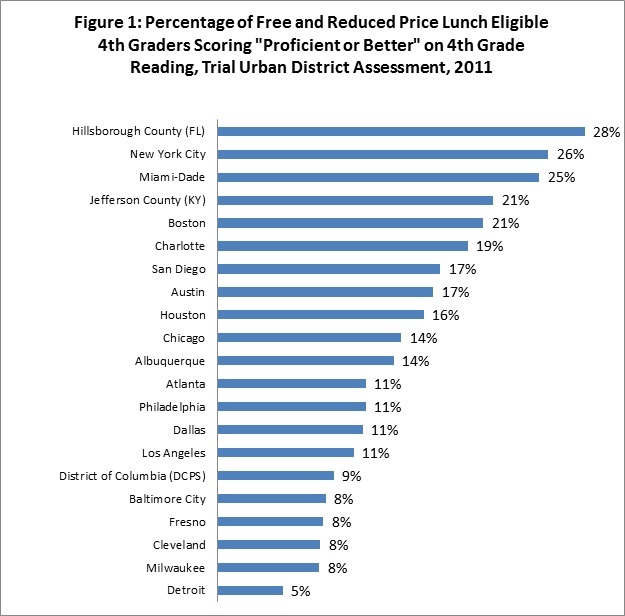
My failure to persuade however got me to thinking about the Trial Urban District Assessment NAEP data. I ran the proficiency numbers for free and reduced lunch eligible students in all the districts and found the following for 4th grade reading:

TUDA 4thNote that the top 3 performers all operate under an A-F school grading system Hillsborough (Tampa), Miami-Dade and New York City (NYC has operated under A-F longer than any non-Florida district). Obviously there are plenty of other factors at play than school grading, but note that a poor child in Tampa is almost six times more likely to be reading at a proficient level than a poor child in Detroit.

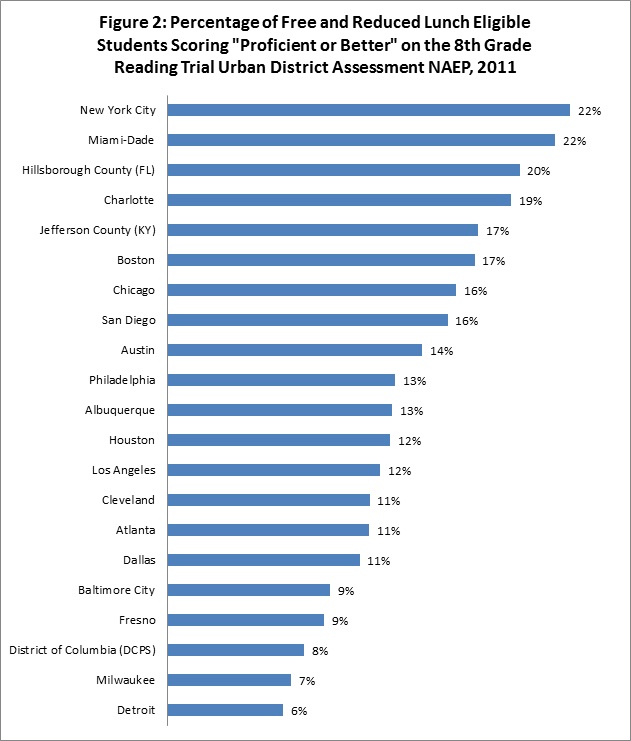
So I decided to run the numbers for 8th grade reading, and found the same basic result, with the same top 3 districts, just in a slightly different order. Top performers NYC and Miami have 8th grade students more than three times more likely to read proficiently than students in the lowest performer (again Detroit).

TUDA 8th

Why do the A-F districts top the list? A 2007 study by the Urban Institute is quite suggestive:

We analyze the impact of the accountability system on Florida’s students and schools using a three-part analysis. First, we estimate the effect of the accountability system and the threat of becoming voucher eligible on student test score performance, both in the short-run and in the longer term. Second, we study the effects of the reform on school policies and practices. Finally, we attempt to determine if the policies appear to affect student achievement or explain the change in student performance. We find that student achievement significantly increased in elementary schools that received an “F” grade by between 6 to 14 percent of a standard deviation in math and between 6 to 10 percent of a standard deviation in reading in the first year. Three years later the impacts persist.

Importantly, we also detect specific school policy changes implemented by the schools that explain part of these increases. Specifically, when faced with increased accountability pressure, schools appear to focus on low-performing students, lengthen the amount of time devoted to instruction, adopt different ways of organizing the day and learning environment of the students and teachers, increase resources available to teachers, and decrease principal control. These, combined with other policies, explain more than 15 percent of the test scores gains of students in reading and over 38 percent of the test scores gains of students in math, depending on the model specification. As such we find evidence that schools respond to accountability pressure in educationally meaningful ways.

So if the powers that be mandated that you were going to come back as an urban poor child, would you want to take your chances in Miami Dade or Dallas or Detroit?

Me too- and school grading is a part of the reason why.


A Once Proud People Begin a Fight Against Hopelessness

April 30, 2013

(Guest Post by Matthew Ladner)

The Arizona Republic ran a fantastic story on their front page of this Sunday’s edition on Navajo schools in Arizona and the efforts underway to turn them around. The story shows how school grading, digital learning and immigration reform can help people who have taken a courageous decision to help themselves.

Background: schools located on the reservations in Arizona face enormous challenges and have truly abysmal test scores to show for it. Isolation, poverty and rampant alcoholism probably constitute the top three problems, though not necessarily in that order. Arizona has the lowest Native American scores on NAEP and they are not only abysmal they have been declining.

In K-12 policy discussions in Phoenix, the subject of “the Res” comes up frequently. Often people will claim that you can’t do this, that or the other thing because of “the Res.” Problems as deep as those caused in large part by a century of having the federal government “take care” of you don’t lend themselves to quick or easy solutions.

It is a long article that focuses on the personal story of Harold Begay, the Navajo Superintendent who returned to run Tuba City school district determined to turn things around. Here are the policy related parts of the story:

When the State Department of Education started assigning letter grades two years ago, Tuba City High School got a D.

It could fall to the bottom or head higher. Begay chose to go higher.When he was named superintendent, he pledged that the district would achieve the top letter grade of A.

Skip ahead….

Last summer, Tuba City High School’s grade improved from a D to a B. In addition to a better performance on standardized tests, the school showed more improvement than other low-performing schools. Navarre was honored at the state Department of Education’s office in Phoenix.

People are starting to believe what Begay told them two years ago”‘We’re going to become an ‘A’ district'” 

As a card-carrying member of the K-12 policy discussion going on in Arizona’s capital, let me be the first to confess that not me nor anyone else down in Phoenix could have ever dreamed up the policy solutions that Begay implemented in Tuba City. That is as it should be – A-F school grading was intended to put a focus on problems and call them by their proper names. Solutions come as a decentralized process.

Most of the conversations I have heard about “Res schools” have involved a sad air of resignation. The article mentions that Arizona Superintendent of Public Instruction John Huppenthal, who carried the A-F bill in the Arizona Senate and implemented it as Superintendent, became the first person in his position in twenty years to visit schools on the reservation. I don’t know whether that is accurate or not, but I think it is fair to say that if anyone has had a serious plan about what to do about reservation schools in Phoenix it has been well concealed for a very long time.

Read the article however and you’ll the solutions that Superintendent Begay developed on his own: a new emphasis on Navajo culture, hiring teachers from the Philipines and use of a digital learning platform know as Beyond Textbooks. Beyond Textbooks is a product developed by the incredibly impressive Vail Arizona school district, located at the opposite end of Arizona from Tuba City in southern Arizona.

Recruiting teachers to extremely isolated and troubled areas is a real challenge. Tuba City is 75 miles north of Flagstaff out in the middle of a very desolate nowhere. If you want a small vignette into the idiocy of our immigration laws, note that Begay is losing half of his Filipino teachers to expiring visas. We ought to be throwing these teachers a ticker-tape parade, but instead we’ve decided to boot them out of the country.

By the way, don’t hold your breath waiting for American nativists to rush to Tuba City to provide the instruction these children need.  They are ummm busy, or something. But I digress.

Tuba City High Schools jump from a D to a B grade was possible because of the emphasis on student learning gains. Twenty-five percent of a school’s grade comes from the gains of the overall student body, and another 25% from the gains of the lowest performing quartile from the previous test. If you get gains your grade gets moving. Arizona will need to nudge up the grading standards in the future but for now the system just may be working as intended by meeting the worst schools where they are at the moment.

Tuba City schools face many challenges and have a long, long way to go, but don’t make the mistake of betting against them- they are back in the fight.


Random Pop Culture Apocalypse: Bon Jovi Touring Comes to Film?

April 25, 2013

(Guest Post by Matthew Ladner)

Loyal Jayblog readers may recall our last episode of Random Pop Culture Apocalypse round about the turn of the decade, which dealt with popular music. In that exciting episode we touched on how iTunes had made Alice Cooper big in Europe and how Bon Freaking Jovi and AC/DC were the top grossing musical touring acts of 2009.  Musical tastes have fractured into micro-genres, making the emergence of a new Monster of Rawk type Rolling Stones/Police/U2 type position almost impossible.  Alice Cooper said he feels sorry for acts trying to come up today because they have to compete not only against each other, but also against the past and that most of them are simply not up to it. Dinosaurs in effect have come to rule the Earth in music.

Could the same thing eventually happen in film? Hmmmm…

There is no doubt that services like Netflix are doing some iTunes to television, but I was thinking about this quote from Alice when it occurred to me that the last 5 films that I paid to see up on the big screen in a row (from first to latest) were:

Hippies had no idea what a disservice they were doing for humanity in teaching Texas rednecks to smoke dope, but at least it makes for a funny movie. Next up:

Ah, the 1990s. How we miss you. Next:

Covered this one already, great to see it on the big screen again. Next:

Objects in the mirror are closer than they appear= priceless. Finally:

I had to trek to Prescott to a film festival for the Matrix, but it was worth the trip to let the Ladner boys see it on the big screen. They seemed suitably impressed.

It remains to be seen whether or not there will be a 2013 release that I enjoy as much as the least of these flicks. Thus far-not so much. Let’s see how the summer goes. In the meantime we can hope that continued improvement in technology will make it more difficult for the studios to continue to push out mostly drek. It seems to have worked for television, which many claim has entered into a new Platinum Age, but then again maybe not.

I don’t know whether the great Jon Bon Jovi was describing the movie industry when he wrote “an Angel’s smile is what you sell/you promised me heaven then put me through hell” but he could have been- hairspray was known to inspire some far-out lyrics back in the 1980s. Rather than lament film drek and/or strike a poseur pose by pretending you liked Terrence Malick’s self-indulgent mess The Tree of Life (someone exclaimed Thank God it is over! at the screening I attended and the audience laughed out loud) the best way to deal with drek is to celebrate it when possible-and it is frequently possible.

So for now the past is beating 2013 5-0. Good luck 2013.