
(Guest Post by Matthew Ladner)
Lawrence Tribe has joined the NY tenure reform lawsuit, just more evidence of:
(Guest Post by Matthew Ladner)
Lawrence Tribe has joined the NY tenure reform lawsuit, just more evidence of:
 Leave a Comment » |
  teacher quality, teacher union | Tagged: Lawrence Tribe, Students Matter |
  Permalink
 Posted by matthewladner
(Guest Post by Matthew Ladner)
The Atlantic has a fascinating analysis of private school attendance by state and city making use of real estate data from Trulia and public school quality data from Great Schools. Go read the whole thing.
Like now…
Back already? Ok good. So here is one strand to take away from this from the perspective of someone who is accused on being out to “destroy public education” here in my pleasant patch of cactus. So let’s start with the stunning unsurprising fact that private school attendance is heavily skewed towards high-income families:

Mmmm hmm, but those nasty school choice programs are killing public schools in Arizona by draining money and students off to private schools right? Eh, not so much:

Arizona is a relatively low-income state with the wealth concentrated among largely empty-nester retirees. If it were not for our private choice programs, Phoenix might make the list for the Top 10 metropolitan areas with the lowest private school enrollment. Oh, wait…

So we came in at #6 despite our choice programs. The Atlantic analysis demonstrates a positive correlation between higher rates of private school attendance with lower levels of public school performance. This might fail to show up in Arizona, despite some of the lowest NAEP scores in the country, if no one can afford it and the state’s grading system hands out A and B grades like a tipsy krewe in a New Orleans Mardi Gras parade:

But gosh, there sure are a lot of people in Arizona who seem convinced that private schools are just killing the public school system. Sure relatively low spending might really have much more to do with living in a relatively poor state with a tax system designed to be friendly to snow birds (charging them low residential property taxes and effectively no income tax if they are even modestly careful with their time) but why let little pesky “facts” get in the way of a good story?
Well, maybe this is a good reason:
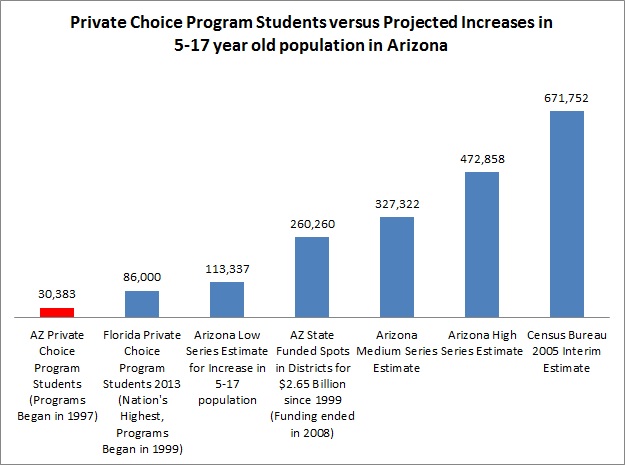
So estimates for the increase in the 5-17 year old population increase between 2010 and 2030 range from just under four times the current private choice program population at the extreme low-end to almost 22 times on the high-end. It’s worth noting that 4 year olds are eligible to receive public assistance for preschool in Arizona, that many 18 year olds are still in school, and that some students start school younger and stay in the public school system until age 21, but that is mostly just piling on. The state spent $2,650,000 between 1999 and 2008 on new district spaces despite the private choice and charter programs, and can no longer afford to do so. Mind you that $2,650,000 built more space in one of the lower performing public school systems in the nation if you judge by NAEP scores, but even this is really no longer financially feasible.
Someone explain to me how a system, like Arizona’s ESA program, that allows kids to choose their method of schooling with only 90% of the state funding, with the hapless and overcrowded districts keeping their local funding, is such a terrible idea. How exactly is this going to “destroy public education” etc?
Anyone?
Bueller?
Leave a Comment » | Education Savings Accounts | Permalink
Posted by matthewladner

(Guest Post by Matthew Ladner)
So the Florida legislature adopted an $18.4 million dollar ESA program for children with severe disabilities as a late amendment to an omnibus education bill. The Florida Education Association has filed suit against the state, loudly trumpeting its desire to defend due process, the rule of law and the American way.
Joanne McCall, the Vice President of the Florida Education Association wrote the following in a newspaper column titled Lawsuit tackles Legislature’s ‘backdoor’ way of passing bills:
We’re all taught to play by the rules. In a civil society, we rely on rules and procedures and laws as we go about our daily routine. When people break the rules, they’re expected to be held accountable for their actions — whether it’s within your family, on the job or at school, or in our society as a whole. The Legislature is no exception. There are rules and procedures in the Florida Constitution, in Florida statutes and in the House and Senate chambers that set out the right way to do things — such as pass a law.
I have yet to read Rules for Radicals but I gather that it recommends a rather cut-throat ends-justify-the-means casual attitude about the truth. Practitioners should have learned from the Dan Rather implosion over “fake but accurate” however that it is awfully easy for people to check up on things these days, and thus a rather simple matter to unmask shallow, self-serving hypocrisy. Someone may want to write a Saul Alinsky for Dummies updated for the internet age, it might lead to a more honest debate and avoid needless bumbling.
Take the Florida Education Association’s current antics for example. Jon East over at RedefinED for instance found that the Florida Education Association supported a $480,000,000 teacher pay raise through almost an identical legislative process a mere two sessions ago: late amendment attached to an omnibus education bill. It does not take an overly active imagination to think that this is probably not the first such incident employed by the FEA, simply the most recent.
The Florida Education Association was strangely silent concerning procedural preferences when the last-minute amendment to an omnibus education bill netted a $480,000,000 teacher pay raise.
In fact, Florida Education Association President Andy Ford praised Governor Rick Scott for getting ‘er done:
Ford said, “FEA thanks Governor Scott for his efforts to provide an immediate across-the-board pay increase to Florida’s classroom teachers in recognition of their demonstrated performance which has brought Florida’s education system to sixth in the nation. FEA applauds the infusion of additional resources into public education as was proposed by the Governor.
Ford could have objected to the procedure used to get this teacher pay raise, and even could have filed suit to stop it. Instead he thanked Governor Scott for pulling it off and groused over some of the details of the funding. One year later a remarkably similar legislative procedure creates a $18.4 million program for children with severe disabilities, and the FEA sends their Vice President out into the papers to wax poetic about legislative process:
These laws failed to pass the right way. They went through the legislative process and didn’t get enough votes to be enacted. So legislative leaders came up with a way to circumvent the rules. This was a backdoor way for legislative leaders to enact measures that had already failed. We all have to be accountable for our actions, even the leaders of the Florida Legislature.
So the $480,000,000 question for the FEA: are you willing to give up the half a billion pay increase and everything else that you have passed over the years through late amendments to omnibus education bills to quash an $18.4 million program for children with severe disabilities?
2 Comments | Education Savings Accounts, teacher union | Tagged: Education Savings Accounts, Florida Education Association, Florida Personal Learning Scholarship Accounts | Permalink
Posted by matthewladner

(Guest Post by Jonathan Butcher)
The new A-F report card rankings are up for Arizona public schools, and the news is good—if you’re sending your child to a charter school. Last year, 40 percent of Arizona charter schools earned an A, compared to 28 percent of traditional schools.
Now that Arizona has four years’ worth of A-F rankings, a year-to-year comparison of charter and traditional schools reveals that charter schools’ success over time is what we hope would have happened to all public schools: more charters are earning A’s and fewer are earning D’s as the years go by (note: Arizona managed to make it so hard to earn an F that few schools have done so).
2010-11 Arizona A-F Letter Grades, Charter v. Traditional

2011-12 Arizona A-F Letter Grades, Charter v. Traditional

2012-13 Arizona A-F Letter Grades, Charter v. Traditional

2013-14 Arizona A-F Letter Grades, Charter v. Traditional

Between the 2010-11 school year and 2012-13 school year, charter schools occupied the two ends of the A-F distribution, with higher percentages of schools earning A’s and D’s than traditional schools.
This year, however, charter schools own the “A” category, while the percent of charters earning D’s has been cut in half—and, for the first time, is lower than the percent of traditional schools earning D’s. True, the percent of traditional schools earning A’s crept up each year, but not as quickly as charter schools. And the percent of traditional schools earning D’s was relatively consistent.
Nothing is held constant here, so I’ll be the first to admit the limits to these charts. Plus, data from the Arizona Board of Regents (ABOR) reports that Arizona high schools are not preparing students for college, so the achievement reflected in these report cards is decidedly less impressive than it should be.
But to the extent that these school grades reflect student success (see here for how the report cards are calculated), charter schools are leading the way—and at a per student cost of $1,500 less than traditional schools. And there’s something to be said for charter schools’ unique designs, whether it’s hybrid classrooms, college prep, or career and technology centers for at-risk students aged 14-21.
Clearly there’s a reason why charters are the fastest-growing sector of the public school system.
Leave a Comment » | charter schools | Tagged: Arizona school grades, charter schools, Jonathan Butcher | Permalink
Posted by matthewladner
(Guest Post by Matthew Ladner)
MOOC there it is! How long until Paul’s stodgy students get hip with MOOCs?
11 Comments | Digital Learning | Tagged: Paul Peterson, Paul Peterson MOOC | Permalink
Posted by matthewladner

(Guest Post by Matthew Ladner)
The Florida Education Association has filed suit in an effort to kill SB 850, that included the creation of the Personal Learning Scholarship Accounts, Florida’s new ESA program. The Goldwater Institute has intervened in the case on behalf of a group of parents enrolled in the new program. During the press conference, a radio reporter asked the parents the following question:
Rick Flagg: This is one for the parents in general, whoever wants to (take it). Your bill was going to pass, regardless. And then the Legislature stuck the corporate voucher provision on there, making this lawsuit inevitable. I’d like to know how you feel about the Legislature doing that to you, and in effect using your kids as pawns in the voucher fight. That’s not for you …
PLSA parent Ashli McCall: I don’t mind being exploited in this manner because I believe in it.
Rick Flagg: Does everyone pretty much agree with that? (Heads nod.) And you’re okay now with them using your kids as the face for this lawsuit? You’re okay with being used as pawns again?
Clint Bolick: I object obviously to the characterization.
Rick Flagg: How would you describe it then?
Clint Bolick: I would describe it as a program that was made part of an omnibus education reform bill. And these parents, are they in jeopardy of losing those opportunities? No question about it. How is that being made a pawn?
How indeed?
I have never met Mr. Flagg, but I assume that he’s a swell guy who loves his momma, waives the flag on the 4th of July and cheers for his favorite sports teams. Flagg may simply have his cynicism cannon pointed in the wrong direction. Perhaps if he knew more about the travails of students with special needs and their parents, he wouldn’t second guess the decision of parents to participate in the program or to defend it in court. If Mr. Flagg had walked in the shoes of parents facing these challenges, it would not seem implausible to him that they might want to participate in a program that provides the opportunity for a truly individualized education plan for their child. It has been, after all, the unfulfilled promise of special education law from the outset.
The following is my distillation of the history of the travails of special education parents and students, as related by a joint project of the Progressive Policy Institute and the Thomas B.. Fordham Foundation. If you want to double-check me read it for yourself here. My summary is as follows:
Back in the early 1970s, a reported 1,000,000 special needs children were denied access to public schools. As in, sorry, we don’t take your kind around here denied access to public schools. The federal government took action to put an end to this discrimination. While the legislation that evolved into today’s Individuals with Disabilities Education Act stands as a landmark piece of civil rights legislation, it did not fulfill the promise of an “individual education plan” for every child with a disability. The federal government had promised to pick up 40% of the costs for special education services, but never entirely followed through. Educators complain endlessly about paperwork requirements and bureaucratic procedures. The PPI/FF tome describes the process in-school process for identifying and developing an education plan “an invitation for conflict” between schools and parents. Parents have a right to sue when districts fail to provide an appropriate education (2% of special needs children nationwide attend private schools at public expense either directly or indirectly as a result of this provision) but this is an option far more available to wealthy families due to the cost of specialized services. What started as a system for granting access and providing individual education plans devolved into a system of CYA whereby districts wished to avoid the possibility of a lawsuit and far too many parents were left deeply disaffected. Process became the focus, not outcomes.
Despite the fact that only a tiny minority of special education students have debilitating disabilities precluding academic progress, an attitude of warehousing is not far from the surface among too many people. For instance, a school district official made the following statement to the Arizona Republic in 2011 regarding the state’s grading system and the emphasis on the gains of low-performing students:
“Our concern is that many of those in the lowest 25 percent are special-education students and . . . will probably always have a hard time.”
This prophecy is not only disgusting but falls straight into the self-fulfilling category: kids will automatically face a hard time if the adults in charge of their education don’t believe they can make academic progress. Mind you that like all other public schools, Arizona districts receive additional funds for special needs students, but bristle at the thought of being held to account for the learning progress of those students. One can only draw the inference that they see their role as warehousing special needs children, not educating them. The soft bigotry of low-expectations lives and breathes.
The PLSA parents are not pawns- they are doing what the parents of special needs children have been forced to do for decades: fighting for their children. If the FEA suit prevails, they lose the ability to take control of the education of their child. They have a direct interest in the outcome, and decided not to be a passive “collateral casualty” of the teacher’s union. The less the special education system operates as a “take it or leave it” system for those who cannot afford expensive attorneys the more children we will see reach their potential. Mr. Flagg lives in a state that has made remarkable progress for special needs children in public school while not coincidentally making them all eligible to attend a public or private school of their choice, so let’s avoid any pretense that this is going to hurt the public school system.
So my question for Mr. Flagg is as follows: if you were forced to repeat life as a special needs child, would you want your parents to have an opt-out for you if they found you in a school run by people checking off boxes on a form, unconcerned with your progress, and displaying the attitude expressed above? If not, why would you make yourself a willing pawn-a mere funding unit- of a public school ignoring your needs? Even pawns have the potential to become a queen if not carelessly sacrificed.
If so, welcome to the parental choice movement. All is forgiven.
Leave a Comment » | Education Savings Accounts | Tagged: Ashli McCall, Clint Bolick, Education Savings Accounts, Florida Education Association, Florida Personal Learning Scholarship Accounts, Rick Flagg | Permalink
Posted by matthewladner

(Guest Post by Matthew Ladner)
The Arizona Republic ran a column by yours truly today calling for making the Arizona Department of Education an executive department reporting directly to the Governor rather than having a separately elected position.
Free from the word limitations of columns, I can provide a bit more detail.
Arizona’s student data system typifies what I describe in the column as dysfunctional policymaking. Officials from school districts and charter schools have complained bitterly about it for many, many years as being riddled with errors. It often crashes, and has remained down for months at a time. I have spoken to district officials who told me that they despaired of the state system ever working and created their own data system as an attempt to cope. All accounts I have heard say that Superintendent Huppenthal has done a good job in making the best out of an awful situation, but one highly placed source described it as getting inaccurate information to you at a faster pace. The whole system, in short, needs to be replaced, as in at least a decade ago.
Okay, so go and get a new data system, right? Wrong. We’ve seen an endless cycle of finger-pointing on the subject. The Department has requested money to fix the system, the legislature has never provided these funds. One can draw the inference that the legislature has collective doubts about the money being put to good use and, well, it is hard to blame them.
Now imagine a world in which former Governor Janet Napolitano had appointed the head of the department. I had my problems with Governor Napolitano philosophically, but I had no doubts about her overall competence. In this alternative reality, a clown car show of a data system reflects badly on her. People that can’t get basic state functions settled don’t win plum assignments like Homeland Security and the University of California system. Moreover, she would have had her own people in charge and the ability to secure the required financing to get a decent system in place during budget negotiations. The means meets motive, problem solved. It would have been a much better and more enduring K-12 legacy for Governor Napolitano than what turned out to be unsustainable school funding increases. Ah, what use we could have made of the aughts…
Back here in the Arizona of the real world, we had, um, this going on during the aughts. As you might imagine, it did not end well, nor inspire confidence in the legislative branch.

Honk! Honk! Data system coming through!
At some point, a problem goes on long enough to qualify a symptom of a much deeper disease. Your local Target has a data system that can track every purchase and reorder lollipops just as they start to run low. In 2014, a reliable and secure student data system isn’t exactly rocket science, but it continues to elude Arizona. Appointing a Superintendent won’t dry every tear or fix all of our problems. It may be more necessary than sufficient, and we really need to make good use of the next four years regardless of who wins the next set of elections.
In the end it may not happen because it just makes too much sense, but hope springs eternal even as time grows short.
Leave a Comment » | school accountability | Permalink
Posted by matthewladner

(Guest Post by Matthew Ladner)
Today is the 102 anniversary of the birth of Milton Friedman. My favorite Friedman quote is one recently rediscovered by Stephanie Linn from a 1995 WaPo column Dr. Friedman penned:
The private schools that 10 percent of children now attend consist of a few elite schools serving at high cost a tiny fraction of the population, and many mostly parochial nonprofit schools able to compete with government schools by charging low fees made possible by the dedicated services of many of the teachers and subsidies from the sponsoring institutions. These private schools do provide a superior education for a small fraction of the children, but they are not in a position to make innovative changes. For that, we need a much larger and more vigorous private enterprise system.
The problem is how to get from here to there. Vouchers are not an end in themselves; they are a means to make a transition from a government to a market system. The deterioration of our school system and the stratification arising out of the new industrial revolution have made privatization of education far more urgent and important than it was 40 years ago.
And even more important today than when Dr. Friedman typed the column. Friedman saw this clearly, and the time has come for the rest of us to catch up: today’s stock of private schools are a means to an end for an important but ultimately small group of students-even with a voucher or tax credit program in place. The stock of empty private school seats represent a vital opportunity for the students who could fill them, but in the big picture it is crucial to focus upon how to get new providers to create new opportunities for students. Voucher programs that can only be used at private schools and only provide enough funding to cover the marginal cost of adding a student to an empty seat are vitally important for the small number of students participating but ultimately represent an evolutionary dead-end.
It’s a shame that it took those of us in Milton’s intellectual debt a decade and a half to create a method to “get there from here” in the form of ESAs, but better late than never. We simply aren’t as bright as the great Milton Friedman, so we will need to work together to bring about the revolutionary improvements he saw as possible so clearly for so many decades.
Happy birthday Dr. Friedman-we are doing our best to catch up to where you got decades ago.
5 Comments | Education Savings Accounts | Tagged: #Milton102, Education Savings Accounts, Milton Friedman | Permalink
Posted by matthewladner

(Guest Post by Matthew Ladner)
A fascinating article in the Atlantic about the lack of textbooks in Philadelphia district schools would have been even more illuminating if the author had discovered that the district spends $20k per student per year.
The blindingly obvious conclusion to draw from this article is that plenty of money exists to get these students all the textbooks they need, but that the district simply has other priorities. The district spends the money, they just spend it on something or someone else, and mysteriously classroom learning never makes to the top of a priority list. These are not “poor schools” but rather wealthy schools that are poorly run and victimizing poor students in the process.
11 Comments | charter schools, vouchers | Tagged: Meredith Broussard, Why Poor Schools Can’t Win at Standardized Testing | Permalink
Posted by matthewladner
(Guest Post by Matthew Ladner)
Okay so the title is a bit of an exaggeration but what the heck, there is a new Planet of the Apes movie out and we believe in giving our audience what they pay for around here at the Jayblog. What’s that you say? You guys read this blog for free? Oh yeah, that’s right. We write it just to entertain ourselves, I forgot.
Anyhoo, Cato’s Jason Bedrick raises questions worth debating about the new Friedman Foundation study by Andy Smarick over at Education Next.
Leave a Comment » | charter schools, vouchers | Tagged: Andy Smarick, Friedman Foundation, Jason Bedrick | Permalink
Posted by matthewladner

 Jay P. Greene's Blog