
(Guest Post by Matthew Ladner)
All states started taking NAEP in 2003. Some jurisdictions (**cough** DC **cough** Florida) scored big gains before 2003, but hey they are near the top anyway. DC is your winner, more to follow.
(Guest Post by Matthew Ladner)
All states started taking NAEP in 2003. Some jurisdictions (**cough** DC **cough** Florida) scored big gains before 2003, but hey they are near the top anyway. DC is your winner, more to follow.
 Leave a Comment » |
  NAEP | Tagged: 2015 NAEP |
  Permalink
 Posted by matthewladner

(Guest Post by Matthew Ladner)
Arizona did well in the 2015 NAEP- up in three of the four tests and notched our first ever above the national average score in any of the four exams. This is all good news, and the gains look more impressive if you compare them to when the economy hummed and spending per pupil was relatively high (2007) to when not so much yet (2015). Sweet are the uses of adversity if surely very difficult for educators and administrators.
I ran numbers for charter vs. non-charter and tried to get closer to apples to apples by examining the scores of general ed students who qualify for a free or reduced lunch. If your story is that the charter schools have a nefarious plot to siphon off all the rich kids from North Scottsdale (good luck btw) these are not those kids.

Some of the really big gains on the charter side here may be explained by an unusual bad showing for charter schools in 2013-and that could relate to the vagaries of NAEP sampling. Nevertheless they are way up from the good ole days of property bubble prosperity as well as from 2013 among both districts and charters- and the most important gains are the blue ones since they still educate 83% of the kids.
So that’s what you get for you “wild west” charter sector that routinely derided by overly cautious types who have no experience with coping with rapid enrollment growth- rocking academic gains for disadvantaged kids! Arizona still has far to go but…

4 Comments | NAEP | Tagged: Arizona 2015 NAEP, Arizona charter schools | Permalink
Posted by matthewladner

(Guest Post by Matthew Ladner)
Let the fun begin! National aggregate results for all students are flat in 4R, down in the other four subjects. The declines are very small- one point on 4th grade math, two points on 8th grade math, down two points on 8th grade reading. On 500 point scale tests none the national results are not worth getting overly excited about- but why let that stop anyone!
The interesting stuff is also found by digging around.
It looks like Maryland must have finally put a stop their reign of terror against the NAEP inclusion standards for kids with disabilities and ELL because their scores declined substantially.

Good for them for making the move. DC looks to have overtaken a statewide average (New Mexico) after rocking the 4th grade reading NAEP with big gains again (see below). Louisiana, Mississippi and the Carolinas also demonstrated big gains on 4th grade reading.
I will take a close look at DC, but here is a preview looking only at general ed kids who are eligible for a free or reduced price lunch:

26/21 point gains in 12 years among FRL eligible kids is very impressive. I’ll track the numbers by some alternative variables later since the definition of FRL has evolved over time. The last time I did this (by tracking kids by parental education instead of FRL status for instance) it confirmed that disadvantaged kids were making big gains in DC- so I will offer a somewhat premature congratulations.
More later…
Leave a Comment » | NAEP | Tagged: DC NAEP scores, NAEP 2015 | Permalink
Posted by matthewladner

(Guest Post by Matthew Ladner)
Health care has already been putting a squeeze on other forms of state spending. K-12 won’t be spared indefinitely. Handy pie charts from the Texas Comptroller of Public Accounts:

If you want to see why Texas leaders deregulated tuition back in 2003, keep an eye on the green “All Other” slice shrinking from 41.1% of the budget to a projected mere 27.7% in 2023. Ooops- you can’t charge tuition to prisoners and well criminal justice has to fit into that green slice along with transportation, universities and a whole bunch of other stuff. Texas universities set a good example for the rest of the country more than a decade ago by planning for a post-state funding world.
Now look at the blue K-12 slice- 44.9% of the budget in 2001 moves to a projected 37.4% in 2023. That doesn’t look all that bad until you consider what will be happening in terms of student and elderly population trends:

More specifically:

So that shrinking % of the budget for K-12 will need to cover a K-12 system that has almost a million more students in 2025 than in 2015. That’s what happens when you add a 100,000 or so new students in your K-12 system per year. Oh, and by the way, the Census Bureau projects a doubling of the elderly population between 2010 and 2030 to boot.
So what does Texas have to fear from parental choice again?
2 Comments | Age Demographic Change | Tagged: Fear, Texas age demography | Permalink
Posted by matthewladner

(Guest Post by Matthew Ladner)
Ryan McMaken notes that international childhood poverty measures use national median incomes as their base. Unicef defines you as poor if you fall below 60% of the median income. What goes unmentioned however is that median incomes vary- a lot.
Having your Rawlsian druthers, you rather not be born a poor child in a country with a relatively low median income-say Mexico or Turkey. If you are going to be born a poor child- much better to be born in a country with a high median income like the United States- or tiny little international banking havens like Luxembourg or Switzerland (ancestral homeland of the Ladner clan btw-we were exiled to the new world when caught smuggling salt into France) or a tiny Nordic country sitting on a whole bunch of oil (Norway).
So the above chart plots Unicef childhood poverty rates across the y-axis but family incomes for those living in relative poverty cross the x-axis. As you can see, the American childhood poverty rate is relatively high, but so to is the American childhood poverty income. In fact a poor child in America has an income four to five times greater than a poor child in Mexico.
It is not clear to me whether the American number includes transfer income or not. President Obama very helpfully noted that if you include transfer income (many poverty measures don’t) then poverty has declined substantially in America. If these figures don’t include transfer income than matters would be even more lopsided in favor of the United States vis-a-vis say a Mexico. If it does, it is still lopsided.
So, now, someone please explain to me again why American Hispanic and African-American kids score so close to the median PISA score for Mexico. Oh yes, there is poverty in the United States, and students of color suffer from it in a disproportionate fashion. Nevertheless, the incidence of childhood poverty in Mexico is far more severe than in the United States. Moreover, public schools in America enjoy lavish levels of per-student funding when compared to their counterparts in Mexico.
Put another way- how is that schools in Mexico have such a greater bang for the buck in overcoming student poverty when compared to urban schools in the United States? Perhaps we should redirect our international education crowd from Finland to Mexico.
2 Comments | Uncategorized | Tagged: poverty in education, Ryan McMaken | Permalink
Posted by matthewladner

(Guest Post by Matthew Ladner)
You may have never heard of American entrepreneur Malcolm Purcel McClean, but you have greatly benefited from his work. The son of a North Carolina farmer, McLean went into the trucking business. One day watching the process of loading a shipment of cotton from trucks to a ship, he had a rather brilliant but simple idea:
I had to wait most of the day to deliver the bales, sitting there in my truck, watching stevedores load other cargo. It struck me that I was looking at a lot of wasted time and money. I watched them take each crate off a truck and slip it into a sling, which would then lift the crate into the hold of the ship. Once there, every sling had to be unloaded, and the cargo stowed properly. The thought occurred to me, as I waited around that day, that it would be easier to lift my trailer up and, without any of its contents being touched, put it on the ship.
Eventually this idea evolved into simply taking the box rather than the entire truck and box onto a ship. In 1955 McLean rolled the entrepreneurial dice, buying two WWII era oil tankers and securing a loan to purchase $42 million worth of docking, shipbuilding, and repair facilities. He refitted the ships and designed trailers to go both below or on the decks of the ships. In April 26th, 1956 his first loaded ship successfully set forth from Port Newark, New Jersey, headed for Houston, Texas.
You knew there would be a Texas angle in this story right? In any case that date is now regarded as a historical marker in maritime history. When McLean passed away in 2001, his obituary noted that the sea transport of goods had not changed much between the time of the Phoenicians and 1956. McLean’s shipping containers enormously decreased the labor and the cost of shipping goods by sea. In 1956 it cost $5.86 per ton for longshoremen to load cargo- McLean’s technique reduced that cost to 16 cents per ton.
Memo to the Bernie Sanders/Pat Buchanan anti-trade Axis of Ignorance: an academic evaluation teased out the impact of containerization on the increase in world trade from that of tariff reductions. Containerization had a larger impact than free trade agreements, which means McLean deserves some of the credit for things like:

and:

Like many successful entrepreneurs, the progress McLean brought determined enemies- especially among unionized dock workers. Oh if we could only forego all of this progress, especially for the poor, so that we could go back to having more dock workers, more expensive goods and more global poverty! In 1980 the United States Supreme Court ruled against dock worker unions who were exploiting antiquated provisions to get paid for work that no longer needed doing.
McLean died a successful but publicity shy man who made the world a much better place while making a fortune for himself that captured only the smallest fraction of the prosperity unleashed by his innovation.
Bonus- innovators in construction have begun using shipping containers to make buildings like:


5 Comments | Al Copeland Humanitarian Award | Tagged: Al Copeland Humanitarian Award, Containerization, Malcolm McLean | Permalink
Posted by matthewladner

(Guest Post by Matthew Ladner)
I spent yesterday up in Prescott attending a meeting of the Classrooms First initiative, which is a panel put together by Governor Ducey to discuss school finance reform in Arizona. Arizona has both online learning programs and CTE programs that basically entail dividing the per pupil funding between a home school and an outside provider. As you might imagine, this gets messy.
On the digital side for instance schools and districts are not required to accept online courses by outside providers for credit. “How are we supposed to know whether the course was any good?” goes the refrain. Of course districts will happily accept online courses which they provided themselves- these of course have all of the necessary quality control and all. An outside observer however would struggle to discern that a district online course was any more effective than one provided by an outside provider.
So Arizona taxpayers foot the bill for all of this, and we have kids completing coursework but finding themselves denied credit for said coursework. Delightful.
CTE training has a different but related set of problems involving division of per student funding.
During this discussion it occurred to me that our state is about a third of the way through the birth process leading to an a la carte education for high school students.
Some people want our mom to stop pushing while we, er, figure things out or something. The contractions however will not agree to a pause. Lobbyist Jay Kaprosy noted that testing is moving in the direction of end of course exams, so we should consider moving the funding from the providers to the student to allow them to divvy it up among providers. A great many details would need working out to move to such a system and the Classrooms First council was understandably cautious (this topic is related but not central to their task) but my reaction:

Leave a Comment » | Uncategorized | Permalink
Posted by matthewladner
Wonk action shot !!
(Guest Post by Matthew Ladner)
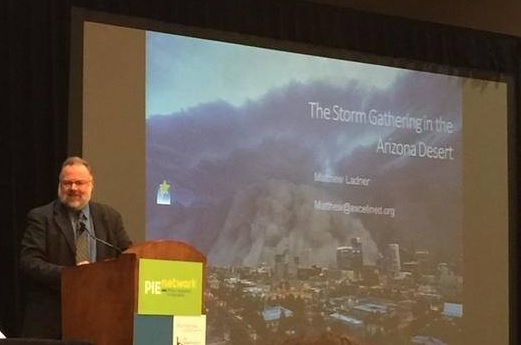
I had the opportunity to participate on a panel at the PIE Network conference in Scottsdale on a panel that used Arizona as the canvass to discuss important issues. A better look at this picture:

No special effects here this is an actual photograph of downtown Phoenix during a haboob– an Arabic word that roughly translates to “gigantic dust storm.” An haboob forms in a weather front in arid regions- thus in the picture your eyes are drawn to the beige dust cloud, note also the huge grey clouds in the background.
Fortunately you probably live in a place that won’t experience an Arizona-style haboob- at least not weather-wise. In terms of your state’s politics-get ready. It’s coming to get you.

Ronald Brownstein has written a series of articles in the National Journal about demographic change and inter-generational conflict under the theme of the Brown and the Gray. He describes the two massive generations: old and white Baby Boomers and above vs. young and brown population as two tectonic plates. The earthquakes have already started here in Arizona. Rather than dismiss Arizona as a remote backwater, you should pay close attention to what has transpired here and learn from our mistakes. Arizona’s demographics and attendant controversies lie in your state’s immediate future.

Regardless of which state you live in, over the next 15 years it will be getting much older and will have a significant increase in the Hispanic population, much of which will occur in the youth population. Paul Taylor’s book The Next America uses extensive polling data to paint a portrait of Baby Boomers as relatively wealthy but deeply miserable. Two sources of Baby Boomer anger: their Millennial kids still living in their house and a widespread view that the country has changed and no one asked for their permission. One cannot help but wonder how the inevitable grown up conversation about Uncle Sam’s $55 trillion in unfunded entitlement liabilities will worsen moods further.
MIT’s James M. Poterba performed a statistical study and found that an increase in the elderly population is associated with a decrease in overall public school spending, and that the effect is all the more pronounced if the ethnicity of the old varies from that of the young. Let’s concede that the Arizona N of 1 matches this story rather perfectly, but that it should be understood in a context of:
I am not inclined to weep if my state happened to expand public school staffing at a rate slower than the national average, given that the national average expanded staffing at a rate ten times greater than enrollment growth and received precious little for it in return in terms of student learning gains.
While I have more than my share of gray hair, I don’t think this qualifies me as an old grouchy white guy. I’m painfully aware that the future of Arizona rests on providing high quality education to all students-including Hispanics. Simply throwing money at a dysfunctional system may satisfy some sort of superficial need to show that you care, but it simply won’t do in terms of a solution. We need far more than symbolism.
I’m not sure how this story ends. The elderly depend heavily on government spending for health care and the young for education. Uncle Sam has a deeply troubling balance sheet and states have become very dependent on his largess. Deep-seated policy related pathologies define both health and education. A generational conflict over scarce resources looms, and it will have a barely if at all disguised ethnic subtext.
The only (relatively) happy path out of this fix lies in innovation-we need more effective and most cost-effective education and health care delivery systems stat.
Our work has only just begun.
Leave a Comment » | Age Demographic Change | Tagged: Arizona politics, PIE Network, Ron Brownstein, The Brown and the Gray | Permalink
Posted by matthewladner

(Guest Post by Matthew Ladner)
…especially if they have to do with per student funding in Arizona public schools, as I had the chance to explain in today’s Arizona Republic.
4 Comments | Uncategorized | Permalink
Posted by matthewladner
(Guest Post by Matthew Ladner)
If a picture is worth a thousand words, here are 3,000 for you. First American manufacturing does more with fewer people (HT: AEI’s Mark J. Perry):

Okay good- ready for the next one? Heritage chart showing that the American education massively increases employment relative to the student count:
But it’s all fine because the kids are learning so much surrounded by so many adults compared to the past right? Er, no:

1 Comment | NAEP | Tagged: Heritage Foundation, Mark J. Perry, NAEP | Permalink
Posted by matthewladner


 Jay P. Greene's Blog