The Past is Never Dead. It’s Not Even Past.

August 3, 2016

(Guest Post by Matthew Ladner)

One of my favorite trends I have spotted in reading history is when an author skillfully makes an allusion to current events without once making any explicit reference to contemporary circumstances. Or perhaps I am just reading too much into things, but try this quote on for size from the opening chapter of Max Hastings’ book Catastrophe 1914: Europe Goes to War:

1.

‘A Feeling that Events Are in the Air’

1 Change and Decay

One day in 1895, a young British army officer lunched in London with the old statesman Sir William Harcourt. After a conversation in which the guest took, by his own account, none too modest a share, Lt. Winston Churchill-for it was he- asked Harcourt eagerly, ‘What will happen then?’ His host replied with inimitably Victorian complacency: ‘My dear Winston, the experiences of a long life have convinced me that nothing ever happens.’ Sepia-tinted photographs exercise a fascination for modern generations, enhanced by the serenity which long plate exposures imposed upon their subjects. We cherish images of old Europe during the last years before war: aristocrats attired in coronets and ball gowns, white ties and tails; Balkan peasants in pantaloons and fezzes; haughty, doomed royal family groups.

Only a man or woman who chose to be blind to the extraordinary happenings in the world could suppose the early years of the twentieth century an era of tranquility, still less contentment. Rather they hosted a ferment of passions and frustrations, scientific and industrial novelties, irreconcilable political ambitions, which caused many of the era’s principals to recognize that the old order could not hold. To be sure, dukes were still attended by footmen wearing white hair powder; smart households were accustomed to eat dinners of then or twelve courses; on the continent duelling was not quite extinct. But it was plain that these things were coming to an end, that the future would be arbitrated by the will of the masses or those skilled at manipulating it, not by the whims of the traditional ruling caste, even if those who held power strove to postpone the deluge.

Sound vaguely familiar?


The Best Pound for Pound Math Education by State in America

August 2, 2016

(Guest Post by Matthew Ladner)

The deeper you look into the NAEP the better things look for my home state.  Earlier I showed you that Arizona led the nation in overall academic gains in both 2013 and 2015. Today let’s take a close look at math, and student subgroups- both in terms of gains and overall performance.

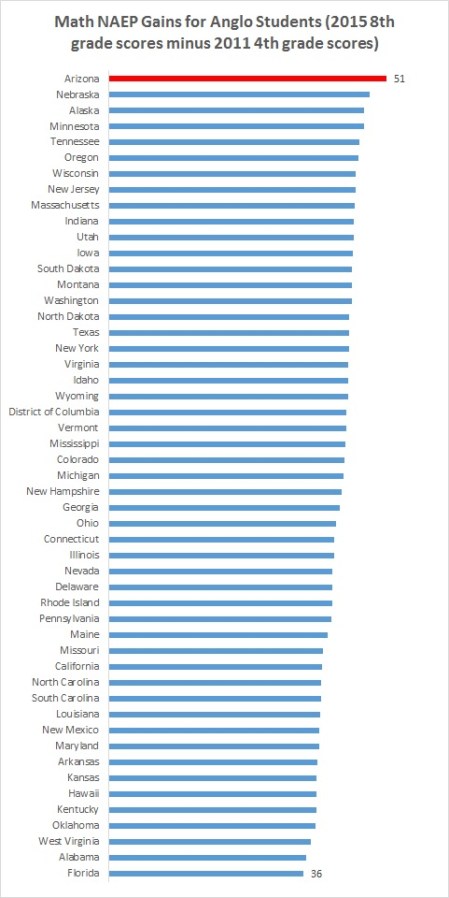
Starting with Anglo students- how did their gains look in 2015? The chart below subtracts the 2011 NAEP 4th grade math scale points from the same cohort’s 2015 8th grade math scores for Anglos.

Anglo math gains

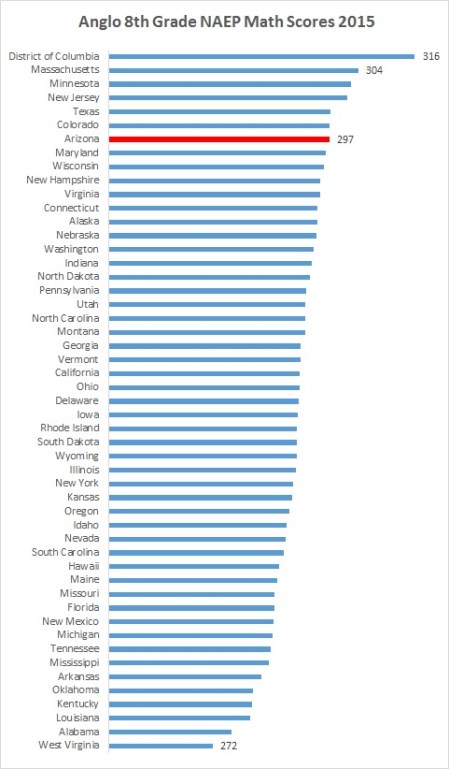
Ok so they led the nation in gains- but that might not matter because their scores could still be low. Except they aren’t:

Anglo math scores

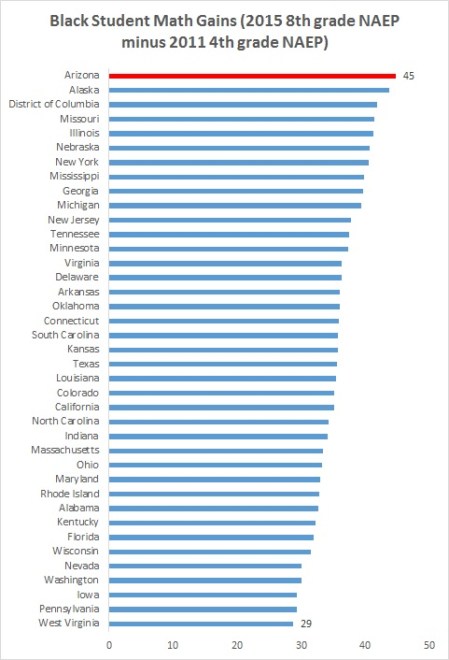
Arizona is in striking distance of everyone but the absurdly gentrified right side of the tracks sections of DC. So moving on to non-Anglo students, the NAEP can also track Black students- here were gains by state in 2015.

Black math gains

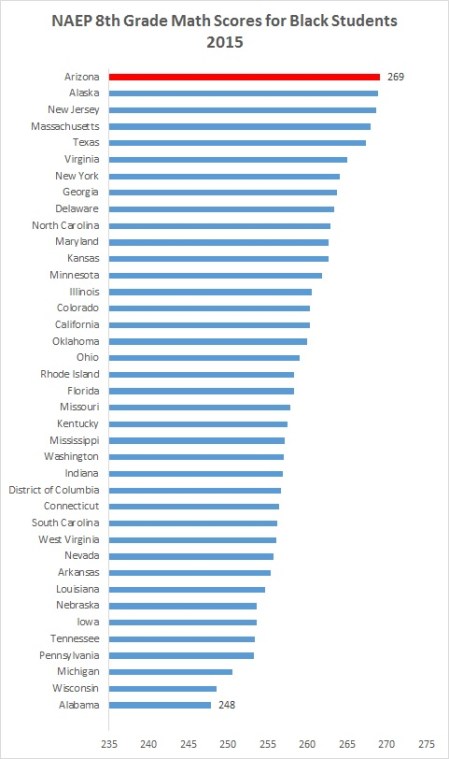
Well would you look at that? Number one again. Hmmm.  Well but it still might not mean much because the overall scores….could..still.be…….low?

Black math scores

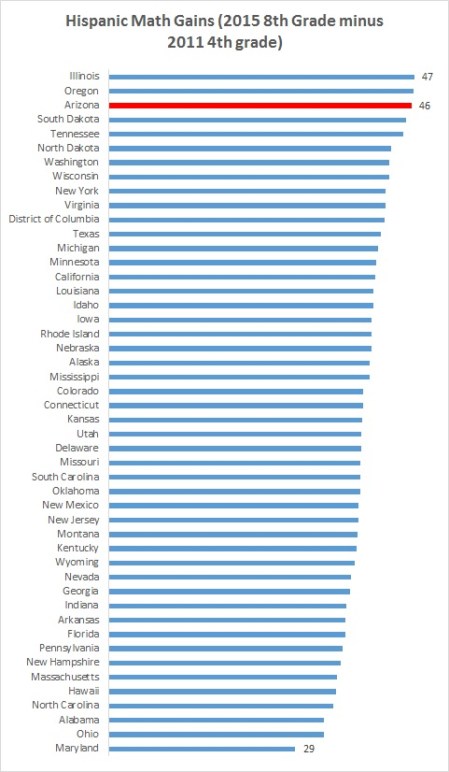
Hispanic students gains/scores are merely spectacular rather than absolute tip of the spear:

Hispanic math gains

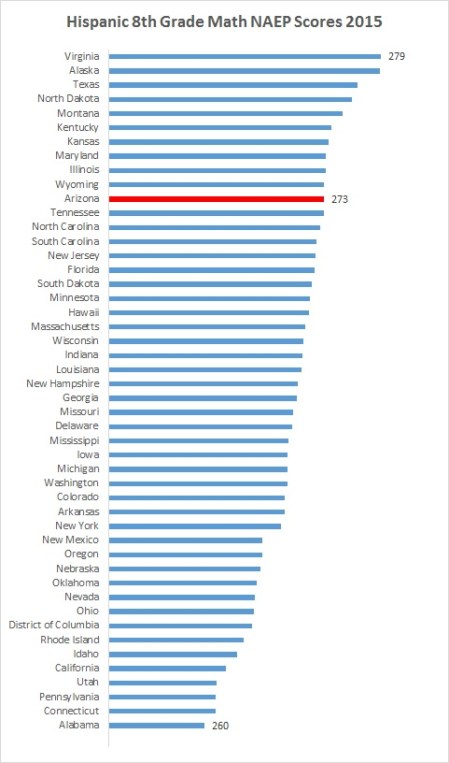
Ah well it gives us worlds yet to conquer, as do the scores:

Hispanic math scores

You don’t have to trust me- look the numbers up for yourself. Ok and then there is this to consider:

Ok so someone try to make a case that a state other than AZ deserves to be considered the pound for pound mathematics champion of the United States. I’ll have my gloves laced up and will be ready to give you a canvass nap in the comments section (unless you have a decent case to make) but I’m declaring Arizona to be the pound for pound state math champion.

P.S. (almost forgot…)


Colorado Faces the Future

July 22, 2016

(Guest Post by Matthew Ladner)

This week I’ve been writing about Colorado’s charter school sector’s delightfully high NAEP scores. To wrap this up, I’d like to put this success in a broader context of Colorado’s present and future.

So if you’ve been to Denver in the last few years, it is hard not to notice that the place is booming. The Big Bird construction cranes kind of give it away.  Growing up in oil-boom Texas, I was told about an old saying that held that if you see more than two Big Bird Cranes in a downtown area get ready for a crash. Denver seems to be defying this old nostrum comfortably. So far.

Favorable age demography stands as big if subtle factor in favor of Colorado’s boom.  The state has an unusually large working age population vis-a-vis the elderly and youth populations. Demographers quantify this through age dependency ratios- take the number of working age people (18-64) and dividing that by the combined number of 17 and younger and 65 and older. The basic idea is that at any given time working age people are pushing society’s cart, while young people are drawing upon public services such as education (for the young) and healthcare (for the elderly) at high rates.

Colorado age dependency


In 2010 Colorado had an age dependency ratio similar to that of the United States as a whole in the 1980s and 1990s.  Lots of working age people with relatively few elderly and young people worked wonders for the United States back then as the Baby Boomers entered their prime working, earning and taxpaying years.  We even had these quaint things called “budget surpluses” at the federal level in the 1990s while the Republicans and Democrats locked each other up and the tax revenue continued to pour in.

Ooops almost got drawn down the 1990s nostalgia event horizon. In any case with one of the nation’s lowest age dependency ratios, le bon temps continuer à rouler dans le Colorado! Perhaps Colorado will make better use of the current boom than the country made of the 1990s in education, as you see from the figure above that the Census Bureau does not project favorable age demography to last.

Colorado youth and elderly

Colorado is currently advantaged by a large middle-aged population, but middle-aged people have a funny way of becoming old.  Elderly people typically move out of their prime earning years, thus paying fewer taxes, and represent some of the most expensive patients in our health care system, some of which state taxpayers foot the bill. A growing elderly population creates strains on all other state spending priorities.

Over the next 15 years, through a combination of an expanding youth population and (mostly) through population aging, the Census Bureau projects Colorado’s total age dependency ratio to move from one of the lowest in the nation in 2010 (55) to a number that is far higher than any state in 2010 (72).  The Colorado of 2030 will have greater age demographic challenges than the Arizona or Florida of today.

One of the few things you can do about this now- world class education results. The United States largely squandered this opportunity in the 1990s, and the consequences seem ever more obvious and ominous.  The American economy may or may not be “rigged” but it seems terribly likely to seem that way to those who did not acquire the knowledge and skills to succeed in life in school. Is there any aspect of American life more rigged than K-12 education?

Colorado’s embrace of charter schools has rewarded the state with a highly effective system of schools producing globally competitive results.  A survey found that 66% of Colorado charter schools had wait lists, and they average size of the wait lists was larger than the average student enrollment of a charter school. Wonderful though it is, one can infer from this that the charter sector alone cannot satisfy parental demand for options. Colorado needs as much improvement as it can get from any and all available sources. More effective and more cost effective education is precisely what Colorado needs and what charter schools have delivered, but the pace needs to quicken.

Much of the Colorado working age population of 2030 will be going back to school in a few weeks. A slowly growing but still minority of these students show globally competitive academic achievement. The clock is ticking- Colorado has the opportunity not to repeat America’s mistakes from the 1990s, but it is far from a given. Unless you succeed, you’ll live to regret it. Colorado has however a record of success to build upon- fire up the Big Birds!


Rocky Mountain HIGHHHHH!!! (State Score Backup!)

July 21, 2016

(Guest Post by Matthew Ladner)

I’ve been digging into the very impressive NAEP scores of Colorado charter schools.  NAEP is the gold-standard of academic testing data, but it does make use of sampling whereby a representative sample of students in each state takes the NAEP rather than every single student. Charter school students in Colorado are now more numerous than say left handed kids with blonde hair and blue eyes, and each NAEP example involves a separate sample of students.  So a single sky-high score on one of the NAEP exams for charter school students could easily be the product of a favorable sample, solid achievement across all four tests instills confidence.

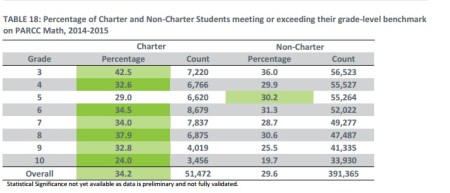
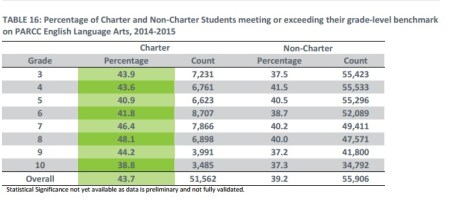
Still it is good to examine other testing data that does not involve sampling. The Colorado Department of Education released a 2016 State of Charter Schools Triennial Report that contains state testing data comparisons for charter and district schools. This data addresses a different question than what we have examined in the previous two posts. Previous posts have demonstrated that Colorado charter schools show top-notch performance across a variety of subgroups when compared to high-performing states. The data below uses state data to address how Colorado charter students scored compared to Colorado district students.

These data have further limitations. The report notes them as “preliminary” and we do not have access to the raw data- only the percentages of students meeting for exceeding grade level benchmarks. The Arizona Charter School Association analysed state data and determined that the state data displayed an even larger gap between charter and districts than the NAEP gaps. Without analysis however, we can’t make comparisons between state and NAEP data. Note also that judging by NAEP that Colorado’s district system is relatively high performing itself compared to other states.

With those caveats in mind, the state data shows a consistent advantage for charter students in math:

CO PARCC Math


And in English Language Arts:

CO PARCC Reading

The report contains some breakdowns by student subgroups (family income, ethnicity) on both the current and previous state exam. These comparisons broadly favor the charter schools. The report also presents aggregate data on schools by type under the state’s accountability framework:

Colorado

For those squinting at their Ipads, the last four columns basically show that a smaller percentage of Colorado charters fell into the “Does Not Meet/Approaching” category (40.52% to 52.07%) than districts, and a larger percentage made either “Meets/Exceeds” (59.48% for charters, 48.93% for districts).

The overall conclusion of these data is not that Colorado charter schools are “good” while Colorado district schools are “bad” whatsoever. Good or bad for whom? The good news for Coloradans is that you have a system of independent public schools operating at scale and producing on average world-class academic results.

Keep it up- in the concluding post I’ll show how Colorado’s need for highly skilled/educated workers is set to grow over time.


Rocky Mountain HIGHHHHH!!! (Reading Scores Too!)

July 20, 2016

(Guest Post by Matthew Ladner)

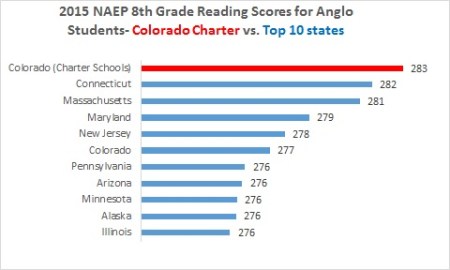
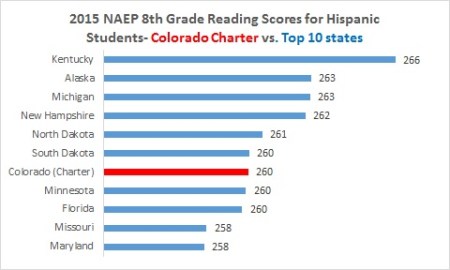
Yesterday we ran through the 2015 NAEP Mathematics scores for Colorado charter schools for various available subgroups. Today we will run through the 2015 Reading NAEP scores for Colorado charter schools, comparing them to the top 10 statewide averages. Let’s start with scores by ethnicity, I’ve truncated these charts but just for perspective the lowest statewide average for Anglos students in 2015 was 261.

CO charter reading Anglos

and for Hispanic students (lowest statewide average =245):

CO charter reading Hispanic


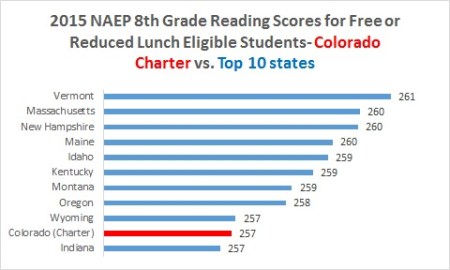
Next we’ll look at scores by Free and Reduced Lunch status. The lowest statewide average for FRL kids in 2015 = 245:

CO charter reading FRL

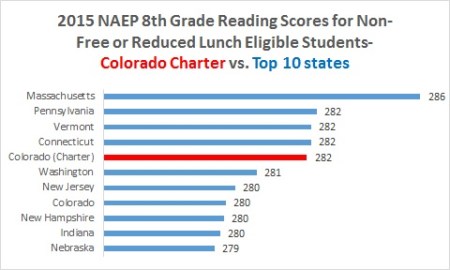
and students not eligible for FRL (lowest statewide average = 266):

CO charter reading non-FRL

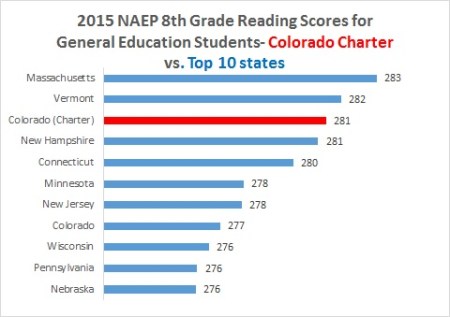
The Colorado Department of Education report indicates that Colorado charter schools have more ELL kids than districts, fewer special education kids. The NAEP does not provide standalone estimates for ELL or Special Education students (sub-samples of sub-samples are tough) but we can compare the general education scores of Colorado charter schools to the general education scores of the top 10 states. The lowest statewide average in 2015 for general education students stood at 257.

CO charter reading general ed

So just as a reminder from the work of Peterson et al, if you are in the Massachusetts neighborhood on NAEP, you are also keeping company with the academic achievement of the upper echelon of European and Asian countries.  So to all the Colorado charter students, educators and supportive policymakers and philanthropists here is to you:


Going bold in Missouri with Education Savings Accounts

July 19, 2016

(Guest Post by Martin F. Lueken)

Last year, Missouri was one of 18 states that introduced legislation to create an education savings account (ESA) program for families. While it didn’t ultimately become law, it’s stoked the conversation about educational choice in the state and how we can empower families to find schooling options that work for their kids.

Under an ESA program, state officials deposit money into an account for education expenses for children who sign up for the plan. Parents can spend the money on a host of education expenses ranging from books to special needs services, online education, tutoring, SAT and ACT preparation or private school tuition. Parents can also roll over unused funds and use them in the future to pay for college tuition.

Currently, there are five K-12 ESA programs operating in five states – Arizona, Florida, Mississippi, Nevada, and Tennessee.

ESAs are a new and promising innovation with lots of potential because they move beyond just giving parents a say in what school their children attend. ESAs empower parents to tailor an educational experience that they want for their own children.

In essence, it expands on what Nobel Laureate and economist Milton Friedman’s vision of providing parents with freedom to choose the school that best suits their children’s needs. Going a step further, ESAs allow parents to unbundle educational goods and services and choose the ones that best meet their needs. School choice is getting an upgrade.

Critics of ESAs and other school choice efforts like to allege that the programs will “siphon” resources from public schools or harm students in some way. Fortunately, school choice has been around long enough to have produced a large body of research to learn from.

Researcher Greg Forster, for instance, systematically reviewed 100 empirical studies. His findings: school choice affects all of these areas mentioned above in a positive way. Students who choose score higher in reading and math, are more likely to graduate and are more likely to succeed in college. They also are more likely to learn civic values. Moreover, increased competition from school choice makes students remaining in public schools better off. When students choose, schools also tend to become more integrated. And not a single study found that school choice cost taxpayers any money.

Although greater educational freedom for Missouri families would be reason enough for many to adopt a program, some, including taxpayers and legislators, want to know how an ESA program would affect the state’s bottom line – a legitimate concern. A paper I recently co-authored with Mike McShane, Director of Education Policy at the Show-Me Institute, estimated the fiscal impact of a broad-eligibility ESA program on Missouri taxpayers and public school districts. This program would be funded by tax credits for private donations, in which nearly all Missouri K-12 age children (88 percent) would be eligible. We considered a program that is capped at $50 million in its first year, which is a drop in Missouri’s $5.7 billion K-12 education budget’s bucket.

Using a variety of circumstances to make our estimates, we found that state government and local school districts combined would save between $8 million and $58 million per year under an ESA program. The school districts alone would save $21 million to $40 million per year. The state – which is footing the bill by issuing tax credits – could save up to $18 million annually.

What does this mean? For starters, public school districts would have more resources for each student who remains in public school (as well as other tangential benefits such as smaller class sizes and better matches between Missouri students and schools).

Overall, however, Missourians and their children would have little to worry about and a whole lot to gain. The Show-Me State has tried many things to improve their schools, especially in the areas that struggle the most, with little success. It’s time to go bold, and try something that’s already a demonstrated success. It’s time for Missouri to create an education system fit for the future.

Update: rephrased for clarity

Martin F. Lueken is the Director of Fiscal Policy and Analysis at the Friedman Foundation for Educational Choice.


Rocky Mountain HIGHHHHHH!!! (Charter Test Scores!)

July 19, 2016

(Guest Post by Matthew Ladner)

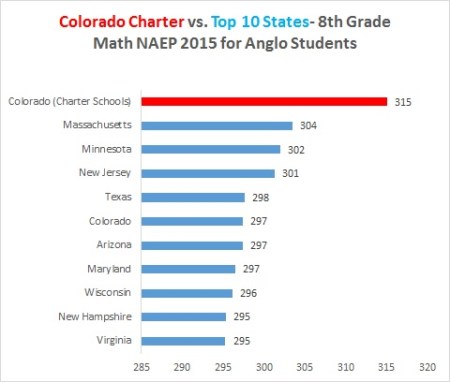
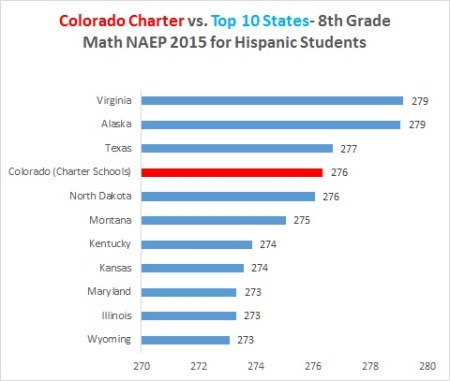
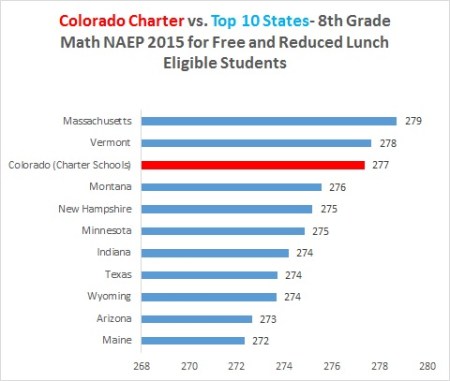
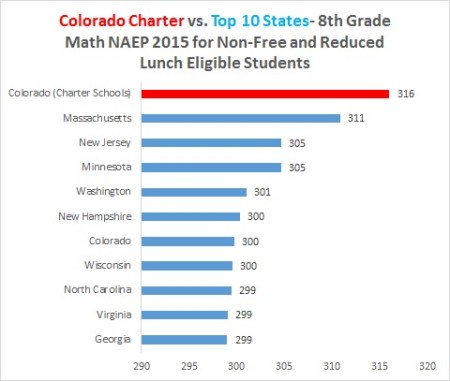
Colorado’s Department of Education released a study of state scores showing that the state’s charter schools scored higher than districts on the state exam. So in 2015 Colorado charter school students also rocked the NAEP.  The charts below will slice and dice the NAEP 8th grade math exam by subgroups, and displays Colorado charter students only to the top 10 scoring states by subgroup.  Colorado charter students did very well on the other NAEP exams as well, scoring for instance near the very top in overall 8th grade reading, but we will use 8th grade math for purposes of illustration.

Colorado Anglo students attending charter schools came out on top compared to the states with the top overall math scores for Anglos:

CO charter 1

Colorado Hispanic students attending charter schools were near the top (Anglos and Hispanics were the two groups numerous enough for NAEP to report on for Colorado charters):

Co charter 2

What about for kids whose family incomes qualify for a Free or Reduced Price lunch under federal guidelines?

Co Charter 3

What about kids above the FRL threshold?

Co Charter 4

Finally there is always a chance that charter schools have a smaller percentage of English Language Learners and/or Special Education students. The chart below therefore only compares the scores of general education students in Colorado charter schools to general education students in the top 10 states.

CO charter 5

How should folks in Colorado feel about all of this? Approximately like:


Colorado Charter Schools CeleNAEP Good Times

July 18, 2016

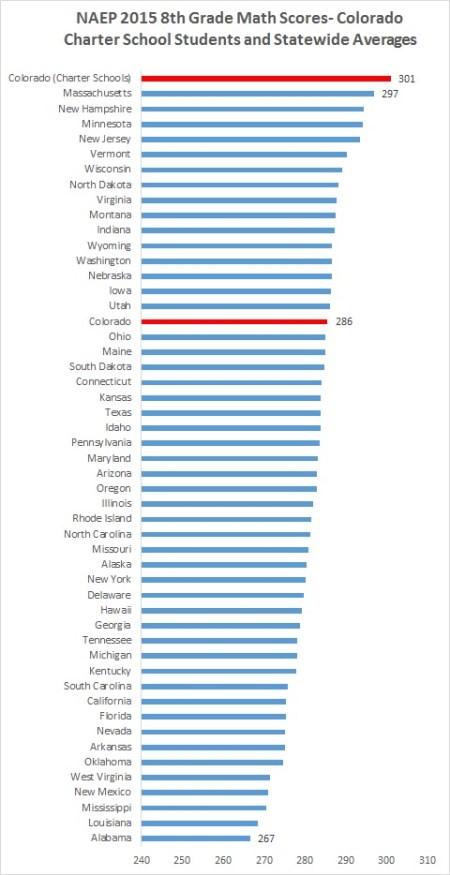
Colorado Charter School 8th grade math NAEP

(Guest Post by Matthew Ladner)

Chalkbeat Colorado reports on a new Colorado Department of Education study that found Colorado charter school students scored higher on state exams than their district counterparts.  I’ve been waiting for this state data to become available because Colorado charter school students crushed the ball on the 2015 NAEP (see above).  More details later but subgroup analysis for Colorado charters looks very favorable as well- FRL eligible CO charter students score in a photo finish loss to the statewide average in MA but ahead of every statewide district system score, etc.


Checker Finn: Ed Reform as the Faber College Pan-Hellenic Disciplinary Council

July 18, 2016

(Guest Post by Matthew Ladner)

Checker Finn wrote a read-worthy lament for the state of ed reform for Hoover. Read the whole thing but this paragraph in particular caught my attention:

Exacerbating the disagreements on those questions is the self-righteousness that seems to have swamped this field in recent years. Education has never been a mirth-filled realm, but when I first got into it a lot of participants could still smile, occasionally giggle, even tell the odd joke—and the chuckles were, often as not, bipartisan. Today, however, practically nobody seems to have a sense of humor, at least not about anything bearing on ed reform. Is it because of our unfunny national politics? Because social media and 24/7 news mean that even a short chortle can be turned by one’s foes into evidence that one is making light of something? I’m not sure about the cause, but I can attest that it’s hard to make common cause with people who can never share a spoof or jest.

Practically nobody?!? It is alas a lonely task, but we continue to hold this last, best outpost of making light of things in ed reform-especially the deeply misguided and doomed to fail yet uhhh-gain sorts of things. We have been spoofing and jesting here at JPGB non-stop since 2008 and ed reform continues to provide plenty of material.

Checker makes an important point-social justice warriors make for poor dinner guests. It reminds me of this Charlie Rose debate about the 1960s when Barbara Ehrenreich droned on sternly while PJ O’Rourke’s related that his fondest 1960s memories involved LSD and picking up hippie women at protests.
Lighten up, Francis-we may as well keep a good sense of humor during what constitutes a protracted process of figuring things out.


Expert Ratings- A Cautionary Tale

July 15, 2016

GB Screenshot

(Guest Post by Matthew Ladner)

A few months ago, I was on a panel discussing the incorporation of user reviews into the K-12 space for things like digital courses and ESAs. One of my fellow panelists expressed skepticism about the entire project until I noted that Rotten Tomatoes allows both “expert” and “user” reviews of movies. With this, he expressed contentment so long as the experts got their own ratings for separate consideration.

It has long been my experience using Rotten Tomatoes however that the user ratings tended to be much more reliable than the critic reviews. Last night I got a double barrel reminder of this when I allowed a 74% fresh critic rating convince me to go see Ghostbusters before the audience score came in (the studio released the film yesterday).

The 44% rating of the audience is incredibly generous. The 74% critic rating reveals some sort of deep divorce from reality. This movie is about as terrible as:

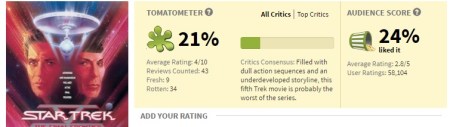
Star Trek V

Apparently 2o+% of people are just unwilling to admit that they paid to see a bad movie. What more proof? The critics nailed this one:

Highlander 2

Sometimes both the critics and the audience gets it wrong, but the critics get it more wrong. This would be the case with Ghostbusters 2016 and:

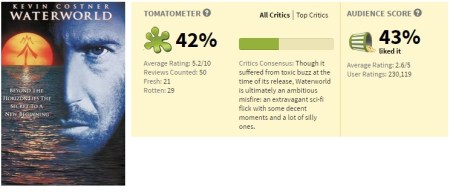
Jones Sometimes the critics and audience agree on a stinker:

Waterworld

So in the end, I’m happy to have “expert” reviews included, but if 74% of them thought that the hot mess I saw last night was a good movie, it says something important about relying solely on experts. Like everything else in life “experts” are not to be trusted.