
(Guest Post by Matthew Ladner)
Amazing story by Ron Matus about one of the original 57 Opportunity Scholarship students and her mother over on RedefinED. I could relate the story but it is better for you to watch it:
(Guest Post by Matthew Ladner)
Amazing story by Ron Matus about one of the original 57 Opportunity Scholarship students and her mother over on RedefinED. I could relate the story but it is better for you to watch it:
 Leave a Comment » |
  vouchers | Tagged: RedefinED, Ron Matus |
  Permalink
 Posted by matthewladner
(Guest Post by Matthew Ladner)
You know what the best part about working in the education freedom movement? Hands down, it’s the humans you get to know. Derrell Bradford is one of my favorite humans.
Leave a Comment » | vouchers | Tagged: Children's Scholarship Fund, Derrell Bradford | Permalink
Posted by matthewladner

(Guest Post by Matthew Ladner)
So states like Arizona and Florida are crushing the ball on interstate mobility– incoming outnumbering outgoing approximately 2 to 1. Ergo it must follow that Arizona is “draining” California of people and money, and Florida is doing the same to New York. Perhaps we should tear up the interstate highway system- this whole freedom thing is messy and it hurts the feelings of those losing taxpayers. To the contrary- I argue we should embrace what Hesiod called “good strife” or what Craig Barrett termed “tension in the system” over at RedefinED.
In education tension in the system can nudge system of schools mired in allegations of corruption to encourage better performance, like for instance this:

Granted you’ll have some in California, burdened as they are with all of that magnificent coastline and almost every other natural advantage imaginable, complain about having to compete with the likes of our humble patch of cactus. You see a similarly disturbing tendency for the advantaged to cry foul when the upstarts do well in education and elsewhere. There is a school of thought that holds that the practice of “amateur sports” was motivated by a desire on the part of British toffs not to be humiliated by working class heroes back in the day. If California prefers to bemoan the cosmic injustice of people seeking happiness rather than putting their own house in order, I say to opportunity seekers-welcome to Arizona! Or as my cajun friends might paraphrase Hesiod: laissez la bon combat rouler chere!
Leave a Comment » | charter schools | Tagged: Craig Barrett, Hesiod, RedefinED blog | Permalink
Posted by matthewladner

(Guest Post by Matthew Ladner)
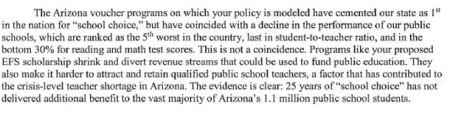
In the Seinfeld episode “The Opposite” Jerry discovers that he is “Even Steven” in that setbacks are quickly followed by gains and his life basically remains the same. Meanwhile, George slowly morphs from a loser living in his parents basement to getting hired by the New York Yankees after giving George Steinbrenner a dressing down about the poor management of the franchise. Meanwhile Elaine ruins a merger of her company and finds herself unemployed. “I’ve become George,” she glumly observes. I often think of this episode when reading odd summaries of Arizona’s K-12 which are opposite of reality. Arizona Congressman Ruben Gallego for instance recently wrote a letter to Secretary of Education Betsy DeVos making a variety of claims about education in Arizona. The letter however makes a variety of claims about which are demonstrably mistaken. I’d like to address the following paragraph in particular:
Arizona public schools have improved performance over time rather than seeing performance decline. Student performance, as measured by the National Assessment of Educational Progress (NAEP) has improved both in the aggregate and across a variety of subgroups as shown in the figure below, which shows NAEP data from the first NAEP exam that includes all states (2003) to the most recent data available (2017) in 8th grade reading and math.
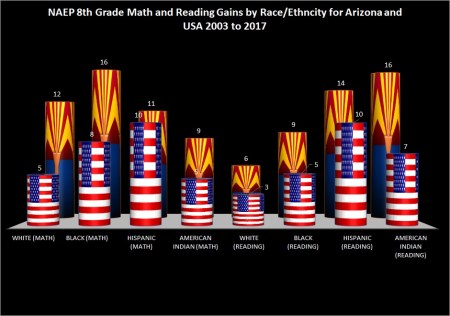
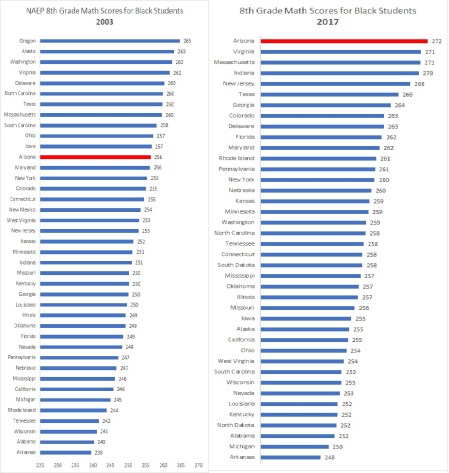
NAEP gains have improved Arizona’s subgroup rankings in overall proficiency by subgroup. For instance the chart below shows where Arizona Black students ranked compared to Black students in other states in 2003 on the left, 2017 on the right on 8th grade math. Moreover, as shown in the figure above, the largest Arizona gains were made by Black students in math (16 points), Hispanic students in reading (14 points) and American Indian students in Reading (16 points). Each of these student groups displayed a command of math and reading at 8th graders in 2017 that we might have reasonable expected their 2003 peers to have shown as 10th graders.
Here is the breakdown for Hispanic students:

Here is the breakdown for Anglo students:

If these levels of gains and proficiency represented the “fifth worst” school system, the rest of the world would be looking at America’s international test scores with envy. It seems profoundly unlikely that Arizona students would be making these enviable academic gains if choice harmed their education. Most Arizona students in Maricopa County attend a school other than their assigned district school. Students attending other district options however outnumber charter students by nearly two to one. Statewide charter student vastly outnumber private choice students in Arizona. Individual district schools both lose and gain students through family decisions. Choice is being done primarily by district schools rather than to district schools. Schools which fail to gain the confidence of families as the best option for their child do lose enrollment, but the positive academic trends show that Arizona schools are rising to the challenge rather than wilting under pressure.
Opponents of choice often conflate it with spending, which is misleading. A great many factors influence public school spending- the wealth of a state, the relative priority placed on K-12 compared to contending priorities like health care and higher education, local and state elections on funding and age demographics-states with lots of elderly and young people. One of the factors influencing per pupil funding trends is enrollment growth. Fast growing states have a harder time in accommodating growth and spending more per pupil at the same time. Arizona had the largest increase in per pupil spending among states with a 20% or more growth in enrollment between 2000 and 2015.

I will however agree with Representative Gallego to this extent: Arizona’s academic improvement is not a coincidence. They represent a huge amount of hard work put in by Arizona students and teachers and some very underestimated policies. This is not to say there isn’t more progress needed (there is) but these gains don’t have “man-hands” or eat their peas one at time and shouldn’t be taken for granted.
30 Comments | Uncategorized | Tagged: Arizona NAEP scores, Rep. Rueben Gallego, Secretary of Education Betsy DeVos, Seinfeld, Seinfeld episode "The Opposite" | Permalink
Posted by matthewladner
(Guest Post by Matthew Ladner)
This is a nifty example of why we need specialized schools and a system flexible enough to meet individual needs.
1 Comment | school choice | Tagged: Taylor Wilson | Permalink
Posted by matthewladner

(Guest Post by Matthew Ladner)
In Arizona and elsewhere there has been a very difficult history regarding the education of Native American children, and a good portion (but not all) of the blame for this can be laid at the feet of Richard Henry Pratt. Born in 1840, Pratt had a long military career which included service in the Union Army during the Civil War and in later military action against Native Americans during the Reconstruction era. Pratt is best known however for championing the forced abduction of Native American children into distant boarding schools in order to “assimilate” them. “Kill the Indian, and Save the man” Pratt is famous for saying.
Pratt’s terrorizing of Native American families lasted for decades but his paternalistic non-sense victims also included African-Americans, Puerto Ricans, Mexicans, Latinos, Pacific Islanders, Asian-Americans, and Mormons.
Pratt’s zeal for benevolent assimilation cultural genocide had more than a faint echo of the effort to make Catholics into “real Americans” during this same period. In the 1920s the Ku Klux Klan and their fellow travelers had a state law passed to make it illegal for a family to attend a private school, which was thankfully struck down by the United States Supreme Court. Pratt however seemed to look on the paternalistic zeitgeist with approving envy, noting “Indian schools are just as well calculated to keep the Indians intact as Indians as Catholic schools are to keep the Catholics intact. Under our principles we have established the public school system, where people of all races may become unified in every way, and loyal to the government; but we do not gather the people of one nation into schools by themselves, and the people of another nation into schools by themselves, but we invite the youth of all peoples into all schools. We shall not succeed in Americanizing the Indian unless we take him in exactly the same way.”
Let me put this through the translato-meter “Our profoundly illiberal attempts to homogenize Catholics are awesome so let’s quadruple down and force it down the unwilling throats of Native Americans at the point of a gun.”
Pratt founded the first “Indian School” in Pennsylvania and the folly spread around the country. Children were forcibly abducted from their families, transported vast distances away, beaten when they spoke their native language, forced to cut their hair etc. The damage done by these practices was huge past the point of quantification and needless to say things did not turn out the way Pratt planned. Today Native American students have on average the lowest levels of academic achievement to be found in the NAEP. The only good thing I can find to say about Pratt is that he was a sharp critic of the reservation system and argued (correctly imo) that the system was producing a damaging dependence on the federal government. Fair enough but Pratt’s alternative vision seems to have been to place Native American children in internment camp schools against their will-even worse.
It will only be a matter of time until you next read some misguided soul attempting to wax poetic about how allowing people to choose education for themselves is somehow a threat to democracy and the common good. “Kids need to attend their zoned public school you see, after all, it’s for their own good,” will be the gist of it. When that happens, think of Richard Henry Pratt and the horrors he caused for decades. Then, in the most polite way possible, invite the fool and/or villain pushing this line of thought to go to hell, go directly to hell, to not pass “Go” and not to collect $200. If they are unfortunate enough to actually get there, they can say hello to RHP, who I am happy to nominate for a William Higginbotham Inhumanitarian Award.
1 Comment | William Higginbotham Inhumanitarian Award | Tagged: Indian Schools, Native American Education, Richard Henry Pratt | Permalink
Posted by matthewladner
(Guest Post by Matthew Ladner)
I was 19 when I first heard this Rolling Stones song. Yes I know late to the party but whatevs I was born in 1967 so the Stones were not exactly on point for my generation, and to this day I hurl a trident at anyone who recognizes any Stones album besides Some Girls as their finest work.

Coo Coo!
So anyway I’m 19 and during the final exam period my dorm had something known as “yell spell” where you could make as much noise as you wanted for 15 minutes. One of my fellow residents somehow had two closet sized speakers in his broom closet sized dorm room and played the original version of this song at an unimaginably loud level. Every “Pleased to meet you!” would rattle your teeth. RAs from other floors rushed down and yelled at our RA, but it didn’t matter because no one could hear you scream. As my eardrums began to rupture, I was struck by the following lyrics:
I shouted out
Who killed the Kennedys?
When after all
It was you and me
Anyhoo this all came back to mind as I began looking into some of the factors influencing teacher pay in Arizona in a piece for the Chamber Business News:
The teacher who posted her paystub on social media however received an annual pay increase of $131.25 despite the override vote, and average salaries dropped by an average of $7,885 between 2017 and 2018. In addition, the fund balance of this district stood at $52 million on July 1, 2016 according to the Superintendent’s Financial Report but at $173 million on June 30, 2018. One cannot discern what the district plans to do with these balance funds from the report but thus far it does not seem to involve improving teacher pay.
I searched the employee association websites looking for signs of displeasure regarding the drop in teacher pay, or the percentage of funds devoted to teacher salary. I didn’t find any. Not only do teachers have reason to be frustrated with this, so do district taxpayers who supported the override.
5 Comments | school funding | Tagged: Chamber Business News | Permalink
Posted by matthewladner

(Guest Post by Matthew Ladner)
Believe it or not 20 years have passed since Jeb Bush kicked off the Florida K-12 reforms during the 1999 legislative session. In a kickoff post at Redefined for a series of articles I lay out the reasoning behind the Florida Supreme Court’s decisive rejection of a recently concluded challenge to these reforms.
A highly coveted Jayblog “No-Prize” goes to whomever leaves the best Beatles lyric pun in the comment section that hasn’t already been used on social media.
3 Comments | Uncategorized | Tagged: 20th anniversary of Jeb Bush K-12 reforms, Governor Jeb Bush | Permalink
Posted by matthewladner

(Guest Post by Matthew Ladner)
So yes that just happened. Florida students with disabilities got the option to attend private schools at public expense without needing to sue their school district in 1999, with the program going statewide in 2001. Usual caveats apply about always having multiple factors going on etc. but I thought I’d just whip this up and leave it here for you dear reader. Right about this same time the ABC News brought us this story about WV special education:
I know special education teachers in West Virginia and elsewhere are doing a very difficult job and I’d be willing to wager that this sort of behavior is rare. However, the kids who are experiencing this sort of treatment and/or are not being served academically, could use options. The newscaster concludes “hard to hear but hopefully change comes from this.”
Indeed.
4 Comments | Education Savings Accounts | Tagged: West Virginia ESA, West Virginia special education | Permalink
Posted by matthewladner

(Guest Post by Matthew Ladner)
The Arizona Chamber of Commerce Foundation and I teamed up with the Goldwater Institute to create a white paper on vacant district space. Arizona has one of the fastest growing student populations but oddly finds itself with a large glut of underutilized district space.
How large is it?
Ah well no one really knows because of severe flaws in reporting but the statewide floor starts at 1.4 million sq feet but the Arizona Auditor General found more than that in a single district by poking around a bit so the ceiling is much much higher. In any case Arizona’s district space increased by 2004 and 2017 by 22.6 million square feet—a 19 percent increase—despite a student enrollment increase of only 6 percent during this same period. Arizona not only has a glut of underutilized district space it appears to be growing.
Research from MIT of co-location of charters within district space demonstrates both financial and academic benefits to districts-specifically in increasing district resources and classroom spending in districts. Arizona has tens of thousands of students stranded on waitlists at high demand district and charter schools, millions of square feet in underutilized district space, and a need to increase resources for classroom use. Mutually beneficial arraingements are there for the taking between high demand schools with waitlists and districts with underutilized space. The scale of these gains are of a scale that Goldwater’s Matt Beienburg and I swallow our pride to point to legislation in California and New York (someone just yelled “get a rope and find a big cactus!) to serve as possible models.
Anyhoo- check it out here. It’s fun to be back writing with GI again.
Leave a Comment » | charter schools | Tagged: Arizona Chamber of Commerce Foundation, Arizone K-12, charter schools, Empty Schools Full of Promise, Goldwater Institute, Matt Beienburg, Vacant District Space | Permalink
Posted by matthewladner

 Jay P. Greene's Blog